Question bank

Q&A: practice questions with answers

Search questions on any topic. Filter by exam category, exam, subject and topic, try the question, then open the answer and explanation.

Courses – airGurukul

8,495 questions found.

Q6641.
Simplify: 1.20.3−25
सरल कीजिए: 1.20.3−25
  1. A3.6
  2. B4
  3. C3.2
  4. D3.4
Show answer

Concept: Convert the decimal fraction to a whole-number fraction by multiplying numerator and denominator by 10.

  1. 1.20.3=123=4
  2. 25=0.4
  3. 4−0.4=3.6

Trick: Same number of decimal places in numerator and denominator → just drop the decimal points.

Answer: (A) 3.6

अवधारणा: दशमलव भिन्न में अंश और हर दोनों को 10 से गुणा कर पूर्णांक भिन्न बनाएँ।

  1. 1.20.3=123=4
  2. 25=0.4
  3. 4−0.4=3.6

ट्रिक: अंश और हर में दशमलव स्थान बराबर हों तो दशमलव हटा दें।

उत्तर: (A) 3.6
RRB NTPC Undergraduate CBT 1MathematicsSimplification of DecimalsRRB NTPC Undergraduate CBT 1 2025 · 17 Jun Shift 2 →
Q6642.
A school drum beats every 12 minutes, and the school bell rings every 18 minutes. If both sounded together at 9:00 AM, how many times will they sound together again before 11:00 AM?
एक स्कूल का ढोल प्रत्येक 12 मिनट पर बजता है, और स्कूल की घंटी प्रत्येक 18 मिनट पर बजती है। यदि दोनों 9:00 AM पर एक साथ बजे, तो 11:00 AM से पहले वे फिर से कितनी बार एक साथ बजेंगे?
  1. A3
  2. B4
  3. C5
  4. D6
Show answer

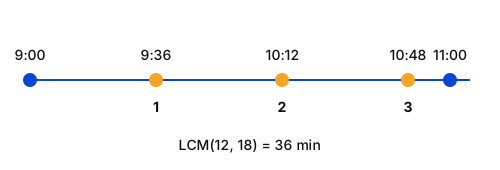
Concept: Two events sound together again after every LCM of their intervals.

  1. LCM(12,18)=36 minutes
  2. Together at 9:36, 10:12, 10:48 AM
  3. Next would be 11:24 AM — after 11:00
  4. So they sound together 3 times

Trick: Window =120 min; ⌊12036⌋=3 (11:00 itself is not a meeting time).

Answer: (A) 3

अवधारणा: दो घटनाएँ अपने अंतरालों के LCM के बाद फिर से साथ होती हैं।

  1. LCM(12,18)=36 मिनट
  2. साथ में बजेंगे: 9:36, 10:12, 10:48 AM
  3. अगली बार 11:24 AM — 11:00 के बाद
  4. अतः 3 बार साथ बजेंगे

ट्रिक: कुल समय =120 मिनट; ⌊12036⌋=3 (11:00 पर साथ नहीं बजते)।

उत्तर: (A) 3

RRB NTPC Undergraduate CBT 1MathematicsLCM Application (Bells)RRB NTPC Undergraduate CBT 1 2025 · 17 Jun Shift 2 →
Q6643.
Find the value of (3+43 of 214÷225−214 of 315).
(3+43 of 214÷225−214 of 315) का मान ज्ञात कीजिए।
  1. A-2.95
  2. B2.95
  3. C-1.48
  4. D1.48
Show answer

Concept: In BODMAS, 'of' is done before ÷ and ×; convert mixed fractions first.

  1. 214=94, 225=125, 315=165
  2. 43 of 94=3 and 94 of 165=365=7.2
  3. 3÷125=54=1.25
  4. 3+1.25−7.2=−2.95

Trick: Order inside the bracket: of → ÷ → + → −.

Answer: (A) −2.95

अवधारणा: BODMAS में 'का (of)' को ÷ और × से पहले हल करते हैं; मिश्र भिन्नों को पहले बदलें।

  1. 214=94, 225=125, 315=165
  2. 43 of 94=3 तथा 94 of 165=365=7.2
  3. 3÷125=54=1.25
  4. 3+1.25−7.2=−2.95

ट्रिक: कोष्ठक के अंदर क्रम: of → ÷ → + → −।

उत्तर: (A) −2.95

RRB NTPC Undergraduate CBT 1MathematicsSimplification (BODMAS)RRB NTPC Undergraduate CBT 1 2025 · 17 Jun Shift 2 →
Q6644.
Girish scored 448 marks in an examination and was 81 marks short of 46% of maximum marks. In the same examination, his friend scored 805 marks. What is the percentage of marks scored by his friend?
गिरीश ने एक परीक्षा में 448 अंक प्राप्त किए और वह अधिकतम अंकों के 46% से 81 अंक पीछे रह गया। उसी परीक्षा में, उसके मित्र ने 805 अंक प्राप्त किए। उसके मित्र द्वारा प्राप्त अंकों का प्रतिशत कितना है?
  1. A71%
  2. B70%
  3. C67%
  4. D72%
Show answer

Concept: Find maximum marks from the given percentage condition, then convert the friend's marks to a percentage.

  1. 46% of maximum =448+81=529
  2. Maximum =5290.46=1150
  3. Friend's %=8051150×100=70%

Trick: 529=232 and 46=2×23, so maximum =529×10046=1150 quickly.

Answer: (B) 70%

अवधारणा: दी गई प्रतिशत शर्त से अधिकतम अंक निकालें, फिर मित्र के अंकों को प्रतिशत में बदलें।

  1. अधिकतम का 46%=448+81=529
  2. अधिकतम अंक =5290.46=1150
  3. मित्र का %=8051150×100=70%

ट्रिक: 529=232 और 46=2×23, अतः अधिकतम =529×10046=1150 जल्दी निकलता है।

उत्तर: (B) 70%

RRB NTPC Undergraduate CBT 1MathematicsPercentage (Marks)RRB NTPC Undergraduate CBT 1 2025 · 17 Jun Shift 2 →
Q6645.
The average of 6.5, 10.8, 20 and a is 15. The value of a is:
6.5, 10.8, 20 और a का औसत 15 है। a का मान है:
  1. A21.7
  2. B24.7
  3. C22.7
  4. D23.7
Show answer

Concept: Sum=Average×Number of terms.

  1. Total of 4 numbers =15×4=60
  2. Known sum =6.5+10.8+20=37.3
  3. a=60−37.3=22.7

Trick: Deviation method: −8.5−4.2+5+(a−15)=0⇒a=22.7.

Answer: (C) 22.7

अवधारणा: योग=औसत×पदों की संख्या।

  1. 4 संख्याओं का योग =15×4=60
  2. ज्ञात योग =6.5+10.8+20=37.3
  3. a=60−37.3=22.7

ट्रिक: विचलन विधि: −8.5−4.2+5+(a−15)=0⇒a=22.7।

उत्तर: (C) 22.7

RRB NTPC Undergraduate CBT 1MathematicsAverageRRB NTPC Undergraduate CBT 1 2025 · 17 Jun Shift 2 →
Q6646.
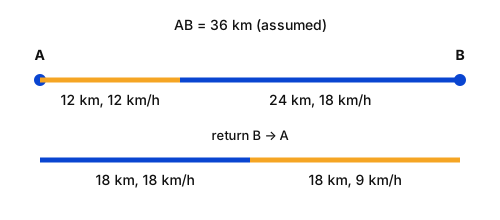
A cyclist travels from point A to B and back from B to A along the same route. On the onward journey, he covers one-third of the distance at 12 km/hr and the remaining distance at 18 km/hr. On the return journey, he covers half of the distance at 9 km/hr and the remaining distance at 18 km/hr. Find the average speed (in km/hr) for the entire round trip.
एक साइकिल चालक बिंदु A से B तक जाता है और उसी मार्ग से B से A तक वापस आता है। जाते समय, वह दूरी का एक-तिहाई भाग 12 km/hr की चाल से और शेष दूरी 18 km/hr की चाल से तय करता है। वापसी यात्रा में, वह दूरी का आधा भाग 9 km/hr की चाल से और शेष दूरी 18 km/hr की चाल से तय करता है। पूरी आने-जाने की यात्रा के लिए औसत चाल (km/hr में) ज्ञात कीजिए।
  1. A9 km/hr
  2. B13.5 km/hr
  3. C15 km/hr
  4. D11.5 km/hr
Show answer

Concept: Average speed=Total distanceTotal time; take a convenient distance (LCM of speeds).

  1. Let AB=36km
  2. Onward: 1212+2418=1+43=73h
  3. Return: 189+1818=2+1=3h
  4. Average =7273+3=72163=13.5km/h

Trick: Never average the speeds directly; always total distance ÷ total time.

Answer: (B) 13.5km/hr

अवधारणा: औसत चाल=कुल दूरीकुल समय; सुविधाजनक दूरी (चालों का LCM) मान लें।

  1. माना AB=36km
  2. जाते समय: 1212+2418=1+43=73h
  3. लौटते समय: 189+1818=2+1=3h
  4. औसत =7273+3=72163=13.5km/h

ट्रिक: चालों का सीधा औसत कभी न लें; हमेशा कुल दूरी ÷ कुल समय।

उत्तर: (B) 13.5km/hr

RRB NTPC Undergraduate CBT 1MathematicsAverage SpeedRRB NTPC Undergraduate CBT 1 2025 · 17 Jun Shift 2 →
Q6647.
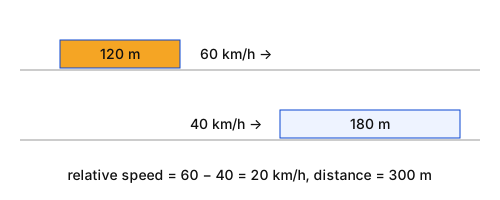
Two trains of lengths 120 m and 180 m are moving in the same direction at speeds of 60 km/h and 40 km/h, respectively. Find the time taken by the trains to cross each other.
120 m और 180 m लंबाई की दो रेलगाड़ियाँ एक ही दिशा में क्रमशः 60 km/h और 40 km/h की चाल से चल रही हैं। रेलगाड़ियों द्वारा एक-दूसरे को पार करने में लिया गया समय ज्ञात कीजिए।
  1. A54 seconds54 सेकंड
  2. B76.9 seconds76.9 सेकंड
  3. C59.3 seconds59.3 सेकंड
  4. D67.9 seconds67.9 सेकंड
Show answer

Concept: Same direction: relative speed = difference of speeds; distance to cross = sum of lengths.

  1. Relative speed =60−40=20km/h=20×518=509m/s
  2. Distance =120+180=300m
  3. Time =300÷509=54s

Trick: Time (s) =total length×18relative speed×5=300×18100=54.

Answer: (A) 54 seconds

अवधारणा: एक ही दिशा में: सापेक्ष चाल = चालों का अंतर; पार करने की दूरी = लंबाइयों का योग।

  1. सापेक्ष चाल =60−40=20km/h=20×518=509m/s
  2. दूरी =120+180=300m
  3. समय =300÷509=54s

ट्रिक: समय (s) =कुल लंबाई×18सापेक्ष चाल×5=300×18100=54।

उत्तर: (A) 54 सेकंड

RRB NTPC Undergraduate CBT 1MathematicsTrains (Same Direction)RRB NTPC Undergraduate CBT 1 2025 · 17 Jun Shift 2 →
Q6648.
The sum of the digits of a two-digit number is 11. If the digits are reversed, the new number is 27 more than the original number. What is the original number?
दो अंकों की एक संख्या के अंकों का योग 11 है। यदि अंकों को उलट दिया जाए, तो नई संख्या मूल संख्या से 27 अधिक हो जाती है। मूल संख्या क्या है?
  1. A56
  2. B47
  3. C38
  4. D65
Show answer

Concept: Number =10a+b; reversed =10b+a; difference =9(b−a).

  1. a+b=11
  2. 9(b−a)=27⇒b−a=3
  3. b=7, a=4 → number =47

Trick: Reversed is larger by 27 → units digit exceeds tens digit by 279=3; only 47 fits (4+7=11).

Answer: (B) 47

अवधारणा: संख्या =10a+b; उलटी संख्या =10b+a; अंतर =9(b−a)।

  1. a+b=11
  2. 9(b−a)=27⇒b−a=3
  3. b=7, a=4 → संख्या =47

ट्रिक: उलटने पर 27 अधिक → इकाई अंक दहाई से 279=3 बड़ा; केवल 47 सही (4+7=11)।

उत्तर: (B) 47

RRB NTPC Undergraduate CBT 1MathematicsTwo-Digit NumbersRRB NTPC Undergraduate CBT 1 2025 · 17 Jun Shift 2 →
Q6649.
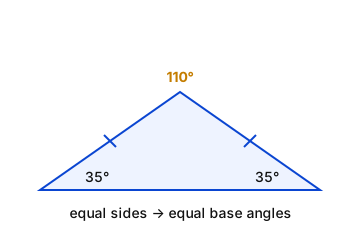
If one angle of an isosceles triangle is 110°, what are the measures of the other angles of the triangle?
यदि एक समद्विबाहु त्रिभुज का एक कोण 110° है, तो त्रिभुज के अन्य कोणों के माप क्या हैं?
  1. A25° and 25°25° और 25°
  2. B35° and 35°35° और 35°
  3. C25° and 35°25° और 35°
  4. D25° and 45°25° और 45°
Show answer

Concept: Angle sum of a triangle =180∘; an isosceles triangle has two equal angles. An angle >90∘ can only be the vertex angle.

  1. 110∘ must be the unequal angle (two angles of 110∘ would exceed 180∘)
  2. Remaining =180∘−110∘=70∘
  3. Each base angle =70∘2=35∘

Trick: Base angle =180∘−vertex2.

Answer: (B) 35∘ and 35∘

अवधारणा: त्रिभुज के कोणों का योग =180∘; समद्विबाहु त्रिभुज में दो कोण बराबर होते हैं। 90∘ से बड़ा कोण केवल शीर्ष कोण हो सकता है।

  1. 110∘ असमान कोण है (दो 110∘ कोण 180∘ से अधिक हो जाएँगे)
  2. शेष =180∘−110∘=70∘
  3. प्रत्येक आधार कोण =70∘2=35∘

ट्रिक: आधार कोण =180∘−शीर्ष कोण2।

उत्तर: (B) 35∘ और 35∘

RRB NTPC Undergraduate CBT 1MathematicsIsosceles TriangleRRB NTPC Undergraduate CBT 1 2025 · 17 Jun Shift 2 →
Q6650.
A shopkeeper offers the following schemes on toys of the same marked price. (A) Successive discounts of 5% and 21% on any number of toys bought.
(B) Successive discounts of 38%, 33% and 21% on any number of toys bought. (C) 8% discount on the first 6 toys and 27% discount on each toy thereon.
(D) 3 toys free of cost on buying 7 toys.
A customer wants to buy 7 toys. Which of the above schemes is the least beneficial to her?
एक दुकानदार समान अंकित मूल्य वाले खिलौनों पर निम्नलिखित योजनाएँ प्रदान करता है। (A) कितने भी खिलौने खरीदने पर 5% और 21% की क्रमागत छूट।
(B) कितने भी खिलौने खरीदने पर 38%, 33% और 21% की क्रमागत छूट। (C) पहले 6 खिलौनों पर 8% छूट और उसके बाद प्रत्येक खिलौने पर 27% छूट।
(D) 7 खिलौने खरीदने पर 3 खिलौने निःशुल्क।
एक ग्राहक 7 खिलौने खरीदना चाहती है। उपरोक्त में से कौन-सी योजना उसके लिए सबसे कम लाभदायक है?
  1. AA
  2. BC
  3. CB
  4. DD
Show answer

Concept: Compare the effective price paid for 7 toys under each scheme (take marked price =100 per toy).

  1. A: 0.95×0.79=0.7505 → pays 75.05%
  2. B: 0.62×0.67×0.79≈0.328 → pays about 32.8%
  3. C: 6×92+1×73=625 out of 700 → pays about 89.3%
  4. D: 3 free on 7 → 10 toys for the price of 7 → pays 70% per toy
  5. Highest payment = least benefit → scheme C

Trick: Least beneficial = largest effective price; successive discounts multiply, never add.

Answer: (B) C

अवधारणा: हर योजना में 7 खिलौनों पर प्रभावी भुगतान की तुलना करें (अंकित मूल्य =100 प्रति खिलौना)।

  1. A: 0.95×0.79=0.7505 → भुगतान 75.05%
  2. B: 0.62×0.67×0.79≈0.328 → भुगतान लगभग 32.8%
  3. C: 6×92+1×73=625, 700 में से → भुगतान लगभग 89.3%
  4. D: 7 पर 3 मुफ्त → 7 के दाम में 10 → प्रति खिलौना 70%
  5. सबसे अधिक भुगतान = सबसे कम लाभ → योजना C

ट्रिक: सबसे कम लाभकारी = सबसे अधिक प्रभावी मूल्य; क्रमागत छूटें गुणा होती हैं, जुड़ती नहीं।

उत्तर: (B) C

RRB NTPC Undergraduate CBT 1MathematicsDiscount SchemesRRB NTPC Undergraduate CBT 1 2025 · 17 Jun Shift 2 →
Q6651.
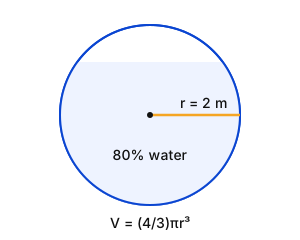
A spherical tank has a radius of 2 meters. If the tank is filled with water to 80% of its total volume, what is the volume of water in the tank (rounded to the nearest cubic meter)?
एक गोलाकार टंकी की त्रिज्या 2 मीटर है। यदि टंकी को उसके कुल आयतन के 80% तक पानी से भरा जाता है, तो टंकी में पानी का आयतन (निकटतम घन मीटर तक पूर्णांकित) कितना है?
  1. A33
  2. B21
  3. C38
  4. D27
Show answer

Concept: Volume of a sphere V=43πr3.

  1. V=43×227×23=70421≈33.52m3
  2. Water =80% of 33.52=0.8×33.52≈26.8
  3. Nearest whole number =27m3

Trick: Option 33 is the full tank — a common trap; remember to take 80%.

Answer: (D) 27

अवधारणा: गोले (sphere) का आयतन V=43πr3।

  1. V=43×227×23=70421≈33.52m3
  2. पानी =33.52 का 80%=0.8×33.52≈26.8
  3. निकटतम पूर्णांक =27m3

ट्रिक: विकल्प 33 पूरा टैंक है — जाल से बचें; 80% लेना न भूलें।

उत्तर: (D) 27

RRB NTPC Undergraduate CBT 1MathematicsVolume of SphereRRB NTPC Undergraduate CBT 1 2025 · 17 Jun Shift 2 →
Q6652.
A and B can do a piece of work in 12 days and 12 days, respectively. Both work for 3 days and then A leaves. How long (in days) will B take to complete the remaining work?
A और B किसी कार्य को क्रमशः 12 दिन और 12 दिन में कर सकते हैं। दोनों 3 दिन तक कार्य करते हैं और फिर A कार्य छोड़ देता है। शेष कार्य को पूरा करने में B को कितना समय (दिनों में) लगेगा?
  1. A6
  2. B5
  3. C8
  4. D7
Show answer

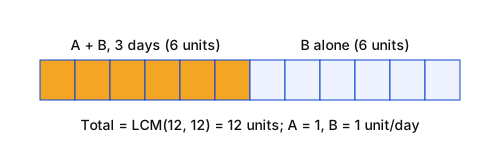
Concept: Take total work =LCM of days; efficiency =workdays.

  1. Total work =12 units; A =1, B =1 unit/day
  2. In 3 days together: 3×2=6 units
  3. Remaining =12−6=6 units
  4. B alone: 61=6 days

Trick: Equal workers → in 3 days they finish half; B needs half of 12 days =6.

Answer: (A) 6

अवधारणा: कुल कार्य = दिनों का LCM मानें; क्षमता =कार्यदिन।

  1. कुल कार्य =12 इकाई; A =1, B =1 इकाई/दिन
  2. 3 दिन साथ में: 3×2=6 इकाई
  3. शेष =12−6=6 इकाई
  4. B अकेला: 61=6 दिन

ट्रिक: दोनों बराबर → 3 दिन में आधा काम; B को 12 दिन का आधा =6 दिन।

उत्तर: (A) 6

RRB NTPC Undergraduate CBT 1MathematicsTime and WorkRRB NTPC Undergraduate CBT 1 2025 · 17 Jun Shift 2 →
Q6653.
₹2,288 is divided among Pankaj, Meera, and Ashok in such a way that if ₹39, ₹47, and ₹40 are deducted from their respective shares, they have money in the ratio 17:15:14. Find Meera’s share after deduction.
₹2,288 को पंकज, मीरा और अशोक के बीच इस प्रकार बाँटा जाता है कि यदि उनके संबंधित हिस्सों में से ₹39, ₹47 और ₹40 घटा दिए जाएँ, तो उनके पास धनराशि 17:15:14 के अनुपात में रह जाती है। कटौती के बाद मीरा का हिस्सा ज्ञात कीजिए।
  1. A₹855
  2. B₹805
  3. C₹705
  4. D₹605
Show answer

Concept: Subtract all deductions from the total; the remainder is divided in the given ratio.

  1. Total deductions =39+47+40=126
  2. Remaining =2288−126=2162
  3. Ratio sum =17+15+14=46; one part =216246=47
  4. Meera after deduction =15×47=705

Trick: Question asks share after deduction — don't add back ₹47 (that gives ₹752).

Answer: (C) ₹705

अवधारणा: कुल राशि में से सभी कटौतियाँ घटाएँ; शेष राशि दिए अनुपात में बँटती है।

  1. कुल कटौती =39+47+40=126
  2. शेष =2288−126=2162
  3. अनुपात योग =17+15+14=46; एक भाग =216246=47
  4. कटौती के बाद मीरा =15×47=705

ट्रिक: प्रश्न कटौती के बाद का भाग पूछ रहा है — ₹47 वापस न जोड़ें (वह ₹752 होगा)।

उत्तर: (C) ₹705

RRB NTPC Undergraduate CBT 1MathematicsRatio (Division with Deductions)RRB NTPC Undergraduate CBT 1 2025 · 17 Jun Shift 2 →
Q6654.
The simplified value of (1224)(126)÷(29×186+48)+69÷2811 of 119 is:
(1224)(126)÷(29×186+48)+69÷2811 of 119 का सरलीकृत मान है:
  1. A16
  2. B43
  3. C37
  4. D112
Show answer

Concept: Follow BODMAS: brackets first, then 'of', then ÷/×, then +.

  1. 12/2412/6=122=14
  2. Bracket: 29×186+48=23+12=76; so 14÷76=314
  3. 2811 of 119=289; 69÷289=628=314
  4. Total =314+314=37

Trick: Do 'of' before ÷: 69÷(2811×119).

Answer: (C) 37

अवधारणा: BODMAS अपनाएँ: पहले कोष्ठक, फिर 'का (of)', फिर ÷/×, फिर +।

  1. 12/2412/6=122=14
  2. कोष्ठक: 29×186+48=23+12=76; अतः 14÷76=314
  3. 2811 of 119=289; 69÷289=628=314
  4. कुल =314+314=37

ट्रिक: ÷ से पहले 'of' हल करें: 69÷(2811×119)।

उत्तर: (C) 37

RRB NTPC Undergraduate CBT 1MathematicsSimplification of FractionsRRB NTPC Undergraduate CBT 1 2025 · 17 Jun Shift 2 →
Q6655.
What is the compound interest on ₹3,000 for 2 years at 20% per annum, interest compounded annually?
₹3,000 पर 20% वार्षिक ब्याज दर से 2 वर्ष का चक्रवृद्धि ब्याज कितना होगा, यदि ब्याज वार्षिक रूप से संयोजित होता है?
  1. A₹1,200
  2. B₹1,300
  3. C₹1,440
  4. D₹1,320
Show answer

Concept: A=P(1+R100)n; CI=A−P.

  1. A=3000×(1.2)2=3000×1.44=4320
  2. CI=4320−3000=1320

Trick: 2-year CI rate =20+20+20×20100=44%; 44% of 3000=1320.

Answer: (D) ₹1,320

अवधारणा: A=P(1+R100)n; चक्रवृद्धि ब्याज =A−P।

  1. A=3000×(1.2)2=3000×1.44=4320
  2. CI=4320−3000=1320

ट्रिक: 2 वर्ष की CI दर =20+20+20×20100=44%; 3000 का 44%=1320।

उत्तर: (D) ₹1,320

RRB NTPC Undergraduate CBT 1MathematicsCompound InterestRRB NTPC Undergraduate CBT 1 2025 · 17 Jun Shift 2 →
Q6656.
The following data shows the number of minutes taken by 15 students to complete a mathematics test: 42, 38, 55, 47, 50, 44, 60, 39, 48, 52, 45, 41, 49, 46, 53. Find the median time taken by the students.
निम्नलिखित आँकड़े 15 छात्रों द्वारा गणित की एक परीक्षा पूरी करने में लिए गए मिनटों की संख्या दर्शाते हैं: 42, 38, 55, 47, 50, 44, 60, 39, 48, 52, 45, 41, 49, 46, 53. छात्रों द्वारा लिया गया माध्यिका समय ज्ञात कीजिए।
  1. A47 minutes47 मिनट
  2. B46 minutes46 मिनट
  3. C48 minutes48 मिनट
  4. D47.5 minutes47.5 मिनट
Show answer

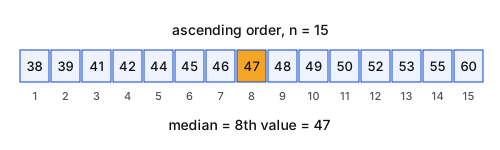
Concept: For n (odd) observations in ascending order, median =(n+12)th value.

  1. Ascending: 38, 39, 41, 42, 44, 45, 46, 47, 48, 49, 50, 52, 53, 55, 60
  2. n=15 → 15+12=8th value
  3. Median =47

Trick: Always sort first — the middle of the unsorted list (39) is wrong.

Answer: (A) 47 minutes

अवधारणा: n (विषम) प्रेक्षणों को आरोही क्रम में रखने पर माध्यिका (median) =(n+12)th मान।

  1. आरोही क्रम: 38, 39, 41, 42, 44, 45, 46, 47, 48, 49, 50, 52, 53, 55, 60
  2. n=15 → 15+12=8वाँ मान
  3. माध्यिका =47

ट्रिक: पहले क्रम में लगाएँ — बिना क्रम की सूची का बीच वाला मान (39) गलत है।

उत्तर: (A) 47 मिनट

RRB NTPC Undergraduate CBT 1MathematicsMedianRRB NTPC Undergraduate CBT 1 2025 · 17 Jun Shift 2 →
Q6657.
A sum of money becomes ₹7,865 after 2 years and ₹8,651.50 after 3 years on compound interest at the same rate, compounded annually. Find the sum.
कोई धनराशि समान दर पर वार्षिक रूप से संयोजित चक्रवृद्धि ब्याज पर 2 वर्ष बाद ₹7,865 और 3 वर्ष बाद ₹8,651.50 हो जाती है। धनराशि ज्ञात कीजिए।
  1. A₹6,500
  2. B₹7,000
  3. C₹7,200
  4. D₹6,800
Show answer

Concept: Amounts of consecutive years differ by the factor (1+R100).

  1. 8651.507865=1.1 → R=10%
  2. P×(1.1)2=7865
  3. P=78651.21=6500

Trick: Interest in 3rd year =786.5 is 10% of 7865 → rate 10%.

Answer: (A) ₹6,500

अवधारणा: लगातार वर्षों की राशियों का अनुपात (1+R100) होता है।

  1. 8651.507865=1.1 → R=10%
  2. P×(1.1)2=7865
  3. P=78651.21=6500

ट्रिक: तीसरे वर्ष का ब्याज =786.5, जो 7865 का 10% है → दर 10%।

उत्तर: (A) ₹6,500

RRB NTPC Undergraduate CBT 1MathematicsCompound Interest (Find Principal)RRB NTPC Undergraduate CBT 1 2025 · 17 Jun Shift 2 →
Q6658.
A wholesaler offers two options for a sofa set marked at ₹80,000: either a flat discount of 30% or two successive discounts of 20% and 12%. What is the difference in the selling price between the two options?
एक थोक विक्रेता ₹80,000 अंकित मूल्य वाले सोफ़ा सेट के लिए दो विकल्प प्रदान करता है: या तो 30% की एकमुश्त छूट या 20% और 12% की दो क्रमागत छूटें। दोनों विकल्पों के विक्रय मूल्य में कितना अंतर है?
  1. A₹320
  2. B₹240
  3. C₹400
  4. D₹480
Show answer

Concept: Two successive discounts a%, b% equal a single discount of (a+b−ab100)%.

  1. Single equivalent of 20% and 12%: 20+12−240100=29.6%
  2. Difference in discount =30%−29.6%=0.4%
  3. 0.4% of 80000=320

Trick: Find only the gap in discount %, then apply it once to the marked price.

Answer: (A) ₹320

अवधारणा: दो क्रमागत छूटें a%, b% एकल छूट (a+b−ab100)% के बराबर होती हैं।

  1. 20% और 12% का समतुल्य: 20+12−240100=29.6%
  2. छूट में अंतर =30%−29.6%=0.4%
  3. 80000 का 0.4%=320

ट्रिक: केवल छूट % का अंतर निकालें, फिर अंकित मूल्य पर एक बार लगाएँ।

उत्तर: (A) ₹320

RRB NTPC Undergraduate CBT 1MathematicsSuccessive DiscountsRRB NTPC Undergraduate CBT 1 2025 · 17 Jun Shift 2 →
Q6659.
A person sells two items: one at a profit of 20% and another at a loss of 10%. If both items cost ₹100 each, what is the overall gain or loss percentage?
एक व्यक्ति दो वस्तुएँ बेचता है: एक को 20% लाभ पर और दूसरी को 10% हानि पर। यदि दोनों वस्तुओं का क्रय मूल्य ₹100 प्रत्येक है, तो कुल लाभ या हानि प्रतिशत कितना है?
  1. A10% loss10% हानि
  2. B10% gain10% लाभ
  3. C5% loss5% हानि
  4. D5% gain5% लाभ
Show answer

Concept: Overall %=Total SP−Total CPTotal CP×100.

  1. SP of first =120, SP of second =90
  2. Total SP =210, Total CP =200
  3. Gain =10200×100=5%

Trick: Equal CPs → overall %=20+(−10)2=5% gain.

Answer: (D) 5% gain

अवधारणा: कुल %=कुल विक्रय मूल्य−कुल क्रय मूल्यकुल क्रय मूल्य×100।

  1. पहली वस्तु का SP =120, दूसरी का =90
  2. कुल SP =210, कुल CP =200
  3. लाभ =10200×100=5%

ट्रिक: क्रय मूल्य बराबर हों तो कुल %=20+(−10)2=5% लाभ।

उत्तर: (D) 5% लाभ

RRB NTPC Undergraduate CBT 1MathematicsProfit and LossRRB NTPC Undergraduate CBT 1 2025 · 17 Jun Shift 2 →
Q6660.
A town had a population of 5,000 at the beginning of a year. During the first year, the population decreased by 10%. In the following year, the population increased by 20%. What was the population of the town at the end of two years?
एक वर्ष के आरंभ में एक कस्बे की जनसंख्या 5,000 थी। पहले वर्ष के दौरान जनसंख्या में 10% की कमी हुई। अगले वर्ष जनसंख्या में 20% की वृद्धि हुई। दो वर्ष के अंत में कस्बे की जनसंख्या कितनी थी?
  1. A5800
  2. B5500
  3. C5200
  4. D5400
Show answer

Concept: Successive % changes multiply: P×(1−10100)(1+20100).

  1. After year 1: 5000×0.9=4500
  2. After year 2: 4500×1.2=5400

Trick: Net change =−10+20−200100=8% → 5000×1.08=5400.

Answer: (D) 5400

अवधारणा: क्रमागत % परिवर्तन गुणा होते हैं: P×(1−10100)(1+20100)।

  1. पहले वर्ष बाद: 5000×0.9=4500
  2. दूसरे वर्ष बाद: 4500×1.2=5400

ट्रिक: शुद्ध परिवर्तन =−10+20−200100=8% → 5000×1.08=5400।

उत्तर: (D) 5400

RRB NTPC Undergraduate CBT 1MathematicsPopulation ChangeRRB NTPC Undergraduate CBT 1 2025 · 17 Jun Shift 2 →