Question bank

Q&A: practice questions with answers

Search questions on any topic. Filter by exam category, exam, subject and topic, try the question, then open the answer and explanation.

Courses – airGurukul

8,495 questions found.

Q6661.
Evaluate 233 + (-15)3 + (-8)3
233 + (-15)3 + (-8)3 का मान ज्ञात कीजिए
  1. A8133
  2. B8059
  3. C8050
  4. D8280
Show answer

Concept: If a+b+c=0, then a3+b3+c3=3abc.

  1. 23+(−15)+(−8)=0 ✔
  2. Value =3×23×(−15)×(−8)
  3. =3×23×120=8280

Trick: Always test a+b+c=0 first in sums of three cubes.

Answer: (D) 8280

अवधारणा: यदि a+b+c=0, तो a3+b3+c3=3abc।

  1. 23+(−15)+(−8)=0 ✔
  2. मान =3×23×(−15)×(−8)
  3. =3×23×120=8280

ट्रिक: तीन घनों के योग में पहले a+b+c=0 जाँचें।

उत्तर: (D) 8280

RRB NTPC Undergraduate CBT 1MathematicsAlgebraic Identity (Cubes)RRB NTPC Undergraduate CBT 1 2025 · 17 Jun Shift 2 →
Q6662.
During a sale, 50% of the goods are sold at 12% profit, 40% of the remaining goods are sold at 16% profit and the still remaining goods are sold at a loss of 19%. If there is an overall profit of x%, then what is the value of x?
एक सेल के दौरान, 50% माल 12% लाभ पर बेचा जाता है, शेष माल का 40% 16% लाभ पर बेचा जाता है और बचा हुआ माल 19% हानि पर बेचा जाता है। यदि कुल लाभ x% है, तो x का मान क्या है?
  1. A2.5
  2. B5.5
  3. C4.5
  4. D3.5
Show answer

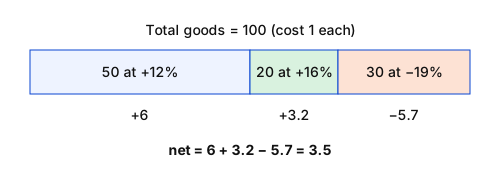
Concept: Take total goods =100 units costing 1 each; add up profit/loss of each part.

  1. 50 units at +12% → +6
  2. 40% of remaining 50=20 units at +16% → +3.2
  3. Remaining 30 units at −19% → −5.7
  4. Net =6+3.2−5.7=3.5 on 100 → x=3.5

Trick: Weighted average: 0.5(12)+0.2(16)+0.3(−19)=3.5.

Answer: (D) 3.5

अवधारणा: कुल माल =100 इकाई (प्रत्येक की लागत 1) मानें; हर भाग का लाभ/हानि जोड़ें।

  1. 50 इकाई +12% पर → +6
  2. शेष 50 का 40%=20 इकाई +16% पर → +3.2
  3. शेष 30 इकाई −19% पर → −5.7
  4. शुद्ध =6+3.2−5.7=3.5, 100 पर → x=3.5

ट्रिक: भारित औसत: 0.5(12)+0.2(16)+0.3(−19)=3.5।

उत्तर: (D) 3.5

RRB NTPC Undergraduate CBT 1MathematicsProfit and Loss (Partial Sales)RRB NTPC Undergraduate CBT 1 2025 · 17 Jun Shift 2 →
Q6663.
10 men and 15 women can complete a project in 12 days. If after 8 days, only 23 of the work is completed, how many more women must be added to finish the work in the next 2 days, assuming all men continue?
10 पुरुष और 15 महिलाएँ एक परियोजना को 12 दिनों में पूरा कर सकते हैं। यदि 8 दिनों के बाद केवल 23 कार्य पूरा हुआ है, तो यह मानते हुए कि सभी पुरुष कार्य जारी रखते हैं, अगले 2 दिनों में कार्य पूरा करने के लिए कितनी और महिलाओं को जोड़ना होगा?
  1. A20
  2. B25
  3. C30
  4. D35
Show answer

Concept: Work done ∝ (workforce × days). Taking one man's daily work equal to one woman's, the group equals 25 workers.

  1. 10 men + 15 women =25 workers; total work =25×12=300 worker-days
  2. Remaining work =13×300=100 worker-days
  3. To finish in 2 days: 1002=50 workers needed
  4. Extra women =50−25=25

Trick: Remaining time is halved (4 days → 2 days) → workforce must double → add another 25.

Answer: (B) 25

अवधारणा: किया गया कार्य ∝ (कार्यबल × दिन)। एक पुरुष और एक महिला का दैनिक कार्य बराबर मानने पर समूह =25 कार्यकर्ता।

  1. 10 पुरुष + 15 महिलाएँ =25 कार्यकर्ता; कुल कार्य =25×12=300 कार्य-दिवस
  2. शेष कार्य =13×300=100
  3. 2 दिन में पूरा करने हेतु: 1002=50 कार्यकर्ता
  4. अतिरिक्त महिलाएँ =50−25=25

ट्रिक: शेष समय आधा (4 → 2 दिन) → कार्यबल दोगुना → 25 और जोड़ें।

उत्तर: (B) 25

RRB NTPC Undergraduate CBT 1MathematicsTime and Work (Men and Women)RRB NTPC Undergraduate CBT 1 2025 · 17 Jun Shift 2 →
Q6664.
Which of the following numbers is divisible by 7?
निम्नलिखित में से कौन-सी संख्या 7 से विभाज्य है?
  1. A21234
  2. B24019
  3. C23452
  4. D24017
Show answer

Concept: Rule for 7: double the last digit and subtract it from the rest; repeat until small.

  1. 24017: 2401−14=2387 → 238−14=224 → 22−8=14 ✔ divisible
  2. Check: 7×3431=24017
  3. 21234 → 2123−8=2115 → 211−10=201 → 20−2=18 ✘

Trick: Alternatively 24017−21000=3017, and 3017=7×431.

Answer: (D) 24017

अवधारणा: 7 का नियम: अंतिम अंक का दोगुना शेष संख्या से घटाएँ; छोटी संख्या मिलने तक दोहराएँ।

  1. 24017: 2401−14=2387 → 238−14=224 → 22−8=14 ✔ विभाज्य
  2. जाँच: 7×3431=24017
  3. 21234 → 2123−8=2115 → 211−10=201 → 20−2=18 ✘

ट्रिक: या 24017−21000=3017, और 3017=7×431।

उत्तर: (D) 24017

RRB NTPC Undergraduate CBT 1MathematicsDivisibility by 7RRB NTPC Undergraduate CBT 1 2025 · 17 Jun Shift 2 →
Q6665.
Two poles of heights 10 m and 30 m stand vertically on level ground at a distance d apart. From a point on the ground between them, along the line joining their feet, the angles of elevation to their tops of the taller and the shorter poles are 60∘ and 30∘, respectively. The distance d between the poles is:
10 m और 30 m ऊँचाई के दो खंभे समतल भूमि पर d दूरी पर ऊर्ध्वाधर खड़े हैं। उनके बीच भूमि पर स्थित एक बिंदु से, उनके पादों को मिलाने वाली रेखा पर, लंबे और छोटे खंभों के शीर्षों के उन्नयन कोण क्रमशः 60∘ और 30∘ हैं। खंभों के बीच की दूरी d है:
  1. A253 meters253 मीटर
  2. B103 meters103 मीटर
  3. C203 meters203 मीटर
  4. D303 meters303 मीटर
Show answer

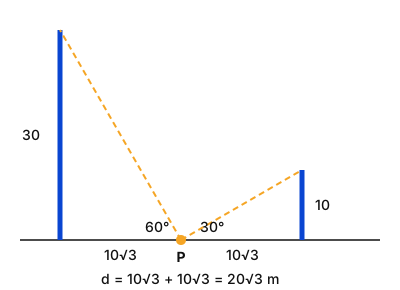
Concept: tanθ=heightbase; the point lies between the poles, so d= sum of the two bases.

  1. Taller pole: tan60∘=30x⇒x=303=103
  2. Shorter pole: tan30∘=10y⇒y=103
  3. d=x+y=203m

Trick: tan60∘=3, tan30∘=13; here both bases come out equal.

Answer: (C) 203 meters

अवधारणा: tanθ=ऊँचाईआधार; बिंदु दोनों खंभों के बीच है, अतः d= दोनों आधारों का योग।

  1. ऊँचा खंभा: tan60∘=30x⇒x=303=103
  2. छोटा खंभा: tan30∘=10y⇒y=103
  3. d=x+y=203m

ट्रिक: tan60∘=3, tan30∘=13; यहाँ दोनों आधार बराबर हैं।

उत्तर: (C) 203 मीटर

RRB NTPC Undergraduate CBT 1MathematicsHeights and DistancesRRB NTPC Undergraduate CBT 1 2025 · 17 Jun Shift 2 →
Q6666.
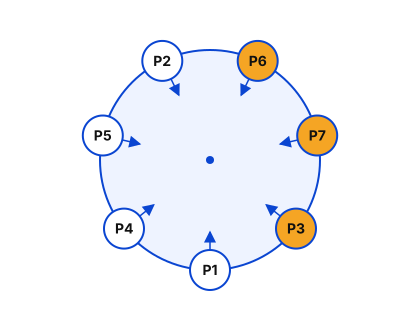
Seven people P1, P2, P3, P4, P5, P6 and P7 are sitting around a circular table facing towards the centre of the table. P1 sits to the immediate right of P3. P6 sits third to left of P3. P2 is sitting immediately between P3 and P7. P5 sits immediately left of P6. What is the position of P4 with respect to P1?
सात व्यक्ति P1, P2, P3, P4, P5, P6 और P7 एक वृत्ताकार मेज़ के चारों ओर मेज़ के केंद्र की ओर मुख करके बैठे हैं। P1, P3 के ठीक दाएँ बैठा है। P6, P3 के बाएँ से तीसरे स्थान पर बैठा है। P2, P3 और P7 के ठीक बीच में बैठा है। P5, P6 के ठीक बाएँ बैठा है। P1 के सापेक्ष P4 का स्थान क्या है?
  1. AImmediate rightठीक दाएँ
  2. BSecond to the leftबाएँ से दूसरा
  3. CSecond to the rightदाएँ से दूसरा
  4. DImmediate leftठीक बाएँ
Show answer

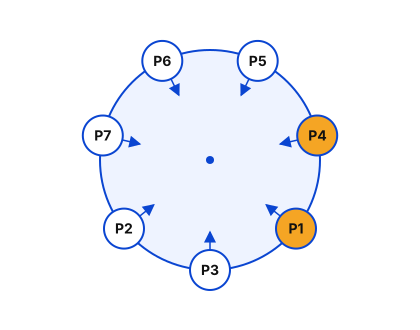
Concept: Facing the centre, a person’s right is anticlockwise and left is clockwise (as seen from above).

  1. Fix P3. P1 is immediately right of P3.
  2. P2 sits between P3 and P7, so P2 is on P3’s left and P7 next to P2.
  3. P6 is third to the left of P3; P5 is immediately left of P6. The only seat left goes to P4 (between P1 and P5).
  4. From P1, the next seat to the right is P4.

Trick: Fill the fixed clues first (P1, P2–P7, P6); the last empty seat is the answer person.

Answer: (A) Immediate right

अवधारणा: केंद्र की ओर मुख होने पर व्यक्ति का दायाँ वामावर्त (anticlockwise) और बायाँ दक्षिणावर्त (clockwise) होता है।

  1. P3 को स्थिर करें। P1, P3 के ठीक दाएँ है।
  2. P2, P3 और P7 के बीच है, अतः P2, P3 के बाएँ और उसके बाद P7।
  3. P6, P3 के बाएँ तीसरा है; P5, P6 के ठीक बाएँ है। बची सीट P4 की है (P1 और P5 के बीच)।
  4. P1 के ठीक दाएँ P4 बैठा है।

ट्रिक: पहले निश्चित संकेत (P1, P2–P7, P6) भरें; अंतिम खाली सीट उत्तर वाले व्यक्ति की होगी।

उत्तर: (A) ठीक दाएँ

RRB NTPC Undergraduate CBT 1General Intelligence and ReasoningCircular Seating ArrangementRRB NTPC Undergraduate CBT 1 2025 · 17 Jun Shift 2 →
Q6667.
Select the pair which follows the same pattern as that followed by the two sets of pairs given below. Both pairs follow the same pattern.
FGJ : HAE
KLO : MFJ
उस युग्म का चयन कीजिए जो उसी पैटर्न का अनुसरण करता है जिसका अनुसरण नीचे दिए गए युग्मों के दो समुच्चय करते हैं। दोनों युग्म एक ही पैटर्न का अनुसरण करते हैं।
FGJ : HAE
KLO : MFJ
  1. AMGQ : OAM
  2. BFJL : HDH
  3. CHMG : JGC
  4. DBMV : DGQ
Show answer

Concept: Use alphabet positions and find the change for each letter: FGJ : HAE.

  1. F(6)→H(8)=+2, G(7)→A(1)=−6, J(10)→E(5)=−5.
  2. Check KLO : MFJ: K→M=+2, L→F=−6, O→J=−5 ✓.
  3. BMV: B(2)+2=D, M(13)−6=G(7), V(22)−5=Q(17) → DGQ ✓.

Trick: Test only the first letter (+2) and then the second (−6) to eliminate options fast.

Answer: (D) BMV : DGQ

अवधारणा: अक्षरों के स्थानीय मान लेकर हर अक्षर का परिवर्तन ज्ञात करें: FGJ : HAE।

  1. F(6)→H(8)=+2, G(7)→A(1)=−6, J(10)→E(5)=−5।
  2. KLO : MFJ जाँचें: K→M=+2, L→F=−6, O→J=−5 ✓।
  3. BMV: B(2)+2=D, M(13)−6=G(7), V(22)−5=Q(17) → DGQ ✓।

ट्रिक: पहले अक्षर (+2) और फिर दूसरे (−6) से विकल्प जल्दी हटाएँ।

उत्तर: (D) BMV : DGQ

RRB NTPC Undergraduate CBT 1General Intelligence and ReasoningLetter AnalogyRRB NTPC Undergraduate CBT 1 2025 · 17 Jun Shift 2 →
Q6668.
What should come in place of ‘?’ in the given series?
314 277 244 215 190 169 ?
दी गई शृंखला में ‘?’ के स्थान पर क्या आना चाहिए?
314 277 244 215 190 169 ?
  1. A155
  2. B149
  3. C152
  4. D146
Show answer

Concept: Find the differences between consecutive terms.

  1. Differences: 314−277=37, 277−244=33, 244−215=29, 215−190=25, 190−169=21.
  2. The differences fall by 4 each time, so the next difference is 21−4=17.
  3. 169−17=152.

Trick: Differences 37, 33, 29, 25, 21, 17 — an AP with d=−4.

Answer: (C) 152

अवधारणा: क्रमागत पदों का अंतर निकालें।

  1. अंतर: 314−277=37, 277−244=33, 244−215=29, 215−190=25, 190−169=21।
  2. अंतर हर बार 4 घट रहा है, अतः अगला अंतर 21−4=17।
  3. 169−17=152।

ट्रिक: अंतर 37, 33, 29, 25, 21, 17 — d=−4 वाली समांतर श्रेणी।

उत्तर: (C) 152

RRB NTPC Undergraduate CBT 1General Intelligence and ReasoningNumber SeriesRRB NTPC Undergraduate CBT 1 2025 · 17 Jun Shift 2 →
Q6669.
Seven boxes A, B, C, D, E, F and G are kept one over the other but not necessarily in the same order. Only D is kept above G. Only two boxes are kept between G and A. Only B is kept below E. F is not kept immediately above A. How many boxes are kept between E and F?
सात डिब्बे A, B, C, D, E, F और G एक के ऊपर एक रखे गए हैं, लेकिन आवश्यक नहीं कि इसी क्रम में हों। G के ऊपर केवल D रखा है। G और A के बीच केवल दो डिब्बे रखे हैं। E के नीचे केवल B रखा है। F, A के ठीक ऊपर नहीं रखा है। E और F के बीच कितने डिब्बे रखे हैं?
  1. A1
  2. B2
  3. C4
  4. D3
Show answer

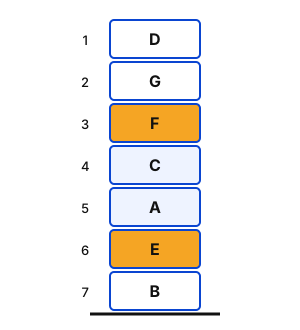
Concept: Number the positions 1 (top) to 7 (bottom) and place the definite clues first.

  1. Only D is above G → D at 1, G at 2.
  2. Two boxes between G and A → A at 5.
  3. Only B is below E → B at 7, E at 6.
  4. F is not immediately above A, so F ≠ 4 → F at 3, C at 4.
  5. Between F (3) and E (6): C and A → 2 boxes.

Trick: “Only X above Y” fixes Y at position 2; “only X below Y” fixes Y at position 6.

Answer: (B) 2

अवधारणा: स्थानों को 1 (ऊपर) से 7 (नीचे) तक क्रमांकित करें और निश्चित संकेत पहले रखें।

  1. केवल D, G के ऊपर है → D स्थान 1, G स्थान 2।
  2. G और A के बीच दो बॉक्स → A स्थान 5।
  3. केवल B, E के नीचे है → B स्थान 7, E स्थान 6।
  4. F, A के ठीक ऊपर नहीं है, अतः F स्थान 4 पर नहीं → F स्थान 3, C स्थान 4।
  5. F (3) और E (6) के बीच: C और A → 2 बॉक्स।

ट्रिक: “केवल X, Y के ऊपर” का अर्थ Y स्थान 2 पर; “केवल X, Y के नीचे” का अर्थ Y स्थान 6 पर।

उत्तर: (B) 2

RRB NTPC Undergraduate CBT 1General Intelligence and ReasoningBox ArrangementRRB NTPC Undergraduate CBT 1 2025 · 17 Jun Shift 2 →
Q6670.
What should come in place of the question mark (?) in the given series based on the English alphabetical order?
TAV SZU RYT QXS ?
अंग्रेज़ी वर्णमाला क्रम के आधार पर दी गई शृंखला में प्रश्न चिह्न (?) के स्थान पर क्या आना चाहिए?
TAV SZU RYT QXS ?
  1. ANWT
  2. BNOT
  3. CPWR
  4. DOXS
Show answer

Concept: Read each letter position of the clusters as a separate series.

  1. 1st letters: T, S, R, Q → next P (−1).
  2. 2nd letters: A, Z, Y, X → next W (−1, Z comes after A going backwards).
  3. 3rd letters: V, U, T, S → next R (−1).
  4. So the answer is PWR.

Trick: Every letter moves one step back each time.

Answer: (C) PWR

अवधारणा: हर समूह के प्रत्येक स्थान के अक्षर को अलग श्रृंखला मानें।

  1. पहले अक्षर: T, S, R, Q → अगला P (−1)।
  2. दूसरे अक्षर: A, Z, Y, X → अगला W (−1, पीछे जाने पर A के बाद Z)।
  3. तीसरे अक्षर: V, U, T, S → अगला R (−1)।
  4. अतः उत्तर PWR है।

ट्रिक: हर अक्षर हर बार एक कदम पीछे जाता है।

उत्तर: (C) PWR

RRB NTPC Undergraduate CBT 1General Intelligence and ReasoningLetter SeriesRRB NTPC Undergraduate CBT 1 2025 · 17 Jun Shift 2 →
Q6671.
In a certain code language, 'XEQA' is coded as '49' and 'KLCH' is coded as ‘36'. What is the code for 'NJDX' in the given code language?
एक निश्चित कूट भाषा में, 'XEQA' को '49' के रूप में कूटबद्ध किया जाता है और 'KLCH' को '36' के रूप में कूटबद्ध किया जाता है। उसी कूट भाषा में 'NJDX' का कूट क्या है?
  1. A51
  2. B49
  3. C55
  4. D54
Show answer

Concept: Add the alphabet positions of the letters and look at the relation with the code.

  1. XEQA: 24+5+17+1=47, and 47+2=49 ✓.
  2. KLCH: 11+12+3+8=34, and 34+2=36 ✓.
  3. NJDX: 14+10+4+24=52, so code =52+2=54.

Trick: Code = (sum of positions) +2.

Answer: (D) 54

अवधारणा: अक्षरों के स्थानीय मानों का योग करें और कोड से संबंध देखें।

  1. XEQA: 24+5+17+1=47, और 47+2=49 ✓।
  2. KLCH: 11+12+3+8=34, और 34+2=36 ✓।
  3. NJDX: 14+10+4+24=52, अतः कोड =52+2=54।

ट्रिक: कोड = (स्थानीय मानों का योग) +2।

उत्तर: (D) 54

RRB NTPC Undergraduate CBT 1General Intelligence and ReasoningCoding–Decoding (Letter Sum)RRB NTPC Undergraduate CBT 1 2025 · 17 Jun Shift 2 →
Q6672.
If ‘A’ stands for ‘÷’ , ‘B’ stands for ‘x’, ‘C’ stands for ‘+’ and ‘D’ stands for ‘-‘ , what will be come in place of the question mark ‘?’ in the following equation?
19 C 6 B 5 D 72 A 8 = ?
यदि ‘A’ का अर्थ ‘÷’, ‘B’ का अर्थ ‘x’, ‘C’ का अर्थ ‘+’ और ‘D’ का अर्थ ‘-‘ है, तो निम्नलिखित समीकरण में प्रश्न चिह्न ‘?’ के स्थान पर क्या आएगा?
19 C 6 B 5 D 72 A 8 = ?
  1. A47
  2. B40
  3. C45
  4. D43
Show answer

Concept: Replace the letters by signs and solve using BODMAS.

  1. 19 C 6 B 5 D 72 A 8=19+6×5−72÷8.
  2. Division and multiplication first: 72÷8=9, 6×5=30.
  3. 19+30−9=40.

Trick: Always do ÷ and × before + and −.

Answer: (B) 40

अवधारणा: अक्षरों के स्थान पर चिह्न रखें और BODMAS से हल करें।

  1. 19 C 6 B 5 D 72 A 8=19+6×5−72÷8।
  2. पहले भाग व गुणा: 72÷8=9, 6×5=30।
  3. 19+30−9=40।

ट्रिक: + और − से पहले हमेशा ÷ और × करें।

उत्तर: (B) 40

RRB NTPC Undergraduate CBT 1General Intelligence and ReasoningSymbol SubstitutionRRB NTPC Undergraduate CBT 1 2025 · 17 Jun Shift 2 →
Q6673.
In the following number-pairs, the second number is obtained by applying certain mathematical operations to the first number. Select the set in which the numbers are related in the same way as are the numbers of the following sets.
(NOTE: Operations should be performed on the whole numbers, without breaking down the numbers into their constituent digits. E.g. 13 – Operations on 13 such as adding / subtracting / multiplying etc. to 13 can be performed. Breaking down 13 into 1 and 3 and then performing mathematical operations on 1 and 3 is not allowed.)
18, 323
19, 360
निम्नलिखित संख्या-युग्मों में, दूसरी संख्या पहली संख्या पर कुछ निश्चित गणितीय संक्रियाएँ करके प्राप्त की जाती है। उस समुच्चय का चयन कीजिए जिसमें संख्याएँ उसी प्रकार संबंधित हैं जिस प्रकार निम्नलिखित समुच्चयों की संख्याएँ संबंधित हैं।
(नोट: संख्याओं को उनके घटक अंकों में विभाजित किए बिना, पूर्ण संख्याओं पर संक्रियाएँ की जानी चाहिए। उदाहरण 13 – 13 पर संक्रियाएँ जैसे 13 में जोड़ना / घटाना / गुणा करना आदि की जा सकती हैं। 13 को 1 और 3 में विभाजित करके फिर 1 और 3 पर गणितीय संक्रियाएँ करने की अनुमति नहीं है।)
18, 323
19, 360
  1. A14, 196
  2. B20, 400
  3. C22, 485
  4. D21, 440
Show answer

Concept: Look for a square relation: the second number is close to the square of the first.

  1. 182=324 and 324−1=323 ✓; 192=361 and 361−1=360 ✓.
  2. Rule: second number =n2−1.
  3. Check options: 142−1=195, 202−1=399, 222−1=483, 212−1=440 ✓.

Trick: If the second number is just below a perfect square, try n2−1.

Answer: (D) 21, 440

अवधारणा: वर्ग संबंध देखें: दूसरी संख्या पहली संख्या के वर्ग के पास है।

  1. 182=324 और 324−1=323 ✓; 192=361 और 361−1=360 ✓।
  2. नियम: दूसरी संख्या =n2−1।
  3. विकल्प जाँचें: 142−1=195, 202−1=399, 222−1=483, 212−1=440 ✓।

ट्रिक: यदि दूसरी संख्या किसी पूर्ण वर्ग से ठीक कम है तो n2−1 आज़माएँ।

उत्तर: (D) 21, 440

RRB NTPC Undergraduate CBT 1General Intelligence and ReasoningNumber-Pair RelationRRB NTPC Undergraduate CBT 1 2025 · 17 Jun Shift 2 →
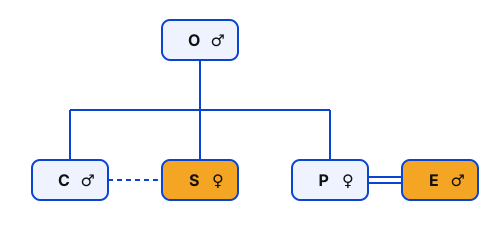
Q6674.
In a certain code language,
A > B means ‘A is the sister of B’,
A = B means ‘A is the father of B’,
A ! B means ‘A is the wife of B’ and
A − B means ‘A is the son of B’.
How is S related to E if ‘S > C − O = P ! E’?
एक निश्चित कूट भाषा में,
A > B का अर्थ है ‘A, B की बहन है’,
A = B का अर्थ है ‘A, B का पिता है’,
A ! B का अर्थ है ‘A, B की पत्नी है’ और
A − B का अर्थ है ‘A, B का पुत्र है’।
यदि ‘S > C − O = P ! E’ है, तो S का E से क्या संबंध है?
  1. AWife's sisterपत्नी की बहन
  2. BWife's motherपत्नी की माँ
  3. CWife's daughterपत्नी की पुत्री
  4. DWife's brotherपत्नी का भाई
Show answer

Concept: Decode each symbol from left to right and build the family tree.

  1. S > C: S is the sister of C (S is female).
  2. C − O: C is the son of O.
  3. O = P: O is the father of P, so S, C and P are siblings.
  4. P ! E: P is the wife of E.
  5. S is the sister of P, i.e. E’s wife’s sister.

Trick: Sister of a sibling (C) is also sister of the other child (P) of the same father.

Answer: (A) Wife's sister

अवधारणा: हर चिह्न को बाएँ से दाएँ डिकोड करें और परिवार वृक्ष बनाएँ।

  1. S > C: S, C की बहन है (S महिला)।
  2. C − O: C, O का पुत्र है।
  3. O = P: O, P का पिता है, अतः S, C और P भाई-बहन हैं।
  4. P ! E: P, E की पत्नी है।
  5. S, P की बहन है, अर्थात E की पत्नी की बहन (साली)।

ट्रिक: एक भाई (C) की बहन, उसी पिता की दूसरी संतान (P) की भी बहन होती है।

उत्तर: (A) पत्नी की बहन

RRB NTPC Undergraduate CBT 1General Intelligence and ReasoningCoded Blood RelationsRRB NTPC Undergraduate CBT 1 2025 · 17 Jun Shift 2 →
Q6675.
What should come in place of ‘?’ in the given series?
118 149 211 242 304 335 ?
दी गई शृंखला में ‘?’ के स्थान पर क्या आना चाहिए?
118 149 211 242 304 335 ?
  1. A427
  2. B387
  3. C407
  4. D397
Show answer

Concept: Find the differences between consecutive terms.

  1. Differences: 149−118=31, 211−149=62, 242−211=31, 304−242=62, 335−304=31.
  2. The pattern is +31, +62 alternately, so the next step is +62.
  3. 335+62=397.

Trick: Alternate differences 31 and 62=2×31.

Answer: (D) 397

अवधारणा: क्रमागत पदों का अंतर निकालें।

  1. अंतर: 149−118=31, 211−149=62, 242−211=31, 304−242=62, 335−304=31।
  2. क्रम एकांतर +31, +62 है, अतः अगला +62।
  3. 335+62=397।

ट्रिक: एकांतर अंतर 31 और 62=2×31।

उत्तर: (D) 397

RRB NTPC Undergraduate CBT 1General Intelligence and ReasoningNumber SeriesRRB NTPC Undergraduate CBT 1 2025 · 17 Jun Shift 2 →
Q6676.
Seven people P1, P2, P3, P4, P5, P6 and P7 are sitting around a circular table facing towards the centre of the table. P7 sits second to right of P1. There are exactly two people between P1 and P6 when checked from right of P1. P2 is sitting immediately between P5 and P6. P3 sits second to right of P4. Who is sitting immediately between P6 and P3?
सात व्यक्ति P1, P2, P3, P4, P5, P6 और P7 एक वृत्ताकार मेज़ के चारों ओर मेज़ के केंद्र की ओर मुख करके बैठे हैं। P7, P1 के दाएँ से दूसरे स्थान पर बैठा है। P1 के दाएँ से गिनने पर P1 और P6 के बीच ठीक दो व्यक्ति हैं। P2, P5 और P6 के ठीक बीच में बैठा है। P3, P4 के दाएँ से दूसरे स्थान पर बैठा है। P6 और P3 के ठीक बीच में कौन बैठा है?
  1. AP5
  2. BP1
  3. CP4
  4. DP7
Show answer

Concept: Facing the centre: right = anticlockwise, left = clockwise.

  1. Fix P1. P7 is second to the right of P1.
  2. Two people between P1 and P6 counting from P1’s right → P6 is third to the right of P1 (P7 is between them).
  3. P2 is between P5 and P6 → P2 next to P6 (on the far side), then P5.
  4. The two empty seats go to P4 and P3 with P3 second to the right of P4 → P4 next to P1 on its left, P3 immediately right of P1.
  5. Seat between P6 and P3 is P7.

Trick: Place the person with the most clues (P1) first and count seats on the drawing.

Answer: (D) P7

अवधारणा: केंद्र की ओर मुख: दायाँ = वामावर्त, बायाँ = दक्षिणावर्त।

  1. P1 को स्थिर करें। P7, P1 के दाएँ दूसरा है।
  2. P1 के दाएँ से गिनने पर P1 और P6 के बीच दो व्यक्ति → P6, P1 के दाएँ तीसरा है (बीच में P7 है)।
  3. P2, P5 और P6 के बीच है → P6 के आगे P2, फिर P5।
  4. बची दो सीटें P4 और P3 की हैं; P3, P4 के दाएँ दूसरा है → P4, P1 के बाएँ और P3, P1 के ठीक दाएँ।
  5. P6 और P3 के बीच P7 बैठा है।

ट्रिक: सबसे अधिक संकेत वाले व्यक्ति (P1) को पहले बैठाएँ और चित्र पर सीटें गिनें।

उत्तर: (D) P7

RRB NTPC Undergraduate CBT 1General Intelligence and ReasoningCircular Seating ArrangementRRB NTPC Undergraduate CBT 1 2025 · 17 Jun Shift 2 →
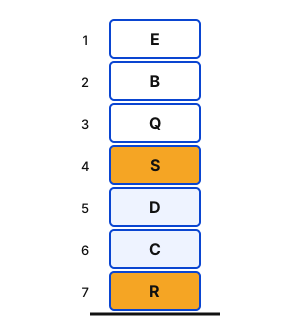
Q6677.
Seven boxes B, C, D, E, Q, R and S are kept one over the other but not necessarily in the same order. No box is kept above E. Only B is kept between E and Q. Only R is kept below C. Only one box is kept between Q and D. How many boxes are kept between S and R?
सात डिब्बे B, C, D, E, Q, R और S एक के ऊपर एक रखे गए हैं, लेकिन आवश्यक नहीं कि इसी क्रम में हों। E के ऊपर कोई डिब्बा नहीं रखा है। E और Q के बीच केवल B रखा है। C के नीचे केवल R रखा है। Q और D के बीच केवल एक डिब्बा रखा है। S और R के बीच कितने डिब्बे रखे हैं?
  1. AThreeतीन
  2. BOneएक
  3. CTwoदो
  4. DFourचार
Show answer

Concept: Number the positions 1 (top) to 7 (bottom).

  1. No box above E → E at 1.
  2. Only B between E and Q → B at 2, Q at 3.
  3. Only R below C → R at 7, C at 6.
  4. One box between Q and D → D at 5 (position 1 is taken).
  5. The remaining box S is at 4. Between S (4) and R (7): D and C → two boxes.

Trick: “No box above E” = E on top; “only R below C” = C sixth, R last.

Answer: (C) Two

अवधारणा: स्थानों को 1 (ऊपर) से 7 (नीचे) तक क्रमांकित करें।

  1. E के ऊपर कोई बॉक्स नहीं → E स्थान 1।
  2. E और Q के बीच केवल B → B स्थान 2, Q स्थान 3।
  3. C के नीचे केवल R → R स्थान 7, C स्थान 6।
  4. Q और D के बीच एक बॉक्स → D स्थान 5 (स्थान 1 भरा है)।
  5. बचा S स्थान 4 पर। S (4) और R (7) के बीच D और C → दो बॉक्स।

ट्रिक: “E के ऊपर कोई नहीं” = E सबसे ऊपर; “C के नीचे केवल R” = C छठा, R अंतिम।

उत्तर: (C) दो

RRB NTPC Undergraduate CBT 1General Intelligence and ReasoningBox ArrangementRRB NTPC Undergraduate CBT 1 2025 · 17 Jun Shift 2 →
Q6678.
In the following triads, each group of letters is related to the subsequent one following a certain logic. Select from the given options the triad which follows the same logic. DISK - DKSI - KSID
LEAF - LFAE - FAEL
निम्नलिखित त्रिकों में, अक्षरों का प्रत्येक समूह एक निश्चित तर्क के अनुसार अगले समूह से संबंधित है। दिए गए विकल्पों में से उस त्रिक का चयन कीजिए जो उसी तर्क का अनुसरण करता है। DISK - DKSI - KSID
LEAF - LFAE - FAEL
  1. APOEM - PMEO - MEOP
  2. BGOAT - GAOT - TAOG
  3. CPRAY - PRYA - RAYP
  4. DWEST - EWST - TESW
Show answer

Concept: Track positions of letters 1, 2, 3, 4 in each step.

  1. DISK → DKSI: letters taken in order 1, 4, 3, 2.
  2. DKSI → KSID: first letter moves to the end (order 2, 3, 4, 1).
  3. Check LEAF → LFAE → FAEL ✓.
  4. POEM → PMEO (1, 4, 3, 2) → MEOP (first letter to the end) ✓.

Trick: Step 1 swaps the 2nd and 4th letters; step 2 sends the first letter to the end.

Answer: (A) POEM - PMEO - MEOP

अवधारणा: हर चरण में अक्षरों के स्थान 1, 2, 3, 4 पर ध्यान दें।

  1. DISK → DKSI: अक्षर क्रम 1, 4, 3, 2।
  2. DKSI → KSID: पहला अक्षर अंत में (क्रम 2, 3, 4, 1)।
  3. जाँच LEAF → LFAE → FAEL ✓।
  4. POEM → PMEO (1, 4, 3, 2) → MEOP (पहला अक्षर अंत में) ✓।

ट्रिक: पहले चरण में दूसरा और चौथा अक्षर बदलते हैं; दूसरे चरण में पहला अक्षर अंत में जाता है।

उत्तर: (A) POEM - PMEO - MEOP

RRB NTPC Undergraduate CBT 1General Intelligence and ReasoningLetter Triads (Position Shuffle)RRB NTPC Undergraduate CBT 1 2025 · 17 Jun Shift 2 →
Q6679.
Based on the English alphabetical order, three of the following four letter-cluster pairs are alike in a certain way and thus form a group. Which is the one that does not belong to that group? (Note: The odd one out is not based on the number of
consonants/vowels or their position in the letter cluster.)
अंग्रेज़ी वर्णमाला क्रम के आधार पर, निम्नलिखित चार अक्षर-समूह युग्मों में से तीन किसी निश्चित प्रकार से एक समान हैं और इस प्रकार एक समूह बनाते हैं। वह कौन-सा युग्म है जो उस समूह से संबंधित नहीं है? (नोट: असंगत युग्म, व्यंजनों/स्वरों की संख्या या अक्षर-समूह में उनके
स्थान पर आधारित नहीं है।)
  1. AUT−PR
  2. BZY−VU
  3. CJI−FE
  4. DML−IH
Show answer

Concept: Compare letter positions inside each cluster and between the two clusters.

  1. ZY−VU: Z→Y=−1, V→U=−1, and Z→V=−4.
  2. JI−FE and ML−IH follow the same: each cluster is two consecutive letters in reverse (−1), and the second cluster starts 4 letters back.
  3. UT−PR: P(16)→R(18)=+2, not −1; also U→P=−5. So UT−PR is odd.

Trick: Three pairs are “reverse-consecutive” twins; spot the cluster that breaks it.

Answer: (A) UT−PR

अवधारणा: हर समूह के भीतर और दोनों समूहों के बीच अक्षरों के स्थान की तुलना करें।

  1. ZY−VU: Z→Y=−1, V→U=−1 और Z→V=−4।
  2. JI−FE और ML−IH भी ऐसे ही हैं: हर समूह में उल्टे क्रम के दो क्रमागत अक्षर (−1), और दूसरा समूह 4 अक्षर पीछे से शुरू।
  3. UT−PR: P(16)→R(18)=+2, −1 नहीं; साथ ही U→P=−5। अतः UT−PR विषम है।

ट्रिक: तीन युग्म “उल्टे क्रमागत” जोड़े हैं; जो नियम तोड़े वही उत्तर।

उत्तर: (A) UT−PR

RRB NTPC Undergraduate CBT 1General Intelligence and ReasoningOdd One Out – Letter PairsRRB NTPC Undergraduate CBT 1 2025 · 17 Jun Shift 2 →
Q6680.
What should come in place of ? in the given series based on the English alphabetical order?
POR VUX BAD HGJ ?
अंग्रेज़ी वर्णमाला क्रम के आधार पर दी गई शृंखला में ? के स्थान पर क्या आना चाहिए?
POR VUX BAD HGJ ?
  1. ANLO
  2. BNMP
  3. CNNO
  4. DNOQ
Show answer

Concept: Compare each letter of a cluster with the same position in the next cluster.

  1. POR: P=16, O=15, R=18; VUX: 22,21,24 → each letter +6.
  2. VUX → BAD (V+6=B after Z) → HGJ, all +6.
  3. HGJ +6: H→N, G→M, J→P → NMP.

Trick: Inside every cluster the pattern is −1,+3 (P→O→R); NMP also follows N→M→P.

Answer: (B) NMP

अवधारणा: हर समूह के प्रत्येक अक्षर की तुलना अगले समूह के उसी स्थान वाले अक्षर से करें।

  1. POR: P=16, O=15, R=18; VUX: 22,21,24 → हर अक्षर +6।
  2. VUX → BAD (Z के बाद V+6=B) → HGJ, सभी +6।
  3. HGJ +6: H→N, G→M, J→P → NMP।

ट्रिक: हर समूह के अंदर क्रम −1,+3 है (P→O→R); NMP में भी N→M→P।

उत्तर: (B) NMP

RRB NTPC Undergraduate CBT 1General Intelligence and ReasoningLetter SeriesRRB NTPC Undergraduate CBT 1 2025 · 17 Jun Shift 2 →