Question bank

Q&A: practice questions with answers

Search questions on any topic. Filter by exam category, exam, subject and topic, try the question, then open the answer and explanation.

Courses – airGurukul

8,495 questions found.

Q6741.
A person covers a certain distance. If he reduces his speed by 25%, by what percentage does the time taken to cover the same distance increase? (Rounded off to two decimal places)
एक व्यक्ति एक निश्चित दूरी तय करता है। यदि वह अपनी चाल 25% कम कर दे, तो उसी दूरी को तय करने में लगने वाले समय में कितने प्रतिशत की वृद्धि होगी? (दो दशमलव स्थानों तक पूर्णांकित)
  1. A25.67%
  2. B30.67%
  3. C20.33%
  4. D33.33%
Show answer

Concept: For a fixed distance, time ∝1speed.

  1. New speed =34 of original.
  2. New time =43 of original.
  3. Increase =4−33×100=1003=33.33%

Trick: If speed falls by x%, time rises by x100−x×100=2575×100=33.33%.

Answer: (D) 33.33%

अवधारणा: निश्चित दूरी के लिए समय ∝1चाल.

  1. नई चाल = मूल का 34.
  2. नया समय = मूल का 43.
  3. वृद्धि =4−33×100=1003=33.33%

ट्रिक: चाल x% घटे तो समय x100−x×100=2575×100=33.33% बढ़ता है।

उत्तर: (D) 33.33%

RRB NTPC Undergraduate CBT 1MathematicsSpeed and TimeRRB NTPC Undergraduate CBT 1 2025 · 17 Jun Shift 1 →
Q6742.
The present age of Mohit is three times the present age of his son Rahul. After 12 years from now, Mohit’s age will be twice Rahul’s age. What is the sum of their present ages (in years)?
मोहित की वर्तमान आयु उसके पुत्र राहुल की वर्तमान आयु की तीन गुनी है। अब से 12 वर्ष बाद, मोहित की आयु राहुल की आयु की दोगुनी होगी। उनकी वर्तमान आयु का योग (वर्षों में) कितना है?
  1. A48
  2. B50
  3. C46
  4. D44
Show answer

Concept: Let the son's present age be x; form the equation for the future condition.

  1. Rahul =x, Mohit =3x.
  2. After 12 years: 3x+12=2(x+12)⇒x=12.
  3. Mohit =36, sum =36+12=48 years.

Trick: Check options: sum must split as 1:3 → 48 gives 12 and 36; after 12 years 48 and 24 ✔.

Answer: (A) 48

अवधारणा: पुत्र की वर्तमान आयु x मानें और भविष्य की शर्त से समीकरण बनाएँ।

  1. राहुल =x, मोहित =3x.
  2. 12 वर्ष बाद: 3x+12=2(x+12)⇒x=12.
  3. मोहित =36, योग =36+12=48 वर्ष।

ट्रिक: विकल्प जाँचें: योग 1:3 में बँटे → 48 से 12 व 36; 12 वर्ष बाद 48 व 24 ✔.

उत्तर: (A) 48

RRB NTPC Undergraduate CBT 1MathematicsProblems on AgesRRB NTPC Undergraduate CBT 1 2025 · 17 Jun Shift 1 →
Q6743.
A local library purchased several biography books and mystery novels for their new collection. The library spent exactly ₹4,800 on biography books and ₹4,800 on mystery novels. Each biography book costs ₹40 more than a mystery novel. The library was able to buy 10 more mystery novels than biography books. Find the number of biography books purchased.
एक स्थानीय पुस्तकालय ने अपने नए संग्रह के लिए कई जीवनी पुस्तकें और रहस्य उपन्यास खरीदे। पुस्तकालय ने जीवनी पुस्तकों पर ठीक ₹4,800 और रहस्य उपन्यासों पर ₹4,800 खर्च किए। प्रत्येक जीवनी पुस्तक का मूल्य एक रहस्य उपन्यास से ₹40 अधिक है। पुस्तकालय जीवनी पुस्तकों की तुलना में 10 अधिक रहस्य उपन्यास खरीद सका। खरीदी गई जीवनी पुस्तकों की संख्या ज्ञात कीजिए।
  1. A18
  2. B24
  3. C21
  4. D30
Show answer

Concept: Number of items =Total costPrice per item; form an equation from the difference in counts.

  1. Let mystery novel price =x, biography price =x+40.
  2. 4800x−4800x+40=10⇒4800×40=10x(x+40)
  3. x2+40x−19200=0⇒(x+160)(x−120)=0⇒x=120
  4. Biography price =160 → books =4800160=30 (mystery =40 ✔).

Trick: Test options: 30 books → ₹160 each; 40 novels → ₹120 each; difference ₹40 ✔.

Answer: (D) 30

अवधारणा: वस्तुओं की संख्या =कुल लागतप्रति वस्तु मूल्य; संख्याओं के अंतर से समीकरण बनाएँ।

  1. रहस्य उपन्यास का मूल्य =x, जीवनी का मूल्य =x+40.
  2. 4800x−4800x+40=10⇒4800×40=10x(x+40)
  3. x2+40x−19200=0⇒(x+160)(x−120)=0⇒x=120
  4. जीवनी का मूल्य =160 → पुस्तकें =4800160=30 (उपन्यास =40 ✔)।

ट्रिक: विकल्प जाँचें: 30 पुस्तकें → ₹160 प्रति; 40 उपन्यास → ₹120 प्रति; अंतर ₹40 ✔.

उत्तर: (D) 30

RRB NTPC Undergraduate CBT 1MathematicsQuadratic Word ProblemRRB NTPC Undergraduate CBT 1 2025 · 17 Jun Shift 1 →
Q6744.
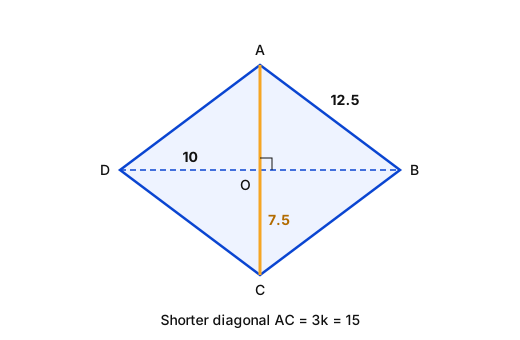
The diagonals of a rhombus are in the ratio 3 :4. If the length of each side of the rhombus is 12.5 units, what is the length of the shorter diagonal?
एक समचतुर्भुज के विकर्णों का अनुपात 3 :4 है। यदि समचतुर्भुज की प्रत्येक भुजा की लंबाई 12.5 इकाई है, तो छोटे विकर्ण की लंबाई कितनी है?
  1. A10 units10 इकाई
  2. B12 units12 इकाई
  3. C18 units18 इकाई
  4. D15 units15 इकाई
Show answer

Concept: Diagonals of a rhombus bisect each other at right angles: side2=(d12)2+(d22)2.

  1. Let diagonals be 3k and 4k; halves 1.5k and 2k.
  2. (1.5k)2+(2k)2=(12.5)2⇒6.25k2=156.25⇒k=5
  3. Shorter diagonal =3k=15 units.

Trick: Half-diagonals and side form a 3:4:5 triangle → 5 parts =12.5, so half-diagonals are 7.5 and 10.

Answer: (D) 15 units

अवधारणा: समचतुर्भुज के विकर्ण एक-दूसरे को समकोण पर समद्विभाजित करते हैं: भुजा2=(d12)2+(d22)2.

  1. विकर्ण 3k और 4k; आधे 1.5k और 2k.
  2. (1.5k)2+(2k)2=(12.5)2⇒6.25k2=156.25⇒k=5
  3. छोटा विकर्ण =3k=15 इकाई।

ट्रिक: आधे विकर्ण व भुजा 3:4:5 त्रिभुज बनाते हैं → 5 भाग =12.5, अतः आधे विकर्ण 7.5 व 10.

उत्तर: (D) 15 इकाई

RRB NTPC Undergraduate CBT 1MathematicsRhombusRRB NTPC Undergraduate CBT 1 2025 · 17 Jun Shift 1 →
Q6745.
A trader buys an article, spends ₹50 on its repair, and sells it for ₹600, making a 25% profit. What was the original purchase price?
एक व्यापारी एक वस्तु खरीदता है, उसकी मरम्मत पर ₹50 खर्च करता है, और उसे ₹600 में बेचकर 25% लाभ अर्जित करता है। वस्तु का मूल क्रय मूल्य कितना था?
  1. A₹480
  2. B₹430
  3. C₹400
  4. D₹450
Show answer

Concept: Repair cost is part of the cost price: CP=SP×100100+Profit%.

  1. Total CP =600×100125=480.
  2. Purchase price =480−50=430.

Trick: 25% profit → SP=54CP → CP=45×600=480; remove repair ₹50.

Answer: (B) ₹430

अवधारणा: मरम्मत खर्च क्रय मूल्य में जुड़ता है: CP=SP×100100+लाभ%.

  1. कुल CP =600×100125=480.
  2. मूल क्रय मूल्य =480−50=430.

ट्रिक: 25% लाभ → SP=54CP → CP=45×600=480; मरम्मत के ₹50 घटाएँ।

उत्तर: (B) ₹430

RRB NTPC Undergraduate CBT 1MathematicsProfit and LossRRB NTPC Undergraduate CBT 1 2025 · 17 Jun Shift 1 →
Q6746.
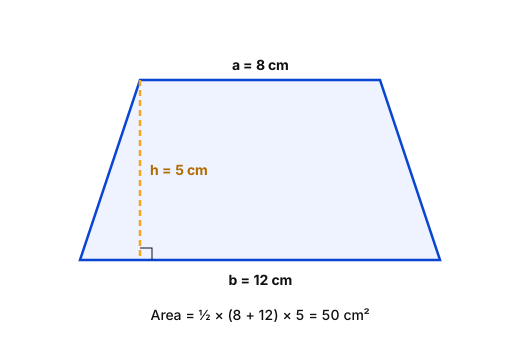
If a trapezium has bases of lengths 8 cm and 12 cm, and height of 5 cm, what is its area?
यदि एक समलंब की समांतर भुजाओं (आधारों) की लंबाई 8 cm और 12 cm है, और ऊँचाई 5 cm है, तो उसका क्षेत्रफल कितना है?
  1. A45 cm²
  2. B50 cm²
  3. C40 cm²
  4. D60 cm²
Show answer

Concept: Area of trapezium =12×(sum of parallel sides)×height.

  1. Sum of bases =8+12=20cm.
  2. Area =12×20×5=50cm2

Trick: Average base × height =10×5=50.

Answer: (B) 50cm2

अवधारणा: समलंब का क्षेत्रफल =12×(समांतर भुजाओं का योग)×ऊँचाई.

  1. आधारों का योग =8+12=20cm.
  2. क्षेत्रफल =12×20×5=50cm2

ट्रिक: औसत आधार × ऊँचाई =10×5=50.

उत्तर: (B) 50cm2

RRB NTPC Undergraduate CBT 1MathematicsArea of TrapeziumRRB NTPC Undergraduate CBT 1 2025 · 17 Jun Shift 1 →
Q6747.
In a batch of 50 managers and supervisors, the average monthly salary of managers is ₹48,000 and that of supervisors is ₹42,000. If the overall monthly average salary of the batch is ₹44,400, find the number of supervisors in the batch.
50 प्रबंधकों और पर्यवेक्षकों के एक बैच में, प्रबंधकों का औसत मासिक वेतन ₹48,000 है और पर्यवेक्षकों का ₹42,000 है। यदि बैच का कुल औसत मासिक वेतन ₹44,400 है, तो बैच में पर्यवेक्षकों की संख्या ज्ञात कीजिए।
  1. A33
  2. B24
  3. C27
  4. D30
Show answer

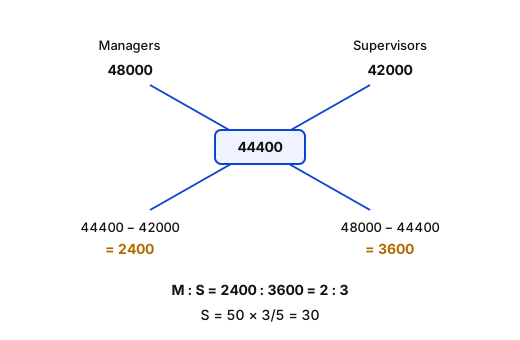
Concept: Alligation: ratio of quantities = (opposite differences from the mean).

  1. Managers : Supervisors =(44400−42000):(48000−44400)=2400:3600=2:3.
  2. Supervisors =50×35=30.
  3. Check: 20×48000+30×4200050=44400 ✔

Trick: Mean is closer to 42000, so supervisors are more than half → 30.

Answer: (D) 30

अवधारणा: एलीगेशन: मात्राओं का अनुपात = औसत से विपरीत अंतरों का अनुपात।

  1. मैनेजर : सुपरवाइज़र =(44400−42000):(48000−44400)=2400:3600=2:3.
  2. सुपरवाइज़र =50×35=30.
  3. जाँच: 20×48000+30×4200050=44400 ✔

ट्रिक: औसत 42000 के अधिक निकट है, अतः सुपरवाइज़र आधे से अधिक → 30.

उत्तर: (D) 30

RRB NTPC Undergraduate CBT 1MathematicsAverage – AlligationRRB NTPC Undergraduate CBT 1 2025 · 17 Jun Shift 1 →
Q6748.
Simplify: (1918÷196)÷(518×1615+46)+68÷2425 of 258
सरल कीजिए: (1918÷196)÷(518×1615+46)+68÷2425 of 258
  1. A1
  2. B34
  3. C3152
  4. D3154
Show answer

Concept: BODMAS – brackets first, then 'of', then division/multiplication, then addition.

  1. 1918÷196=1918×619=13
  2. 518×1615+46=827+1827=2627
  3. 13÷2627=926; and 2425 of 258=3, so 68÷3=14.
  4. 926+14=18+1352=3152

Trick: 'of' is solved before ÷ – the most common trap in such questions.

Answer: (C) 3152

अवधारणा: BODMAS – पहले कोष्ठक, फिर 'of' (का), फिर भाग/गुणा, फिर जोड़।

  1. 1918÷196=1918×619=13
  2. 518×1615+46=827+1827=2627
  3. 13÷2627=926; तथा 2425 of 258=3, अतः 68÷3=14.
  4. 926+14=18+1352=3152

ट्रिक: 'of' को ÷ से पहले हल करें – ऐसे प्रश्नों का सबसे आम जाल।

उत्तर: (C) 3152

RRB NTPC Undergraduate CBT 1MathematicsSimplification (fractions)RRB NTPC Undergraduate CBT 1 2025 · 17 Jun Shift 1 →
Q6749.
A mobile phone is marked at ₹8,000. If two successive discounts of 15% and 10% are given, what is the selling price?
एक मोबाइल फ़ोन का अंकित मूल्य ₹8,000 है। यदि 15% और 10% की दो क्रमागत छूट दी जाती हैं, तो विक्रय मूल्य कितना है?
  1. A₹6,120
  2. B₹6,200
  3. C₹6,160
  4. D₹6,180
Show answer

Concept: SP=MP×(1−d1100)(1−d2100).

  1. After 15%: 8000×0.85=6800.
  2. After 10%: 6800×0.9=6120.

Trick: Net discount =15+10−15×10100=23.5% → 8000×0.765=6120.

Answer: (A) ₹6,120

अवधारणा: SP=MP×(1−d1100)(1−d2100).

  1. 15% के बाद: 8000×0.85=6800.
  2. 10% के बाद: 6800×0.9=6120.

ट्रिक: कुल छूट =15+10−15×10100=23.5% → 8000×0.765=6120.

उत्तर: (A) ₹6,120

RRB NTPC Undergraduate CBT 1MathematicsSuccessive DiscountsRRB NTPC Undergraduate CBT 1 2025 · 17 Jun Shift 1 →
Q6750.
If 2cotA=4, find the value of cosec2A+1cosec2A−1
यदि 2cotA=4 है, तो cosec2A+1cosec2A−1 का मान ज्ञात कीजिए।
  1. A1.5
  2. B1
  3. C4
  4. D2.5
Show answer

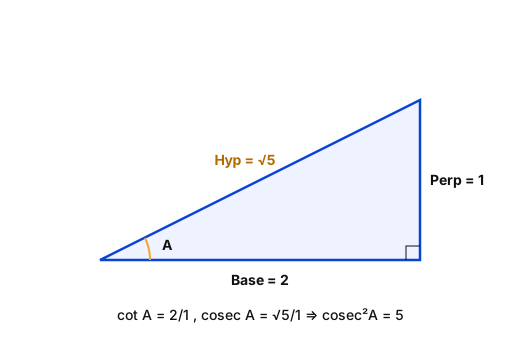
Concept: cosec2A=1+cot2A.

  1. 2cotA=4⇒cotA=2.
  2. cosec2A=1+4=5.
  3. 5+15−1=64=1.5

Trick: Expression =2+cot2Acot2A=2+44=1.5 directly.

Answer: (A) 1.5

अवधारणा: cosec2A=1+cot2A.

  1. 2cotA=4⇒cotA=2.
  2. cosec2A=1+4=5.
  3. 5+15−1=64=1.5

ट्रिक: व्यंजक =2+cot2Acot2A=2+44=1.5 सीधे।

उत्तर: (A) 1.5

RRB NTPC Undergraduate CBT 1MathematicsTrigonometric IdentitiesRRB NTPC Undergraduate CBT 1 2025 · 17 Jun Shift 1 →
Q6751.
If the third proportional to 0.8 and 5.6 is n, then what is the value of n?
यदि 0.8 और 5.6 का तृतीयानुपाती n है, तो n का मान क्या है?
  1. A39.2
  2. B0.84
  3. C31.36
  4. D4.48
Show answer

Concept: Third proportional to a and b is b2a (since a:b=b:n).

  1. n=5.620.8=31.360.8
  2. n=39.2

Trick: 5.60.8=7, so n=5.6×7=39.2.

Answer: (A) 39.2

अवधारणा: a और b का तृतीय समानुपाती =b2a (क्योंकि a:b=b:n)।

  1. n=5.620.8=31.360.8
  2. n=39.2

ट्रिक: 5.60.8=7, अतः n=5.6×7=39.2.

उत्तर: (A) 39.2

RRB NTPC Undergraduate CBT 1MathematicsThird ProportionalRRB NTPC Undergraduate CBT 1 2025 · 17 Jun Shift 1 →
Q6752.
The value of {18 + [24 ÷ (3 of 2)] × 4} − 10 is equal to:
{18 + [24 ÷ (3 of 2)] × 4} − 10 का मान किसके बराबर है?
  1. A40
  2. B28
  3. C24
  4. D72
Show answer

Concept: BODMAS with 'of' solved before division.

  1. 3 of 2=6; 24÷6=4.
  2. 4×4=16; 18+16=34.
  3. 34−10=24

Trick: If you do 24÷3×2 instead of using 'of', you get 72 – a trap option.

Answer: (C) 24

अवधारणा: BODMAS – 'of' को भाग से पहले हल करें।

  1. 3 of 2=6; 24÷6=4.
  2. 4×4=16; 18+16=34.
  3. 34−10=24

ट्रिक: 'of' छोड़कर 24÷3×2 करने पर 72 आता है – यह जाल विकल्प है।

उत्तर: (C) 24

RRB NTPC Undergraduate CBT 1MathematicsSimplification (BODMAS)RRB NTPC Undergraduate CBT 1 2025 · 17 Jun Shift 1 →
Q6753.
The ratio of the heights of Shyam and Manish is 7 : 8. If Shyam’s height is 140 cm, who is taller and by how much?
श्याम और मनीष की ऊँचाइयों का अनुपात 7 : 8 है। यदि श्याम की ऊँचाई 140 cm है, तो कौन लंबा है और कितना?
  1. AManish is taller by 10 cmमनीष 10 cm लंबा है
  2. BManish is taller by 20 cmमनीष 20 cm लंबा है
  3. CShyam is taller by 20 cmश्याम 20 cm लंबा है
  4. DShyam is taller by 10 cmश्याम 10 cm लंबा है
Show answer

Concept: Find 1 part from the known height.

  1. Shyam =7 parts =140⇒1 part =20cm.
  2. Manish =8×20=160cm.
  3. Manish is taller by 160−140=20cm.

Trick: Difference is 1 part =1407=20, and the bigger ratio term (8) belongs to Manish.

Answer: (B) Manish is taller by 20 cm

अवधारणा: ज्ञात ऊँचाई से 1 भाग का मान निकालें।

  1. श्याम =7 भाग =140⇒1 भाग =20cm.
  2. मनीष =8×20=160cm.
  3. मनीष 160−140=20cm लंबा है।

ट्रिक: अंतर = 1 भाग =1407=20, और बड़ा पद (8) मनीष का है।

उत्तर: (B) मनीष 20 cm लंबा है

RRB NTPC Undergraduate CBT 1MathematicsRatioRRB NTPC Undergraduate CBT 1 2025 · 17 Jun Shift 1 →
Q6754.
A and B can do a piece of work in 12 days and 28 days, respectively. Both work for 3 days and then A leaves. How long (in days) will B take to complete the remaining work?
A और B किसी काम को क्रमशः 12 दिन और 28 दिन में कर सकते हैं। दोनों 3 दिन तक काम करते हैं और फिर A काम छोड़ देता है। B शेष काम को पूरा करने में कितना समय (दिनों में) लेगा?
  1. A20
  2. B19
  3. C18
  4. D17
Show answer

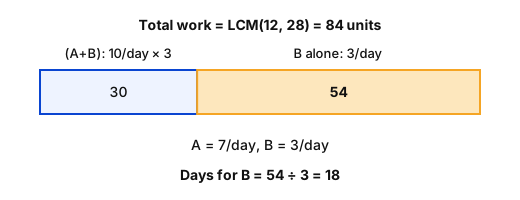
Concept: Take total work = LCM of days; efficiency =workdays.

  1. Work =LCM(12,28)=84; A =7/day, B =3/day.
  2. In 3 days together: 3×10=30 units.
  3. Remaining =54 units; B alone: 543=18 days.

Trick: Fractions: 3(112+128)=514; rest 914×28=18.

Answer: (C) 18

अवधारणा: कुल कार्य = दिनों का LCM; दक्षता =कार्यदिन.

  1. कार्य =LCM(12,28)=84; A =7/दिन, B =3/दिन।
  2. 3 दिन साथ में: 3×10=30 इकाई।
  3. शेष =54 इकाई; B अकेला: 543=18 दिन।

ट्रिक: भिन्न से: 3(112+128)=514; शेष 914×28=18.

उत्तर: (C) 18

RRB NTPC Undergraduate CBT 1MathematicsTime and WorkRRB NTPC Undergraduate CBT 1 2025 · 17 Jun Shift 1 →
Q6755.
The price of a trouser is first increased by 20% and then decreased by 25%. What is the net percentage change in the price?
एक पतलून के मूल्य में पहले 20% की वृद्धि की जाती है और फिर 25% की कमी की जाती है। मूल्य में शुद्ध प्रतिशत परिवर्तन कितना है?
  1. A5% decrease5% कमी
  2. B5% increase5% वृद्धि
  3. C10% decrease10% कमी
  4. D10% increase10% वृद्धि
Show answer

Concept: Net change =a+b+ab100 (use − sign for decrease).

  1. a=+20, b=−25.
  2. Net =20−25−20×25100=−5−5=−10%

Trick: 100→120→90 → 10% decrease.

Answer: (C) 10% decrease

अवधारणा: कुल परिवर्तन =a+b+ab100 (कमी के लिए ऋण चिह्न)।

  1. a=+20, b=−25.
  2. कुल =20−25−20×25100=−5−5=−10%

ट्रिक: 100→120→90 → 10% कमी।

उत्तर: (C) 10% कमी

RRB NTPC Undergraduate CBT 1MathematicsSuccessive Percentage ChangeRRB NTPC Undergraduate CBT 1 2025 · 17 Jun Shift 1 →
Q6756.
A car travels 120 km at 40 km/h, 180 km at 60 km/h, and 100 km at 50 km/h. What is the average speed of the car for the entire journey?
एक कार 120 km की दूरी 40 km/h से, 180 km की दूरी 60 km/h से, और 100 km की दूरी 50 km/h से तय करती है। पूरी यात्रा के लिए कार की औसत चाल कितनी है?
  1. A50 km/h
  2. B48 km/h
  3. C55 km/h
  4. D45 km/h
Show answer

Concept: Average speed =Total distanceTotal time (not the average of speeds).

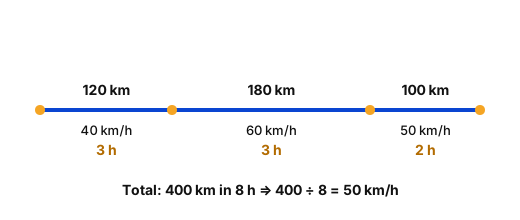
  1. Times: 12040=3, 18060=3, 10050=2 hours.
  2. Total distance =400km, total time =8h.
  3. Average speed =4008=50km/h

Trick: Never take 40+60+503 blindly – here it also gives 50 only by coincidence.

Answer: (A) 50km/h

अवधारणा: औसत चाल =कुल दूरीकुल समय (चालों का औसत नहीं)।

  1. समय: 12040=3, 18060=3, 10050=2 घंटे।
  2. कुल दूरी =400km, कुल समय =8h.
  3. औसत चाल =4008=50km/h

ट्रिक: 40+60+503 सीधे न लें – यहाँ भी 50 आना केवल संयोग है।

उत्तर: (A) 50km/h

RRB NTPC Undergraduate CBT 1MathematicsAverage SpeedRRB NTPC Undergraduate CBT 1 2025 · 17 Jun Shift 1 →
Q6757.
If a car travels 120 km using 8 liters of petrol, how much petrol will be required to travel 225 km?
यदि एक कार 8 लीटर पेट्रोल का उपयोग करके 120 km की दूरी तय करती है, तो 225 km की दूरी तय करने के लिए कितने पेट्रोल की आवश्यकता होगी?
  1. A16 liters16 लीटर
  2. B17 liters17 लीटर
  3. C15 liters15 लीटर
  4. D18 liters18 लीटर
Show answer

Concept: Petrol used is directly proportional to distance.

  1. Mileage =1208=15km per litre.
  2. Petrol for 225 km =22515=15 litres.

Trick: 225120=158 → 8×158=15.

Answer: (C) 15 liters

अवधारणा: पेट्रोल की खपत दूरी के समानुपाती है।

  1. माइलेज =1208=15km प्रति लीटर।
  2. 225 km के लिए पेट्रोल =22515=15 लीटर।

ट्रिक: 225120=158 → 8×158=15.

उत्तर: (C) 15 लीटर

RRB NTPC Undergraduate CBT 1MathematicsUnitary MethodRRB NTPC Undergraduate CBT 1 2025 · 17 Jun Shift 1 →
Q6758.
Three friends, Amit, Bharat, and Chitra, can individually complete a painting project in 12 hours, 18 hours, and 24 hours, respectively. If they all work together for 4 hours and then Amit leaves, how many hours will Bharat and Chitra take to finish the remaining work?
तीन मित्र, अमित, भरत और चित्रा, एक पेंटिंग परियोजना को अकेले-अकेले क्रमशः 12 घंटे, 18 घंटे और 24 घंटे में पूरा कर सकते हैं। यदि वे सभी 4 घंटे तक एक साथ काम करते हैं और फिर अमित चला जाता है, तो भरत और चित्रा को शेष काम पूरा करने में कितने घंटे लगेंगे?
  1. A267 hours267 घंटे
  2. B257 hours257 घंटे
  3. C367 hours367 घंटे
  4. D357 hours357 घंटे
Show answer

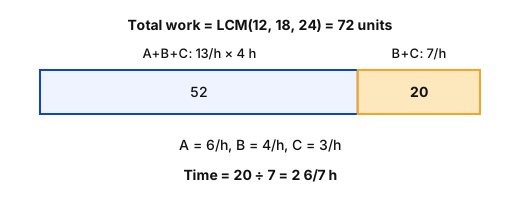
Concept: Total work = LCM of times; efficiency =worktime.

  1. Work =LCM(12,18,24)=72; A =6, B =4, C =3 units/h.
  2. 4 hours together: 4×13=52 units.
  3. Remaining =20 units; B + C =7 units/h.
  4. Time =207=267 hours.

Trick: 207 lies between 2 and 3 → only (A) or (B); 20=2×7+6 → 267.

Answer: (A) 267 hours

अवधारणा: कुल कार्य = समयों का LCM; दक्षता =कार्यसमय.

  1. कार्य =LCM(12,18,24)=72; A =6, B =4, C =3 इकाई/घंटा।
  2. 4 घंटे साथ में: 4×13=52 इकाई।
  3. शेष =20 इकाई; B + C =7 इकाई/घंटा।
  4. समय =207=267 घंटे।

ट्रिक: 207 2 और 3 के बीच है → केवल (A) या (B); 20=2×7+6 → 267.

उत्तर: (A) 267 घंटे

RRB NTPC Undergraduate CBT 1MathematicsTime and WorkRRB NTPC Undergraduate CBT 1 2025 · 17 Jun Shift 1 →
Q6759.
The sides of a triangle are in the ratio 5:6:7 and its perimeter is 90 cm. What is the area of this triangle (in square cm)?
एक त्रिभुज की भुजाओं का अनुपात 5:6:7 है और उसका परिमाप 90 cm है। इस त्रिभुज का क्षेत्रफल (वर्ग cm में) कितना है?
  1. A1503cm2
  2. B1406cm2
  3. C1507cm2
  4. D1506cm2
Show answer

Concept: Heron's formula: Area =s(s−a)(s−b)(s−c), s=a+b+c2.

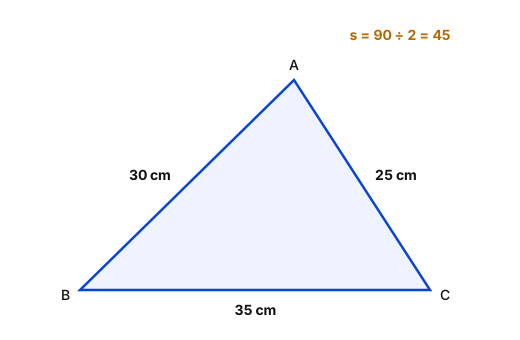
  1. Sides =5k+6k+7k=90⇒k=5 → 25,30,35cm.
  2. s=45; s−a=20, s−b=15, s−c=10.
  3. Area =45×20×15×10=135000=22500×6=1506

Trick: For ratio 5:6:7, area =66k2=66×25=1506.

Answer: (D) 1506cm2

अवधारणा: हीरोन का सूत्र: क्षेत्रफल =s(s−a)(s−b)(s−c), s=a+b+c2.

  1. भुजाएँ =5k+6k+7k=90⇒k=5 → 25,30,35cm.
  2. s=45; s−a=20, s−b=15, s−c=10.
  3. क्षेत्रफल =45×20×15×10=135000=22500×6=1506

ट्रिक: अनुपात 5:6:7 के लिए क्षेत्रफल =66k2=66×25=1506.

उत्तर: (D) 1506cm2

RRB NTPC Undergraduate CBT 1MathematicsHeron's FormulaRRB NTPC Undergraduate CBT 1 2025 · 17 Jun Shift 1 →
Q6760.
What is the mode of the following data: 12, 15, 18, 18, 20, 18, 22, 22, 25, 28, 22, 15, 18, 12?
निम्नलिखित आँकड़ों का बहुलक (mode) क्या है: 12, 15, 18, 18, 20, 18, 22, 22, 25, 28, 22, 15, 18, 12?
  1. A22
  2. B18
  3. C15
  4. D12
Show answer

Concept: Mode is the value that occurs most often.

  1. Frequencies: 12 → 2, 15 → 2, 18 → 4, 20 → 1, 22 → 3, 25 → 1, 28 → 1.
  2. 18 occurs the maximum (4) times.

Trick: Only compare the repeated values – 18 (4 times) beats 22 (3 times).

Answer: (B) 18

अवधारणा: बहुलक (Mode) वह मान है जो सबसे अधिक बार आता है।

  1. बारंबारता: 12 → 2, 15 → 2, 18 → 4, 20 → 1, 22 → 3, 25 → 1, 28 → 1.
  2. 18 सबसे अधिक (4) बार आता है।

ट्रिक: केवल दोहराए गए मानों की तुलना करें – 18 (4 बार), 22 (3 बार) से आगे है।

उत्तर: (B) 18

RRB NTPC Undergraduate CBT 1MathematicsModeRRB NTPC Undergraduate CBT 1 2025 · 17 Jun Shift 1 →