Question bank

Q&A: practice questions with answers

Search questions on any topic. Filter by exam category, exam, subject and topic, try the question, then open the answer and explanation.

Courses – airGurukul

8,495 questions found.

Q6761.
Two successive price increases of 15% and 15% on an article are equivalent to a single percentage increase of:
किसी वस्तु के मूल्य में 15% और 15% की दो क्रमागत वृद्धियाँ कितने प्रतिशत की एकल वृद्धि के समतुल्य हैं?
  1. A31%
  2. B30%
  3. C32.25%
  4. D31.5%
Show answer

Concept: Equivalent single change =a+b+ab100.

  1. a=b=15.
  2. 15+15+15×15100=30+2.25=32.25%

Trick: 1.152=1.3225 → 32.25% increase.

Answer: (C) 32.25%

अवधारणा: समतुल्य एकल परिवर्तन =a+b+ab100.

  1. a=b=15.
  2. 15+15+15×15100=30+2.25=32.25%

ट्रिक: 1.152=1.3225 → 32.25% वृद्धि।

उत्तर: (C) 32.25%

RRB NTPC Undergraduate CBT 1MathematicsSuccessive Percentage ChangeRRB NTPC Undergraduate CBT 1 2025 · 17 Jun Shift 1 →
Q6762.
An investment triples in 6 years under compound interest. After how many years will it become 27 times?
चक्रवृद्धि ब्याज पर एक निवेश 6 वर्षों में तीन गुना हो जाता है। कितने वर्षों बाद यह 27 गुना हो जाएगा?
  1. A24 years24 वर्ष
  2. B15 years15 वर्ष
  3. C21 years21 वर्ष
  4. D18 years18 वर्ष
Show answer

Concept: Under CI, if money becomes x times in n years, it becomes xk times in kn years.

  1. 3 times in 6 years.
  2. 27=33 → time =3×6=18 years.

Trick: CI multiplies: ×3 every 6 years → 1→3→9→27 (3 steps = 18 years).

Answer: (D) 18 years

अवधारणा: चक्रवृद्धि ब्याज में यदि धन n वर्ष में x गुना हो, तो kn वर्ष में xk गुना होगा।

  1. 6 वर्ष में 3 गुना।
  2. 27=33 → समय =3×6=18 वर्ष।

ट्रिक: हर 6 वर्ष में ×3 → 1→3→9→27 (3 चरण = 18 वर्ष)।

उत्तर: (D) 18 वर्ष

RRB NTPC Undergraduate CBT 1MathematicsCompound Interest (multiples)RRB NTPC Undergraduate CBT 1 2025 · 17 Jun Shift 1 →
Q6763.
If the ratio of two numbers is 3 : 8, and their HCF is 6, then their LCM is:
यदि दो संख्याओं का अनुपात 3 : 8 है, और उनका HCF 6 है, तो उनका LCM है:
  1. A155
  2. B189
  3. C148
  4. D144
Show answer

Concept: If numbers are in ratio a:b (co-prime) with HCF h, numbers are ha, hb and LCM =h×a×b.

  1. Numbers =6×3=18 and 6×8=48.
  2. LCM =6×3×8=144

Trick: LCM must be a multiple of 6 and 8 (i.e. of 24) → only 144 fits.

Answer: (D) 144

अवधारणा: यदि संख्याएँ a:b (सह-अभाज्य) में हों और HCF h हो, तो संख्याएँ ha, hb तथा LCM =h×a×b.

  1. संख्याएँ =6×3=18 और 6×8=48.
  2. LCM =6×3×8=144

ट्रिक: LCM, 6 और 8 (अर्थात 24) का गुणज होना चाहिए → केवल 144.

उत्तर: (D) 144

RRB NTPC Undergraduate CBT 1MathematicsHCF and LCMRRB NTPC Undergraduate CBT 1 2025 · 17 Jun Shift 1 →
Q6764.
A two-digit number is such that four times the sum of its digits is equal to the number formed by reversing its digits. If the difference between the digits is 3, find the original number.
एक दो-अंकीय संख्या ऐसी है कि उसके अंकों के योग का चार गुना, उसके अंकों को उलटने से बनी संख्या के बराबर है। यदि अंकों के बीच का अंतर 3 है, तो मूल संख्या ज्ञात कीजिए।
  1. A63
  2. B96
  3. C69
  4. D36
Show answer

Concept: Number =10a+b, reversed =10b+a.

  1. 4(a+b)=10b+a⇒3a=6b⇒a=2b.
  2. a−b=3⇒b=3, a=6.
  3. Number =63; check: 4×9=36 ✔

Trick: Test options: only 63 gives 4×(6+3)=36 = its reverse.

Answer: (A) 63

अवधारणा: संख्या =10a+b, उलटी संख्या =10b+a.

  1. 4(a+b)=10b+a⇒3a=6b⇒a=2b.
  2. a−b=3⇒b=3, a=6.
  3. संख्या =63; जाँच: 4×9=36 ✔

ट्रिक: विकल्प जाँचें: केवल 63 में 4×(6+3)=36 = उलटी संख्या।

उत्तर: (A) 63

RRB NTPC Undergraduate CBT 1MathematicsNumber System – DigitsRRB NTPC Undergraduate CBT 1 2025 · 17 Jun Shift 1 →
Q6765.
A trader buys 20 kg of rice for ₹1,000 and sells it at ₹55 per kg. What is the profit percentage?
एक व्यापारी 20 kg चावल ₹1,000 में खरीदता है और उसे ₹55 प्रति kg की दर से बेचता है। लाभ प्रतिशत कितना है?
  1. A12%
  2. B10%
  3. C8%
  4. D15%
Show answer

Concept: Profit%=SP−CPCP×100.

  1. CP per kg =100020=50.
  2. Profit per kg =55−50=5.
  3. Profit%=550×100=10%

Trick: Total SP =20×55=1100 → ₹100 profit on ₹1000 = 10%.

Answer: (B) 10%

अवधारणा: लाभ%=SP−CPCP×100.

  1. प्रति kg CP =100020=50.
  2. प्रति kg लाभ =55−50=5.
  3. लाभ%=550×100=10%

ट्रिक: कुल SP =20×55=1100 → ₹1000 पर ₹100 लाभ = 10%.

उत्तर: (B) 10%

RRB NTPC Undergraduate CBT 1MathematicsProfit PercentageRRB NTPC Undergraduate CBT 1 2025 · 17 Jun Shift 1 →
Q6766.
Which of the following letter-number clusters will replace the question mark (?) in the given series to make it logically complete?
DIXC 6 JNBF 12 PSFI 18 VXJL 24 BCNO 30 ?
निम्नलिखित में से कौन-सा अक्षर-संख्या समूह दी गई शृंखला में प्रश्न चिह्न (?) के स्थान पर आकर उसे तार्किक रूप से पूर्ण करेगा?
DIXC 6 JNBF 12 PSFI 18 VXJL 24 BCNO 30 ?
  1. AHIRS 34
  2. BIISS 34
  3. CHHRR 36
  4. DIHSR 36
Show answer

Concept: Track each letter position and the number separately.

  1. 1st letters: D, J, P, V, B, H – each +6 (V → B wraps round).
  2. 2nd letters: I, N, S, X, C, H – each +5.
  3. 3rd letters: X, B, F, J, N, R – each +4; 4th letters: C, F, I, L, O, R – each +3.
  4. Numbers: 6, 12, 18, 24, 30, 36 – each +6. So the term is HHRR 36.

Trick: Letter steps +6,+5,+4,+3 fall by one from left to right.

Answer: (C) HHRR 36

अवधारणा: प्रत्येक अक्षर की स्थिति और संख्या को अलग-अलग देखें।

  1. पहले अक्षर: D, J, P, V, B, H – हर बार +6 (V के बाद B, क्रम घूमता है)।
  2. दूसरे अक्षर: I, N, S, X, C, H – हर बार +5।
  3. तीसरे अक्षर: X, B, F, J, N, R – +4; चौथे अक्षर: C, F, I, L, O, R – +3।
  4. संख्याएँ: 6, 12, 18, 24, 30, 36 – +6। अतः पद HHRR 36 है।

ट्रिक: अक्षरों का अंतर बाएँ से दाएँ +6,+5,+4,+3 घटता है।

उत्तर: (C) HHRR 36

RRB NTPC Undergraduate CBT 1General Intelligence and ReasoningLetter-Number SeriesRRB NTPC Undergraduate CBT 1 2025 · 17 Jun Shift 1 →
Q6767.
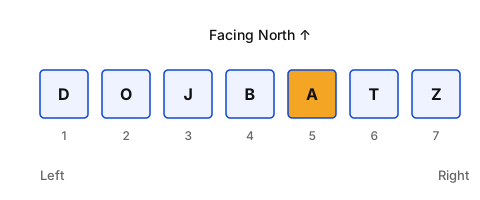
Seven people A, B, D, J, O, T and Z are sitting in a row, facing north. Only three people sit to the left of B. Only Z sits to the right of T. Only three people sit between T and O. J sits at some place to the left of A but at some place to the right of D. Who sits
immediately to the right of B?
सात व्यक्ति A, B, D, J, O, T और Z एक पंक्ति में उत्तर की ओर मुख करके बैठे हैं। B के बाईं ओर केवल तीन व्यक्ति बैठे हैं। T के दाईं ओर केवल Z बैठा है। T और O के बीच केवल तीन व्यक्ति बैठे हैं। J, A के बाईं ओर किसी स्थान पर, किंतु D के दाईं ओर किसी स्थान पर बैठा है। B के
ठीक दाईं ओर कौन बैठा है?
  1. AT
  2. BO
  3. CZ
  4. DA
Show answer

Concept: Fix the definite positions first (seats 1–7 from left, all facing north).

  1. Three people left of B → B is 4th.
  2. Only Z is right of T → T = 6th, Z = 7th.
  3. Three people between T and O → O = 2nd.
  4. D, J, A fill seats 1, 3, 5 with D left of J left of A → D = 1, J = 3, A = 5.
  5. Immediately right of B (4th) is A (5th).

Trick: Start with ‘only’ clues – they lock seats at the ends.

Answer: (D) A

अवधारणा: पहले निश्चित स्थान तय करें (बाएँ से सीट 1–7, सभी उत्तर की ओर मुख)।

  1. B के बाएँ तीन व्यक्ति → B चौथे स्थान पर।
  2. T के दाएँ केवल Z → T = 6, Z = 7।
  3. T और O के बीच तीन व्यक्ति → O = 2।
  4. D, J, A सीट 1, 3, 5 पर, क्रम D, J, A → D = 1, J = 3, A = 5।
  5. B (4) के ठीक दाएँ A (5) है।

ट्रिक: 'केवल' वाले संकेत पहले लगाएँ – वे सिरों की सीटें तय कर देते हैं।

उत्तर: (D) A

RRB NTPC Undergraduate CBT 1General Intelligence and ReasoningLinear Seating ArrangementRRB NTPC Undergraduate CBT 1 2025 · 17 Jun Shift 1 →
Q6768.
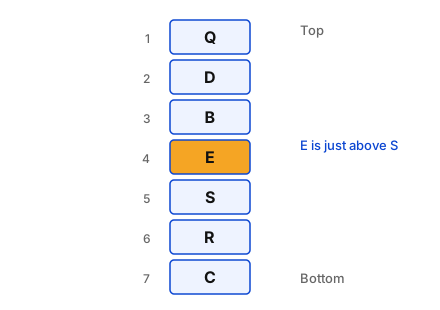
Seven boxes B, C, D, E, Q, R and S are kept one over the other but not necessarily in the same order. No box is kept below C. Only two boxes are kept between E and C. Only Q is kept above D. S is kept at some place below B but at some place above R. Which box is kept immediately above S?
सात बॉक्स B, C, D, E, Q, R और S एक के ऊपर एक रखे गए हैं, लेकिन जरूरी नहीं कि इसी क्रम में हों। C के नीचे कोई बॉक्स नहीं रखा गया है। E और C के बीच केवल दो बॉक्स रखे गए हैं। D के ऊपर केवल Q रखा गया है। S, B के नीचे किसी स्थान पर, किंतु R के ऊपर किसी स्थान पर रखा गया है। S के ठीक ऊपर कौन-सा बॉक्स रखा गया है?
  1. AR
  2. BD
  3. CB
  4. DE
Show answer

Concept: Number the positions 1 (top) to 7 (bottom) and place definite boxes first.

  1. No box below C → C = 7 (bottom).
  2. Two boxes between E and C → E = 4.
  3. Only Q above D → Q = 1, D = 2.
  4. S below B and above R: positions 3, 5, 6 left → B = 3, S = 5, R = 6.
  5. Box immediately above S (5) is E (4).

Trick: ‘No box below X’ = X at bottom; ‘only Q above D’ = Q top, D second.

Answer: (D) E

अवधारणा: स्थान 1 (ऊपर) से 7 (नीचे) तक लें और पहले निश्चित बॉक्स रखें।

  1. C के नीचे कोई बॉक्स नहीं → C = 7 (सबसे नीचे)।
  2. E और C के बीच दो बॉक्स → E = 4।
  3. D के ऊपर केवल Q → Q = 1, D = 2।
  4. S, B के नीचे और R के ऊपर: बचे स्थान 3, 5, 6 → B = 3, S = 5, R = 6।
  5. S (5) के ठीक ऊपर E (4) है।

ट्रिक: 'X के नीचे कोई नहीं' = X सबसे नीचे; 'D के ऊपर केवल Q' = Q सबसे ऊपर, D दूसरा।

उत्तर: (D) E

RRB NTPC Undergraduate CBT 1General Intelligence and ReasoningBox ArrangementRRB NTPC Undergraduate CBT 1 2025 · 17 Jun Shift 1 →
Q6769.
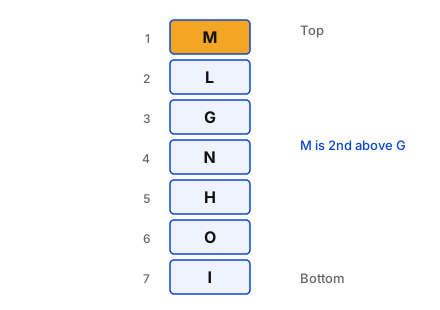
Seven boxes, G, H, I, L, M, N and O, are kept one over the other, but not necessarily in the same order.
No box is kept above M. Only two boxes are kept between L and H. Only three boxes are kept between M and H. N is kept immediately above H. Only four boxes are kept between L and I. G is kept at some place above O.
Which box is kept second above G?
सात बॉक्स, G, H, I, L, M, N और O, एक के ऊपर एक रखे गए हैं, लेकिन जरूरी नहीं कि इसी क्रम में हों।
M के ऊपर कोई बॉक्स नहीं रखा गया है। L और H के बीच केवल दो बॉक्स रखे गए हैं। M और H के बीच केवल तीन बॉक्स रखे गए हैं। N, H के ठीक ऊपर रखा गया है। L और I के बीच केवल चार बॉक्स रखे गए हैं। G, O के ऊपर किसी स्थान पर रखा गया है।
G के ऊपर दूसरे स्थान पर कौन-सा बॉक्स रखा गया है?
  1. AH
  2. BL
  3. CM
  4. DO
Show answer

Concept: Number positions 1 (top) to 7 (bottom).

  1. No box above M → M = 1.
  2. Three boxes between M and H → H = 5; N immediately above H → N = 4.
  3. Two boxes between L and H → L = 2 (8 is not possible).
  4. Four boxes between L and I → I = 7.
  5. G above O in the remaining 3 and 6 → G = 3, O = 6. Second above G (3) is position 1 = M.

Trick: Chain the ‘between’ clues from the fixed box M: M → H → L → I.

Answer: (C) M

अवधारणा: स्थान 1 (ऊपर) से 7 (नीचे) तक लें।

  1. M के ऊपर कोई नहीं → M = 1।
  2. M और H के बीच तीन बॉक्स → H = 5; N, H के ठीक ऊपर → N = 4।
  3. L और H के बीच दो बॉक्स → L = 2 (8 संभव नहीं)।
  4. L और I के बीच चार बॉक्स → I = 7।
  5. बचे स्थान 3 और 6 में G, O के ऊपर → G = 3, O = 6। G (3) से दूसरा ऊपर स्थान 1 = M।

ट्रिक: निश्चित बॉक्स M से 'बीच' वाले संकेत जोड़ते जाएँ: M → H → L → I।

उत्तर: (C) M

RRB NTPC Undergraduate CBT 1General Intelligence and ReasoningBox ArrangementRRB NTPC Undergraduate CBT 1 2025 · 17 Jun Shift 1 →
Q6770.
Based on the English alphabetical order, three of the following four letter-cluster pairs are alike in a certain way and thus form a group. Which is the one that does not belong to that group?
(Note: The odd one out is not based on the number of consonants/vowels or their position in the letter cluster.)
अंग्रेज़ी वर्णमाला क्रम के आधार पर, निम्नलिखित चार अक्षर-समूह युग्मों में से तीन किसी निश्चित प्रकार से एक समान हैं और इस प्रकार एक समूह बनाते हैं। कौन-सा युग्म उस समूह से संबंधित नहीं है?
(ध्यान दें: असंगत अक्षर-समूह, उस अक्षर-समूह में व्यंजनों/स्वरों की संख्या या उनके स्थान पर आधारित नहीं है।)
  1. AHV - KT
  2. BOA - RY
  3. CSZ - VW
  4. DYT - BR
Show answer

Concept: Compare 1st letters of the two parts and 2nd letters of the two parts.

  1. HV – KT: H+3=K, V−2=T.
  2. OA – RY: O+3=R, A−2=Y; YT – BR: Y+3=B, T−2=R.
  3. SZ – VW: S+3=V but Z−3=W (not −2).
  4. So SZ – VW is the odd one.

Trick: Pattern (+3,−2); the alphabet wraps (Y → B, A → Y).

Answer: (C) SZ - VW

अवधारणा: दोनों भागों के पहले अक्षरों और दूसरे अक्षरों की तुलना करें।

  1. HV – KT: H+3=K, V−2=T।
  2. OA – RY: O+3=R, A−2=Y; YT – BR: Y+3=B, T−2=R।
  3. SZ – VW: S+3=V पर Z−3=W (−2 नहीं)।
  4. अतः SZ – VW विषम है।

ट्रिक: पैटर्न (+3,−2); वर्णमाला चक्रीय है (Y → B, A → Y)।

उत्तर: (C) SZ - VW

RRB NTPC Undergraduate CBT 1General Intelligence and ReasoningOdd One Out – Letter PairsRRB NTPC Undergraduate CBT 1 2025 · 17 Jun Shift 1 →
Q6771.
What will come in place of ‘?’ in the following equation, if ‘+’ and ‘-‘ are interchanged and ‘x’ and ‘÷’ are interchanged?
14 x 2 - 12 ÷ 4 + 8 = ?
यदि '+' और '-' को आपस में बदल दिया जाए तथा 'x' और '÷' को आपस में बदल दिया जाए, तो निम्नलिखित समीकरण में '?' के स्थान पर क्या आएगा?
14 x 2 - 12 ÷ 4 + 8 = ?
  1. A16
  2. B47
  3. C22
  4. D18
Show answer

Concept: Interchange the signs first, then apply BODMAS.

  1. Given: 14×2−12÷4+8.
  2. After interchange: 14÷2+12×4−8.
  3. =7+48−8=47.

Trick: Rewrite the whole expression with new signs before calculating.

Answer: (B) 47

अवधारणा: पहले चिह्न बदलें, फिर BODMAS लगाएँ।

  1. दिया है: 14×2−12÷4+8।
  2. चिह्न बदलने पर: 14÷2+12×4−8।
  3. =7+48−8=47।

ट्रिक: गणना से पहले पूरे व्यंजक को नए चिह्नों के साथ लिख लें।

उत्तर: (B) 47

RRB NTPC Undergraduate CBT 1General Intelligence and ReasoningMathematical OperationsRRB NTPC Undergraduate CBT 1 2025 · 17 Jun Shift 1 →
Q6772.
In a certain code language,
A % B means ‘A is the father of B’,
A € B means ‘A is the wife of B’,
A = B means ‘A is the mother of B’, and
A ? B means ‘A is the daughter of B’.
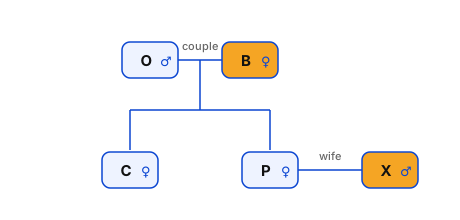
Based on the above, how is B related to X if 'B = C ? O % P € X'?
एक निश्चित कूट भाषा में,
A % B का अर्थ है 'A, B का पिता है',
A € B का अर्थ है 'A, B की पत्नी है',
A = B का अर्थ है 'A, B की माता है', और
A ? B का अर्थ है 'A, B की पुत्री है'।
उपरोक्त के आधार पर, यदि 'B = C ? O % P € X' है, तो B, X से किस प्रकार संबंधित है?
  1. ABrother's wifeभाई की पत्नी
  2. BWifeपत्नी
  3. CSisterबहन
  4. DWife's motherपत्नी की माता
Show answer

Concept: Decode each symbol and draw the family tree.

  1. B = C → B is mother of C; C ? O → C is daughter of O.
  2. So O is C’s father and B’s husband.
  3. O % P → O is father of P, so B is mother of P.
  4. P € X → P is wife of X. B is mother of X’s wife.

Trick: Mother of wife = mother-in-law; here read it as ‘Wife’s mother’.

Answer: (D) Wife’s mother

अवधारणा: प्रत्येक चिह्न को डिकोड करके वंश-वृक्ष बनाएँ।

  1. B = C → B, C की माँ है; C ? O → C, O की बेटी है।
  2. अतः O, C का पिता और B का पति है।
  3. O % P → O, P का पिता है, इसलिए B, P की माँ है।
  4. P € X → P, X की पत्नी है। B, X की पत्नी की माँ है।

ट्रिक: पत्नी की माँ = सास; विकल्प में 'Wife’s mother'।

उत्तर: (D) पत्नी की माँ (Wife’s mother)

RRB NTPC Undergraduate CBT 1General Intelligence and ReasoningCoded Blood RelationsRRB NTPC Undergraduate CBT 1 2025 · 17 Jun Shift 1 →
Q6773.
Each of the digits in the number 4317856 is arranged in ascending order from left to right. What will be the sum of the digits that are second from the left and second from the right in the new number thus formed?
संख्या 4317856 के प्रत्येक अंक को बाएँ से दाएँ आरोही क्रम में व्यवस्थित किया जाता है। इस प्रकार बनी नई संख्या में बाएँ से दूसरे और दाएँ से दूसरे अंकों का योग क्या होगा?
  1. A10
  2. B9
  3. C7
  4. D8
Show answer

Concept: Arrange the digits in ascending order and pick the positions.

  1. 4317856 in ascending order → 1345678.
  2. Second from left = 3; second from right = 7.
  3. Sum =3+7=10.

Trick: With 7 digits, 2nd from right = 6th from left.

Answer: (A) 10

अवधारणा: अंकों को आरोही क्रम में लगाकर स्थान चुनें।

  1. 4317856 आरोही क्रम में → 1345678।
  2. बाएँ से दूसरा = 3; दाएँ से दूसरा = 7।
  3. योग =3+7=10।

ट्रिक: 7 अंकों में दाएँ से दूसरा = बाएँ से छठा।

उत्तर: (A) 10

RRB NTPC Undergraduate CBT 1General Intelligence and ReasoningDigit ArrangementRRB NTPC Undergraduate CBT 1 2025 · 17 Jun Shift 1 →
Q6774.
Select the triad which follows the same pattern as that followed by the two triads given below. Both triads follow the same pattern.
JM - NQ - RU
BE - FI - JM
उस त्रिक का चयन कीजिए जो उसी पैटर्न का अनुसरण करता है, जिसका अनुसरण नीचे दिए गए दो त्रिक करते हैं। दोनों त्रिक एक ही पैटर्न का अनुसरण करते हैं।
JM - NQ - RU
BE - FI - JM
  1. ANE - QK - XQ
  2. BHI - MP - SU
  3. CMP - QT - UX
  4. DEB - IG - NL
Show answer

Concept: Check the gap inside each pair and the gap between pairs.

  1. JM – NQ – RU: inside each pair +3 (J→M, N→Q, R→U); first letters J→N→R are +4.
  2. BE – FI – JM: same, +3 inside and +4 between.
  3. MP – QT – UX: M→P, Q→T, U→X (+3) and M→Q→U (+4) ✓.
  4. Others break the pattern, e.g. NE has −9.

Trick: Pattern: pair gap +3, triad step +4.

Answer: (C) MP - QT - UX

अवधारणा: प्रत्येक युग्म के अंदर का अंतर और युग्मों के बीच का अंतर देखें।

  1. JM – NQ – RU: हर युग्म में +3 (J→M, N→Q, R→U); पहले अक्षर J→N→R में +4।
  2. BE – FI – JM: वही, अंदर +3 और बीच में +4।
  3. MP – QT – UX: M→P, Q→T, U→X (+3) और M→Q→U (+4) ✓।
  4. बाकी विकल्प पैटर्न तोड़ते हैं, जैसे NE में −9।

ट्रिक: पैटर्न: युग्म में +3, आगे बढ़ने पर +4।

उत्तर: (C) MP - QT - UX

RRB NTPC Undergraduate CBT 1General Intelligence and ReasoningLetter TriadsRRB NTPC Undergraduate CBT 1 2025 · 17 Jun Shift 1 →
Q6775.
What should come in place of the question mark (?) in the given series based on the English alphabetical order?
GNI JRL MVO PZR ?
अंग्रेज़ी वर्णमाला क्रम के आधार पर दी गई शृंखला में प्रश्न चिह्न (?) के स्थान पर क्या आना चाहिए?
GNI JRL MVO PZR ?
  1. ARDV
  2. BSDU
  3. CTCV
  4. DTEU
Show answer

Concept: Track the 1st, 2nd and 3rd letters separately.

  1. 1st: G, J, M, P → +3 → S.
  2. 2nd: N, R, V, Z → +4 → D (Z wraps to D).
  3. 3rd: I, L, O, R → +3 → U.
  4. Next term = SDU.

Trick: Z +4 = D because after Z we restart at A.

Answer: (B) SDU

अवधारणा: पहले, दूसरे और तीसरे अक्षर को अलग-अलग देखें।

  1. पहला: G, J, M, P → +3 → S।
  2. दूसरा: N, R, V, Z → +4 → D (Z के बाद फिर A से)।
  3. तीसरा: I, L, O, R → +3 → U।
  4. अगला पद = SDU।

ट्रिक: Z +4 = D, क्योंकि Z के बाद A से गिनती फिर शुरू होती है।

उत्तर: (B) SDU

RRB NTPC Undergraduate CBT 1General Intelligence and ReasoningLetter SeriesRRB NTPC Undergraduate CBT 1 2025 · 17 Jun Shift 1 →
Q6776.
What should come in place of ‘?’ in the given series?
372 321 277 240 210 187 ?
दी गई शृंखला में '?' के स्थान पर क्या आना चाहिए?
372 321 277 240 210 187 ?
  1. A173
  2. B171
  3. C165
  4. D168
Show answer

Concept: Find the differences between consecutive terms.

  1. Differences: 372−321=51, 321−277=44, 277−240=37, 240−210=30, 210−187=23.
  2. They decrease by 7 each: 51, 44, 37, 30, 23, next 16.
  3. 187−16=171.

Trick: Second difference is constant (7).

Answer: (B) 171

अवधारणा: क्रमागत पदों के अंतर निकालें।

  1. अंतर: 372−321=51, 321−277=44, 277−240=37, 240−210=30, 210−187=23।
  2. ये हर बार 7 घटते हैं: 51, 44, 37, 30, 23, अगला 16।
  3. 187−16=171।

ट्रिक: दूसरा अंतर स्थिर (7) है।

उत्तर: (B) 171

RRB NTPC Undergraduate CBT 1General Intelligence and ReasoningNumber SeriesRRB NTPC Undergraduate CBT 1 2025 · 17 Jun Shift 1 →
Q6777.
In the following number-pairs, the second number is obtained by applying certain mathematical operations to the first number. Select the set in which the numbers are related in the same way as are the numbers of the following sets.
(NOTE: Operations should be performed on the whole numbers, without breaking down the numbers into their constituent digits. E.g. 13 – Operations on 13 such as adding / subtracting /multiplying etc. to 13 can be performed. Breaking down 13 into 1 and 3 and then performing mathematical operations on 1 and 3 is not allowed.)
123, 116
102, 95
निम्नलिखित संख्या-युग्मों में, पहली संख्या पर कुछ गणितीय संक्रियाएँ करके दूसरी संख्या प्राप्त की जाती है। उस समुच्चय का चयन कीजिए जिसमें संख्याएँ उसी प्रकार संबंधित हैं, जिस प्रकार निम्नलिखित समुच्चयों की संख्याएँ संबंधित हैं।
(ध्यान दें: संख्याओं को उनके घटक अंकों में तोड़े बिना, संक्रियाएँ पूर्ण संख्याओं पर की जानी चाहिए। उदाहरण के लिए 13 – 13 पर संक्रियाएँ जैसे 13 में जोड़ना/घटाना/गुणा करना आदि किया जा सकता है। 13 को 1 और 3 में तोड़ना और फिर 1 और 3 पर गणितीय संक्रियाएँ करना वर्जित है।)
123, 116
102, 95
  1. A365, 357
  2. B413, 402
  3. C604, 596
  4. D541, 534
Show answer

Concept: Find the operation that turns the first number into the second.

  1. 123−7=116 and 102−7=95 → rule: subtract 7.
  2. Check options: 365−357=8, 413−402=11, 604−596=8, 541−534=7 ✓.
  3. So (541, 534) follows the rule.

Trick: Just compute first minus second for each option.

Answer: (D) 541, 534

अवधारणा: पहली संख्या से दूसरी बनाने वाली संक्रिया खोजें।

  1. 123−7=116 और 102−7=95 → नियम: 7 घटाएँ।
  2. विकल्प जाँचें: 365−357=8, 413−402=11, 604−596=8, 541−534=7 ✓।
  3. अतः (541, 534) नियम का पालन करता है।

ट्रिक: हर विकल्प में पहली संख्या − दूसरी संख्या निकालें।

उत्तर: (D) 541, 534

RRB NTPC Undergraduate CBT 1General Intelligence and ReasoningNumber Pair AnalogyRRB NTPC Undergraduate CBT 1 2025 · 17 Jun Shift 1 →
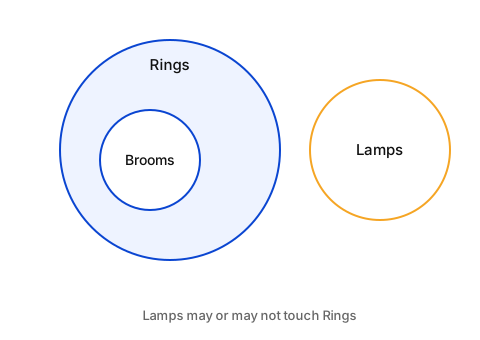
Q6778.
Read the given statement(s) and conclusions carefully. Assuming that the information given in the statements is true, even if it appears to be at variance with commonly known facts, decide which of the given conclusions logically follow(s) from the statement(s).
Statements:
All brooms are rings.
No broom is a lamp.
Conclusions:
(I) Some lamps are rings.
(II) All rings are lamps.
दिए गए कथनों और निष्कर्षों को ध्यानपूर्वक पढ़िए। यह मानते हुए कि कथनों में दी गई जानकारी सत्य है, भले ही वह सामान्यतः ज्ञात तथ्यों से भिन्न प्रतीत होती हो, निर्णय कीजिए कि दिए गए निष्कर्षों में से कौन-सा/से निष्कर्ष कथनों का तार्किक रूप से अनुसरण करता है/करते हैं।
कथन:
सभी झाड़ू, अंगूठियाँ हैं।
कोई झाड़ू, लैंप नहीं है।
निष्कर्ष:
(I) कुछ लैंप, अंगूठियाँ हैं।
(II) सभी अंगूठियाँ, लैंप हैं।
  1. ANeither conclusion (I) nor (II) followsन तो निष्कर्ष (I) और न ही (II) अनुसरण करता है
  2. BBoth conclusions (I) and (II) followदोनों निष्कर्ष (I) और (II) अनुसरण करते हैं
  3. COnly conclusion (II) followsकेवल निष्कर्ष (II) अनुसरण करता है
  4. DOnly conclusion (I) followsकेवल निष्कर्ष (I) अनुसरण करता है
Show answer

Concept: Draw the least-overlap Venn diagram and test each conclusion.

  1. Brooms lie inside Rings; Lamps are completely outside Brooms.
  2. Lamps may or may not touch Rings, so ‘Some lamps are rings’ is not certain → (I) does not follow.
  3. ‘All rings are lamps’ is impossible, because rings that are brooms are not lamps → (II) does not follow.

Trick: A conclusion follows only if it is true in every possible diagram.

Answer: (A) Neither conclusion (I) nor (II) follows

अवधारणा: न्यूनतम ओवरलैप वाला वेन आरेख बनाकर प्रत्येक निष्कर्ष जाँचें।

  1. ब्रूम, रिंग के अंदर हैं; लैंप, ब्रूम से पूरी तरह बाहर हैं।
  2. लैंप, रिंग को छू भी सकते हैं और नहीं भी, इसलिए 'कुछ लैंप रिंग हैं' निश्चित नहीं → (I) अनुसरण नहीं करता।
  3. 'सभी रिंग लैंप हैं' असंभव है, क्योंकि जो रिंग ब्रूम हैं वे लैंप नहीं → (II) अनुसरण नहीं करता।

ट्रिक: निष्कर्ष तभी सही है जब वह हर संभव आरेख में सत्य हो।

उत्तर: (A) न तो निष्कर्ष (I) और न ही (II) अनुसरण करता है

RRB NTPC Undergraduate CBT 1General Intelligence and ReasoningSyllogismRRB NTPC Undergraduate CBT 1 2025 · 17 Jun Shift 1 →
Q6779.
Based on the English alphabetical order, three of the following four letter-cluster pairs are alike in a certain way and thus form a group. Which is the one that does not belong to that group?
(Note: The odd one out is not based on the number of consonants/vowels or their position in the letter-cluster pairs.)
अंग्रेज़ी वर्णमाला क्रम के आधार पर, निम्नलिखित चार अक्षर-समूह युग्मों में से तीन किसी निश्चित प्रकार से एक समान हैं और इस प्रकार एक समूह बनाते हैं। कौन-सा युग्म उस समूह से संबंधित नहीं है?
(ध्यान दें: असंगत युग्म, अक्षर-समूह युग्मों में व्यंजनों/स्वरों की संख्या या उनके स्थान पर आधारित नहीं है।)
  1. ASA – LI
  2. BYG-RO
  3. COW – HF
  4. DAI-TQ
Show answer

Concept: Compare first letters and second letters of the two clusters.

  1. SA – LI: S−7=L, A+8=I.
  2. YG – RO: Y−7=R, G+8=O; AI – TQ: A−7=T, I+8=Q.
  3. OW – HF: O−7=H but W+8=E, not F.
  4. So OW – HF is the odd one.

Trick: Rule (−7,+8); W +8 wraps: X, Y, Z, A, B, C, D, E.

Answer: (C) OW – HF

अवधारणा: दोनों क्लस्टरों के पहले और दूसरे अक्षरों की तुलना करें।

  1. SA – LI: S−7=L, A+8=I।
  2. YG – RO: Y−7=R, G+8=O; AI – TQ: A−7=T, I+8=Q।
  3. OW – HF: O−7=H पर W+8=E, F नहीं।
  4. अतः OW – HF विषम है।

ट्रिक: नियम (−7,+8); W +8: X, Y, Z, A, B, C, D, E।

उत्तर: (C) OW – HF

RRB NTPC Undergraduate CBT 1General Intelligence and ReasoningOdd One Out – Letter PairsRRB NTPC Undergraduate CBT 1 2025 · 17 Jun Shift 1 →
Q6780.
Read the given statement(s) and conclusions carefully. Assuming that the information given in the statements is true, even if it appears to be at variance with commonly known facts, decide which of the given conclusions logically follow(s) from the statement(s).
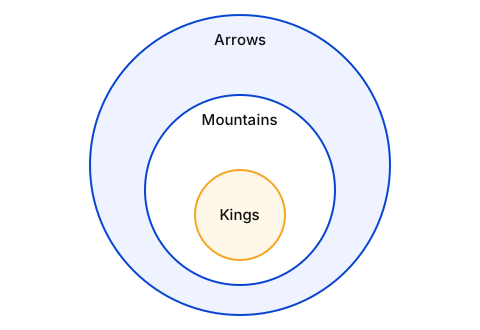
Statements: All kings are mountains. All mountains are arrows.
Conclusion (I): Some mountains are kings.
Conclusion (II): All kings are arrows.
दिए गए कथनों और निष्कर्षों को ध्यानपूर्वक पढ़िए। यह मानते हुए कि कथनों में दी गई जानकारी सत्य है, भले ही वह सामान्यतः ज्ञात तथ्यों से भिन्न प्रतीत होती हो, निर्णय कीजिए कि दिए गए निष्कर्षों में से कौन-सा/से निष्कर्ष कथनों का तार्किक रूप से अनुसरण करता है/करते हैं।
कथन: सभी राजा, पर्वत हैं। सभी पर्वत, तीर हैं।
निष्कर्ष (I): कुछ पर्वत, राजा हैं।
निष्कर्ष (II): सभी राजा, तीर हैं।
  1. AOnly conclusion (II) followsकेवल निष्कर्ष (II) अनुसरण करता है
  2. BNeither conclusion (I) nor (II) followsन तो निष्कर्ष (I) और न ही (II) अनुसरण करता है
  3. COnly conclusion (I) followsकेवल निष्कर्ष (I) अनुसरण करता है
  4. DBoth conclusions (I) and (II) followदोनों निष्कर्ष (I) और (II) अनुसरण करते हैं
Show answer

Concept: Two ‘All’ statements give a chain: Kings ⊂ Mountains ⊂ Arrows.

  1. All kings are mountains → some mountains are kings (conversion of ‘All’) → (I) follows.
  2. Kings lie inside Mountains, which lie inside Arrows → all kings are arrows → (II) follows.
  3. Both conclusions are true in the diagram.

Trick: All A are B + All B are C ⇒ All A are C, and Some B are A.

Answer: (D) Both conclusions (I) and (II) follow

अवधारणा: दो 'सभी' कथन एक श्रृंखला बनाते हैं: राजा ⊂ पर्वत ⊂ तीर।

  1. सभी राजा पर्वत हैं → कुछ पर्वत राजा हैं ('सभी' का रूपांतरण) → (I) अनुसरण करता है।
  2. राजा पर्वत के अंदर, पर्वत तीर के अंदर → सभी राजा तीर हैं → (II) अनुसरण करता है।
  3. आरेख में दोनों निष्कर्ष सत्य हैं।

ट्रिक: सभी A, B हैं + सभी B, C हैं ⇒ सभी A, C हैं, और कुछ B, A हैं।

उत्तर: (D) निष्कर्ष (I) और (II) दोनों अनुसरण करते हैं

RRB NTPC Undergraduate CBT 1General Intelligence and ReasoningSyllogismRRB NTPC Undergraduate CBT 1 2025 · 17 Jun Shift 1 →