Question bank

Q&A: practice questions with answers

Search questions on any topic. Filter by exam category, exam, subject and topic, try the question, then open the answer and explanation.

Courses – airGurukul

8,495 questions found.

Q6781.
Based on the alphabetical order, three of the following four are alike in a certain way and thus form a group. Which is the one that does not belong to that group?
(Note: The odd one out is not based on the number of consonants/vowels or their position in the letter cluster.)
वर्णमाला क्रम के आधार पर, निम्नलिखित चार में से तीन किसी निश्चित प्रकार से एक समान हैं और इस प्रकार एक समूह बनाते हैं। कौन-सा उस समूह से संबंधित नहीं है?
(ध्यान दें: असंगत अक्षर-समूह, उस अक्षर-समूह में व्यंजनों/स्वरों की संख्या या उनके स्थान पर आधारित नहीं है।)
  1. AHKJ
  2. BNQU
  3. CPSW
  4. DKNR
Show answer

Concept: Find the gaps between consecutive letters.

  1. NQU: N→Q +3, Q→U +4.
  2. PSW: +3, +4; KNR: +3, +4.
  3. HKJ: H→K +3, K→J −1 – different.
  4. So HKJ is the odd one.

Trick: Three clusters follow (+3,+4).

Answer: (A) HKJ

अवधारणा: क्रमागत अक्षरों के बीच का अंतर देखें।

  1. NQU: N→Q +3, Q→U +4।
  2. PSW: +3, +4; KNR: +3, +4।
  3. HKJ: H→K +3, K→J −1 – अलग।
  4. अतः HKJ विषम है।

ट्रिक: तीन समूह (+3,+4) पैटर्न पर हैं।

उत्तर: (A) HKJ

RRB NTPC Undergraduate CBT 1General Intelligence and ReasoningOdd One Out – Letter ClustersRRB NTPC Undergraduate CBT 1 2025 · 17 Jun Shift 1 →
Q6782.
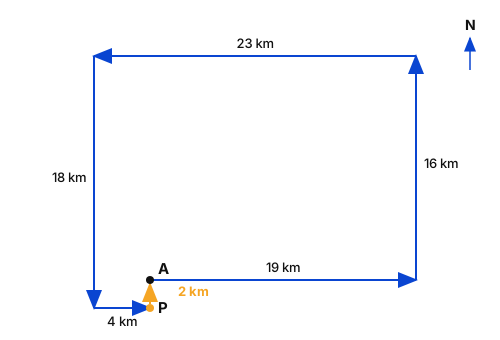
Bhavesh starts from Point A and drives 19 km towards the east. He then takes a left turn, drives 16 km, turns left and drives 23 km. He then takes a left turn and drives 18 km. He takes a final left turn, drives 4 km and stops at Point P. How far (shortest distance) and towards which direction should he drive in order to reach Point A again? (All turns are 90-degree turns only unless specified.)
भावेश बिंदु A से चलना शुरू करता है और पूर्व की ओर 19 km गाड़ी चलाता है। फिर वह बाएँ मुड़ता है, 16 km गाड़ी चलाता है, बाएँ मुड़ता है और 23 km गाड़ी चलाता है। फिर वह बाएँ मुड़ता है और 18 km गाड़ी चलाता है। वह अंतिम बार बाएँ मुड़ता है, 4 km गाड़ी चलाता है और बिंदु P पर रुक जाता है। बिंदु A पर फिर से पहुँचने के लिए उसे कितनी दूर (न्यूनतम दूरी) और किस दिशा में गाड़ी चलानी चाहिए? (जब तक निर्दिष्ट न हो, सभी मोड़ केवल 90 डिग्री के मोड़ हैं।)
  1. A2 km to the northउत्तर की ओर 2 km
  2. B2 km to the southदक्षिण की ओर 2 km
  3. C3 km to the southदक्षिण की ओर 3 km
  4. D3 km to the northउत्तर की ओर 3 km
Show answer

Concept: Track net east–west and north–south movement (all turns are left).

  1. East 19, left → North 16, left → West 23, left → South 18, left → East 4.
  2. East–West: 19−23+4=0.
  3. North–South: 16−18=−2, i.e. P is 2km south of A.
  4. To return to A, drive 2km towards the north.

Trick: Four left turns in a row bring you back to the starting direction (East).

Answer: (A) 2 km to the north

अवधारणा: कुल पूर्व–पश्चिम और उत्तर–दक्षिण चाल निकालें (सभी मोड़ बाएँ)।

  1. पूर्व 19, बाएँ → उत्तर 16, बाएँ → पश्चिम 23, बाएँ → दक्षिण 18, बाएँ → पूर्व 4।
  2. पूर्व–पश्चिम: 19−23+4=0।
  3. उत्तर–दक्षिण: 16−18=−2, अर्थात P, A से 2km दक्षिण में है।
  4. A तक लौटने के लिए 2km उत्तर की ओर जाना होगा।

ट्रिक: लगातार चार बार बाएँ मुड़ने पर दिशा फिर से पूर्व हो जाती है।

उत्तर: (A) 2 km उत्तर की ओर

RRB NTPC Undergraduate CBT 1General Intelligence and ReasoningDirection and DistanceRRB NTPC Undergraduate CBT 1 2025 · 17 Jun Shift 1 →
Q6783.
Select the pair that follows the same pattern as that followed by the two pairs given below. Both pairs follow the same pattern.
ROD : UKF
OLF : RHH
उस युग्म का चयन कीजिए जो उसी पैटर्न का अनुसरण करता है, जिसका अनुसरण नीचे दिए गए दो युग्म करते हैं। दोनों युग्म एक ही पैटर्न का अनुसरण करते हैं।
ROD : UKF
OLF : RHH
  1. AJQS : MMV
  2. BPUD : SRH
  3. CUIL : QFO
  4. DKFK : NBM
Show answer

Concept: Compare each letter with the corresponding letter of the pair.

  1. ROD : UKF → R+3=U, O−4=K, D+2=F.
  2. OLF : RHH → +3, −4, +2 ✓.
  3. KFK : NBM → K+3=N, F−4=B, K+2=M ✓.
  4. Others fail, e.g. JQS : MMV has S+3.

Trick: Rule (+3,−4,+2).

Answer: (D) KFK : NBM

अवधारणा: हर अक्षर की तुलना युग्म के संगत अक्षर से करें।

  1. ROD : UKF → R+3=U, O−4=K, D+2=F।
  2. OLF : RHH → +3, −4, +2 ✓।
  3. KFK : NBM → K+3=N, F−4=B, K+2=M ✓।
  4. बाकी विकल्प गलत, जैसे JQS : MMV में S+3।

ट्रिक: नियम (+3,−4,+2)।

उत्तर: (D) KFK : NBM

RRB NTPC Undergraduate CBT 1General Intelligence and ReasoningLetter AnalogyRRB NTPC Undergraduate CBT 1 2025 · 17 Jun Shift 1 →
Q6784.
Each of the digits in the number 7543168 is arranged in ascending order from left to right. What will be the sum of the digits which are second from the left and third from the right in the new number thus formed?
संख्या 7543168 के प्रत्येक अंक को बाएँ से दाएँ आरोही क्रम में व्यवस्थित किया जाता है। इस प्रकार बनी नई संख्या में बाएँ से दूसरे और दाएँ से तीसरे अंकों का योग क्या होगा?
  1. A10
  2. B9
  3. C5
  4. D6
Show answer

Concept: Arrange the digits in ascending order and pick the positions.

  1. 7543168 in ascending order → 1345678.
  2. Second from left = 3; third from right = 6.
  3. Sum =3+6=9.

Trick: With 7 digits, 3rd from right = 5th from left.

Answer: (B) 9

अवधारणा: अंकों को आरोही क्रम में लगाकर स्थान चुनें।

  1. 7543168 आरोही क्रम में → 1345678।
  2. बाएँ से दूसरा = 3; दाएँ से तीसरा = 6।
  3. योग =3+6=9।

ट्रिक: 7 अंकों में दाएँ से तीसरा = बाएँ से पाँचवाँ।

उत्तर: (B) 9

RRB NTPC Undergraduate CBT 1General Intelligence and ReasoningDigit ArrangementRRB NTPC Undergraduate CBT 1 2025 · 17 Jun Shift 1 →
Q6785.
Each letter in the word COMPLEX is changed to the letter immediately preceding it in the English alphabetical order and then all the letters thus formed are arranged in alphabetical order. Which of the following letters will be fourth from the right in the new group of letters thus formed?
शब्द COMPLEX के प्रत्येक अक्षर को अंग्रेज़ी वर्णमाला क्रम में उसके ठीक पहले आने वाले अक्षर से बदल दिया जाता है और फिर इस प्रकार बने सभी अक्षरों को वर्णमाला क्रम में व्यवस्थित किया जाता है। इस प्रकार बने अक्षरों के नए समूह में दाएँ से चौथा अक्षर निम्नलिखित में से कौन-सा होगा?
  1. AL
  2. BN
  3. CD
  4. DK
Show answer

Concept: Change each letter, then sort alphabetically.

  1. COMPLEX → each letter −1 → B N L O K D W.
  2. Arranged alphabetically: B D K L N O W.
  3. From the right: W(1), O(2), N(3), L(4).

Trick: 4th from right in 7 letters = 4th from left as well (middle letter).

Answer: (A) L

अवधारणा: प्रत्येक अक्षर बदलें, फिर वर्णानुक्रम में लगाएँ।

  1. COMPLEX → हर अक्षर −1 → B N L O K D W।
  2. वर्णानुक्रम में: B D K L N O W।
  3. दाएँ से: W(1), O(2), N(3), L(4)।

ट्रिक: 7 अक्षरों में दाएँ से चौथा = बाएँ से चौथा (बीच का अक्षर)।

उत्तर: (A) L

RRB NTPC Undergraduate CBT 1General Intelligence and ReasoningAlphabet ArrangementRRB NTPC Undergraduate CBT 1 2025 · 17 Jun Shift 1 →
Q6786.
In a certain code language, ‘LEST’ is coded as ‘7453’ and ‘LOTS’ is coded as ‘2735’.What is the code for ‘O’ in the given code language?
एक निश्चित कूट भाषा में, 'LEST' को '7453' के रूप में कूटबद्ध किया जाता है और 'LOTS' को '2735' के रूप में कूटबद्ध किया जाता है। दी गई कूट भाषा में 'O' के लिए कूट क्या है?
  1. A5
  2. B7
  3. C3
  4. D2
Show answer

Concept: Common letters get common digits (order may be jumbled).

  1. LEST → 7453; LOTS → 2735.
  2. Common letters L, S, T ↔ common digits 7, 3, 5.
  3. Left: O in LOTS ↔ 2 in 2735.
  4. So O = 2.

Trick: Strike out common letters and common digits – the leftover pair matches.

Answer: (D) 2

अवधारणा: समान अक्षरों के समान अंक होते हैं (क्रम बदला हो सकता है)।

  1. LEST → 7453; LOTS → 2735।
  2. समान अक्षर L, S, T ↔ समान अंक 7, 3, 5।
  3. बचा: LOTS में O ↔ 2735 में 2।
  4. अतः O = 2।

ट्रिक: समान अक्षर और अंक काट दें – बचा हुआ जोड़ा ही उत्तर है।

उत्तर: (D) 2

RRB NTPC Undergraduate CBT 1General Intelligence and ReasoningCoding–DecodingRRB NTPC Undergraduate CBT 1 2025 · 17 Jun Shift 1 →
Q6787.
Refer to the given number series and answer the question that follows. All numbers are single-digit numbers only. Counting to be done from left to right only.
(Left) 2 7 5 6 8 4 1 5 3 2 8 6 4 7 6 9 2 5 8 7 1 3 4 6 5 8 2 7 (Right)
How many such odd digits are there which are immediately preceded by a perfect square and immediately followed by an odd digit?
(NOTE: 1 is also a perfect square.)
दी गई संख्या शृंखला का अवलोकन कीजिए और इसके बाद आने वाले प्रश्न का उत्तर दीजिए। सभी संख्याएँ केवल एक-अंकीय संख्याएँ हैं। गिनती केवल बाएँ से दाएँ की जानी है।
(बाएँ) 2 7 5 6 8 4 1 5 3 2 8 6 4 7 6 9 2 5 8 7 1 3 4 6 5 8 2 7 (दाएँ)
ऐसे कितने विषम अंक हैं, जिनके ठीक पहले एक पूर्ण वर्ग है और ठीक बाद एक विषम अंक है?
(ध्यान दें: 1 भी एक पूर्ण वर्ग है।)
  1. AMore than threeतीन से अधिक
  2. BThreeतीन
  3. CTwoदो
  4. DOneएक
Show answer

Concept: Look for the pattern: perfect square (1, 4, 9) → odd digit → odd digit.

  1. Odd digits preceded by 1, 4 or 9: ‘4 1 5’, ‘1 5 3’, ‘4 7 6’, ‘1 3 4’.
  2. Next digit must be odd: ‘4 1 5’ ✓ (5 odd), ‘1 5 3’ ✓ (3 odd).
  3. ‘4 7 6’ ✗ (6 even), ‘1 3 4’ ✗ (4 even).
  4. Count = 2.

Trick: Scan only around 1, 4 and 9 – that cuts the work.

Answer: (C) Two

अवधारणा: पैटर्न खोजें: पूर्ण वर्ग (1, 4, 9) → विषम अंक → विषम अंक।

  1. 1, 4 या 9 से पहले वाले विषम अंक: '4 1 5', '1 5 3', '4 7 6', '1 3 4'।
  2. अगला अंक विषम हो: '4 1 5' ✓ (5 विषम), '1 5 3' ✓ (3 विषम)।
  3. '4 7 6' ✗ (6 सम), '1 3 4' ✗ (4 सम)।
  4. संख्या = 2।

ट्रिक: केवल 1, 4 और 9 के आसपास देखें – काम कम हो जाता है।

उत्तर: (C) दो

RRB NTPC Undergraduate CBT 1General Intelligence and ReasoningNumber Series – ConditionsRRB NTPC Undergraduate CBT 1 2025 · 17 Jun Shift 1 →
Q6788.
Each vowel in the word ANTIQUE is changed to the letter immediately following it in the English alphabetical order and each consonant is changed to the letter immediately preceding it in the English alphabetical order. Which of the following letters will be second from the left in the new group of letters thus formed?
शब्द ANTIQUE के प्रत्येक स्वर को अंग्रेज़ी वर्णमाला क्रम में उसके ठीक बाद आने वाले अक्षर से बदल दिया जाता है और प्रत्येक व्यंजन को अंग्रेज़ी वर्णमाला क्रम में उसके ठीक पहले आने वाले अक्षर से बदल दिया जाता है। इस प्रकार बने अक्षरों के नए समूह में बाएँ से दूसरा अक्षर निम्नलिखित में से कौन-सा होगा?
  1. AM
  2. BJ
  3. CS
  4. DP
Show answer

Concept: Vowels → next letter; consonants → previous letter.

  1. A→B, N→M, T→S, I→J, Q→P, U→V, E→F.
  2. New group: B M S J P V F.
  3. Second from the left = M.

Trick: Only the 2nd letter is asked – just change N: consonant → M.

Answer: (A) M

अवधारणा: स्वर → अगला अक्षर; व्यंजन → पिछला अक्षर।

  1. A→B, N→M, T→S, I→J, Q→P, U→V, E→F।
  2. नया समूह: B M S J P V F।
  3. बाएँ से दूसरा = M।

ट्रिक: केवल दूसरा अक्षर पूछा है – बस N बदलें: व्यंजन → M।

उत्तर: (A) M

RRB NTPC Undergraduate CBT 1General Intelligence and ReasoningLetter CodingRRB NTPC Undergraduate CBT 1 2025 · 17 Jun Shift 1 →
Q6789.
In a certain code language,
A @ B means ‘A is the sister of B’,
A $ B means ‘A is the father of B’,
A # B means ‘A is the wife of B’ and
A & B means ‘A is the brother of B’.
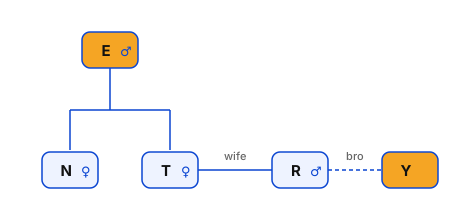
How is E related to Y if ‘E $ N @ T # R & Y’?
एक निश्चित कूट भाषा में,
A @ B का अर्थ है 'A, B की बहन है',
A $ B का अर्थ है 'A, B का पिता है',
A # B का अर्थ है 'A, B की पत्नी है' और
A & B का अर्थ है 'A, B का भाई है'।
यदि 'E $ N @ T # R & Y' है, तो E, Y से किस प्रकार संबंधित है?
  1. ABrother's daughter's husbandभाई की पुत्री का पति
  2. B​Mother's brotherमाता का भाई
  3. C​Brother's wife's sisterभाई की पत्नी की बहन
  4. D​Brother's wife's fatherभाई की पत्नी का पिता
Show answer

Concept: Decode from Y backwards and draw the tree.

  1. R & Y → R is Y’s brother.
  2. T # R → T is R’s wife, i.e. Y’s brother’s wife.
  3. N @ T → N is T’s sister → Y’s brother’s wife’s sister.
  4. E $ N → E is N’s father, hence also T’s father → Y’s brother’s wife’s father.

Trick: Father of a sister is also the father of the other sister.

Answer: (D) Brother’s wife’s father

अवधारणा: Y से पीछे की ओर डिकोड करें और वंश-वृक्ष बनाएँ।

  1. R & Y → R, Y का भाई है।
  2. T # R → T, R की पत्नी है, यानी Y के भाई की पत्नी।
  3. N @ T → N, T की बहन है → Y के भाई की पत्नी की बहन।
  4. E $ N → E, N का पिता है, इसलिए T का भी पिता → Y के भाई की पत्नी के पिता।

ट्रिक: एक बहन का पिता दूसरी बहन का भी पिता होता है।

उत्तर: (D) भाई की पत्नी के पिता (Brother’s wife’s father)

RRB NTPC Undergraduate CBT 1General Intelligence and ReasoningCoded Blood RelationsRRB NTPC Undergraduate CBT 1 2025 · 17 Jun Shift 1 →
Q6790.
LOQK is related to SVXR in a certain way based on the English alphabetical order. In the same way, ILNH is related to PSUO. To which of the following is FIKE related, following the same logic?
अंग्रेज़ी वर्णमाला क्रम के आधार पर LOQK एक निश्चित प्रकार से SVXR से संबंधित है। उसी प्रकार, ILNH, PSUO से संबंधित है। समान तर्क का अनुसरण करते हुए, FIKE निम्नलिखित में से किससे संबंधित है?
  1. AMPRL
  2. BPMLR
  3. CMPLR
  4. DPMRL
Show answer

Concept: Find the shift from each letter of the first cluster to the second.

  1. LOQK → SVXR: L→S, O→V, Q→X, K→R, each +7.
  2. ILNH → PSUO: each +7 ✓.
  3. FIKE +7 → F→M, I→P, K→R, E→L = MPRL.

Trick: Same shift +7 for every letter.

Answer: (A) MPRL

अवधारणा: पहले समूह के प्रत्येक अक्षर से दूसरे समूह तक का अंतर देखें।

  1. LOQK → SVXR: L→S, O→V, Q→X, K→R, हर बार +7।
  2. ILNH → PSUO: हर बार +7 ✓।
  3. FIKE +7 → F→M, I→P, K→R, E→L = MPRL।

ट्रिक: हर अक्षर में समान +7।

उत्तर: (A) MPRL

RRB NTPC Undergraduate CBT 1General Intelligence and ReasoningLetter AnalogyRRB NTPC Undergraduate CBT 1 2025 · 17 Jun Shift 1 →
Q6791.
In a certain code language, ‘CANE’ is coded as ‘5731’ and ‘RACE’ is coded as ‘7435’. What is the code for ‘R’ in the given code language?
एक निश्चित कूट भाषा में, 'CANE' को '5731' के रूप में कूटबद्ध किया जाता है और 'RACE' को '7435' के रूप में कूटबद्ध किया जाता है। दी गई कूट भाषा में 'R' के लिए कूट क्या है?
  1. A3
  2. B5
  3. C7
  4. D4
Show answer

Concept: Common letters share common digits.

  1. CANE → 5731; RACE → 7435.
  2. Common letters A, C, E ↔ common digits 7, 5, 3.
  3. Left: R in RACE ↔ 4 in 7435.
  4. So R = 4.

Trick: Cancel the matching letters and digits; the leftover pair is the answer.

Answer: (D) 4

अवधारणा: समान अक्षरों के समान अंक होते हैं।

  1. CANE → 5731; RACE → 7435।
  2. समान अक्षर A, C, E ↔ समान अंक 7, 5, 3।
  3. बचा: RACE में R ↔ 7435 में 4।
  4. अतः R = 4।

ट्रिक: मिलते अक्षर और अंक काट दें; बचा हुआ जोड़ा उत्तर है।

उत्तर: (D) 4

RRB NTPC Undergraduate CBT 1General Intelligence and ReasoningCoding–DecodingRRB NTPC Undergraduate CBT 1 2025 · 17 Jun Shift 1 →
Q6792.
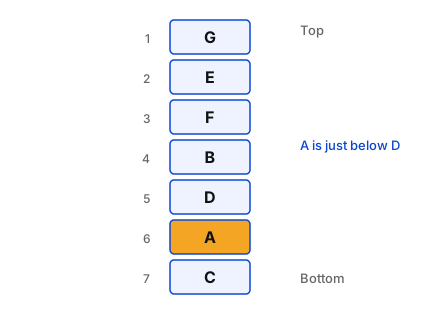
Seven boxes A, B, C, D, E, F and G are kept one over the other but not necessarily in the same order. No box is kept above G. Only three boxes are kept between G and D. Only one box is kept between E and B. B is kept immediately above D. Only four boxes are kept between E and C. F is kept at some place above A. Which box is kept immediately below D?
सात बॉक्स A, B, C, D, E, F और G एक के ऊपर एक रखे गए हैं, लेकिन जरूरी नहीं कि इसी क्रम में हों। G के ऊपर कोई बॉक्स नहीं रखा गया है। G और D के बीच केवल तीन बॉक्स रखे गए हैं। E और B के बीच केवल एक बॉक्स रखा गया है। B, D के ठीक ऊपर रखा गया है। E और C के बीच केवल चार बॉक्स रखे गए हैं। F, A के ऊपर किसी स्थान पर रखा गया है। D के ठीक नीचे कौन-सा बॉक्स रखा गया है?
  1. AF
  2. BA
  3. CG
  4. DB
Show answer

Concept: Number positions 1 (top) to 7 (bottom).

  1. No box above G → G = 1; three boxes between G and D → D = 5.
  2. B immediately above D → B = 4.
  3. One box between E and B → E = 2 or 6; four between E and C → E = 2, C = 7 (E = 6 would need C = 1, taken by G).
  4. F above A in remaining 3 and 6 → F = 3, A = 6.
  5. Immediately below D (5) is A (6).

Trick: Test both cases for E – one clashes with G at the top.

Answer: (B) A

अवधारणा: स्थान 1 (ऊपर) से 7 (नीचे) तक लें।

  1. G के ऊपर कोई नहीं → G = 1; G और D के बीच तीन बॉक्स → D = 5।
  2. B, D के ठीक ऊपर → B = 4।
  3. E और B के बीच एक बॉक्स → E = 2 या 6; E और C के बीच चार → E = 2, C = 7 (E = 6 पर C = 1 होगा, जो G का है)।
  4. बचे 3 और 6 में F, A के ऊपर → F = 3, A = 6।
  5. D (5) के ठीक नीचे A (6) है।

ट्रिक: E के दोनों विकल्प जाँचें – एक में ऊपर G से टकराव होता है।

उत्तर: (B) A

RRB NTPC Undergraduate CBT 1General Intelligence and ReasoningBox ArrangementRRB NTPC Undergraduate CBT 1 2025 · 17 Jun Shift 1 →
Q6793.
What should come in place of ‘?’ in the given series?
71 68 ? 53 41 26
दी गई शृंखला में '?' के स्थान पर क्या आना चाहिए?
71 68 ? 53 41 26
  1. A64
  2. B63
  3. C61
  4. D62
Show answer

Concept: Differences are multiples of 3.

  1. 71−3=68, 68−6=62, 62−9=53, 53−12=41, 41−15=26.
  2. Differences 3, 6, 9, 12, 15 increase by 3.
  3. Missing term =62.

Trick: Check: 62−9=53 confirms the blank.

Answer: (D) 62

अवधारणा: अंतर 3 के गुणज हैं।

  1. 71−3=68, 68−6=62, 62−9=53, 53−12=41, 41−15=26।
  2. अंतर 3, 6, 9, 12, 15 – हर बार 3 बढ़ता है।
  3. लुप्त पद =62।

ट्रिक: जाँच: 62−9=53 से रिक्त स्थान पक्का होता है।

उत्तर: (D) 62

RRB NTPC Undergraduate CBT 1General Intelligence and ReasoningNumber SeriesRRB NTPC Undergraduate CBT 1 2025 · 17 Jun Shift 1 →
Q6794.
What should come in place of the question mark (?) in the given series based on the English alphabetical order?
ACE HJL OQS VXZ ?
अंग्रेज़ी वर्णमाला क्रम के आधार पर दी गई शृंखला में प्रश्न चिह्न (?) के स्थान पर क्या आना चाहिए?
ACE HJL OQS VXZ ?
  1. ACEG
  2. BCFF
  3. CCDG
  4. DCDF
Show answer

Concept: Within a term letters move +2; from term to term each letter moves +7.

  1. 1st letters: A, H, O, V → +7 → C (V + 7 wraps to C).
  2. 2nd letters: C, J, Q, X → +7 → E; 3rd letters: E, L, S, Z → +7 → G.
  3. Next term = CEG (also C, E, G differ by 2 ✓).

Trick: Alphabet has 26 letters: 22+7=29, 29−26=3 = C.

Answer: (A) CEG

अवधारणा: एक पद के अंदर अक्षर +2; एक पद से अगले पद में हर अक्षर +7।

  1. पहले अक्षर: A, H, O, V → +7 → C (V + 7 घूमकर C)।
  2. दूसरे अक्षर: C, J, Q, X → +7 → E; तीसरे अक्षर: E, L, S, Z → +7 → G।
  3. अगला पद = CEG (C, E, G में भी +2 ✓)।

ट्रिक: वर्णमाला में 26 अक्षर: 22+7=29, 29−26=3 = C।

उत्तर: (A) CEG

RRB NTPC Undergraduate CBT 1General Intelligence and ReasoningLetter SeriesRRB NTPC Undergraduate CBT 1 2025 · 17 Jun Shift 1 →
Q6795.
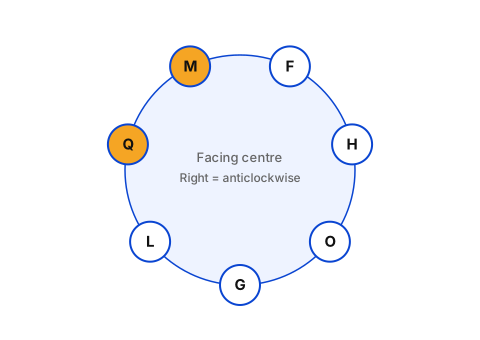
Seven people F, G, H, L, M, O and Q are sitting around a circular table, facing the centre of the table. O sits to the immediate right of G. F sits to the immediate right of H. Only two people sit between Q and O when counted from the right of Q. Only three people sit between M and G when counted from the right of G. How many people sit between F and L when counted from the right of F?
सात व्यक्ति F, G, H, L, M, O और Q एक वृत्ताकार मेज़ के चारों ओर मेज़ के केंद्र की ओर मुख करके बैठे हैं। O, G के ठीक दाईं ओर बैठा है। F, H के ठीक दाईं ओर बैठा है। Q के दाईं ओर से गिनने पर Q और O के बीच केवल दो व्यक्ति बैठे हैं। G के दाईं ओर से गिनने पर M और G के बीच केवल तीन व्यक्ति बैठे हैं। F के दाईं ओर से गिनने पर F और L के बीच कितने व्यक्ति बैठे हैं?
  1. AOneएक
  2. BTwoदो
  3. CThreeतीन
  4. DFourचार
Show answer

Concept: Facing the centre, ‘right’ means moving anticlockwise.

  1. Fix G; O is immediately to G’s right.
  2. M is 4th to the right of G (three people between, counted from the right of G).
  3. Q is 3rd to the left of O (two people between Q and O from Q’s right).
  4. F is immediate right of H → H, F fill the two adjacent empty seats after O; L takes the last seat.
  5. From F going right: M, Q, then L → two people between F and L.

Trick: Facing centre: right = anticlockwise, left = clockwise.

Answer: (B) Two

अवधारणा: केंद्र की ओर मुख होने पर 'दाएँ' का अर्थ वामावर्त (anticlockwise) चलना है।

  1. G को स्थिर करें; O, G के ठीक दाएँ है।
  2. M, G के दाएँ से चौथा है (G के दाएँ से गिनने पर बीच में तीन लोग)।
  3. Q, O से बाएँ तीसरा है (Q के दाएँ से गिनने पर Q और O के बीच दो लोग)।
  4. F, H के ठीक दाएँ → H, F, O के बाद की दो सटी खाली सीटों पर; L अंतिम सीट पर।
  5. F से दाएँ चलने पर: M, Q, फिर L → F और L के बीच दो लोग।

ट्रिक: केंद्र की ओर मुख: दायाँ = वामावर्त, बायाँ = दक्षिणावर्त।

उत्तर: (B) दो

RRB NTPC Undergraduate CBT 1General Intelligence and ReasoningCircular ArrangementRRB NTPC Undergraduate CBT 1 2025 · 17 Jun Shift 1 →
Q6796.
The 20-Point Economic Programme was initially launched in 1975 primarily to:
20-सूत्री आर्थिक कार्यक्रम मूल रूप से 1975 में मुख्यतः किस उद्देश्य से शुरू किया गया था?
  1. AReduce government borrowingसरकारी उधारी कम करना
  2. BPromote foreign direct investmentप्रत्यक्ष विदेशी निवेश को बढ़ावा देना
  3. CAccelerate socio-economic reformsसामाजिक-आर्थिक सुधारों में तेज़ी लाना
  4. DLiberalize trade policiesव्यापार नीतियों का उदारीकरण करना
Show answer

Concept: The 20-Point Programme (TPP) was launched by PM Indira Gandhi in 1975.

  1. Its aim was to fight poverty and improve the quality of life of the poor — i.e. to accelerate socio-economic reforms.
  2. It was restructured in 1982, 1986 and 2006 (TPP-2006).
  3. It had nothing to do with FDI or trade liberalisation, which came after 1991.

Yaad rakhein: TPP 1975 = 'Garibi Hatao' agenda — land reforms, housing, drinking water, employment.

Answer: (C) Accelerate socio-economic reforms

अवधारणा: 20 सूत्री कार्यक्रम 1975 में प्रधानमंत्री इंदिरा गांधी ने शुरू किया।

  1. उद्देश्य गरीबी उन्मूलन और गरीबों के जीवन-स्तर में सुधार, यानी सामाजिक-आर्थिक सुधारों को तेज़ करना था।
  2. इसे 1982, 1986 और 2006 में पुनर्गठित किया गया।
  3. FDI और व्यापार उदारीकरण 1991 के बाद आए।

याद रखें: TPP 1975 = 'गरीबी हटाओ' एजेंडा।

उत्तर: (C) सामाजिक-आर्थिक सुधारों को तेज़ करना

RRB NTPC Undergraduate CBT 1General AwarenessIndian Economy – 20-Point ProgrammeRRB NTPC Undergraduate CBT 1 2025 · 16 Jun Shift 3 →
Q6797.
The architectural style of the Jagannath Temple is primarily associated with which of the following traditions?
जगन्नाथ मंदिर की स्थापत्य शैली मुख्य रूप से निम्नलिखित में से किस परंपरा से संबंधित है?
  1. ADravidian styleद्रविड़ शैली
  2. BHoysala Styleहोयसल शैली
  3. CVesara styleवेसर शैली
  4. DKalinga styleकलिंग शैली
Show answer

Concept: The Jagannath Temple at Puri (Odisha) was built in the 12th century under the Eastern Ganga king Anantavarman Chodaganga Deva.

  1. Odisha temples form the Kalinga style, a sub-type of the Nagara style, with a curvilinear rekha deul tower.
  2. Dravidian = South India (e.g. Brihadeeswara); Hoysala/Vesara = Karnataka (Belur, Halebidu).

Yaad rakhein: Kalinga style trio: Jagannath (Puri), Lingaraj (Bhubaneswar), Sun Temple (Konark).

Answer: (D) Kalinga style

अवधारणा: पुरी (ओडिशा) का जगन्नाथ मंदिर 12वीं शताब्दी में पूर्वी गंग राजा अनंतवर्मन चोडगंग देव ने बनवाया।

  1. ओडिशा के मंदिर कलिंग शैली (नागर की उप-शैली) के हैं, जिसमें वक्राकार रेखा देउल शिखर होता है।
  2. द्रविड़ = दक्षिण भारत; होयसल/वेसर = कर्नाटक।

याद रखें: कलिंग शैली: जगन्नाथ (पुरी), लिंगराज (भुवनेश्वर), सूर्य मंदिर (कोणार्क)।

उत्तर: (D) कलिंग शैली

RRB NTPC Undergraduate CBT 1General AwarenessTemple ArchitectureRRB NTPC Undergraduate CBT 1 2025 · 16 Jun Shift 3 →
Q6798.
Which option is used in Windows 11 to temporarily turn off the computer to save power while keeping programs open?
Windows 11 में प्रोग्रामों को खुला रखते हुए बिजली बचाने के लिए कंप्यूटर को अस्थायी रूप से बंद करने हेतु किस विकल्प का उपयोग किया जाता है?
  1. AHibernateहाइबरनेट (Hibernate)
  2. BWake Upवेक अप (Wake Up)
  3. CRestartरीस्टार्ट (Restart)
  4. DShut Downशट डाउन (Shut Down)
Show answer

Concept: Windows power options decide how the PC turns off.

  1. Hibernate saves open programs and documents to the hard disk and switches the PC off, using almost no power; on restart you return to where you left.
  2. Restart and Shut Down close all programs; 'Wake Up' is not a power-off option.

Yaad rakhein: Sleep keeps work in RAM (low power); Hibernate keeps work on disk (no power).

Answer: (A) Hibernate

अवधारणा: Windows के पावर विकल्प तय करते हैं कि PC कैसे बंद हो।

  1. Hibernate खुले प्रोग्राम और फ़ाइलें हार्ड डिस्क पर सहेजकर PC बंद कर देता है; दोबारा चालू करने पर काम वहीं से मिलता है।
  2. Restart और Shut Down सभी प्रोग्राम बंद कर देते हैं।

याद रखें: Sleep = काम RAM में; Hibernate = काम डिस्क पर।

उत्तर: (A) Hibernate

RRB NTPC Undergraduate CBT 1General AwarenessComputer – Power OptionsRRB NTPC Undergraduate CBT 1 2025 · 16 Jun Shift 3 →
Q6799.
Which of the following Articles of the Indian Constitution provides for the suspension of enforcement of the rights conferred by Part III during emergencies?
भारतीय संविधान का निम्नलिखित में से कौन-सा अनुच्छेद आपातकाल के दौरान भाग III द्वारा प्रदत्त अधिकारों के प्रवर्तन के निलंबन का प्रावधान करता है?
  1. AArticle 358अनुच्छेद 358
  2. BArticle 356अनुच्छेद 356
  3. CArticle 359अनुच्छेद 359
  4. DArticle 357अनुच्छेद 357
Show answer

Concept: Part XVIII (Articles 352–360) deals with emergencies.

  1. Article 359 lets the President suspend the right to move courts for enforcement of Part III rights (except Articles 20 and 21) during a National Emergency.
  2. Article 358 automatically suspends Article 19; Article 356 is President's Rule; Article 357 deals with legislative powers under it.

Yaad rakhein: 358 → Art. 19 suspended automatically; 359 → enforcement of other rights suspended by Presidential order.

Answer: (C) Article 359

अवधारणा: भाग XVIII (अनुच्छेद 352–360) आपातकाल से संबंधित है।

  1. अनुच्छेद 359 के तहत राष्ट्रपति राष्ट्रीय आपातकाल में भाग III के अधिकारों को लागू कराने हेतु न्यायालय जाने का अधिकार निलंबित कर सकते हैं (अनुच्छेद 20, 21 छोड़कर)।
  2. अनुच्छेद 358 से अनुच्छेद 19 स्वतः निलंबित होता है; 356 = राष्ट्रपति शासन।

याद रखें: 358 → अनुच्छेद 19 स्वतः निलंबित; 359 → राष्ट्रपति आदेश से अन्य अधिकारों का प्रवर्तन निलंबित।

उत्तर: (C) अनुच्छेद 359

RRB NTPC Undergraduate CBT 1General AwarenessPolity – Emergency ProvisionsRRB NTPC Undergraduate CBT 1 2025 · 16 Jun Shift 3 →
Q6800.
Which term describes sound energy received per second per unit area?
प्रति सेकंड प्रति इकाई क्षेत्रफल पर प्राप्त ध्वनि ऊर्जा को किस पद से व्यक्त किया जाता है?
  1. AIntensityतीव्रता (Intensity)
  2. BFrequencyआवृत्ति (Frequency)
  3. CEchoप्रतिध्वनि (Echo)
  4. DPitchतारत्व (Pitch)
Show answer

Concept: Intensity of sound = sound energy passing per second through unit area (normal to the direction of propagation).

  1. SI unit: W/m2; loudness depends on it.
  2. Frequency = vibrations per second; pitch depends on frequency; echo is reflected sound.

Yaad rakhein: Energy per second per area → Intensity; vibrations per second → Frequency.

Answer: (A) Intensity

अवधारणा: ध्वनि की तीव्रता (Intensity) = इकाई क्षेत्रफल से प्रति सेकंड गुजरने वाली ध्वनि ऊर्जा।

  1. SI मात्रक: W/m2; प्रबलता इसी पर निर्भर।
  2. आवृत्ति = प्रति सेकंड कंपन; तारत्व आवृत्ति पर निर्भर; प्रतिध्वनि = परावर्तित ध्वनि।

याद रखें: ऊर्जा/सेकंड/क्षेत्रफल → तीव्रता।

उत्तर: (A) Intensity (तीव्रता)

RRB NTPC Undergraduate CBT 1General AwarenessPhysics – SoundRRB NTPC Undergraduate CBT 1 2025 · 16 Jun Shift 3 →