Question bank

Q&A: practice questions with answers

Search questions on any topic. Filter by exam category, exam, subject and topic, try the question, then open the answer and explanation.

Courses – airGurukul

8,495 questions found.

Q6861.
A company’s revenue increases by 20% in the first year, decreases by 10% in the second year, and increases by 15% in the third year. What is the overall percentage change in revenue over the three years?
एक कंपनी का राजस्व पहले वर्ष में 20% बढ़ता है, दूसरे वर्ष में 10% घटता है, और तीसरे वर्ष में 15% बढ़ता है। तीन वर्षों में राजस्व में कुल प्रतिशत परिवर्तन कितना है?
  1. A25.2% increase25.2% वृद्धि
  2. B24.2% increase24.2% वृद्धि
  3. C23.2% increase23.2% वृद्धि
  4. D26.2% increase26.2% वृद्धि
Show answer

Concept: Multiply the growth factors of each year.

  1. 1.20×0.90=1.08.
  2. 1.08×1.15=1.242.
  3. Change =24.2% increase.

Trick: Base 100: 100→120→108→124.2.

Answer: (B) 24.2% increase

अवधारणा: हर वर्ष के गुणकों का गुणा करें।

  1. 1.20×0.90=1.08।
  2. 1.08×1.15=1.242।
  3. 24.2% वृद्धि।

ट्रिक: आधार 100: 100→120→108→124.2।

उत्तर: (B) 24.2% वृद्धि

RRB NTPC Undergraduate CBT 1MathematicsSuccessive Percentage ChangeRRB NTPC Undergraduate CBT 1 2025 · 16 Jun Shift 3 →
Q6862.
If 2(x+1)×4(y−2)=32 and x=3y, what is the value of y?
यदि 2(x+1)×4(y−2)=32 और x=3y है, तो y का मान क्या है?
  1. A1.4
  2. B1.6
  3. C1
  4. D1.5
Show answer

Concept: Write all terms with base 2 and equate powers.

  1. 2x+1×22(y−2)=25.
  2. x+1+2y−4=5⇒x+2y=8.
  3. 3y+2y=8⇒y=85=1.6.

Trick: 4=22 and 32=25 — same base turns it into a linear equation.

Answer: (B) 1.6

अवधारणा: सभी पदों का आधार 2 बनाकर घातें बराबर करें।

  1. 2x+1×22(y−2)=25।
  2. x+2y=8।
  3. 5y=8⇒y=1.6।

ट्रिक: 4=22, 32=25।

उत्तर: (B) 1.6

RRB NTPC Undergraduate CBT 1MathematicsIndicesRRB NTPC Undergraduate CBT 1 2025 · 16 Jun Shift 3 →
Q6863.
The present ages of A and B are in the ratio 4:5. If after 8 years from now, A will be 32 years old, what is B’s present age?
A और B की वर्तमान आयु का अनुपात 4:5 है। यदि अब से 8 वर्ष बाद A की आयु 32 वर्ष होगी, तो B की वर्तमान आयु क्या है?
  1. A30 years30 वर्ष
  2. B34 years34 वर्ष
  3. C32 years32 वर्ष
  4. D28 years28 वर्ष
Show answer

Concept: Find A's present age, then use the ratio.

  1. A now =32−8=24.
  2. 4 parts =24⇒1 part =6.
  3. B =5×6=30 years.

Trick: B =24×54=30.

Answer: (A) 30 years

अवधारणा: A की वर्तमान आयु निकालकर अनुपात लगाएँ।

  1. A अभी =24।
  2. 4 भाग =24⇒1 भाग =6।
  3. B =30 वर्ष।

ट्रिक: B =24×54=30।

उत्तर: (A) 30 वर्ष

RRB NTPC Undergraduate CBT 1MathematicsAges – RatioRRB NTPC Undergraduate CBT 1 2025 · 16 Jun Shift 3 →
Q6864.
The arithmetic mean of 3, 7, 11, ..., 51 is ______.
3, 7, 11, ..., 51 का समांतर माध्य ______ है।
  1. A35
  2. B23
  3. C31
  4. D27
Show answer

Concept: Mean of an AP =first+last2.

  1. AP 3, 7, 11, …, 51 (common difference 4, 13 terms).
  2. Mean =3+512=27.

Trick: In any AP the average equals the middle term (7th term =3+6×4=27).

Answer: (D) 27

अवधारणा: समांतर श्रेणी का माध्य =प्रथम+अंतिम2।

  1. 3, 7, …, 51 (सार्व अंतर 4, 13 पद)।
  2. माध्य =542=27।

ट्रिक: AP में औसत = मध्य पद (7वाँ पद = 27)।

उत्तर: (D) 27

RRB NTPC Undergraduate CBT 1MathematicsArithmetic ProgressionRRB NTPC Undergraduate CBT 1 2025 · 16 Jun Shift 3 →
Q6865.
The LCM of the numbers 7, 12.4 and 1 is:
संख्याओं 7, 12.4 और 1 का LCM है:
  1. A440
  2. B441
  3. C434
  4. D442
Show answer

Concept: Write decimals as reduced fractions: LCM=LCM of numeratorsHCF of denominators.

  1. 12.4=625; 7=71, 1=11.
  2. LCM =LCM(7,62,1)HCF(1,5,1)=4341=434.
  3. Check: 434÷7=62, 434÷12.4=35 ✓.

Trick: Always reduce the fraction (12410→625) before taking LCM.

Answer: (C) 434

अवधारणा: दशमलव को सरल भिन्न लिखें: LCM=अंशों का LCMहरों का HCF।

  1. 12.4=625।
  2. LCM =LCM(7,62,1)HCF(1,5,1)=434।
  3. जाँच: 434÷7=62, 434÷12.4=35 ✓।

ट्रिक: LCM लेने से पहले भिन्न को सरलतम रूप में लाएँ।

उत्तर: (C) 434

RRB NTPC Undergraduate CBT 1MathematicsLCM of DecimalsRRB NTPC Undergraduate CBT 1 2025 · 16 Jun Shift 3 →
Q6866.
What should come in place of the question mark (?) in the given series based on the English alphabetical order?
MLJ HGE CBZ XWU ?
अंग्रेज़ी वर्णमाला क्रम के आधार पर दी गई शृंखला में प्रश्न चिह्न (?) के स्थान पर क्या आना चाहिए?
MLJ HGE CBZ XWU ?
  1. ASQO
  2. BSRP
  3. CSTV
  4. DSSO
Show answer

Concept: Write each letter's position: within a group the pattern is n,n−1,n−3; the first letters move back by 5.

  1. First letters: M(13) → H(8) → C(3) → X(24) → S(19), each −5 (wrapping after A).
  2. Inside each group: M L J =13,12,10; H G E =8,7,5; X W U =24,23,21.
  3. So S(19), R(18), P(16) → SRP.

Trick: Check the first letters only: they step back by 5, so the answer starts with S; then −1,−2 gives SRP.

Answer: (B) SRP

अवधारणा: प्रत्येक अक्षर का स्थान लिखें: हर समूह में पैटर्न n,n−1,n−3 है; पहले अक्षर 5 पीछे जाते हैं।

  1. पहले अक्षर: M(13) → H(8) → C(3) → X(24) → S(19), हर बार −5 (A के बाद घूमकर)।
  2. समूह के भीतर: M L J =13,12,10; H G E =8,7,5; X W U =24,23,21।
  3. इसलिए S(19), R(18), P(16) → SRP।

ट्रिक: केवल पहले अक्षर देखें: वे 5 पीछे जाते हैं, तो उत्तर S से शुरू होगा; फिर −1,−2 से SRP।

उत्तर: (B) SRP

RRB NTPC Undergraduate CBT 1General Intelligence and ReasoningAlphabet seriesRRB NTPC Undergraduate CBT 1 2025 · 16 Jun Shift 3 →
Q6867.
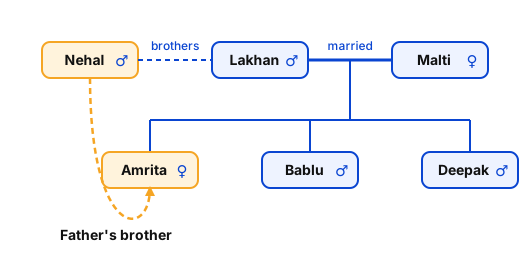
Amrita is the sister of Bablu. Bablu is the brother of Deepak. Deepak is the son of Malti and Malti is the wife of Lakhan. Nehal is the brother of Lakhan. How is Nehal related to Amrita?
अमृता, बबलू की बहन है। बबलू, दीपक का भाई है। दीपक, मालती का पुत्र है और मालती, लखन की पत्नी है। नेहल, लखन का भाई है। नेहल का अमृता से क्या संबंध है?
  1. AFather's brotherपिता का भाई
  2. BSonपुत्र
  3. CMother's brotherमाता का भाई
  4. DBrotherभाई
Show answer

Concept: Draw the family tree from the given links.

  1. Malti is Lakhan's wife; Deepak is their son.
  2. Bablu is Deepak's brother and Amrita is Bablu's sister, so Amrita is also a child of Lakhan.
  3. Nehal is Lakhan's brother → Nehal is Amrita's father's brother (uncle, chacha).

Trick: Brother of father = paternal uncle (chacha).

Answer: (A) Father's brother

अवधारणा: दिए गए संबंधों से वंश-वृक्ष बनाएँ।

  1. मालती, लखन की पत्नी है; दीपक उनका पुत्र है।
  2. बबलू दीपक का भाई है और अमृता बबलू की बहन है, अतः अमृता भी लखन की संतान है।
  3. नेहाल, लखन का भाई है → नेहाल अमृता के पिता का भाई (चाचा) है।

ट्रिक: पिता का भाई = चाचा।

उत्तर: (A) पिता का भाई

RRB NTPC Undergraduate CBT 1General Intelligence and ReasoningBlood relationsRRB NTPC Undergraduate CBT 1 2025 · 16 Jun Shift 3 →
Q6868.
Select the set in which the numbers are related in the same way as are the numbers of the following sets.
(NOTE: Operations should be performed on the whole numbers, without breaking down the numbers into their constituent digits. E.g. 13 – Operations on 13 such as
adding/subtracting/multiplying etc. to 13 can be performed. Breaking down 13 into 1 and 3 and then performing mathematical operations on 1 and 3 is not allowed.) (18, 6, 217)
(21, 6, 253)
उस समुच्चय का चयन कीजिए जिसमें संख्याएँ उसी प्रकार संबंधित हैं जिस प्रकार निम्नलिखित समुच्चयों की संख्याएँ संबंधित हैं।
(ध्यान दें: संक्रियाएँ संख्याओं को उनके घटक अंकों में विभाजित किए बिना, पूर्ण संख्याओं पर की जानी चाहिए। उदाहरण के लिए 13 – 13 पर संक्रियाएँ जैसे
13 में जोड़ना/घटाना/गुणा करना आदि किया जा सकता है। 13 को 1 और 3 में विभाजित करना और फिर 1 और 3 पर गणितीय संक्रियाएँ करना वर्जित है।) (18, 6, 217)
(21, 6, 253)
  1. A(22, 5, 220)
  2. B(23, 6, 276)
  3. C(24, 6, 287)
  4. D(23, 4, 185)
Show answer

Concept: Look for third number = first × (2 × second) +1.

  1. (18,6,217): 18×12+1=216+1=217 ✓
  2. (21,6,253): 21×12+1=252+1=253 ✓
  3. (23,4,185): 23×8+1=184+1=185 ✓
  4. Others: 22×10+1=221≠220, 23×12+1=277≠276, 24×12+1=289≠287.

Trick: 217 and 253 are 1 more than multiples of 18 and 21 – that '+1' reveals the rule.

Answer: (D) (23, 4, 185)

अवधारणा: नियम खोजें: तीसरी संख्या = पहली × (2 × दूसरी) +1।

  1. (18,6,217): 18×12+1=216+1=217 ✓
  2. (21,6,253): 21×12+1=252+1=253 ✓
  3. (23,4,185): 23×8+1=184+1=185 ✓
  4. अन्य: 22×10+1=221≠220, 23×12+1=277≠276, 24×12+1=289≠287।

ट्रिक: 217 और 253 क्रमशः 18 और 21 के गुणजों से 1 अधिक हैं – यही '+1' नियम बताता है।

उत्तर: (D) (23, 4, 185)

RRB NTPC Undergraduate CBT 1General Intelligence and ReasoningNumber analogy – tripletsRRB NTPC Undergraduate CBT 1 2025 · 16 Jun Shift 3 →
Q6869.
What should come in place of the question mark (?) in the given series to make it logically complete?
Q18N O23P M28R K33T ?
दी गई शृंखला को तार्किक रूप से पूर्ण करने के लिए प्रश्न चिह्न (?) के स्थान पर क्या आना चाहिए?
Q18N O23P M28R K33T ?
  1. AI38U
  2. BI38V
  3. CJ36V
  4. DJ40U
Show answer

Concept: Treat the three parts of each term separately.

  1. First letter: Q, O, M, K → −2 each → I.
  2. Number: 18, 23, 28, 33 → +5 → 38.
  3. Last letter: N, P, R, T → +2 each → V.

Trick: Split each term into letter–number–letter and run three mini-series.

Answer: (B) I38V

अवधारणा: प्रत्येक पद के तीनों भाग अलग-अलग देखें।

  1. पहला अक्षर: Q, O, M, K → हर बार −2 → I।
  2. संख्या: 18, 23, 28, 33 → +5 → 38।
  3. अंतिम अक्षर: N, P, R, T → हर बार +2 → V।

ट्रिक: हर पद को अक्षर–संख्या–अक्षर में तोड़कर तीन छोटी शृंखलाएँ चलाएँ।

उत्तर: (B) I38V

RRB NTPC Undergraduate CBT 1General Intelligence and ReasoningAlpha-numeric seriesRRB NTPC Undergraduate CBT 1 2025 · 16 Jun Shift 3 →
Q6870.
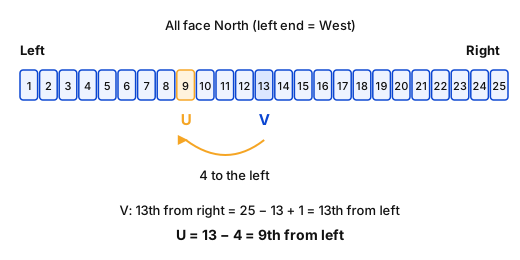
In a row of 25 students facing North, Vinayak is 13th from the right end. If Utkarsh is 4th to the left of Vinayak, what is Utkarsh's position from the left end of the row?
उत्तर की ओर मुख करके बैठे 25 विद्यार्थियों की एक पंक्ति में, विनायक दाएँ छोर से 13वें स्थान पर है। यदि उत्कर्ष, विनायक के बाएँ से चौथे स्थान पर है, तो पंक्ति के बाएँ छोर से उत्कर्ष का स्थान क्या है?
  1. A8th8वाँ
  2. B9th9वाँ
  3. C4thचौथा
  4. D6thछठा
Show answer

Concept: Position from left = total − position from right +1. Facing North, 'left' means towards the left end.

  1. Vinayak from left =25−13+1=13th.
  2. Utkarsh is 4 places to the left of Vinayak → 13−4=9th from the left.

Trick: Left + right position = total +1.

Answer: (B) 9th

अवधारणा: बाएँ से स्थान = कुल − दाएँ से स्थान +1। उत्तर की ओर मुख होने पर 'बाएँ' का अर्थ बाएँ छोर की ओर है।

  1. विनायक बाएँ से =25−13+1=13वाँ।
  2. उत्कर्ष, विनायक से 4 स्थान बाएँ → बाएँ से 13−4=9वाँ।

ट्रिक: बाएँ + दाएँ स्थान = कुल +1।

उत्तर: (B) 9वाँ

RRB NTPC Undergraduate CBT 1General Intelligence and ReasoningRanking – row positionRRB NTPC Undergraduate CBT 1 2025 · 16 Jun Shift 3 →
Q6871.
In a certain code language, ‘rest restores energy’ is coded as ‘rk fj mg’ and ‘positive energy attracts’ is coded as ‘tw es fj’. How is ‘energy’ coded in the given language?
एक निश्चित कूट भाषा में, ‘rest restores energy’ को ‘rk fj mg’ के रूप में कूटबद्ध किया जाता है और ‘positive energy attracts’ को ‘tw es fj’ के रूप में कूटबद्ध किया जाता है। दी गई भाषा में ‘energy’ को किस प्रकार कूटबद्ध किया जाता है?
  1. Ark
  2. Bes
  3. Cmg
  4. Dfj
Show answer

Concept: A word common to two sentences takes the code common to both.

  1. 'energy' appears in both: 'rest restores energy' and 'positive energy attracts'.
  2. Common code in 'rk fj mg' and 'tw es fj' is 'fj'.

Trick: Match the common word with the common code.

Answer: (D) fj

अवधारणा: दो वाक्यों में समान शब्द का कोड भी दोनों में समान होगा।

  1. 'energy' दोनों में है: 'rest restores energy' और 'positive energy attracts'।
  2. 'rk fj mg' और 'tw es fj' में समान कोड 'fj' है।

ट्रिक: समान शब्द ↔ समान कोड।

उत्तर: (D) fj

RRB NTPC Undergraduate CBT 1General Intelligence and ReasoningCoding–decoding (word codes)RRB NTPC Undergraduate CBT 1 2025 · 16 Jun Shift 3 →
Q6872.
Refer to the following series and answer the question. (Counting to be done from left to right only.) (All numbers are single-digit numbers only.)
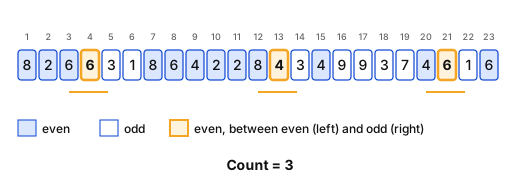
(Left) 8 2 6 6 3 1 8 6 4 2 2 8 4 3 4 9 9 3 7 4 6 1 6 (Right)
How many such even digits are there, each of which is immediately preceded by an even digit and also immediately followed by an odd digit?
निम्नलिखित शृंखला का संदर्भ लीजिए और प्रश्न का उत्तर दीजिए। (गिनती केवल बाएँ से दाएँ की जानी है।) (सभी संख्याएँ केवल एक-अंकीय संख्याएँ हैं।)
(बाएँ) 8 2 6 6 3 1 8 6 4 2 2 8 4 3 4 9 9 3 7 4 6 1 6 (दाएँ)
ऐसे कितने सम अंक हैं, जिनमें से प्रत्येक के ठीक पहले एक सम अंक है और ठीक बाद एक विषम अंक भी है?
  1. ANoneकोई नहीं
  2. BTwoदो
  3. CThreeतीन
  4. DOneएक
Show answer

Concept: Scan for the pattern Even – Even – Odd and count the middle digit.

  1. Position 4: 6 → 6 before (even), 3 after (odd) ✓
  2. Position 13: 4 → 8 before, 3 after ✓
  3. Position 21: 6 → 4 before, 1 after ✓
  4. No other even digit has an even neighbour before and an odd one after.

Trick: First mark every odd digit, then look only at the digit just before it.

Answer: (C) Three

अवधारणा: सम – सम – विषम पैटर्न खोजें और बीच वाले अंक गिनें।

  1. स्थान 4: 6 → पहले 6 (सम), बाद में 3 (विषम) ✓
  2. स्थान 13: 4 → पहले 8, बाद में 3 ✓
  3. स्थान 21: 6 → पहले 4, बाद में 1 ✓
  4. किसी अन्य सम अंक के पहले सम और बाद में विषम अंक नहीं है।

ट्रिक: पहले सभी विषम अंक चिह्नित करें, फिर केवल उनके ठीक पहले वाला अंक देखें।

उत्तर: (C) तीन

RRB NTPC Undergraduate CBT 1General Intelligence and ReasoningNumber series – digit conditionsRRB NTPC Undergraduate CBT 1 2025 · 16 Jun Shift 3 →
Q6873.
Based on the English alphabetical order, three of the following four letter-cluster pairs are alike in a certain way and thus form a group. Which letter-cluster pair DOES NOT belong to that group?
(Note: The odd one out is not based on the number of consonants/vowels or their position in the letter-cluster.)
अंग्रेज़ी वर्णमाला क्रम के आधार पर, निम्नलिखित चार अक्षर-समूह युग्मों में से तीन किसी निश्चित प्रकार से समान हैं और इस प्रकार एक समूह बनाते हैं। कौन-सा अक्षर-समूह युग्म उस समूह से संबंधित नहीं है?
(ध्यान दें: असंगत अक्षर-समूह, उस अक्षर-समूह में व्यंजनों/स्वरों की संख्या या उनके स्थान पर आधारित नहीं है।)
  1. ATL - NX
  2. BNF - HR
  3. CJB - DN
  4. DDV - PH
Show answer

Concept: Compare the letter positions within each cluster.

  1. TL – NX: 20→12 (−8), 14→24 (+10).
  2. NF – HR: 14→6 (−8), 8→18 (+10); JB – DN: 10→2 (−8), 4→14 (+10).
  3. DV – PH: 4→22 (+18), 16→8 (−8) – pattern differs.

Trick: Also, first letters T→N, N→H, J→D drop by 6, but D→P does not.

Answer: (D) DV - PH

अवधारणा: हर क्लस्टर के अक्षरों के स्थान की तुलना करें।

  1. TL – NX: 20→12 (−8), 14→24 (+10)।
  2. NF – HR: 14→6 (−8), 8→18 (+10); JB – DN: 10→2 (−8), 4→14 (+10)।
  3. DV – PH: 4→22 (+18), 16→8 (−8) – पैटर्न अलग।

ट्रिक: पहले अक्षर T→N, N→H, J→D में 6 घटता है, D→P में नहीं।

उत्तर: (D) DV - PH

RRB NTPC Undergraduate CBT 1General Intelligence and ReasoningOdd one out – letter pairsRRB NTPC Undergraduate CBT 1 2025 · 16 Jun Shift 3 →
Q6874.
Based on the English alphabetical order, three of the following four are alike in a certain way and thus form a group. Which is the one that does not belong to that group? (Note: The odd man out is not based on the number of consonants/vowels or their position in the letter cluster.)
अंग्रेज़ी वर्णमाला क्रम के आधार पर, निम्नलिखित चार में से तीन किसी निश्चित प्रकार से समान हैं और इस प्रकार एक समूह बनाते हैं। वह कौन-सा है जो उस समूह से संबंधित नहीं है? (ध्यान दें: असंगत, अक्षर-समूह में व्यंजनों/स्वरों की संख्या या उनके स्थान पर आधारित नहीं है।)
  1. ALIH
  2. BCAY
  3. CYVU
  4. DRON
Show answer

Concept: Find the gaps between consecutive letters.

  1. LIH: 12→9→8 (−3,−1); YVU: 25→22→21 (−3,−1); RON: 18→15→14 (−3,−1).
  2. CAY: 3→1→25 (−2,−2 with wrap-around) – different.

Trick: Write the alphabet numbers once; the three matching clusters show the same gaps.

Answer: (B) CAY

अवधारणा: क्रमागत अक्षरों के बीच का अंतर देखें।

  1. LIH: 12→9→8 (−3,−1); YVU: 25→22→21 (−3,−1); RON: 18→15→14 (−3,−1)।
  2. CAY: 3→1→25 (−2,−2, घूमकर) – अलग।

ट्रिक: अक्षरों के क्रमांक एक बार लिख लें; तीन समूहों में एक-सा अंतर दिखेगा।

उत्तर: (B) CAY

RRB NTPC Undergraduate CBT 1General Intelligence and ReasoningOdd one out – letter clustersRRB NTPC Undergraduate CBT 1 2025 · 16 Jun Shift 3 →
Q6875.
What should come in place of ‘?’ in the given series?
56 57 ? 70 86 111
दी गई शृंखला में ‘?’ के स्थान पर क्या आना चाहिए?
56 57 ? 70 86 111
  1. A63
  2. B61
  3. C62
  4. D64
Show answer

Concept: Differences are perfect squares 12,22,32,42,52.

  1. 56+1=57
  2. 57+4=61
  3. 61+9=70, 70+16=86, 86+25=111 ✓

Trick: Check from the end: 111−86=25, 86−70=16 → squares, so ?=70−9.

Answer: (B) 61

अवधारणा: अंतर पूर्ण वर्ग हैं: 12,22,32,42,52।

  1. 56+1=57
  2. 57+4=61
  3. 61+9=70, 70+16=86, 86+25=111 ✓

ट्रिक: पीछे से जाँचें: 111−86=25, 86−70=16 → वर्ग, अतः ?=70−9।

उत्तर: (B) 61

RRB NTPC Undergraduate CBT 1General Intelligence and ReasoningNumber series – squaresRRB NTPC Undergraduate CBT 1 2025 · 16 Jun Shift 3 →
Q6876.
Based on the alphabetical order, three of the following four are alike in a certain way and thus form a group. Which is the one that does not belong to that group?
(Note: The odd man out is not based on the number of consonants/vowels or their position in the letter cluster.)
वर्णमाला क्रम के आधार पर, निम्नलिखित चार में से तीन किसी निश्चित प्रकार से समान हैं और इस प्रकार एक समूह बनाते हैं। वह कौन-सा है जो उस समूह से संबंधित नहीं है?
(ध्यान दें: असंगत, अक्षर-समूह में व्यंजनों/स्वरों की संख्या या उनके स्थान पर आधारित नहीं है।)
  1. ADGI
  2. BLOQ
  3. CZDE
  4. DUXZ
Show answer

Concept: Find the gaps between consecutive letters.

  1. DGI: 4→7→9 (+3,+2); LOQ: 12→15→17 (+3,+2); UXZ: 21→24→26 (+3,+2).
  2. ZDE: 26→4→5 (+4,+1 with wrap-around) – different.

Trick: Use EJOTY (5,10,15,20,25) to read letter positions fast.

Answer: (C) ZDE

अवधारणा: क्रमागत अक्षरों के बीच का अंतर देखें।

  1. DGI: 4→7→9 (+3,+2); LOQ: 12→15→17 (+3,+2); UXZ: 21→24→26 (+3,+2)।
  2. ZDE: 26→4→5 (+4,+1, घूमकर) – अलग।

ट्रिक: अक्षरों के स्थान जल्दी पढ़ने के लिए EJOTY (5,10,15,20,25) याद रखें।

उत्तर: (C) ZDE

RRB NTPC Undergraduate CBT 1General Intelligence and ReasoningOdd one out – letter clustersRRB NTPC Undergraduate CBT 1 2025 · 16 Jun Shift 3 →
Q6877.
Refer to the following letter series and answer the question that follows.
(Left) X P S A D U G L O E J F K I M C R T Q (Right)
How many letters are there in the English alphabetical series between the letter which is fifth from the right end and third from the left end of the series?
निम्नलिखित अक्षर शृंखला का संदर्भ लीजिए और उसके बाद दिए गए प्रश्न का उत्तर दीजिए।
(बाएँ) X P S A D U G L O E J F K I M C R T Q (दाएँ)
अंग्रेज़ी वर्णमाला शृंखला में उस अक्षर, जो शृंखला के दाएँ छोर से पाँचवाँ है, और उस अक्षर, जो बाएँ छोर से तीसरा है, के बीच कितने अक्षर हैं?
  1. AFiveपाँच
  2. BSixछह
  3. CFourचार
  4. DSevenसात
Show answer

Concept: Locate the two letters, then count the letters strictly between them in A–Z.

  1. From the right: Q, T, R, C, M → 5th from right is M.
  2. From the left: X, P, S → 3rd from left is S.
  3. Between M(13) and S(19) in the alphabet: N, O, P, Q, R → 19−13−1=5.

Trick: Letters between two positions = difference −1.

Answer: (A) Five

अवधारणा: दोनों अक्षर ढूँढें, फिर A–Z में उनके बीच के अक्षर गिनें।

  1. दाएँ से: Q, T, R, C, M → दाएँ से 5वाँ M।
  2. बाएँ से: X, P, S → बाएँ से तीसरा S।
  3. वर्णमाला में M(13) और S(19) के बीच: N, O, P, Q, R → 19−13−1=5।

ट्रिक: दो स्थानों के बीच अक्षर = अंतर −1।

उत्तर: (A) पाँच

RRB NTPC Undergraduate CBT 1General Intelligence and ReasoningLetter series – positionRRB NTPC Undergraduate CBT 1 2025 · 16 Jun Shift 3 →
Q6878.
Each of the digits in the number 3184657 is arranged in ascending order from left to right. The position(s) of how many digits will remain unchanged as compared to that in the original number?
संख्या 3184657 के प्रत्येक अंक को बाएँ से दाएँ आरोही क्रम में व्यवस्थित किया जाता है। मूल संख्या की तुलना में कितने अंकों का/के स्थान अपरिवर्तित रहेगा/रहेंगे?
  1. AOneएक
  2. BThreeतीन
  3. CNoneकोई नहीं
  4. DTwoदो
Show answer

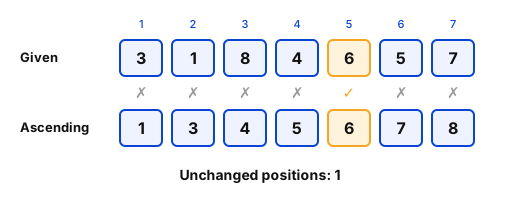
Concept: Write the digits in ascending order under the original number and compare place by place.

  1. Original: 3 1 8 4 6 5 7
  2. Ascending: 1 3 4 5 6 7 8
  3. Same place: only 6 (5th place) → one digit.

Trick: Only the digits that are already in their 'sorted' place stay unchanged – compare column-wise.

Answer: (A) One

अवधारणा: मूल संख्या के नीचे अंक आरोही क्रम में लिखें और स्थान-दर-स्थान तुलना करें।

  1. मूल: 3 1 8 4 6 5 7
  2. आरोही: 1 3 4 5 6 7 8
  3. समान स्थान: केवल 6 (5वाँ स्थान) → एक अंक।

ट्रिक: केवल वही अंक अपरिवर्तित रहते हैं जो पहले से अपने 'क्रमित' स्थान पर हैं – कॉलम-वार मिलाएँ।

उत्तर: (A) एक

RRB NTPC Undergraduate CBT 1General Intelligence and ReasoningDigit arrangementRRB NTPC Undergraduate CBT 1 2025 · 16 Jun Shift 3 →
Q6879.
In a certain code language, 'PWEA' is coded as '90' and 'QAMT’ is coded as '102'. What is the code for 'LJCV' in the given code language?
एक निश्चित कूट भाषा में, 'PWEA' को '90' के रूप में और 'QAMT' को '102' के रूप में कूटबद्ध किया जाता है। उसी कूट भाषा में 'LJCV' के लिए कूट क्या है?
  1. A91
  2. B94
  3. C86
  4. D97
Show answer

Concept: Code =2×(sum of alphabet positions).

  1. PWEA: 16+23+5+1=45, 45×2=90 ✓
  2. QAMT: 17+1+13+20=51, 51×2=102 ✓
  3. LJCV: 12+10+3+22=47, 47×2=94.

Trick: Both codes are even and roughly double the letter sum – test ×2 first.

Answer: (B) 94

अवधारणा: कोड =2×(अक्षरों के स्थानों का योग)।

  1. PWEA: 16+23+5+1=45, 45×2=90 ✓
  2. QAMT: 17+1+13+20=51, 51×2=102 ✓
  3. LJCV: 12+10+3+22=47, 47×2=94।

ट्रिक: दोनों कोड सम हैं और अक्षर-योग के लगभग दुगने – पहले ×2 जाँचें।

उत्तर: (B) 94

RRB NTPC Undergraduate CBT 1General Intelligence and ReasoningCoding – letter sumRRB NTPC Undergraduate CBT 1 2025 · 16 Jun Shift 3 →
Q6880.
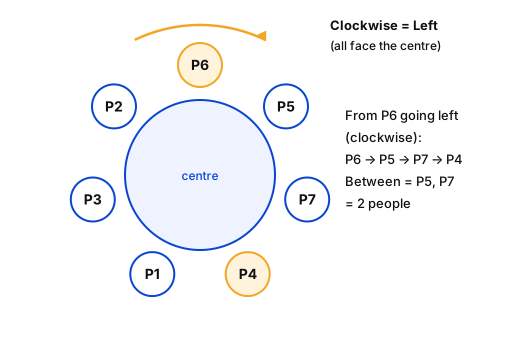
Seven people P1, P2, P3, P4, P5, P6 and P7 are sitting around a circular table facing towards the centre of the table. P5 sits to the immediate left of P6. There are exactly two people between P1 and P6 when checked from right of P6. P3 is sitting immediately between P2 and P1. P7 is sitting immediately between P4 and P5. How many people are sitting between P4 and P6 when checked from left of P6?
सात व्यक्ति P1, P2, P3, P4, P5, P6 और P7 एक वृत्ताकार मेज़ के चारों ओर मेज़ के केंद्र की ओर मुख करके बैठे हैं। P5, P6 के ठीक बाएँ बैठा है। P6 के दाएँ से देखने पर P1 और P6 के बीच ठीक दो व्यक्ति हैं। P3, P2 और P1 के ठीक बीच में बैठा है। P7, P4 और P5 के ठीक बीच में बैठा है। P6 के बाएँ से देखने पर P4 और P6 के बीच कितने व्यक्ति बैठे हैं?
  1. AThreeतीन
  2. BFourचार
  3. CTwoदो
  4. DOneएक
Show answer

Concept: Facing the centre: left = clockwise, right = anticlockwise.

  1. P5 is immediate left of P6. Going right from P6, two people are skipped and P1 comes 3rd.
  2. P7 sits between P4 and P5, so the order to the left of P6 is P5, P7, P4.
  3. P3 between P2 and P1 fills the rest: P6, P5, P7, P4, P1, P3, P2 (clockwise).
  4. From P6 going left to P4: P5 and P7 lie between → 2.

Trick: Fix P6 first and place every person relative to it.

Answer: (C) Two

अवधारणा: केंद्र की ओर मुख होने पर: बायाँ = दक्षिणावर्त (clockwise), दायाँ = वामावर्त।

  1. P5, P6 के ठीक बाएँ है। P6 के दाएँ से दो लोगों के बाद तीसरा P1 है।
  2. P7, P4 और P5 के बीच है, इसलिए P6 के बाएँ क्रम P5, P7, P4 है।
  3. P3, P2 और P1 के बीच → बाकी स्थान भरें: P6, P5, P7, P4, P1, P3, P2 (दक्षिणावर्त)।
  4. P6 के बाएँ से P4 तक: बीच में P5 और P7 → 2।

ट्रिक: पहले P6 को स्थिर करें और बाकी सबको उसके सापेक्ष रखें।

उत्तर: (C) दो

RRB NTPC Undergraduate CBT 1General Intelligence and ReasoningCircular seating arrangementRRB NTPC Undergraduate CBT 1 2025 · 16 Jun Shift 3 →