Question bank

Q&A: practice questions with answers

Search questions on any topic. Filter by exam category, exam, subject and topic, try the question, then open the answer and explanation.

Courses – airGurukul

8,495 questions found.

Q6961.
If on a sale, there is 40% discount on the marked price of ₹1,200, but the sale is done at ₹520 only, then how much additional discount did the customer get?
यदि एक सेल में ₹1,200 के अंकित मूल्य पर 40% की छूट है, परंतु बिक्री केवल ₹520 में की जाती है, तो ग्राहक को कितनी अतिरिक्त छूट मिली?
  1. A2579%
  2. B2779%
  3. C2679%
  4. D2879%
Show answer

Concept: The additional discount is calculated on the price after the first discount.

  1. After 40% discount: 1200×0.6= ₹720.
  2. Sold at ₹520, so extra discount =720−520= ₹200.
  3. Additional discount% =200720×100=2509=2779%.

Trick: 200720=518; 518×100=27.7―.

Answer: (B) 2779%

अवधारणा: अतिरिक्त छूट पहली छूट के बाद की कीमत पर निकाली जाती है।

  1. 40% छूट के बाद: 1200×0.6= ₹720।
  2. बिक्री ₹520 पर, अतः अतिरिक्त छूट =720−520= ₹200।
  3. अतिरिक्त छूट% =200720×100=2509=2779%।

ट्रिक: 200720=518; 518×100=27.7―।

उत्तर: (B) 2779%

RRB NTPC Undergraduate CBT 1MathematicsSuccessive DiscountRRB NTPC Undergraduate CBT 1 2025 · 16 Jun Shift 2 →
Q6962.
15 men and 19 women can complete a piece of work in 8 days, and 9 men and 4 women can complete the same work in 14 days. The work of how many women is equivalent to that of one man?
15 पुरुष और 19 महिलाएँ एक कार्य को 8 दिनों में पूरा कर सकते हैं, और 9 पुरुष और 4 महिलाएँ उसी कार्य को 14 दिनों में पूरा कर सकते हैं। कितनी महिलाओं का कार्य एक पुरुष के कार्य के बराबर है?
  1. A18
  2. B17
  3. C15
  4. D16
Show answer

Concept: Equate total work: (workers × days) in both cases.

  1. 8(15m+19w)=14(9m+4w).
  2. 120m+152w=126m+56w⇒96w=6m.
  3. m=16w: one man = 16 women.

Trick: Divide by 2 first: 4(15m+19w)=7(9m+4w) keeps numbers small.

Answer: (D) 16

अवधारणा: कुल कार्य बराबर करें: दोनों स्थितियों में (कर्मचारी × दिन)।

  1. 8(15m+19w)=14(9m+4w)।
  2. 120m+152w=126m+56w⇒96w=6m।
  3. m=16w: एक पुरुष = 16 महिलाएँ।

ट्रिक: पहले 2 से भाग दें: 4(15m+19w)=7(9m+4w) से संख्याएँ छोटी रहती हैं।

उत्तर: (D) 16

RRB NTPC Undergraduate CBT 1MathematicsTime and Work – EfficiencyRRB NTPC Undergraduate CBT 1 2025 · 16 Jun Shift 2 →
Q6963.
Two numbers differ by 8. If five times the smaller number is subtracted from twice the larger number, the result is 13. What is the larger number?
दो संख्याओं का अंतर 8 है। यदि बड़ी संख्या के दोगुने में से छोटी संख्या का पाँच गुना घटाया जाए, तो परिणाम 13 आता है। बड़ी संख्या क्या है?
  1. A12
  2. B10
  3. C8
  4. D9
Show answer

Concept: Form two equations in the larger (L) and smaller (S) numbers.

  1. L−S=8 and 2L−5S=13.
  2. Put L=S+8: 2S+16−5S=13⇒3S=3⇒S=1.
  3. L=9; check 2×9−5×1=13.

Trick: Test options: L=9,S=1 gives 18−5=13 – done.

Answer: (D) 9

अवधारणा: बड़ी (L) और छोटी (S) संख्या में दो समीकरण बनाएँ।

  1. L−S=8 और 2L−5S=13।
  2. L=S+8 रखें: 2S+16−5S=13⇒3S=3⇒S=1।
  3. L=9; जाँच 2×9−5×1=13।

ट्रिक: विकल्प जाँचें: L=9,S=1 से 18−5=13 – हो गया।

उत्तर: (D) 9

RRB NTPC Undergraduate CBT 1MathematicsLinear EquationsRRB NTPC Undergraduate CBT 1 2025 · 16 Jun Shift 2 →
Q6964.
A shopkeeper buys sugar at ₹48 per kg. While selling, he uses a faulty weighing scale that gives only 960 g instead of 1 kg. In addition, he marks the selling price at a profit of 20% on the cost price and then offers a discount of 10% on the marked price. Find the overall percentage profit or loss made by the shopkeeper.
एक दुकानदार ₹48 प्रति kg की दर से चीनी खरीदता है। बेचते समय, वह एक दोषपूर्ण तराज़ू का उपयोग करता है जो 1 kg के स्थान पर केवल 960 g तौलता है। इसके अतिरिक्त, वह क्रय मूल्य पर 20% लाभ जोड़कर विक्रय मूल्य अंकित करता है और फिर अंकित मूल्य पर 10% की छूट देता है। दुकानदार द्वारा अर्जित कुल लाभ या हानि प्रतिशत ज्ञात कीजिए।
  1. A4.5% loss4.5% हानि
  2. B11.4% profit11.4% लाभ
  3. C12.5% profit12.5% लाभ
  4. D10% profit10% लाभ
Show answer

Concept: Take 1 kg "sold": compare actual cost of goods given with money received.

  1. SP of 1 kg =48×1.2×0.9= ₹51.84.
  2. He actually gives 960 g, costing 48×0.96= ₹46.08.
  3. Profit% =51.84−46.0846.08×100=5.7646.08×100=12.5%.

Trick: Multiply factors: 1.2×0.90.96=1.080.96=1.125 → 12.5% profit.

Answer: (C) 12.5% profit

अवधारणा: 1 kg "बेचा" मानें: दिए गए माल की वास्तविक लागत और प्राप्त राशि की तुलना करें।

  1. 1 kg का SP =48×1.2×0.9= ₹51.84।
  2. वास्तव में 960 g देता है, लागत 48×0.96= ₹46.08।
  3. लाभ% =51.84−46.0846.08×100=5.7646.08×100=12.5%।

ट्रिक: गुणनखंड गुणा करें: 1.2×0.90.96=1.080.96=1.125 → 12.5% लाभ।

उत्तर: (C) 12.5% profit

RRB NTPC Undergraduate CBT 1MathematicsProfit – Faulty Weight & DiscountRRB NTPC Undergraduate CBT 1 2025 · 16 Jun Shift 2 →
Q6965.
Three numbers are in the ratio of 19 : 7 : 13, and their LCM is 8645. Their HCF is:
तीन संख्याएँ 19 : 7 : 13 के अनुपात में हैं, और उनका LCM (लघुत्तम समापवर्त्य) 8645 है। उनका HCF (महत्तम समापवर्तक) है:
  1. A25
  2. B5
  3. C15
  4. D30
Show answer

Concept: If numbers are 19x,7x,13x with 19, 7, 13 coprime, HCF =x and LCM =19×7×13×x.

  1. 19×7×13=1729.
  2. 1729x=8645⇒x=5.
  3. HCF =5.

Trick: 1729 (the Hardy–Ramanujan number) ×5=8645 – recognise it.

Answer: (B) 5

अवधारणा: संख्याएँ 19x,7x,13x हों और 19, 7, 13 सह-अभाज्य हों, तो HCF =x और LCM =19×7×13×x।

  1. 19×7×13=1729।
  2. 1729x=8645⇒x=5।
  3. HCF =5।

ट्रिक: 1729 (हार्डी–रामानुजन संख्या) ×5=8645 – पहचान लें।

उत्तर: (B) 5

RRB NTPC Undergraduate CBT 1MathematicsHCF and LCM – RatioRRB NTPC Undergraduate CBT 1 2025 · 16 Jun Shift 2 →
Q6966.
What should come in place of the ‘?’ in the given series?
19 36 59 94 147 ?
दी गई श्रृंखला में '?' के स्थान पर क्या आना चाहिए?
19 36 59 94 147 ?
  1. A220
  2. B224
  3. C228
  4. D226
Show answer

Concept: Check differences; if they are irregular, check the second differences.

  1. Differences: 36−19=17, 59−36=23, 94−59=35, 147−94=53.
  2. Second differences: 6,12,18 → next 24.
  3. Next difference =53+24=77, so ?=147+77=224.

Trick: When first differences grow unevenly, look for a pattern like +6,+12,+18 in the second level.

Answer: (B) 224

अवधारणा: अंतर देखें; अनियमित हों तो दूसरे स्तर के अंतर देखें।

  1. अंतर: 36−19=17, 59−36=23, 94−59=35, 147−94=53।
  2. दूसरे अंतर: 6,12,18 → अगला 24।
  3. अगला अंतर =53+24=77, अतः ?=147+77=224।

ट्रिक: पहले अंतर असमान बढ़ें तो दूसरे स्तर में +6,+12,+18 जैसा पैटर्न खोजें।

उत्तर: (B) 224

RRB NTPC Undergraduate CBT 1General Intelligence and ReasoningNumber seriesRRB NTPC Undergraduate CBT 1 2025 · 16 Jun Shift 2 →
Q6967.
Refer to the given letter series and answer the question that follows. Counting to be done from left to right only.
(Left) O E D F F B G F G I Y U I L V U Y T S V T (Right)
How many such consonants are there, each of which is immediately preceded by a consonant and also immediately followed by a vowel?
दी गई अक्षर श्रृंखला को देखिए और उसके बाद दिए गए प्रश्न का उत्तर दीजिए। गिनती केवल बाएँ से दाएँ की जानी है।
(बाएँ) O E D F F B G F G I Y U I L V U Y T S V T (दाएँ)
ऐसे कितने व्यंजन हैं, जिनमें से प्रत्येक के ठीक पहले एक व्यंजन है और ठीक बाद एक स्वर भी है?
  1. ANoneकोई नहीं
  2. BOneएक
  3. CTwoदो
  4. DThreeतीन
Show answer

Concept: Mark vowels (A, E, I, O, U); every other letter, including Y, is a consonant. Look for the pattern Consonant – Consonant – Vowel.

  1. Vowels are at positions 1 (O), 2 (E), 10 (I), 12 (U), 13 (I), 16 (U).
  2. Only letters just before a vowel can qualify: F G I → G ✓ (preceded by F); I Y U → Y ✗ (preceded by I); L V U → V ✓ (preceded by L).
  3. So the letters are G and V.

Trick: First find every vowel, then check only the two letters before each vowel – fastest way.

Answer: (C) Two

अवधारणा: स्वर (A, E, I, O, U) चिह्नित करें; Y सहित बाकी सब व्यंजन हैं। पैटर्न खोजें: व्यंजन – व्यंजन – स्वर।

  1. स्वर स्थान 1 (O), 2 (E), 10 (I), 12 (U), 13 (I), 16 (U) पर हैं।
  2. केवल स्वर से ठीक पहले वाले अक्षर योग्य हो सकते हैं: F G I → G ✓ (पहले F); I Y U → Y ✗ (पहले I स्वर); L V U → V ✓ (पहले L)।
  3. अतः अक्षर G और V हैं।

ट्रिक: पहले सभी स्वर खोजें, फिर हर स्वर से पहले के दो अक्षर ही जाँचें।

उत्तर: (C) दो

RRB NTPC Undergraduate CBT 1General Intelligence and ReasoningLetter series – countingRRB NTPC Undergraduate CBT 1 2025 · 16 Jun Shift 2 →
Q6968.
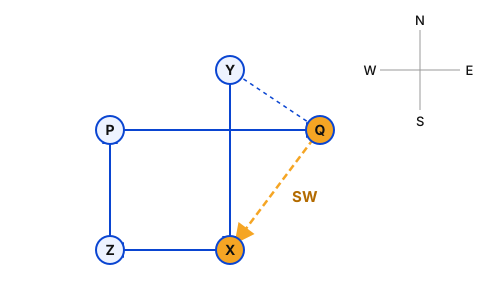
Town X is to the south of Town Y. Town Z is to the west of Town X. Town P is to the north of Town Z. Town Q is to the east of Town P. Town Y is to the north-west of Town Q. What is the position of Town X with respect to Town Q?
नगर X, नगर Y के दक्षिण में है। नगर Z, नगर X के पश्चिम में है। नगर P, नगर Z के उत्तर में है। नगर Q, नगर P के पूर्व में है। नगर Y, नगर Q के उत्तर-पश्चिम में है। नगर Q के सापेक्ष नगर X की स्थिति क्या है?
  1. ANorth-eastउत्तर-पूर्व
  2. BNorth-westउत्तर-पश्चिम
  3. CSouth-eastदक्षिण-पूर्व
  4. DSouth-westदक्षिण-पश्चिम
Show answer

Concept: Place the towns step by step on a grid with X as the origin.

  1. Y is north of X; Z is west of X; P is north of Z; Q is east of P (same level as P).
  2. Y is north-west of Q → Q lies east of the X–Y line and below Y.
  3. So Q is to the north-east of X, i.e. X is to the south-west of Q.

Trick: Find Q's position from X (NE) and reverse it: NE ↔ SW.

Answer: (D) South-west

अवधारणा: X को मूल बिंदु मानकर कस्बों को क्रम से ग्रिड पर रखें।

  1. Y, X के उत्तर में; Z, X के पश्चिम में; P, Z के उत्तर में; Q, P के पूर्व में (P के समान स्तर पर)।
  2. Y, Q के उत्तर-पश्चिम में → Q, X–Y रेखा के पूर्व में और Y से नीचे है।
  3. अतः Q, X के उत्तर-पूर्व में है, यानी X, Q के दक्षिण-पश्चिम में।

ट्रिक: X से Q की दिशा (NE) निकालें और उलट दें: NE ↔ SW।

उत्तर: (D) दक्षिण-पश्चिम

RRB NTPC Undergraduate CBT 1General Intelligence and ReasoningDirection senseRRB NTPC Undergraduate CBT 1 2025 · 16 Jun Shift 2 →
Q6969.
Which of the following letter-number clusters will replace the question mark (?) in the given series to make it logically complete?
XK253, UO236, RS219, ?
निम्नलिखित में से कौन-सा अक्षर-संख्या समूह दी गई श्रृंखला में प्रश्न चिह्न (?) के स्थान पर आकर उसे तार्किक रूप से पूर्ण करेगा?
XK253, UO236, RS219, ?
  1. AOW202
  2. BNW206
  3. COV204
  4. DMV208
Show answer

Concept: Treat the first letter, second letter and number as three separate series.

  1. First letter: X → U → R → O (each −3).
  2. Second letter: K → O → S → W (each +4).
  3. Number: 253→236→219→202 (each −17).

Trick: Check the number part first: only one option ends in 202.

Answer: (A) OW202

अवधारणा: पहला अक्षर, दूसरा अक्षर और संख्या – तीन अलग श्रृंखलाएँ मानें।

  1. पहला अक्षर: X → U → R → O (हर बार −3)।
  2. दूसरा अक्षर: K → O → S → W (हर बार +4)।
  3. संख्या: 253→236→219→202 (हर बार −17)।

ट्रिक: पहले संख्या जाँचें: केवल एक विकल्प 202 पर खत्म होता है।

उत्तर: (A) OW202

RRB NTPC Undergraduate CBT 1General Intelligence and ReasoningAlphanumeric seriesRRB NTPC Undergraduate CBT 1 2025 · 16 Jun Shift 2 →
Q6970.
Select the set in which the numbers are related in the same way as are the numbers of the following sets.
(NOTE: Operations should be performed on the whole numbers, without breaking down the numbers into their constituent digits. E.g. 13 – Operations on 13 such as
adding/subtracting/multiplying etc. to 13 can be performed. Breaking down 13 into 1 and 3 and then performing mathematical operations on 1 and 3 is not allowed.) 91, 184
88, 178
उस समुच्चय का चयन कीजिए जिसमें संख्याएँ उसी प्रकार संबंधित हैं जिस प्रकार निम्नलिखित समुच्चयों की संख्याएँ संबंधित हैं।
(ध्यान दें: संक्रियाएँ संख्याओं को उनके घटक अंकों में विभाजित किए बिना, पूर्ण संख्याओं पर की जानी चाहिए। उदाहरण के लिए, 13 – 13 पर संक्रियाएँ जैसे
13 में जोड़ना/घटाना/गुणा करना आदि किया जा सकता है। 13 को 1 और 3 में विभाजित करना और फिर 1 और 3 पर गणितीय संक्रियाएँ करना वर्जित है।) 91, 184
88, 178
  1. A99, 200
  2. B104, 218
  3. C76, 152
  4. D92, 184
Show answer

Concept: Find one rule that turns the first number into the second in both given pairs.

  1. 91×2+2=184 ✓; 88×2+2=178 ✓ → rule: second =2× first +2.
  2. 99×2+2=200 ✓.
  3. Others: 104×2+2=210≠218, 76×2+2=154≠152, 92×2+2=186≠184.

Trick: Second number is about double the first → test 'double plus/minus a small number'.

Answer: (A) 99, 200

अवधारणा: एक ऐसा नियम खोजें जो दोनों दिए युग्मों में पहली संख्या से दूसरी बनाए।

  1. 91×2+2=184 ✓; 88×2+2=178 ✓ → नियम: दूसरी =2× पहली +2।
  2. 99×2+2=200 ✓।
  3. अन्य: 104×2+2=210≠218, 76×2+2=154≠152, 92×2+2=186≠184।

ट्रिक: दूसरी संख्या लगभग दोगुनी है → 'दोगुना ± छोटी संख्या' जाँचें।

उत्तर: (A) 99, 200

RRB NTPC Undergraduate CBT 1General Intelligence and ReasoningNumber pair analogyRRB NTPC Undergraduate CBT 1 2025 · 16 Jun Shift 2 →
Q6971.
In a certain code language,
A @ B means ‘A is the mother of B’,
A × B means ‘A is the wife of B’,
A + B means ‘A is the brother of B’ and
A ÷ B means ‘A is the father of B’.
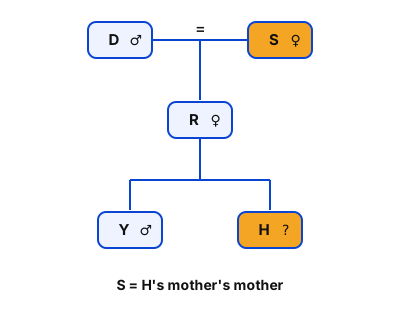
How is S related to H if ‘S × D ÷ R @ Y + H’?
एक निश्चित कूट भाषा में,
A @ B का अर्थ है 'A, B की माँ है',
A × B का अर्थ है 'A, B की पत्नी है',
A + B का अर्थ है 'A, B का भाई है' और
A ÷ B का अर्थ है 'A, B का पिता है'।
यदि 'S × D ÷ R @ Y + H' है, तो S का H से क्या संबंध है?
  1. AMother's motherमाँ की माँ
  2. BMotherमाँ
  3. CSisterबहन
  4. DMother's sisterमाँ की बहन
Show answer

Concept: Decode each symbol and draw the family tree.

  1. S × D: S is the wife of D.
  2. D ÷ R: D is the father of R → S is R's mother.
  3. R @ Y: R is the mother of Y; Y + H: Y is the brother of H → R is H's mother.
  4. S is the mother of H's mother.

Trick: Mother's mother = maternal grandmother (nani).

Answer: (A) Mother's mother

अवधारणा: हर प्रतीक का अर्थ निकालें और वंश-वृक्ष बनाएँ।

  1. S × D: S, D की पत्नी है।
  2. D ÷ R: D, R का पिता है → S, R की माँ है।
  3. R @ Y: R, Y की माँ है; Y + H: Y, H का भाई है → R, H की माँ है।
  4. S, H की माँ की माँ (नानी) है।

ट्रिक: माँ की माँ = नानी।

उत्तर: (A) माँ की माँ (Mother's mother)

RRB NTPC Undergraduate CBT 1General Intelligence and ReasoningCoded blood relationsRRB NTPC Undergraduate CBT 1 2025 · 16 Jun Shift 2 →
Q6972.
In a certain code language,
A # B means ‘A is the daughter of B’,
A @ B means ‘A is the brother of B’,
A ! B means ‘A is the wife of B’ and
A & B means ‘A is the father of B’.
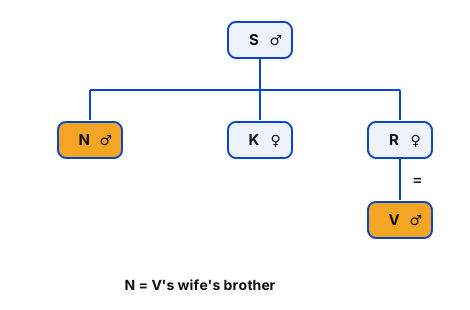
How is N related to V if ‘N @ K # S & R ! V’?
एक निश्चित कूट भाषा में,
A # B का अर्थ है 'A, B की पुत्री है',
A @ B का अर्थ है 'A, B का भाई है',
A ! B का अर्थ है 'A, B की पत्नी है' और
A & B का अर्थ है 'A, B का पिता है'।
यदि 'N @ K # S & R ! V' है, तो N का V से क्या संबंध है?
  1. AWife's fatherपत्नी का पिता
  2. BHusbandपति
  3. CWife's brotherपत्नी का भाई
  4. DSonपुत्र
Show answer

Concept: Decode each symbol and draw the family tree.

  1. N @ K: N is the brother of K.
  2. K # S: K is the daughter of S; S & R: S is the father of R → N, K and R are siblings.
  3. R ! V: R is the wife of V.
  4. So N is the brother of V's wife.

Trick: Brother of wife = wife's brother (saala).

Answer: (C) Wife's brother

अवधारणा: हर प्रतीक का अर्थ निकालें और वंश-वृक्ष बनाएँ।

  1. N @ K: N, K का भाई है।
  2. K # S: K, S की बेटी है; S & R: S, R का पिता है → N, K और R भाई-बहन हैं।
  3. R ! V: R, V की पत्नी है।
  4. अतः N, V की पत्नी का भाई (साला) है।

ट्रिक: पत्नी का भाई = साला।

उत्तर: (C) पत्नी का भाई (Wife's brother)

RRB NTPC Undergraduate CBT 1General Intelligence and ReasoningCoded blood relationsRRB NTPC Undergraduate CBT 1 2025 · 16 Jun Shift 2 →
Q6973.
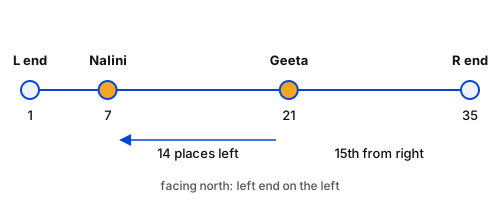
In a row of 35 people facing the north, Geeta is 15th from the right end. If Nalini sits 14th to the left of Geeta, what is Nalini’s position from the left end of the row?
उत्तर की ओर मुख करके बैठे 35 व्यक्तियों की एक पंक्ति में, गीता दाएँ छोर से 15वें स्थान पर है। यदि नलिनी, गीता के बाईं ओर 14वें स्थान पर बैठी है, तो पंक्ति के बाएँ छोर से नलिनी का स्थान क्या है?
  1. A9th9वाँ
  2. B7th7वाँ
  3. C4th4था
  4. D5th5वाँ
Show answer

Concept: Position from left = total − position from right +1.

  1. Geeta from left =35−15+1=21st.
  2. Nalini is 14 places to the left of Geeta: 21−14=7.
  3. Nalini is 7th from the left end.

Trick: Left + Right = Total +1.

Answer: (B) 7th

अवधारणा: बाएँ से स्थान = कुल − दाएँ से स्थान +1।

  1. गीता बाएँ से =35−15+1=21वीं।
  2. नलिनी, गीता के बाईं ओर 14वें स्थान पर: 21−14=7।
  3. नलिनी बाएँ छोर से 7वीं है।

ट्रिक: बाएँ + दाएँ = कुल +1।

उत्तर: (B) 7वीं

RRB NTPC Undergraduate CBT 1General Intelligence and ReasoningRanking – rowRRB NTPC Undergraduate CBT 1 2025 · 16 Jun Shift 2 →
Q6974.
Based on the English alphabetical order, three of the following four letter-clusters are alike in a certain way and thus form a group. Which letter-cluster DOES NOT belong to that group?
(Note: The odd one out is not based on the number of consonants/vowels or their position in the letter-cluster.)
अंग्रेज़ी वर्णमाला क्रम के आधार पर, निम्नलिखित चार अक्षर-समूहों में से तीन किसी निश्चित प्रकार से एकसमान हैं और इस प्रकार एक समूह बनाते हैं। कौन-सा अक्षर-समूह उस समूह से संबंधित नहीं है?
(ध्यान दें: असंगत अक्षर-समूह, उस अक्षर-समूह में व्यंजनों/स्वरों की संख्या या उनके स्थान पर आधारित नहीं है।)
  1. ATWQM
  2. BCFZV
  3. CMPIE
  4. DKNHD
Show answer

Concept: Find the gaps between consecutive letters using their positions (A = 1 … Z = 26).

  1. TWQM: T(20) → W(23) → Q(17) → M(13): +3,−6,−4.
  2. CFZV: 3→6→26→22: +3,−6 (looping back), −4; KNHD: 11→14→8→4: +3,−6,−4.
  3. MPIE: 13→16→9→5: +3,−7,−4 ✗.

Trick: Write numbers above letters; the middle gap is usually where the odd one differs.

Answer: (C) MPIE

अवधारणा: अक्षरों के स्थानीय मान (A = 1 … Z = 26) से लगातार अक्षरों का अंतर निकालें।

  1. TWQM: T(20) → W(23) → Q(17) → M(13): +3,−6,−4।
  2. CFZV: 3→6→26→22: +3,−6 (चक्र में), −4; KNHD: 11→14→8→4: +3,−6,−4।
  3. MPIE: 13→16→9→5: +3,−7,−4 ✗।

ट्रिक: अक्षरों के ऊपर संख्याएँ लिखें; अक्सर बीच वाला अंतर ही अलग होता है।

उत्तर: (C) MPIE

RRB NTPC Undergraduate CBT 1General Intelligence and ReasoningLetter cluster odd one outRRB NTPC Undergraduate CBT 1 2025 · 16 Jun Shift 2 →
Q6975.
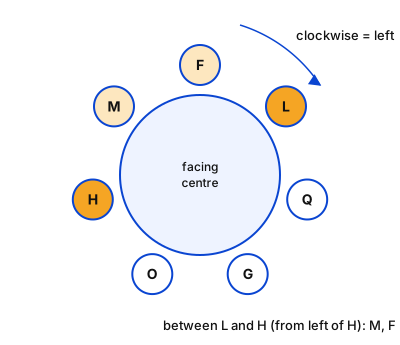
Seven people F, G, H, L, M, O and Q are sitting around a circular table, facing the centre of the table. Only three people sit between G and F when counted from the right of F. Q sits to the immediate right of G. Only three people sit between Q and M when counted from the left of Q. O sits to the immediate right of H. How many people sit between L and H when counted from the left of H?
सात व्यक्ति F, G, H, L, M, O और Q एक वृत्ताकार मेज़ के चारों ओर मेज़ के केंद्र की ओर मुख करके बैठे हैं। F के दाएँ से गिनने पर G और F के बीच केवल तीन व्यक्ति बैठे हैं। Q, G के ठीक दाएँ बैठा है। Q के बाएँ से गिनने पर Q और M के बीच केवल तीन व्यक्ति बैठे हैं। O, H के ठीक दाएँ बैठा है। H के बाएँ से गिनने पर L और H के बीच कितने व्यक्ति बैठे हैं?
  1. ATwoदो
  2. BOneएक
  3. CFourचार
  4. DThreeतीन
Show answer

Concept: Facing the centre: left = clockwise, right = anticlockwise.

  1. Fix F. Counting to the right of F, three people sit between F and G → G is 4th to the right of F.
  2. Q is immediately right of G; counting left from Q, three sit between Q and M → M is 4th to the left of Q (2nd to the right of F).
  3. Remaining seats: H and O together (O immediately right of H), L in the last seat.
  4. Counting left (clockwise) from H: M, F, then L → two people.

Trick: In circular puzzles with 7 seats, '3 between' from one side means '2 between' from the other side.

Answer: (A) Two

अवधारणा: केंद्र की ओर मुख: बायाँ = दक्षिणावर्त, दायाँ = वामावर्त।

  1. F को स्थिर करें। F के दाएँ से गिनने पर F और G के बीच तीन व्यक्ति → G, F के दाएँ चौथे स्थान पर।
  2. Q, G के ठीक दाएँ; Q के बाएँ से गिनने पर Q और M के बीच तीन → M, Q के बाएँ चौथे (F के दाएँ दूसरे) स्थान पर।
  3. बचे स्थान: H और O साथ (O, H के ठीक दाएँ), अंतिम स्थान पर L।
  4. H के बाएँ (दक्षिणावर्त) से गिनें: M, F, फिर L → दो व्यक्ति।

ट्रिक: 7 सीटों में एक ओर से '3 बीच में' = दूसरी ओर से '2 बीच में'।

उत्तर: (A) दो

RRB NTPC Undergraduate CBT 1General Intelligence and ReasoningCircular seatingRRB NTPC Undergraduate CBT 1 2025 · 16 Jun Shift 2 →
Q6976.
Read the given statements and conclusions carefully. You have to take the given statements to be true even if they seem to be at variance from commonly known facts. You have to decide which conclusions logically follow/s from the given statements. Statements: All gloves are bandages. No glove is a sling.
Conclusion (I) : Some slings are bandages
Conclusion (II) : All bandages are slings
दिए गए कथनों और निष्कर्षों को ध्यानपूर्वक पढ़िए। आपको दिए गए कथनों को सत्य मानना है, भले ही वे सामान्यतः ज्ञात तथ्यों से भिन्न प्रतीत होते हों। आपको निर्णय करना है कि कौन-सा/से निष्कर्ष दिए गए कथनों का तार्किक रूप से अनुसरण करता है/करते हैं। कथन: सभी दस्ताने, पट्टियाँ हैं। कोई भी दस्ताना, स्लिंग नहीं है।
निष्कर्ष (I) : कुछ स्लिंग, पट्टियाँ हैं
निष्कर्ष (II) : सभी पट्टियाँ, स्लिंग हैं
  1. ABoth conclusions (I) and (II) followनिष्कर्ष (I) और (II) दोनों अनुसरण करते हैं
  2. BOnly conclusion (II) followsकेवल निष्कर्ष (II) अनुसरण करता है
  3. CNeither conclusion (I) nor (II) followsन तो निष्कर्ष (I) और न ही (II) अनुसरण करता है
  4. DOnly conclusion (I) followsकेवल निष्कर्ष (I) अनुसरण करता है
Show answer

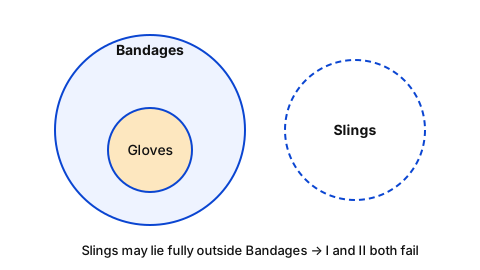
Concept: Draw the least possible Venn diagram and test each conclusion.

  1. All gloves are bandages → Gloves circle inside Bandages.
  2. No glove is a sling → Slings is apart from Gloves; it can lie fully outside Bandages too.
  3. I (some slings are bandages) is only possible, not certain ✗.
  4. II (all bandages are slings) is impossible, since gloves are bandages but not slings ✗.

Trick: A conclusion follows only if it is true in every possible diagram.

Answer: (C) Neither conclusion (I) nor (II) follows

अवधारणा: न्यूनतम संभव वेन आरेख बनाकर प्रत्येक निष्कर्ष जाँचें।

  1. सभी दस्ताने पट्टियाँ हैं → Gloves वृत्त, Bandages के अंदर।
  2. कोई दस्ताना स्लिंग नहीं → Slings, Gloves से अलग; यह Bandages से भी पूरी तरह बाहर हो सकता है।
  3. I (कुछ स्लिंग पट्टियाँ हैं) केवल संभव है, निश्चित नहीं ✗।
  4. II (सभी पट्टियाँ स्लिंग हैं) असंभव, क्योंकि दस्ताने पट्टियाँ हैं पर स्लिंग नहीं ✗।

ट्रिक: निष्कर्ष तभी अनुसरण करता है जब वह हर संभव आरेख में सत्य हो।

उत्तर: (C) न तो निष्कर्ष (I) और न ही (II) अनुसरण करता है

RRB NTPC Undergraduate CBT 1General Intelligence and ReasoningSyllogismRRB NTPC Undergraduate CBT 1 2025 · 16 Jun Shift 2 →
Q6977.
In a certain code language, ‘car event stop’ is coded as 'mb mj gs' and ‘stop van lime’ is coded as ‘ii mb rb’. How is ‘stop’ coded in the given language?
एक निश्चित कूट भाषा में, 'car event stop' को 'mb mj gs' के रूप में कूटबद्ध किया जाता है और 'stop van lime' को 'ii mb rb' के रूप में कूटबद्ध किया जाता है। दी गई भाषा में 'stop' को किस प्रकार कूटबद्ध किया जाता है?
  1. Ags
  2. Bmb
  3. Cii
  4. Dmj
Show answer

Concept: A word common to two sentences gets the code common to both coded forms.

  1. 'car event stop' → mb mj gs; 'stop van lime' → ii mb rb.
  2. Common word: stop; common code: mb.
  3. So stop = mb.

Trick: Match the common word with the common code – no need to decode other words.

Answer: (B) mb

अवधारणा: दो वाक्यों में समान शब्द का कोड दोनों कोडित रूपों में समान होता है।

  1. 'car event stop' → mb mj gs; 'stop van lime' → ii mb rb।
  2. समान शब्द: stop; समान कोड: mb।
  3. अतः stop = mb।

ट्रिक: समान शब्द को समान कोड से मिलाएँ – बाकी शब्द डिकोड करने की ज़रूरत नहीं।

उत्तर: (B) mb

RRB NTPC Undergraduate CBT 1General Intelligence and ReasoningCoding – common wordsRRB NTPC Undergraduate CBT 1 2025 · 16 Jun Shift 2 →
Q6978.
In a certain code language, ‘DESK’ is coded as ‘2794’ and ‘KIDS’ is coded as ‘6924’. What is the code for ‘I’ in the given code language?
एक निश्चित कूट भाषा में, 'DESK' को '2794' के रूप में और 'KIDS' को '6924' के रूप में कूटबद्ध किया जाता है। दी गई कूट भाषा में 'I' के लिए कूट क्या है?
  1. A4
  2. B6
  3. C9
  4. D2
Show answer

Concept: Letters common to both words take the digits common to both codes.

  1. DESK → 2794 and KIDS → 6924.
  2. Common letters D, S, K ↔ common digits 2, 9, 4.
  3. Left-over: E ↔ 7 (in DESK) and I ↔ 6 (in KIDS).

Trick: Cancel common letters and common digits; what remains pairs up.

Answer: (B) 6

अवधारणा: दोनों शब्दों के समान अक्षरों को दोनों कोडों के समान अंक मिलते हैं।

  1. DESK → 2794 और KIDS → 6924।
  2. समान अक्षर D, S, K ↔ समान अंक 2, 9, 4।
  3. शेष: E ↔ 7 (DESK में) और I ↔ 6 (KIDS में)।

ट्रिक: समान अक्षर और समान अंक हटाएँ; जो बचे वे जोड़े बनाते हैं।

उत्तर: (B) 6

RRB NTPC Undergraduate CBT 1General Intelligence and ReasoningCoding – letters to digitsRRB NTPC Undergraduate CBT 1 2025 · 16 Jun Shift 2 →
Q6979.
Based on the English alphabetical order, three of the following four letter-cluster pairs are alike in a certain way and thus form a group. Which is the one that does not belong to that group?
(Note: The odd man out is not based on the number of consonants/vowels or their position in the letter cluster.)
अंग्रेज़ी वर्णमाला क्रम के आधार पर, निम्नलिखित चार अक्षर-समूह युग्मों में से तीन किसी निश्चित प्रकार से एकसमान हैं और इस प्रकार एक समूह बनाते हैं। वह कौन-सा युग्म है जो उस समूह से संबंधित नहीं है?
(ध्यान दें: असंगत युग्म, अक्षर-समूह में व्यंजनों/स्वरों की संख्या या उनके स्थान पर आधारित नहीं है।)
  1. ARK – OG
  2. BMJ – IF
  3. CRF – NB
  4. DUG – QC
Show answer

Concept: Compare each letter of the first cluster with the matching letter of the second.

  1. MJ – IF: 13→9, 10→6: −4,−4.
  2. RF – NB: 18→14, 6→2: −4,−4; UG – QC: 21→17, 7→3: −4,−4.
  3. RK – OG: 18→15 (−3), 11→7 (−4) ✗.

Trick: Check the first letters only: R→O (−3) breaks the −4 pattern at once.

Answer: (A) RK – OG

अवधारणा: पहले समूह के प्रत्येक अक्षर की तुलना दूसरे समूह के संगत अक्षर से करें।

  1. MJ – IF: 13→9, 10→6: −4,−4।
  2. RF – NB: 18→14, 6→2: −4,−4; UG – QC: 21→17, 7→3: −4,−4।
  3. RK – OG: 18→15 (−3), 11→7 (−4) ✗।

ट्रिक: केवल पहले अक्षर देखें: R→O (−3) तुरंत −4 पैटर्न तोड़ता है।

उत्तर: (A) RK – OG

RRB NTPC Undergraduate CBT 1General Intelligence and ReasoningLetter pair odd one outRRB NTPC Undergraduate CBT 1 2025 · 16 Jun Shift 2 →
Q6980.
If ‘P’ stands for ‘×’, ‘Q’ stands for ‘÷’, ‘R’ stands for ‘−’ and ‘S’ stands for ‘+’, what will come in place of the question mark ‘?’ in the following equation?
78 Q 3 S (55 Q 5) P 4 R 16 P 5 S 65 = ?
यदि 'P' का अर्थ '×', 'Q' का अर्थ '÷', 'R' का अर्थ '−' और 'S' का अर्थ '+' है, तो निम्नलिखित समीकरण में प्रश्न चिह्न '?' के स्थान पर क्या आएगा?
78 Q 3 S (55 Q 5) P 4 R 16 P 5 S 65 = ?
  1. A49
  2. B70
  3. C35
  4. D55
Show answer

Concept: Replace letters with signs, then apply BODMAS.

  1. Expression: 78÷3+(55÷5)×4−16×5+65.
  2. =26+11×4−80+65.
  3. =26+44−80+65=55.

Trick: Solve the bracket first, then all ÷ and ×, then + and −.

Answer: (D) 55

अवधारणा: अक्षरों के स्थान पर चिह्न रखें, फिर BODMAS लगाएँ।

  1. व्यंजक: 78÷3+(55÷5)×4−16×5+65।
  2. =26+11×4−80+65।
  3. =26+44−80+65=55।

ट्रिक: पहले कोष्ठक, फिर सभी ÷ और ×, फिर + और −।

उत्तर: (D) 55

RRB NTPC Undergraduate CBT 1General Intelligence and ReasoningMathematical operationsRRB NTPC Undergraduate CBT 1 2025 · 16 Jun Shift 2 →