Question bank

Q&A: practice questions with answers

Search questions on any topic. Filter by exam category, exam, subject and topic, try the question, then open the answer and explanation.

Courses – airGurukul

8,495 questions found.

Q7041.
A car travels from City A to City B at a speed of 60 km/h. After reaching City B, the driver increases the speed by 20 km/h for the return journey. Due to road repairs on the way back, the car is forced to slow down for 30 minutes, during which it travels at only 30 km/h instead of the increased speed. If the total time for the round trip is 7 hours, find the distance between City A and City B.
एक कार शहर A से शहर B तक 60 km/h की चाल से यात्रा करती है। शहर B पहुँचने के बाद, चालक वापसी यात्रा के लिए चाल 20 km/h बढ़ा देता है। वापसी के रास्ते में सड़क की मरम्मत के कारण कार को 30 मिनट के लिए धीमा होना पड़ता है, जिसके दौरान वह बढ़ी हुई चाल के बजाय केवल 30 km/h की चाल से चलती है। यदि आने-जाने की यात्रा का कुल समय 7 घंटे है, तो शहर A और शहर B के बीच की दूरी ज्ञात कीजिए।
  1. A22927 km
  2. B22725 km
  3. C21927 km
  4. D22925 km
Show answer

Concept: Total time = sum of times of each stretch. In the 30-minute slow stretch the car covers 30×12=15 km.

  1. Let distance =d km. Onward time =d60.
  2. Return: 12 h at 30 km/h (15 km) + d−1580 h at 80 km/h.
  3. d60+12+d−1580=7⇒4d+3d240=6.5+1580=10716.
  4. 7d=107×24016=1605⇒d=16057=22927 km.

Trick: Convert the slow stretch into a fixed distance (15 km) first; the rest is a plain two-speed equation.

Answer: (A) 22927 km

अवधारणा: कुल समय = हर हिस्से के समय का योग। 30 मिनट की धीमी चाल में कार 30×12=15 km चलती है।

  1. दूरी =d km मानें। जाने का समय =d60।
  2. वापसी: 12 घंटा 30 km/h पर (15 km) + d−1580 घंटा 80 km/h पर।
  3. d60+12+d−1580=7⇒4d+3d240=6.5+1580=10716।
  4. 7d=107×24016=1605⇒d=16057=22927 km।

ट्रिक: धीमे हिस्से को पहले निश्चित दूरी (15 km) में बदल लें; बाकी साधारण दो-चाल वाला समीकरण है।

उत्तर: (A) 22927 km

RRB NTPC Undergraduate CBT 1MathematicsSpeed, Time & DistanceRRB NTPC Undergraduate CBT 1 2025 · 16 Jun Shift 1 →
Q7042.
The arithmetic mean of 10 observations is 42. Three of the observations are 30, 38, and 50. The remaining six observations have an average of 45. Find the missing
observation.
10 प्रेक्षणों का समांतर माध्य 42 है। इनमें से तीन प्रेक्षण 30, 38 और 50 हैं। शेष छह प्रेक्षणों का औसत 45 है। लुप्त
प्रेक्षण ज्ञात कीजिए।
  1. A31
  2. B33
  3. C32
  4. D34
Show answer

Concept: Sum = mean × count; the missing value is total minus the known parts.

  1. Total of 10 =10×42=420.
  2. Known three: 30+38+50=118; six others: 6×45=270.
  3. Missing =420−118−270=32.

Trick: Work with totals, never with averages directly.

Answer: (C) 32

अवधारणा: योग = औसत × संख्या; लुप्त मान = कुल − ज्ञात भाग।

  1. 10 का योग =10×42=420।
  2. तीन ज्ञात: 30+38+50=118; बाकी छह: 6×45=270।
  3. लुप्त =420−118−270=32।

ट्रिक: हमेशा योग पर काम करें, औसत पर सीधे नहीं।

उत्तर: (C) 32

RRB NTPC Undergraduate CBT 1MathematicsAverageRRB NTPC Undergraduate CBT 1 2025 · 16 Jun Shift 1 →
Q7043.
A sum of ₹20,000 amounts to ₹21,218 in 2 years under compound interest, compounded annually. Find the rate of interest per annum.
₹20,000 की राशि वार्षिक रूप से संयोजित चक्रवृद्धि ब्याज पर 2 वर्षों में ₹21,218 हो जाती है। वार्षिक ब्याज दर ज्ञात कीजिए।
  1. A3%
  2. B5%
  3. C8%
  4. D4%
Show answer

Concept: A=P(1+r100)2.

  1. (1+r100)2=2121820000=1.0609.
  2. 1.032=1.0609 → r=3%.

Trick: 2-year CI %=2r+r2100; for r=3: 6+0.09=6.09% of 20000 =1218 ✓.

Answer: (A) 3%

अवधारणा: A=P(1+r100)2।

  1. (1+r100)2=2121820000=1.0609।
  2. 1.032=1.0609 → r=3%।

ट्रिक: 2 वर्ष का प्रभावी CI %=2r+r2100; r=3 पर 6.09% → 20000 का 1218 ✓।

उत्तर: (A) 3%

RRB NTPC Undergraduate CBT 1MathematicsCompound InterestRRB NTPC Undergraduate CBT 1 2025 · 16 Jun Shift 1 →
Q7044.
Find the value of {3.46+314−518+4.25+0.165}.
{3.46+314−518+4.25+0.165} का मान ज्ञात कीजिए।
  1. A7
  2. B7.4
  3. C6
  4. D6.8
Show answer

Concept: Convert mixed fractions to decimals and add step by step.

  1. 314=3.25, 518=5.125.
  2. 3.46+3.25=6.71; 6.71−5.125=1.585.
  3. 1.585+4.25+0.165=6.000.

Trick: Pair decimals that complete each other: 3.46+4.25+0.165=7.875 and 3.25−5.125=−1.875 → 6.

Answer: (C) 6

अवधारणा: मिश्र भिन्नों को दशमलव में बदलकर क्रम से जोड़ें।

  1. 314=3.25, 518=5.125।
  2. 3.46+3.25=6.71; 6.71−5.125=1.585।
  3. 1.585+4.25+0.165=6.000।

ट्रिक: पूरक दशमलव जोड़ें: 3.46+4.25+0.165=7.875 और 3.25−5.125=−1.875 → 6।

उत्तर: (C) 6

RRB NTPC Undergraduate CBT 1MathematicsSimplificationRRB NTPC Undergraduate CBT 1 2025 · 16 Jun Shift 1 →
Q7045.
A sum of ₹8,000 is borrowed at a simple interest rate of 5% per annum for 3 years. What is the simple interest payable?
₹8,000 की राशि 5% वार्षिक साधारण ब्याज दर पर 3 वर्षों के लिए उधार ली जाती है। देय साधारण ब्याज कितना है?
  1. A₹1,200
  2. B₹1,600
  3. C₹1,400
  4. D₹1,000
Show answer

Concept: SI=P×R×T100.

  1. SI=8000×5×3100=80×15=1200.

Trick: 5% for 3 years =15% of principal; 15% of 8000 =1200.

Answer: (A) ₹1,200

अवधारणा: SI=P×R×T100।

  1. SI=8000×5×3100=80×15=1200।

ट्रिक: 3 वर्ष का 5% = मूलधन का 15%; 8000 का 15%=1200।

उत्तर: (A) ₹1,200

RRB NTPC Undergraduate CBT 1MathematicsSimple InterestRRB NTPC Undergraduate CBT 1 2025 · 16 Jun Shift 1 →
Q7046.
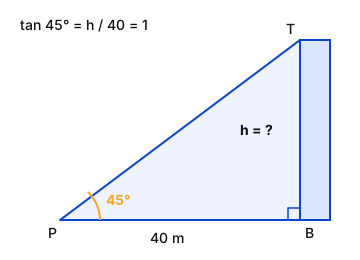
The angle of elevation of the top of a building from a point 40 m away is 45°. What is the height of the building?
40 m दूर स्थित एक बिंदु से एक भवन के शिखर का उन्नयन कोण 45° है। भवन की ऊँचाई कितनी है?
  1. A20 m
  2. B40 m
  3. C36 m
  4. D30 m
Show answer

Concept: tanθ=heightdistance.

  1. tan45∘=h40.
  2. tan45∘=1⇒h=40 m.

Yaad rakhein: At 45∘ elevation, height = distance (isosceles right triangle).

Answer: (B) 40 m

अवधारणा: tanθ=ऊँचाईदूरी।

  1. tan45∘=h40।
  2. tan45∘=1⇒h=40 m।

याद रखें: 45∘ उन्नयन कोण पर ऊँचाई = दूरी (समद्विबाहु समकोण त्रिभुज)।

उत्तर: (B) 40 m

RRB NTPC Undergraduate CBT 1MathematicsHeights & DistancesRRB NTPC Undergraduate CBT 1 2025 · 16 Jun Shift 1 →
Q7047.
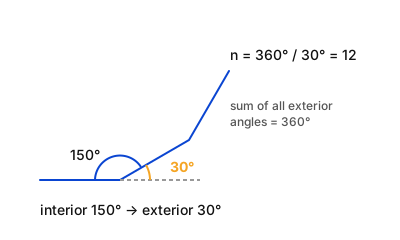
How many sides does a regular polygon have if each interior angle measures 150°?
यदि किसी सम बहुभुज का प्रत्येक अंतः कोण 150° है, तो उसकी कितनी भुजाएँ हैं?
  1. A15 sides15 भुजाएँ
  2. B10 sides10 भुजाएँ
  3. C8 sides8 भुजाएँ
  4. D12 sides12 भुजाएँ
Show answer

Concept: Exterior angle =180∘− interior angle, and n=360∘exterior angle.

  1. Exterior angle =180∘−150∘=30∘.
  2. n=360∘30∘=12.

Yaad rakhein: 108∘→5, 120∘→6, 135∘→8, 144∘→10, 150∘→12 sides.

Answer: (D) 12 sides

अवधारणा: बाह्य कोण =180∘− अंतः कोण, और n=360∘बाह्य कोण।

  1. बाह्य कोण =180∘−150∘=30∘।
  2. n=360∘30∘=12।

याद रखें: 108∘→5, 120∘→6, 135∘→8, 144∘→10, 150∘→12 भुजाएँ।

उत्तर: (D) 12 sides

RRB NTPC Undergraduate CBT 1MathematicsPolygon AnglesRRB NTPC Undergraduate CBT 1 2025 · 16 Jun Shift 1 →
Q7048.
Simplify √[1624+√{3225+√(419+157)}].
√[1624+√{3225+√(419+157)}] को सरल कीजिए।
  1. A43
  2. B45
  3. C47
  4. D41
Show answer

Concept: Simplify nested radicals from the innermost bracket outward.

  1. 419+157=576, 576=24.
  2. 3225+24=3249=572, 3249=57.
  3. 1624+57=1681=412, 1681=41.

Yaad rakhein: 412=1681, 572=3249, 242=576 — memorise squares up to 60.

Answer: (D) 41

अवधारणा: सबसे अंदर वाले कोष्ठक से बाहर की ओर करणी हल करें।

  1. 419+157=576, 576=24।
  2. 3225+24=3249=572, 3249=57।
  3. 1624+57=1681=412, 1681=41।

याद रखें: 412=1681, 572=3249, 242=576 — 60 तक के वर्ग याद रखें।

उत्तर: (D) 41

RRB NTPC Undergraduate CBT 1MathematicsSquare RootsRRB NTPC Undergraduate CBT 1 2025 · 16 Jun Shift 1 →
Q7049.
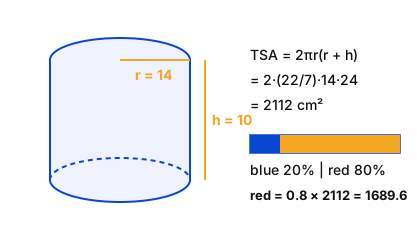
A closed cylindrical reservoir features a radius of 14 cm and a height of 10 cm. If 20% of the total surface area of this reservoir is coated in blue paint and the remaining surface is coated in red, determine the total area in square centimeters that is painted red. [Use π = 22/7]
एक बंद बेलनाकार जलाशय की त्रिज्या 14 cm और ऊँचाई 10 cm है। यदि इस जलाशय के कुल पृष्ठीय क्षेत्रफल के 20% भाग पर नीला पेंट किया गया है और शेष पृष्ठ पर लाल पेंट किया गया है, तो लाल रंग से पेंट किया गया कुल क्षेत्रफल वर्ग सेंटीमीटर में ज्ञात कीजिए। [π = 22/7 का प्रयोग कीजिए]
  1. A424.4 cm2
  2. B422.4 cm2
  3. C1689.6 cm2
  4. D1687.6 cm2
Show answer

Concept: Total surface area of a closed cylinder =2πr(r+h); red part =80% of it.

  1. TSA =2×227×14×(14+10)=88×24=2112 cm2.
  2. Red =80% of 2112=0.8×2112=1689.6 cm2.

Trick: With r=14, 2πr=88 exactly — then just multiply by (r+h).

Answer: (C) 1689.6 cm2

अवधारणा: बंद बेलन का कुल पृष्ठीय क्षेत्रफल =2πr(r+h); लाल भाग इसका 80%।

  1. TSA =2×227×14×(14+10)=88×24=2112 cm2।
  2. लाल =2112 का 80%=0.8×2112=1689.6 cm2।

ट्रिक: r=14 पर 2πr=88 ठीक-ठीक आता है — फिर बस (r+h) से गुणा करें।

उत्तर: (C) 1689.6 cm2

RRB NTPC Undergraduate CBT 1MathematicsMensuration – CylinderRRB NTPC Undergraduate CBT 1 2025 · 16 Jun Shift 1 →
Q7050.
A company has 10 officers and 30 clerks. The average monthly salary of an officer is ₹45,000 and that of a clerk is ₹25,000. What is the average salary of the entire staff?
एक कंपनी में 10 अधिकारी और 30 लिपिक हैं। एक अधिकारी का औसत मासिक वेतन ₹45,000 और एक लिपिक का ₹25,000 है। संपूर्ण कर्मचारियों का औसत वेतन कितना है?
  1. A₹35,000
  2. B₹30,000
  3. C₹28,000
  4. D₹32,000
Show answer

Concept: Average salary =total salarytotal staff.

  1. Total =10×45000+30×25000=450000+750000=1200000.
  2. Average =120000040=30000.

Trick: Ratio 1:3 → average lies 14 of the gap (20000) above 25000 → 25000+5000=30000.

Answer: (B) ₹30,000

अवधारणा: औसत वेतन =कुल वेतनकुल कर्मचारी।

  1. कुल =10×45000+30×25000=450000+750000=1200000।
  2. औसत =120000040=30000।

ट्रिक: अनुपात 1:3 → औसत, अंतर (20000) के 14 भाग जितना 25000 से ऊपर → 30000।

उत्तर: (B) ₹30,000

RRB NTPC Undergraduate CBT 1MathematicsWeighted AverageRRB NTPC Undergraduate CBT 1 2025 · 16 Jun Shift 1 →
Q7051.
The largest four-digit number which when divided by 12, 13 and 7 leaves remainder 3 in each case is:
चार अंकों की वह सबसे बड़ी संख्या, जिसे 12, 13 और 7 से विभाजित करने पर प्रत्येक स्थिति में 3 शेषफल प्राप्त होता है, है:
  1. A9934
  2. B9618
  3. C9438
  4. D9831
Show answer

Concept: Required number = (largest 4-digit multiple of LCM) +3.

  1. LCM(12,13,7)=1092.
  2. 9999÷1092=9 rem 171 → largest multiple =9999−171=9828.
  3. Number =9828+3=9831.

Trick: Options check: 9831−3=9828=9×1092 ✓ (divisible by 7, 12 and 13).

Answer: (D) 9831

अवधारणा: अभीष्ट संख्या = (LCM का सबसे बड़ा 4-अंकीय गुणज) +3।

  1. LCM(12,13,7)=1092।
  2. 9999÷1092=9 शेष 171 → सबसे बड़ा गुणज =9999−171=9828।
  3. संख्या =9828+3=9831।

ट्रिक: विकल्प जाँच: 9831−3=9828=9×1092 ✓ (7, 12, 13 से विभाज्य)।

उत्तर: (D) 9831

RRB NTPC Undergraduate CBT 1MathematicsLCM & RemaindersRRB NTPC Undergraduate CBT 1 2025 · 16 Jun Shift 1 →
Q7052.
A cyclist travels 40 meters in 8 seconds. What is his speed?
एक साइकिल चालक 8 सेकंड में 40 मीटर की दूरी तय करता है। उसकी चाल कितनी है?
  1. A18 km/hr
  2. B21 km/hr
  3. C16 km/hr
  4. D24 km/hr
Show answer

Concept: Speed =distancetime; m/s to km/h multiply by 185.

  1. Speed =408=5 m/s.
  2. 5×185=18 km/h.

Yaad rakhein: 5 m/s =18 km/h, 10 m/s =36 km/h.

Answer: (A) 18 km/hr

अवधारणा: चाल =दूरीसमय; m/s से km/h के लिए 185 से गुणा करें।

  1. चाल =408=5 m/s।
  2. 5×185=18 km/h।

याद रखें: 5 m/s =18 km/h, 10 m/s =36 km/h।

उत्तर: (A) 18 km/hr

RRB NTPC Undergraduate CBT 1MathematicsSpeed ConversionRRB NTPC Undergraduate CBT 1 2025 · 16 Jun Shift 1 →
Q7053.
The HCF and LCM of two positive integers are 36 and 7,560, respectively. If one of the numbers is 540, what is the other number?
दो धनात्मक पूर्णांकों का HCF और LCM क्रमशः 36 और 7,560 है। यदि इनमें से एक संख्या 540 है, तो दूसरी संख्या क्या है?
  1. A396
  2. B468
  3. C432
  4. D504
Show answer

Concept: For two numbers, HCF×LCM=a×b.

  1. b=36×7560540.
  2. 7560540=14 → b=36×14=504.

Trick: The other number must be a multiple of the HCF 36 — only 396, 432 and 504 are; check 504=36×14 with LCM 7560 ✓.

Answer: (D) 504

अवधारणा: दो संख्याओं के लिए HCF×LCM=a×b।

  1. b=36×7560540।
  2. 7560540=14 → b=36×14=504।

ट्रिक: दूसरी संख्या HCF 36 का गुणज होनी चाहिए; 504=36×14 और LCM 7560 से मेल ✓।

उत्तर: (D) 504

RRB NTPC Undergraduate CBT 1MathematicsHCF & LCMRRB NTPC Undergraduate CBT 1 2025 · 16 Jun Shift 1 →
Q7054.
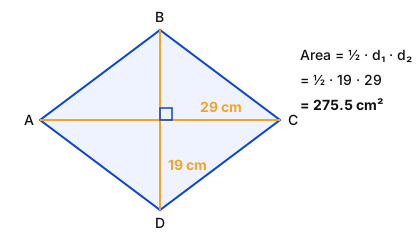
The diagonals of a rhombus are 19 cm and 29 cm. Find its area.
एक समचतुर्भुज के विकर्ण 19 cm और 29 cm हैं। उसका क्षेत्रफल ज्ञात कीजिए।
  1. A255.5 cm²
  2. B265.5 cm²
  3. C275.5 cm²
  4. D285.5 cm²
Show answer

Concept: Area of a rhombus =12d1d2 (diagonals bisect each other at right angles).

  1. Area =12×19×29.
  2. 19×29=551 → area =275.5 cm2.

Trick: 19×29=(24−5)(24+5)=576−25=551.

Answer: (C) 275.5 cm2

अवधारणा: समचतुर्भुज का क्षेत्रफल =12d1d2 (विकर्ण एक-दूसरे को समकोण पर समद्विभाजित करते हैं)।

  1. क्षेत्रफल =12×19×29।
  2. 19×29=551 → क्षेत्रफल =275.5 cm2।

ट्रिक: 19×29=(24−5)(24+5)=576−25=551।

उत्तर: (C) 275.5 cm2

RRB NTPC Undergraduate CBT 1MathematicsArea of RhombusRRB NTPC Undergraduate CBT 1 2025 · 16 Jun Shift 1 →
Q7055.
If a:b = 12:13 and b:c = 4:5, what is a:c?
यदि a:b = 12:13 और b:c = 4:5 है, तो a:c क्या है?
  1. A12:5
  2. B4:5
  3. C4:13
  4. D48:65
Show answer

Concept: a:c=ab×bc.

  1. ac=1213×45=4865.
  2. a:b:c=48:52:65 → a:c=48:65.

Trick: Multiply the first terms and the last terms: a:c=(12×4):(13×5).

Answer: (D) 48:65

अवधारणा: a:c=ab×bc।

  1. ac=1213×45=4865।
  2. a:b:c=48:52:65 → a:c=48:65।

ट्रिक: पहले पद आपस में और अंतिम पद आपस में गुणा करें: a:c=(12×4):(13×5)।

उत्तर: (D) 48:65

RRB NTPC Undergraduate CBT 1MathematicsRatioRRB NTPC Undergraduate CBT 1 2025 · 16 Jun Shift 1 →
Q7056.
The price of a jacket is first increased by 20% and then decreased by 25%. If the original price was ₹600, what is the final price of the jacket?
एक जैकेट का मूल्य पहले 20% बढ़ाया जाता है और फिर 25% घटाया जाता है। यदि मूल मूल्य ₹600 था, तो जैकेट का अंतिम मूल्य क्या है?
  1. A₹570
  2. B₹600
  3. C₹480
  4. D₹540
Show answer

Concept: Apply the multipliers one after another.

  1. 600×1.20=720.
  2. 720×0.75=540.

Trick: Net change =20−25−20×25100=−10% → 600×0.9=540.

Answer: (D) ₹540

अवधारणा: गुणकों को एक के बाद एक लगाएँ।

  1. 600×1.20=720।
  2. 720×0.75=540।

ट्रिक: शुद्ध परिवर्तन =20−25−20×25100=−10% → 600×0.9=540।

उत्तर: (D) ₹540

RRB NTPC Undergraduate CBT 1MathematicsSuccessive Percentage ChangeRRB NTPC Undergraduate CBT 1 2025 · 16 Jun Shift 1 →
Q7057.
Evaluate 243 + (-5)3 + (-19)3
243 + (-5)3 + (-19)3 का मान ज्ञात कीजिए।
  1. A6840
  2. B6763
  3. C6572
  4. D6783
Show answer

Concept: If a+b+c=0 then a3+b3+c3=3abc.

  1. 24+(−5)+(−19)=0.
  2. Sum =3×24×(−5)×(−19)=3×24×95=6840.

Trick: Whenever three cubes are asked, first check if the bases add to zero.

Answer: (A) 6840

अवधारणा: यदि a+b+c=0 तो a3+b3+c3=3abc।

  1. 24+(−5)+(−19)=0।
  2. योग =3×24×(−5)×(−19)=3×24×95=6840।

ट्रिक: तीन घनों का योग पूछा जाए तो पहले देखें कि आधारों का योग शून्य है या नहीं।

उत्तर: (A) 6840

RRB NTPC Undergraduate CBT 1MathematicsAlgebraic IdentityRRB NTPC Undergraduate CBT 1 2025 · 16 Jun Shift 1 →
Q7058.
A shopkeeper purchases rice at ₹60 per kg. While selling, he uses a weighing scale that shows 1 kg when only 900 g is actually weighed. He marks the price 20% above the cost price. Later, he gives a 10% discount on the marked price but continues using the same faulty scale. Find his profit (in ₹) on each transaction where the buyer pays for 1 kg.
एक दुकानदार ₹60 प्रति kg की दर से चावल खरीदता है। बेचते समय वह ऐसे तराजू का उपयोग करता है जो वास्तव में केवल 900 g तौलने पर 1 kg दर्शाता है। वह क्रय मूल्य से 20% अधिक मूल्य अंकित करता है। बाद में, वह अंकित मूल्य पर 10% की छूट देता है, परंतु उसी दोषपूर्ण तराजू का उपयोग जारी रखता है। प्रत्येक लेन-देन, जिसमें क्रेता 1 kg का भुगतान करता है, पर उसका लाभ (₹ में) ज्ञात कीजिए।
  1. A₹10.80
  2. B₹9.80
  3. C₹10.20
  4. D₹9.20
Show answer

Concept: The buyer pays for 1 kg at the discounted marked price but receives only 900 g; profit = amount received − cost of 900 g.

  1. Marked price of 1 kg =60×1.2=72; after 10% discount =64.80.
  2. Cost of 900 g actually given =0.9×60=54.
  3. Profit =64.80−54=10.80.

Trick: Profit %=1.2×0.90.9−1=20% on cost 54 → 10.80.

Answer: (A) ₹10.80

अवधारणा: ग्राहक छूट वाले अंकित मूल्य पर 1 kg का पैसा देता है पर पाता केवल 900 g; लाभ = प्राप्त राशि − 900 g की लागत।

  1. 1 kg का अंकित मूल्य =60×1.2=72; 10% छूट के बाद =64.80।
  2. वास्तव में दिए 900 g की लागत =0.9×60=54।
  3. लाभ =64.80−54=10.80।

ट्रिक: लाभ %=1.2×0.90.9−1=20%, लागत 54 पर → 10.80।

उत्तर: (A) ₹10.80

RRB NTPC Undergraduate CBT 1MathematicsProfit & Loss – False WeightRRB NTPC Undergraduate CBT 1 2025 · 16 Jun Shift 1 →
Q7059.
Mary is 3 years older than her sister. If their combined age is 27 years, what is Mary's age (in years)?
मैरी अपनी बहन से 3 वर्ष बड़ी है। यदि उनकी आयु का योग 27 वर्ष है, तो मैरी की आयु (वर्षों में) क्या है?
  1. A15
  2. B14
  3. C13
  4. D12
Show answer

Concept: Form a linear equation.

  1. Sister =x, Mary =x+3; x+x+3=27⇒x=12.
  2. Mary =15 years.

Trick: Sum 27, difference 3 → larger =27+32=15.

Answer: (A) 15

अवधारणा: रैखिक समीकरण बनाएँ।

  1. बहन =x, Mary =x+3; x+x+3=27⇒x=12।
  2. Mary =15 वर्ष।

ट्रिक: योग 27, अंतर 3 → बड़ी =27+32=15।

उत्तर: (A) 15

RRB NTPC Undergraduate CBT 1MathematicsAgesRRB NTPC Undergraduate CBT 1 2025 · 16 Jun Shift 1 →
Q7060.
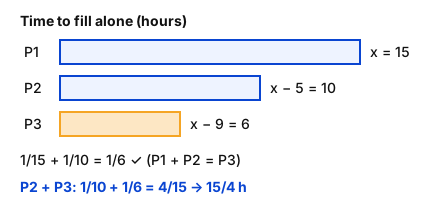
A swimming pool is fitted with three pipes. The first two pipes working simultaneously, fill the pool in the same time as the third pipe alone. The second pipe alone fills the pool 5 hours faster than the first pipe and 4 hours slower than the third pipe. In what time will the second and third pipes together fill the pool?
एक स्विमिंग पूल में तीन पाइप लगे हैं। पहले दो पाइप एक साथ कार्य करते हुए पूल को उतने ही समय में भरते हैं जितने समय में अकेला तीसरा पाइप भरता है। दूसरा पाइप अकेले पूल को पहले पाइप से 5 घंटे जल्दी और तीसरे पाइप से 4 घंटे देर से भरता है। दूसरा और तीसरा पाइप मिलकर पूल को कितने समय में भरेंगे?
  1. A4 hours4 घंटे
  2. B334 hours334 घंटे
  3. C712 hours712 घंटे
  4. D6 hours6 घंटे
Show answer

Concept: Let the first pipe take x h; then second =x−5, third =x−9 and 1x+1x−5=1x−9.

  1. (2x−5)(x−9)=x(x−5)⇒x2−18x+45=0⇒x=15 (reject 3).
  2. Times: 15, 10, 6 h.
  3. Second + third: 110+16=415 → 154=334 h.

Trick: The classic triple (15,10,6): 115+110=16 — remember it.

Answer: (B) 334 hours

अवधारणा: पहला पाइप x घंटे ले; दूसरा =x−5, तीसरा =x−9 और 1x+1x−5=1x−9।

  1. (2x−5)(x−9)=x(x−5)⇒x2−18x+45=0⇒x=15 (3 अमान्य)।
  2. समय: 15, 10, 6 घंटे।
  3. दूसरा + तीसरा: 110+16=415 → 154=334 घंटे।

ट्रिक: प्रसिद्ध त्रिक (15,10,6): 115+110=16 — याद रखें।

उत्तर: (B) 334 hours

RRB NTPC Undergraduate CBT 1MathematicsPipes & CisternsRRB NTPC Undergraduate CBT 1 2025 · 16 Jun Shift 1 →