Question bank

Q&A: practice questions with answers

Search questions on any topic. Filter by exam category, exam, subject and topic, try the question, then open the answer and explanation.

Courses – airGurukul

8,495 questions found.

Q7061.
A smart city metro line had an average of 4,500 daily riders last month. This month, it averaged 4,860 riders per day. What is the percentage growth in ridership?
एक स्मार्ट सिटी मेट्रो लाइन पर पिछले महीने औसतन 4,500 दैनिक यात्री थे। इस महीने, प्रतिदिन औसतन 4,860 यात्री रहे। यात्री संख्या में प्रतिशत वृद्धि कितनी है?
  1. A6.4%
  2. B8%
  3. C4.5%
  4. D10.2%
Show answer

Concept: Growth %=increaseoriginal×100.

  1. Increase =4860−4500=360.
  2. 3604500×100=8%.

Trick: 10% of 4500 =450, so 360 is 8%.

Answer: (B) 8%

अवधारणा: वृद्धि %=वृद्धिमूल×100।

  1. वृद्धि =4860−4500=360।
  2. 3604500×100=8%।

ट्रिक: 4500 का 10%=450, इसलिए 360 =8%।

उत्तर: (B) 8%

RRB NTPC Undergraduate CBT 1MathematicsPercentageRRB NTPC Undergraduate CBT 1 2025 · 16 Jun Shift 1 →
Q7062.
Find the mean proportional between (x + y)2 and (x - y)2, (x and y are natural number and x > y).
(x + y)2 और (x - y)2 का मध्यानुपाती ज्ञात कीजिए, (x और y प्राकृत संख्याएँ हैं और x > y)।
  1. Axy + x2
  2. Bx2 + y2
  3. Cxy + y2
  4. Dx2– y2
Show answer

Concept: Mean proportional of a and b is ab.

  1. (x+y)2(x−y)2=(x+y)(x−y) (positive since x>y).
  2. =x2−y2.

Yaad rakhein: (x+y)(x−y)=x2−y2.

Answer: (D) x2−y2

अवधारणा: a और b का मध्यानुपाती ab होता है।

  1. (x+y)2(x−y)2=(x+y)(x−y) (x>y से धनात्मक)।
  2. =x2−y2।

याद रखें: (x+y)(x−y)=x2−y2।

उत्तर: (D) x2−y2

RRB NTPC Undergraduate CBT 1MathematicsMean ProportionalRRB NTPC Undergraduate CBT 1 2025 · 16 Jun Shift 1 →
Q7063.
If x=5, what is the value of x+25?
यदि x=5 है, तो x+25 का मान क्या है?
  1. A35
  2. B25
  3. C52
  4. D53
Show answer

Concept: Square both sides to get x, then simplify the surd.

  1. x=5⇒x=25.
  2. x+25=50=25×2=52.

Yaad rakhein: 50=52, 45=35, 20=25, 75=53.

Answer: (C) 52

अवधारणा: दोनों पक्षों का वर्ग करके x निकालें, फिर करणी सरल करें।

  1. x=5⇒x=25।
  2. x+25=50=25×2=52।

याद रखें: 50=52, 45=35, 20=25, 75=53।

उत्तर: (C) 52

RRB NTPC Undergraduate CBT 1MathematicsSurdsRRB NTPC Undergraduate CBT 1 2025 · 16 Jun Shift 1 →
Q7064.
The marked price of a sweater is ₹600. The wholesaler offers a 20% discount to a retailer for up to 20 sweaters and a 25% discount if the order exceeds 20 sweaters. Find the amount paid by the retailer if he orders 22 such sweaters.
एक स्वेटर का अंकित मूल्य ₹600 है। थोक विक्रेता एक खुदरा विक्रेता को 20 स्वेटर तक के लिए 20% छूट और ऑर्डर 20 स्वेटर से अधिक होने पर 25% छूट देता है। यदि खुदरा विक्रेता ऐसे 22 स्वेटर का ऑर्डर देता है, तो उसके द्वारा भुगतान की गई राशि ज्ञात कीजिए।
  1. A₹9,250
  2. B₹9,500
  3. C₹9,850
  4. D₹9,900
Show answer

Concept: 22 sweaters exceed 20, so the 25% discount applies to the whole order.

  1. Price per sweater =600×0.75=450.
  2. Amount =22×450=9900.

Trick: 22×450=22×400+22×50=8800+1100.

Answer: (D) ₹9,900

अवधारणा: 22 स्वेटर 20 से अधिक हैं, अतः पूरे ऑर्डर पर 25% छूट लगेगी।

  1. प्रति स्वेटर मूल्य =600×0.75=450।
  2. राशि =22×450=9900।

ट्रिक: 22×450=22×400+22×50=8800+1100।

उत्तर: (D) ₹9,900

RRB NTPC Undergraduate CBT 1MathematicsDiscountRRB NTPC Undergraduate CBT 1 2025 · 16 Jun Shift 1 →
Q7065.
Ritu gets a discount of 40% on an oven whose marked price is ₹1000. Since she pays by credit card, she gets an additional 22% discount. How much does she pay (in ₹)?
ऋतु को एक ओवन पर 40% की छूट मिलती है, जिसका अंकित मूल्य ₹1000 है। चूँकि वह क्रेडिट कार्ड से भुगतान करती है, इसलिए उसे 22% की अतिरिक्त छूट मिलती है। वह कितना भुगतान (₹ में) करती है?
  1. A469
  2. B468
  3. C467
  4. D465
Show answer

Concept: The second discount applies on the already reduced price.

  1. After 40%: 1000×0.6=600.
  2. After 22%: 600×0.78=468.

Trick: 22% of 600 =132; 600−132=468.

Answer: (B) 468

अवधारणा: दूसरी छूट पहले से घटे मूल्य पर लगती है।

  1. 40% के बाद: 1000×0.6=600।
  2. 22% के बाद: 600×0.78=468।

ट्रिक: 600 का 22%=132; 600−132=468।

उत्तर: (B) 468

RRB NTPC Undergraduate CBT 1MathematicsSuccessive DiscountRRB NTPC Undergraduate CBT 1 2025 · 16 Jun Shift 1 →
Q7066.
Each vowel in the word LIMEADE is changed to the letter immediately following it in the English alphabetical order, and each consonant is changed to the letter immediately preceding it in the English alphabetical order. How many letters will appear exactly twice in the new group of letters thus formed?
शब्द LIMEADE में प्रत्येक स्वर को अंग्रेज़ी वर्णमाला क्रम में उसके ठीक बाद वाले अक्षर से बदल दिया जाता है, और प्रत्येक व्यंजन को अंग्रेज़ी वर्णमाला क्रम में उसके ठीक पहले वाले अक्षर से बदल दिया जाता है। इस प्रकार बने अक्षरों के नए समूह में कितने अक्षर ठीक दो बार आएँगे?
  1. ATwoदो
  2. BThreeतीन
  3. CZeroशून्य
  4. DOneएक
Show answer

Concept: Vowel → next letter (+1), consonant → previous letter (−1).

  1. L → K, I → J, M → L, E → F, A → B, D → C, E → F.
  2. New group: K J L F B C F.
  3. Only F appears exactly twice.

Trick: Two E’s in LIMEADE both become F – repeated input letters give the repeated output.

Answer: (D) One

अवधारणा: स्वर → अगला अक्षर (+1), व्यंजन → पिछला अक्षर (−1)।

  1. L → K, I → J, M → L, E → F, A → B, D → C, E → F।
  2. नया समूह: K J L F B C F।
  3. केवल F ठीक दो बार आता है।

ट्रिक: LIMEADE के दोनों E, F बनते हैं – दोहराए अक्षर से ही दोहराव बनता है।

उत्तर: (D) एक (One)

RRB NTPC Undergraduate CBT 1General Intelligence and ReasoningCoding – letter shiftingRRB NTPC Undergraduate CBT 1 2025 · 16 Jun Shift 1 →
Q7067.
Which of the following letter-number clusters will replace the question mark (?) in the given series to make it logically complete?
EAW 87 ZVR 75 UQM 63 PLH 51 ?
निम्नलिखित में से कौन-सा अक्षर-संख्या समूह दी गई श्रृंखला में प्रश्न चिह्न (?) के स्थान पर आकर उसे तार्किक रूप से पूर्ण करेगा?
EAW 87 ZVR 75 UQM 63 PLH 51 ?
  1. AKHB 39
  2. BKSB 38
  3. CKFB 38
  4. DKGC 39
Show answer

Concept: Each letter moves back by 5 places and the number decreases by 12.

  1. E → Z → U → P → K; A → V → Q → L → G; W → R → M → H → C (each −5).
  2. Numbers: 87,75,63,51 → 51−12=39.
  3. Next term: KGC 39.

Trick: Opposite of −5 is +21; use E-J-O-T-Y jumps to move quickly.

Answer: (D) KGC 39

अवधारणा: हर अक्षर 5 स्थान पीछे जाता है और संख्या 12 घटती है।

  1. E → Z → U → P → K; A → V → Q → L → G; W → R → M → H → C (हर बार −5)।
  2. संख्याएँ: 87,75,63,51 → 51−12=39।
  3. अगला पद: KGC 39।

ट्रिक: −5 चलना = +21 चलना; E-J-O-T-Y की छलाँग याद रखें।

उत्तर: (D) KGC 39

RRB NTPC Undergraduate CBT 1General Intelligence and ReasoningLetter-number seriesRRB NTPC Undergraduate CBT 1 2025 · 16 Jun Shift 1 →
Q7068.
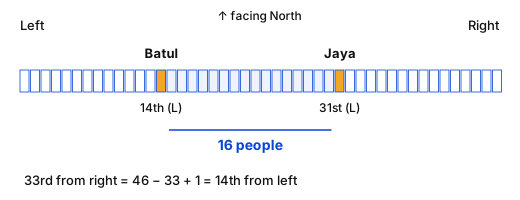
In a row of 46 people facing the north, Batul sits 33rd from the right end. If Jaya sits 31st from the left end of the row, how many people sit between Batul and Jaya?
उत्तर की ओर मुख करके बैठे 46 व्यक्तियों की एक पंक्ति में, बतूल दाएँ छोर से 33वें स्थान पर बैठी है। यदि जया पंक्ति के बाएँ छोर से 31वें स्थान पर बैठी है, तो बतूल और जया के बीच कितने व्यक्ति बैठे हैं?
  1. A13
  2. B16
  3. C14
  4. D18
Show answer

Concept: Position from left = Total − position from right +1.

  1. Batul from left =46−33+1=14th.
  2. Jaya is 31st from left.
  3. People between =31−14−1=16.

Trick: Between two people on the same side = difference of positions −1.

Answer: (B) 16

अवधारणा: बाएँ से स्थान = कुल − दाएँ से स्थान +1।

  1. बतूल बाएँ से =46−33+1=14वाँ।
  2. जया बाएँ से 31वें स्थान पर।
  3. बीच में व्यक्ति =31−14−1=16।

ट्रिक: एक ही ओर से स्थान हों तो बीच के लोग = अंतर −1।

उत्तर: (B) 16

RRB NTPC Undergraduate CBT 1General Intelligence and ReasoningRanking – row arrangementRRB NTPC Undergraduate CBT 1 2025 · 16 Jun Shift 1 →
Q7069.
If ‘A’ stands for ‘+’, ‘B’ stands for ‘−’, ‘C’ stands for ‘×’ and ‘D’ stands for ‘÷’, then what will come in place of the question mark (?) in the following equation?
40 D 5 A 8 C 2 B 12 = ?
यदि ‘A’ का अर्थ ‘+’, ‘B’ का अर्थ ‘−’, ‘C’ का अर्थ ‘×’ और ‘D’ का अर्थ ‘÷’ है, तो निम्नलिखित समीकरण में प्रश्न चिह्न (?) के स्थान पर क्या आएगा?
40 D 5 A 8 C 2 B 12 = ?
  1. A12
  2. B10
  3. C14
  4. D16
Show answer

Concept: Replace letters by signs, then apply BODMAS (÷, × first; then +, −).

  1. 40÷5+8×2−12
  2. =8+16−12
  3. =12

Trick: Write the substituted expression first – most errors come from mixing up the letter codes.

Answer: (A) 12

अवधारणा: अक्षरों को चिह्नों से बदलें, फिर BODMAS लगाएँ (पहले ÷, ×; फिर +, −)।

  1. 40÷5+8×2−12
  2. =8+16−12
  3. =12

ट्रिक: पहले बदला हुआ व्यंजक लिख लें – ग़लती अक्सर कोड मिलाने में होती है।

उत्तर: (A) 12

RRB NTPC Undergraduate CBT 1General Intelligence and ReasoningMathematical operationsRRB NTPC Undergraduate CBT 1 2025 · 16 Jun Shift 1 →
Q7070.
In a certain code language, ‘watch bow third’ is coded as 'ft gb vs' and ‘canoe watch art’ is coded as ‘vs rp hr’. How is ‘watch’ coded in the given language?
एक निश्चित कूट भाषा में, ‘watch bow third’ को 'ft gb vs' लिखा जाता है और ‘canoe watch art’ को ‘vs rp hr’ लिखा जाता है। उसी भाषा में ‘watch’ को कैसे लिखा जाएगा?
  1. Agb
  2. Bvs
  3. Crp
  4. Dft
Show answer

Concept: A word common to two sentences takes the code common to both.

  1. ‘watch bow third’ → ft gb vs
  2. ‘canoe watch art’ → vs rp hr
  3. Common word: watch; common code: vs.

Trick: Common word ↔ common code.

Answer: (B) vs

अवधारणा: दोनों वाक्यों में समान शब्द का कोड भी दोनों में समान होता है।

  1. ‘watch bow third’ → ft gb vs
  2. ‘canoe watch art’ → vs rp hr
  3. समान शब्द: watch; समान कोड: vs।

ट्रिक: समान शब्द ↔ समान कोड।

उत्तर: (B) vs

RRB NTPC Undergraduate CBT 1General Intelligence and ReasoningCoding-decoding – wordsRRB NTPC Undergraduate CBT 1 2025 · 16 Jun Shift 1 →
Q7071.
What should come in place of '?' in the given series based on the English alphabetical order?
KFS GBO CXK YTG ?
अंग्रेज़ी वर्णमाला क्रम के आधार पर दी गई श्रृंखला में '?' के स्थान पर क्या आना चाहिए?
KFS GBO CXK YTG ?
  1. AVSF
  2. BVWD
  3. CWDG
  4. DUPC
Show answer

Concept: Each of the three letter positions moves back by 4.

  1. 1st letters: K → G → C → Y → U
  2. 2nd letters: F → B → X → T → P
  3. 3rd letters: S → O → K → G → C

Trick: −4 cycling past A: C − 4 = Y (wraps around).

Answer: (D) UPC

अवधारणा: तीनों स्थानों के अक्षर हर बार 4 पीछे जाते हैं।

  1. पहले अक्षर: K → G → C → Y → U
  2. दूसरे अक्षर: F → B → X → T → P
  3. तीसरे अक्षर: S → O → K → G → C

ट्रिक: A के बाद पीछे जाने पर Z से गिनें: C − 4 = Y।

उत्तर: (D) UPC

RRB NTPC Undergraduate CBT 1General Intelligence and ReasoningLetter seriesRRB NTPC Undergraduate CBT 1 2025 · 16 Jun Shift 1 →
Q7072.
Read the given statement(s) and conclusions carefully. Assuming that the information given in the statements is true, even if it appears to be at variance with commonly known facts, decide which of the given conclusions logically follow(s) from the statement(s).
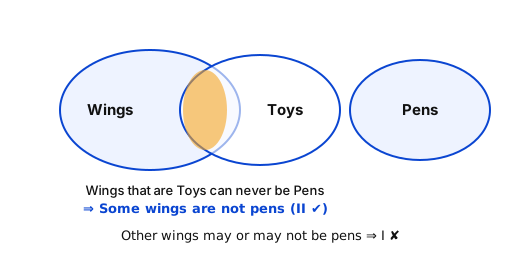
Statements: Some wings are toys. No toys are pens.
Conclusion (I): No pens are wings.
Conclusion (II): Some wings are not pens.
दिए गए कथन(नों) और निष्कर्षों को ध्यानपूर्वक पढ़िए। यह मानते हुए कि कथनों में दी गई जानकारी सत्य है, भले ही वह सामान्य रूप से ज्ञात तथ्यों से भिन्न प्रतीत होती हो, निर्णय कीजिए कि दिए गए निष्कर्षों में से कौन-सा/से निष्कर्ष कथन(नों) का तार्किक रूप से अनुसरण करता है/करते हैं।
कथन: कुछ पंख, खिलौने हैं। कोई खिलौना, कलम नहीं है।
निष्कर्ष (I): कोई कलम, पंख नहीं है।
निष्कर्ष (II): कुछ पंख, कलम नहीं हैं।
  1. AOnly conclusion (II) followsकेवल निष्कर्ष (II) अनुसरण करता है
  2. BOnly conclusion (I) followsकेवल निष्कर्ष (I) अनुसरण करता है
  3. CBoth conclusions (I) and (II) followनिष्कर्ष (I) और (II) दोनों अनुसरण करते हैं
  4. DNeither conclusion (I) nor (II) followsन तो निष्कर्ष (I) और न ही (II) अनुसरण करता है
Show answer

Concept: Some A are B + No B are C ⇒ Some A are not C (always true).

  1. The wings that are toys can never be pens ⇒ Some wings are not pens – II follows.
  2. Other wings may or may not be pens, so ‘No pens are wings’ is not certain – I does not follow.

Trick: Some + No = Some not (in that order).

Answer: (A) Only conclusion (II) follows

अवधारणा: कुछ A, B हैं + कोई B, C नहीं ⇒ कुछ A, C नहीं हैं (सदैव सत्य)।

  1. जो wings, toys हैं वे कभी pens नहीं हो सकते ⇒ कुछ wings, pens नहीं हैं – II अनुसरण करता है।
  2. बाक़ी wings pens हो भी सकते हैं, इसलिए ‘कोई pen, wing नहीं’ निश्चित नहीं – I अनुसरण नहीं करता।

ट्रिक: कुछ + कोई नहीं = कुछ नहीं (इसी क्रम में)।

उत्तर: (A) केवल निष्कर्ष (II) अनुसरण करता है

RRB NTPC Undergraduate CBT 1General Intelligence and ReasoningSyllogismRRB NTPC Undergraduate CBT 1 2025 · 16 Jun Shift 1 →
Q7073.
Refer to the following letter series and answer the question. (Counting to be done from left to right only)
(Left) D F T B M E Q Y O W G U S I K A R C X Z H (Right)
How many such vowels are there, each of which is immediately preceded by a consonant and also immediately followed by a consonant?
निम्नलिखित अक्षर श्रृंखला को देखिए और प्रश्न का उत्तर दीजिए। (गिनती केवल बाएँ से दाएँ की जानी है)
(बाएँ) D F T B M E Q Y O W G U S I K A R C X Z H (दाएँ)
ऐसे कितने स्वर हैं, जिनमें से प्रत्येक के ठीक पहले एक व्यंजन है और ठीक बाद भी एक व्यंजन है?
  1. A2
  2. B5
  3. C3
  4. D4
Show answer

Concept: Check each vowel (A, E, I, O, U) for consonants on both sides.

  1. E: M E Q ✓
  2. O: Y O W ✓; U: G U S ✓
  3. I: S I K ✓; A: K A R ✓
  4. Total =5.

Trick: List only vowels first, then check neighbours – faster than scanning every letter.

Answer: (B) 5

अवधारणा: हर स्वर (A, E, I, O, U) के दोनों ओर व्यंजन है या नहीं, जाँचें।

  1. E: M E Q ✓
  2. O: Y O W ✓; U: G U S ✓
  3. I: S I K ✓; A: K A R ✓
  4. कुल =5।

ट्रिक: पहले केवल स्वर ढूँढें, फिर पड़ोसी देखें – हर अक्षर जाँचने से तेज़।

उत्तर: (B) 5

RRB NTPC Undergraduate CBT 1General Intelligence and ReasoningLetter series – positionRRB NTPC Undergraduate CBT 1 2025 · 16 Jun Shift 1 →
Q7074.
Select the pair that follows the same pattern as that followed by the two pairs given below. Both pairs follow the same pattern.
CFG : GJK ;
KMP : OQT
उस युग्म का चयन कीजिए जो उसी पैटर्न का अनुसरण करता है जिसका अनुसरण नीचे दिए गए दो युग्म करते हैं। दोनों युग्म एक ही पैटर्न का अनुसरण करते हैं।
CFG : GJK ;
KMP : OQT
  1. AGNP : KRT
  2. BLMI : NOK
  3. CDJL : AGI
  4. DACH : BDI
Show answer

Concept: Each letter of the first cluster moves forward by 4.

  1. C+4=G, F+4=J, G+4=K; K+4=O, M+4=Q, P+4=T.
  2. GNP: G+4=K, N+4=R, P+4=T → KRT ✓
  3. LMI → NOK is +2; DJL → AGI is −3; ACH → BDI is +1.

Trick: Check only the first letter of each option first – usually eliminates the rest.

Answer: (A) GNP : KRT

अवधारणा: पहले समूह का हर अक्षर 4 आगे जाता है।

  1. C+4=G, F+4=J, G+4=K; K+4=O, M+4=Q, P+4=T।
  2. GNP: G+4=K, N+4=R, P+4=T → KRT ✓
  3. LMI → NOK में +2; DJL → AGI में −3; ACH → BDI में +1।

ट्रिक: पहले हर विकल्प का पहला अक्षर जाँचें – बाक़ी जल्दी हट जाते हैं।

उत्तर: (A) GNP : KRT

RRB NTPC Undergraduate CBT 1General Intelligence and ReasoningLetter analogyRRB NTPC Undergraduate CBT 1 2025 · 16 Jun Shift 1 →
Q7075.
Based on the English alphabetical order, three of the following four letter-cluster pairs are alike in a certain way and thus form a group. Which is the one that does not belong to that group?
(Note: The odd one out is not based on the number of consonants/vowels or their position in the letter cluster.)
अंग्रेज़ी वर्णमाला क्रम के आधार पर, निम्नलिखित चार अक्षर-समूह युग्मों में से तीन किसी निश्चित प्रकार से एकसमान हैं और इस प्रकार एक समूह बनाते हैं। कौन-सा युग्म उस समूह से संबंधित नहीं है?
(ध्यान दें: असंगत युग्म, व्यंजनों/स्वरों की संख्या या अक्षर-समूह में उनके स्थान पर आधारित नहीं है।)
  1. ATG - QE
  2. BZI - WF
  3. CUC -RA
  4. DXD - UB
Show answer

Concept: Find the shift from the first to the second cluster for each letter.

  1. TG – QE: T−3=Q, G−2=E
  2. UC – RA: U−3=R, C−2=A; XD – UB: X−3=U, D−2=B
  3. ZI – WF: Z−3=W, I−3=F ✗ (second letter shifts by 3, not 2).

Trick: Pattern (−3,−2) in three pairs; odd one breaks it.

Answer: (B) ZI - WF

अवधारणा: हर अक्षर का पहले से दूसरे समूह तक खिसकाव देखें।

  1. TG – QE: T−3=Q, G−2=E
  2. UC – RA: U−3=R, C−2=A; XD – UB: X−3=U, D−2=B
  3. ZI – WF: Z−3=W, I−3=F ✗ (दूसरा अक्षर 2 नहीं, 3 खिसका)।

ट्रिक: तीन युग्मों में (−3,−2); विषम उसे तोड़ता है।

उत्तर: (B) ZI - WF

RRB NTPC Undergraduate CBT 1General Intelligence and ReasoningOdd one out – letter pairsRRB NTPC Undergraduate CBT 1 2025 · 16 Jun Shift 1 →
Q7076.
If ‘A’ stands for ‘÷’, ‘B’ stands for ‘x’, ‘C’ stands for ‘+’ and ‘D’ stands for ‘-‘, what will be come in place of the question mark ‘?’ in the following equation?
2 B 32 A 1 D 1 C 45 = ?
यदि ‘A’ का अर्थ ‘÷’, ‘B’ का अर्थ ‘x’, ‘C’ का अर्थ ‘+’ और ‘D’ का अर्थ ‘-‘ है, तो निम्नलिखित समीकरण में प्रश्न चिह्न ‘?’ के स्थान पर क्या आएगा?
2 B 32 A 1 D 1 C 45 = ?
  1. A108
  2. B110
  3. C106
  4. D109
Show answer

Concept: Substitute signs (B = ×, A = ÷, D = −, C = +) and apply BODMAS.

  1. 2×32÷1−1+45
  2. =64−1+45
  3. =108

Trick: Do × and ÷ left to right, then + and −.

Answer: (A) 108

अवधारणा: चिह्न बदलें (B = ×, A = ÷, D = −, C = +) और BODMAS लगाएँ।

  1. 2×32÷1−1+45
  2. =64−1+45
  3. =108

ट्रिक: × और ÷ बाएँ से दाएँ, फिर + और −।

उत्तर: (A) 108

RRB NTPC Undergraduate CBT 1General Intelligence and ReasoningMathematical operationsRRB NTPC Undergraduate CBT 1 2025 · 16 Jun Shift 1 →
Q7077.
KEGJ is related to RLNQ in a certain way based on the English alphabetical order. In the same way, NHJM is related to UOQT. To which of the following is QKMP related, following the same logic?
अंग्रेज़ी वर्णमाला क्रम के आधार पर KEGJ एक निश्चित प्रकार से RLNQ से संबंधित है। उसी प्रकार NHJM, UOQT से संबंधित है। उसी तर्क का अनुसरण करते हुए QKMP निम्नलिखित में से किससे संबंधित है?
  1. ARXWT
  2. BRXTW
  3. CXRWT
  4. DXRTW
Show answer

Concept: Every letter moves forward by 7.

  1. K+7=R, E+7=L, G+7=N, J+7=Q (KEGJ → RLNQ)
  2. N+7=U, H+7=O, J+7=Q, M+7=T (NHJM → UOQT)
  3. Q+7=X, K+7=R, M+7=T, P+7=W → XRTW

Trick: Only the first letter is needed: Q+7=X leaves XRWT/XRTW; then K+7=R, M+7=T settles it.

Answer: (D) XRTW

अवधारणा: हर अक्षर 7 आगे जाता है।

  1. K+7=R, E+7=L, G+7=N, J+7=Q (KEGJ → RLNQ)
  2. N+7=U, H+7=O, J+7=Q, M+7=T (NHJM → UOQT)
  3. Q+7=X, K+7=R, M+7=T, P+7=W → XRTW

ट्रिक: Q+7=X से दो विकल्प बचते हैं; M+7=T (तीसरा अक्षर) से उत्तर तय।

उत्तर: (D) XRTW

RRB NTPC Undergraduate CBT 1General Intelligence and ReasoningLetter analogyRRB NTPC Undergraduate CBT 1 2025 · 16 Jun Shift 1 →
Q7078.
Seven boxes M, N, O, P, Q, R and S are kept one over the other but not necessarily in the same order. No box is kept above O. Only three boxes are kept between O and S. Only one box is kept between Q and M. M is kept immediately above S. Only four boxes are kept between Q and P. R is kept at some place above N. Which box is kept second below R?
सात बक्से M, N, O, P, Q, R और S एक के ऊपर एक रखे गए हैं, परंतु आवश्यक नहीं कि इसी क्रम में हों। O के ऊपर कोई बक्सा नहीं रखा है। O और S के बीच केवल तीन बक्से रखे हैं। Q और M के बीच केवल एक बक्सा रखा है। M, S के ठीक ऊपर रखा है। Q और P के बीच केवल चार बक्से रखे हैं। R, N के ऊपर किसी स्थान पर रखा है। R के नीचे दूसरे स्थान पर कौन-सा बक्सा रखा है?
  1. AQ
  2. BS
  3. CO
  4. DN
Show answer

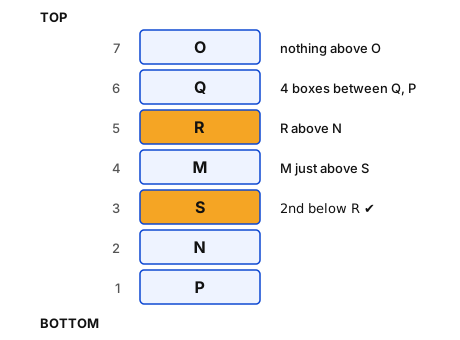
Concept: Number positions 1 (bottom) to 7 (top) and place fixed clues first.

  1. Nothing above O ⇒ O =7; three between O and S ⇒ S =3; M just above S ⇒ M =4.
  2. One between Q and M ⇒ Q =2 or 6. Four between Q and P: Q =2 needs P =7 (taken) ⇒ Q =6, P =1.
  3. R above N in positions 2, 5 ⇒ R =5, N =2.
  4. Second below R (5) is position 3 = S.

Trick: Start with the box at an extreme (top/bottom) – it fixes the most clues.

Answer: (B) S

अवधारणा: स्थान 1 (नीचे) से 7 (ऊपर) मानें और निश्चित सूचनाएँ पहले लगाएँ।

  1. O के ऊपर कोई नहीं ⇒ O =7; O और S के बीच तीन ⇒ S =3; M, S के ठीक ऊपर ⇒ M =4।
  2. Q और M के बीच एक ⇒ Q =2 या 6। Q और P के बीच चार: Q =2 पर P =7 (भरा) ⇒ Q =6, P =1।
  3. बचे स्थान 2, 5 में R, N के ऊपर ⇒ R =5, N =2।
  4. R (5) से दूसरा नीचे स्थान 3 = S।

ट्रिक: सबसे ऊपर/नीचे वाले डिब्बे से शुरू करें – वह सबसे अधिक सूचनाएँ तय करता है।

उत्तर: (B) S

RRB NTPC Undergraduate CBT 1General Intelligence and ReasoningBox arrangementRRB NTPC Undergraduate CBT 1 2025 · 16 Jun Shift 1 →
Q7079.
Based on the English alphabetical order, three of the following four are alike in a certain way and thus form a group. Which is the one that does not belong to that group? (Note: The odd man out is not based on the number of consonants/vowels or their position in the letter cluster.)
अंग्रेज़ी वर्णमाला क्रम के आधार पर, निम्नलिखित चार में से तीन किसी निश्चित प्रकार से एकसमान हैं और इस प्रकार एक समूह बनाते हैं। कौन-सा उस समूह से संबंधित नहीं है? (ध्यान दें: असंगत, व्यंजनों/स्वरों की संख्या या अक्षर-समूह में उनके स्थान पर आधारित नहीं है।)
  1. AYAD
  2. BEHJ
  3. CMOR
  4. DSUX
Show answer

Concept: Check the gaps between consecutive letters.

  1. YAD: Y+2=A, A+3=D → (+2,+3)
  2. MOR: (+2,+3); SUX: (+2,+3)
  3. EHJ: E+3=H, H+2=J → (+3,+2) ✗

Trick: Same gaps but in reverse order is the classic odd one.

Answer: (B) EHJ

अवधारणा: लगातार अक्षरों के बीच का अंतर देखें।

  1. YAD: Y+2=A, A+3=D → (+2,+3)
  2. MOR: (+2,+3); SUX: (+2,+3)
  3. EHJ: E+3=H, H+2=J → (+3,+2) ✗

ट्रिक: अंतर वही पर उलटे क्रम में – यही विषम पद है।

उत्तर: (B) EHJ

RRB NTPC Undergraduate CBT 1General Intelligence and ReasoningOdd one out – letter clustersRRB NTPC Undergraduate CBT 1 2025 · 16 Jun Shift 1 →
Q7080.
Seven boxes, M, N, O, P, Q, R and S, are kept one over the other, but not necessarily in the same order.
Only four boxes are kept between Q and O. Only P is kept above Q. Only two boxes are kept between N and R. S is kept immediately above M. R is not kept immediately above S.
Which box is kept fourth from the top?
सात बक्से, M, N, O, P, Q, R और S, एक के ऊपर एक रखे गए हैं, परंतु आवश्यक नहीं कि इसी क्रम में हों।
Q और O के बीच केवल चार बक्से रखे हैं। Q के ऊपर केवल P रखा है। N और R के बीच केवल दो बक्से रखे हैं। S, M के ठीक ऊपर रखा है। R, S के ठीक ऊपर नहीं रखा है।
ऊपर से चौथे स्थान पर कौन-सा बक्सा रखा है?
  1. AS
  2. BO
  3. CP
  4. DM
Show answer

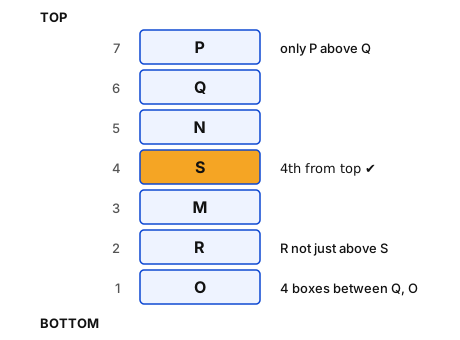
Concept: Number positions from the top (1 = top, 7 = bottom).

  1. Only P above Q ⇒ P =1, Q =2. Four between Q and O ⇒ O =7.
  2. Positions 3–6 for N, R, S, M. Two between N and R ⇒ N, R at 3 and 6; so S, M at 4, 5 (S just above M).
  3. If R =3 it would be just above S – not allowed ⇒ N =3, R =6.
  4. Order: P, Q, N, S, M, R, O ⇒ 4th from top = S.

Trick: A ‘pair’ clue (S just above M) plus a ‘gap’ clue usually leaves only one fit.

Answer: (A) S

अवधारणा: ऊपर से स्थान गिनें (1 = सबसे ऊपर, 7 = सबसे नीचे)।

  1. केवल P, Q के ऊपर ⇒ P =1, Q =2। Q और O के बीच चार ⇒ O =7।
  2. स्थान 3–6 में N, R, S, M। N और R के बीच दो ⇒ N, R स्थान 3 और 6 पर; S, M स्थान 4, 5 पर (S, M के ठीक ऊपर)।
  3. R =3 हो तो वह S के ठीक ऊपर होगा – मना है ⇒ N =3, R =6।
  4. क्रम: P, Q, N, S, M, R, O ⇒ ऊपर से चौथा = S।

ट्रिक: ‘जोड़ी’ वाली सूचना + ‘अंतर’ वाली सूचना से प्रायः एक ही स्थिति बचती है।

उत्तर: (A) S

RRB NTPC Undergraduate CBT 1General Intelligence and ReasoningBox arrangementRRB NTPC Undergraduate CBT 1 2025 · 16 Jun Shift 1 →