Question bank

Q&A: practice questions with answers

Search questions on any topic. Filter by exam category, exam, subject and topic, try the question, then open the answer and explanation.

Courses – airGurukul

8,495 questions found.

Q7241.
Eduardo, Abraham and Xavier can finish a certain piece of work in 6, 34 and 36 days, respectively. All three of them started the work together. Eduardo left the work after 2 days and Abraham left just 3 days before the work was completed. Find the total number of days taken for the work to be completed.
Eduardo, Abraham और Xavier किसी काम को क्रमशः 6, 34 और 36 दिनों में पूरा कर सकते हैं। तीनों ने एक साथ काम शुरू किया। Eduardo ने 2 दिन बाद काम छोड़ दिया और Abraham ने काम पूरा होने से ठीक 3 दिन पहले काम छोड़ दिया। काम पूरा होने में लगे कुल दिनों की संख्या ज्ञात कीजिए।
  1. A11.7
  2. B14.6
  3. C15.2
  4. D13.2
Show answer

Concept: Add each person's fraction of work done; total =1.

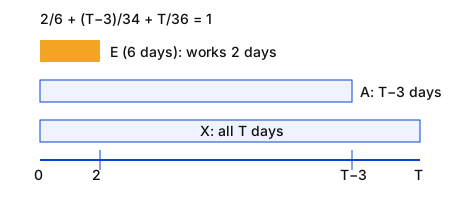
  1. Let total time =T days. Eduardo works 2 days, Abraham (T−3) days, Xavier T days.
  2. 26+T−334+T36=1⇒T−334+T36=23.
  3. Multiply by 612: 18(T−3)+17T=408⇒35T=462.
  4. T=13.2 days.

Trick: Write "who worked how many days" on a timeline first – the equation then writes itself.

Answer: (D) 13.2

अवधारणा: हर व्यक्ति के किए कार्य का भाग जोड़ें; योग =1।

  1. कुल समय =T दिन। Eduardo 2 दिन, Abraham (T−3) दिन, Xavier T दिन काम करता है।
  2. 26+T−334+T36=1⇒T−334+T36=23।
  3. 612 से गुणा: 18(T−3)+17T=408⇒35T=462।
  4. T=13.2 दिन।

ट्रिक: पहले टाइमलाइन पर लिखें कि किसने कितने दिन काम किया – समीकरण अपने आप बन जाता है।

उत्तर: (D) 13.2
RRB NTPC Undergraduate CBT 1MathematicsTime and WorkRRB NTPC Undergraduate CBT 1 2025 · 15 Jun Shift 2 →
Q7242.
Which formula correctly calculates simple interest when the principal, rate, and time are known?
जब मूलधन, दर और समय ज्ञात हों, तो कौन-सा सूत्र साधारण ब्याज की सही गणना करता है?
  1. ASimple Interest = Principal + Rate + Timeसाधारण ब्याज = मूलधन + दर + समय
  2. BSimple Interest = Principal × Time / Rateसाधारण ब्याज = मूलधन × समय / दर
  3. CSimple Interest = Principal × Rate / Timeसाधारण ब्याज = मूलधन × दर / समय
  4. DSimple Interest = (Principal × Rate × Time) / 100साधारण ब्याज = (मूलधन × दर × समय) / 100
Show answer

Concept: Simple interest grows linearly with principal, rate and time.

  1. SI=P×R×T100, where R is the rate per cent per annum.
  2. Options A–C add or divide the quantities, which gives wrong units (interest must be in rupees, proportional to all three).

Yaad rakhein: "PRT by 100" – doubling any one of P, R or T doubles the SI.

Answer: (D) Simple Interest = (Principal × Rate × Time) / 100

अवधारणा: साधारण ब्याज मूलधन, दर और समय तीनों के समानुपाती होता है।

  1. SI=P×R×T100, जहाँ R प्रतिशत वार्षिक दर है।
  2. विकल्प A–C में जोड़ या भाग है, जो गलत है – ब्याज तीनों के गुणनफल पर निर्भर करता है।

याद रखें: "PRT बटा 100" – P, R या T में से कोई भी दोगुना हो तो SI दोगुना।

उत्तर: (D) Simple Interest = (Principal × Rate × Time) / 100

RRB NTPC Undergraduate CBT 1MathematicsSimple InterestRRB NTPC Undergraduate CBT 1 2025 · 15 Jun Shift 2 →
Q7243.
The marked price of a cooker is the same at four shops I, II, III and IV. Shop I allows two successive discounts of 87% and 37%, shop II allows successive discounts of 81% and 37%, shop III allows successive discounts of 57% and 54% and shop IV allows successive discounts of 91%, 25%, and 59% on the marked price of the cooker. Which shop is selling the cooker at the lowest price?
चार दुकानों I, II, III और IV पर एक कुकर का अंकित मूल्य समान है। दुकान I कुकर के अंकित मूल्य पर 87% और 37% की दो क्रमिक छूट देती है, दुकान II 81% और 37% की क्रमिक छूट देती है, दुकान III 57% और 54% की क्रमिक छूट देती है और दुकान IV 91%, 25% और 59% की क्रमिक छूट देती है। कौन-सी दुकान कुकर को सबसे कम मूल्य पर बेच रही है?
  1. AIV
  2. BII
  3. CIII
  4. DI
Show answer

Concept: After successive discounts d1,d2,… the price paid =MP×(1−d1)(1−d2)⋯; smallest multiplier = lowest price.

  1. I: 0.13×0.63=0.0819.
  2. II: 0.19×0.63=0.1197.
  3. III: 0.43×0.46=0.1978.
  4. IV: 0.09×0.75×0.41=0.0277 – the smallest.

Trick: Compare the "paid fractions", not the discounts; a 91% discount alone (pay 9%) already beats every other shop.

Answer: (A) IV

अवधारणा: क्रमिक छूट d1,d2,… के बाद भुगतान =MP×(1−d1)(1−d2)⋯; सबसे छोटा गुणक = सबसे कम कीमत।

  1. I: 0.13×0.63=0.0819।
  2. II: 0.19×0.63=0.1197।
  3. III: 0.43×0.46=0.1978।
  4. IV: 0.09×0.75×0.41=0.0277 – सबसे कम।

ट्रिक: छूट नहीं, "भुगतान अंश" की तुलना करें; अकेली 91% छूट (9% भुगतान) ही बाकी सबसे कम है।

उत्तर: (A) IV

RRB NTPC Undergraduate CBT 1MathematicsSuccessive DiscountsRRB NTPC Undergraduate CBT 1 2025 · 15 Jun Shift 2 →
Q7244.
What smallest positive number should be subtracted from 3 and 5 so that 8 is the third proportional to them?
3 और 5 में से कौन-सी सबसे छोटी धनात्मक संख्या घटाई जानी चाहिए ताकि 8 उनका तृतीयानुपाती हो?
  1. A-2
  2. B2
  3. C-1
  4. D1
Show answer

Concept: If c is the third proportional to a,b then a:b=b:c, i.e. b2=ac.

  1. Subtract x: numbers become 3−x and 5−x.
  2. (5−x)2=8(3−x)⇒25−10x+x2=24−8x.
  3. x2−2x+1=0⇒(x−1)2=0⇒x=1.
  4. Check: 2,4,8 → 42=2×8 ✓.

Trick: Look for a geometric chain ending in 8: 2,4,8 – subtracting 1 from 3 and 5 gives exactly that.

Answer: (D) 1

अवधारणा: यदि c, a,b का तृतीयानुपाती है तो a:b=b:c, अर्थात b2=ac।

  1. x घटाने पर संख्याएँ 3−x और 5−x।
  2. (5−x)2=8(3−x)⇒x2−2x+1=0।
  3. (x−1)2=0⇒x=1।
  4. जाँच: 2,4,8 → 42=2×8 ✓।

ट्रिक: 8 पर खत्म होने वाली गुणोत्तर श्रृंखला 2,4,8 खोजें – 3 और 5 में से 1 घटाने पर यही मिलती है।

उत्तर: (D) 1

RRB NTPC Undergraduate CBT 1MathematicsProportionRRB NTPC Undergraduate CBT 1 2025 · 15 Jun Shift 2 →
Q7245.
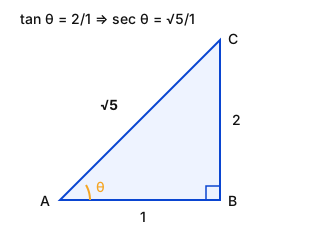
Given that tan θ = 2 and θ is in the first quadrant, what is the value of sec θ?
दिया गया है कि tan θ = 2 है और θ प्रथम चतुर्थांश में है, तो sec θ का मान क्या है?
  1. A2
  2. B2
  3. C3
  4. D5
Show answer

Concept: sec2θ=1+tan2θ; in the first quadrant secθ>0.

  1. sec2θ=1+22=5.
  2. secθ=5 (positive in quadrant I).
  3. Triangle check: perpendicular 2, base 1, hypotenuse 5 → secθ=51.

Yaad rakhein: tanθ=pb → hypotenuse =p2+b2, then sec=hb.

Answer: (D) 5

अवधारणा: sec2θ=1+tan2θ; प्रथम चतुर्थांश में secθ>0।

  1. sec2θ=1+22=5।
  2. secθ=5 (धनात्मक)।
  3. त्रिभुज से जाँच: लम्ब 2, आधार 1, कर्ण 5 → secθ=51।

याद रखें: tanθ=pb → कर्ण =p2+b2, फिर sec=hb।

उत्तर: (D) 5

RRB NTPC Undergraduate CBT 1MathematicsTrigonometric RatiosRRB NTPC Undergraduate CBT 1 2025 · 15 Jun Shift 2 →
Q7246.
Find the smallest number which when divided by 9, 12 and 15 leaves a remainder 3 in each case.
वह सबसे छोटी संख्या ज्ञात कीजिए जिसे 9, 12 और 15 से विभाजित करने पर प्रत्येक स्थिति में शेषफल 3 प्राप्त होता है।
  1. A363
  2. B723
  3. C123
  4. D183
Show answer

Concept: Same remainder r with every divisor → number =LCM×k+r.

  1. LCM(9,12,15)=180.
  2. Smallest such number =180+3=183.
  3. Check: 183÷9, ÷12, ÷15 each leave remainder 3 ✓.

Trick: Options minus 3 must be a multiple of 180: 123−3=120 ✗, 183−3=180 ✓.

Answer: (D) 183

अवधारणा: हर भाजक से समान शेष r → संख्या =LCM×k+r।

  1. LCM(9,12,15)=180।
  2. सबसे छोटी संख्या =180+3=183।
  3. जाँच: 183 को 9, 12, 15 से भाग देने पर शेष 3 ✓।

ट्रिक: विकल्प में से 3 घटाने पर 180 का गुणज होना चाहिए: 183−3=180 ✓।

उत्तर: (D) 183

RRB NTPC Undergraduate CBT 1MathematicsLCM – RemaindersRRB NTPC Undergraduate CBT 1 2025 · 15 Jun Shift 2 →
Q7247.
The difference between the measure of an interior angle and an exterior angle of a regular polygon is 100°. What is the number of sides of the polygon?
एक सम बहुभुज के एक अंतः कोण और एक बाह्य कोण की माप का अंतर 100° है। बहुभुज की भुजाओं की संख्या कितनी है?
  1. A12
  2. B8
  3. C9
  4. D10
Show answer

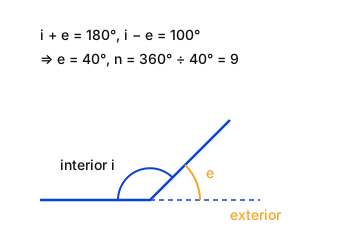
Concept: Interior + exterior angle =180∘ and exterior angle of a regular polygon =360∘n.

  1. i+e=180∘, i−e=100∘ → 2e=80∘⇒e=40∘.
  2. n=360∘40∘=9.

Trick: Solve for the exterior angle first – it always divides 360∘ exactly.

Answer: (C) 9

अवधारणा: अंतःकोण + बहिष्कोण =180∘ और सम बहुभुज का बहिष्कोण =360∘n।

  1. i+e=180∘, i−e=100∘ → e=40∘।
  2. n=360∘40∘=9।

ट्रिक: पहले बहिष्कोण निकालें – वह हमेशा 360∘ को पूरा-पूरा भाग देता है।

उत्तर: (C) 9

RRB NTPC Undergraduate CBT 1MathematicsPolygonsRRB NTPC Undergraduate CBT 1 2025 · 15 Jun Shift 2 →
Q7248.
A and B invest ₹12,000 and ₹8,000, respectively, in a business. If the total profit is ₹10,000, what is A’s share of profit?
A और B किसी व्यवसाय में क्रमशः ₹12,000 और ₹8,000 का निवेश करते हैं। यदि कुल लाभ ₹10,000 है, तो लाभ में A का हिस्सा क्या है?
  1. A₹4,000
  2. B₹5,000
  3. C₹6,000
  4. D₹7,000
Show answer

Concept: Same time → profit shared in the ratio of investments.

  1. A:B=12000:8000=3:2.
  2. A's share =35×10000=₹6,000.

Trick: A invests 60% of the total capital, so takes 60% of the profit.

Answer: (C) ₹6,000

अवधारणा: समान समय → लाभ निवेश के अनुपात में बँटता है।

  1. A:B=12000:8000=3:2।
  2. A का भाग =35×10000=₹6,000।

ट्रिक: A की पूँजी कुल का 60% है, इसलिए लाभ का भी 60%।

उत्तर: (C) ₹6,000

RRB NTPC Undergraduate CBT 1MathematicsPartnershipRRB NTPC Undergraduate CBT 1 2025 · 15 Jun Shift 2 →
Q7249.
The median of the given distribution is 28.5. Find the missing frequency x.
Class0-1010-2020-3030-4040-5050-60
Frequency5x201575
दिए गए बंटन की माध्यिका 28.5 है। लुप्त बारंबारता x ज्ञात कीजिए।
वर्ग0-1010-2020-3030-4040-5050-60
बारंबारता5x201575
  1. A10
  2. B8
  3. C3
  4. D5
Show answer

Concept: Median=l+N2−cff×h; median 28.5 lies in class 20–30.

  1. N=5+x+20+15+7+5=52+x; cf before 20–30 =5+x; f=20, h=10, l=20.
  2. 28.5=20+52+x2−(5+x)20×10.
  3. 8.5=21−x22⇒17=21−x2⇒x=8.

Trick: Once l,f,h are known, the whole question reduces to one linear equation in x.

Answer: (B) 8

अवधारणा: माध्यिका=l+N2−cff×h; 28.5 वर्ग 20–30 में है।

  1. N=52+x; 20–30 से पहले cf=5+x; f=20, h=10, l=20।
  2. 28.5=20+52+x2−(5+x)20×10।
  3. 17=21−x2⇒x=8।

ट्रिक: l,f,h तय होते ही प्रश्न x का एक रैखिक समीकरण रह जाता है।

उत्तर: (B) 8

RRB NTPC Undergraduate CBT 1MathematicsStatistics – MedianRRB NTPC Undergraduate CBT 1 2025 · 15 Jun Shift 2 →
Q7250.
The cost of five tables and seven chairs is ₹7040. If a table costs ₹400 more than a chair, find the cost of a table.
पाँच मेज़ों और सात कुर्सियों का मूल्य ₹7040 है। यदि एक मेज़ का मूल्य एक कुर्सी से ₹400 अधिक है, तो एक मेज़ का मूल्य ज्ञात कीजिए।
  1. A₹420
  2. B₹820
  3. C₹700
  4. D₹800
Show answer

Concept: Express both items in one variable.

  1. Chair =c, table =c+400.
  2. 5(c+400)+7c=7040⇒12c=5040⇒c=420.
  3. Table =420+400=₹820.

Trick: Remove the extra 5×400=2000 first: 12 chairs =5040.

Answer: (B) ₹820

अवधारणा: दोनों वस्तुओं को एक चर में लिखें।

  1. कुर्सी =c, मेज़ =c+400।
  2. 5(c+400)+7c=7040⇒12c=5040⇒c=420।
  3. मेज़ =₹820।

ट्रिक: पहले अतिरिक्त 5×400=2000 हटाएँ: 12 कुर्सियाँ =5040।

उत्तर: (B) ₹820

RRB NTPC Undergraduate CBT 1MathematicsLinear EquationsRRB NTPC Undergraduate CBT 1 2025 · 15 Jun Shift 2 →
Q7251.
A water pipe is in the shape of a hollow cylinder with an outer radius of 10 cm and an inner radius of 8 cm. If the length of the pipe is 2 m, what is the total surface area (including both ends and the inner and outer curved surfaces) of the pipe in square centimeters? (Use π = 22/7 and rounded off to the nearest integer)
पानी का एक पाइप एक खोखले बेलन के आकार का है जिसकी बाह्य त्रिज्या 10 cm और आंतरिक त्रिज्या 8 cm है। यदि पाइप की लंबाई 2 m है, तो पाइप का कुल पृष्ठीय क्षेत्रफल (दोनों सिरों तथा आंतरिक और बाह्य वक्र पृष्ठों सहित) वर्ग सेंटीमीटर में कितना है? (π = 22/7 का प्रयोग कीजिए और निकटतम पूर्णांक तक पूर्णांकित कीजिए)
  1. A22855 cm2
  2. B25124 cm2
  3. C22848 cm2
  4. D18848 cm2
Show answer

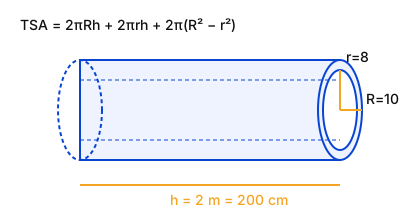
Concept: TSA of a hollow cylinder =2πRh+2πrh+2π(R2−r2).

  1. R=10, r=8, h=200 cm.
  2. Outer CSA =2π×10×200=4000π; inner CSA =3200π.
  3. Two rings =2π(100−64)=72π.
  4. Total =7272π=7272×227≈22854.9≈22855cm2.

Trick: Factor 2π out: 2π[h(R+r)+(R2−r2)]=2π×3636.

Answer: (A) 22855 cm2

अवधारणा: खोखले बेलन का TSA =2πRh+2πrh+2π(R2−r2)।

  1. R=10, r=8, h=200 cm।
  2. बाहरी CSA =4000π; भीतरी CSA =3200π।
  3. दोनों सिरे (वलय) =2π(100−64)=72π।
  4. कुल =7272π=7272×227≈22855cm2।

ट्रिक: 2π बाहर निकालें: 2π[h(R+r)+(R2−r2)]=2π×3636।

उत्तर: (A) 22855 cm2

RRB NTPC Undergraduate CBT 1MathematicsMensuration – Hollow CylinderRRB NTPC Undergraduate CBT 1 2025 · 15 Jun Shift 2 →
Q7252.
If 40% of a number exceeds 25% of it by 42, then the number is:
यदि किसी संख्या का 40%, उसी संख्या के 25% से 42 अधिक है, तो वह संख्या है:
  1. A300
  2. B280
  3. C260
  4. D320
Show answer

Concept: Difference of two percentages of the same number is a percentage of that number.

  1. 40%−25%=15% of the number =42.
  2. Number =42×10015=280.

Trick: 15%=42⇒5%=14⇒100%=280.

Answer: (B) 280

अवधारणा: एक ही संख्या के दो प्रतिशतों का अंतर उसी संख्या का प्रतिशत होता है।

  1. 40%−25%=15% =42।
  2. संख्या =42×10015=280।

ट्रिक: 15%=42⇒5%=14⇒100%=280।

उत्तर: (B) 280

RRB NTPC Undergraduate CBT 1MathematicsPercentageRRB NTPC Undergraduate CBT 1 2025 · 15 Jun Shift 2 →
Q7253.
A and B can do a piece of work in 12 days and 30 days, respectively. Both work for 4 days and then A leaves. How long (in days) will B take to complete the remaining work?
A और B किसी काम को क्रमशः 12 दिन और 30 दिन में कर सकते हैं। दोनों 4 दिन तक काम करते हैं और फिर A काम छोड़ देता है। शेष काम को पूरा करने में B को कितना समय (दिनों में) लगेगा?
  1. A15
  2. B18
  3. C17
  4. D16
Show answer

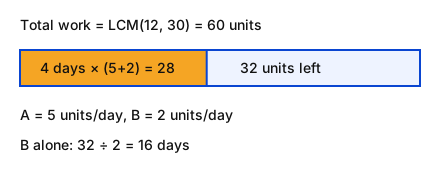
Concept: Take total work =LCM(12,30)=60 units.

  1. A =5 units/day, B =2 units/day.
  2. 4 days together: 4×7=28 units; remaining =32.
  3. B alone: 322=16 days.

Trick: Unit method avoids fractions – always take LCM as the total work.

Answer: (D) 16

अवधारणा: कुल कार्य =LCM(12,30)=60 इकाई लें।

  1. A =5 इकाई/दिन, B =2 इकाई/दिन।
  2. 4 दिन साथ: 4×7=28 इकाई; शेष =32।
  3. B अकेले: 322=16 दिन।

ट्रिक: इकाई विधि से भिन्न नहीं बनती – कुल कार्य हमेशा LCM लें।

उत्तर: (D) 16

RRB NTPC Undergraduate CBT 1MathematicsTime and WorkRRB NTPC Undergraduate CBT 1 2025 · 15 Jun Shift 2 →
Q7254.
The largest four-digit number which when divided by 11, 7 and 14 leaves the remainder 2 in each case, is:
चार अंकों की वह सबसे बड़ी संख्या, जिसे 11, 7 और 14 से विभाजित करने पर प्रत्येक स्थिति में शेषफल 2 प्राप्त होता है, है:
  1. A9972
  2. B9435
  3. C9858
  4. D9901
Show answer

Concept: Required number =(largest 4-digit multiple of LCM)+2.

  1. LCM(11,7,14)=154.
  2. 9999÷154=64 remainder 143 → largest multiple =9999−143=9856.
  3. Number =9856+2=9858.

Trick: Option minus 2 must be divisible by 154: 9858−2=9856=154×64 ✓.

Answer: (C) 9858

अवधारणा: अभीष्ट संख्या =(LCM का सबसे बड़ा 4-अंकीय गुणज)+2।

  1. LCM(11,7,14)=154।
  2. 9999÷154=64, शेष 143 → सबसे बड़ा गुणज =9856।
  3. संख्या =9856+2=9858।

ट्रिक: विकल्प −2 को 154 से विभाज्य होना चाहिए: 9856=154×64 ✓।

उत्तर: (C) 9858

RRB NTPC Undergraduate CBT 1MathematicsLCM – RemaindersRRB NTPC Undergraduate CBT 1 2025 · 15 Jun Shift 2 →
Q7255.
Evaluate 233 + (-19)3 + (-4)3
233 + (-19)3 + (-4)3 का मान ज्ञात कीजिए।
  1. A4958
  2. B5089
  3. C5244
  4. D4998
Show answer

Concept: If a+b+c=0 then a3+b3+c3=3abc.

  1. 23+(−19)+(−4)=0.
  2. Sum of cubes =3×23×(−19)×(−4)=3×1748=5244.

Trick: Whenever three numbers add to zero, never cube them – use 3abc.

Answer: (C) 5244

अवधारणा: यदि a+b+c=0 तो a3+b3+c3=3abc।

  1. 23+(−19)+(−4)=0।
  2. घनों का योग =3×23×(−19)×(−4)=5244।

ट्रिक: तीन संख्याओं का योग शून्य हो तो घन न करें – 3abc लगाएँ।

उत्तर: (C) 5244

RRB NTPC Undergraduate CBT 1MathematicsAlgebraic IdentitiesRRB NTPC Undergraduate CBT 1 2025 · 15 Jun Shift 2 →
Q7256.
Venu invested a certain sum of money at 10% per annum. After 2 years, he received ₹136.50 as compound interest, compounded annually. Find the corresponding simple interest (in ₹) for 2 years at the same rate.
वेणु ने एक निश्चित धनराशि 10% वार्षिक दर पर निवेश की। 2 वर्ष बाद, उसे वार्षिक रूप से संयोजित चक्रवृद्धि ब्याज के रूप में ₹136.50 प्राप्त हुए। समान दर पर 2 वर्ष के लिए संगत साधारण ब्याज (₹ में) ज्ञात कीजिए।
  1. A115
  2. B125
  3. C130
  4. D120
Show answer

Concept: For 2 years, CISI=200+R200.

  1. CI2=P[(1.1)2−1]=0.21P=136.50⇒P=650.
  2. SI=650×10×2100=₹130.

Trick: SI=CI×200200+R=136.5×200210=130.

Answer: (C) 130

अवधारणा: 2 वर्ष के लिए CISI=200+R200।

  1. CI2=0.21P=136.50⇒P=650।
  2. SI=650×10×2100=₹130।

ट्रिक: SI=CI×200200+R=136.5×200210=130।

उत्तर: (C) 130

RRB NTPC Undergraduate CBT 1MathematicsCompound InterestRRB NTPC Undergraduate CBT 1 2025 · 15 Jun Shift 2 →
Q7257.
The simplified value of the expression 0.5×0.125÷8−2 is ____.
व्यंजक 0.5×0.125÷8−2 का सरलीकृत मान ____ है।
  1. A2
  2. B1
  3. C4
  4. D8
Show answer

Concept: a−n=1an; dividing by 8−2 means multiplying by 64.

  1. 0.5×0.125=0.0625=116.
  2. 116÷164=116×64=4.

Trick: In powers of 2: 2−1×2−3÷2−6=2−1−3+6=22=4.

Answer: (C) 4

अवधारणा: a−n=1an; 8−2 से भाग = 64 से गुणा।

  1. 0.5×0.125=116।
  2. 116×64=4।

ट्रिक: 2 की घातों में: 2−1×2−3÷2−6=22=4।

उत्तर: (C) 4

RRB NTPC Undergraduate CBT 1MathematicsIndices and DecimalsRRB NTPC Undergraduate CBT 1 2025 · 15 Jun Shift 2 →
Q7258.
If 4x−4x−1=48, then the value of 2x−12x+3 is:
यदि 4x−4x−1=48 है, तो 2x−12x+3 का मान है:
  1. A59
  2. B58
  3. C511
  4. D54
Show answer

Concept: Factor out the smaller power: 4x−4x−1=4x−1(4−1).

  1. 3×4x−1=48⇒4x−1=16=42.
  2. x−1=2⇒x=3.
  3. 2x−12x+3=59.

Trick: an−an−1=an−1(a−1) – spot this pattern instantly in such questions.

Answer: (A) 59

अवधारणा: छोटी घात बाहर निकालें: 4x−4x−1=4x−1(4−1)।

  1. 3×4x−1=48⇒4x−1=16=42।
  2. x=3।
  3. 2x−12x+3=59।

ट्रिक: an−an−1=an−1(a−1) – यह पैटर्न तुरंत पहचानें।

उत्तर: (A) 59

RRB NTPC Undergraduate CBT 1MathematicsExponential EquationsRRB NTPC Undergraduate CBT 1 2025 · 15 Jun Shift 2 →
Q7259.
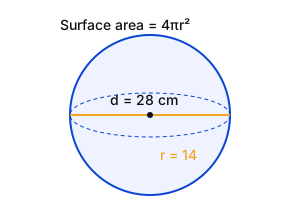
A spherical tank has a diameter of 28 cm. What is the total surface area of the tank? (Use π = 22/7)
एक गोलाकार टंकी का व्यास 28 cm है। टंकी का कुल पृष्ठीय क्षेत्रफल क्या है? (π = 22/7 का प्रयोग कीजिए)
  1. A2456 cm²
  2. B2458 cm²
  3. C2464 cm²
  4. D2460 cm²
Show answer

Concept: Surface area of a sphere =4πr2.

  1. r=282=14 cm.
  2. 4×227×14×14=4×22×28=2464cm2.

Yaad rakhein: With r a multiple of 7, cancel 7 first – no decimals at all.

Answer: (C) 2464 cm²

अवधारणा: गोले का पृष्ठीय क्षेत्रफल =4πr2।

  1. r=14 cm।
  2. 4×227×14×14=2464cm2।

याद रखें: r 7 का गुणज हो तो पहले 7 काटें – दशमलव नहीं आएगा।

उत्तर: (C) 2464 cm²

RRB NTPC Undergraduate CBT 1MathematicsMensuration – SphereRRB NTPC Undergraduate CBT 1 2025 · 15 Jun Shift 2 →
Q7260.
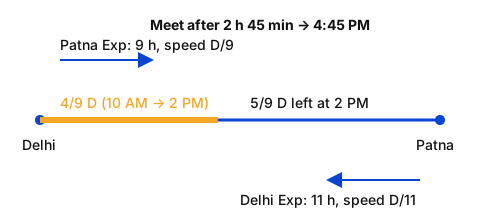
Patna Express leaves Delhi at 10:00 AM and reaches Patna at 7:00 PM the same day. Delhi Express leaves Patna at 2:00 PM and reaches Delhi at 1:00 AM on the next day. Both trains travel on the same route in opposite directions. At what time do they meet?
पटना एक्सप्रेस सुबह 10:00 AM पर दिल्ली से प्रस्थान करती है और उसी दिन शाम 7:00 PM पर पटना पहुँचती है। दिल्ली एक्सप्रेस दोपहर 2:00 PM पर पटना से प्रस्थान करती है और अगले दिन रात 1:00 AM पर दिल्ली पहुँचती है। दोनों ट्रेनें एक ही मार्ग पर विपरीत दिशाओं में चलती हैं। वे किस समय मिलेंगी?
  1. A04:45PM
  2. B04:30PM
  3. C03:45PM
  4. D04:15PM
Show answer

Concept: Take the route length =D; speeds are D9 and D11 (9 h and 11 h journeys).

  1. By 2:00 PM Patna Express has covered 4×D9=4D9; gap left =5D9.
  2. Relative speed =D9+D11=20D99.
  3. Time =5D9÷20D99=59×9920=2.75 h =2 h 45 min.
  4. 2:00+2:45=4:45 PM.

Trick: Take D=99 km: speeds 11 and 9 km/h, gap at 2 PM =55 km, time =5520=2.75 h.

Answer: (A) 04:45 PM

अवधारणा: मार्ग की लंबाई =D; चालें D9 और D11 (9 घंटे और 11 घंटे की यात्रा)।

  1. 2:00 PM तक Patna Express 4D9 चल चुकी; शेष दूरी =5D9।
  2. सापेक्ष चाल =D9+D11=20D99।
  3. समय =59×9920=2.75 घंटे =2 घंटे 45 मिनट।
  4. 2:00+2:45=4:45 PM।

ट्रिक: D=99 km लें: चालें 11 और 9 km/h, 2 PM पर दूरी 55 km, समय =5520=2.75 घंटे।

उत्तर: (A) 04:45 PM

RRB NTPC Undergraduate CBT 1MathematicsTrains – Meeting TimeRRB NTPC Undergraduate CBT 1 2025 · 15 Jun Shift 2 →