Question bank

Q&A: practice questions with answers

Search questions on any topic. Filter by exam category, exam, subject and topic, try the question, then open the answer and explanation.

Courses – airGurukul

8,495 questions found.

Q7341.
A and B can do a piece of work in 12 days and 24 days, respectively. Both work for 2 days and then A leaves. How long (in days) will B take to complete the remaining work?
A और B किसी कार्य को क्रमशः 12 दिन और 24 दिन में कर सकते हैं। दोनों 2 दिन तक कार्य करते हैं और फिर A कार्य छोड़ देता है। B को शेष कार्य पूरा करने में कितना समय (दिनों में) लगेगा?
  1. A17
  2. B19
  3. C20
  4. D18
Show answer

Concept: Take total work = LCM of days and work in units per day.

  1. Total work =24 units; A does 2 units/day, B does 1 unit/day.
  2. In 2 days together: (2+1)×2=6 units. Remaining =18 units.
  3. B alone: 181=18 days.

Trick: 2 days of both = 6 days of B alone; so B needs 24−6=18 days more.

Answer: (D) 18

अवधारणा: कुल कार्य = दिनों का LCM लें और प्रतिदिन की इकाइयों में काम करें।

  1. कुल कार्य =24 इकाई; A =2 इकाई/दिन, B =1 इकाई/दिन।
  2. 2 दिन में दोनों: 3×2=6 इकाई; शेष =18।
  3. B अकेले: 18 दिन।

ट्रिक: दोनों के 2 दिन = B के अकेले 6 दिन के बराबर; अतः B को 24−6=18 दिन और लगेंगे।

उत्तर: (D) 18

RRB NTPC Undergraduate CBT 1MathematicsTime and workRRB NTPC Undergraduate CBT 1 2025 · 14 Jun Shift 3 →
Q7342.
The sum of two positive numbers is 40 and their product is 175. The positive difference between them is:
दो धनात्मक संख्याओं का योग 40 है और उनका गुणनफल 175 है। उनके बीच का धनात्मक अंतर कितना है?
  1. A32
  2. B36
  3. C34
  4. D30
Show answer

Concept: (a−b)2=(a+b)2−4ab.

  1. (a−b)2=402−4×175=1600−700=900.
  2. a−b=900=30.
  3. Check: numbers are 35 and 5 (35×5=175).

Trick: Product 175 =35×5 and 35+5=40 – spot the pair directly.

Answer: (D) 30

अवधारणा: (a−b)2=(a+b)2−4ab।

  1. (a−b)2=1600−700=900।
  2. a−b=30।
  3. जाँच: संख्याएँ 35 और 5 हैं।

ट्रिक: 175=35×5 और 35+5=40 – जोड़ा सीधे पहचानें।

उत्तर: (D) 30

RRB NTPC Undergraduate CBT 1MathematicsAlgebraic identitiesRRB NTPC Undergraduate CBT 1 2025 · 14 Jun Shift 3 →
Q7343.
At what annual interest rate will a principal amount of ₹1,000 become ₹1,728 in a period of 1 year and 6 months, assuming that the interest is compounded semi-annually?
किस वार्षिक ब्याज दर पर ₹1,000 की मूलधनराशि 1 वर्ष 6 महीने की अवधि में ₹1,728 हो जाएगी, यदि ब्याज अर्धवार्षिक रूप से संयोजित होता है?
  1. A41%
  2. B40%
  3. C35%
  4. D32%
Show answer

Concept: Semi-annual compounding: rate per half-year =R2, periods =2× years.

  1. 1 year 6 months =3 half-years.
  2. 17281000=(1210)3, so growth per half-year =1.2, i.e. 20%.
  3. Annual rate =2×20=40%.

Yaad rakhein: 1728=123 and 1000=103 – a cube means three periods of 20%.

Answer: (B) 40%

अवधारणा: अर्धवार्षिक चक्रवृद्धि में दर =R2 प्रति छमाही और अवधि =2× वर्ष।

  1. 1 वर्ष 6 माह =3 छमाही।
  2. 17281000=(1210)3, अतः प्रति छमाही 20% वृद्धि।
  3. वार्षिक दर =40%।

याद रखें: 1728=123, 1000=103 – घन का मतलब 20% की तीन अवधियाँ।

उत्तर: (B) 40%

RRB NTPC Undergraduate CBT 1MathematicsCompound interestRRB NTPC Undergraduate CBT 1 2025 · 14 Jun Shift 3 →
Q7344.
The largest four-digit number which when divided by 12, 8 and 11 leaves the remainder 3 in each case, is:
चार अंकों की वह सबसे बड़ी संख्या कौन-सी है, जिसे 12, 8 और 11 से विभाजित करने पर प्रत्येक स्थिति में शेषफल 3 प्राप्त होता है?
  1. A9928
  2. B9771
  3. C9821
  4. D9535
Show answer

Concept: Numbers leaving the same remainder r on division by several divisors are of the form (multiple of LCM) +r.

  1. LCM of 12, 8, 11 =264.
  2. Largest 4-digit multiple of 264: 9999÷264=37 remainder 231, so 264×37=9768.
  3. Required number =9768+3=9771.

Trick: Subtract 3 from each option and test divisibility by 8 and 11: 9768 ends in 768 (divisible by 8) and 9−7+6−8=0 (divisible by 11).

Answer: (B) 9771

अवधारणा: कई भाजकों से समान शेष r देने वाली संख्या = (LCM का गुणज) +r।

  1. 12, 8, 11 का LCM =264।
  2. 264 का सबसे बड़ा 4-अंकीय गुणज =264×37=9768।
  3. अभीष्ट संख्या =9768+3=9771।

ट्रिक: विकल्पों में से 3 घटाकर 8 और 11 से विभाज्यता जाँचें: 9768 ही दोनों से विभाज्य है।

उत्तर: (B) 9771

RRB NTPC Undergraduate CBT 1MathematicsLCM – remaindersRRB NTPC Undergraduate CBT 1 2025 · 14 Jun Shift 3 →
Q7345.
Four identical cubes are placed one after another and the length of the cuboid so formed is 256 cm. Find the volume of a single cube.
चार सर्वसम घनों को एक के बाद एक रखा जाता है और इस प्रकार बने घनाभ की लंबाई 256 cm है। एक घन का आयतन ज्ञात कीजिए।
  1. A265144 cm3
  2. B262154 cm3
  3. C362144 cm3
  4. D262144 cm3
Show answer

Concept: Placing n identical cubes in a row gives a cuboid of length n× side.

  1. Side of each cube =2564=64 cm.
  2. Volume =643=64×64×64=262144cm3.

Yaad rakhein: 643=218=262144; the options differ only in digit order, so compute the last digits: 4×4×4=64 ends in 4 and 642=4096, 4096×64=262144.

Answer: (D) 262144cm3

अवधारणा: n समान घनों को एक पंक्ति में रखने से बनी घनाभ की लंबाई =n× भुजा।

  1. प्रत्येक घन की भुजा =2564=64 cm।
  2. आयतन =643=262144cm3।

याद रखें: 642=4096, 4096×64=262144; विकल्पों में अंक उलट-पुलट हैं, इसलिए सावधानी से गुणा करें।

उत्तर: (D) 262144cm3

RRB NTPC Undergraduate CBT 1MathematicsMensuration – cubeRRB NTPC Undergraduate CBT 1 2025 · 14 Jun Shift 3 →
Q7346.
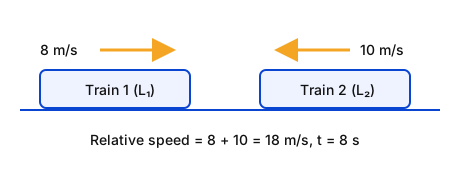
Two trains are moving in opposite directions at speeds of 8 m/s and 10 m/s. If they completely pass each other in 8 seconds, find the combined length of both trains.
दो रेलगाड़ियाँ 8 m/s और 10 m/s की चाल से विपरीत दिशाओं में चल रही हैं। यदि वे 8 सेकंड में एक-दूसरे को पूरी तरह पार कर लेती हैं, तो दोनों रेलगाड़ियों की संयुक्त लंबाई ज्ञात कीजिए।
  1. A156 meters156 मीटर
  2. B150 meters150 मीटर
  3. C152 meters152 मीटर
  4. D144 meters144 मीटर
Show answer

Concept: Opposite directions – relative speed = sum of speeds; distance covered while crossing = sum of lengths.

  1. Relative speed =8+10=18 m/s.
  2. Combined length =18×8=144 m.

Trick: Opposite → add speeds; same direction → subtract. Then length = speed × time.

Answer: (D) 144 meters

अवधारणा: विपरीत दिशा में सापेक्ष चाल = चालों का योग; पार करने में तय दूरी = लंबाइयों का योग।

  1. सापेक्ष चाल =8+10=18 m/s।
  2. कुल लंबाई =18×8=144 m।

ट्रिक: विपरीत दिशा → चालें जोड़ें; समान दिशा → घटाएँ। फिर लंबाई = चाल × समय।

उत्तर: (D) 144 meters

RRB NTPC Undergraduate CBT 1MathematicsTrainsRRB NTPC Undergraduate CBT 1 2025 · 14 Jun Shift 3 →
Q7347.
If the fourth proportional to 5, 15, and 25 is k, then find k.
यदि 5, 15 और 25 का चतुर्थानुपाती k है, तो k ज्ञात कीजिए।
  1. Ak = 60
  2. Bk = 75
  3. Ck = 90
  4. Dk = 125
Show answer

Concept: Fourth proportional to a,b,c is d with a:b=c:d, so d=b×ca.

  1. k=15×255=75.
  2. Check: 5:15=1:3 and 25:75=1:3.

Trick: Second term is 3 times the first, so the fourth is 3 times the third: 3×25=75.

Answer: (B) k = 75

अवधारणा: a,b,c का चतुर्थानुपाती d है जहाँ a:b=c:d, अतः d=b×ca।

  1. k=15×255=75।
  2. जाँच: 5:15=25:75=1:3।

ट्रिक: दूसरा पद पहले का 3 गुना है, अतः चौथा तीसरे का 3 गुना: 75।

उत्तर: (B) k = 75

RRB NTPC Undergraduate CBT 1MathematicsProportionRRB NTPC Undergraduate CBT 1 2025 · 14 Jun Shift 3 →
Q7348.
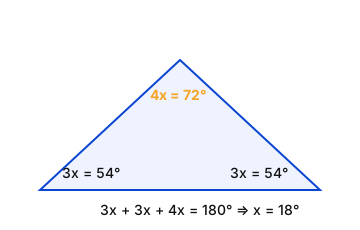
In a triangle, the ratio of three angles is 3 : 3 : 4. Find the measure of the largest angle.
एक त्रिभुज में, तीनों कोणों का अनुपात 3 : 3 : 4 है। सबसे बड़े कोण का माप ज्ञात कीजिए।
  1. A84°
  2. B72°
  3. C62°
  4. D40°
Show answer

Concept: Angles of a triangle add to 180∘.

  1. Let angles be 3x,3x,4x: 10x=180∘⇒x=18∘.
  2. Largest angle =4×18=72∘.

Trick: Largest angle =largest ratio partsum of parts×180=410×180=72∘.

Answer: (B) 72∘

अवधारणा: त्रिभुज के कोणों का योग 180∘ होता है।

  1. कोण 3x,3x,4x मानें: 10x=180∘⇒x=18∘।
  2. सबसे बड़ा कोण =4×18=72∘।

ट्रिक: सबसे बड़ा कोण =410×180=72∘।

उत्तर: (B) 72∘

RRB NTPC Undergraduate CBT 1MathematicsAngles of a triangleRRB NTPC Undergraduate CBT 1 2025 · 14 Jun Shift 3 →
Q7349.
The average of 8 numbers is 45. If each number is decreased by 3, what will the new average be?
8 संख्याओं का औसत 45 है। यदि प्रत्येक संख्या में 3 की कमी की जाए, तो नया औसत क्या होगा?
  1. A42
  2. B8
  3. C39
  4. D45
Show answer

Concept: If every observation changes by the same amount, the average changes by exactly that amount.

  1. Each of 8 numbers decreases by 3 → total decreases by 24.
  2. New average =45−248=45−3=42.

Trick: Add/subtract the same number from all → average shifts by that number; no need to touch the total.

Answer: (A) 42

अवधारणा: यदि हर संख्या में समान परिवर्तन हो, तो औसत में भी उतना ही परिवर्तन होता है।

  1. 8 संख्याओं में 3-3 घटे → योग में 24 की कमी।
  2. नया औसत =45−3=42।

ट्रिक: सबमें समान संख्या जोड़ें/घटाएँ → औसत उतना ही खिसकता है।

उत्तर: (A) 42

RRB NTPC Undergraduate CBT 1MathematicsAverageRRB NTPC Undergraduate CBT 1 2025 · 14 Jun Shift 3 →
Q7350.
Find the greatest number that divides 75, 105 and 150 exactly.
वह सबसे बड़ी संख्या ज्ञात कीजिए जो 75, 105 और 150 को पूर्णतः विभाजित करती है।
  1. A10
  2. B25
  3. C5
  4. D15
Show answer

Concept: The greatest number dividing given numbers exactly is their HCF.

  1. 75=3×52, 105=3×5×7, 150=2×3×52.
  2. Common factors: 3×5=15.

Trick: 25 does not divide 105, 10 does not divide 75 – eliminate; 15 divides all three.

Answer: (D) 15

अवधारणा: दी गई संख्याओं को पूर्णतः विभाजित करने वाली सबसे बड़ी संख्या उनका HCF है।

  1. 75=3×52, 105=3×5×7, 150=2×3×52।
  2. उभयनिष्ठ गुणनखंड =3×5=15।

ट्रिक: 25 से 105 और 10 से 75 विभाजित नहीं होते – हटाएँ; 15 तीनों को काटता है।

उत्तर: (D) 15

RRB NTPC Undergraduate CBT 1MathematicsHCFRRB NTPC Undergraduate CBT 1 2025 · 14 Jun Shift 3 →
Q7351.
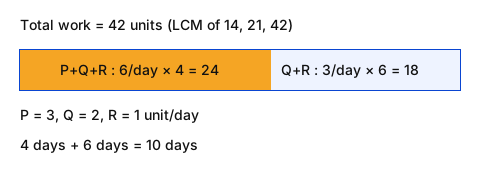
A team of 3 workers, P, Q, and R, is assigned to paint a large wall. P alone can finish the work in 14 days, Q alone in 21 days, and R alone in 42 days. If they start together but P leaves after 4 days, and the remaining work is completed by Q and R together, in how many total days is the wall completely painted?
3 श्रमिकों, P, Q और R, की एक टीम को एक बड़ी दीवार पेंट करने का कार्य सौंपा जाता है। P अकेले कार्य को 14 दिनों में, Q अकेले 21 दिनों में और R अकेले 42 दिनों में पूरा कर सकता है। यदि वे एक साथ कार्य आरंभ करते हैं परंतु P 4 दिनों के बाद कार्य छोड़ देता है, और शेष कार्य Q और R मिलकर पूरा करते हैं, तो दीवार कुल कितने दिनों में पूरी तरह पेंट हो जाती है?
  1. A10 days10 दिन
  2. B9 days9 दिन
  3. C11 days11 दिन
  4. D12 days12 दिन
Show answer

Concept: Total work = LCM of days; efficiency = units per day.

  1. LCM(14, 21, 42) =42 units. P =3, Q =2, R =1 unit/day.
  2. First 4 days (all three): 6×4=24 units; remaining =18.
  3. Q + R =3 units/day → 183=6 days.
  4. Total =4+6=10 days.

Trick: P's 4 days =12 units; the other 30 units are done by Q + R at 3/day = 10 days, which is the total time.

Answer: (A) 10 days

अवधारणा: कुल कार्य = दिनों का LCM; दक्षता = इकाई प्रति दिन।

  1. LCM(14, 21, 42) =42 इकाई; P =3, Q =2, R =1 इकाई/दिन।
  2. पहले 4 दिन तीनों: 24 इकाई; शेष 18।
  3. Q + R =3 इकाई/दिन → 6 दिन।
  4. कुल =4+6=10 दिन।

ट्रिक: Q + R पूरे समय काम करते हैं: 3×T+3×4=42⇒T=10 दिन।

उत्तर: (A) 10 days

RRB NTPC Undergraduate CBT 1MathematicsTime and workRRB NTPC Undergraduate CBT 1 2025 · 14 Jun Shift 3 →
Q7352.
A shopkeeper fixes the marked price of an item 150% above its cost price. What percentage of discount on marked price should be allowed to gain 110%?
एक दुकानदार किसी वस्तु का अंकित मूल्य उसके क्रय मूल्य से 150% अधिक निर्धारित करता है। 110% का लाभ प्राप्त करने के लिए अंकित मूल्य पर कितने प्रतिशत की छूट दी जानी चाहिए?
  1. A17%
  2. B16%
  3. C14%
  4. D15%
Show answer

Concept: SP = MP × (1 − discount); required SP comes from the desired profit on CP.

  1. Let CP =100. MP =250 (150% above CP).
  2. Required SP for 110% gain =210.
  3. Discount =250−210=40; 40250×100=16%.

Trick: SPMP=210250=0.84, so discount =16%.

Answer: (B) 16%

अवधारणा: SP = MP × (1 − छूट); अभीष्ट SP, CP पर वांछित लाभ से मिलता है।

  1. CP =100 मानें, MP =250।
  2. 110% लाभ के लिए SP =210।
  3. छूट =40; 40250×100=16%।

ट्रिक: SPMP=210250=0.84 → छूट 16%।

उत्तर: (B) 16%

RRB NTPC Undergraduate CBT 1MathematicsProfit, loss and discountRRB NTPC Undergraduate CBT 1 2025 · 14 Jun Shift 3 →
Q7353.
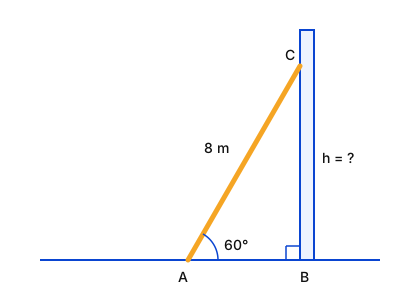
A ladder of length 8 m is placed against a vertical wall, making an angle of 60° with the ground. How high does the ladder reach up the wall?
8 m लंबी एक सीढ़ी एक ऊर्ध्वाधर दीवार के सहारे इस प्रकार रखी गई है कि वह भूमि के साथ 60° का कोण बनाती है। सीढ़ी दीवार पर कितनी ऊँचाई तक पहुँचती है?
  1. A43 m
  2. B63 m
  3. C33 m
  4. D53 m
Show answer

Concept: In a right triangle, sinθ=oppositehypotenuse; the ladder is the hypotenuse.

  1. Height h=8sin60∘=8×32.
  2. h=43 m ≈6.93 m.

Yaad rakhein: 30∘-60∘-90∘ triangle sides are 1:3:2; hypotenuse 8 → side opposite 60∘ is 43.

Answer: (A) 43 m

अवधारणा: समकोण त्रिभुज में sinθ=लंबकर्ण; सीढ़ी कर्ण है।

  1. ऊँचाई h=8sin60∘=8×32।
  2. h=43 m ≈6.93 m।

याद रखें: 30∘-60∘-90∘ त्रिभुज की भुजाएँ 1:3:2; कर्ण 8 → 60∘ के सामने की भुजा 43।

उत्तर: (A) 43 m

RRB NTPC Undergraduate CBT 1MathematicsHeights and distancesRRB NTPC Undergraduate CBT 1 2025 · 14 Jun Shift 3 →
Q7354.
Which of the following pairs of numbers is co-prime?
A) (15, 25)
B) (14, 35)
C) (9, 28)
D) (21, 49)
निम्नलिखित में से कौन-सा संख्या युग्म सह-अभाज्य (co-prime) है?
A) (15, 25)
B) (14, 35)
C) (9, 28)
D) (21, 49)
  1. AB
  2. BC
  3. CD
  4. DA
Show answer

Concept: Two numbers are co-prime when their HCF is 1.

  1. (15, 25): HCF 5; (14, 35): HCF 7; (21, 49): HCF 7 – not co-prime.
  2. (9, 28): 9=32, 28=22×7 – no common factor, HCF 1. So pair C is co-prime.
  3. Pair C corresponds to option (B).

Trick: Pairs with both numbers multiples of 5 or 7 are instantly out; 9 and 28 share nothing.

Answer: (B) C

अवधारणा: दो संख्याएँ सह-अभाज्य हैं जब उनका HCF 1 हो।

  1. (15, 25): HCF 5; (14, 35): HCF 7; (21, 49): HCF 7 – सह-अभाज्य नहीं।
  2. (9, 28): 9=32, 28=22×7 – HCF 1, अतः युग्म C सह-अभाज्य है।
  3. युग्म C विकल्प (B) है।

ट्रिक: जिन युग्मों में दोनों संख्याएँ 5 या 7 की गुणज हों, वे तुरंत बाहर।

उत्तर: (B) C

RRB NTPC Undergraduate CBT 1MathematicsCo-prime numbersRRB NTPC Undergraduate CBT 1 2025 · 14 Jun Shift 3 →
Q7355.
Three positive integers a, b, and c satisfy the following conditions: (i) a and b are coprime, (ii) b and c are coprime, (iii) a and c are not coprime, (iv) abc = 360. The minimum possible value of a + b + c is:
तीन धनात्मक पूर्णांक a, b और c निम्नलिखित शर्तों को संतुष्ट करते हैं: (i) a और b सह-अभाज्य हैं, (ii) b और c सह-अभाज्य हैं, (iii) a और c सह-अभाज्य नहीं हैं, (iv) abc = 360. a + b + c का न्यूनतम संभव मान कितना है?
  1. A95
  2. B27
  3. C23
  4. D33
Show answer

Concept: 360=23×32×5. b must share no prime with a or c, while a and c share a prime.

  1. Give b a prime of its own and split the rest between a and c so they share a factor.
  2. b=5, a×c=72 with a common factor: a=6,c=12 → 6×5×12=360.
  3. Check: gcd(6,5) = 1, gcd(5,12) = 1, gcd(6,12) = 6. Sum =6+5+12=23.
  4. Other splits (3,8,15 → 26; 2,45,4 → 51) give larger sums.

Trick: Keep the lone prime 5 as b and make a,c as balanced as possible (6 and 12) – balanced factors give the smallest sum.

Answer: (C) 23

अवधारणा: 360=23×32×5। b का a या c से कोई उभयनिष्ठ अभाज्य नहीं, जबकि a और c में एक उभयनिष्ठ अभाज्य हो।

  1. b को अलग अभाज्य दें, बाकी a और c में बाँटें ताकि वे एक गुणनखंड साझा करें।
  2. b=5, a=6, c=12 → 6×5×12=360।
  3. जाँच: gcd(6,5) = 1, gcd(5,12) = 1, gcd(6,12) = 6; योग =23।
  4. अन्य विभाजन (3,8,15 → 26) बड़े योग देते हैं।

ट्रिक: अकेले अभाज्य 5 को b रखें और a,c को यथासंभव संतुलित (6,12) बनाएँ – संतुलित गुणनखंडों का योग न्यूनतम होता है।

उत्तर: (C) 23

RRB NTPC Undergraduate CBT 1MathematicsNumber system – co-primesRRB NTPC Undergraduate CBT 1 2025 · 14 Jun Shift 3 →
Q7356.
The average of 6.5, 10.8, 20 and a is 13. The value of a is:
6.5, 10.8, 20 और a का औसत 13 है। a का मान कितना है?
  1. A15.7
  2. B16.7
  3. C14.7
  4. D13.7
Show answer

Concept: Sum = average × count.

  1. Sum of four numbers =13×4=52.
  2. 6.5+10.8+20=37.3.
  3. a=52−37.3=14.7.

Trick: Deviations from 13: −6.5,−2.2,+7 → total −1.7, so a must be 13+1.7=14.7.

Answer: (C) 14.7

अवधारणा: योग = औसत × संख्या।

  1. चारों का योग =13×4=52।
  2. 6.5+10.8+20=37.3।
  3. a=52−37.3=14.7।

ट्रिक: 13 से विचलन: −6.5,−2.2,+7 → कुल −1.7, अतः a=13+1.7=14.7।

उत्तर: (C) 14.7

RRB NTPC Undergraduate CBT 1MathematicsAverageRRB NTPC Undergraduate CBT 1 2025 · 14 Jun Shift 3 →
Q7357.
If 3x−3x−1=18, then the value of 2x−12x+3 is:
यदि 3x−3x−1=18 है, तो 2x−12x+3 का मान कितना है?
  1. A513
  2. B56
  3. C512
  4. D59
Show answer

Concept: 3x−1=3x3; factor out the common power.

  1. 3x−3x3=18⇒3x×23=18⇒3x=27, so x=3.
  2. 2x−12x+3=6−16+3=59.

Trick: 3x−3x−1=2×3x−1; so 3x−1=9⇒x=3.

Answer: (D) 59

अवधारणा: 3x−1=3x3; उभयनिष्ठ घात बाहर निकालें।

  1. 3x×23=18⇒3x=27⇒x=3।
  2. 2x−12x+3=59।

ट्रिक: 3x−3x−1=2×3x−1=18⇒3x−1=9⇒x=3।

उत्तर: (D) 59

RRB NTPC Undergraduate CBT 1MathematicsIndicesRRB NTPC Undergraduate CBT 1 2025 · 14 Jun Shift 3 →
Q7358.
If 45% of a number exceeds 20% of it by 30, then the number is:
यदि किसी संख्या का 45%, उसी संख्या के 20% से 30 अधिक है, तो वह संख्या कितनी है?
  1. A140
  2. B100
  3. C120
  4. D160
Show answer

Concept: Difference of two percentages of the same number is that percentage-difference of the number.

  1. 45%−20%=25% of the number =30.
  2. Number =3025×100=120.

Trick: 25%=14, so the number is 4×30=120.

Answer: (C) 120

अवधारणा: एक ही संख्या के दो प्रतिशतों का अंतर = प्रतिशत-अंतर × संख्या।

  1. 45%−20%=25% का मान =30।
  2. संख्या =30×4=120।

ट्रिक: 25%=14, अतः संख्या =4×30=120।

उत्तर: (C) 120

RRB NTPC Undergraduate CBT 1MathematicsPercentageRRB NTPC Undergraduate CBT 1 2025 · 14 Jun Shift 3 →
Q7359.
A product with marked price ₹3,000 is sold with successive discounts of 15% and 25%. What is the final selling price after these two discounts?
₹3,000 अंकित मूल्य वाले एक उत्पाद को 15% और 25% की क्रमिक छूट पर बेचा जाता है। इन दो छूटों के बाद अंतिम विक्रय मूल्य कितना है?
  1. A₹1,936.50
  2. B₹1,872
  3. C₹1,912.50
  4. D₹1,896
Show answer

Concept: Successive discounts multiply: SP =MP×(1−d1)(1−d2).

  1. 3000×0.85=2550.
  2. 2550×0.75=1912.50.

Trick: Single equivalent discount =15+25−15×25100=36.25%; 3000×0.6375=1912.5.

Answer: (C) ₹1,912.50

अवधारणा: क्रमिक छूटें गुणा होती हैं: SP =MP×(1−d1)(1−d2)।

  1. 3000×0.85=2550।
  2. 2550×0.75=1912.50।

ट्रिक: एकल समतुल्य छूट =15+25−15×25100=36.25%; 3000×0.6375=1912.5।

उत्तर: (C) ₹1,912.50

RRB NTPC Undergraduate CBT 1MathematicsSuccessive discountsRRB NTPC Undergraduate CBT 1 2025 · 14 Jun Shift 3 →
Q7360.
Two articles are sold at the same selling price. On one article, the trader makes a 25% profit, and on the other, he incurs a 25% loss. What is the overall percentage loss?
दो वस्तुएँ समान विक्रय मूल्य पर बेची जाती हैं। एक वस्तु पर व्यापारी को 25% लाभ होता है, और दूसरी पर उसे 25% हानि होती है। कुल प्रतिशत हानि कितनी है?
  1. A7.25%
  2. B6.25%
  3. C5.25%
  4. D8.25%
Show answer

Concept: Same SP, equal profit % and loss % → always a net loss of (x10)2%.

  1. Loss =(2510)2=6.25%.
  2. Check: SP =100 each; CPs =80 and 133.33, total CP =213.33, total SP =200; loss =13.33213.33=6.25%.

Yaad rakhein: Same SP, x% gain and x% loss → loss =x2100%, never a profit.

Answer: (B) 6.25%

अवधारणा: समान SP पर समान लाभ % और हानि % → सदैव (x10)2% की हानि।

  1. हानि =(2510)2=6.25%।
  2. जाँच: SP =100 प्रत्येक; CP =80 और 133.33; कुल CP 213.33, कुल SP 200 → हानि 6.25%।

याद रखें: समान SP, x% लाभ और x% हानि → हानि =x2100%।

उत्तर: (B) 6.25%

RRB NTPC Undergraduate CBT 1MathematicsProfit and loss – same SPRRB NTPC Undergraduate CBT 1 2025 · 14 Jun Shift 3 →