Question bank

Q&A: practice questions with answers

Search questions on any topic. Filter by exam category, exam, subject and topic, try the question, then open the answer and explanation.

Courses – airGurukul

8,495 questions found.

Q7361.
A merchant marks his products 30% above the cost price and provides a 10% discount on the marked price. What percent profit does he earn?
एक व्यापारी अपने उत्पादों पर क्रय मूल्य से 30% अधिक मूल्य अंकित करता है और अंकित मूल्य पर 10% की छूट देता है। वह कितने प्रतिशत लाभ अर्जित करता है?
  1. A17%
  2. B15%
  3. C16%
  4. D18%
Show answer

Concept: SP =CP×(1+markup)×(1−discount).

  1. CP =100, MP =130.
  2. SP =130×0.9=117.
  3. Profit =17%.

Trick: Net =30−10−30×10100=17%.

Answer: (A) 17%

अवधारणा: SP =CP×(1+मार्कअप)×(1−छूट)।

  1. CP =100, MP =130।
  2. SP =130×0.9=117।
  3. लाभ =17%।

ट्रिक: शुद्ध =30−10−30×10100=17%।

उत्तर: (A) 17%

RRB NTPC Undergraduate CBT 1MathematicsProfit, loss and discountRRB NTPC Undergraduate CBT 1 2025 · 14 Jun Shift 3 →
Q7362.
The sum of two numbers is 54. If three times the smaller number exceeds twice the larger number by 6, find the difference between the two numbers.
दो संख्याओं का योग 54 है। यदि छोटी संख्या का तीन गुना, बड़ी संख्या के दो गुने से 6 अधिक है, तो दोनों संख्याओं के बीच का अंतर ज्ञात कीजिए।
  1. A8.4
  2. B7.6
  3. C6.6
  4. D7.2
Show answer

Concept: Form two equations and solve.

  1. Let smaller =s, larger =54−s.
  2. 3s−2(54−s)=6⇒5s=114⇒s=22.8.
  3. Larger =31.2; difference =31.2−22.8=8.4.

Trick: 3s−2l=6 and 2s+2l=108 → add: 5s=114 directly.

Answer: (A) 8.4

अवधारणा: दो समीकरण बनाकर हल करें।

  1. छोटी =s, बड़ी =54−s।
  2. 3s−2(54−s)=6⇒5s=114⇒s=22.8।
  3. बड़ी =31.2; अंतर =8.4।

ट्रिक: 3s−2l=6 और 2s+2l=108 जोड़ें → 5s=114।

उत्तर: (A) 8.4

RRB NTPC Undergraduate CBT 1MathematicsLinear equationsRRB NTPC Undergraduate CBT 1 2025 · 14 Jun Shift 3 →
Q7363.
The price of an article is first increased by 30% and then decreased by 20%. Due to these successive changes, the final price becomes ₹40 more than the original price. What is the original price of the article?
एक वस्तु के मूल्य में पहले 30% की वृद्धि की जाती है और फिर 20% की कमी की जाती है। इन क्रमिक परिवर्तनों के कारण, अंतिम मूल्य मूल मूल्य से ₹40 अधिक हो जाता है। वस्तु का मूल मूल्य कितना है?
  1. A₹1,000
  2. B₹1,200
  3. C₹1,100
  4. D₹900
Show answer

Concept: Net change for +a% then −b% is a−b−ab100.

  1. Net =30−20−6=+4%.
  2. 4% of original =40⇒ original =1000.
  3. Check: 1000→1300→1040, which is ₹40 more.

Trick: 1.3×0.8=1.04 → a 4% rise; 40÷0.04=1000.

Answer: (A) ₹1,000

अवधारणा: +a% फिर −b% का शुद्ध परिवर्तन =a−b−ab100।

  1. शुद्ध =30−20−6=+4%।
  2. मूल का 4%=40⇒ मूल =1000।
  3. जाँच: 1000→1300→1040।

ट्रिक: 1.3×0.8=1.04 → 4% वृद्धि; 40÷0.04=1000।

उत्तर: (A) ₹1,000

RRB NTPC Undergraduate CBT 1MathematicsSuccessive percentage changeRRB NTPC Undergraduate CBT 1 2025 · 14 Jun Shift 3 →
Q7364.
Find the third proportional to 240 and 120.
240 और 120 का तृतीयानुपाती ज्ञात कीजिए।
  1. A40
  2. B50
  3. C60
  4. D80
Show answer

Concept: Third proportional to a,b is c with a:b=b:c, so c=b2a.

  1. c=1202240=14400240=60.
  2. Check: 240:120=120:60=2:1.

Trick: 120 is half of 240, so the next term is half of 120 = 60.

Answer: (C) 60

अवधारणा: a,b का तृतीयानुपाती c=b2a।

  1. c=1202240=60।
  2. जाँच: 240:120=120:60।

ट्रिक: 120, 240 का आधा है, अतः अगला पद 120 का आधा = 60।

उत्तर: (C) 60

RRB NTPC Undergraduate CBT 1MathematicsProportionRRB NTPC Undergraduate CBT 1 2025 · 14 Jun Shift 3 →
Q7365.
The value of 2723·9−123−1·8114 is
2723·9−123−1·8114 का मान कितना है?
  1. A1
  2. B3
  3. C6
  4. D9
Show answer

Concept: Write every base as a power of 3 and use (am)n=amn.

  1. 2723=(33)23=32=9; 9−12=13. Numerator =9×13=3.
  2. 8114=3; 3−1×3=1. Denominator =1.
  3. Value =31=3.

Trick: In powers of 3: numerator 32−1=31, denominator 3−1+1=30 → 31−0=3.

Answer: (B) 3

अवधारणा: हर आधार को 3 की घात में लिखें और (am)n=amn लगाएँ।

  1. 2723=9; 9−12=13; अंश =3।
  2. 8114=3; 3−1×3=1; हर =1।
  3. मान =3।

ट्रिक: 3 की घातों में: अंश 31, हर 30 → उत्तर 3।

उत्तर: (B) 3

RRB NTPC Undergraduate CBT 1MathematicsIndicesRRB NTPC Undergraduate CBT 1 2025 · 14 Jun Shift 3 →
Q7366.
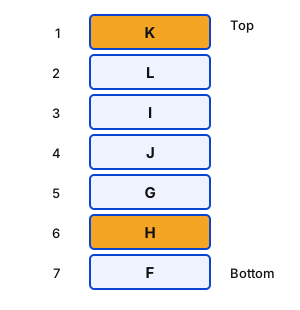
Seven boxes, F, G, H, I, J, K and L, are kept one over the other, but not necessarily in the same order.
Only one box is kept between G and F. J is kept at the fourth position from the top. Only one box is kept above L. I is kept immediately below L. K is kept at a position
somewhere above J.
How many boxes are kept between K and H?
सात बक्से, F, G, H, I, J, K और L, एक के ऊपर एक रखे गए हैं, परंतु आवश्यक नहीं कि इसी क्रम में हों।
G और F के बीच केवल एक बक्सा रखा है। J ऊपर से चौथे स्थान पर रखा है। L के ऊपर केवल एक बक्सा रखा है। I, L के ठीक नीचे रखा है। K, J के ऊपर किसी स्थान पर
रखा है।
K और H के बीच कितने बक्से रखे हैं?
  1. AOneएक
  2. BTwoदो
  3. CThreeतीन
  4. DFourचार
Show answer

Concept: Fix the definite positions first (counting from the top), then place the rest.

  1. J is 4th from top. Only one box above L → L = 2nd, I (immediately below L) = 3rd.
  2. K is above J → the only free place above J is 1st, so K = 1st.
  3. Positions 5, 6, 7 remain for F, G, H. Only one box between G and F → G, F at 5 and 7; H = 6th.
  4. K (1st) and H (6th): boxes between = L, I, J, G/F = 4.

Trick: “Only one above L” pins L at 2 – always start from such absolute clues.

Answer: (D) Four

अवधारणा: पहले निश्चित स्थान (ऊपर से गिनकर) तय करें, फिर बाकी रखें।

  1. J ऊपर से 4था। L के ऊपर केवल एक बॉक्स → L = 2रा, I (L के ठीक नीचे) = 3रा।
  2. K, J के ऊपर है → J के ऊपर एकमात्र खाली स्थान 1ला, अतः K = 1ला।
  3. स्थान 5, 6, 7 पर F, G, H। G और F के बीच केवल एक → G, F = 5 व 7; H = 6ठा।
  4. K (1) और H (6) के बीच: L, I, J, G/F = 4 बॉक्स।

ट्रिक: “L के ऊपर केवल एक” L को 2 पर जड़ देता है – ऐसे निश्चित संकेतों से शुरू करें।

उत्तर: (D) Four

RRB NTPC Undergraduate CBT 1General Intelligence and ReasoningPuzzle – Box arrangementRRB NTPC Undergraduate CBT 1 2025 · 14 Jun Shift 3 →
Q7367.
Each vowel in the word RADULAE is changed to the letter immediately following it in the English alphabetical order, and each consonant is changed to the letter immediately preceding it in the English alphabetical order. How many letters will appear exactly twice in the new group of letters thus formed?
शब्द RADULAE के प्रत्येक स्वर को अंग्रेज़ी वर्णमाला क्रम में उसके ठीक बाद वाले अक्षर से और प्रत्येक व्यंजन को अंग्रेज़ी वर्णमाला क्रम में उसके ठीक पहले वाले अक्षर से बदल दिया जाता है। इस प्रकार बने अक्षरों के नए समूह में कितने अक्षर ठीक दो बार आएँगे?
  1. AZeroशून्य
  2. BTwoदो
  3. COneएक
  4. DThreeतीन
Show answer

Concept: Vowels (A, E, I, O, U) move +1, consonants move −1 in the alphabet.

  1. R A D U L A E → R−1 = Q, A+1 = B, D−1 = C, U+1 = V, L−1 = K, A+1 = B, E+1 = F.
  2. New group: Q B C V K B F.
  3. Only B appears exactly twice (from the two A’s) → one letter.

Trick: Repeated letters in the original word (A, A) stay repeated after the shift – count them first.

Answer: (C) One

अवधारणा: स्वर (A, E, I, O, U) वर्णमाला में +1 और व्यंजन −1 खिसकते हैं।

  1. R A D U L A E → R−1 = Q, A+1 = B, D−1 = C, U+1 = V, L−1 = K, A+1 = B, E+1 = F।
  2. नया समूह: Q B C V K B F।
  3. केवल B ठीक दो बार आता है (दोनों A से) → एक अक्षर।

ट्रिक: मूल शब्द के दोहराए अक्षर (A, A) खिसकने के बाद भी दोहराए रहते हैं – पहले उन्हें गिनें।

उत्तर: (C) One

RRB NTPC Undergraduate CBT 1General Intelligence and ReasoningLetter manipulationRRB NTPC Undergraduate CBT 1 2025 · 14 Jun Shift 3 →
Q7368.
Select the set in which the numbers are related in the same way as are the numbers of the following sets.
(NOTE: Operations should be performed on the whole numbers, without breaking down the numbers into their constituent digits. E.g. 13 – Operations on 13 such as
adding/subtracting/multiplying etc. to 13 can be performed. Breaking down 13 into 1 and 3 and then performing mathematical operations on 1 and 3 is not allowed.) (2, 5, 7)
(3, 10, 13)
उस समुच्चय का चयन कीजिए जिसमें संख्याएँ उसी प्रकार संबंधित हैं जिस प्रकार निम्नलिखित समुच्चयों की संख्याएँ संबंधित हैं।
(ध्यान दें: संख्याओं को उनके घटक अंकों में विभाजित किए बिना, संक्रियाएँ पूर्ण संख्याओं पर की जानी चाहिए। उदाहरण के लिए 13 – 13 पर संक्रियाएँ जैसे
13 में जोड़ना/घटाना/गुणा करना आदि किया जा सकता है। 13 को 1 और 3 में विभाजित करना और फिर 1 और 3 पर गणितीय संक्रियाएँ करना वर्जित है।) (2, 5, 7)
(3, 10, 13)
  1. A(7, 49, 51)
  2. B(6, 37, 43)
  3. C(5, 26, 36)
  4. D(8, 63, 75)
Show answer

Concept: Find a rule linking the three numbers (a, b, c) that works for both given sets.

  1. (2, 5, 7): 22+1=5 and 5+2=7.
  2. (3, 10, 13): 32+1=10 and 10+3=13. Rule: b=a2+1,c=b+a.
  3. (6, 37, 43): 62+1=37 ✓, 37+6=43 ✓. Others fail: (7, 49, 51) needs 50; (5, 26, 36) needs 31; (8, 63, 75) needs 65.

Trick: Check the first pair rule (a2+1) on options – only (6, 37) survives.

Answer: (B) (6, 37, 43)

अवधारणा: तीनों संख्याओं (a, b, c) को जोड़ने वाला ऐसा नियम खोजें जो दोनों दिए सेटों पर लागू हो।

  1. (2, 5, 7): 22+1=5 और 5+2=7।
  2. (3, 10, 13): 32+1=10 और 10+3=13। नियम: b=a2+1,c=b+a।
  3. (6, 37, 43): 62+1=37 ✓, 37+6=43 ✓। बाकी असफल: (7, 49, 51) में 50 चाहिए; (5, 26, 36) में 31; (8, 63, 75) में 65।

ट्रिक: पहले जोड़े का नियम (a2+1) विकल्पों पर जाँचें – केवल (6, 37) बचता है।

उत्तर: (B) (6, 37, 43)

RRB NTPC Undergraduate CBT 1General Intelligence and ReasoningNumber analogy (triplets)RRB NTPC Undergraduate CBT 1 2025 · 14 Jun Shift 3 →
Q7369.
In a certain code language, ‘stage pig add’ is coded as ‘yv se kk’ and ‘third add bee’ is coded as ‘se ec wm’. How is ‘add’ coded in that language? (All codes are two-letter codes.)
एक निश्चित कूट भाषा में, ‘stage pig add’ को ‘yv se kk’ लिखा जाता है और ‘third add bee’ को ‘se ec wm’ लिखा जाता है। उसी भाषा में ‘add’ को कैसे लिखा जाएगा? (सभी कूट दो अक्षरों वाले कूट हैं।)
  1. Akk
  2. Byv
  3. Cec
  4. Dse
Show answer

Concept: A word common to two sentences has the code common to both.

  1. ‘stage pig add’ → ‘yv se kk’; ‘third add bee’ → ‘se ec wm’.
  2. Common word = add; common code = se.
  3. So add = se.

Trick: Match common words with common codes – no need to decode the rest.

Answer: (D) se

अवधारणा: दो वाक्यों में उभयनिष्ठ शब्द का कूट भी दोनों में उभयनिष्ठ होता है।

  1. ‘stage pig add’ → ‘yv se kk’; ‘third add bee’ → ‘se ec wm’।
  2. उभयनिष्ठ शब्द = add; उभयनिष्ठ कूट = se।
  3. अतः add = se।

ट्रिक: उभयनिष्ठ शब्द को उभयनिष्ठ कूट से मिलाएँ – बाकी डिकोड करने की ज़रूरत नहीं।

उत्तर: (D) se

RRB NTPC Undergraduate CBT 1General Intelligence and ReasoningCoding–decoding (common word)RRB NTPC Undergraduate CBT 1 2025 · 14 Jun Shift 3 →
Q7370.
Refer to the given letter series and answer the question that follows. Counting to be done from left to right only.
(Left) F M I H Y F Y E G K Y O N V K H Q T E K N (Right)
How many such vowels are there, each of which is immediately preceded by a consonant and also immediately followed by a vowel?
दी गई अक्षर श्रृंखला को देखिए और उसके बाद दिए गए प्रश्न का उत्तर दीजिए। गिनती केवल बाएँ से दाएँ की जानी है।
(बाएँ) F M I H Y F Y E G K Y O N V K H Q T E K N (दाएँ)
ऐसे कितने स्वर हैं, जिनमें से प्रत्येक के ठीक पहले एक व्यंजन है और ठीक बाद एक स्वर भी है?
  1. ANoneकोई नहीं
  2. BOneएक
  3. CTwoदो
  4. DThreeतीन
Show answer

Concept: Vowels are A, E, I, O, U; Y is a consonant. Check each vowel’s left and right neighbours.

  1. Series: F M I H Y F Y E G K Y O N V K H Q T E K N – vowels at positions 3, 8, 12, 19.
  2. I: M–I–H (followed by consonant ✗); E: Y–E–G ✗; O: Y–O–N ✗; E: T–E–K ✗.
  3. No vowel is followed by another vowel → none.

Trick: “Followed by a vowel” means two vowels together – scan for any adjacent vowel pair; there is none.

Answer: (A) None

अवधारणा: स्वर A, E, I, O, U हैं; Y व्यंजन है। हर स्वर के बाएँ-दाएँ पड़ोसी जाँचें।

  1. श्रृंखला: F M I H Y F Y E G K Y O N V K H Q T E K N – स्वर स्थान 3, 8, 12, 19 पर।
  2. I: M–I–H (बाद में व्यंजन ✗); E: Y–E–G ✗; O: Y–O–N ✗; E: T–E–K ✗।
  3. किसी स्वर के बाद स्वर नहीं → कोई नहीं।

ट्रिक: “बाद में स्वर” का अर्थ दो स्वर साथ-साथ – कोई भी सटा हुआ स्वर-जोड़ा खोजें; नहीं है।

उत्तर: (A) None

RRB NTPC Undergraduate CBT 1General Intelligence and ReasoningLetter series – countingRRB NTPC Undergraduate CBT 1 2025 · 14 Jun Shift 3 →
Q7371.
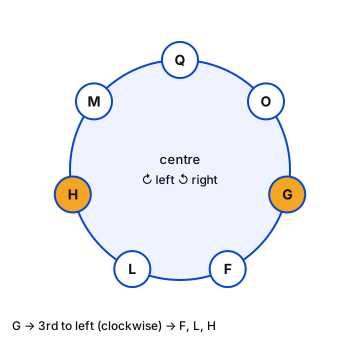
Seven people F, G, H, L, M, O and Q are sitting around a circular table, facing the centre of the table. Only two people sit between Q and L when counted from the right of Q. Only two people sit between L and O when counted from the left of O. Only three people sit between Q and F when counted from the right of Q. M sits to the immediate left of H. Who sits third to the left of G?
सात व्यक्ति F, G, H, L, M, O और Q एक वृत्ताकार मेज़ के चारों ओर मेज़ के केंद्र की ओर मुख करके बैठे हैं। Q के दाएँ से गिनने पर Q और L के बीच केवल दो व्यक्ति बैठे हैं। O के बाएँ से गिनने पर L और O के बीच केवल दो व्यक्ति बैठे हैं। Q के दाएँ से गिनने पर Q और F के बीच केवल तीन व्यक्ति बैठे हैं। M, H के ठीक बाएँ बैठा है। G के बाएँ से तीसरे स्थान पर कौन बैठा है?
  1. AH
  2. BL
  3. CF
  4. DM
Show answer

Concept: Facing the centre: left = clockwise, right = anticlockwise. Number the 7 seats clockwise with Q at seat 1.

  1. Two between Q and L from Q’s right (anticlockwise) → L at seat 5.
  2. Two between L and O from O’s left (clockwise) → O is 3 seats anticlockwise of L → O at seat 2.
  3. Three between Q and F from Q’s right → F at seat 4.
  4. Seats 3, 6, 7 left for G, H, M. M immediately left (clockwise) of H → H = 6, M = 7; G = 3.
  5. Third to the left of G (clockwise): F, L, H.

Trick: Write “right = anticlockwise” on the diagram once; every clue then becomes a simple count.

Answer: (A) H

अवधारणा: केंद्र की ओर मुख: बायाँ = दक्षिणावर्त (clockwise), दायाँ = वामावर्त। Q को सीट 1 मानकर 7 सीटें clockwise क्रमांकित करें।

  1. Q के दाएँ (वामावर्त) से Q व L के बीच दो → L सीट 5 पर।
  2. O के बाएँ (clockwise) से L व O के बीच दो → O, L से 3 सीट वामावर्त → O सीट 2 पर।
  3. Q के दाएँ से Q व F के बीच तीन → F सीट 4 पर।
  4. सीट 3, 6, 7 पर G, H, M। M, H के ठीक बाएँ (clockwise) → H = 6, M = 7; G = 3।
  5. G के बाएँ तीसरा (clockwise): F, L, H।

ट्रिक: चित्र पर एक बार “दायाँ = वामावर्त” लिख लें; फिर हर संकेत सिर्फ़ गिनती है।

उत्तर: (A) H

RRB NTPC Undergraduate CBT 1General Intelligence and ReasoningCircular seating arrangementRRB NTPC Undergraduate CBT 1 2025 · 14 Jun Shift 3 →
Q7372.
Based on the English alphabetical order, three of the following four letter-cluster pairs are alike in a certain way and thus form a group. Which letter-cluster pair DOES NOT belong to that group? (Note: The odd one out is not based on the number of
consonants/vowels or their position in the letter-cluster.)
अंग्रेज़ी वर्णमाला क्रम के आधार पर, निम्नलिखित चार अक्षर-समूह युग्मों में से तीन किसी निश्चित प्रकार से एकसमान हैं और इस प्रकार एक समूह बनाते हैं। कौन-सा अक्षर-समूह युग्म उस समूह से संबंधित नहीं है? (ध्यान दें: असंगत युग्म, अक्षर-समूह में
व्यंजनों/स्वरों की संख्या या उनके स्थान पर आधारित नहीं है।)
  1. AST - YZ
  2. BCD - IJ
  3. CIJ - OP
  4. DMJ - LP
Show answer

Concept: Compare the alphabetical gap between corresponding letters of each pair.

  1. ST – YZ: S→Y = +6, T→Z = +6.
  2. CD – IJ: +6, +6. IJ – OP: +6, +6.
  3. MJ – LP: M→L = −1, J→P = +6 – breaks the pattern.

Trick: Use place values (A=1 … Z=26); three pairs differ by +6 for both letters.

Answer: (D) MJ - LP

अवधारणा: प्रत्येक जोड़े के संगत अक्षरों के बीच वर्णमाला अंतर की तुलना करें।

  1. ST – YZ: S→Y = +6, T→Z = +6।
  2. CD – IJ: +6, +6। IJ – OP: +6, +6।
  3. MJ – LP: M→L = −1, J→P = +6 – पैटर्न टूटता है।

ट्रिक: स्थान-मान (A=1 … Z=26) लें; तीन जोड़ों में दोनों अक्षर +6 बढ़ते हैं।

उत्तर: (D) MJ - LP

RRB NTPC Undergraduate CBT 1General Intelligence and ReasoningLetter-cluster classificationRRB NTPC Undergraduate CBT 1 2025 · 14 Jun Shift 3 →
Q7373.
What should come in place of the question mark (?) in the given series based on the English alphabetical order?
PRY WYF DFM KMT ?
अंग्रेज़ी वर्णमाला क्रम के आधार पर दी गई श्रृंखला में प्रश्न चिह्न (?) के स्थान पर क्या आना चाहिए?
PRY WYF DFM KMT ?
  1. ARTA
  2. BRAT
  3. CRTY
  4. DERT
Show answer

Concept: Track each position of the cluster separately across the series.

  1. 1st letters: P → W → D → K → ? : each +7 → K+7 = R.
  2. 2nd letters: R → Y → F → M → ? : +7 → T.
  3. 3rd letters: Y → F → M → T → ? : +7 → A.

Trick: +7 wraps around Z (K=11, 11+7=18=R; T=20, 20+7=27→1=A).

Answer: (A) RTA

अवधारणा: श्रृंखला में समूह की प्रत्येक स्थिति को अलग-अलग ट्रैक करें।

  1. पहले अक्षर: P → W → D → K → ? : हर बार +7 → K+7 = R।
  2. दूसरे अक्षर: R → Y → F → M → ? : +7 → T।
  3. तीसरे अक्षर: Y → F → M → T → ? : +7 → A।

ट्रिक: +7 में Z के बाद A से गिनती चलती है (K=11, 11+7=18=R; T=20, 20+7=27→1=A)।

उत्तर: (A) RTA

RRB NTPC Undergraduate CBT 1General Intelligence and ReasoningLetter-cluster seriesRRB NTPC Undergraduate CBT 1 2025 · 14 Jun Shift 3 →
Q7374.
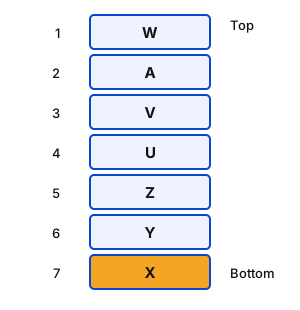
Seven boxes, A, U, V, W, X, Y and Z, are kept one over the other, but not necessarily in the same order.
Y is kept second from the bottom. Only two boxes are kept between Y and V. A is kept on one of the positions before V but on one of the positions after W. Only Z is kept between Y and U.
Which box is kept first from the bottom?
सात बक्से, A, U, V, W, X, Y और Z, एक के ऊपर एक रखे गए हैं, परंतु आवश्यक नहीं कि इसी क्रम में हों।
Y नीचे से दूसरे स्थान पर रखा है। Y और V के बीच केवल दो बक्से रखे हैं। A, V से पहले वाले स्थानों में से किसी एक पर परंतु W के बाद वाले स्थानों में से किसी एक पर रखा है। Y और U के बीच केवल Z रखा है।
नीचे से पहले स्थान पर कौन-सा बक्सा रखा है?
  1. AA
  2. BW
  3. CX
  4. DU
Show answer

Concept: Number positions 1 (top) to 7 (bottom); “before” = above, “after” = below.

  1. Y is 2nd from bottom → position 6. Two boxes between Y and V → V at 3.
  2. Only Z between Y and U → Z at 5, U at 4 (going upward; downward is impossible).
  3. A is above V but below W → W = 1, A = 2.
  4. Only X is left → X at 7, the bottom.

Trick: With 7 boxes, “second from bottom” = 6th from top; convert all clues to one direction.

Answer: (C) X

अवधारणा: स्थान 1 (ऊपर) से 7 (नीचे) क्रमांकित करें; “before” = ऊपर, “after” = नीचे।

  1. Y नीचे से 2रा → स्थान 6। Y और V के बीच दो बॉक्स → V स्थान 3 पर।
  2. Y और U के बीच केवल Z → Z = 5, U = 4 (ऊपर की ओर; नीचे संभव नहीं)।
  3. A, V के ऊपर पर W के नीचे → W = 1, A = 2।
  4. केवल X बचा → X स्थान 7 पर, सबसे नीचे।

ट्रिक: 7 बॉक्स में “नीचे से दूसरा” = ऊपर से 6ठा; सभी संकेत एक ही दिशा में बदलें।

उत्तर: (C) X

RRB NTPC Undergraduate CBT 1General Intelligence and ReasoningPuzzle – Box arrangementRRB NTPC Undergraduate CBT 1 2025 · 14 Jun Shift 3 →
Q7375.
Based on the alphabetical order, three of the following four are alike in a certain way and thus form a group. Which is the one that does not belong to that group?
(Note: The odd one out is not based on the number of consonants/vowels or their position in the letter cluster.)
वर्णमाला क्रम के आधार पर, निम्नलिखित चार में से तीन किसी निश्चित प्रकार से एकसमान हैं और इस प्रकार एक समूह बनाते हैं। कौन-सा विकल्प उस समूह से संबंधित नहीं है?
(ध्यान दें: असंगत विकल्प, अक्षर-समूह में व्यंजनों/स्वरों की संख्या या उनके स्थान पर आधारित नहीं है।)
  1. AOGY
  2. BQAI
  3. CKCU
  4. DPHZ
Show answer

Concept: Use place values and check the differences between consecutive letters in each cluster.

  1. OGY: O(15)→G(7) = −8, G(7)→Y(25) = +18.
  2. KCU: K(11)→C(3) = −8, C→U(21) = +18. PHZ: P(16)→H(8) = −8, H→Z(26) = +18.
  3. QAI: Q(17)→A(1) = −16, A→I(9) = +8 – different.

Trick: Pattern “−8, +18” in three clusters; QAI breaks it.

Answer: (B) QAI

अवधारणा: स्थान-मान लेकर प्रत्येक समूह में क्रमागत अक्षरों के अंतर जाँचें।

  1. OGY: O(15)→G(7) = −8, G(7)→Y(25) = +18।
  2. KCU: K(11)→C(3) = −8, C→U(21) = +18। PHZ: P(16)→H(8) = −8, H→Z(26) = +18।
  3. QAI: Q(17)→A(1) = −16, A→I(9) = +8 – अलग।

ट्रिक: तीन समूहों में पैटर्न “−8, +18”; QAI इसे तोड़ता है।

उत्तर: (B) QAI

RRB NTPC Undergraduate CBT 1General Intelligence and ReasoningLetter-cluster classificationRRB NTPC Undergraduate CBT 1 2025 · 14 Jun Shift 3 →
Q7376.
Each vowel in the word NOTFERN is changed to the letter immediately following it in the English alphabetical order, and each consonant is changed to the letter immediately preceding it in the English alphabetical order. How many letters will appear exactly twice in the new group of letters thus formed?
शब्द NOTFERN के प्रत्येक स्वर को अंग्रेज़ी वर्णमाला क्रम में उसके ठीक बाद वाले अक्षर से और प्रत्येक व्यंजन को अंग्रेज़ी वर्णमाला क्रम में उसके ठीक पहले वाले अक्षर से बदल दिया जाता है। इस प्रकार बने अक्षरों के नए समूह में कितने अक्षर ठीक दो बार आएँगे?
  1. ATwoदो
  2. BOneएक
  3. CThreeतीन
  4. DZeroशून्य
Show answer

Concept: Vowels move +1, consonants move −1 in the alphabet.

  1. N O T F E R N → N−1 = M, O+1 = P, T−1 = S, F−1 = E, E+1 = F, R−1 = Q, N−1 = M.
  2. New group: M P S E F Q M.
  3. Only M appears exactly twice → one letter.

Trick: The two N’s both become M; no other letter repeats.

Answer: (B) One

अवधारणा: स्वर +1, व्यंजन −1 खिसकते हैं।

  1. N O T F E R N → N−1 = M, O+1 = P, T−1 = S, F−1 = E, E+1 = F, R−1 = Q, N−1 = M।
  2. नया समूह: M P S E F Q M।
  3. केवल M ठीक दो बार → एक अक्षर।

ट्रिक: दोनों N, M बन जाते हैं; कोई और अक्षर नहीं दोहराता।

उत्तर: (B) One

RRB NTPC Undergraduate CBT 1General Intelligence and ReasoningLetter manipulationRRB NTPC Undergraduate CBT 1 2025 · 14 Jun Shift 3 →
Q7377.
In a certain code language, ‘LOTS’ is coded as ‘8439’ and ‘JOLS’ is coded as ‘4853’. What is the code for ‘J’ in the given code language?
एक निश्चित कूट भाषा में, ‘LOTS’ को ‘8439’ लिखा जाता है और ‘JOLS’ को ‘4853’ लिखा जाता है। दी गई कूट भाषा में ‘J’ का कूट क्या है?
  1. A4
  2. B3
  3. C5
  4. D8
Show answer

Concept: Letters common to both words get the common digits; the leftover letter gets the leftover digit.

  1. LOTS → 8 4 3 9; JOLS → 4 8 5 3.
  2. Common letters O, L, S ↔ common digits {8, 4, 3}.
  3. Leftover in JOLS is J ↔ leftover digit 5.

Trick: Digits need not be in letter order – just compare the sets.

Answer: (C) 5

अवधारणा: दोनों शब्दों के उभयनिष्ठ अक्षरों को उभयनिष्ठ अंक मिलते हैं; बचे अक्षर को बचा अंक।

  1. LOTS → 8 4 3 9; JOLS → 4 8 5 3।
  2. उभयनिष्ठ अक्षर O, L, S ↔ उभयनिष्ठ अंक {8, 4, 3}।
  3. JOLS में बचा J ↔ बचा अंक 5।

ट्रिक: अंक अक्षर-क्रम में होना ज़रूरी नहीं – बस सेट मिलाएँ।

उत्तर: (C) 5

RRB NTPC Undergraduate CBT 1General Intelligence and ReasoningCoding–decoding (letters to digits)RRB NTPC Undergraduate CBT 1 2025 · 14 Jun Shift 3 →
Q7378.
Based on the English alphabetical order, three of the following four letter-cluster pairs are alike in a certain way and thus form a group. Which is the one that does not belong to that group? (Note: The odd one out is not based on the number of
consonants/vowels or their position in the letter cluster.)
अंग्रेज़ी वर्णमाला क्रम के आधार पर, निम्नलिखित चार अक्षर-समूह युग्मों में से तीन किसी निश्चित प्रकार से एकसमान हैं और इस प्रकार एक समूह बनाते हैं। कौन-सा युग्म उस समूह से संबंधित नहीं है? (ध्यान दें: असंगत युग्म, अक्षर-समूह में
व्यंजनों/स्वरों की संख्या या उनके स्थान पर आधारित नहीं है।)
  1. AUS−OP
  2. BTR−OM
  3. CPN−KI
  4. DXV−SQ
Show answer

Concept: Compare the shift of each letter from the first cluster to the second.

  1. TR − OM: T→O = −5, R→M = −5.
  2. PN − KI: −5, −5. XV − SQ: −5, −5.
  3. US − OP: U→O = −6, S→P = −3 – odd one.

Trick: Three pairs have a uniform −5 shift; check the first option last if it looks different.

Answer: (A) US−OP

अवधारणा: पहले समूह से दूसरे तक प्रत्येक अक्षर के खिसकाव की तुलना करें।

  1. TR − OM: T→O = −5, R→M = −5।
  2. PN − KI: −5, −5। XV − SQ: −5, −5।
  3. US − OP: U→O = −6, S→P = −3 – विषम।

ट्रिक: तीन जोड़ों में समान −5 खिसकाव; US−OP अलग है।

उत्तर: (A) US−OP

RRB NTPC Undergraduate CBT 1General Intelligence and ReasoningLetter-cluster classificationRRB NTPC Undergraduate CBT 1 2025 · 14 Jun Shift 3 →
Q7379.
LOSM is related to QTXR in a certain way based on the English alphabetical order. In the same way, ILPJ is related to NQUO. To which of the following is FIMG related, following the same logic?
अंग्रेज़ी वर्णमाला क्रम के आधार पर LOSM एक निश्चित प्रकार से QTXR से संबंधित है। उसी प्रकार, ILPJ, NQUO से संबंधित है। समान तर्क का अनुसरण करते हुए, FIMG निम्नलिखित में से किससे संबंधित है?
  1. ANKLR
  2. BNKRL
  3. CKNRL
  4. DKNLR
Show answer

Concept: Find the letter-wise shift in the given pair and apply it to the new cluster.

  1. LOSM → QTXR: L+5 = Q, O+5 = T, S+5 = X, M+5 = R.
  2. ILPJ → NQUO: each letter +5 (confirms rule).
  3. FIMG: F+5 = K, I+5 = N, M+5 = R, G+5 = L → KNRL.

Trick: Uniform +5; options with the same letters in a different order (KNLR, NKRL) are traps.

Answer: (C) KNRL

अवधारणा: दिए जोड़े में अक्षर-वार खिसकाव खोजें और नए समूह पर लागू करें।

  1. LOSM → QTXR: L+5 = Q, O+5 = T, S+5 = X, M+5 = R।
  2. ILPJ → NQUO: हर अक्षर +5 (नियम की पुष्टि)।
  3. FIMG: F+5 = K, I+5 = N, M+5 = R, G+5 = L → KNRL।

ट्रिक: समान +5; वही अक्षर अलग क्रम में (KNLR, NKRL) जाल हैं।

उत्तर: (C) KNRL

RRB NTPC Undergraduate CBT 1General Intelligence and ReasoningLetter-cluster analogyRRB NTPC Undergraduate CBT 1 2025 · 14 Jun Shift 3 →
Q7380.
In a certain code language,
J + Q means ‘J is the mother of Q’,
J – Q means ‘J is the brother of Q’,
J x Q means ‘J is the husband of Q’ and
J ÷ Q means ‘J is the sister of Q’.
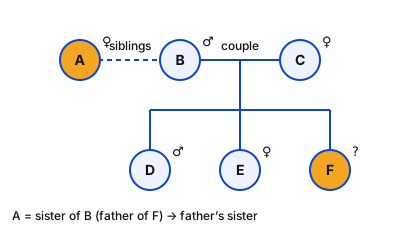
Based on the above, how is A related to F if ‘A ÷ B x C + D – E ÷ F’?
एक निश्चित कूट भाषा में,
J + Q का अर्थ है ‘J, Q की माँ है’,
J – Q का अर्थ है ‘J, Q का भाई है’,
J x Q का अर्थ है ‘J, Q का पति है’ और
J ÷ Q का अर्थ है ‘J, Q की बहन है’।
उपरोक्त के आधार पर, यदि ‘A ÷ B x C + D – E ÷ F’ है, तो A का F से क्या संबंध है?
  1. AFather's sisterपिता की बहन
  2. BSisterबहन
  3. CMotherमाँ
  4. DMother's sisterमाँ की बहन
Show answer

Concept: Decode left to right and draw the family tree.

  1. A ÷ B: A is sister of B. B × C: B is husband of C.
  2. C + D: C is mother of D; so B and C are parents of D.
  3. D – E: D is brother of E; E ÷ F: E is sister of F → D, E, F are siblings, children of B and C.
  4. A is the sister of B, F’s father → A is F’s father’s sister.

Trick: Siblings share parents – once B is D’s father, he is F’s father too.

Answer: (A) Father’s sister

अवधारणा: बाएँ से दाएँ डिकोड करें और वंश-वृक्ष बनाएँ।

  1. A ÷ B: A, B की बहन। B × C: B, C का पति।
  2. C + D: C, D की माँ; अतः B और C, D के माता-पिता।
  3. D – E: D, E का भाई; E ÷ F: E, F की बहन → D, E, F भाई-बहन, B व C की संतानें।
  4. A, F के पिता B की बहन → A, F की बुआ (father’s sister)।

ट्रिक: भाई-बहनों के माता-पिता एक ही होते हैं – B, D का पिता है तो F का भी।

उत्तर: (A) Father’s sister

RRB NTPC Undergraduate CBT 1General Intelligence and ReasoningBlood relations (coded)RRB NTPC Undergraduate CBT 1 2025 · 14 Jun Shift 3 →