Question bank

Q&A: practice questions with answers

Search questions on any topic. Filter by exam category, exam, subject and topic, try the question, then open the answer and explanation.

Courses – airGurukul

8,495 questions found.

Q7381.
What will come in place of ‘?’ in the following equation, if ‘+’ and ‘-‘ are interchanged and ‘x’ and ‘÷’ are interchanged?
12 ÷ 4 + 9 x 3 - 8 = ?
यदि ‘+’ और ‘-‘ को आपस में बदल दिया जाए तथा ‘x’ और ‘÷’ को आपस में बदल दिया जाए, तो निम्नलिखित समीकरण में ‘?’ के स्थान पर क्या आएगा?
12 ÷ 4 + 9 x 3 - 8 = ?
  1. A53
  2. B39
  3. C44
  4. D35
Show answer

Concept: Swap the signs as instructed, then apply BODMAS.

  1. Given: 12÷4+9×3−8. After swapping (+ ↔ −, × ↔ ÷): 12×4−9÷3+8.
  2. Division first: 9÷3=3; multiplication: 12×4=48.
  3. 48−3+8=53.

Trick: Rewrite the whole expression with new signs before calculating – avoids mixing old and new.

Answer: (A) 53

अवधारणा: निर्देशानुसार चिह्न बदलें, फिर BODMAS लगाएँ।

  1. दिया: 12÷4+9×3−8। बदलने पर (+ ↔ −, × ↔ ÷): 12×4−9÷3+8।
  2. पहले भाग: 9÷3=3; गुणा: 12×4=48।
  3. 48−3+8=53।

ट्रिक: गणना से पहले पूरा व्यंजक नए चिह्नों से लिख लें – पुराने-नए चिह्न मिलने की गलती नहीं होगी।

उत्तर: (A) 53
RRB NTPC Undergraduate CBT 1General Intelligence and ReasoningMathematical operations (interchange)RRB NTPC Undergraduate CBT 1 2025 · 14 Jun Shift 3 →
Q7382.
In a certain code language,
A x B means ‘A is the mother of B’,
A ≠ B means ‘A is the wife of B’,
A ÷ B means ‘A is the daughter of B’ and
A ₹ B means ‘A is the father of B’.
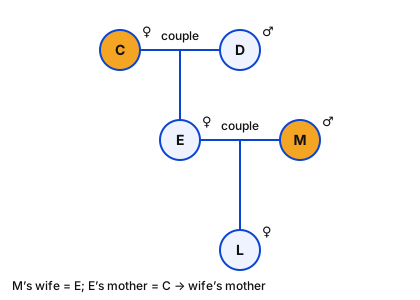
Based on the above, how is C related to M if 'C ≠ D ₹ E x L ÷ M'?
एक निश्चित कूट भाषा में,
A x B का अर्थ है ‘A, B की माँ है’,
A ≠ B का अर्थ है ‘A, B की पत्नी है’,
A ÷ B का अर्थ है ‘A, B की बेटी है’ और
A ₹ B का अर्थ है ‘A, B का पिता है’।
उपरोक्त के आधार पर, यदि 'C ≠ D ₹ E x L ÷ M' है, तो C का M से क्या संबंध है?
  1. ABrother's wifeभाई की पत्नी
  2. BHusband's motherपति की माँ
  3. CWife's motherपत्नी की माँ
  4. DWife's brother's wifeपत्नी के भाई की पत्नी
Show answer

Concept: Decode each symbol and build the tree generation by generation.

  1. C ≠ D: C is wife of D. D ₹ E: D is father of E → C is E’s mother.
  2. E × L: E is mother of L. L ÷ M: L is daughter of M → M is L’s father, i.e. E’s husband.
  3. C is the mother of E, and E is M’s wife → C is M’s wife’s mother.

Trick: Mother of L + father of L = couple; then C (E’s mother) is M’s mother-in-law.

Answer: (C) Wife’s mother

अवधारणा: हर प्रतीक डिकोड कर पीढ़ी-दर-पीढ़ी वृक्ष बनाएँ।

  1. C ≠ D: C, D की पत्नी। D ₹ E: D, E का पिता → C, E की माँ।
  2. E × L: E, L की माँ। L ÷ M: L, M की बेटी → M, L का पिता, अर्थात E का पति।
  3. C, E की माँ है और E, M की पत्नी → C, M की पत्नी की माँ (सास)।

ट्रिक: L की माँ + L का पिता = दंपति; फिर C (E की माँ) M की सास।

उत्तर: (C) Wife’s mother

RRB NTPC Undergraduate CBT 1General Intelligence and ReasoningBlood relations (coded)RRB NTPC Undergraduate CBT 1 2025 · 14 Jun Shift 3 →
Q7383.
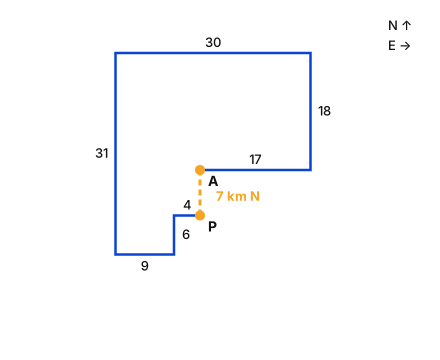
Mr. Yorly starts from Point A and drives 17 km towards East. He then takes a left turn, drives 18 km, turns left and drives 30 km. He then takes a left turn and drives 31 km. He then takes a left turn, drives 9 km, turns left and drives 6 km. He takes a final right turn, drives 4 km and stops at Point P. How far (shortest distance) and towards which direction should he drive in order to reach Point A again? (All turns are 90 degrees turns only unless specified.)
श्री Yorly बिंदु A से आरंभ करते हैं और पूर्व की ओर 17 km गाड़ी चलाते हैं। फिर वे बाएँ मुड़ते हैं, 18 km गाड़ी चलाते हैं, बाएँ मुड़ते हैं और 30 km गाड़ी चलाते हैं। फिर वे बाएँ मुड़ते हैं और 31 km गाड़ी चलाते हैं। फिर वे बाएँ मुड़ते हैं, 9 km गाड़ी चलाते हैं, बाएँ मुड़ते हैं और 6 km गाड़ी चलाते हैं। अंत में वे दाएँ मुड़ते हैं, 4 km गाड़ी चलाते हैं और बिंदु P पर रुक जाते हैं। बिंदु A पर पुनः पहुँचने के लिए उन्हें कितनी दूरी (न्यूनतम दूरी) तक और किस दिशा में गाड़ी चलानी चाहिए? (जब तक निर्दिष्ट न हो, सभी मोड़ केवल 90 डिग्री के मोड़ हैं।)
  1. A5 km to the Westपश्चिम की ओर 5 km
  2. B9 km to the Eastपूर्व की ओर 9 km
  3. C8 km to the Northउत्तर की ओर 8 km
  4. D7 km to the Northउत्तर की ओर 7 km
Show answer

Concept: Use coordinates: East = +x, North = +y; left turn rotates E→N→W→S→E.

  1. A (0, 0) → East 17 → (17, 0) → left (North) 18 → (17, 18) → left (West) 30 → (−13, 18).
  2. Left (South) 31 → (−13, −13) → left (East) 9 → (−4, −13) → left (North) 6 → (−4, −7).
  3. Right turn → East 4 → P (0, −7).
  4. P is 7 km directly south of A → he must drive 7 km North.

Trick: Net East–West: 17−30+9+4=0; net North–South: 18−31+6=−7 → 7 km due north.

Answer: (D) 7 km to the North

अवधारणा: निर्देशांक लें: पूर्व = +x, उत्तर = +y; बायाँ मोड़ E→N→W→S→E घुमाता है।

  1. A (0, 0) → पूर्व 17 → (17, 0) → बाएँ (उत्तर) 18 → (17, 18) → बाएँ (पश्चिम) 30 → (−13, 18)।
  2. बाएँ (दक्षिण) 31 → (−13, −13) → बाएँ (पूर्व) 9 → (−4, −13) → बाएँ (उत्तर) 6 → (−4, −7)।
  3. दायाँ मोड़ → पूर्व 4 → P (0, −7)।
  4. P, A से ठीक 7 km दक्षिण में → उसे 7 km उत्तर चलना होगा।

ट्रिक: शुद्ध पूर्व–पश्चिम: 17−30+9+4=0; शुद्ध उत्तर–दक्षिण: 18−31+6=−7 → 7 km ठीक उत्तर।

उत्तर: (D) 7 km to the North

RRB NTPC Undergraduate CBT 1General Intelligence and ReasoningDirection & distanceRRB NTPC Undergraduate CBT 1 2025 · 14 Jun Shift 3 →
Q7384.
Read the given statements and conclusions carefully. Assuming that the information given in the statements is true, even if it appears to be at variance with commonly known facts, decide which of the given conclusions logically follow(s) from the statements.
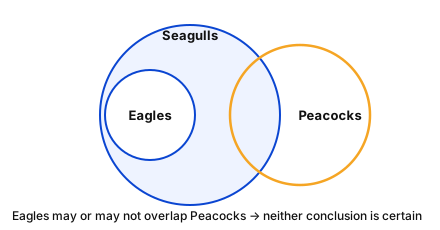
Statement: All Eagles are Seagulls. Some Seagulls are Peacocks.
Conclusion (I): Some Eagles are Peacocks.
Conclusion (II): No Peacocks are Eagles.
दिए गए कथन और निष्कर्षों को ध्यानपूर्वक पढ़िए। यह मानते हुए कि कथन में दी गई जानकारी सत्य है, भले ही वह सामान्यतः ज्ञात तथ्यों से भिन्न प्रतीत होती हो, निर्णय लीजिए कि दिए गए निष्कर्षों में से कौन-सा/कौन-से निष्कर्ष तार्किक रूप से कथन का अनुसरण करता है/करते हैं।
कथन: सभी चीलें, समुद्री बगुले हैं। कुछ समुद्री बगुले, मोर हैं।
निष्कर्ष (I): कुछ चीलें, मोर हैं।
निष्कर्ष (II): कोई मोर, चील नहीं है।
  1. AOnly conclusion (I) followsकेवल निष्कर्ष (I) अनुसरण करता है
  2. BBoth conclusions (I) and (II) followनिष्कर्ष (I) और (II) दोनों अनुसरण करते हैं
  3. COnly conclusion (II) followsकेवल निष्कर्ष (II) अनुसरण करता है
  4. DNeither conclusion (I) nor (II) followsन तो निष्कर्ष (I) और न ही (II) अनुसरण करता है
Show answer

Concept: Draw the Venn diagram; a conclusion follows only if it is true in every possible diagram.

  1. All Eagles are Seagulls → Eagles circle inside Seagulls. Some Seagulls are Peacocks → Peacocks overlaps Seagulls somewhere.
  2. The overlap may or may not include Eagles → “Some Eagles are Peacocks” is not certain (I ✗).
  3. Equally, “No Peacocks are Eagles” is not certain (II ✗).

Trick: All + Some (through the middle term) → no definite conclusion between the end terms.

Answer: (D) Neither conclusion (I) nor (II) follows

अवधारणा: वेन आरेख बनाएँ; निष्कर्ष तभी निकलता है जब वह हर संभव आरेख में सत्य हो।

  1. All Eagles are Seagulls → Eagles का वृत्त Seagulls के अंदर। Some Seagulls are Peacocks → Peacocks कहीं Seagulls से ओवरलैप।
  2. यह ओवरलैप Eagles को छू भी सकता है, नहीं भी → “Some Eagles are Peacocks” निश्चित नहीं (I ✗)।
  3. इसी तरह “No Peacocks are Eagles” भी निश्चित नहीं (II ✗)।

ट्रिक: All + Some (मध्य पद से) → अंतिम पदों के बीच कोई निश्चित निष्कर्ष नहीं।

उत्तर: (D) Neither conclusion (I) nor (II) follows

RRB NTPC Undergraduate CBT 1General Intelligence and ReasoningSyllogismRRB NTPC Undergraduate CBT 1 2025 · 14 Jun Shift 3 →
Q7385.
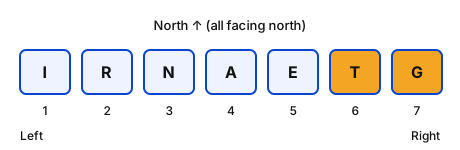
Seven people, T, E, A, R, I, N and G, are sitting in a row, facing north. Only two people sit to the left of N. Only three people sit between N and G. Only one person sits between G and E. I sits to the immediate left of R. A is not an immediate neighbor of G. How many people sit to the right of T?
सात व्यक्ति, T, E, A, R, I, N और G, एक पंक्ति में उत्तर की ओर मुख करके बैठे हैं। N के बाईं ओर केवल दो व्यक्ति बैठे हैं। N और G के बीच केवल तीन व्यक्ति बैठे हैं। G और E के बीच केवल एक व्यक्ति बैठा है। I, R के ठीक बाईं ओर बैठा है। A, G का निकटतम पड़ोसी नहीं है। T के दाईं ओर कितने व्यक्ति बैठे हैं?
  1. ATwoदो
  2. BFourचार
  3. COneएक
  4. DThreeतीन
Show answer

Concept: Facing north, left and right are the same as ours. Number seats 1–7 from the left.

  1. Two people to the left of N → N at 3. Three between N and G → G at 7.
  2. One between G and E → E at 5.
  3. I immediately left of R: free seats 1, 2, 4, 6 → only (1, 2) are adjacent → I = 1, R = 2.
  4. A is not next to G → A ≠ 6 → A = 4, T = 6.
  5. To the right of T (seat 6) there is only G → one person.

Trick: “Only two to the left of N” fixes N at seat 3 instantly – start there.

Answer: (C) One

अवधारणा: उत्तर की ओर मुख होने पर बायाँ-दायाँ हमारे जैसा ही। बाएँ से सीट 1–7 क्रमांकित करें।

  1. N के बाएँ दो लोग → N सीट 3 पर। N व G के बीच तीन → G सीट 7 पर।
  2. G व E के बीच एक → E सीट 5 पर।
  3. I, R के ठीक बाएँ: खाली सीटें 1, 2, 4, 6 → केवल (1, 2) सटी हैं → I = 1, R = 2।
  4. A, G का पड़ोसी नहीं → A ≠ 6 → A = 4, T = 6।
  5. T (सीट 6) के दाएँ केवल G → एक व्यक्ति।

ट्रिक: “N के बाएँ केवल दो” N को तुरंत सीट 3 पर तय करता है – वहीं से शुरू करें।

उत्तर: (C) One

RRB NTPC Undergraduate CBT 1General Intelligence and ReasoningLinear seating arrangementRRB NTPC Undergraduate CBT 1 2025 · 14 Jun Shift 3 →
Q7386.
KL 9 is related to IH −2 in a certain way. In the same way, PG 7 is related to NC −4. To which of the following is JQ 14 related, following the same logic?
KL 9 एक निश्चित प्रकार से IH −2 से संबंधित है। उसी प्रकार, PG 7, NC −4 से संबंधित है। समान तर्क का अनुसरण करते हुए, JQ 14 निम्नलिखित में से किससे संबंधित है?
  1. AHN 6
  2. BIM 3
  3. CIN 6
  4. DHM 3
Show answer

Concept: Apply the same operation to each letter and to the number.

  1. KL 9 → IH −2: K−2 = I, L−4 = H, 9−11=−2.
  2. PG 7 → NC −4: P−2 = N, G−4 = C, 7−11=−4 – rule confirmed.
  3. JQ 14: J−2 = H, Q−4 = M, 14−11=3 → HM 3.

Trick: First letter −2, second letter −4, number −11; eliminate options whose letters are wrong first.

Answer: (D) HM 3

अवधारणा: प्रत्येक अक्षर और संख्या पर वही संक्रिया लागू करें।

  1. KL 9 → IH −2: K−2 = I, L−4 = H, 9−11=−2।
  2. PG 7 → NC −4: P−2 = N, G−4 = C, 7−11=−4 – नियम पुष्ट।
  3. JQ 14: J−2 = H, Q−4 = M, 14−11=3 → HM 3।

ट्रिक: पहला अक्षर −2, दूसरा −4, संख्या −11; पहले गलत अक्षरों वाले विकल्प हटाएँ।

उत्तर: (D) HM 3

RRB NTPC Undergraduate CBT 1General Intelligence and ReasoningLetter–number analogyRRB NTPC Undergraduate CBT 1 2025 · 14 Jun Shift 3 →
Q7387.
What should come in place of ‘?’ in the given series?
135 150 180 225 285 ?
दी गई श्रृंखला में ‘?’ के स्थान पर क्या आना चाहिए?
135 150 180 225 285 ?
  1. A360
  2. B340
  3. C350
  4. D330
Show answer

Concept: Look at the differences between consecutive terms.

  1. 150−135=15,180−150=30,225−180=45,285−225=60.
  2. Differences are multiples of 15: 15, 30, 45, 60 → next 75.
  3. 285+75=360.

Trick: All terms are multiples of 15: 9,10,12,15,19,24×15 (gaps 1, 2, 3, 4, 5) → 24×15=360.

Answer: (A) 360

अवधारणा: क्रमागत पदों के अंतर देखें।

  1. 150−135=15,180−150=30,225−180=45,285−225=60।
  2. अंतर 15 के गुणज: 15, 30, 45, 60 → अगला 75।
  3. 285+75=360।

ट्रिक: सभी पद 15 के गुणज: 9,10,12,15,19,24×15 (अंतर 1, 2, 3, 4, 5) → 24×15=360।

उत्तर: (A) 360

RRB NTPC Undergraduate CBT 1General Intelligence and ReasoningNumber seriesRRB NTPC Undergraduate CBT 1 2025 · 14 Jun Shift 3 →
Q7388.
If ‘A’ stands for ‘÷’, ‘B’ stands for ‘×’, ‘C’ stands for ‘+’ and ‘D’ stands for ‘−’, then what will come in place of the question mark (?) in the following equation?
3 A 42 B 14 C 29 D 22 = ?
यदि ‘A’ का अर्थ ‘÷’, ‘B’ का अर्थ ‘×’, ‘C’ का अर्थ ‘+’ और ‘D’ का अर्थ ‘−’ है, तो निम्नलिखित समीकरण में प्रश्न चिह्न (?) के स्थान पर क्या आएगा?
3 A 42 B 14 C 29 D 22 = ?
  1. A11
  2. B10
  3. C8
  4. D9
Show answer

Concept: Replace the letters by their operators and apply BODMAS.

  1. 3 A 42 B 14 C 29 D 22 → 3÷42×14+29−22.
  2. 3÷42=114; 114×14=1.
  3. 1+29−22=8.

Trick: ÷ then × left to right: 3×1442=1 in one step.

Answer: (C) 8

अवधारणा: अक्षरों की जगह संक्रिया चिह्न रखें और BODMAS लगाएँ।

  1. 3 A 42 B 14 C 29 D 22 → 3÷42×14+29−22।
  2. 3÷42=114; 114×14=1।
  3. 1+29−22=8।

ट्रिक: ÷ फिर × बाएँ से दाएँ: 3×1442=1 एक ही कदम में।

उत्तर: (C) 8

RRB NTPC Undergraduate CBT 1General Intelligence and ReasoningMathematical operations (symbol substitution)RRB NTPC Undergraduate CBT 1 2025 · 14 Jun Shift 3 →
Q7389.
Read the given statement(s) and conclusions carefully. Assuming that the information given in the statements is true, even if it appears to be at variance with commonly known facts, decide which of the given conclusions logically follow(s) from the statement(s).
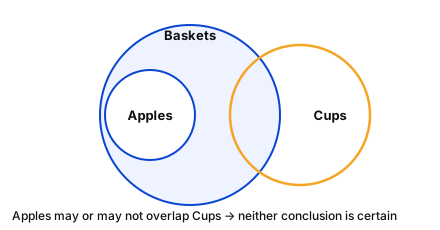
Statements: All apples are baskets. Some baskets are cups.
Conclusions:
(I) Some apples are cups.
(II) All cups are apples.
दिए गए कथन/कथनों और निष्कर्षों को ध्यानपूर्वक पढ़िए। यह मानते हुए कि कथनों में दी गई जानकारी सत्य है, भले ही वह सामान्यतः ज्ञात तथ्यों से भिन्न प्रतीत होती हो, निर्णय लीजिए कि दिए गए निष्कर्षों में से कौन-सा/कौन-से निष्कर्ष तार्किक रूप से कथन/कथनों का अनुसरण करता है/करते हैं।
कथन: सभी सेब, टोकरियाँ हैं। कुछ टोकरियाँ, कप हैं।
निष्कर्ष:
(I) कुछ सेब, कप हैं।
(II) सभी कप, सेब हैं।
  1. ANeither conclusion (I) nor (II) followsन तो निष्कर्ष (I) और न ही (II) अनुसरण करता है
  2. BOnly conclusion (II) followsकेवल निष्कर्ष (II) अनुसरण करता है
  3. COnly conclusion (I) followsकेवल निष्कर्ष (I) अनुसरण करता है
  4. DBoth conclusions (I) and (II) followनिष्कर्ष (I) और (II) दोनों अनुसरण करते हैं
Show answer

Concept: A conclusion follows only if it holds in every Venn diagram consistent with the statements.

  1. All apples are baskets → Apples inside Baskets. Some baskets are cups → Cups overlaps Baskets.
  2. The Cups overlap need not reach Apples → “Some apples are cups” is only possible, not definite (I ✗).
  3. “All cups are apples” is certainly not forced – cups may lie outside apples (II ✗).

Trick: “All A are B” + “Some B are C” never gives a definite A–C conclusion.

Answer: (A) Neither conclusion (I) nor (II) follows

अवधारणा: निष्कर्ष तभी निकलता है जब वह कथनों के अनुरूप हर वेन आरेख में सत्य हो।

  1. All apples are baskets → Apples, Baskets के अंदर। Some baskets are cups → Cups, Baskets से ओवरलैप।
  2. Cups का ओवरलैप Apples तक पहुँचे यह ज़रूरी नहीं → “Some apples are cups” केवल संभव, निश्चित नहीं (I ✗)।
  3. “All cups are apples” भी बाध्य नहीं – cups apples के बाहर हो सकते हैं (II ✗)।

ट्रिक: “All A are B” + “Some B are C” से A–C का कोई निश्चित निष्कर्ष कभी नहीं निकलता।

उत्तर: (A) Neither conclusion (I) nor (II) follows

RRB NTPC Undergraduate CBT 1General Intelligence and ReasoningSyllogismRRB NTPC Undergraduate CBT 1 2025 · 14 Jun Shift 3 →
Q7390.
What should come in place of the question mark (?) in the given series based on the English alphabetical order?
TUW XYA BCE FGI ?
अंग्रेज़ी वर्णमाला क्रम के आधार पर दी गई श्रृंखला में प्रश्न चिह्न (?) के स्थान पर क्या आना चाहिए?
TUW XYA BCE FGI ?
  1. AKJL
  2. BJKM
  3. CJLM
  4. DJMK
Show answer

Concept: Track each position separately; here every letter moves +4.

  1. 1st letters: T → X → B → F → ? : +4 → J.
  2. 2nd letters: U → Y → C → G → ? : +4 → K.
  3. 3rd letters: W → A → E → I → ? : +4 → M.

Trick: Within each cluster the pattern is (n, n+1, n+3) – JKM fits; JLM, JMK, KJL do not.

Answer: (B) JKM

अवधारणा: हर स्थिति अलग ट्रैक करें; यहाँ हर अक्षर +4 बढ़ता है।

  1. पहले अक्षर: T → X → B → F → ? : +4 → J।
  2. दूसरे अक्षर: U → Y → C → G → ? : +4 → K।
  3. तीसरे अक्षर: W → A → E → I → ? : +4 → M।

ट्रिक: हर समूह के भीतर पैटर्न (n, n+1, n+3) – JKM फिट; JLM, JMK, KJL नहीं।

उत्तर: (B) JKM

RRB NTPC Undergraduate CBT 1General Intelligence and ReasoningLetter-cluster seriesRRB NTPC Undergraduate CBT 1 2025 · 14 Jun Shift 3 →
Q7391.
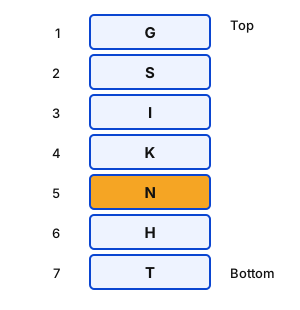
Seven boxes, K, N, I, G, H, T and S, are kept one over the other, but not necessarily in the same order.
K is kept fourth from the top. Only one box is kept between H and K. Only three boxes are kept between H and S. S is kept at some place above K. I is kept immediately below S. N is kept at one of the places above T. G is not kept immediately above or below H. How many boxes are kept below N?
सात बक्से, K, N, I, G, H, T और S, एक के ऊपर एक रखे गए हैं, परंतु आवश्यक नहीं कि इसी क्रम में हों।
K ऊपर से चौथे स्थान पर रखा है। H और K के बीच केवल एक बक्सा रखा है। H और S के बीच केवल तीन बक्से रखे हैं। S, K के ऊपर किसी स्थान पर रखा है। I, S के ठीक नीचे रखा है। N, T के ऊपर वाले स्थानों में से किसी एक पर रखा है। G, H के ठीक ऊपर या ठीक नीचे नहीं रखा है। N के नीचे कितने बक्से रखे हैं?
  1. AOneएक
  2. BTwoदो
  3. CZeroशून्य
  4. DThreeतीन
Show answer

Concept: Number 1 (top) to 7 (bottom); test the two cases a “between” clue creates.

  1. K = 4. One box between H and K → H = 2 or 6.
  2. Three between H and S with S above K: H = 2 gives S = 6 (below K ✗); so H = 6, S = 2. I immediately below S → I = 3.
  3. Free: 1, 5, 7 for N, G, T. G not adjacent to H (6) → G ≠ 5, 7 → G = 1.
  4. N above T → N = 5, T = 7. Below N: H, T → two boxes.

Trick: Use the “S above K” condition to kill one case immediately.

Answer: (B) Two

अवधारणा: 1 (ऊपर) से 7 (नीचे) क्रमांकित करें; “बीच में” वाले संकेत के दोनों केस जाँचें।

  1. K = 4। H और K के बीच एक → H = 2 या 6।
  2. H और S के बीच तीन, S, K के ऊपर: H = 2 से S = 6 (K के नीचे ✗); अतः H = 6, S = 2। I, S के ठीक नीचे → I = 3।
  3. खाली: 1, 5, 7 पर N, G, T। G, H (6) से सटा नहीं → G ≠ 5, 7 → G = 1।
  4. N, T के ऊपर → N = 5, T = 7। N के नीचे: H, T → दो बॉक्स।

ट्रिक: “S, K के ऊपर” शर्त से एक केस तुरंत खारिज करें।

उत्तर: (B) Two

RRB NTPC Undergraduate CBT 1General Intelligence and ReasoningPuzzle – Box arrangementRRB NTPC Undergraduate CBT 1 2025 · 14 Jun Shift 3 →
Q7392.
If ‘A’ stands for ‘÷’, ‘B’ stands for ‘×’, ‘C’ stands for ‘+’ and ‘D’ stands for ‘−’, what will come in place of the question mark ‘?’ in the following equation?
7 A 7 C 20 B 2 = ? C 20
यदि ‘A’ का अर्थ ‘÷’, ‘B’ का अर्थ ‘×’, ‘C’ का अर्थ ‘+’ और ‘D’ का अर्थ ‘−’ है, तो निम्नलिखित समीकरण में प्रश्न चिह्न ‘?’ के स्थान पर क्या आएगा?
7 A 7 C 20 B 2 = ? C 20
  1. A22
  2. B21
  3. C24
  4. D20
Show answer

Concept: Substitute the operators, simplify both sides with BODMAS, then solve for ?.

  1. 7 A 7 C 20 B 2 = ? C 20 → 7÷7+20×2=?+20.
  2. LHS: 1+40=41.
  3. ?=41−20=21.

Trick: Do not forget the right side also has an operation (+ 20).

Answer: (B) 21

अवधारणा: संक्रिया चिह्न रखें, दोनों पक्ष BODMAS से सरल करें, फिर ? निकालें।

  1. 7 A 7 C 20 B 2 = ? C 20 → 7÷7+20×2=?+20।
  2. LHS: 1+40=41।
  3. ?=41−20=21।

ट्रिक: दाएँ पक्ष की संक्रिया (+ 20) भूलें नहीं।

उत्तर: (B) 21

RRB NTPC Undergraduate CBT 1General Intelligence and ReasoningMathematical operations (symbol substitution)RRB NTPC Undergraduate CBT 1 2025 · 14 Jun Shift 3 →
Q7393.
What should come in place of ‘?’ in the given series?
4 10 18 38 74 ?
दी गई श्रृंखला में ‘?’ के स्थान पर क्या आना चाहिए?
4 10 18 38 74 ?
  1. A148
  2. B150
  3. C154
  4. D152
Show answer

Concept: When differences are irregular, try “×2 ± constant”.

  1. 4×2+2=10, 10×2−2=18, 18×2+2=38, 38×2−2=74.
  2. Pattern alternates +2, −2; next is +2.
  3. 74×2+2=150.

Trick: Each term ≈ double the previous → check ×2 first, then fix the small adjustment.

Answer: (B) 150

अवधारणा: अंतर अनियमित हों तो “×2 ± स्थिरांक” आज़माएँ।

  1. 4×2+2=10, 10×2−2=18, 18×2+2=38, 38×2−2=74।
  2. पैटर्न +2, −2 बारी-बारी; अगला +2।
  3. 74×2+2=150।

ट्रिक: हर पद पिछले का लगभग दोगुना → पहले ×2 जाँचें, फिर छोटा समायोजन।

उत्तर: (B) 150

RRB NTPC Undergraduate CBT 1General Intelligence and ReasoningNumber seriesRRB NTPC Undergraduate CBT 1 2025 · 14 Jun Shift 3 →
Q7394.
Based on the English alphabetical order, three of the following four letter-cluster pairs are alike in a certain way and thus form a group. Which is the one that does not belong to that group?
(Note: The odd man out is not based on the number of consonants/vowels or their position in the letter cluster.)
अंग्रेज़ी वर्णमाला क्रम के आधार पर, निम्नलिखित चार अक्षर-समूह युग्मों में से तीन किसी निश्चित प्रकार से एकसमान हैं और इस प्रकार एक समूह बनाते हैं। कौन-सा युग्म उस समूह से संबंधित नहीं है?
(ध्यान दें: असंगत युग्म, अक्षर-समूह में व्यंजनों/स्वरों की संख्या या उनके स्थान पर आधारित नहीं है।)
  1. ARF – NB
  2. BMJ – IF
  3. CUG – QC
  4. DPT – LG
Show answer

Concept: Compare the shift of each letter from the first cluster to the second.

  1. RF – NB: R→N = −4, F→B = −4.
  2. MJ – IF: −4, −4. UG – QC: −4, −4.
  3. PT – LG: P→L = −4, T→G = −13 – odd one.

Trick: Check the second letter too – the first letter of PT–LG also drops by 4, which is the trap.

Answer: (D) PT – LG

अवधारणा: पहले समूह से दूसरे तक प्रत्येक अक्षर के खिसकाव की तुलना करें।

  1. RF – NB: R→N = −4, F→B = −4।
  2. MJ – IF: −4, −4। UG – QC: −4, −4।
  3. PT – LG: P→L = −4, T→G = −13 – विषम।

ट्रिक: दूसरा अक्षर भी जाँचें – PT–LG का पहला अक्षर भी −4 है, यही जाल है।

उत्तर: (D) PT – LG

RRB NTPC Undergraduate CBT 1General Intelligence and ReasoningLetter-cluster classificationRRB NTPC Undergraduate CBT 1 2025 · 14 Jun Shift 3 →
Q7395.
What should come in place of the question mark (?) in the given series based on the English alphabetical order?
YBZ DGE ILJ NQO ?
अंग्रेज़ी वर्णमाला क्रम के आधार पर दी गई श्रृंखला में प्रश्न चिह्न (?) के स्थान पर क्या आना चाहिए?
YBZ DGE ILJ NQO ?
  1. ASWS
  2. BSVT
  3. CSUS
  4. DSTV
Show answer

Concept: Track each position separately; every letter moves +5.

  1. 1st letters: Y → D → I → N → ? : +5 → S.
  2. 2nd letters: B → G → L → Q → ? : +5 → V.
  3. 3rd letters: Z → E → J → O → ? : +5 → T.

Trick: Within each cluster the pattern is (n, n+3, n+1) – SVT fits (S=19, V=22, T=20).

Answer: (B) SVT

अवधारणा: हर स्थिति अलग ट्रैक करें; हर अक्षर +5 बढ़ता है।

  1. पहले अक्षर: Y → D → I → N → ? : +5 → S।
  2. दूसरे अक्षर: B → G → L → Q → ? : +5 → V।
  3. तीसरे अक्षर: Z → E → J → O → ? : +5 → T।

ट्रिक: हर समूह के भीतर पैटर्न (n, n+3, n+1) – SVT फिट (S=19, V=22, T=20)।

उत्तर: (B) SVT

RRB NTPC Undergraduate CBT 1General Intelligence and ReasoningLetter-cluster seriesRRB NTPC Undergraduate CBT 1 2025 · 14 Jun Shift 3 →
Q7396.
As of Union Budget 2025-26, what is the proposed size of the new Fund of Funds for Startups?
केंद्रीय बजट 2025-26 के अनुसार, स्टार्टअप्स के लिए नए फंड ऑफ फंड्स (Fund of Funds) का प्रस्तावित आकार कितना है?
  1. A₹12,000 crore₹12,000 करोड़
  2. B₹5,000 crore₹5,000 करोड़
  3. C₹10,000 crore₹10,000 करोड़
  4. D₹7,500 crore₹7,500 करोड़
Show answer

Concept: Budget 2025-26 announced a new Fund of Funds for Startups (FFS) with expanded scope.

  1. Finance Minister Nirmala Sitharaman proposed a fresh contribution of ₹10,000 crore for a new Fund of Funds for Startups.
  2. The earlier FFS (2016) had a corpus of ₹10,000 crore which had catalysed commitments of over ₹91,000 crore; the new fund repeats the ₹10,000 crore size.

Yaad rakhein: Budget 2025-26 start-up measures: new FFS ₹10,000 crore; Deep Tech Fund of Funds also announced.

Answer: (C) ₹10,000 crore

अवधारणा: बजट 2025-26 में स्टार्टअप्स के लिए नया फंड ऑफ फंड्स (FFS) घोषित किया गया।

  1. वित्त मंत्री निर्मला सीतारमण ने नए Fund of Funds for Startups के लिए ₹10,000 करोड़ के नए योगदान का प्रस्ताव रखा।
  2. पहले FFS (2016) का कोष भी ₹10,000 करोड़ था, जिसने ₹91,000 करोड़ से अधिक की प्रतिबद्धताएँ जुटाईं; नया फंड उसी आकार का है।

याद रखें: बजट 2025-26: नया FFS ₹10,000 करोड़; Deep Tech Fund of Funds की भी घोषणा।

उत्तर: (C) ₹10,000 करोड़

RRB NTPC Undergraduate CBT 1General AwarenessUnion Budget 2025-26RRB NTPC Undergraduate CBT 1 2025 · 14 Jun Shift 2 →
Q7397.
Consider the following statements about Right to Information (RTI) and choose the correct option.
I. RTI has become a weapon to ensure maximum fairness and transparency.
II. RTI Act has also been used to enhance the efficiency of the working of the Consumer Forums.
सूचना का अधिकार (RTI) के संबंध में निम्नलिखित कथनों पर विचार कीजिए और सही विकल्प चुनिए।
I. RTI अधिकतम निष्पक्षता और पारदर्शिता सुनिश्चित करने का एक हथियार बन गया है।
II. RTI अधिनियम का उपयोग उपभोक्ता फोरमों के कार्य की दक्षता बढ़ाने के लिए भी किया गया है।
  1. ANeither I nor II is correctन तो I और न ही II सही है
  2. BOnly I is correctकेवल I सही है
  3. CBoth I and II are correctI और II दोनों सही हैं
  4. DOnly II is correctकेवल II सही है
Show answer

Concept: The RTI Act, 2005 empowers citizens to seek information from public authorities, promoting transparency and accountability.

  1. Statement I is correct: RTI is widely described as a weapon of the common citizen to ensure fairness and transparency in governance.
  2. Statement II is also correct: RTI applications have been used to check pendency and functioning of Consumer Forums (which are public authorities), improving their efficiency.
  3. Hence both statements are correct.

Yaad rakhein: RTI Act came into force on 12 October 2005; information is normally to be supplied within 30 days.

Answer: (C) Both I and II are correct

अवधारणा: RTI अधिनियम, 2005 नागरिकों को सार्वजनिक प्राधिकरणों से सूचना माँगने का अधिकार देता है, जिससे पारदर्शिता और जवाबदेही बढ़ती है।

  1. कथन I सही है: RTI को निष्पक्षता और पारदर्शिता सुनिश्चित करने का आम नागरिक का हथियार कहा जाता है।
  2. कथन II भी सही है: उपभोक्ता मंचों (Consumer Forums) की लंबित स्थिति और कार्यप्रणाली की जाँच में RTI आवेदनों का उपयोग हुआ है, जिससे उनकी कार्यकुशलता बढ़ी।
  3. अतः दोनों कथन सही हैं।

याद रखें: RTI अधिनियम 12 अक्टूबर 2005 से लागू; सूचना सामान्यतः 30 दिन में देनी होती है।

उत्तर: (C) I और II दोनों सही हैं

RRB NTPC Undergraduate CBT 1General AwarenessRight to InformationRRB NTPC Undergraduate CBT 1 2025 · 14 Jun Shift 2 →
Q7398.
Which new industries grew after 1991 due to economic reforms?
1991 के बाद आर्थिक सुधारों के कारण कौन-से नए उद्योगों का विकास हुआ?
  1. ASpace and Nuclearअंतरिक्ष और परमाणु
  2. BRailways and Defenceरेलवे और रक्षा
  3. CBanking and Information Technologyबैंकिंग और सूचना प्रौद्योगिकी
  4. DOil and Gas onlyकेवल तेल और गैस
Show answer

Concept: The 1991 LPG reforms (Liberalisation, Privatisation, Globalisation) opened the economy to private and foreign players.

  1. Banking was liberalised (new private banks like HDFC, ICICI, Axis from 1993-94) and the IT/software services industry boomed (Infosys, Wipro, TCS exports).
  2. Space, nuclear, railways and defence remained largely government-controlled; "oil and gas only" is too narrow.

Yaad rakhein: 1991 reforms: Finance Minister Manmohan Singh, PM P. V. Narasimha Rao; New Industrial Policy, 24 July 1991.

Answer: (C) Banking and Information Technology

अवधारणा: 1991 के LPG सुधारों (उदारीकरण, निजीकरण, वैश्वीकरण) ने अर्थव्यवस्था को निजी और विदेशी कंपनियों के लिए खोला।

  1. बैंकिंग का उदारीकरण हुआ (1993-94 से HDFC, ICICI, Axis जैसे निजी बैंक) और IT/सॉफ्टवेयर सेवा उद्योग तेज़ी से बढ़ा (Infosys, Wipro, TCS का निर्यात)।
  2. अंतरिक्ष, परमाणु, रेलवे और रक्षा मुख्यतः सरकारी नियंत्रण में ही रहे; "केवल तेल और गैस" बहुत संकीर्ण है।

याद रखें: 1991 सुधार: वित्त मंत्री मनमोहन सिंह, PM पी. वी. नरसिम्हा राव; नई औद्योगिक नीति 24 जुलाई 1991।

उत्तर: (C) बैंकिंग और सूचना प्रौद्योगिकी

RRB NTPC Undergraduate CBT 1General AwarenessEconomic Reforms 1991RRB NTPC Undergraduate CBT 1 2025 · 14 Jun Shift 2 →
Q7399.
Which of the following keyboard shortcuts is used to paste copied content?
कॉपी की गई सामग्री को पेस्ट करने के लिए निम्नलिखित में से किस कीबोर्ड शॉर्टकट का उपयोग किया जाता है?
  1. ACtrl + V
  2. BCtrl + S
  3. CCtrl + F
  4. DCtrl + C
Show answer

Concept: Standard clipboard shortcuts in Windows: Ctrl + C copy, Ctrl + X cut, Ctrl + V paste.

  1. Ctrl + V pastes the content currently on the clipboard.
  2. Ctrl + S saves, Ctrl + F opens Find, Ctrl + C copies (it does not paste).

Yaad rakhein: C-X-V sit side by side on the keyboard: Copy, cut (X looks like scissors), paste (V points down = "insert here").

Answer: (A) Ctrl + V

अवधारणा: Windows के मानक क्लिपबोर्ड शॉर्टकट: Ctrl + C कॉपी, Ctrl + X कट, Ctrl + V पेस्ट।

  1. Ctrl + V क्लिपबोर्ड की सामग्री को पेस्ट करता है।
  2. Ctrl + S सेव, Ctrl + F खोज (Find), Ctrl + C कॉपी करता है (पेस्ट नहीं)।

याद रखें: कीबोर्ड पर C-X-V साथ-साथ हैं: Copy, cut (X कैंची जैसा), paste (V नीचे इशारा = "यहाँ डालो")।

उत्तर: (A) Ctrl + V

RRB NTPC Undergraduate CBT 1General AwarenessComputer – Keyboard ShortcutsRRB NTPC Undergraduate CBT 1 2025 · 14 Jun Shift 2 →
Q7400.
The largest freshwater lake in India is:
भारत की सबसे बड़ी मीठे पानी की झील कौन-सी है?
  1. AWular Lakeवुलर झील
  2. BDal Lakeडल झील
  3. CChilika Lakeचिल्का झील
  4. DLoktak Lakeलोकटक झील
Show answer

Concept: Wular Lake in Bandipora district, Jammu & Kashmir, is the largest freshwater lake in India.

  1. Wular Lake is fed by the Jhelum river and is a Ramsar wetland (1990).
  2. Chilika (Odisha) is the largest brackish-water lagoon, Loktak (Manipur) is the largest freshwater lake of North-East India, Dal is a smaller urban lake in Srinagar.

Yaad rakhein: Largest freshwater = Wular; largest saltwater/brackish lagoon = Chilika; largest saline lake = Sambhar (Rajasthan).

Answer: (A) Wular Lake

अवधारणा: जम्मू-कश्मीर के बांदीपोरा ज़िले की वुलर झील भारत की सबसे बड़ी मीठे पानी की झील है।

  1. वुलर झील झेलम नदी से पोषित है और रामसर स्थल (1990) है।
  2. चिल्का (ओडिशा) सबसे बड़ा खारे पानी का लैगून, लोकटक (मणिपुर) पूर्वोत्तर की सबसे बड़ी मीठे पानी की झील, डल श्रीनगर की छोटी शहरी झील है।

याद रखें: सबसे बड़ी मीठे पानी की = वुलर; सबसे बड़ा खारा लैगून = चिल्का; सबसे बड़ी लवणीय झील = सांभर (राजस्थान)।

उत्तर: (A) वुलर झील

RRB NTPC Undergraduate CBT 1General AwarenessLakes of IndiaRRB NTPC Undergraduate CBT 1 2025 · 14 Jun Shift 2 →