Question bank

Q&A: practice questions with answers

Search questions on any topic. Filter by exam category, exam, subject and topic, try the question, then open the answer and explanation.

Courses – airGurukul

8,495 questions found.

Q7441.
Which of the following is a pair of co-primes?
निम्नलिखित में से कौन-सा सह-अभाज्य संख्याओं (co-primes) का युग्म है?
  1. A44 and 9944 और 99
  2. B25 and 3625 और 36
  3. C42 and 5642 और 56
  4. D27 and 3627 और 36
Show answer

Concept: Two numbers are co-prime when their HCF is 1.

  1. 44 and 99: HCF 11. 42 and 56: HCF 14. 27 and 36: HCF 9.
  2. 25 =52 and 36 =22×32 share no prime factor, HCF =1.

Trick: Two consecutive numbers, or two perfect squares of different primes, are always co-prime.

Answer: (B) 25 and 36

अवधारणा: दो संख्याएँ सह-अभाज्य (co-prime) हैं यदि उनका HCF 1 हो।

  1. 44 और 99: HCF 11। 42 और 56: HCF 14। 27 और 36: HCF 9।
  2. 25 =52 और 36 =22×32 में कोई उभयनिष्ठ अभाज्य गुणनखंड नहीं, HCF =1।

ट्रिक: दो क्रमागत संख्याएँ, या अलग-अलग अभाज्यों के वर्ग, हमेशा सह-अभाज्य होते हैं।

उत्तर: (B) 25 और 36
RRB NTPC Undergraduate CBT 1MathematicsHCF – Co-primesRRB NTPC Undergraduate CBT 1 2025 · 14 Jun Shift 2 →
Q7442.
A tank is filled by two pipes, A and B, and emptied by a third pipe C. Pipe A fills the tank in 10 hours and pipe B in 15 hours. Pipe C empties it in 20 hours. If all three pipes are opened together, and pipe C is closed after 4 hours, how much total time will it take to fill the tank?
एक टंकी को दो पाइपों A और B द्वारा भरा जाता है और तीसरे पाइप C द्वारा खाली किया जाता है। पाइप A टंकी को 10 घंटे में और पाइप B 15 घंटे में भरता है। पाइप C इसे 20 घंटे में खाली करता है। यदि तीनों पाइप एक साथ खोले जाते हैं, और 4 घंटे बाद पाइप C को बंद कर दिया जाता है, तो टंकी को भरने में कुल कितना समय लगेगा?
  1. A8.2 hours8.2 घंटे
  2. B7.2 hours7.2 घंटे
  3. C8 hours8 घंटे
  4. D7.5 hours7.5 घंटे
Show answer

Concept: Take total work = LCM(10, 15, 20) = 60 units.

  1. A =+6, B =+4, C =−3 units/hour.
  2. All three for 4 hours: (6+4−3)×4=28 units. Remaining =32 units.
  3. A + B =10 units/hour ⇒3210=3.2 hours. Total =4+3.2=7.2 hours.

Trick: With LCM units the fractions vanish – work only with whole numbers till the last step.

Answer: (B) 7.2 hours

अवधारणा: कुल कार्य = LCM(10, 15, 20) = 60 इकाई।

  1. A =+6, B =+4, C =−3 इकाई/घंटा।
  2. तीनों 4 घंटे: (6+4−3)×4=28 इकाई। शेष =32 इकाई।
  3. A + B =10 इकाई/घंटा ⇒3210=3.2 घंटे। कुल =4+3.2=7.2 घंटे।

ट्रिक: LCM इकाई लेने से भिन्न गायब – अंतिम चरण तक पूर्णांकों में काम करें।

उत्तर: (B) 7.2 घंटे

RRB NTPC Undergraduate CBT 1MathematicsPipes and CisternsRRB NTPC Undergraduate CBT 1 2025 · 14 Jun Shift 2 →
Q7443.
The marked price of an article is ₹500. During a sale, its price is reduced to ₹450. What is the percentage decrease in price?
एक वस्तु का अंकित मूल्य ₹500 है। सेल के दौरान, इसका मूल्य घटाकर ₹450 कर दिया जाता है। मूल्य में प्रतिशत कमी कितनी है?
  1. A12%
  2. B10%
  3. C5%
  4. D8%
Show answer

Concept: % decrease=decreaseoriginal×100.

  1. Decrease =500−450=50.
  2. 50500×100=10%.

Trick: Always divide by the original (earlier) value, not the new one.

Answer: (B) 10%

अवधारणा: % कमी=कमीमूल मान×100।

  1. कमी =500−450=50।
  2. 50500×100=10%।

ट्रिक: हमेशा मूल (पहले वाले) मान से भाग दें, नए से नहीं।

उत्तर: (B) 10%

RRB NTPC Undergraduate CBT 1MathematicsPercentageRRB NTPC Undergraduate CBT 1 2025 · 14 Jun Shift 2 →
Q7444.
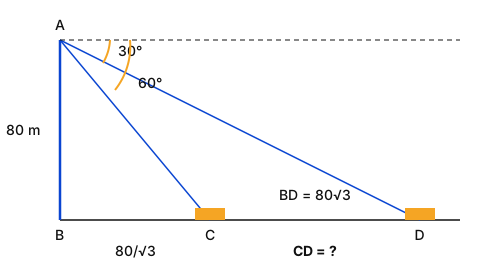
From the top of a cliff 80 meters high, the angles of depression of two ships in the same direction are 30° and 60°. Find the distance between the ships (rounded off to two decimal places).
80 मीटर ऊँची एक चट्टान के शिखर से, समान दिशा में स्थित दो जहाजों के अवनमन कोण 30° और 60° हैं। जहाजों के बीच की दूरी ज्ञात कीजिए (दशमलव के दो स्थानों तक पूर्णांकित)।
  1. A92.78 meters92.78 मीटर
  2. B92.18 meters92.18 मीटर
  3. C92.58 meters92.58 मीटर
  4. D92.38 meters92.38 मीटर
Show answer

Concept: In a right triangle, horizontal distance =heighttanθ; angle of depression = angle of elevation from the ship.

  1. Nearer ship (60°): BC=80tan60∘=803.
  2. Farther ship (30°): BD=80tan30∘=803.
  3. CD=803−803=80×23=1601.732≈92.38m.

Trick: For angles 30° and 60° the gap is always 2h3 – here 2×803.

Answer: (D) 92.38 meters

अवधारणा: समकोण त्रिभुज में क्षैतिज दूरी =ऊँचाईtanθ; अवनमन कोण = जहाज़ से उन्नयन कोण।

  1. पास वाला जहाज़ (60°): BC=80tan60∘=803।
  2. दूर वाला जहाज़ (30°): BD=80tan30∘=803।
  3. CD=803−803=1603=1601.732≈92.38m।

ट्रिक: 30° और 60° के लिए दोनों के बीच की दूरी हमेशा 2h3 होती है।

उत्तर: (D) 92.38 मीटर

RRB NTPC Undergraduate CBT 1MathematicsHeights and DistancesRRB NTPC Undergraduate CBT 1 2025 · 14 Jun Shift 2 →
Q7445.
A shopkeeper marks the price of sugar 24% above the cost price and gives a discount of 18%, but uses a weight of 800 grams instead of 1 kg. Find his overall profit
percentage.
एक दुकानदार चीनी का मूल्य क्रय मूल्य से 24% अधिक अंकित करता है और 18% की छूट देता है, लेकिन 1 kg के स्थान पर 800 ग्राम के बाट का उपयोग करता है। उसका कुल लाभ
प्रतिशत ज्ञात कीजिए।
  1. A25.4%
  2. B28%
  3. C26%
  4. D27.1%
Show answer

Concept: Compare what the customer pays with the cost of what he actually receives.

  1. Let CP = ₹100 per kg. MP =124, SP after 18% discount =124×0.82=101.68.
  2. He gives only 800 g, whose cost =80.
  3. Profit =101.68−8080×100=21.6880×100=27.1%.

Trick: Price multiplier 1.24×0.82=1.0168; weight multiplier 1000800=1.25; overall 1.0168×1.25=1.271⇒27.1%.

Answer: (D) 27.1%

अवधारणा: ग्राहक जो चुकाता है उसकी तुलना उसे वास्तव में मिले माल की लागत से करें।

  1. CP = ₹100 प्रति kg मानें। MP =124, 18% छूट के बाद SP =124×0.82=101.68।
  2. वह केवल 800 g देता है, जिसकी लागत =80।
  3. लाभ =101.68−8080×100=27.1%।

ट्रिक: मूल्य गुणक 1.24×0.82=1.0168; बाट गुणक 1000800=1.25; कुल 1.0168×1.25=1.271⇒27.1%।

उत्तर: (D) 27.1%

RRB NTPC Undergraduate CBT 1MathematicsProfit & Loss – False WeightRRB NTPC Undergraduate CBT 1 2025 · 14 Jun Shift 2 →
Q7446.
Find the value of {(3)−5×(8)5×(125)3×(36)3(100)4×256×216×(2)2}.
{(3)−5×(8)5×(125)3×(36)3(100)4×256×216×(2)2} का मान ज्ञात कीजिए।
  1. A27
  2. B59
  3. C38
  4. D45
Show answer

Concept: Write every number as a product of primes and cancel powers.

  1. Numerator: 3−5×215×59×(22·32)3=221×59×36−5=221×59×3.
  2. Denominator: (2252)4×28×2333×22=221×58×33.
  3. Ratio =59×358×33=59.

Trick: Count the powers of 2 first – they are equal (21 each), so only 3s and 5s survive.

Answer: (B) 59

अवधारणा: हर संख्या को अभाज्य गुणनखंडों में लिखें और घातें काटें।

  1. अंश: 3−5×215×59×(22·32)3=221×59×3।
  2. हर: (2252)4×28×2333×22=221×58×33।
  3. अनुपात =59×358×33=59।

ट्रिक: पहले 2 की घातें गिनें – दोनों ओर 21 हैं, अतः केवल 3 और 5 बचते हैं।

उत्तर: (B) 59

RRB NTPC Undergraduate CBT 1MathematicsIndicesRRB NTPC Undergraduate CBT 1 2025 · 14 Jun Shift 2 →
Q7447.
Find the mean proportional between (2+3) and (10−75).
(2+3) और (10−75) के बीच मध्यानुपाती ज्ञात कीजिए।
  1. A2+3
  2. B2
  3. C5
  4. D3
Show answer

Concept: Mean proportional between a and b is ab.

  1. 75=53, so the second number is 10−53=5(2−3).
  2. Product =(2+3)×5(2−3)=5(4−3)=5.
  3. Mean proportional =5.

Trick: Spot the conjugate pair (2+3)(2−3)=1 – the product collapses to 5 instantly.

Answer: (C) 5

अवधारणा: a और b का मध्यानुपाती (mean proportional) =ab।

  1. 75=53, अतः दूसरी संख्या 10−53=5(2−3)।
  2. गुणनफल =(2+3)×5(2−3)=5(4−3)=5।
  3. मध्यानुपाती =5।

ट्रिक: संयुग्मी जोड़ा (2+3)(2−3)=1 पहचानें – गुणनफल तुरंत 5 बन जाता है।

उत्तर: (C) 5

RRB NTPC Undergraduate CBT 1MathematicsMean Proportional – SurdsRRB NTPC Undergraduate CBT 1 2025 · 14 Jun Shift 2 →
Q7448.
Find the least value of (4K2+2M) for which the five digits number 7KM93 is divisible by 9.
(4K2+2M) का न्यूनतम मान ज्ञात कीजिए, जिसके लिए पाँच अंकों की संख्या 7KM93, 9 से विभाज्य है।
  1. A16
  2. B12
  3. C27
  4. D14
Show answer

Concept: A number is divisible by 9 if its digit sum is a multiple of 9.

  1. Digit sum of 7KM93 =7+K+M+9+3=19+K+M.
  2. Need 19+K+M=27 or 36⇒K+M=8 or 17.
  3. Minimise 4K2+2M: take K=0, M=8⇒0+16=16 (any K≥1 gives more).

Trick: K2 carries the big coefficient, so push K to 0 and load everything on M.

Answer: (A) 16

अवधारणा: कोई संख्या 9 से विभाज्य है यदि उसके अंकों का योग 9 का गुणज हो।

  1. 7KM93 का अंक-योग =7+K+M+9+3=19+K+M।
  2. 19+K+M=27 या 36⇒K+M=8 या 17।
  3. 4K2+2M न्यूनतम: K=0, M=8⇒16 (कोई भी K≥1 अधिक देता है)।

ट्रिक: K2 पर बड़ा गुणांक है, इसलिए K=0 रखें और सारा भार M पर डालें।

उत्तर: (A) 16

RRB NTPC Undergraduate CBT 1MathematicsDivisibility by 9RRB NTPC Undergraduate CBT 1 2025 · 14 Jun Shift 2 →
Q7449.
Nitin sells two articles for ₹2,973 each with no profit, no loss in the entire transaction. If one article was sold at a gain of 50%, then the other article is sold at a loss of:
नितिन दो वस्तुओं में से प्रत्येक को ₹2,973 में बेचता है और पूरे लेन-देन में न लाभ होता है, न हानि। यदि एक वस्तु 50% लाभ पर बेची गई थी, तो दूसरी वस्तु कितनी हानि पर बेची गई?
  1. A26%
  2. B22%
  3. C27%
  4. D25%
Show answer

Concept: No overall profit/loss ⇒ total CP = total SP.

  1. Total SP =2×2973=5946= total CP.
  2. CP of first (50% gain) =29731.5=1982.
  3. CP of second =5946−1982=3964; loss =3964−2973=991; 9913964×100=25%.

Trick: Gain 12 on CP₁ means CP₁ =23SP; the other must then lose the same rupee amount: 13SP on CP₂ =43SP ⇒25%.

Answer: (D) 25%

अवधारणा: कुल न लाभ न हानि ⇒ कुल CP = कुल SP।

  1. कुल SP =2×2973=5946= कुल CP।
  2. पहली वस्तु (50% लाभ) का CP =29731.5=1982।
  3. दूसरी का CP =5946−1982=3964; हानि =991; 9913964×100=25%।

ट्रिक: पहली पर लाभ =13SP; दूसरी पर उतनी ही रुपये की हानि, और उसका CP =43SP ⇒25%।

उत्तर: (D) 25%

RRB NTPC Undergraduate CBT 1MathematicsProfit & LossRRB NTPC Undergraduate CBT 1 2025 · 14 Jun Shift 2 →
Q7450.
Simplify: (40963100004)×548×186
सरल कीजिए: (40963100004)×548×186
  1. A36
  2. B30
  3. C29
  4. D31
Show answer

Concept: 40963=16 (since 163=4096) and 100004=10.

  1. 1610×548×186.
  2. 16×510×48=80480=16.
  3. 1866=31.

Trick: Remember 4096=212, so its cube root is 24=16 and its square root is 64.

Answer: (D) 31

अवधारणा: 40963=16 (163=4096) और 100004=10।

  1. 1610×548×186।
  2. 16×510×48=80480=16।
  3. 1866=31।

याद रखें: 4096=212, अतः घनमूल 24=16 और वर्गमूल 64।

उत्तर: (D) 31

RRB NTPC Undergraduate CBT 1MathematicsSimplification – RootsRRB NTPC Undergraduate CBT 1 2025 · 14 Jun Shift 2 →
Q7451.
X, Y, and Z enter into a partnership. X invests ₹60,000 for 12 months, Y invests ₹80,000 for 6 months, and Z invests ₹1,20,000 for 4 months. If the total profit is ₹77,000, what is the share of Z?
X, Y और Z एक साझेदारी में प्रवेश करते हैं। X, 12 महीनों के लिए ₹60,000 का निवेश करता है, Y, 6 महीनों के लिए ₹80,000 का निवेश करता है, और Z, 4 महीनों के लिए ₹1,20,000 का निवेश करता है। यदि कुल लाभ ₹77,000 है, तो Z का हिस्सा कितना है?
  1. A₹22,000
  2. B₹20,000
  3. C₹24,000
  4. D₹18,000
Show answer

Concept: Profit is shared in the ratio of (capital × time).

  1. X : Y : Z =60000×12:80000×6:120000×4=720:480:480=3:2:2.
  2. Z's share =27×77000=22000.

Trick: Divide all capitals by 20,000 first (3, 4, 6) then multiply by months: 36 : 24 : 24.

Answer: (A) ₹22,000

अवधारणा: लाभ (पूँजी × समय) के अनुपात में बँटता है।

  1. X : Y : Z =60000×12:80000×6:120000×4=720:480:480=3:2:2।
  2. Z का हिस्सा =27×77000=22000।

ट्रिक: पूँजियों को पहले 20,000 से भाग दें (3, 4, 6), फिर महीनों से गुणा: 36 : 24 : 24।

उत्तर: (A) ₹22,000

RRB NTPC Undergraduate CBT 1MathematicsPartnershipRRB NTPC Undergraduate CBT 1 2025 · 14 Jun Shift 2 →
Q7452.
A shirt originally costing ₹800 is first decreased by 30% and then increased by 15%. What is its new price?
मूल रूप से ₹800 की एक कमीज़ के मूल्य में पहले 30% की कमी की जाती है और फिर 15% की वृद्धि की जाती है। इसका नया मूल्य कितना है?
  1. A₹750
  2. B₹714
  3. C₹644
  4. D₹680
Show answer

Concept: Apply multipliers one after another: −30%→×0.7, +15%→×1.15.

  1. 800×0.7=560.
  2. 560×1.15=644.

Trick: Net change =−30+15−30×15100=−19.5%; 800×0.805=644.

Answer: (C) ₹644

अवधारणा: गुणक एक के बाद एक लगाएँ: −30%→×0.7, +15%→×1.15।

  1. 800×0.7=560।
  2. 560×1.15=644।

ट्रिक: कुल परिवर्तन =−30+15−30×15100=−19.5%; 800×0.805=644।

उत्तर: (C) ₹644

RRB NTPC Undergraduate CBT 1MathematicsSuccessive Percentage ChangeRRB NTPC Undergraduate CBT 1 2025 · 14 Jun Shift 2 →
Q7453.
Find the rate of interest at which the simple interest on ₹15,000 for 4 years is ₹3,600.
वह ब्याज दर ज्ञात कीजिए, जिस पर ₹15,000 पर 4 वर्षों का साधारण ब्याज ₹3,600 है।
  1. A7%
  2. B5%
  3. C4%
  4. D6%
Show answer

Concept: R=SI×100P×T.

  1. R=3600×10015000×4.
  2. =36000060000=6%.

Trick: SI per year =900; 900 is 6% of 15000.

Answer: (D) 6%

अवधारणा: R=SI×100P×T।

  1. R=3600×10015000×4।
  2. =36000060000=6%।

ट्रिक: प्रति वर्ष ब्याज =900; 900, 15000 का 6% है।

उत्तर: (D) 6%

RRB NTPC Undergraduate CBT 1MathematicsSimple InterestRRB NTPC Undergraduate CBT 1 2025 · 14 Jun Shift 2 →
Q7454.
An article marked at ₹1,250 is sold at two successive discounts such that the selling price becomes ₹900. If the first discount is 20%, what is the second discount?
₹1,250 अंकित मूल्य वाली एक वस्तु को दो क्रमागत छूटों पर इस प्रकार बेचा जाता है कि विक्रय मूल्य ₹900 हो जाता है। यदि पहली छूट 20% है, तो दूसरी छूट कितनी है?
  1. A10%
  2. B15%
  3. C8%
  4. D12%
Show answer

Concept: SP = MP ×(1−d1)(1−d2).

  1. After 20%: 1250×0.8=1000.
  2. 1000→900 is a drop of 100, i.e. 1001000=10%.

Trick: Second discount is always calculated on the already-reduced price, never on the MP.

Answer: (A) 10%

अवधारणा: SP = MP ×(1−d1)(1−d2)।

  1. 20% के बाद: 1250×0.8=1000।
  2. 1000→900 में 100 की कमी, अर्थात् 1001000=10%।

ट्रिक: दूसरी छूट हमेशा घटे हुए मूल्य पर लगती है, MP पर नहीं।

उत्तर: (A) 10%

RRB NTPC Undergraduate CBT 1MathematicsSuccessive DiscountRRB NTPC Undergraduate CBT 1 2025 · 14 Jun Shift 2 →
Q7455.
Two taps can fill a cistern in 4 hours and 22 hours, respectively. A third tap can empty it in 22 hours. How long (in hours) will it take to fill one-fourth of the empty cistern if all the taps are opened together?
दो नल एक टंकी को क्रमशः 4 घंटे और 22 घंटे में भर सकते हैं। एक तीसरा नल इसे 22 घंटे में खाली कर सकता है। यदि सभी नल एक साथ खोल दिए जाएँ, तो खाली टंकी के एक-चौथाई भाग को भरने में कितना समय (घंटों में) लगेगा?
  1. A2
  2. B4
  3. C1
  4. D3
Show answer

Concept: Net rate = sum of filling rates − emptying rate.

  1. Net rate =14+122−122=14 cistern per hour.
  2. Time for 14 cistern =1/41/4=1 hour.

Trick: The 22-hour filler and 22-hour emptier cancel exactly – only the 4-hour tap matters.

Answer: (C) 1

अवधारणा: शुद्ध दर = भरने की दरों का योग − खाली करने की दर।

  1. शुद्ध दर =14+122−122=14 टंकी प्रति घंटा।
  2. 14 टंकी का समय =1/41/4=1 घंटा।

ट्रिक: 22 घंटे वाला भरने वाला और 22 घंटे वाला खाली करने वाला नल एक-दूसरे को काट देते हैं – केवल 4 घंटे वाला नल मायने रखता है।

उत्तर: (C) 1

RRB NTPC Undergraduate CBT 1MathematicsPipes and CisternsRRB NTPC Undergraduate CBT 1 2025 · 14 Jun Shift 2 →
Q7456.
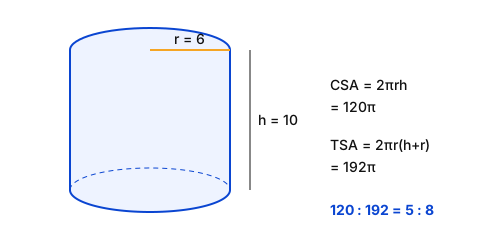
A cylindrical tank has a diameter of 12 m and a height of 10 m. If the tank is closed at both ends, what is the ratio of its curved surface area to its total surface area?
एक बेलनाकार टंकी का व्यास 12 m और ऊँचाई 10 m है। यदि टंकी दोनों सिरों पर बंद है, तो इसके वक्र पृष्ठीय क्षेत्रफल और कुल पृष्ठीय क्षेत्रफल का अनुपात क्या है?
  1. A4:7
  2. B5:8
  3. C3:5
  4. D2:5
Show answer

Concept: CSA =2πrh, TSA (closed) =2πr(h+r), so CSATSA=hh+r.

  1. r=6m, h=10m.
  2. Ratio =hh+r=1016=58.

Trick: 2πr cancels – no need to compute 120π and 192π; just h:(h+r).

Answer: (B) 5:8

अवधारणा: CSA =2πrh, TSA (बंद) =2πr(h+r), अतः CSATSA=hh+r।

  1. r=6m, h=10m।
  2. अनुपात =hh+r=1016=58।

ट्रिक: 2πr कट जाता है – 120π और 192π निकालने की ज़रूरत नहीं; सीधे h:(h+r)।

उत्तर: (B) 5:8

RRB NTPC Undergraduate CBT 1MathematicsMensuration – CylinderRRB NTPC Undergraduate CBT 1 2025 · 14 Jun Shift 2 →
Q7457.
Find the mean of the following data.
Class interval0-88-1616-2424-3232-4040-48
Frequency4673128
निम्नलिखित आंकड़ों का माध्य ज्ञात कीजिए।
वर्ग अंतराल0-88-1616-2424-3232-4040-48
बारंबारता4673128
  1. A29.3
  2. B30.5
  3. C27.4
  4. D25.2
Show answer

Concept: Mean =∑fx∑f, where x is the class mid-point.

  1. Mid-points: 4, 12, 20, 28, 36, 44; frequencies: 4, 6, 7, 3, 12, 8; ∑f=40.
  2. ∑fx=16+72+140+84+432+352=1096.
  3. Mean =109640=27.4.

Trick: Use assumed mean 28: deviations −24,−16,−8,0,8,16 give ∑fd=−24; mean =28−2440=27.4.

Answer: (C) 27.4

अवधारणा: माध्य =∑fx∑f, जहाँ x वर्ग का मध्य-बिंदु है।

  1. मध्य-बिंदु: 4, 12, 20, 28, 36, 44; बारंबारता: 4, 6, 7, 3, 12, 8; ∑f=40।
  2. ∑fx=16+72+140+84+432+352=1096।
  3. माध्य =109640=27.4।

ट्रिक: कल्पित माध्य 28 लें: विचलन −24,−16,−8,0,8,16 से ∑fd=−24; माध्य =28−2440=27.4।

उत्तर: (C) 27.4

RRB NTPC Undergraduate CBT 1MathematicsStatistics – Mean of Grouped DataRRB NTPC Undergraduate CBT 1 2025 · 14 Jun Shift 2 →
Q7458.
The largest four-digit number which when divided by 10, 11 and 8 leaves remainder 7 in each case is:
चार अंकों की वह सबसे बड़ी संख्या, जिसे 10, 11 और 8 से विभाजित करने पर प्रत्येक स्थिति में शेषफल 7 प्राप्त होता है, कौन-सी है?
  1. A9687
  2. B9398
  3. C9557
  4. D9978
Show answer

Concept: Number =k×LCM+7; pick the largest such number below 10000.

  1. LCM(10, 11, 8) =440.
  2. Largest 4-digit multiple of 440: 440×22=9680 (440×23=10120 is too big).
  3. Required number =9680+7=9687.

Trick: Check options: 9687−7=9680, and 9680÷440=22 exactly.

Answer: (A) 9687

अवधारणा: संख्या =k×LCM+7; 10000 से छोटी सबसे बड़ी ऐसी संख्या लें।

  1. LCM(10, 11, 8) =440।
  2. 440 का सबसे बड़ा 4-अंकीय गुणज: 440×22=9680 (440×23=10120 बड़ा है)।
  3. अभीष्ट संख्या =9680+7=9687।

ट्रिक: विकल्प जाँचें: 9687−7=9680, और 9680÷440=22 पूर्णतः।

उत्तर: (A) 9687

RRB NTPC Undergraduate CBT 1MathematicsLCM – RemaindersRRB NTPC Undergraduate CBT 1 2025 · 14 Jun Shift 2 →
Q7459.
Simplify: 34017×15613+148428−1410
सरल कीजिए: 34017×15613+148428−1410
  1. A281.6
  2. B271.6
  3. C261.6
  4. D291.6
Show answer

Concept: Simplify each fraction, then follow BODMAS (multiply before add/subtract).

  1. 34017=20, 15613=12, 148428=53, 1410=1.4.
  2. 20×12=240.
  3. 240+53−1.4=291.6.

Trick: 1484=28×53 because 28×50=1400 and 28×3=84.

Answer: (D) 291.6

अवधारणा: हर भिन्न को सरल करें, फिर BODMAS (पहले गुणा, फिर जोड़/घटाव)।

  1. 34017=20, 15613=12, 148428=53, 1410=1.4।
  2. 20×12=240।
  3. 240+53−1.4=291.6।

ट्रिक: 1484=28×53 क्योंकि 28×50=1400 और 28×3=84।

उत्तर: (D) 291.6

RRB NTPC Undergraduate CBT 1MathematicsSimplification – BODMASRRB NTPC Undergraduate CBT 1 2025 · 14 Jun Shift 2 →
Q7460.
The original price of a refrigerator was $1,500. During a clearance sale, it was initially discounted by 30%, followed by an additional 10% discount on the reduced price. What is the total percentage discount applied to the refrigerator?
एक रेफ्रिजरेटर का मूल मूल्य $1,500 था। क्लीयरेंस सेल के दौरान, इस पर पहले 30% की छूट दी गई, जिसके बाद घटे हुए मूल्य पर 10% की अतिरिक्त छूट दी गई। रेफ्रिजरेटर पर लागू कुल प्रतिशत छूट कितनी है?
  1. A37%
  2. B30%
  3. C40%
  4. D35%
Show answer

Concept: Net discount =a+b−ab100.

  1. 30+10−30×10100=40−3=37%.
  2. Check: 1500×0.7×0.9=945; discount =555=37% of 1500.

Trick: Successive discounts are always less than their simple sum (40%) – eliminates (C) at once.

Answer: (A) 37%

अवधारणा: कुल छूट =a+b−ab100।

  1. 30+10−30×10100=40−3=37%।
  2. जाँच: 1500×0.7×0.9=945; छूट =555, जो 1500 का 37% है।

ट्रिक: क्रमिक छूट हमेशा साधारण योग (40%) से कम होती है – (C) तुरंत हट जाता है।

उत्तर: (A) 37%

RRB NTPC Undergraduate CBT 1MathematicsSuccessive DiscountRRB NTPC Undergraduate CBT 1 2025 · 14 Jun Shift 2 →