Question bank

Q&A: practice questions with answers

Search questions on any topic. Filter by exam category, exam, subject and topic, try the question, then open the answer and explanation.

Courses – airGurukul

8,495 questions found.

Q7461.
The average of 12 numbers is 38. If two more numbers 50 and 62 are included, the new average is
(Round off your answer to two decimal places.)
12 संख्याओं का औसत 38 है। यदि दो और संख्याएँ 50 और 62 शामिल की जाती हैं, तो नया औसत कितना होगा?
(अपने उत्तर को दशमलव के दो स्थानों तक पूर्णांकित कीजिए।)
  1. A40.57
  2. B41.57
  3. C39.57
  4. D38.57
Show answer

Concept: New average =old sum+new numbersnew count.

  1. Old sum =12×38=456.
  2. New sum =456+50+62=568, count =14.
  3. 56814=40.571…≈40.57.

Trick: Extras above 38: 12+24=36 spread over 14 numbers =3614=2.57; 38+2.57=40.57.

Answer: (A) 40.57

अवधारणा: नया औसत =पुराना योग+नई संख्याएँनई गिनती।

  1. पुराना योग =12×38=456।
  2. नया योग =456+50+62=568, गिनती =14।
  3. 56814=40.571…≈40.57।

ट्रिक: 38 से अधिक अंश: 12+24=36, 14 संख्याओं में बँटे =2.57; 38+2.57=40.57।

उत्तर: (A) 40.57

RRB NTPC Undergraduate CBT 1MathematicsAverageRRB NTPC Undergraduate CBT 1 2025 · 14 Jun Shift 2 →
Q7462.
The measure of an interior angle of a regular polygon is 162°. Find the number of sides of the polygon.
एक सम बहुभुज के अंतः कोण की माप 162° है। बहुभुज की भुजाओं की संख्या ज्ञात कीजिए।
  1. A18
  2. B22
  3. C12
  4. D20
Show answer

Concept: Exterior angle =180∘−interior, and number of sides n=360∘exterior angle.

  1. Exterior angle =180∘−162∘=18∘.
  2. n=36018=20.

Trick: Always switch to the exterior angle – it avoids solving (n−2)180n=162.

Answer: (D) 20

अवधारणा: बाह्य कोण =180∘−अंतः कोण, भुजाएँ n=360∘बाह्य कोण।

  1. बाह्य कोण =180∘−162∘=18∘।
  2. n=36018=20।

ट्रिक: हमेशा बाह्य कोण पर जाएँ – (n−2)180n=162 हल करने से बचते हैं।

उत्तर: (D) 20

RRB NTPC Undergraduate CBT 1MathematicsPolygonsRRB NTPC Undergraduate CBT 1 2025 · 14 Jun Shift 2 →
Q7463.
The mean proportional between 12 and a number is twice the mean proportional between 9 and 16. Find the number.
12 और एक संख्या का मध्यानुपाती, 9 और 16 के मध्यानुपाती का दोगुना है। वह संख्या ज्ञात कीजिए।
  1. A72
  2. B56
  3. C48
  4. D60
Show answer

Concept: Mean proportional between a and b is ab.

  1. Between 9 and 16: 144=12; twice of it =24.
  2. 12x=24⇒12x=576⇒x=48.

Trick: 9×16=3×4=12 – multiply the square roots instead of the numbers.

Answer: (C) 48

अवधारणा: a और b का मध्यानुपाती =ab।

  1. 9 और 16 के बीच: 144=12; इसका दुगुना =24।
  2. 12x=24⇒12x=576⇒x=48।

ट्रिक: 9×16=3×4=12 – संख्याओं के बजाय वर्गमूलों को गुणा करें।

उत्तर: (C) 48

RRB NTPC Undergraduate CBT 1MathematicsMean ProportionalRRB NTPC Undergraduate CBT 1 2025 · 14 Jun Shift 2 →
Q7464.
A shopkeeper sells two types of pens, A and B. The total number of pens sold in a day is 120. The price of pen A is ₹12 each and pen B is ₹8 each. If the total sale amount is ₹1120, how many pens of type A did he sell?
एक दुकानदार दो प्रकार के पेन, A और B बेचता है। एक दिन में बेचे गए पेनों की कुल संख्या 120 है। पेन A का मूल्य ₹12 प्रति पेन और पेन B का मूल्य ₹8 प्रति पेन है। यदि कुल बिक्री राशि ₹1120 है, तो उसने A प्रकार के कितने पेन बेचे?
  1. A40
  2. B70
  3. C80
  4. D50
Show answer

Concept: Two unknowns, two conditions (count and total value).

  1. Let A =a, so B =120−a.
  2. 12a+8(120−a)=1120⇒4a+960=1120⇒4a=160.
  3. a=40.

Trick: Alligation: if all 120 were B, sale =960; extra 160 comes from A at ₹4 more each ⇒40 pens.

Answer: (A) 40

अवधारणा: दो अज्ञात, दो शर्तें (संख्या और कुल मूल्य)।

  1. A =a, तो B =120−a।
  2. 12a+8(120−a)=1120⇒4a+960=1120⇒4a=160।
  3. a=40।

ट्रिक: यदि सभी 120 पेन B होते तो बिक्री =960; अतिरिक्त 160 हर A पेन से ₹4 ज़्यादा आया ⇒40 पेन।

उत्तर: (A) 40

RRB NTPC Undergraduate CBT 1MathematicsLinear EquationsRRB NTPC Undergraduate CBT 1 2025 · 14 Jun Shift 2 →
Q7465.
Two banks, A and B, offered loans at 3.5% and 6.5% per annum, respectively. Ajay borrowed an amount of ₹2,60,000 from each bank. Find the positive difference between the amounts of simple interest (in ₹) paid to the two banks by Ajay after 2 years.
दो बैंकों, A और B ने क्रमशः 3.5% और 6.5% वार्षिक दर पर ऋण की पेशकश की। अजय ने प्रत्येक बैंक से ₹2,60,000 की राशि उधार ली। 2 वर्ष बाद अजय द्वारा दोनों बैंकों को चुकाए गए साधारण ब्याज की राशियों के बीच धनात्मक अंतर (₹ में) ज्ञात कीजिए।
  1. A15,100
  2. B17,100
  3. C16,600
  4. D15,600
Show answer

Concept: Same principal and time, so difference in SI =P×(rate difference)×T÷100.

  1. Rate difference =6.5−3.5=3%.
  2. Difference =260000×3×2100=15600.

Trick: No need to compute both interests – work directly with the 3% gap.

Answer: (D) 15,600

अवधारणा: समान मूलधन और समय, अतः SI का अंतर =P×(दर का अंतर)×T÷100।

  1. दर का अंतर =6.5−3.5=3%।
  2. अंतर =260000×3×2100=15600।

ट्रिक: दोनों ब्याज अलग-अलग निकालने की ज़रूरत नहीं – सीधे 3% के अंतर पर काम करें।

उत्तर: (D) 15,600

RRB NTPC Undergraduate CBT 1MathematicsSimple InterestRRB NTPC Undergraduate CBT 1 2025 · 14 Jun Shift 2 →
Q7466.
Based on the alphabetical order, three of the following four are alike in a certain way and thus form a group. Which is the one that does not belong to that group?
(Note: The odd man out is not based on the number of consonants/vowels or their position in the letter cluster.)
अंग्रेज़ी वर्णमाला क्रम के आधार पर, निम्नलिखित चार में से तीन किसी निश्चित प्रकार से एकसमान हैं और इस प्रकार एक समूह बनाते हैं। वह कौन-सा है जो उस समूह से संबंधित नहीं है?
(ध्यान दें: असंगत का निर्धारण व्यंजनों/स्वरों की संख्या या अक्षर-समूह में उनके स्थान के आधार पर नहीं किया गया है।)
  1. ABAE
  2. BRQT
  3. CAZD
  4. DEDH
Show answer

Concept: Find the gap (difference in alphabetical position) between consecutive letters in each cluster; the one with a different pattern is the odd one.

  1. BAE: B→A =−1, A→E =+4.
  2. AZD: A→Z =−1, Z→D =+4 (wrapping past Z); EDH: E→D =−1, D→H =+4.
  3. RQT: R→Q =−1, Q→T =+3 – breaks the (−1,+4) pattern.

Trick: Write positions (A=1 … Z=26) and compute differences; a single different gap gives the odd one.

Answer: (B) RQT

अवधारणा: प्रत्येक समूह में क्रमागत अक्षरों के बीच अंतर (वर्णमाला स्थान का) निकालें; जिसका पैटर्न अलग हो वही विषम है।

  1. BAE: B→A =−1, A→E =+4।
  2. AZD: A→Z =−1, Z→D =+4 (Z के बाद घूमकर); EDH: E→D =−1, D→H =+4।
  3. RQT: R→Q =−1, Q→T =+3 – (−1,+4) पैटर्न टूटता है।

ट्रिक: स्थान (A=1 … Z=26) लिखकर अंतर निकालें; एक अलग अंतर विषम बता देता है।

उत्तर: (B) RQT

RRB NTPC Undergraduate CBT 1General Intelligence and ReasoningOdd one out – Letter clustersRRB NTPC Undergraduate CBT 1 2025 · 14 Jun Shift 2 →
Q7467.
Refer to the following letter series and answer the question. (Counting to be done from left to right only.)
(Left) V A R V Y R A C M W S A I G Z O W V R R F (Right)
How many such vowels are there, each of which is immediately preceded by a consonant and also immediately followed by a consonant?
निम्नलिखित अक्षर श्रृंखला को देखिए और प्रश्न का उत्तर दीजिए। (गिनती केवल बाएँ से दाएँ की जानी है।)
(बाएँ) V A R V Y R A C M W S A I G Z O W V R R F (दाएँ)
ऐसे कितने स्वर हैं, जिनमें से प्रत्येक के ठीक पहले एक व्यंजन है और ठीक बाद भी एक व्यंजन है?
  1. AThreeतीन
  2. BOneएक
  3. CTwoदो
  4. DNoneकोई नहीं
Show answer

Concept: Scan every vowel in the given sequence and check whether the letter just before it and the letter just after it are both consonants.

  1. Series: V A R V Y R A C M W S A I G Z O W V R R F.
  2. A (2nd): V–A–R ✓; A (7th): R–A–C ✓; O (16th): Z–O–W ✓.
  3. A (12th) is followed by vowel I ✗; I (13th) is preceded by vowel A ✗. Total = 3.

Trick: Underline vowels first, then look only at their two neighbours – ignore everything else.

Answer: (A) Three

अवधारणा: दी गई श्रृंखला में हर स्वर (vowel) को देखें और जाँचें कि उसके ठीक पहले और ठीक बाद दोनों व्यंजन (consonant) हैं या नहीं।

  1. श्रृंखला: V A R V Y R A C M W S A I G Z O W V R R F।
  2. A (2रा): V–A–R ✓; A (7वाँ): R–A–C ✓; O (16वाँ): Z–O–W ✓।
  3. A (12वाँ) के बाद स्वर I है ✗; I (13वाँ) से पहले स्वर A है ✗। कुल = 3।

ट्रिक: पहले स्वरों को रेखांकित करें, फिर केवल उनके दोनों पड़ोसी देखें – बाकी छोड़ दें।

उत्तर: (A) Three (तीन)

RRB NTPC Undergraduate CBT 1General Intelligence and ReasoningLetter series – CountingRRB NTPC Undergraduate CBT 1 2025 · 14 Jun Shift 2 →
Q7468.
In a certain code language,
A ^ B means ‘A is the mother of B’,
A ÷ B means ‘A is the daughter of B’,
A ! B means ‘A is the wife of B’, and
A √ B means ‘A is the father of B’.
Based on the above, how is T related to Z if 'T √ U ÷ V ^ W ! Z'?
एक निश्चित कूट भाषा में,
A ^ B का अर्थ है 'A, B की माता है',
A ÷ B का अर्थ है 'A, B की पुत्री है',
A ! B का अर्थ है 'A, B की पत्नी है', और
A √ B का अर्थ है 'A, B का पिता है'।
उपरोक्त के आधार पर, यदि 'T √ U ÷ V ^ W ! Z' है, तो T का Z से क्या संबंध है?
  1. AFather's brotherपिता का भाई
  2. BBrother's sonभाई का पुत्र
  3. CWife's fatherपत्नी का पिता
  4. DWife's brotherपत्नी का भाई
Show answer

Concept: Decode each symbol step by step and build the family tree; then trace the path from Z to T.

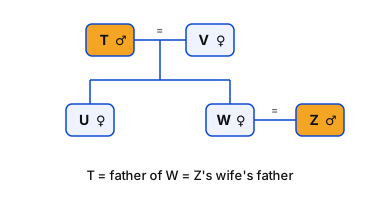
  1. T √ U: T is the father of U. U ÷ V: U is the daughter of V → V is the mother of U, so T and V are husband and wife.
  2. V ∧ W: V is the mother of W → T is also the father of W.
  3. W ! Z: W is the wife of Z → T is the father of Z's wife, i.e. T is Z's wife's father (father-in-law).

Trick: Start from the person asked about (Z) and walk backwards: Z → wife W → her father T.

Answer: (C) Wife’s father

अवधारणा: प्रत्येक चिह्न को क्रमशः डिकोड करके वंश-वृक्ष बनाएँ; फिर Z से T तक का रास्ता देखें।

  1. T √ U: T, U का पिता। U ÷ V: U, V की पुत्री → V, U की माता, अतः T और V पति-पत्नी हैं।
  2. V ∧ W: V, W की माता → T, W का भी पिता है।
  3. W ! Z: W, Z की पत्नी → T, Z की पत्नी का पिता (ससुर) है।

ट्रिक: जिसके बारे में पूछा है (Z) उससे पीछे चलें: Z → पत्नी W → उसका पिता T।

उत्तर: (C) Wife’s father (पत्नी का पिता)

RRB NTPC Undergraduate CBT 1General Intelligence and ReasoningBlood relations – CodedRRB NTPC Undergraduate CBT 1 2025 · 14 Jun Shift 2 →
Q7469.
Select the pair which follows the same pattern as that followed by the two sets of pairs given below. Both pairs follow the same pattern.
FHI : GBE
KXN : LRJ
उस युग्म का चयन कीजिए, जो उसी पैटर्न का अनुसरण करता है, जिसका अनुसरण नीचे दिए गए युग्मों के दो समुच्चय करते हैं। दोनों युग्म समान पैटर्न का अनुसरण करते हैं।
FHI : GBE
KXN : LRJ
  1. ABNU : CHQ
  2. BHLP : IFM
  3. CMHD : NBA
  4. DFKK : GEH
Show answer

Concept: Find how each letter of the first cluster changes to give the second cluster, then apply the same shifts to the options.

  1. FHI : GBE → F+1=G, H−6=B, I−4=E. KXN : LRJ → K+1=L, X−6=R, N−4=J. Pattern (+1,−6,−4).
  2. BNU → B+1=C, N−6=H, U−4=Q = CHQ ✓.
  3. HLP → IFL (not IFM); MHD → NBZ; FKK → GEG – all fail.

Trick: Test the first letter shift on all options first; here all give +1, so check the second letter (−6) next – it eliminates nothing, then the third (−4) decides.

Answer: (A) BNU : CHQ

अवधारणा: देखें कि पहले समूह का प्रत्येक अक्षर कैसे बदलकर दूसरा समूह बनता है, फिर वही परिवर्तन विकल्पों पर लगाएँ।

  1. FHI : GBE → F+1=G, H−6=B, I−4=E। KXN : LRJ → K+1=L, X−6=R, N−4=J। पैटर्न (+1,−6,−4)।
  2. BNU → B+1=C, N−6=H, U−4=Q = CHQ ✓।
  3. HLP → IFL (IFM नहीं); MHD → NBZ; FKK → GEG – सब असफल।

ट्रिक: पहले सभी विकल्पों पर पहले अक्षर का परिवर्तन जाँचें; यहाँ सब +1 देते हैं, तो तीसरे अक्षर (−4) से निर्णय करें।

उत्तर: (A) BNU : CHQ

RRB NTPC Undergraduate CBT 1General Intelligence and ReasoningAnalogy – Letter clustersRRB NTPC Undergraduate CBT 1 2025 · 14 Jun Shift 2 →
Q7470.
Seven boxes, L, M, N, O, P, Q and R, are kept one over the other, but not necessarily in the same order.
P is kept second from the top. Only three boxes are kept between L and M. N is kept immediately before P. Only M is kept after O. R is kept immediately above O.
How many boxes are kept between Q and M?
सात बक्से, L, M, N, O, P, Q और R, एक के ऊपर एक रखे गए हैं, लेकिन आवश्यक नहीं कि इसी क्रम में हों।
P को ऊपर से दूसरे स्थान पर रखा गया है। L और M के बीच केवल तीन बक्से रखे गए हैं। N को P के ठीक पहले रखा गया है। O के बाद केवल M रखा गया है। R को O के ठीक ऊपर रखा गया है।
Q और M के बीच कितने बक्से रखे गए हैं?
  1. AThreeतीन
  2. BTwoदो
  3. COneएक
  4. DFourचार
Show answer

Concept: Number the positions 1 (top) to 7 (bottom) and place the boxes using the definite clues first.

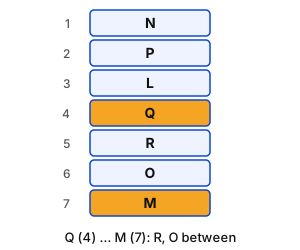
  1. P is 2nd from top → P = 2. N is immediately above P → N = 1.
  2. Only M is below O → O = 6, M = 7. R is immediately above O → R = 5.
  3. Three boxes between L and M → L = 3. Remaining Q = 4.
  4. Between Q (4) and M (7): R and O → two boxes.

Trick: Fix the "ends" first (top-2, bottom-2), the middle fills itself.

Answer: (B) Two

अवधारणा: स्थान ऊपर से 1 और नीचे 7 तक अंकित करें और पहले निश्चित सुरागों से बॉक्स रखें।

  1. P ऊपर से 2रा → P = 2। N, P के ठीक ऊपर → N = 1।
  2. O के नीचे केवल M → O = 6, M = 7। R, O के ठीक ऊपर → R = 5।
  3. L और M के बीच तीन बॉक्स → L = 3। शेष Q = 4।
  4. Q (4) और M (7) के बीच: R और O → दो बॉक्स।

ट्रिक: पहले "सिरे" तय करें (ऊपर के 2, नीचे के 2), बीच अपने आप भर जाता है।

उत्तर: (B) Two (दो)

RRB NTPC Undergraduate CBT 1General Intelligence and ReasoningBox arrangement – StackingRRB NTPC Undergraduate CBT 1 2025 · 14 Jun Shift 2 →
Q7471.
What should come in place of the question mark (?) in the given series based on the English alphabetical order?
DXN HCR LHV PMZ ?
अंग्रेज़ी वर्णमाला क्रम के आधार पर दी गई श्रृंखला में प्रश्न चिह्न (?) के स्थान पर क्या आना चाहिए?
DXN HCR LHV PMZ ?
  1. AUSC
  2. BSQE
  3. CTRD
  4. DTSC
Show answer

Concept: Compare the same position of successive clusters; each position usually moves by a constant step.

  1. 1st letters: D, H, L, P → +4 each → next T.
  2. 2nd letters: X, C, H, M → +5 each (X+5 = C wrapping) → next R.
  3. 3rd letters: N, R, V, Z → +4 each → next D (Z+4 = D). So TRD.

Trick: Steps of +4 and +5: after Z continue from A (Z→A→B→C→D).

Answer: (C) TRD

अवधारणा: क्रमागत समूहों के समान स्थान की तुलना करें; प्रत्येक स्थान प्रायः एक समान कदम से बढ़ता है।

  1. पहले अक्षर: D, H, L, P → हर बार +4 → अगला T।
  2. दूसरे अक्षर: X, C, H, M → +5 (X+5 = C घूमकर) → अगला R।
  3. तीसरे अक्षर: N, R, V, Z → +4 → अगला D (Z+4 = D)। अतः TRD।

ट्रिक: +4 और +5 के कदम: Z के बाद A से गिनें (Z→A→B→C→D)।

उत्तर: (C) TRD

RRB NTPC Undergraduate CBT 1General Intelligence and ReasoningLetter seriesRRB NTPC Undergraduate CBT 1 2025 · 14 Jun Shift 2 →
Q7472.
Each vowel in the word BACKLOG is changed to the letter immediately following it in the English alphabetical order and each consonant is changed to the letter immediately preceding it in the English alphabetical order. Which of the following letters will appear exactly twice in the new group of letters thus formed?
शब्द BACKLOG के प्रत्येक स्वर को अंग्रेज़ी वर्णमाला क्रम में उसके ठीक बाद वाले अक्षर में बदल दिया जाता है और प्रत्येक व्यंजन को अंग्रेज़ी वर्णमाला क्रम में उसके ठीक पहले वाले अक्षर में बदल दिया जाता है। इस प्रकार बने अक्षरों के नए समूह में निम्नलिखित में से कौन-सा अक्षर ठीक दो बार आएगा?
  1. AK
  2. BB
  3. CP
  4. DJ
Show answer

Concept: Apply the rule letter by letter: vowel → next letter, consonant → previous letter, then count repeats.

  1. B A C K L O G → B−1=A, A+1=B, C−1=B, K−1=J, L−1=K, O+1=P, G−1=F.
  2. New group: A B B J K P F.
  3. B appears exactly twice; K, P appear once and J once.

Trick: Write the word vertically and convert each letter – avoids skipping one.

Answer: (B) B

अवधारणा: नियम अक्षर-दर-अक्षर लगाएँ: स्वर → अगला अक्षर, व्यंजन → पिछला अक्षर, फिर दोहराव गिनें।

  1. B A C K L O G → B−1=A, A+1=B, C−1=B, K−1=J, L−1=K, O+1=P, G−1=F।
  2. नया समूह: A B B J K P F।
  3. B ठीक दो बार आता है; K, P और J एक-एक बार।

ट्रिक: शब्द को लंबवत लिखकर हर अक्षर बदलें – कोई छूटेगा नहीं।

उत्तर: (B) B

RRB NTPC Undergraduate CBT 1General Intelligence and ReasoningLetter operations – Word codingRRB NTPC Undergraduate CBT 1 2025 · 14 Jun Shift 2 →
Q7473.
Seven people A, B, D, J, O, T and Z are sitting in a row, facing north. Only two people sit to the left of O. Only three people sit between O and Z. Only one person sits between Z and D. A sits to the immediate left of J. B is not an immediate neighbor of Z. Who sits immediately to the right of D?
सात व्यक्ति A, B, D, J, O, T और Z एक पंक्ति में उत्तर की ओर मुख करके बैठे हैं। O के बाईं ओर केवल दो व्यक्ति बैठे हैं। O और Z के बीच केवल तीन व्यक्ति बैठे हैं। Z और D के बीच केवल एक व्यक्ति बैठा है। A, J के ठीक बाईं ओर बैठा है। B, Z का निकटतम पड़ोसी नहीं है। D के ठीक दाईं ओर कौन बैठा है?
  1. AT
  2. BB
  3. CO
  4. DZ
Show answer

Concept: Number seats 1 to 7 from left to right (all face north, so left/right are as we see them). Place people from the most definite clue.

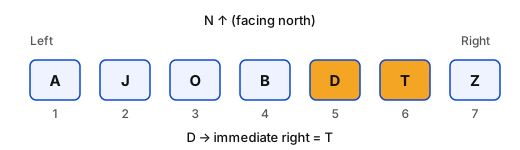
  1. Only two to the left of O → O = 3. Three between O and Z → Z = 7.
  2. One between Z and D → D = 5. A is immediately left of J → the only free adjacent pair is (1, 2): A = 1, J = 2.
  3. B is not a neighbour of Z → B = 4, T = 6. So T sits immediately right of D.

Trick: For north-facing rows: right = higher seat number. "Only two to the left" pins a seat instantly.

Answer: (A) T

अवधारणा: सीटें बाएँ से दाएँ 1 से 7 अंकित करें (सब उत्तर की ओर, अतः बाएँ/दाएँ वही जो हमें दिखता है)। सबसे निश्चित सुराग से शुरू करें।

  1. O के बाएँ केवल दो → O = 3। O और Z के बीच तीन → Z = 7।
  2. Z और D के बीच एक → D = 5। A, J के ठीक बाएँ → खाली जोड़ी केवल (1, 2): A = 1, J = 2।
  3. B, Z का पड़ोसी नहीं → B = 4, T = 6। अतः D के ठीक दाएँ T है।

ट्रिक: उत्तरमुखी पंक्ति में दाएँ = बड़ी सीट संख्या। "बाएँ केवल दो" से सीट तुरंत तय हो जाती है।

उत्तर: (A) T

RRB NTPC Undergraduate CBT 1General Intelligence and ReasoningLinear seating arrangementRRB NTPC Undergraduate CBT 1 2025 · 14 Jun Shift 2 →
Q7474.
What should come in place of ‘?’ in the given series?
184 164 145 127 110 94 ?
दी गई श्रृंखला में '?' के स्थान पर क्या आना चाहिए?
184 164 145 127 110 94 ?
  1. A83
  2. B75
  3. C81
  4. D79
Show answer

Concept: Look at the successive differences; here they themselves change by a constant.

  1. Differences: 184−164=20, 164−145=19, 145−127=18, 127−110=17, 110−94=16.
  2. Differences decrease by 1, so next difference =15.
  3. 94−15=79.

Trick: When numbers fall slowly, test differences first – a neat 20, 19, 18 … settles it.

Answer: (D) 79

अवधारणा: क्रमागत अंतर देखें; यहाँ अंतर स्वयं एक समान मात्रा से बदलते हैं।

  1. अंतर: 184−164=20, 164−145=19, 145−127=18, 127−110=17, 110−94=16।
  2. अंतर 1-1 घट रहे हैं, अतः अगला अंतर =15।
  3. 94−15=79।

ट्रिक: जब संख्याएँ धीरे-धीरे घटें, पहले अंतर जाँचें – साफ़ 20, 19, 18 … से हल हो जाता है।

उत्तर: (D) 79

RRB NTPC Undergraduate CBT 1General Intelligence and ReasoningNumber seriesRRB NTPC Undergraduate CBT 1 2025 · 14 Jun Shift 2 →
Q7475.
What should come in place of ? in the given series based on the English alphabetical order?
TWY VYA XAC ZCE ?
अंग्रेज़ी वर्णमाला क्रम के आधार पर दी गई श्रृंखला में ? के स्थान पर क्या आना चाहिए?
TWY VYA XAC ZCE ?
  1. ABDF
  2. BBEG
  3. CBFF
  4. DBCE
Show answer

Concept: Compare corresponding letters of consecutive clusters to find the constant shift.

  1. 1st letters: T, V, X, Z → +2 → next B (Z→A→B).
  2. 2nd letters: W, Y, A, C → +2 → next E.
  3. 3rd letters: Y, A, C, E → +2 → next G. Answer BEG.

Trick: Every position moves +2; after Z wrap round to A.

Answer: (B) BEG

अवधारणा: क्रमागत समूहों के संगत अक्षरों की तुलना कर समान परिवर्तन निकालें।

  1. पहले अक्षर: T, V, X, Z → +2 → अगला B (Z→A→B)।
  2. दूसरे अक्षर: W, Y, A, C → +2 → अगला E।
  3. तीसरे अक्षर: Y, A, C, E → +2 → अगला G। उत्तर BEG।

ट्रिक: हर स्थान +2 बढ़ता है; Z के बाद A से घूमें।

उत्तर: (B) BEG

RRB NTPC Undergraduate CBT 1General Intelligence and ReasoningLetter seriesRRB NTPC Undergraduate CBT 1 2025 · 14 Jun Shift 2 →
Q7476.
Seven boxes B, C, D, E, Q, R and S are kept one over the other but not necessarily in the same order. No box is kept above E. Only B is kept between E and Q. Only R is kept below C. Only one box is kept between Q and D. How many boxes are kept between S and R?
सात बक्से B, C, D, E, Q, R और S एक के ऊपर एक रखे गए हैं, लेकिन आवश्यक नहीं कि इसी क्रम में हों। E के ऊपर कोई बक्सा नहीं रखा गया है। E और Q के बीच केवल B रखा गया है। C के नीचे केवल R रखा गया है। Q और D के बीच केवल एक बक्सा रखा गया है। S और R के बीच कितने बक्से रखे गए हैं?
  1. AThreeतीन
  2. BFourचार
  3. CTwoदो
  4. DOneएक
Show answer

Concept: Number positions 1 (top) to 7 (bottom) and use the definite clues first.

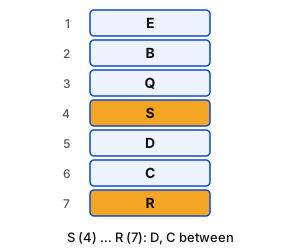
  1. No box above E → E = 1. Only B between E and Q → B = 2, Q = 3.
  2. Only R below C → C = 6, R = 7.
  3. One box between Q and D → D = 5. Remaining S = 4.
  4. Between S (4) and R (7): D and C → two boxes.

Trick: "No box above X" / "only Y below X" fix the top and bottom immediately.

Answer: (C) Two

अवधारणा: स्थान ऊपर से 1 और नीचे 7 तक अंकित करें; पहले निश्चित सुराग लगाएँ।

  1. E के ऊपर कोई बॉक्स नहीं → E = 1। E और Q के बीच केवल B → B = 2, Q = 3।
  2. C के नीचे केवल R → C = 6, R = 7।
  3. Q और D के बीच एक बॉक्स → D = 5। शेष S = 4।
  4. S (4) और R (7) के बीच: D और C → दो बॉक्स।

ट्रिक: "X के ऊपर कोई नहीं" / "X के नीचे केवल Y" से ऊपर-नीचे तुरंत तय हो जाते हैं।

उत्तर: (C) Two (दो)

RRB NTPC Undergraduate CBT 1General Intelligence and ReasoningBox arrangement – StackingRRB NTPC Undergraduate CBT 1 2025 · 14 Jun Shift 2 →
Q7477.
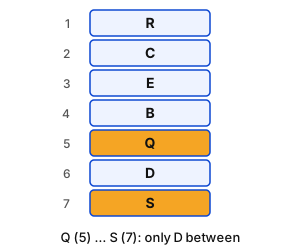
Seven boxes B, C, D, E, Q, R and S are kept one over the other but not necessarily in the same order. Only five boxes are kept above D. Only three boxes are kept between D and C. Only four boxes are kept between C and S. Only E is kept between C and B. R is kept at one of the positions above C. How many boxes are kept between Q and S?
सात बक्से B, C, D, E, Q, R और S एक के ऊपर एक रखे गए हैं, लेकिन आवश्यक नहीं कि इसी क्रम में हों। D के ऊपर केवल पाँच बक्से रखे गए हैं। D और C के बीच केवल तीन बक्से रखे गए हैं। C और S के बीच केवल चार बक्से रखे गए हैं। C और B के बीच केवल E रखा गया है। R को C के ऊपर के स्थानों में से किसी एक स्थान पर रखा गया है। Q और S के बीच कितने बक्से रखे गए हैं?
  1. ATwoदो
  2. BOneएक
  3. CFourचार
  4. DThreeतीन
Show answer

Concept: Number positions 1 (top) to 7 (bottom). Convert each clue into a position.

  1. Five boxes above D → D = 6. Three between D and C → C = 2 (position 10 is impossible).
  2. Four between C and S → S = 7. Only E between C and B → E = 3, B = 4 (upward is impossible).
  3. R is above C → R = 1. Remaining Q = 5.
  4. Between Q (5) and S (7): only D → one box.

Trick: With 7 boxes, "n between" has two candidates – reject the one that falls outside 1–7.

Answer: (B) One

अवधारणा: स्थान ऊपर से 1 और नीचे 7 तक अंकित करें। हर सुराग को स्थान में बदलें।

  1. D के ऊपर पाँच बॉक्स → D = 6। D और C के बीच तीन → C = 2 (स्थान 10 असंभव)।
  2. C और S के बीच चार → S = 7। C और B के बीच केवल E → E = 3, B = 4 (ऊपर की ओर असंभव)।
  3. R, C के ऊपर → R = 1। शेष Q = 5।
  4. Q (5) और S (7) के बीच: केवल D → एक बॉक्स।

ट्रिक: 7 बॉक्स में "n के बीच" के दो विकल्प होते हैं – जो 1–7 से बाहर जाए उसे हटाएँ।

उत्तर: (B) One (एक)

RRB NTPC Undergraduate CBT 1General Intelligence and ReasoningBox arrangement – StackingRRB NTPC Undergraduate CBT 1 2025 · 14 Jun Shift 2 →
Q7478.
If ‘A’ stands for ‘÷’, ‘B’ stands for ‘×’, ‘C’ stands for ‘+’ and ‘D’ stands for ‘−’, then what will come in place of the question mark (?) in the following equation?
22 C 10 D 9 A 21 B 42 = ?
यदि 'A' का अर्थ '÷', 'B' का अर्थ '×', 'C' का अर्थ '+' और 'D' का अर्थ '−' है, तो निम्नलिखित समीकरण में प्रश्न चिह्न (?) के स्थान पर क्या आएगा?
22 C 10 D 9 A 21 B 42 = ?
  1. A16
  2. B12
  3. C14
  4. D15
Show answer

Concept: Replace the letters by the given operators and simplify using BODMAS (division and multiplication before addition and subtraction).

  1. 22 C 10 D 9 A 21 B 42=22+10−9÷21×42.
  2. 9÷21×42=921×42=18.
  3. 22+10−18=14.

Trick: Do ÷ and × left to right first; 921×42 is just 9×2.

Answer: (C) 14

अवधारणा: अक्षरों की जगह दिए गए चिह्न रखें और BODMAS से हल करें (भाग व गुणा पहले, जोड़-घटाव बाद में)।

  1. 22 C 10 D 9 A 21 B 42=22+10−9÷21×42।
  2. 9÷21×42=921×42=18।
  3. 22+10−18=14।

ट्रिक: पहले ÷ और × बाएँ से दाएँ करें; 921×42 बस 9×2 है।

उत्तर: (C) 14

RRB NTPC Undergraduate CBT 1General Intelligence and ReasoningMathematical operations – Symbol substitutionRRB NTPC Undergraduate CBT 1 2025 · 14 Jun Shift 2 →
Q7479.
Based on the English alphabetical order, three of the following four letter-cluster pairs are alike in a certain way and thus form a group. Which is the one that does not belong to that group?
(Note: The odd one out is not based on the number of consonants/vowels or their position in the letter-cluster pairs.)
अंग्रेज़ी वर्णमाला क्रम के आधार पर, निम्नलिखित चार अक्षर-समूह युग्मों में से तीन किसी निश्चित प्रकार से एकसमान हैं और इस प्रकार एक समूह बनाते हैं। वह कौन-सा है जो उस समूह से संबंधित नहीं है?
(ध्यान दें: असंगत का निर्धारण व्यंजनों/स्वरों की संख्या या अक्षर-समूह युग्मों में उनके स्थान के आधार पर नहीं किया गया है।)
  1. AKM – HA
  2. BOR-LE
  3. CBE-YR
  4. DMP – JC
Show answer

Concept: Find the shift from the first letter to the third and from the second to the fourth in each pair.

  1. OR–LE: O→L =−3, R→E =−13. BE–YR: B→Y =−3 (wrap), E→R =−13 (wrap). MP–JC: M→J =−3, P→C =−13.
  2. KM–HA: K→H =−3, but M→A =−12 – different.
  3. So KM–HA is the odd one.

Trick: Treat the alphabet as a circle (26 letters): E−13 → R, B−3 → Y.

Answer: (A) KM – HA

अवधारणा: प्रत्येक युग्म में पहले अक्षर से तीसरे और दूसरे से चौथे अक्षर तक का परिवर्तन निकालें।

  1. OR–LE: O→L =−3, R→E =−13। BE–YR: B→Y =−3 (घूमकर), E→R =−13 (घूमकर)। MP–JC: M→J =−3, P→C =−13।
  2. KM–HA: K→H =−3, पर M→A =−12 – अलग।
  3. अतः KM–HA विषम है।

ट्रिक: वर्णमाला को 26 अक्षरों का वृत्त मानें: E−13 → R, B−3 → Y।

उत्तर: (A) KM – HA

RRB NTPC Undergraduate CBT 1General Intelligence and ReasoningOdd one out – Letter pairsRRB NTPC Undergraduate CBT 1 2025 · 14 Jun Shift 2 →
Q7480.
Read the given statement(s) and conclusions carefully. Assuming that the information given in the statements is true, even if it appears to be at variance with commonly known facts, decide which of the given conclusions logically follow(s) from the statement(s).
Statements:
All diesels are petrol.
Some petrol are fuels.
Conclusions:
(I) No fuel is petrol.
(II) No petrol is diesel.
दिए गए कथन/कथनों और निष्कर्षों को ध्यानपूर्वक पढ़िए। यह मानते हुए कि कथनों में दी गई जानकारी सत्य है, भले ही वह सामान्य रूप से ज्ञात तथ्यों से भिन्न प्रतीत होती हो, निर्णय लीजिए कि दिए गए निष्कर्षों में से कौन-सा/से निष्कर्ष कथन/कथनों का तार्किक रूप से अनुसरण करता है/करते हैं।
कथन:
सभी डीज़ल, पेट्रोल हैं।
कुछ पेट्रोल, ईंधन हैं।
निष्कर्ष:
(I) कोई ईंधन, पेट्रोल नहीं है।
(II) कोई पेट्रोल, डीज़ल नहीं है।
  1. ANeither conclusion (I) nor (II) followsन तो निष्कर्ष (I) और न ही (II) अनुसरण करता है
  2. BOnly conclusion (I) followsकेवल निष्कर्ष (I) अनुसरण करता है
  3. COnly conclusion (II) followsकेवल निष्कर्ष (II) अनुसरण करता है
  4. DBoth conclusions (I) and (II) followनिष्कर्ष (I) और (II) दोनों अनुसरण करते हैं
Show answer

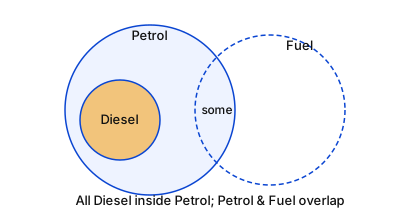
Concept: Draw a Venn diagram from the statements and test each conclusion; a conclusion follows only if it is true in every possible diagram.

  1. "All diesels are petrol" → Diesel circle lies inside Petrol. "Some petrol are fuels" → Petrol and Fuel overlap.
  2. Conclusion I "No fuel is petrol" contradicts the given overlap → does not follow.
  3. Conclusion II "No petrol is diesel" contradicts "All diesels are petrol" (some petrol are definitely diesel) → does not follow.

Trick: A "No…" conclusion can never follow when the statements already say "All/Some" between the same two terms.

Answer: (A) Neither conclusion (I) nor (II) follows

अवधारणा: कथनों से वेन आरेख बनाएँ और हर निष्कर्ष जाँचें; निष्कर्ष तभी सही जब वह हर संभव आरेख में सत्य हो।

  1. "सभी डीज़ल पेट्रोल हैं" → Diesel वृत्त Petrol के अंदर। "कुछ पेट्रोल ईंधन हैं" → Petrol और Fuel एक-दूसरे को काटते हैं।
  2. निष्कर्ष I "कोई ईंधन पेट्रोल नहीं" दिए गए ओवरलैप के विपरीत → अनुसरण नहीं करता।
  3. निष्कर्ष II "कोई पेट्रोल डीज़ल नहीं" "सभी डीज़ल पेट्रोल हैं" के विपरीत (कुछ पेट्रोल निश्चित रूप से डीज़ल हैं) → अनुसरण नहीं करता।

ट्रिक: जब कथन दो पदों के बीच "सभी/कुछ" कहें, तो उन्हीं के बीच "कोई नहीं" निष्कर्ष कभी नहीं निकलता।

उत्तर: (A) न तो निष्कर्ष (I) न ही (II) अनुसरण करता है

RRB NTPC Undergraduate CBT 1General Intelligence and ReasoningSyllogismRRB NTPC Undergraduate CBT 1 2025 · 14 Jun Shift 2 →