Question bank

Q&A: practice questions with answers

Search questions on any topic. Filter by exam category, exam, subject and topic, try the question, then open the answer and explanation.

Courses – airGurukul

8,495 questions found.

Q7481.
Select the set in which the numbers are related in the same way as are the numbers of the following sets.
(NOTE: Operations should be performed on the whole numbers, without breaking down the numbers into their constituent digits. E.g. 13 – Operations on 13 such as
adding/subtracting/multiplying etc. to 13 can be performed. Breaking down 13 into 1 and 3 and then performing mathematical operations on 1 and 3 is not allowed.) 13, 196
17, 324
उस समुच्चय का चयन कीजिए, जिसमें संख्याएँ उसी प्रकार संबंधित हैं, जिस प्रकार निम्नलिखित समुच्चयों की संख्याएँ संबंधित हैं।
(ध्यान दें: संक्रियाएँ संख्याओं को उनके घटक अंकों में विभाजित किए बिना, पूर्ण संख्याओं पर की जानी चाहिए। उदाहरण के लिए, 13 – 13 पर संक्रियाएँ जैसे
13 में जोड़ना/घटाना/गुणा करना आदि किया जा सकता है। 13 को 1 और 3 में विभाजित करना और फिर 1 और 3 पर गणितीय संक्रियाएँ करना अनुमत नहीं है।) 13, 196
17, 324
  1. A21, 400
  2. B18, 381
  3. C15, 256
  4. D19, 361
Show answer

Concept: Relate the second number to the first using whole-number operations; here the second number is a perfect square close to the first.

  1. 13→(13+1)2=142=196; 17→(17+1)2=182=324. Rule: (n+1)2.
  2. 15→162=256 ✓.
  3. 21→222=484≠400; 18→192=361≠381; 19→202=400≠361.

Trick: When the second number is a perfect square, check n2, (n+1)2, (n−1)2 first.

Answer: (C) 15, 256

अवधारणा: पूर्ण-संख्या संक्रियाओं से दूसरी संख्या को पहली से जोड़ें; यहाँ दूसरी संख्या पहली के पास का पूर्ण वर्ग है।

  1. 13→(13+1)2=142=196; 17→(17+1)2=182=324। नियम: (n+1)2।
  2. 15→162=256 ✓।
  3. 21→222=484≠400; 18→192=361≠381; 19→202=400≠361।

ट्रिक: दूसरी संख्या पूर्ण वर्ग हो तो पहले n2, (n+1)2, (n−1)2 जाँचें।

उत्तर: (C) 15, 256

RRB NTPC Undergraduate CBT 1General Intelligence and ReasoningNumber analogyRRB NTPC Undergraduate CBT 1 2025 · 14 Jun Shift 2 →
Q7482.
Each of the digits in the number 2536841 is arranged in ascending order from left to right. What will be the sum of the digits that are second from the left and second from the right in the new number thus formed?
संख्या 2536841 के प्रत्येक अंक को बाएँ से दाएँ आरोही क्रम में व्यवस्थित किया जाता है। इस प्रकार बनी नई संख्या में बाएँ से दूसरे और दाएँ से दूसरे अंकों का योग कितना होगा?
  1. A11
  2. B7
  3. C10
  4. D8
Show answer

Concept: Rewrite the digits in ascending order, then pick the required positions.

  1. Digits of 2536841: 2, 5, 3, 6, 8, 4, 1 → ascending: 1 2 3 4 5 6 8.
  2. Second from the left = 2; second from the right = 6.
  3. Sum =2+6=8.

Trick: Note that 7 is missing from the number – do not write 1234567 by habit.

Answer: (D) 8

अवधारणा: अंकों को आरोही क्रम में लिखें, फिर माँगे गए स्थान चुनें।

  1. 2536841 के अंक: 2, 5, 3, 6, 8, 4, 1 → आरोही: 1 2 3 4 5 6 8।
  2. बाएँ से दूसरा = 2; दाएँ से दूसरा = 6।
  3. योग =2+6=8।

ट्रिक: ध्यान दें संख्या में 7 नहीं है – आदतन 1234567 न लिखें।

उत्तर: (D) 8

RRB NTPC Undergraduate CBT 1General Intelligence and ReasoningNumber arrangementRRB NTPC Undergraduate CBT 1 2025 · 14 Jun Shift 2 →
Q7483.
Based on the English alphabetical order, three of the following four are alike in a certain way and thus form a group. Which is the one that does not belong to that group? (Note: The odd man out is not based on the number of consonants/vowels or their position in the letter cluster.)
अंग्रेज़ी वर्णमाला क्रम के आधार पर, निम्नलिखित चार में से तीन किसी निश्चित प्रकार से एकसमान हैं और इस प्रकार एक समूह बनाते हैं। वह कौन-सा है जो उस समूह से संबंधित नहीं है? (ध्यान दें: असंगत का निर्धारण व्यंजनों/स्वरों की संख्या या अक्षर-समूह में उनके स्थान के आधार पर नहीं किया गया है।)
  1. AKIF
  2. BGFB
  3. CIGD
  4. DQOL
Show answer

Concept: Compute the gap between consecutive letters in each cluster.

  1. KIF: K→I =−2, I→F =−3. IGD: I→G =−2, G→D =−3. QOL: Q→O =−2, O→L =−3.
  2. GFB: G→F =−1, F→B =−4 – different pattern.
  3. So GFB is the odd one.

Trick: Pattern (−2,−3) in three clusters; the one with (−1,−4) stands out.

Answer: (B) GFB

अवधारणा: प्रत्येक समूह में क्रमागत अक्षरों का अंतर निकालें।

  1. KIF: K→I =−2, I→F =−3। IGD: I→G =−2, G→D =−3। QOL: Q→O =−2, O→L =−3।
  2. GFB: G→F =−1, F→B =−4 – अलग पैटर्न।
  3. अतः GFB विषम है।

ट्रिक: तीन समूहों में (−2,−3) पैटर्न; (−1,−4) वाला अलग दिखता है।

उत्तर: (B) GFB

RRB NTPC Undergraduate CBT 1General Intelligence and ReasoningOdd one out – Letter clustersRRB NTPC Undergraduate CBT 1 2025 · 14 Jun Shift 2 →
Q7484.
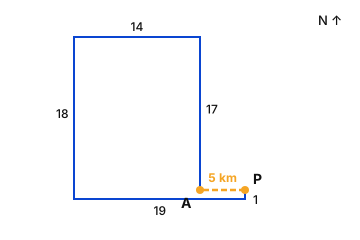
Sikar starts from Point A and drives 17 km towards the north. He then takes a left turn, drives 14 km, turns left and drives 18 km. He then takes a left turn and drives 19 km. He takes a final left turn, drives 1 km and stops at Point P. How far (shortest distance) and towards which direction should he drive in order to reach Point A again? (All turns are 90-degree turns only unless specified.)
सीकर बिंदु A से चलना शुरू करता है और उत्तर की ओर 17 km गाड़ी चलाता है। फिर वह बाएँ मुड़ता है, 14 km गाड़ी चलाता है, बाएँ मुड़ता है और 18 km गाड़ी चलाता है। फिर वह बाएँ मुड़ता है और 19 km गाड़ी चलाता है। वह अंतिम बार बाएँ मुड़ता है, 1 km गाड़ी चलाता है और बिंदु P पर रुक जाता है। बिंदु A पर पुनः पहुँचने के लिए उसे कितनी दूर (न्यूनतम दूरी) और किस दिशा में गाड़ी चलानी चाहिए? (जब तक निर्दिष्ट न हो, सभी मोड़ केवल 90 डिग्री के मोड़ हैं।)
  1. A6 km to the westपश्चिम की ओर 6 km
  2. B3 km to the westपश्चिम की ओर 3 km
  3. C5 km to the westपश्चिम की ओर 5 km
  4. D4 km to the eastपूर्व की ओर 4 km
Show answer

Concept: Take A as origin with north as +y and east as +x; a left turn rotates the heading anticlockwise (N→W→S→E→N). Track the coordinates.

  1. 17 km north: (0,17). Left → west 14 km: (−14,17). Left → south 18 km: (−14,−1).
  2. Left → east 19 km: (5,−1). Left → north 1 km: P =(5,0).
  3. P is 5 km east of A on the same line, so he must drive 5 km to the west to reach A.

Trick: Net east–west: 19−14=5 km east; net north–south: 17−18+1=0. Only the 5 km remains.

Answer: (C) 5 km to the west

अवधारणा: A को मूल बिंदु मानें, उत्तर +y और पूर्व +x; बायाँ मोड़ दिशा को वामावर्त घुमाता है (N→W→S→E→N)। निर्देशांक लिखते चलें।

  1. 17 km उत्तर: (0,17)। बाएँ → पश्चिम 14 km: (−14,17)। बाएँ → दक्षिण 18 km: (−14,−1)।
  2. बाएँ → पूर्व 19 km: (5,−1)। बाएँ → उत्तर 1 km: P =(5,0)।
  3. P, A से उसी रेखा पर 5 km पूर्व में है, अतः A पहुँचने के लिए 5 km पश्चिम चलना होगा।

ट्रिक: शुद्ध पूर्व–पश्चिम: 19−14=5 km पूर्व; शुद्ध उत्तर–दक्षिण: 17−18+1=0। केवल 5 km बचता है।

उत्तर: (C) 5 km to the west (5 km पश्चिम)

RRB NTPC Undergraduate CBT 1General Intelligence and ReasoningDirection and distanceRRB NTPC Undergraduate CBT 1 2025 · 14 Jun Shift 2 →
Q7485.
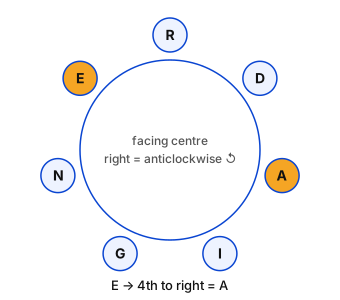
R, E, A, D, I, N and G are sitting around a circular table, facing the centre of the table. Only two people sit between R and G when counted from the right of R. Only three people sit between D and N when counted from the right of N. G sits to the immediate right of N. A sits to the immediate right of I.
Who sits fourth to the right of E?
R, E, A, D, I, N और G एक वृत्ताकार मेज़ के चारों ओर मेज़ के केंद्र की ओर मुख करके बैठे हैं। R के दाएँ से गिनने पर R और G के बीच केवल दो व्यक्ति बैठे हैं। N के दाएँ से गिनने पर D और N के बीच केवल तीन व्यक्ति बैठे हैं। G, N के ठीक दाईं ओर बैठा है। A, I के ठीक दाईं ओर बैठा है।
E के दाईं ओर चौथे स्थान पर कौन बैठा है?
  1. AR
  2. BA
  3. CN
  4. DG
Show answer

Concept: All face the centre, so "to the right" means anticlockwise. Number seats 1–7 clockwise and translate each clue.

  1. Fix R at seat 1. Two people between R and G from R's right → G is 3rd to the right of R → G = 5.
  2. G is immediately right of N → N is immediately left of G → N = 6. Three between D and N from N's right → D is 4th to the right of N → D = 2.
  3. A is immediately right of I → I is just clockwise of A; free seats 3, 4, 7 → A = 3, I = 4, E = 7.
  4. Fourth to the right of E (7) → seats 6, 5, 4, 3 → A.

Trick: Facing centre: right = anticlockwise, left = clockwise. Draw the circle – never do it in your head.

Answer: (B) A

अवधारणा: सब केंद्र की ओर देख रहे हैं, अतः "दाएँ" = वामावर्त (anticlockwise)। सीटें 1–7 दक्षिणावर्त अंकित कर हर सुराग बदलें।

  1. R को सीट 1 पर रखें। R के दाएँ से R और G के बीच दो → G, R के दाएँ तीसरा → G = 5।
  2. G, N के ठीक दाएँ → N, G के ठीक बाएँ → N = 6। N के दाएँ से D और N के बीच तीन → D, N के दाएँ चौथा → D = 2।
  3. A, I के ठीक दाएँ → I, A से ठीक दक्षिणावर्त; खाली सीटें 3, 4, 7 → A = 3, I = 4, E = 7।
  4. E (7) के दाएँ चौथा → सीटें 6, 5, 4, 3 → A।

ट्रिक: केंद्रमुखी: दाएँ = वामावर्त, बाएँ = दक्षिणावर्त। वृत्त बनाएँ – दिमाग में न करें।

उत्तर: (B) A

RRB NTPC Undergraduate CBT 1General Intelligence and ReasoningCircular seating arrangementRRB NTPC Undergraduate CBT 1 2025 · 14 Jun Shift 2 →
Q7486.
If ‘A’ stands for ‘÷’ , ‘B’ stands for ‘×’, ‘C’ stands for ‘+’ and ‘D’ stands for ‘−’, what will come in place of the question mark ‘?’ in the following equation?
9 A 3 C 15 B 2 = ? D 10
यदि 'A' का अर्थ '÷', 'B' का अर्थ '×', 'C' का अर्थ '+' और 'D' का अर्थ '−' है, तो निम्नलिखित समीकरण में प्रश्न चिह्न '?' के स्थान पर क्या आएगा?
9 A 3 C 15 B 2 = ? D 10
  1. A33
  2. B43
  3. C39
  4. D34
Show answer

Concept: Substitute the operators and solve both sides with BODMAS, then isolate the unknown.

  1. 9 A 3 C 15 B 2=9÷3+15×2=3+30=33.
  2. Right side: ? D 10=?−10.
  3. ?−10=33⇒?=43.

Trick: When the unknown is on the right, compute the left fully, then undo the operation (−10 → add 10).

Answer: (B) 43

अवधारणा: चिह्न रखकर दोनों पक्ष BODMAS से हल करें, फिर अज्ञात निकालें।

  1. 9 A 3 C 15 B 2=9÷3+15×2=3+30=33।
  2. दायाँ पक्ष: ? D 10=?−10।
  3. ?−10=33⇒?=43।

ट्रिक: अज्ञात दाएँ हो तो बायाँ पूरा हल करें, फिर संक्रिया उलटें (−10 → 10 जोड़ें)।

उत्तर: (B) 43

RRB NTPC Undergraduate CBT 1General Intelligence and ReasoningMathematical operations – Symbol substitutionRRB NTPC Undergraduate CBT 1 2025 · 14 Jun Shift 2 →
Q7487.
Refer to the following number series and answer the question. (All numbers are single- digit numbers only. Counting to be done from left to right only.)
(Left) 5 3 8 6 6 3 5 7 9 7 3 4 8 3 9 2 5 5 1 5 6 1 2 (Right)
How many such even digits are there, each of which is immediately preceded by an even digit and also immediately followed by an even digit?
निम्नलिखित संख्या श्रृंखला को देखिए और प्रश्न का उत्तर दीजिए। (सभी संख्याएँ केवल एक अंक वाली संख्याएँ हैं। गिनती केवल बाएँ से दाएँ की जानी है।)
(बाएँ) 5 3 8 6 6 3 5 7 9 7 3 4 8 3 9 2 5 5 1 5 6 1 2 (दाएँ)
ऐसे कितने सम अंक हैं, जिनमें से प्रत्येक के ठीक पहले एक सम अंक है और ठीक बाद भी एक सम अंक है?
  1. ATwoदो
  2. BOneएक
  3. CFourचार
  4. DThreeतीन
Show answer

Concept: Mark every even digit and check whether both its immediate neighbours are also even.

  1. Series: 5 3 8 6 6 3 5 7 9 7 3 4 8 3 9 2 5 5 1 5 6 1 2.
  2. Only triple of consecutive even digits is 8 6 6 → the middle 6 (4th digit) qualifies.
  3. 4 8 is followed by 3; 2 is preceded by 9; the last 2 has no right neighbour. Total = 1.

Trick: Look for a run of three even digits in a row – the middle one(s) count.

Answer: (B) One

अवधारणा: हर सम अंक चिह्नित करें और देखें कि उसके दोनों पड़ोसी भी सम हैं या नहीं।

  1. श्रृंखला: 5 3 8 6 6 3 5 7 9 7 3 4 8 3 9 2 5 5 1 5 6 1 2।
  2. लगातार तीन सम अंकों का एकमात्र समूह 8 6 6 → बीच वाला 6 (4था अंक) योग्य है।
  3. 4 8 के बाद 3 है; 2 से पहले 9; अंतिम 2 का दायाँ पड़ोसी नहीं। कुल = 1।

ट्रिक: लगातार तीन सम अंकों की कतार खोजें – बीच वाले गिने जाते हैं।

उत्तर: (B) One (एक)

RRB NTPC Undergraduate CBT 1General Intelligence and ReasoningNumber series – CountingRRB NTPC Undergraduate CBT 1 2025 · 14 Jun Shift 2 →
Q7488.
Select the triad that follows the same pattern as that followed by the two triads given below. Both triads follow the same pattern.
JS-BJ-SB
LU-DL-UD
उस त्रयी का चयन कीजिए, जो उसी पैटर्न का अनुसरण करती है, जिसका अनुसरण नीचे दी गई दो त्रयी करती हैं। दोनों त्रयी समान पैटर्न का अनुसरण करती हैं।
JS-BJ-SB
LU-DL-UD
  1. ANW-FN-WF
  2. BNW-FN-WR
  3. CNW-FN-KL
  4. DNW-FN-OP
Show answer

Concept: Each triad uses only three letters: the pairs are formed by rotating them, with the new letter 8 places before the first letter.

  1. JS–BJ–SB: letters J, S and B, where B = J−8. Pairs: (J,S), (B,J), (S,B).
  2. LU–DL–UD: D = L−8; pairs (L,U), (D,L), (U,D) – same rotation.
  3. NW: F = N−8 → pairs (N,W), (F,N), (W,F) → NW–FN–WF.

Trick: Third pair = 2nd letter of 1st pair + 1st letter of 2nd pair. Only option A has WF.

Answer: (A) NW-FN-WF

अवधारणा: हर त्रिक में केवल तीन अक्षर हैं: युग्म उन्हें घुमाकर बनते हैं, और नया अक्षर पहले अक्षर से 8 स्थान पहले है।

  1. JS–BJ–SB: अक्षर J, S और B, जहाँ B = J−8। युग्म: (J,S), (B,J), (S,B)।
  2. LU–DL–UD: D = L−8; युग्म (L,U), (D,L), (U,D) – वही घुमाव।
  3. NW: F = N−8 → युग्म (N,W), (F,N), (W,F) → NW–FN–WF।

ट्रिक: तीसरा युग्म = पहले युग्म का दूसरा अक्षर + दूसरे युग्म का पहला अक्षर। केवल विकल्प A में WF है।

उत्तर: (A) NW-FN-WF

RRB NTPC Undergraduate CBT 1General Intelligence and ReasoningAnalogy – Letter triadsRRB NTPC Undergraduate CBT 1 2025 · 14 Jun Shift 2 →
Q7489.
In a certain code language, ‘hall menu peak’ is coded as ‘yy ae wp’ and ‘peak boat owner’ is coded as ‘mr yy sf’. How is ‘peak’ coded in that language?
एक निश्चित कूट भाषा में, 'hall menu peak' को 'yy ae wp' के रूप में कूटबद्ध किया जाता है और 'peak boat owner' को 'mr yy sf' के रूप में कूटबद्ध किया जाता है। उस भाषा में 'peak' को किस प्रकार कूटबद्ध किया जाता है?
  1. Awp
  2. Byy
  3. Cmr
  4. Dae
Show answer

Concept: A word common to two sentences has a code common to both coded sentences.

  1. "hall menu peak" → yy ae wp; "peak boat owner" → mr yy sf.
  2. Common word = peak; common code = yy.
  3. So peak = yy.

Trick: Match the repeated word with the repeated code – no need to decode anything else.

Answer: (B) yy

अवधारणा: दो वाक्यों में उभयनिष्ठ शब्द का कोड दोनों कोडित वाक्यों में उभयनिष्ठ होता है।

  1. "hall menu peak" → yy ae wp; "peak boat owner" → mr yy sf।
  2. उभयनिष्ठ शब्द = peak; उभयनिष्ठ कोड = yy।
  3. अतः peak = yy।

ट्रिक: दोहराए गए शब्द को दोहराए गए कोड से मिलाएँ – और कुछ डिकोड करने की ज़रूरत नहीं।

उत्तर: (B) yy

RRB NTPC Undergraduate CBT 1General Intelligence and ReasoningCoding-decoding – Common wordRRB NTPC Undergraduate CBT 1 2025 · 14 Jun Shift 2 →
Q7490.
What should come in place of ‘?’ in the given series?
9 ? 18 45 109 234
दी गई श्रृंखला में '?' के स्थान पर क्या आना चाहिए?
9 ? 18 45 109 234
  1. A15
  2. B10
  3. C17
  4. D12
Show answer

Concept: Check the differences between consecutive terms; here they are perfect cubes.

  1. 234−109=125=53, 109−45=64=43, 45−18=27=33.
  2. So 18−?=23=8⇒?=10, and 10−9=1=13 ✓.
  3. Series: 9, 10, 18, 45, 109, 234 with differences 13,23,33,43,53.

Trick: Start from the big end: 125 and 64 are instantly recognisable cubes.

Answer: (B) 10

अवधारणा: क्रमागत पदों के अंतर जाँचें; यहाँ वे पूर्ण घन (cube) हैं।

  1. 234−109=125=53, 109−45=64=43, 45−18=27=33।
  2. अतः 18−?=23=8⇒?=10, और 10−9=1=13 ✓।
  3. श्रृंखला: 9, 10, 18, 45, 109, 234, अंतर 13,23,33,43,53।

ट्रिक: बड़े सिरे से शुरू करें: 125 और 64 तुरंत पहचाने जाने वाले घन हैं।

उत्तर: (B) 10

RRB NTPC Undergraduate CBT 1General Intelligence and ReasoningNumber seriesRRB NTPC Undergraduate CBT 1 2025 · 14 Jun Shift 2 →
Q7491.
In a certain code language,
A @ B means ‘A is the mother of B’,
A × B means ‘A is the wife of B’,
A + B means ‘A is the brother of B’ and
A ÷ B means ‘A is the father of B’.
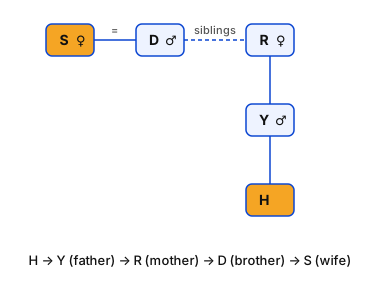
How is S related to H if ‘S × D + R @ Y ÷ H’?
एक निश्चित कूट भाषा में,
A @ B का अर्थ है 'A, B की माता है',
A × B का अर्थ है 'A, B की पत्नी है',
A + B का अर्थ है 'A, B का भाई है' और
A ÷ B का अर्थ है 'A, B का पिता है'।
यदि 'S × D + R @ Y ÷ H' है, तो S का H से क्या संबंध है?
  1. AFather's mother's brother's wifeपिता की माता के भाई की पत्नी
  2. BFather's brother's wifeपिता के भाई की पत्नी
  3. CFather's mother's brother's daughterपिता की माता के भाई की पुत्री
  4. DBrother's wifeभाई की पत्नी
Show answer

Concept: Decode symbol by symbol, build the tree, then walk from H upward to S.

  1. S × D: S is the wife of D. D + R: D is the brother of R.
  2. R @ Y: R is the mother of Y. Y ÷ H: Y is the father of H.
  3. From H: father Y → Y's mother R → R's brother D → D's wife S. So S is H's father's mother's brother's wife.

Trick: Build the chain in words from the person asked (H) and read it off: father → mother → brother → wife.

Answer: (A) Father’s mother’s brother’s wife

अवधारणा: चिह्न-दर-चिह्न डिकोड करें, वृक्ष बनाएँ, फिर H से ऊपर S तक चलें।

  1. S × D: S, D की पत्नी। D + R: D, R का भाई।
  2. R @ Y: R, Y की माता। Y ÷ H: Y, H का पिता।
  3. H से: पिता Y → Y की माता R → R का भाई D → D की पत्नी S। अतः S, H के पिता की माता के भाई की पत्नी है।

ट्रिक: पूछे गए व्यक्ति (H) से शब्दों में शृंखला बनाकर पढ़ें: पिता → माता → भाई → पत्नी।

उत्तर: (A) Father’s mother’s brother’s wife (पिता की माता के भाई की पत्नी)

RRB NTPC Undergraduate CBT 1General Intelligence and ReasoningBlood relations – CodedRRB NTPC Undergraduate CBT 1 2025 · 14 Jun Shift 2 →
Q7492.
Which of the following letter-number clusters will replace the question mark (?) in the given series to make it logically complete?
RU29 QT37 PS45 OR53 ?
निम्नलिखित में से कौन-सा अक्षर-संख्या समूह दी गई श्रृंखला में प्रश्न चिह्न (?) का स्थान लेकर उसे तार्किक रूप से पूर्ण करेगा?
RU29 QT37 PS45 OR53 ?
  1. ANQ61
  2. BNQ62
  3. CNR61
  4. DNR62
Show answer

Concept: Treat the letters and the number as separate series.

  1. Letters: RU → QT → PS → OR: each letter moves −1 → next NQ.
  2. Numbers: 29, 37, 45, 53 → +8 each → 53+8=61.
  3. Answer: NQ61.

Trick: Letters step back by 1, numbers step up by 8 – check both parts before choosing.

Answer: (A) NQ61

अवधारणा: अक्षरों और संख्या को अलग-अलग श्रृंखला मानें।

  1. अक्षर: RU → QT → PS → OR: हर अक्षर −1 → अगला NQ।
  2. संख्याएँ: 29, 37, 45, 53 → हर बार +8 → 53+8=61।
  3. उत्तर: NQ61।

ट्रिक: अक्षर 1 पीछे, संख्या 8 आगे – चुनने से पहले दोनों भाग जाँचें।

उत्तर: (A) NQ61

RRB NTPC Undergraduate CBT 1General Intelligence and ReasoningAlphanumeric seriesRRB NTPC Undergraduate CBT 1 2025 · 14 Jun Shift 2 →
Q7493.
Select the triad that follows the same pattern as the one followed by the two triads given below. Both triads follow the same pattern.
PK - QL - RT
RM - SN - TV
उस त्रयी का चयन कीजिए, जो उसी पैटर्न का अनुसरण करती है, जिसका अनुसरण नीचे दी गई दो त्रयी करती हैं। दोनों त्रयी समान पैटर्न का अनुसरण करती हैं।
PK - QL - RT
RM - SN - TV
  1. ALG - MH - NP
  2. BKG - MI - NO
  3. CLG - MH - NO
  4. DKG - MH - NO
Show answer

Concept: Find how each letter changes from pair to pair within the triad.

  1. PK–QL–RT: first letters P→Q→R (+1,+1); second letters K→L (+1), L→T (+8).
  2. RM–SN–TV: R→S→T (+1,+1); M→N (+1), N→V (+8). Pattern confirmed.
  3. LG–MH–NP: L→M→N ✓; G→H (+1), H→P (+8) ✓.

Trick: Options B and D break the +1 step in the first letters (K→M); option C has H→O (+7).

Answer: (A) LG - MH - NP

अवधारणा: त्रिक के भीतर युग्म से युग्म तक हर अक्षर का परिवर्तन निकालें।

  1. PK–QL–RT: पहले अक्षर P→Q→R (+1,+1); दूसरे अक्षर K→L (+1), L→T (+8)।
  2. RM–SN–TV: R→S→T (+1,+1); M→N (+1), N→V (+8)। पैटर्न पुष्ट।
  3. LG–MH–NP: L→M→N ✓; G→H (+1), H→P (+8) ✓।

ट्रिक: विकल्प B और D में पहले अक्षरों का +1 कदम टूटता है (K→M); विकल्प C में H→O (+7) है।

उत्तर: (A) LG - MH - NP

RRB NTPC Undergraduate CBT 1General Intelligence and ReasoningAnalogy – Letter triadsRRB NTPC Undergraduate CBT 1 2025 · 14 Jun Shift 2 →
Q7494.
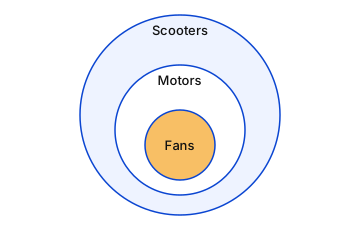
Read the given statements and conclusions carefully. You have to take the given statements to be true even if they seem to be at variance from commonly known facts. You have to decide which conclusions logically follow/s from the given statements. Statements: All fans are motors. All motors are scooters.
Conclusion (I) : Some scooters are motors
Conclusion (II) : All fans are scooters
दिए गए कथनों और निष्कर्षों को ध्यानपूर्वक पढ़िए। आपको दिए गए कथनों को सत्य मानना है, भले ही वे सामान्य रूप से ज्ञात तथ्यों से भिन्न प्रतीत होते हों। आपको निर्णय लेना है कि कौन-से निष्कर्ष दिए गए कथनों का तार्किक रूप से अनुसरण करते हैं। कथन: सभी पंखे, मोटर हैं। सभी मोटर, स्कूटर हैं।
निष्कर्ष (I) : कुछ स्कूटर, मोटर हैं
निष्कर्ष (II) : सभी पंखे, स्कूटर हैं
  1. ABoth conclusions (I) and (II) followनिष्कर्ष (I) और (II) दोनों अनुसरण करते हैं
  2. BOnly conclusion (I) followsकेवल निष्कर्ष (I) अनुसरण करता है
  3. CNeither conclusion (I) nor (II) followsन तो निष्कर्ष (I) और न ही (II) अनुसरण करता है
  4. DOnly conclusion (II) followsकेवल निष्कर्ष (II) अनुसरण करता है
Show answer

Concept: Draw the Venn diagram: "All A are B" puts circle A inside circle B.

  1. All fans are motors → Fans inside Motors. All motors are scooters → Motors inside Scooters.
  2. Conclusion I: Some scooters are motors – true, since the whole Motors circle lies inside Scooters.
  3. Conclusion II: All fans are scooters – true, Fans ⊂ Motors ⊂ Scooters. Both follow.

Trick: Two "All" statements in a chain give "All first are last" and "Some last are middle" for free.

Answer: (A) Both conclusions (I) and (II) follow

अवधारणा: वेन आरेख बनाएँ: "सभी A, B हैं" में वृत्त A, वृत्त B के अंदर आता है।

  1. सभी पंखे मोटर हैं → Fans, Motors के अंदर। सभी मोटर स्कूटर हैं → Motors, Scooters के अंदर।
  2. निष्कर्ष I: कुछ स्कूटर मोटर हैं – सत्य, क्योंकि पूरा Motors वृत्त Scooters के अंदर है।
  3. निष्कर्ष II: सभी पंखे स्कूटर हैं – सत्य, Fans ⊂ Motors ⊂ Scooters। दोनों अनुसरण करते हैं।

ट्रिक: शृंखला में दो "सभी" कथन से "सभी पहले, अंतिम हैं" और "कुछ अंतिम, बीच वाले हैं" सीधे मिल जाते हैं।

उत्तर: (A) दोनों निष्कर्ष (I) और (II) अनुसरण करते हैं

RRB NTPC Undergraduate CBT 1General Intelligence and ReasoningSyllogismRRB NTPC Undergraduate CBT 1 2025 · 14 Jun Shift 2 →
Q7495.
In a certain code language, ‘queen chin steak’ is coded as ' kc eq rq' and ‘steak arch food’ is coded as ‘yg kc mz’. How is ‘steak’ coded in the given language?
एक निश्चित कूट भाषा में, 'queen chin steak' को 'kc eq rq' के रूप में कूटबद्ध किया जाता है और 'steak arch food' को 'yg kc mz' के रूप में कूटबद्ध किया जाता है। दी गई भाषा में 'steak' को किस प्रकार कूटबद्ध किया जाता है?
  1. Arq
  2. Bkc
  3. Cyg
  4. Deq
Show answer

Concept: The word appearing in both sentences takes the code appearing in both coded forms.

  1. "queen chin steak" → kc eq rq; "steak arch food" → yg kc mz.
  2. Common word = steak; common code = kc.
  3. So steak = kc.

Trick: Spot the repeated word and the repeated code – done in five seconds.

Answer: (B) kc

अवधारणा: दोनों वाक्यों में आने वाले शब्द का कोड वही है जो दोनों कोडित रूपों में आता है।

  1. "queen chin steak" → kc eq rq; "steak arch food" → yg kc mz।
  2. उभयनिष्ठ शब्द = steak; उभयनिष्ठ कोड = kc।
  3. अतः steak = kc।

ट्रिक: दोहराया गया शब्द और दोहराया गया कोड पहचानें – पाँच सेकंड का काम।

उत्तर: (B) kc

RRB NTPC Undergraduate CBT 1General Intelligence and ReasoningCoding-decoding – Common wordRRB NTPC Undergraduate CBT 1 2025 · 14 Jun Shift 2 →
Q7496.
At the age of 92, Paul Biya became the world’s oldest head of state after winning his eighth presidential term in October 2025. He is the president of which of the following countries?
92 वर्ष की आयु में, पॉल बिया (Paul Biya) अक्टूबर 2025 में अपना आठवाँ राष्ट्रपति कार्यकाल जीतने के बाद विश्व के सबसे वृद्ध राष्ट्राध्यक्ष बन गए। वे निम्नलिखित में से किस देश के राष्ट्रपति हैं?
  1. AChadचाड
  2. BNigeriaनाइजीरिया
  3. CSudanसूडान
  4. DCameroonकैमरून
Show answer

Concept: Paul Biya has ruled Cameroon since 1982.

  1. In the October 2025 presidential election he was declared winner of an eighth term at age 92, making him the world's oldest serving head of state.
  2. Chad is led by Mahamat Déby, Nigeria by Bola Tinubu and Sudan by Gen. al-Burhan.

Yaad rakhein: Biya – Cameroon (capital Yaoundé) – in power since 1982.

Answer: (D) Cameroon

अवधारणा: पॉल बिया 1982 से कैमरून के राष्ट्रपति हैं।

  1. अक्टूबर 2025 के राष्ट्रपति चुनाव में 92 वर्ष की आयु में आठवाँ कार्यकाल जीतकर वे विश्व के सबसे वृद्ध राष्ट्राध्यक्ष बने।
  2. चाड – महामत डेबी, नाइजीरिया – बोला टीनूबू, सूडान – जनरल अल-बुरहान।

याद रखें: बिया – कैमरून (राजधानी याउंडे) – 1982 से सत्ता में।

उत्तर: (D) Cameroon

RRB NTPC Undergraduate CBT 1General AwarenessCurrent affairs – world leadersRRB NTPC Undergraduate CBT 1 2025 · 14 Jun Shift 1 →
Q7497.
Under the proposed Budget, what is the fiscal deficit target for FY 2025-26?
प्रस्तावित बजट के अंतर्गत, वित्त वर्ष 2025-26 के लिए राजकोषीय घाटे का लक्ष्य क्या है?
  1. A6.2% of GDPGDP का 6.2%
  2. B5.0% of GDPGDP का 5.0%
  3. C4.4% of GDPGDP का 4.4%
  4. D3.8% of GDPGDP का 3.8%
Show answer

Concept: Union Budget 2025-26 (1 Feb 2025) set the fiscal deficit target at 4.4% of GDP.

  1. Revised estimate for 2024-25 was 4.8%; the glide path brings it to 4.4% in 2025-26.
  2. The government has committed to keep the deficit such that debt declines to about 50% of GDP by 2031.

Yaad rakhein: FY24: 5.6% → FY25: 4.8% → FY26: 4.4%.

Answer: (C) 4.4% of GDP

अवधारणा: केंद्रीय बजट 2025-26 (1 फरवरी 2025) में राजकोषीय घाटे का लक्ष्य GDP का 4.4% रखा गया।

  1. 2024-25 का संशोधित अनुमान 4.8% था; 2025-26 में यह 4.4% पर लाया गया।
  2. लक्ष्य 2031 तक ऋण को GDP के लगभग 50% तक लाना है।

याद रखें: FY24: 5.6% → FY25: 4.8% → FY26: 4.4%।

उत्तर: (C) 4.4% of GDP

RRB NTPC Undergraduate CBT 1General AwarenessUnion Budget 2025-26RRB NTPC Undergraduate CBT 1 2025 · 14 Jun Shift 1 →
Q7498.
Which of the following celebrated Sanskrit poets and playwrights was one of the Navaratnas in the court of Chandragupta II?
निम्नलिखित में से कौन-से प्रसिद्ध संस्कृत कवि और नाटककार चंद्रगुप्त द्वितीय के दरबार के नवरत्नों में से एक थे?
  1. ABhasaभास
  2. BKalidasaकालिदास
  3. CBanaबाण
  4. DBhavabhutiभवभूति
Show answer

Concept: Kalidasa, author of Abhijnanashakuntalam and Meghaduta, was one of the nine gems (Navaratnas) of Chandragupta II Vikramaditya.

  1. Other Navaratnas: Amarasimha, Varahamihira, Dhanvantari, etc.
  2. Bana was court poet of Harsha (7th c.), Bhavabhuti of Yashovarman of Kannauj (8th c.), Bhasa predates the Guptas.

Yaad rakhein: Vikramaditya ke darbar ke 9 ratna – Kalidasa sabse prasiddh.

Answer: (B) Kalidasa

अवधारणा: अभिज्ञानशाकुंतलम् और मेघदूत के रचयिता कालिदास चंद्रगुप्त द्वितीय विक्रमादित्य के नवरत्नों में थे।

  1. अन्य नवरत्न: अमरसिंह, वराहमिहिर, धन्वंतरि आदि।
  2. बाण हर्ष (7वीं सदी) के, भवभूति कन्नौज के यशोवर्मन (8वीं सदी) के दरबारी थे; भास गुप्तों से पहले के हैं।

याद रखें: विक्रमादित्य के दरबार के 9 रत्न – कालिदास सबसे प्रसिद्ध।

उत्तर: (B) Kalidasa

RRB NTPC Undergraduate CBT 1General AwarenessGupta period – NavaratnasRRB NTPC Undergraduate CBT 1 2025 · 14 Jun Shift 1 →
Q7499.
What type of joint allows the widest range of movement, including medial and lateral rotation, as in the shoulder and hip?
किस प्रकार का जोड़ (joint) गति की सबसे व्यापक सीमा, जिसमें मध्य (medial) और पार्श्व (lateral) घूर्णन भी शामिल है, की अनुमति देता है, जैसे कंधे और कूल्हे में?
  1. APivot Jointधुराग्र संधि (Pivot Joint)
  2. BBall and Socket Jointकंदुक-खल्लिका संधि (Ball and Socket Joint)
  3. CHinge Jointकब्ज़ा संधि (Hinge Joint)
  4. DGliding Jointविसर्पी संधि (Gliding Joint)
Show answer

Concept: A ball-and-socket joint allows movement in all directions, including rotation.

  1. Shoulder and hip joints are ball-and-socket: a rounded head fits into a cup-shaped socket.
  2. Hinge (knee, elbow) – one plane; pivot (atlas-axis) – rotation only; gliding (wrist bones) – sliding.

Yaad rakhein: Shoulder & hip = ball and socket = maximum movement.

Answer: (B) Ball and Socket Joint

अवधारणा: कंदुक-खल्लिका संधि (ball and socket joint) सभी दिशाओं में, घूर्णन सहित, गति देती है।

  1. कंधा और कूल्हा इसी प्रकार के जोड़ हैं – गोल सिरा प्याले जैसे गड्ढे में बैठता है।
  2. हिंज (घुटना, कोहनी) – एक तल; पिवट (एटलस-एक्सिस) – केवल घूर्णन; ग्लाइडिंग (कलाई) – फिसलन।

याद रखें: कंधा व कूल्हा = ball and socket = अधिकतम गति।

उत्तर: (B) Ball and Socket Joint

RRB NTPC Undergraduate CBT 1General AwarenessBiology – jointsRRB NTPC Undergraduate CBT 1 2025 · 14 Jun Shift 1 →
Q7500.
Which process mainly helps in the formation of V-shaped valleys in mountainous regions?
पर्वतीय क्षेत्रों में V-आकार की घाटियों के निर्माण में मुख्य रूप से कौन-सी प्रक्रिया सहायक होती है?
  1. ARiver erosionनदी अपरदन
  2. BWave actionतरंग क्रिया
  3. CGlacier movementहिमनद की गति
  4. DWind erosionपवन अपरदन
Show answer

Concept: V-shaped valleys are formed by vertical (downward) erosion of rivers in their youthful mountain stage.

  1. Fast-flowing rivers cut down into the bed faster than the sides widen, giving a V profile.
  2. Glaciers carve U-shaped valleys; wind and waves do not form mountain valleys.

Yaad rakhein: River = V-shaped, Glacier = U-shaped.

Answer: (A) River erosion

अवधारणा: V-आकार की घाटियाँ पर्वतीय (युवावस्था) भाग में नदी के ऊर्ध्वाधर अपरदन से बनती हैं।

  1. तेज बहती नदी तल को किनारों की अपेक्षा तेजी से काटती है, जिससे V प्रोफाइल बनती है।
  2. हिमनद U-आकार की घाटी बनाते हैं; पवन और लहरें पर्वतीय घाटियाँ नहीं बनातीं।

याद रखें: नदी = V-आकार, हिमनद = U-आकार।

उत्तर: (A) River erosion

RRB NTPC Undergraduate CBT 1General AwarenessGeography – landformsRRB NTPC Undergraduate CBT 1 2025 · 14 Jun Shift 1 →