Question bank

Q&A: practice questions with answers

Search questions on any topic. Filter by exam category, exam, subject and topic, try the question, then open the answer and explanation.

Courses – airGurukul

8,495 questions found.

Q7561.
A and B can do a piece of work in 12 days and 18 days, respectively. Both work for 2 days and then A leaves. How long (in days) will B take to complete the remaining work?
A और B किसी कार्य को क्रमशः 12 दिन और 18 दिन में कर सकते हैं। दोनों 2 दिन तक कार्य करते हैं और फिर A चला जाता है। शेष कार्य को पूरा करने में B कितना समय (दिनों में) लेगा?
  1. A15
  2. B14
  3. C13
  4. D12
Show answer

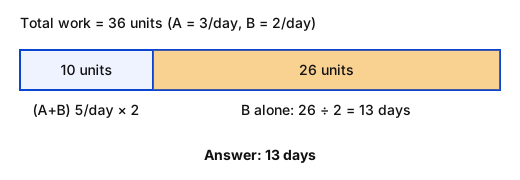
Concept: Total work =LCM(12,18)=36 units; efficiency = work per day.

  1. A =3 units/day, B =2 units/day.
  2. In 2 days together: 5×2=10 units; remaining 26.
  3. B alone: 262=13 days.

Trick: Fractions: done =2(112+118)=518; left 1318×18=13 days.

Answer: (C) 13

अवधारणा: कुल कार्य =LCM(12,18)=36 इकाई; दक्षता = प्रतिदिन कार्य।

  1. A =3, B =2 इकाई/दिन।
  2. 2 दिन साथ: 5×2=10 इकाई; शेष 26।
  3. B अकेला: 262=13 दिन।

ट्रिक: भिन्न से: हुआ =2(112+118)=518; शेष 1318×18=13 दिन।

उत्तर: (C) 13

RRB NTPC Undergraduate CBT 1MathematicsTime and workRRB NTPC Undergraduate CBT 1 2025 · 14 Jun Shift 1 →
Q7562.
What is the correct ascending order of the following ratios?
11:15, 23:55, 32:33, 4:11, 26:35
निम्नलिखित अनुपातों का सही आरोही क्रम क्या है?
11:15, 23:55, 32:33, 4:11, 26:35
  1. A4:11, 23:55, 11:15, 26:35, 32:33
  2. B4:11, 26:35, 11:15, 23:55, 32:33
  3. C4:11, 11:15, 23:55, 26:35, 32:33
  4. D4:11, 23:55, 26:35, 11:15, 32:33
Show answer

Concept: Convert each ratio to a decimal and arrange.

  1. 411≈0.364, 2355≈0.418, 1115≈0.733, 2635≈0.743, 3233≈0.970.
  2. Ascending: 4:11<23:55<11:15<26:35<32:33.

Trick: Only 11:15 vs 26:35 is close – cross-multiply: 11×35=385<26×15=390, so 11:15 is smaller.

Answer: (A) 4:11, 23:55, 11:15, 26:35, 32:33

अवधारणा: हर अनुपात को दशमलव में बदलकर क्रम लगाएँ।

  1. 411≈0.364, 2355≈0.418, 1115≈0.733, 2635≈0.743, 3233≈0.970।
  2. आरोही: 4:11<23:55<11:15<26:35<32:33।

ट्रिक: केवल 11:15 और 26:35 पास हैं – वज्र-गुणन: 11×35=385<26×15=390, अतः 11:15 छोटा।

उत्तर: (A) 4:11, 23:55, 11:15, 26:35, 32:33

RRB NTPC Undergraduate CBT 1MathematicsComparing ratiosRRB NTPC Undergraduate CBT 1 2025 · 14 Jun Shift 1 →
Q7563.
A sum of ₹10,000 is invested at a compound interest rate of 10% per annum for 2 years, compounded annually. What is the compound interest earned?
₹10,000 की राशि को 2 वर्षों के लिए 10% वार्षिक चक्रवृद्धि ब्याज दर पर निवेश किया जाता है, ब्याज वार्षिक रूप से संयोजित होता है। अर्जित चक्रवृद्धि ब्याज क्या है?
  1. A₹1,900
  2. B₹2,000
  3. C₹2,200
  4. D₹2,100
Show answer

Concept: A=P(1+R100)T; CI =A−P.

  1. A=10000×(1.1)2=10000×1.21=12100.
  2. CI =12100−10000=₹2,100.

Trick: 2-year CI rate =R+R+R2100=10+10+1=21% of 10,000 =2100.

Answer: (D) ₹2,100

अवधारणा: A=P(1+R100)T; CI =A−P।

  1. A=10000×(1.1)2=12100।
  2. CI =12100−10000=₹2,100।

ट्रिक: 2 वर्ष की प्रभावी CI दर =R+R+R2100=21%; 10,000 का 21%=2100।

उत्तर: (D) ₹2,100

RRB NTPC Undergraduate CBT 1MathematicsCompound interestRRB NTPC Undergraduate CBT 1 2025 · 14 Jun Shift 1 →
Q7564.
Evaluate 253 + (-20)3 + (-5)3
253 + (-20)3 + (-5)3 का मान ज्ञात कीजिए।
  1. A7244
  2. B7467
  3. C7500
  4. D7360
Show answer

Concept: If a+b+c=0, then a3+b3+c3=3abc.

  1. 25+(−20)+(−5)=0 ✓.
  2. 3abc=3×25×(−20)×(−5)=3×2500=7500.

Trick: Whenever three numbers sum to zero, skip the cubes and use 3abc.

Answer: (C) 7500

अवधारणा: यदि a+b+c=0, तो a3+b3+c3=3abc।

  1. 25+(−20)+(−5)=0 ✓।
  2. 3abc=3×25×(−20)×(−5)=7500।

ट्रिक: तीन संख्याओं का योग शून्य हो तो घन निकालने की जगह सीधे 3abc लगाएँ।

उत्तर: (C) 7500

RRB NTPC Undergraduate CBT 1MathematicsAlgebraic identity a³+b³+c³RRB NTPC Undergraduate CBT 1 2025 · 14 Jun Shift 1 →
Q7565.
Meena and her mother visit a shop. The shopkeeper tells them that the price of 5 identical dresses is ₹4,955. Meena buys 9 such dresses. Find the total cost of the 9 dresses.
मीना और उसकी माँ एक दुकान पर जाती हैं। दुकानदार उन्हें बताता है कि 5 एक जैसी पोशाकों का मूल्य ₹4,955 है। मीना ऐसी 9 पोशाकें खरीदती है। 9 पोशाकों का कुल मूल्य ज्ञात कीजिए।
  1. A₹8,919
  2. B₹8,199
  3. C₹8,099
  4. D₹8,991
Show answer

Concept: Find the cost of one unit, then multiply.

  1. Cost of 1 dress =49555=₹991.
  2. Cost of 9 dresses =991×9=₹8,919.

Trick: 991×9=(1000−9)×9=9000−81=8919.

Answer: (A) ₹8,919

अवधारणा: एक इकाई की कीमत निकालकर गुणा करें।

  1. 1 ड्रेस =49555=₹991।
  2. 9 ड्रेस =991×9=₹8,919।

ट्रिक: 991×9=(1000−9)×9=9000−81=8919।

उत्तर: (A) ₹8,919

RRB NTPC Undergraduate CBT 1MathematicsUnitary methodRRB NTPC Undergraduate CBT 1 2025 · 14 Jun Shift 1 →
Q7566.
If 2 is added to each odd digit and 2 is subtracted from each even digit in the number 7213546, what will be difference between the highest and lowest digits in the number thus formed?
यदि संख्या 7213546 में प्रत्येक विषम अंक में 2 जोड़ दिया जाए और प्रत्येक सम अंक में से 2 घटा दिया जाए, तो इस प्रकार बनी संख्या में सबसे बड़े और सबसे छोटे अंकों के बीच का अंतर क्या होगा?
  1. A9
  2. B6
  3. C8
  4. D7
Show answer

Concept: Apply the rule digit by digit: odd digit +2, even digit −2, then compare the digits of the new number.

  1. 7 2 1 3 5 4 6 → 7+2=9, 2−2=0, 1+2=3, 3+2=5, 5+2=7, 4−2=2, 6−2=4.
  2. New number: 9 0 3 5 7 2 4.
  3. Highest digit 9, lowest digit 0 → difference 9−0=9.

Trick: Write the new digits directly under the old ones – the lone even digit 2 becomes 0, which usually becomes the minimum.

Answer: (A) 9

अवधारणा: नियम हर अंक पर लगाएँ: विषम अंक +2, सम अंक −2, फिर नई संख्या के अंकों की तुलना करें।

  1. 7 2 1 3 5 4 6 → 7+2=9, 2−2=0, 1+2=3, 3+2=5, 5+2=7, 4−2=2, 6−2=4।
  2. नई संख्या: 9 0 3 5 7 2 4।
  3. सबसे बड़ा अंक 9, सबसे छोटा 0 → अंतर 9−0=9।

ट्रिक: नए अंक सीधे पुराने अंकों के नीचे लिखें – अकेला सम अंक 2 घटकर 0 बनता है, जो प्रायः न्यूनतम होता है।

उत्तर: (A) 9

RRB NTPC Undergraduate CBT 1General Intelligence and ReasoningNumber operationsRRB NTPC Undergraduate CBT 1 2025 · 14 Jun Shift 1 →
Q7567.
Each of the digits in the number 9342156 is arranged in ascending order from left to right. The position(s) of how many digits will remain unchanged as compared to that in the original number?
संख्या 9342156 के प्रत्येक अंक को बाएँ से दाएँ आरोही क्रम में व्यवस्थित किया जाता है। मूल संख्या की तुलना में कितने अंकों का/के स्थान अपरिवर्तित रहेगा/रहेंगे?
  1. ANoneएक भी नहीं
  2. BOneएक
  3. CThreeतीन
  4. DTwoदो
Show answer

Concept: Sort the digits in ascending order and compare position by position with the original.

  1. Original: 9 3 4 2 1 5 6; ascending: 1 2 3 4 5 6 9.
  2. Compare pairs (old, new): (9, 1), (3, 2), (4, 3), (2, 4), (1, 5), (5, 6), (6, 9) – no position has the same digit in both.
  3. Hence no digit keeps its place.

Trick: Write both numbers one below the other and tick only columns where the digits match.

Answer: (A) None

अवधारणा: अंकों को आरोही क्रम में लगाएँ और मूल संख्या से स्थान-दर-स्थान तुलना करें।

  1. मूल: 9 3 4 2 1 5 6; आरोही: 1 2 3 4 5 6 9।
  2. तुलना (पुराना, नया): (9, 1), (3, 2), (4, 3), (2, 4), (1, 5), (5, 6), (6, 9) – किसी भी स्थान पर दोनों अंक समान नहीं।
  3. अतः कोई अंक अपने स्थान पर नहीं रहता।

ट्रिक: दोनों संख्याएँ एक के नीचे एक लिखें और केवल उन्हीं स्तंभों पर निशान लगाएँ जहाँ अंक मिलते हैं।

उत्तर: (A) None

RRB NTPC Undergraduate CBT 1General Intelligence and ReasoningDigit arrangementRRB NTPC Undergraduate CBT 1 2025 · 14 Jun Shift 1 →
Q7568.
What should come in place of ‘?’ in the given series?
37 57 81 109 141 177 ?
दी गई शृंखला में ‘?’ के स्थान पर क्या आना चाहिए?
37 57 81 109 141 177 ?
  1. A205
  2. B211
  3. C217
  4. D214
Show answer

Concept: Take successive differences; if they grow by a constant, extend the pattern.

  1. 57−37=20, 81−57=24, 109−81=28, 141−109=32, 177−141=36.
  2. Differences increase by 4 each time, so the next difference is 40.
  3. 177+40=217.

Trick: Differences 20, 24, 28 … (multiples of 4) – a second-level arithmetic progression.

Answer: (C) 217

अवधारणा: क्रमागत अंतर निकालें; यदि वे समान मात्रा से बढ़ें तो पैटर्न आगे बढ़ाएँ।

  1. 57−37=20, 81−57=24, 109−81=28, 141−109=32, 177−141=36।
  2. अंतर हर बार 4 बढ़ता है, अतः अगला अंतर 40।
  3. 177+40=217।

ट्रिक: अंतर 20, 24, 28 … (4 के गुणज) – द्वितीय-स्तर की समांतर श्रेणी।

उत्तर: (C) 217

RRB NTPC Undergraduate CBT 1General Intelligence and ReasoningNumber seriesRRB NTPC Undergraduate CBT 1 2025 · 14 Jun Shift 1 →
Q7569.
Based on the English alphabetical order, three of the following four letter-cluster pairs are alike in a certain way and thus form a group. Which is the one that does not belong to that group?
(Note: The odd one out is not based on the number of consonants/vowels or their position in the letter-cluster.)
अंग्रेज़ी वर्णमाला क्रम के आधार पर, निम्नलिखित चार अक्षर-समूह युग्मों में से तीन किसी निश्चित प्रकार से एकसमान हैं और इस प्रकार एक समूह बनाते हैं। कौन-सा युग्म उस समूह से संबंधित नहीं है?
(नोट: असंगत युग्म, व्यंजनों/स्वरों की संख्या या अक्षर-समूह में उनके स्थान पर आधारित नहीं है।)
  1. AON - QP
  2. BUT - WX
  3. CSR - UT
  4. DLK - NM
Show answer

Concept: Compare corresponding letters of each pair using alphabet positions.

  1. ON → QP: O+2=Q, N+2=P.
  2. SR → UT: S+2=U, R+2=T; LK → NM: L+2=N, K+2=M.
  3. UT → WX: U+2=W but T+4=X – breaks the (+2,+2) pattern.

Trick: In the three alike pairs the second cluster is also two consecutive letters in reverse (QP, UT, NM); WX is forward order – spot it at a glance.

Answer: (B) UT - WX

अवधारणा: प्रत्येक जोड़ी के संगत अक्षरों की तुलना वर्णमाला स्थान से करें।

  1. ON → QP: O+2=Q, N+2=P।
  2. SR → UT: S+2=U, R+2=T; LK → NM: L+2=N, K+2=M।
  3. UT → WX: U+2=W पर T+4=X – (+2,+2) पैटर्न टूटता है।

ट्रिक: तीन समान जोड़ियों में दूसरा समूह भी उल्टे क्रम के दो क्रमागत अक्षर है (QP, UT, NM); WX सीधे क्रम में है – एक नज़र में पकड़ें।

उत्तर: (B) UT - WX

RRB NTPC Undergraduate CBT 1General Intelligence and ReasoningLetter-cluster classificationRRB NTPC Undergraduate CBT 1 2025 · 14 Jun Shift 1 →
Q7570.
Refer to the given letter series and answer the question that follows. Counting to be done from left to right only.
(Left) O K I Y C R L U K V I E H L Y V O N Q O S Z (Right)
How many such consonants are there, each of which is immediately preceded by a vowel and also immediately followed by a vowel?
दी गई अक्षर शृंखला को देखिए और उसके बाद आने वाले प्रश्न का उत्तर दीजिए। गिनती केवल बाएँ से दाएँ की जानी है।
(बाएँ) O K I Y C R L U K V I E H L Y V O N Q O S Z (दाएँ)
ऐसे कितने व्यंजन हैं, जिनमें से प्रत्येक के ठीक पहले एक स्वर है और ठीक बाद भी एक स्वर है?
  1. A3
  2. B2
  3. C4
  4. D1
Show answer

Concept: Look for the pattern vowel – consonant – vowel in the series (vowels: A, E, I, O, U).

  1. Series: O K I Y C R L U K V I E H L Y V O N Q O S Z.
  2. Vowel-consonant-vowel triplets: O-K-I ✓; I-Y-C ✗; U-K-V ✗; I-E-H (E is a vowel, H followed by L) ✗; O-N-Q ✗; O-S-Z ✗.
  3. Only K (2nd letter) qualifies.

Trick: Underline the vowels first; then check only the single letters sandwiched between two underlined ones.

Answer: (D) 1

अवधारणा: श्रृंखला में स्वर – व्यंजन – स्वर का पैटर्न खोजें (स्वर: A, E, I, O, U)।

  1. श्रृंखला: O K I Y C R L U K V I E H L Y V O N Q O S Z।
  2. स्वर-व्यंजन-स्वर तिकड़ी: O-K-I ✓; I-Y-C ✗; U-K-V ✗; I-E-H (E स्वर है, H के बाद L) ✗; O-N-Q ✗; O-S-Z ✗।
  3. केवल K (दूसरा अक्षर) शर्त पूरी करता है।

ट्रिक: पहले स्वरों को रेखांकित करें; फिर केवल उन अकेले अक्षरों को जाँचें जो दो रेखांकित अक्षरों के बीच हों।

उत्तर: (D) 1

RRB NTPC Undergraduate CBT 1General Intelligence and ReasoningLetter series countingRRB NTPC Undergraduate CBT 1 2025 · 14 Jun Shift 1 →
Q7571.
Each of the digits in the number 3164857 is arranged in ascending order from left to right. What will be the sum of the digits that are third from the left and third from the right in the new number thus formed?
संख्या 3164857 के प्रत्येक अंक को बाएँ से दाएँ आरोही क्रम में व्यवस्थित किया जाता है। इस प्रकार बनी नई संख्या में बाएँ से तीसरे और दाएँ से तीसरे अंकों का योग क्या होगा?
  1. A9
  2. B8
  3. C10
  4. D12
Show answer

Concept: Arrange digits in ascending order, then pick the required positions.

  1. Digits of 3164857: 3, 1, 6, 4, 8, 5, 7 → ascending: 1 3 4 5 6 7 8.
  2. Third from left = 4; third from right = 6.
  3. Sum =4+6=10.

Trick: In a 7-digit sorted number, 3rd from left and 3rd from right are symmetric about the middle digit (5) – here 4+6=2×5=10.

Answer: (C) 10

अवधारणा: अंकों को आरोही क्रम में लगाएँ, फिर माँगे गए स्थान चुनें।

  1. 3164857 के अंक: 3, 1, 6, 4, 8, 5, 7 → आरोही: 1 3 4 5 6 7 8।
  2. बाएँ से तीसरा = 4; दाएँ से तीसरा = 6।
  3. योग =4+6=10।

ट्रिक: 7 अंकों की क्रमबद्ध संख्या में बाएँ से तीसरा और दाएँ से तीसरा मध्य अंक (5) के सममित होते हैं – यहाँ 4+6=2×5=10।

उत्तर: (C) 10

RRB NTPC Undergraduate CBT 1General Intelligence and ReasoningDigit arrangementRRB NTPC Undergraduate CBT 1 2025 · 14 Jun Shift 1 →
Q7572.
Seven people, N, H, C, D, E, R and G, are sitting in a row, facing north.
Only one person sits to the left of R. G sits fourth from the right end. Only two people sit between R and E. D sits to the immediate left of N. H does not sit to the left of C. How many people sit between C and D?
सात व्यक्ति, N, H, C, D, E, R और G, उत्तर की ओर मुख करके एक पंक्ति में बैठे हैं।
R के बाईं ओर केवल एक व्यक्ति बैठा है। G दाएँ छोर से चौथे स्थान पर बैठा है। R और E के बीच केवल दो व्यक्ति बैठे हैं। D, N के ठीक बाईं ओर बैठा है। H, C के बाईं ओर नहीं बैठा है। C और D के बीच कितने व्यक्ति बैठे हैं?
  1. ATwoदो
  2. BFourचार
  3. CThreeतीन
  4. DOneएक
Show answer

Concept: Number the seats 1–7 from left to right (all face north, so left/right are the same as ours) and fix the definite positions first.

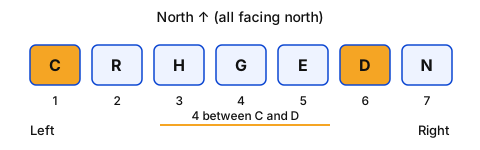
  1. Only one person left of R → R at seat 2. G fourth from right → seat 4. Two between R and E → E at seat 5.
  2. D is immediately left of N, so D–N must occupy consecutive free seats: only 6–7 fit → D at 6, N at 7.
  3. H and C take seats 1 and 3; H is not to the left of C → C at 1, H at 3.
  4. Between C (1) and D (6): R, H, G, E = four people.

Trick: Place the "from the end" and "only one" clues first; the adjacent pair (D–N) then has a single slot.

Answer: (B) Four

अवधारणा: सीटों को बाएँ से दाएँ 1–7 क्रमांक दें (सभी उत्तर की ओर हैं, अतः बाएँ/दाएँ हमारे जैसे ही) और पहले निश्चित स्थान तय करें।

  1. R के बाएँ केवल एक व्यक्ति → R सीट 2 पर। G दाएँ से चौथा → सीट 4। R और E के बीच दो → E सीट 5 पर।
  2. D, N के ठीक बाएँ है, अतः D–N लगातार खाली सीटों पर: केवल 6–7 संभव → D सीट 6, N सीट 7।
  3. H और C सीट 1 व 3 पर; H, C के बाएँ नहीं → C सीट 1, H सीट 3।
  4. C (1) और D (6) के बीच: R, H, G, E = चार व्यक्ति।

ट्रिक: "छोर से" और "केवल एक" वाले संकेत पहले रखें; फिर आसन्न जोड़ी (D–N) के लिए एक ही जगह बचती है।

उत्तर: (B) Four

RRB NTPC Undergraduate CBT 1General Intelligence and ReasoningLinear seating arrangementRRB NTPC Undergraduate CBT 1 2025 · 14 Jun Shift 1 →
Q7573.
Bablu is the husband of Chetna. Anita is the daughter of Bablu. Ekam is the brother of Anita. Manu is the son of Anita. Kunal is the brother of Manu. How is Chetna related to Kunal?
बबलू, चेतना का पति है। अनीता, बबलू की पुत्री है। एकम, अनीता का भाई है। मनु, अनीता का पुत्र है। कुणाल, मनु का भाई है। चेतना, कुणाल से किस प्रकार संबंधित है?
  1. AMother's motherमाँ की माँ
  2. BDaughterपुत्री
  3. CFather's motherपिता की माँ
  4. DMotherमाँ
Show answer

Concept: Build the family tree generation by generation, then trace the path from Kunal up to Chetna.

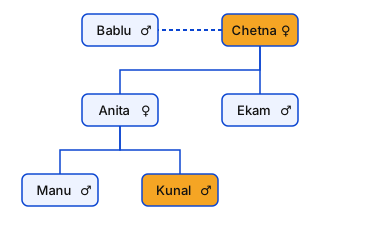
  1. Bablu (husband) – Chetna (wife); Anita and Ekam are their children.
  2. Manu is Anita's son; Kunal is Manu's brother → Kunal is also Anita's son.
  3. Kunal → mother Anita → her mother Chetna. So Chetna is Kunal's mother's mother (maternal grandmother).

Trick: Always start from the person asked about (Kunal) and climb upward; "mother's mother" = nani.

Answer: (A) Mother's mother

अवधारणा: पीढ़ी-दर-पीढ़ी वंश-वृक्ष बनाएँ, फिर कुणाल से चेतना तक का रास्ता देखें।

  1. बबलू (पति) – चेतना (पत्नी); अनीता और एकम उनकी संतानें।
  2. मनु अनीता का पुत्र; कुणाल मनु का भाई → कुणाल भी अनीता का पुत्र।
  3. कुणाल → माँ अनीता → उसकी माँ चेतना। अतः चेतना कुणाल की माँ की माँ (नानी) है।

ट्रिक: हमेशा जिस व्यक्ति के बारे में पूछा है (कुणाल) उससे ऊपर की ओर चढ़ें; "Mother's mother" = नानी।

उत्तर: (A) Mother's mother

RRB NTPC Undergraduate CBT 1General Intelligence and ReasoningBlood relationsRRB NTPC Undergraduate CBT 1 2025 · 14 Jun Shift 1 →
Q7574.
Seven boxes A, B, C, D, E, F and G are kept one over the other but not necessarily in the same order. Only G is kept above A. Only two boxes are kept between A and C. Only D is kept below E. F is not kept immediately above C. How many boxes are kept between E and F?
सात बक्से A, B, C, D, E, F और G एक के ऊपर एक रखे गए हैं, लेकिन ज़रूरी नहीं कि इसी क्रम में हों। A के ऊपर केवल G रखा गया है। A और C के बीच केवल दो बक्से रखे गए हैं। E के नीचे केवल D रखा गया है। F, C के ठीक ऊपर नहीं रखा गया है। E और F के बीच कितने बक्से रखे गए हैं?
  1. A4
  2. B2
  3. C3
  4. D1
Show answer

Concept: Number positions 1 (bottom) to 7 (top) and use the "only" clues to pin the ends.

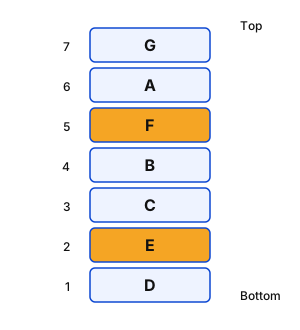
  1. Only G is above A → G at 7, A at 6.
  2. Two boxes between A and C → C at 3. Only D is below E → D at 1, E at 2.
  3. Positions 4 and 5 remain for B and F; F is not immediately above C (position 4) → F at 5, B at 4.
  4. Between E (2) and F (5): C and B = 2 boxes.

Trick: "Only X is above/below Y" fixes two boxes at an end at once – start there.

Answer: (B) 2

अवधारणा: स्थानों को 1 (नीचे) से 7 (ऊपर) क्रमांक दें और "केवल" वाले संकेतों से छोर तय करें।

  1. A के ऊपर केवल G → G स्थान 7, A स्थान 6।
  2. A और C के बीच दो बॉक्स → C स्थान 3। E के नीचे केवल D → D स्थान 1, E स्थान 2।
  3. स्थान 4 व 5 पर B और F बचते हैं; F, C के ठीक ऊपर (स्थान 4) नहीं → F स्थान 5, B स्थान 4।
  4. E (2) और F (5) के बीच: C और B = 2 बॉक्स।

ट्रिक: "Y के ऊपर/नीचे केवल X" एक साथ छोर के दो बॉक्स तय कर देता है – वहीं से शुरू करें।

उत्तर: (B) 2

RRB NTPC Undergraduate CBT 1General Intelligence and ReasoningBox arrangementRRB NTPC Undergraduate CBT 1 2025 · 14 Jun Shift 1 →
Q7575.
Which of the following letter-number clusters will replace the question mark (?) in the given series to make it logically complete?
HEP 27, MCN 41, RAL 55, WYJ 69, ?
निम्नलिखित में से कौन-सा अक्षर-संख्या समूह दी गई शृंखला में प्रश्न चिह्न (?) के स्थान पर आकर इसे तार्किक रूप से पूर्ण करेगा?
HEP 27, MCN 41, RAL 55, WYJ 69, ?
  1. ACVH 83
  2. BBXG 81
  3. CBWH 83
  4. DAWG 81
Show answer

Concept: Track each letter position separately and the number separately.

  1. 1st letters H → M → R → W: +5 each; next W+5=B (wrap after Z).
  2. 2nd letters E → C → A → Y: −2 each; next Y−2=W. 3rd letters P → N → L → J: −2; next J−2=H.
  3. Numbers 27, 41, 55, 69: +14; next 69+14=83.

Trick: Check the number first – only options A and C end in 83; then the first letter (W+5=B) settles it.

Answer: (C) BWH 83

अवधारणा: प्रत्येक अक्षर-स्थान और संख्या को अलग-अलग ट्रैक करें।

  1. पहले अक्षर H → M → R → W: हर बार +5; अगला W+5=B (Z के बाद फिर A से)।
  2. दूसरे अक्षर E → C → A → Y: −2; अगला Y−2=W। तीसरे अक्षर P → N → L → J: −2; अगला J−2=H।
  3. संख्याएँ 27, 41, 55, 69: +14; अगली 69+14=83।

ट्रिक: पहले संख्या जाँचें – केवल A और C में 83 है; फिर पहला अक्षर (W+5=B) निर्णय कर देता है।

उत्तर: (C) BWH 83

RRB NTPC Undergraduate CBT 1General Intelligence and ReasoningLetter-number seriesRRB NTPC Undergraduate CBT 1 2025 · 14 Jun Shift 1 →
Q7576.
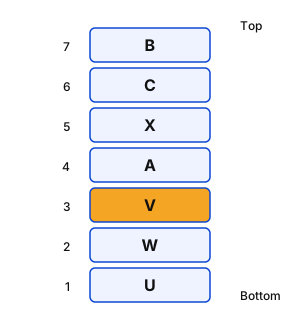
Seven boxes, U, V, W, X, A, B and C, are kept one over the other, but not necessarily in the same order.
Only U is kept below W. Only A is kept between V and X. Only C is kept between B and X. Box B is kept at the top-most position.
Which box is kept at the third position from the bottom?
सात बक्से, U, V, W, X, A, B और C, एक के ऊपर एक रखे गए हैं, लेकिन ज़रूरी नहीं कि इसी क्रम में हों।
W के नीचे केवल U रखा गया है। V और X के बीच केवल A रखा गया है। B और X के बीच केवल C रखा गया है। बक्सा B सबसे ऊपर के स्थान पर रखा गया है।
नीचे से तीसरे स्थान पर कौन-सा बक्सा रखा गया है?
  1. AV
  2. BX
  3. CC
  4. DA
Show answer

Concept: Number positions 1 (bottom) to 7 (top); fix the stated ends, then fit the "only one between" pairs.

  1. B is top-most → B at 7. Only U is below W → U at 1, W at 2.
  2. Only C is between B and X → C at 6, X at 5.
  3. Only A is between V and X → A at 4, V at 3.
  4. Third from the bottom = position 3 = V.

Trick: Each "only one between" clue, once one end is known, fixes two boxes in a row.

Answer: (A) V

अवधारणा: स्थान 1 (नीचे) से 7 (ऊपर) क्रमांकित करें; पहले बताए गए छोर तय करें, फिर "बीच में केवल एक" वाली जोड़ियाँ बैठाएँ।

  1. B सबसे ऊपर → B स्थान 7। W के नीचे केवल U → U स्थान 1, W स्थान 2।
  2. B और X के बीच केवल C → C स्थान 6, X स्थान 5।
  3. V और X के बीच केवल A → A स्थान 4, V स्थान 3।
  4. नीचे से तीसरा = स्थान 3 = V।

ट्रिक: "बीच में केवल एक" वाला संकेत, एक छोर ज्ञात होते ही, लगातार दो बॉक्स तय कर देता है।

उत्तर: (A) V

RRB NTPC Undergraduate CBT 1General Intelligence and ReasoningBox arrangementRRB NTPC Undergraduate CBT 1 2025 · 14 Jun Shift 1 →
Q7577.
Which of the following letter-number clusters will replace the question mark (?) in the given series to make it logically complete?
ZQF 19 , DUJ 28 , HYN 37 , LCR 46 , ?
निम्नलिखित में से कौन-सा अक्षर-संख्या समूह दी गई शृंखला में प्रश्न चिह्न (?) के स्थान पर आकर इसे तार्किक रूप से पूर्ण करेगा?
ZQF 19 , DUJ 28 , HYN 37 , LCR 46 , ?
  1. APGV 55
  2. BQFU 60
  3. CQHU 57
  4. DRFW 52
Show answer

Concept: Find the uniform shift of each letter and the number.

  1. Z → D → H → L: +4 each; next L+4=P.
  2. Q → U → Y → C: +4; next C+4=G. F → J → N → R: +4; next R+4=V.
  3. Numbers 19, 28, 37, 46: +9; next 55.

Trick: All three letters move +4 and the number +9 – only PGV 55 fits both.

Answer: (A) PGV 55

अवधारणा: प्रत्येक अक्षर और संख्या की समान बढ़त ज्ञात करें।

  1. Z → D → H → L: हर बार +4; अगला L+4=P।
  2. Q → U → Y → C: +4; अगला C+4=G। F → J → N → R: +4; अगला R+4=V।
  3. संख्याएँ 19, 28, 37, 46: +9; अगली 55।

ट्रिक: तीनों अक्षर +4 और संख्या +9 बढ़ती है – केवल PGV 55 दोनों पर खरा है।

उत्तर: (A) PGV 55

RRB NTPC Undergraduate CBT 1General Intelligence and ReasoningLetter-number seriesRRB NTPC Undergraduate CBT 1 2025 · 14 Jun Shift 1 →
Q7578.
Read the given statements and conclusions carefully. Assuming that the information given in the statements is true, even if it appears to be at variance with commonly known facts, decide which of the given conclusions logically follow(s) from the statements.
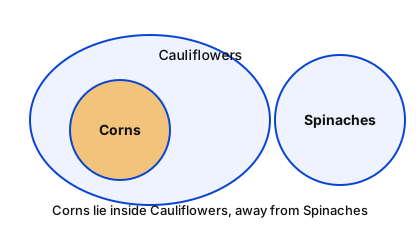
Statement: All Corns are Cauliflowers. No Cauliflowers are Spinaches.
Conclusion (I): No Spinaches are Corns.
Conclusion (II): Some Spinaches are Corns.
दिए गए कथनों और निष्कर्षों को ध्यानपूर्वक पढ़िए। यह मानते हुए कि कथनों में दी गई जानकारी सत्य है, भले ही वह सामान्यतः ज्ञात तथ्यों से भिन्न प्रतीत होती हो, निर्णय कीजिए कि दिए गए निष्कर्षों में से कौन-सा/से निष्कर्ष कथनों का तार्किक रूप से अनुसरण करता है/करते हैं।
कथन: सभी मक्के, फूलगोभियाँ हैं। कोई फूलगोभी, पालक नहीं है।
निष्कर्ष (I): कोई पालक, मक्का नहीं है।
निष्कर्ष (II): कुछ पालक, मक्के हैं।
  1. ANeither conclusion (I) nor (II) followsन तो निष्कर्ष (I) और न ही (II) अनुसरण करता है
  2. BOnly conclusion (I) followsकेवल निष्कर्ष (I) अनुसरण करता है
  3. COnly conclusion (II) followsकेवल निष्कर्ष (II) अनुसरण करता है
  4. DBoth conclusions (I) and (II) followनिष्कर्ष (I) और (II) दोनों अनुसरण करते हैं
Show answer

Concept: Draw the Venn diagram: "All Corns are Cauliflowers" puts the Corn circle inside Cauliflowers; "No Cauliflowers are Spinaches" keeps Spinaches completely apart.

  1. Since every Corn lies inside Cauliflowers and Cauliflowers never touch Spinaches, no Corn can be a Spinach → Conclusion (I) follows.
  2. Conclusion (II) "Some Spinaches are Corns" directly contradicts this → does not follow.

Trick: All A are B + No B are C ⇒ No A are C (and No C are A) – a standard valid pair.

Answer: (B) Only conclusion (I) follows

अवधारणा: वेन आरेख बनाएँ: "All Corns are Cauliflowers" से Corn का वृत्त Cauliflowers के अंदर; "No Cauliflowers are Spinaches" से Spinaches पूरी तरह अलग।

  1. हर Corn, Cauliflowers के अंदर है और Cauliflowers, Spinaches को छूते ही नहीं, अतः कोई Corn, Spinach नहीं हो सकता → निष्कर्ष (I) सही।
  2. निष्कर्ष (II) "Some Spinaches are Corns" इसके सीधे विपरीत है → अनुसरण नहीं करता।

ट्रिक: All A are B + No B are C ⇒ No A are C (और No C are A) – मानक वैध जोड़ी।

उत्तर: (B) Only conclusion (I) follows

RRB NTPC Undergraduate CBT 1General Intelligence and ReasoningSyllogismRRB NTPC Undergraduate CBT 1 2025 · 14 Jun Shift 1 →
Q7579.
Based on the English alphabetical order, three of the following four letter-clusters are alike in a certain way and thus form a group. Which is the one that does not belong to that group?
(Note: The odd one out is not based on the number of consonants/vowels or their position in the letter-cluster.)
अंग्रेज़ी वर्णमाला क्रम के आधार पर, निम्नलिखित चार अक्षर-समूहों में से तीन किसी निश्चित प्रकार से एकसमान हैं और इस प्रकार एक समूह बनाते हैं। कौन-सा अक्षर-समूह उस समूह से संबंधित नहीं है?
(नोट: असंगत अक्षर-समूह, व्यंजनों/स्वरों की संख्या या अक्षर-समूह में उनके स्थान पर आधारित नहीं है।)
  1. AGKN
  2. BQNJ
  3. CBFI
  4. DPTW
Show answer

Concept: Find the gap pattern between consecutive letters of each cluster.

  1. GKN: G+4=K, K+3=N → (+4,+3).
  2. BFI: B+4=F, F+3=I; PTW: P+4=T, T+3=W → same (+4,+3).
  3. QNJ: Q−3=N, N−4=J → (−3,−4), moving backwards – the odd one.

Trick: Three clusters run forward in the alphabet; QNJ runs backward – visible even before counting gaps.

Answer: (B) QNJ

अवधारणा: प्रत्येक समूह के क्रमागत अक्षरों के बीच अंतर का पैटर्न देखें।

  1. GKN: G+4=K, K+3=N → (+4,+3)।
  2. BFI: B+4=F, F+3=I; PTW: P+4=T, T+3=W → वही (+4,+3)।
  3. QNJ: Q−3=N, N−4=J → (−3,−4), उल्टी दिशा – यही अलग है।

ट्रिक: तीन समूह वर्णमाला में आगे बढ़ते हैं; QNJ पीछे जाता है – अंतर गिनने से पहले ही दिखता है।

उत्तर: (B) QNJ

RRB NTPC Undergraduate CBT 1General Intelligence and ReasoningLetter-cluster classificationRRB NTPC Undergraduate CBT 1 2025 · 14 Jun Shift 1 →
Q7580.
HI 26 is related to FF 11 in a certain way. In the same way, MG 22 is related to KD 7. To which of the following is KF 14 related, following the same logic?
HI 26 एक निश्चित प्रकार से FF 11 से संबंधित है। उसी प्रकार, MG 22, KD 7 से संबंधित है। उसी तर्क का अनुसरण करते हुए, KF 14 निम्नलिखित में से किससे संबंधित है?
  1. AHC −1
  2. BIB −3
  3. CIC −1
  4. DHB −3
Show answer

Concept: Find how each letter and the number change from the first term to the second, then apply the same change.

  1. HI 26 → FF 11: H−2=F, I−3=F, 26−15=11.
  2. MG 22 → KD 7: M−2=K, G−3=D, 22−15=7 ✓ same rule.
  3. KF 14 → K−2=I, F−3=C, 14−15=−1 → IC −1.

Trick: Pattern (−2,−3,−15); among options only IC −1 has both letters and number matching.

Answer: (C) IC −1

अवधारणा: पहले पद से दूसरे पद तक प्रत्येक अक्षर और संख्या का परिवर्तन निकालें, फिर वही नियम लगाएँ।

  1. HI 26 → FF 11: H−2=F, I−3=F, 26−15=11।
  2. MG 22 → KD 7: M−2=K, G−3=D, 22−15=7 ✓ वही नियम।
  3. KF 14 → K−2=I, F−3=C, 14−15=−1 → IC −1।

ट्रिक: पैटर्न (−2,−3,−15); विकल्पों में केवल IC −1 में अक्षर और संख्या दोनों मेल खाते हैं।

उत्तर: (C) IC −1

RRB NTPC Undergraduate CBT 1General Intelligence and ReasoningLetter-number analogyRRB NTPC Undergraduate CBT 1 2025 · 14 Jun Shift 1 →