Question bank

Q&A: practice questions with answers

Search questions on any topic. Filter by exam category, exam, subject and topic, try the question, then open the answer and explanation.

Courses – airGurukul

8,495 questions found.

Q741.
If the marked price of a book is ₹900, then find the selling price of the book after getting discount of 13%.
यदि एक पुस्तक का अंकित मूल्य ₹900 है, तो 13% की छूट मिलने के बाद पुस्तक का विक्रय मूल्य ज्ञात कीजिए।
  1. A₹891
  2. B₹789
  3. C₹783
  4. D₹889
Show answer

Concept: Selling price =MP×100−Discount%100.

  1. MP = ₹900, discount = 13%.
  2. SP =900×87100=783.

Trick: Discount =13% of 900=117; 900−117=783.

Answer: (C) ₹783

अवधारणा: विक्रय मूल्य =अंकित मूल्य×100−छूट%100।

  1. अंकित मूल्य = ₹900, छूट = 13%।
  2. विक्रय मूल्य =900×87100=783।

ट्रिक: छूट =900 का 13%=117; 900−117=783।

उत्तर: (C) ₹783

RRB NTPC Undergraduate CBT 1MathematicsDiscountRRB NTPC Undergraduate CBT 1 2024 · 22 Aug Shift 2 →
Q742.
The average of three numbers is 20. If two of them are 18 and 28, the third number is:
तीन संख्याओं का औसत 20 है। यदि उनमें से दो संख्याएँ 18 और 28 हैं, तो तीसरी संख्या है:
  1. A15
  2. B16
  3. C14
  4. D13
Show answer

Concept: Sum of numbers = average × count.

  1. Sum of three numbers =20×3=60.
  2. Third number =60−(18+28)=60−46=14.

Trick: Deviation method: 18→−2, 28→+8; third must be 20−6=14.

Answer: (C) 14

अवधारणा: संख्याओं का योग = औसत × संख्या।

  1. तीनों का योग =20×3=60।
  2. तीसरी संख्या =60−(18+28)=60−46=14।

ट्रिक: विचलन विधि: 18→−2, 28→+8; तीसरी =20−6=14।

उत्तर: (C) 14

RRB NTPC Undergraduate CBT 1MathematicsAverageRRB NTPC Undergraduate CBT 1 2024 · 22 Aug Shift 2 →
Q743.
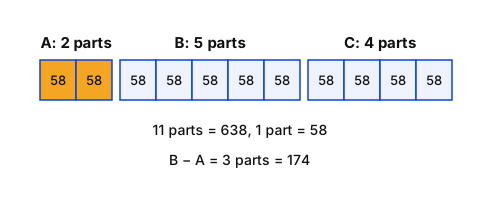
An amount of ₹638 is divided among three persons in the ratio of 2 : 5 : 4. The difference between the largest and the smallest shares (in ₹) in the distribution is:
₹638 की राशि को तीन व्यक्तियों में 2 : 5 : 4 के अनुपात में बाँटा जाता है। इस वितरण में सबसे बड़े और सबसे छोटे हिस्से के बीच का अंतर (₹ में) है:
  1. A76
  2. B110
  3. C157
  4. D174
Show answer

Concept: Divide the total by the sum of ratio parts to get the value of one part.

  1. Total parts =2+5+4=11; one part =63811=58.
  2. Largest − smallest =(5−2) parts =3×58=174.

Trick: Directly: 311×638=174.

Answer: (D) 174

अवधारणा: कुल राशि को अनुपात के भागों के योग से भाग देकर एक भाग का मान निकालें।

  1. कुल भाग =2+5+4=11; एक भाग =63811=58।
  2. सबसे बड़ा − सबसे छोटा =(5−2) भाग =3×58=174।

ट्रिक: सीधे: 311×638=174।

उत्तर: (D) 174

RRB NTPC Undergraduate CBT 1MathematicsRatio and ProportionRRB NTPC Undergraduate CBT 1 2024 · 22 Aug Shift 2 →
Q744.
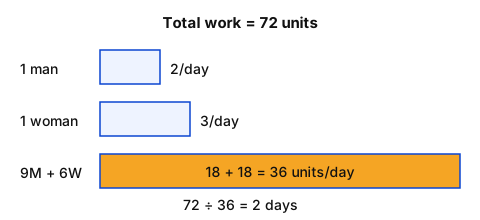
2 men can complete a piece of work in 18 days, while 4 women can do it in 6 days. In how many days can 6 women and 9 men complete this work?
2 पुरुष एक काम को 18 दिनों में पूरा कर सकते हैं, जबकि 4 महिलाएँ उसे 6 दिनों में कर सकती हैं। 6 महिलाएँ और 9 पुरुष मिलकर इस काम को कितने दिनों में पूरा कर सकते हैं?
  1. A1 day1 दिन
  2. B2 days2 दिन
  3. C3 days3 दिन
  4. D4 days4 दिन
Show answer

Concept: Take total work = LCM of man-days and woman-days, then find one person's daily work.

  1. 2 men × 18 days = 36 man-days; 4 women × 6 days = 24 woman-days. Total work = LCM(36,24)=72 units.
  2. 1 man =7236=2 units/day; 1 woman =7224=3 units/day.
  3. 9 men + 6 women =9×2+6×3=36 units/day → time =7236=2 days.

Trick: 9 men do 936=14 and 6 women do 624=14 per day → 12 per day → 2 days.

Answer: (B) 2 days

अवधारणा: कुल कार्य = पुरुष-दिवस और महिला-दिवस का LCM लें, फिर एक व्यक्ति का दैनिक कार्य निकालें।

  1. 2 पुरुष × 18 दिन = 36 पुरुष-दिवस; 4 महिलाएँ × 6 दिन = 24 महिला-दिवस। कुल कार्य = LCM(36,24)=72 इकाई।
  2. 1 पुरुष =7236=2 इकाई/दिन; 1 महिला =7224=3 इकाई/दिन।
  3. 9 पुरुष + 6 महिलाएँ =9×2+6×3=36 इकाई/दिन → समय =7236=2 दिन।

ट्रिक: 9 पुरुष प्रतिदिन 936=14 और 6 महिलाएँ 624=14 → 12 प्रतिदिन → 2 दिन।

उत्तर: (B) 2 दिन

RRB NTPC Undergraduate CBT 1MathematicsTime and WorkRRB NTPC Undergraduate CBT 1 2024 · 22 Aug Shift 2 →
Q745.
If 2 times Mary’s present age is 20 years more than 6 times Diya's present age, and 5 times Diya's present age is 6 years less than Mary's present age, then what is the difference (in years) between the ages of Mary and Diya?
यदि मैरी की वर्तमान आयु का 2 गुना, दीया की वर्तमान आयु के 6 गुने से 20 वर्ष अधिक है, और दीया की वर्तमान आयु का 5 गुना, मैरी की वर्तमान आयु से 6 वर्ष कम है, तो मैरी और दीया की आयु के बीच का अंतर (वर्षों में) कितना है?
  1. A15
  2. B18
  3. C16
  4. D14
Show answer

Concept: Write each statement as a linear equation and solve.

  1. Let Mary = M, Diya = D. Then 2M=6D+20⇒M=3D+10.
  2. Also 5D=M−6⇒M=5D+6.
  3. 3D+10=5D+6⇒D=2, M=16.
  4. Difference =16−2=14 years.

Trick: Check: 2×16=32=6×2+20 ✓ and 5×2=10=16−6 ✓.

Answer: (D) 14

अवधारणा: प्रत्येक कथन को रैखिक समीकरण में लिखकर हल करें।

  1. मान लें मैरी = M, दीया = D। तब 2M=6D+20⇒M=3D+10।
  2. साथ ही 5D=M−6⇒M=5D+6।
  3. 3D+10=5D+6⇒D=2, M=16।
  4. अंतर =16−2=14 वर्ष।

ट्रिक: जाँच: 2×16=32=6×2+20 ✓ और 5×2=10=16−6 ✓।

उत्तर: (D) 14

RRB NTPC Undergraduate CBT 1MathematicsProblems on AgesRRB NTPC Undergraduate CBT 1 2024 · 22 Aug Shift 2 →
Q746.
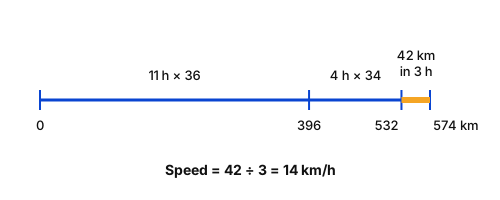
Anaya has to reach Hyderabad which is 574 km away in 18 hours. His starting speed for 11 hours was 36 km/hr. For the next 136 km his speed was 34 km/hr. By what speed he must travel now so as to reach Hyderabad in the decided time of 18 hours?
अनाया को 574 km दूर स्थित हैदराबाद 18 घंटे में पहुँचना है। प्रारंभिक 11 घंटों तक उसकी चाल 36 km/hr थी। अगले 136 km के लिए उसकी चाल 34 km/hr थी। निर्धारित 18 घंटे के समय में हैदराबाद पहुँचने के लिए अब उसे किस चाल से यात्रा करनी होगी?
  1. A8 km/hr
  2. B14 km/hr
  3. C9 km/hr
  4. D20 km/hr
Show answer

Concept: Required speed =remaining distanceremaining time.

  1. First part: 11×36=396km.
  2. Next 136 km at 34 km/h takes 13634=4 h. Covered =396+136=532km in 15 h.
  3. Remaining: 574−532=42km in 18−15=3 h → speed =423=14km/h.

Trick: Always track both distance and time used; the leftover of each gives the speed.

Answer: (B) 14km/h

अवधारणा: आवश्यक चाल =शेष दूरीशेष समय।

  1. पहला भाग: 11×36=396km।
  2. अगले 136 km, 34 km/h से 13634=4 घंटे। तय दूरी =396+136=532km, समय 15 घंटे।
  3. शेष: 574−532=42km, 18−15=3 घंटे में → चाल =423=14km/h।

ट्रिक: दूरी और समय दोनों का हिसाब रखें; बचा हुआ भाग ही चाल देता है।

उत्तर: (B) 14km/h

RRB NTPC Undergraduate CBT 1MathematicsSpeed, Time and DistanceRRB NTPC Undergraduate CBT 1 2024 · 22 Aug Shift 2 →
Q747.
The simple interest on a certain sum for 713 years at the rate of 4.5% per annum is ₹6,270.
What will be the amount payable on the same sum at the rate of 8.6% per annum simple interest in 1112 years?
किसी निश्चित राशि पर 713 वर्षों के लिए 4.5% वार्षिक दर से साधारण ब्याज ₹6,270 है।
उसी राशि पर 8.6% वार्षिक साधारण ब्याज की दर से 1112 वर्षों में देय मिश्रधन कितना होगा?
  1. A₹37,783
  2. B₹37,791
  3. C₹37,784
  4. D₹37,794
Show answer

Concept: SI=P×R×T100 and Amount =P+SI.

  1. 713=223 years: 6270=P×4.5×223×100=0.33P⇒P=19000.
  2. New SI =19000×8.6×11.5100=190×98.9=18791.
  3. Amount =19000+18791=37791.

Trick: Rate × time: 4.5×223=33% gives ₹6,270, so P=62700.33; then 8.6×11.5=98.9%.

Answer: (B) ₹37,791

अवधारणा: साधारण ब्याज=P×R×T100 और मिश्रधन =P+ब्याज।

  1. 713=223 वर्ष: 6270=P×4.5×223×100=0.33P⇒P=19000।
  2. नया ब्याज =19000×8.6×11.5100=190×98.9=18791।
  3. मिश्रधन =19000+18791=37791।

ट्रिक: दर × समय: 4.5×223=33% = ₹6,270, अतः P=62700.33; फिर 8.6×11.5=98.9%।

उत्तर: (B) ₹37,791

RRB NTPC Undergraduate CBT 1MathematicsSimple InterestRRB NTPC Undergraduate CBT 1 2024 · 22 Aug Shift 2 →
Q748.
Find the mean proportional between 18 and 32.
18 और 32 का मध्यानुपाती ज्ञात कीजिए।
  1. A24
  2. B21
  3. C26
  4. D23
Show answer

Concept: Mean proportional between a and b is ab.

  1. 18×32=576=24.
  2. Check: 18:24=24:32 (both =3:4).

Trick: 18=2×9, 32=2×16 → 4×144=2×12=24.

Answer: (A) 24

अवधारणा: a और b का मध्यानुपाती ab होता है।

  1. 18×32=576=24।
  2. जाँच: 18:24=24:32 (दोनों =3:4)।

ट्रिक: 18=2×9, 32=2×16 → 4×144=2×12=24।

उत्तर: (A) 24

RRB NTPC Undergraduate CBT 1MathematicsMean ProportionalRRB NTPC Undergraduate CBT 1 2024 · 22 Aug Shift 2 →
Q749.
If
x=acosecAsinB,
y=bcosecAcosB, and
z=ccotA,
then, what is the value of x2a2+y2b2−z2c2?
यदि
x=acosecAsinB,
y=bcosecAcosB, और
z=ccotA,
है, तो x2a2+y2b2−z2c2 का मान क्या है?
  1. A−2
  2. B−1
  3. C0
  4. D1
Show answer

Concept: Use sin2B+cos2B=1 and csc2A−cot2A=1.

  1. x2a2=csc2Asin2B and y2b2=csc2Acos2B.
  2. Sum =csc2A(sin2B+cos2B)=csc2A.
  3. z2c2=cot2A, so the expression =csc2A−cot2A=1.

Trick: Put A=90∘, B=0∘: x=0, y=b, z=0 → value =1.

Answer: (D) 1

अवधारणा: sin2B+cos2B=1 और csc2A−cot2A=1 का प्रयोग करें।

  1. x2a2=csc2Asin2B और y2b2=csc2Acos2B।
  2. योग =csc2A(sin2B+cos2B)=csc2A।
  3. z2c2=cot2A, अतः व्यंजक =csc2A−cot2A=1।

ट्रिक: A=90∘, B=0∘ रखें: x=0, y=b, z=0 → मान =1।

उत्तर: (D) 1

RRB NTPC Undergraduate CBT 1MathematicsTrigonometric IdentitiesRRB NTPC Undergraduate CBT 1 2024 · 22 Aug Shift 2 →
Q750.
Find the simple interest (in ₹) on ₹1,200 at an interest rate of 4% per month for 2 months.
₹1,200 पर 4% प्रति माह की ब्याज दर से 2 माह का साधारण ब्याज (₹ में) ज्ञात कीजिए।
  1. A₹96
  2. B₹16
  3. C₹28
  4. D₹8
Show answer

Concept: SI=P×R×T100, with rate and time in the same unit (here per month).

  1. P=1200, R=4% per month, T=2 months.
  2. SI=1200×4×2100=96.

Trick: 4% per month for 2 months =8%; 8% of 1200=96.

Answer: (A) ₹96

अवधारणा: ब्याज=P×R×T100, दर और समय एक ही इकाई में (यहाँ प्रति माह)।

  1. P=1200, R=4% प्रति माह, T=2 माह।
  2. ब्याज=1200×4×2100=96।

ट्रिक: 2 माह के लिए 4% प्रति माह =8%; 1200 का 8%=96।

उत्तर: (A) ₹96

RRB NTPC Undergraduate CBT 1MathematicsSimple InterestRRB NTPC Undergraduate CBT 1 2024 · 22 Aug Shift 2 →
Q751.
The average runs scored by a batsman in 23 matches is 40. In the next 10 matches, the batsman scored an average of 14 runs. Find his average runs scored (rounded off to two decimal places) in all 33 matches.
एक बल्लेबाज़ द्वारा 23 मैचों में बनाए गए रनों का औसत 40 है। अगले 10 मैचों में बल्लेबाज़ ने औसतन 14 रन बनाए। सभी 33 मैचों में उसके द्वारा बनाए गए रनों का औसत (दो दशमलव स्थानों तक पूर्णांकित) ज्ञात कीजिए।
  1. A32.12
  2. B33.12
  3. C31.12
  4. D34.12
Show answer

Concept: Total = average × number of matches; overall average = combined total ÷ total matches.

  1. Runs in 23 matches =23×40=920.
  2. Runs in next 10 matches =10×14=140.
  3. Total =920+140=1060 in 33 matches.
  4. Average =106033=32.1212…≈32.12.

Trick: Deviation method: 40−10×(40−14)33=40−26033=40−7.88=32.12.

Answer: (A) 32.12

अवधारणा: कुल = औसत × मैचों की संख्या; कुल औसत = कुल रन ÷ कुल मैच।

  1. 23 मैचों के रन =23×40=920।
  2. अगले 10 मैचों के रन =10×14=140।
  3. कुल =920+140=1060, मैच =33।
  4. औसत =106033≈32.12।

ट्रिक: विचलन विधि: 40−10×2633=40−7.88=32.12।

उत्तर: (A) 32.12

RRB NTPC Undergraduate CBT 1MathematicsAverageRRB NTPC Undergraduate CBT 1 2024 · 22 Aug Shift 2 →
Q752.
Pipe A can fill a tank in 16 hours, pipe B can fill the same tank in 26 hours and pipe C can fill the same tank in 16 hours. The time taken by them to fill the same tank if they operate together is::
पाइप A एक टंकी को 16 घंटे में भर सकता है, पाइप B उसी टंकी को 26 घंटे में भर सकता है और पाइप C उसी टंकी को 16 घंटे में भर सकता है। यदि वे एक साथ कार्य करें, तो उसी टंकी को भरने में उनके द्वारा लिया गया समय है:
  1. A9217 hours9217 घंटे
  2. B2217 hours2217 घंटे
  3. C6217 hours6217 घंटे
  4. D3217 hours3217 घंटे
Show answer

Concept: When pipes work together, their one-hour works add: 1T=1a+1b+1c.

  1. One-hour work =116+126+116=18+126.
  2. =13+4104=17104.
  3. Time =10417=6217 hours.

Trick: LCM method: tank =208 units; A, B, C fill 13,8,13 units/h =34 units/h; 20834=6217 h.

Answer: (C) 6217 hours

अवधारणा: साथ चलने पर एक घंटे का कार्य जुड़ता है: 1T=1a+1b+1c।

  1. एक घंटे का कार्य =116+126+116=18+126।
  2. =17104।
  3. समय =10417=6217 घंटे।

ट्रिक: LCM विधि: टंकी =208 इकाई; दर 13+8+13=34 इकाई/घंटा; 20834=6217 घंटे।

उत्तर: (C) 6217 घंटे

RRB NTPC Undergraduate CBT 1MathematicsPipes and CisternsRRB NTPC Undergraduate CBT 1 2024 · 22 Aug Shift 2 →
Q753.
The value of 62+32−781−16 is
62+32−781−16 का मान है
  1. A-50
  2. B-40
  3. C-37
  4. D-32
Show answer

Concept: Evaluate powers and roots first (BODMAS), then add/subtract left to right.

  1. 62=36, 32=3, 781=7×9=63.
  2. Value =36+3−63−16.
  3. =39−79=−40.

Trick: a2=a for positive a – no need to square and root again.

Answer: (B) −40

अवधारणा: पहले घात और वर्गमूल (BODMAS), फिर बाएँ से दाएँ जोड़-घटाव।

  1. 62=36, 32=3, 781=63।
  2. मान =36+3−63−16।
  3. =39−79=−40।

ट्रिक: धनात्मक a के लिए a2=a।

उत्तर: (B) −40

RRB NTPC Undergraduate CBT 1MathematicsSimplification (Square Roots)RRB NTPC Undergraduate CBT 1 2024 · 22 Aug Shift 2 →
Q754.
The HCF and the LCM of two numbers are 24 and 288, respectively. If one of the numbers is 72, find the other one.
दो संख्याओं का महत्तम समापवर्तक (HCF) और लघुत्तम समापवर्त्य (LCM) क्रमशः 24 और 288 हैं। यदि उनमें से एक संख्या 72 है, तो दूसरी संख्या ज्ञात कीजिए।
  1. A10
  2. B20
  3. C170
  4. D96
Show answer

Concept: For two numbers: HCF×LCM=product of the numbers.

  1. 24×288=72×x.
  2. x=24×28872=24×4=96.
  3. Check: HCF(72,96)=24, LCM=288 ✓.

Trick: 28872=4, so other number =24×4.

Answer: (D) 96

अवधारणा: दो संख्याओं के लिए: HCF×LCM=गुणनफल।

  1. 24×288=72×x।
  2. x=24×28872=96।
  3. जाँच: HCF(72,96)=24, LCM=288 ✓।

ट्रिक: 28872=4, अतः दूसरी संख्या =24×4=96।

उत्तर: (D) 96

RRB NTPC Undergraduate CBT 1MathematicsHCF and LCMRRB NTPC Undergraduate CBT 1 2024 · 22 Aug Shift 2 →
Q755.
The LCM of 23 × 72 × 12, 22 × 122 × 18 and 73 × 122 × 182 is:
23 × 72 × 12, 22 × 122 × 18 और 73 × 122 × 182 का LCM है:
  1. A27 x 35 x 73
  2. B27 x 36 x 74
  3. C27 x 36 x 73
  4. D27 x 36 x 72
Show answer

Concept: Write every number in prime factors; LCM takes the highest power of each prime.

  1. 23×72×12=25×3×72.
  2. 22×122×18=22×2432×2·32=27×34.
  3. 73×122×182=73×2432×2234=26×36×73.
  4. LCM =27×36×73.

Trick: 12=22·3, 18=2·32 – convert first, then pick max powers.

Answer: (C) 27×36×73

अवधारणा: सभी को अभाज्य गुणनखंडों में लिखें; LCM में हर अभाज्य की सबसे बड़ी घात लें।

  1. 23×72×12=25×3×72।
  2. 22×122×18=27×34।
  3. 73×122×182=26×36×73।
  4. LCM =27×36×73।

ट्रिक: 12=22·3, 18=2·32 – पहले बदलें, फिर अधिकतम घात चुनें।

उत्तर: (C) 27×36×73

RRB NTPC Undergraduate CBT 1MathematicsLCM using Prime FactorsRRB NTPC Undergraduate CBT 1 2024 · 22 Aug Shift 2 →
Q756.
Simplify: 3((73)x2−26x+13)−7(x2+9x−11)
सरल कीजिए: 3((73)x2−26x+13)−7(x2+9x−11)
  1. A141x − 116
  2. B−141x − 116
  3. C141x + 116
  4. D−141x + 116
Show answer

Concept: Expand each bracket and combine like terms.

  1. 3(73x2−26x+13)=7x2−78x+39.
  2. −7(x2+9x−11)=−7x2−63x+77.
  3. Add: (7−7)x2+(−78−63)x+(39+77)=−141x+116.

Trick: The x2 terms cancel (7x2−7x2), so only check the sign of the x-term: −78−63=−141.

Answer: (D) −141x+116

अवधारणा: प्रत्येक कोष्ठक खोलें और समान पद जोड़ें।

  1. 3(73x2−26x+13)=7x2−78x+39।
  2. −7(x2+9x−11)=−7x2−63x+77।
  3. जोड़ें: −141x+116।

ट्रिक: x2 पद कट जाते हैं; x का गुणांक −78−63=−141, अचर 39+77=116।

उत्तर: (D) −141x+116

RRB NTPC Undergraduate CBT 1MathematicsAlgebraic SimplificationRRB NTPC Undergraduate CBT 1 2024 · 22 Aug Shift 2 →
Q757.
A trader claims to sell vegetables at a profit of 52%, but also dishonestly uses a weight which is 8% less than what is mentioned on it. Find the total percentage of profit earned by the trader. (Round off the answer to the nearest whole number.)
एक व्यापारी 52% के लाभ पर सब्ज़ियाँ बेचने का दावा करता है, लेकिन साथ ही बेईमानी से एक ऐसे बाट का उपयोग करता है जो उस पर अंकित भार से 8% कम है। व्यापारी द्वारा अर्जित कुल लाभ प्रतिशत ज्ञात कीजिए। (उत्तर को निकटतम पूर्ण संख्या तक पूर्णांकित कीजिए।)
  1. A61%
  2. B63%
  3. C69%
  4. D65%
Show answer

Concept: With false weight, the trader receives the price of 1 unit but gives only (1−0.08) unit.

  1. Let CP of 1 kg =₹100; he charges ₹152.
  2. He actually gives 0.92 kg, costing ₹92.
  3. Profit %=152−9292×100=600092=65.2%.
  4. Nearest whole number =65%.

Trick: Profit%=(1.520.92−1)×100≈65%.

Answer: (D) 65%

अवधारणा: कम तौल में व्यापारी 1 इकाई का मूल्य लेता है पर 0.92 इकाई ही देता है।

  1. 1 kg का CP =₹100; वह ₹152 लेता है।
  2. वास्तव में 0.92 kg देता है, लागत ₹92।
  3. लाभ %=152−9292×100=65.2%।
  4. निकटतम पूर्णांक =65%।

ट्रिक: लाभ%=(1.520.92−1)×100≈65%।

उत्तर: (D) 65%

RRB NTPC Undergraduate CBT 1MathematicsProfit and Loss (False Weight)RRB NTPC Undergraduate CBT 1 2024 · 22 Aug Shift 2 →
Q758.
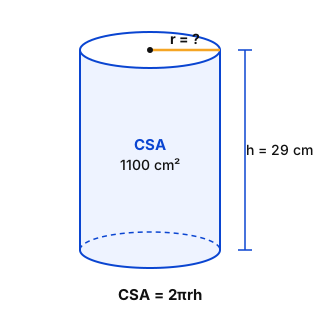
A cylindrical rod has an outer curved surface area of 1100 cm2. If the length of the rod is 29 cm, then the outer radius (in cm) of the rod, correct to two places of decimal, is:
(Take π=227)
एक बेलनाकार छड़ का बाहरी वक्र पृष्ठीय क्षेत्रफल 1100 cm2 है। यदि छड़ की लंबाई 29 cm है, तो दो दशमलव स्थानों तक सही, छड़ की बाहरी त्रिज्या (cm में) है:
(Take π=227)
  1. A5.53
  2. B4.72
  3. C6.03
  4. D8.17
Show answer

Concept: Curved surface area of a cylinder =2πrh.

  1. 2×227×r×29=1100.
  2. r=1100×72×22×29=77001276.
  3. r≈6.034≈6.03cm.

Trick: 110044=25, so r=25×729=17529≈6.03.

Answer: (C) 6.03

अवधारणा: बेलन का वक्र पृष्ठीय क्षेत्रफल =2πrh।

  1. 2×227×r×29=1100।
  2. r=1100×744×29=17529।
  3. r≈6.03cm।

ट्रिक: 110044=25, अतः r=25×729≈6.03।

उत्तर: (C) 6.03

RRB NTPC Undergraduate CBT 1MathematicsMensuration – CylinderRRB NTPC Undergraduate CBT 1 2024 · 22 Aug Shift 2 →
Q759.
Simplify 13×(3×42)÷9+59−75
सरल कीजिए 13×(3×42)÷9+59−75
  1. A1573
  2. B1609
  3. C1603
  4. D1579
Show answer

Concept: BODMAS: brackets and powers first, then × and ÷ from left to right, then + and −.

  1. 3×42=48.
  2. 13×48=624, then 624÷9=2083.
  3. 2083+59−75=2083−16=208−483=1603.

Trick: Only the options with denominator 3 can be right since 6249=2083.

Answer: (C) 1603

अवधारणा: BODMAS: पहले कोष्ठक व घात, फिर बाएँ से दाएँ × और ÷, फिर + और −।

  1. 3×42=48।
  2. 13×48=624, 624÷9=2083।
  3. 2083+59−75=208−483=1603।

ट्रिक: 6249=2083, अतः हर 3 वाले विकल्प ही संभव।

उत्तर: (C) 1603

RRB NTPC Undergraduate CBT 1MathematicsSimplification (BODMAS)RRB NTPC Undergraduate CBT 1 2024 · 22 Aug Shift 2 →
Q760.
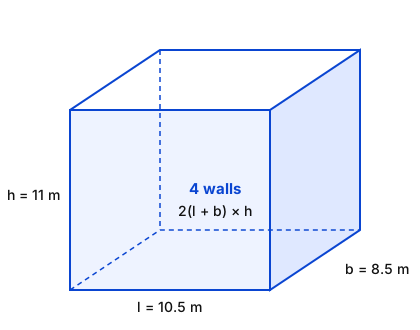
If the length, breadth and height of a room are 10.5 m, 8.5 m and 11 m, respectively, then what is the area (in m2) of the four walls of the room?
यदि एक कमरे की लंबाई, चौड़ाई और ऊँचाई क्रमशः 10.5 m, 8.5 m और 11 m है, तो कमरे की चारों दीवारों का क्षेत्रफल (m2 में) कितना है?
  1. A414
  2. B418
  3. C416
  4. D412
Show answer

Concept: Area of four walls of a room =2(l+b)×h.

  1. l+b=10.5+8.5=19m.
  2. Area =2×19×11.
  3. =418m2.

Trick: Four walls = perimeter of floor × height: 38×11=418.

Answer: (B) 418

अवधारणा: कमरे की चार दीवारों का क्षेत्रफल =2(l+b)×h।

  1. l+b=10.5+8.5=19m।
  2. क्षेत्रफल =2×19×11।
  3. =418m2।

ट्रिक: चार दीवारें = फर्श का परिमाप × ऊँचाई: 38×11=418।

उत्तर: (B) 418

RRB NTPC Undergraduate CBT 1MathematicsArea of Four WallsRRB NTPC Undergraduate CBT 1 2024 · 22 Aug Shift 2 →