Question bank

Q&A: practice questions with answers

Search questions on any topic. Filter by exam category, exam, subject and topic, try the question, then open the answer and explanation.

Courses – airGurukul

8,495 questions found.

Q7741.
Find the median of the following data (correct to two places of decimal).
Class interval0-66-1212-1818-2424-3030-36
Frequency57101398
निम्नलिखित आँकड़ों की माध्यिका ज्ञात कीजिए (दशमलव के दो स्थानों तक सही)।
वर्ग अंतराल0-66-1212-1818-2424-3030-36
बारंबारता57101398
  1. A29.73
  2. B21.23
  3. C19.85
  4. D26.48
Show answer

Concept: Median =l+N2−cff×h.

  1. N=5+7+10+13+9+8=52, N2=26.
  2. Cumulative frequencies: 5, 12, 22, 35, … → 26 lies in class 18–24 (cf=22, f=13, h=6).
  3. Median =18+26−2213×6=18+2413=18+1.846=19.85.

Trick: Find the first cumulative frequency that crosses N2 – that is the median class; cf is the one before it.

Answer: (C) 19.85

अवधारणा: माध्यिका =l+N2−cff×h।

  1. N=5+7+10+13+9+8=52, N2=26।
  2. संचयी बारंबारता: 5, 12, 22, 35, … → 26 वर्ग 18–24 में है (cf=22, f=13, h=6)।
  3. माध्यिका =18+26−2213×6=18+2413=18+1.846=19.85।

ट्रिक: जो संचयी बारंबारता पहली बार N2 को पार करे, वही माध्यिका वर्ग; cf उससे पहले वाली लें।

उत्तर: (C) 19.85
RRB NTPC Undergraduate CBT 1MathematicsStatistics – MedianRRB NTPC Undergraduate CBT 1 2025 · 9 May Shift 2 →
Q7742.
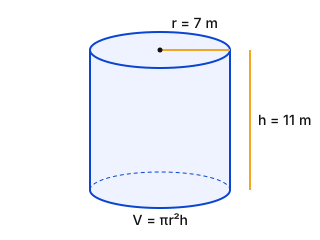
A cylindrical tank has a radius of 7 m and a height of 11 m. How many litres of water can it hold? (Use π = 22/7)
एक बेलनाकार टंकी की त्रिज्या 7 m और ऊँचाई 11 m है। इसमें कितने लीटर पानी आ सकता है? (π = 22/7 का प्रयोग कीजिए)
  1. A16,94,000
  2. B16,74,000
  3. C16,64,000
  4. D16,84,000
Show answer

Concept: Volume of cylinder =πr2h; 1m3=1000 litres.

  1. V=227×7×7×11=22×7×11=1694m3.
  2. Litres =1694×1000=16,94,000.

Trick: With r=7, 227×72=154; then 154×11=1694.

Answer: (A) 16,94,000

अवधारणा: बेलन का आयतन =πr2h; 1m3=1000 लीटर।

  1. V=227×7×7×11=22×7×11=1694m3।
  2. लीटर =1694×1000=16,94,000।

ट्रिक: r=7 हो तो 227×72=154; फिर 154×11=1694।

उत्तर: (A) 16,94,000

RRB NTPC Undergraduate CBT 1MathematicsMensuration – CylinderRRB NTPC Undergraduate CBT 1 2025 · 9 May Shift 2 →
Q7743.
A shopkeeper bought 7 decorative lamps for ₹2,850. Due to damage, 2 lamps could not be sold. He sold the remaining lamps at ₹360 each. What is his total loss (in ₹)?
एक दुकानदार ने ₹2,850 में 7 सजावटी लैंप खरीदे। क्षतिग्रस्त होने के कारण 2 लैंप बेचे नहीं जा सके। उसने शेष लैंप ₹360 प्रति लैंप की दर से बेच दिए। उसकी कुल हानि (₹ में) कितनी है?
  1. A₹960
  2. B₹1,050
  3. C₹840
  4. D₹1,100
Show answer

Concept: Loss = Total cost − Total selling price.

  1. Cost of 7 lamps =₹2850.
  2. Sold 7−2=5 lamps: 5×360=₹1800.
  3. Loss =2850−1800=₹1050.

Trick: Unsold items earn nothing – compare the whole cost with the money actually received.

Answer: (B) ₹1,050

अवधारणा: हानि = कुल लागत − कुल विक्रय मूल्य।

  1. 7 लैंप की लागत =₹2850।
  2. बेचे 7−2=5 लैंप: 5×360=₹1800।
  3. हानि =2850−1800=₹1050।

ट्रिक: बिना बिके सामान से कुछ नहीं मिलता – पूरी लागत की तुलना वास्तव में मिली राशि से करें।

उत्तर: (B) ₹1,050

RRB NTPC Undergraduate CBT 1MathematicsProfit and LossRRB NTPC Undergraduate CBT 1 2025 · 9 May Shift 2 →
Q7744.
The cost of a certain fabric is directly proportional to its length for a given width. If the cost of 8 meters of the fabric is ₹3,200, what will be the cost of 25 meters of the same fabric?
एक निश्चित कपड़े की लागत, दी गई चौड़ाई के लिए, उसकी लंबाई के अनुक्रमानुपाती होती है। यदि 8 मीटर कपड़े की लागत ₹3,200 है, तो उसी कपड़े के 25 मीटर की लागत क्या होगी?
  1. A₹9,800
  2. B₹9,400
  3. C₹10,000
  4. D₹9,600
Show answer

Concept: Direct proportion: C1L1=C2L2.

  1. Cost per metre =32008=₹400.
  2. Cost of 25 m =400×25=₹10,000.

Trick: Unitary method – find the price of 1 unit first.

Answer: (C) ₹10,000

अवधारणा: अनुक्रमानुपात: C1L1=C2L2।

  1. प्रति मीटर मूल्य =32008=₹400।
  2. 25 m का मूल्य =400×25=₹10,000।

ट्रिक: ऐकिक नियम – पहले 1 इकाई का मूल्य निकालें।

उत्तर: (C) ₹10,000

RRB NTPC Undergraduate CBT 1MathematicsDirect ProportionRRB NTPC Undergraduate CBT 1 2025 · 9 May Shift 2 →
Q7745.
Find the mode of the following distribution:
Class5-1515-2525-3535-45
Frequency6141812
निम्नलिखित बंटन का बहुलक ज्ञात कीजिए:
वर्ग5-1515-2525-3535-45
बारंबारता6141812
  1. A29
  2. B30
  3. C28
  4. D26
Show answer

Concept: Mode =l+f1−f02f1−f0−f2×h.

  1. Highest frequency 18 → modal class 25–35; l=25, f1=18, f0=14, f2=12, h=10.
  2. Mode =25+18−1436−14−12×10=25+410×10=29.

Trick: Denominator =2f1−f0−f2 – write it as (f1−f0)+(f1−f2)=4+6=10.

Answer: (A) 29

अवधारणा: बहुलक =l+f1−f02f1−f0−f2×h।

  1. सबसे अधिक बारंबारता 18 → बहुलक वर्ग 25–35; l=25, f1=18, f0=14, f2=12, h=10।
  2. बहुलक =25+18−1436−14−12×10=25+410×10=29।

ट्रिक: हर =2f1−f0−f2 को (f1−f0)+(f1−f2)=4+6=10 लिखें।

उत्तर: (A) 29

RRB NTPC Undergraduate CBT 1MathematicsStatistics – ModeRRB NTPC Undergraduate CBT 1 2025 · 9 May Shift 2 →
Q7746.
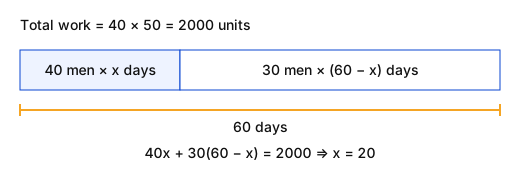
40 persons begin to work together on a job. But after some days 10 persons left the work. As a result, the job which should have been completed in 50 days is completed in 60 days. How many days after the commencement of the work did the 10 persons leave?
40 व्यक्ति एक काम पर एक साथ काम करना शुरू करते हैं। लेकिन कुछ दिनों के बाद 10 व्यक्ति काम छोड़ देते हैं। परिणामस्वरूप, जो काम 50 दिनों में पूरा होना चाहिए था, वह 60 दिनों में पूरा होता है। काम शुरू होने के कितने दिनों बाद 10 व्यक्तियों ने काम छोड़ा?
  1. A15
  2. B18
  3. C22
  4. D20
Show answer

Concept: Total work = men × days (man-days).

  1. Total work =40×50=2000 man-days.
  2. Let the 10 persons leave after x days: 40x+30(60−x)=2000.
  3. 40x+1800−30x=2000⇒10x=200⇒x=20.

Trick: 30 men working all 60 days do 1800; the missing 200 units were done by the extra 10 men at 10/day → 20 days.

Answer: (D) 20

अवधारणा: कुल कार्य = व्यक्ति × दिन (man-days)।

  1. कुल कार्य =40×50=2000 man-days।
  2. माना 10 व्यक्ति x दिन बाद गए: 40x+30(60−x)=2000।
  3. 40x+1800−30x=2000⇒10x=200⇒x=20।

ट्रिक: 30 व्यक्ति पूरे 60 दिन में 1800 करते; बाकी 200 इकाई अतिरिक्त 10 व्यक्तियों ने 10/दिन की दर से कीं → 20 दिन।

उत्तर: (D) 20

RRB NTPC Undergraduate CBT 1MathematicsTime and WorkRRB NTPC Undergraduate CBT 1 2025 · 9 May Shift 2 →
Q7747.
If p is a prime number and GCD (p2−1, p2+1) = 2, then the value of p must be:
यदि p एक अभाज्य संख्या है और GCD (p2−1, p2+1) = 2 है, तो p का मान अवश्य होगा:
  1. AAny prime numberकोई भी अभाज्य संख्या
  2. BAny odd primeकोई भी विषम अभाज्य संख्या
  3. COnly 3केवल 3
  4. DOnly 2केवल 2
Show answer

Concept: gcd(a,b)=gcd(a,b−a); here (p2+1)−(p2−1)=2, so the GCD is 1 or 2.

  1. If p is odd, p2 is odd → p2−1 and p2+1 are both even → GCD =2.
  2. If p=2: gcd(3,5)=1, not 2.
  3. So the condition holds for every odd prime (3, 5, 7, …), not only 3.

Trick: Two numbers differing by 2 have GCD 2 exactly when both are even.

Answer: (B) Any odd prime

अवधारणा: gcd(a,b)=gcd(a,b−a); यहाँ (p2+1)−(p2−1)=2, अतः GCD 1 या 2 ही हो सकता है।

  1. p विषम हो तो p2 विषम → p2−1 और p2+1 दोनों सम → GCD =2।
  2. p=2 पर: gcd(3,5)=1, 2 नहीं।
  3. अतः शर्त हर विषम अभाज्य (3, 5, 7, …) के लिए सत्य है, केवल 3 के लिए नहीं।

ट्रिक: 2 के अंतर वाली दो संख्याओं का GCD 2 तभी होता है जब दोनों सम हों।

उत्तर: (B) कोई भी विषम अभाज्य

RRB NTPC Undergraduate CBT 1MathematicsNumber System – GCDRRB NTPC Undergraduate CBT 1 2025 · 9 May Shift 2 →
Q7748.
A car covers a distance of 180 km in 3 hours. Find its average speed.
एक कार 3 घंटे में 180 km की दूरी तय करती है। इसकी औसत चाल ज्ञात कीजिए।
  1. A50 km/h
  2. B70 km/h
  3. C80 km/h
  4. D60 km/h
Show answer

Concept: Average speed =Total distanceTotal time.

  1. Speed =1803=60km/h.

Trick: Direct division – no conversion needed as both are in km and hours.

Answer: (D) 60 km/h

अवधारणा: औसत चाल =कुल दूरीकुल समय।

  1. चाल =1803=60km/h।

ट्रिक: सीधा भाग दें – km और घंटे पहले से हैं, कोई रूपांतरण नहीं चाहिए।

उत्तर: (D) 60 km/h

RRB NTPC Undergraduate CBT 1MathematicsSpeed, Distance and TimeRRB NTPC Undergraduate CBT 1 2025 · 9 May Shift 2 →
Q7749.
Riya and Neha have certain amount of money. If Riya gives ₹20 to Neha, then Riya will have three times as much money as Neha. However, if Neha gives ₹40 to Riya, then Riya will have five times as much money as Neha. What is the total amount of money (in ₹) that Riya and Neha initially had together?
रिया और नेहा के पास कुछ धनराशि है। यदि रिया नेहा को ₹20 देती है, तो रिया के पास नेहा से तीन गुना धनराशि हो जाएगी। परंतु, यदि नेहा रिया को ₹40 देती है, तो रिया के पास नेहा से पाँच गुना धनराशि हो जाएगी। रिया और नेहा के पास प्रारंभ में कुल कितनी धनराशि (₹ में) थी?
  1. A710
  2. B690
  3. C720
  4. D700
Show answer

Concept: Form two equations from the two "give" conditions.

  1. Riya gives ₹20: R−20=3(N+20)⇒R=3N+80.
  2. Neha gives ₹40: R+40=5(N−40)⇒R=5N−240.
  3. 3N+80=5N−240⇒N=160, R=560; total =720.

Trick: Check: 540=3×180 ✓ and 600=5×120 ✓.

Answer: (C) 720

अवधारणा: दोनों "देने" की शर्तों से दो समीकरण बनाएँ।

  1. रिया ₹20 देती है: R−20=3(N+20)⇒R=3N+80।
  2. नेहा ₹40 देती है: R+40=5(N−40)⇒R=5N−240।
  3. 3N+80=5N−240⇒N=160, R=560; कुल =720।

ट्रिक: जाँच: 540=3×180 ✓ और 600=5×120 ✓।

उत्तर: (C) 720

RRB NTPC Undergraduate CBT 1MathematicsLinear EquationsRRB NTPC Undergraduate CBT 1 2025 · 9 May Shift 2 →
Q7750.
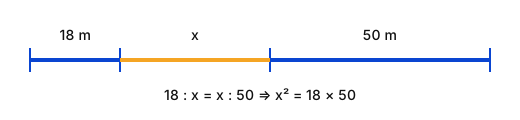
In a fitness park, a straight walking path is divided into three consecutive segments. The lengths of the first and third segments are 18 m and 50 m respectively. If the length of the middle segment is the mean proportional between the other two, what is its length?
एक फिटनेस पार्क में, एक सीधा पैदल पथ तीन क्रमागत खंडों में विभाजित है। पहले और तीसरे खंड की लंबाइयाँ क्रमशः 18 m और 50 m हैं। यदि बीच वाले खंड की लंबाई अन्य दोनों के बीच का मध्यानुपाती (mean proportional) है, तो उसकी लंबाई क्या है?
  1. A30 m
  2. B27 m
  3. C25 m
  4. D36 m
Show answer

Concept: Mean proportional between a and b is ab.

  1. x=18×50=900=30.
  2. Check: 18:30=30:50=3:5 ✓.

Trick: 18×50=900 is a perfect square – spot it instantly.

Answer: (A) 30 m

अवधारणा: a और b का मध्यानुपाती ab होता है।

  1. x=18×50=900=30।
  2. जाँच: 18:30=30:50=3:5 ✓।

ट्रिक: 18×50=900 पूर्ण वर्ग है – तुरंत पहचानें।

उत्तर: (A) 30 m

RRB NTPC Undergraduate CBT 1MathematicsMean ProportionalRRB NTPC Undergraduate CBT 1 2025 · 9 May Shift 2 →
Q7751.
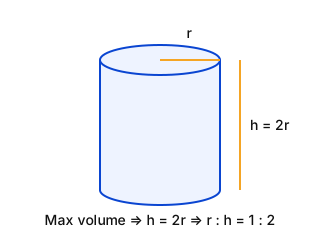
A solid right circular cylinder has curved surface area 1408πcm2. If the volume of the cylinder is maximum, then the ratio of radius to height is
एक ठोस लंब वृत्तीय बेलन का वक्र पृष्ठीय क्षेत्रफल 1408πcm2 है। यदि बेलन का आयतन अधिकतम है, तो त्रिज्या और ऊँचाई का अनुपात है
  1. A1:4
  2. B2:1
  3. C1:3
  4. D1:2
Show answer

Concept: For a closed right circular cylinder of fixed surface area, the volume is maximum when height = diameter, i.e. h=2r.

  1. Surface area S=2πrh+2πr2 fixed → V=πr2h=r(S−2πr2)2.
  2. dVdr=0⇒S=6πr2⇒2πrh=4πr2⇒h=2r.
  3. Hence r:h=1:2.

Yaad rakhein: Max-volume cylinder for given surface = "height equals diameter" (r:h=1:2); the given value 1408π is not needed for the ratio.

Answer: (D) 1:2

अवधारणा: नियत पृष्ठीय क्षेत्रफल वाले बंद लंब वृत्तीय बेलन का आयतन अधिकतम तब होता है जब ऊँचाई = व्यास, अर्थात h=2r।

  1. S=2πrh+2πr2 नियत → V=πr2h=r(S−2πr2)2।
  2. dVdr=0⇒S=6πr2⇒2πrh=4πr2⇒h=2r।
  3. अतः r:h=1:2।

याद रखें: दिए पृष्ठ पर अधिकतम आयतन वाला बेलन = "ऊँचाई बराबर व्यास" (r:h=1:2); अनुपात के लिए 1408π का मान चाहिए ही नहीं।

उत्तर: (D) 1:2

RRB NTPC Undergraduate CBT 1MathematicsMensuration – Cylinder (maximum volume)RRB NTPC Undergraduate CBT 1 2025 · 9 May Shift 2 →
Q7752.
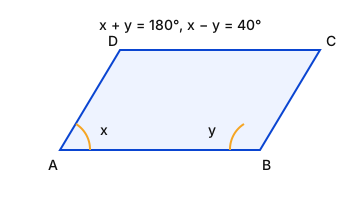
In a parallelogram, the difference of two adjacent angles is 40°. Find the measure of the smaller angle.
एक समांतर चतुर्भुज में, दो आसन्न कोणों का अंतर 40° है। छोटे कोण का माप ज्ञात कीजिए।
  1. A60°
  2. B80°
  3. C50°
  4. D70°
Show answer

Concept: Adjacent angles of a parallelogram are supplementary: x+y=180∘.

  1. x+y=180∘ and x−y=40∘.
  2. Adding: 2x=220∘⇒x=110∘; so y=70∘.

Trick: Smaller angle =180∘−difference2=140∘2=70∘.

Answer: (D) 70∘

अवधारणा: समांतर चतुर्भुज के आसन्न कोण संपूरक होते हैं: x+y=180∘।

  1. x+y=180∘ और x−y=40∘।
  2. जोड़ने पर 2x=220∘⇒x=110∘; अतः y=70∘।

ट्रिक: छोटा कोण =180∘−अंतर2=140∘2=70∘।

उत्तर: (D) 70∘

RRB NTPC Undergraduate CBT 1MathematicsParallelogram anglesRRB NTPC Undergraduate CBT 1 2025 · 9 May Shift 2 →
Q7753.
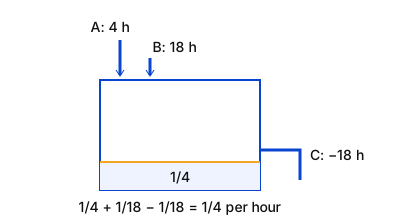
Two taps can fill a cistern in 4 hours and 18 hours, respectively. A third tap can empty it in 18 hours. How long (in hours) will it take to fill one-fourth of the empty cistern if all the taps are opened together?
दो नल एक टंकी को क्रमशः 4 घंटे और 18 घंटे में भर सकते हैं। एक तीसरा नल इसे 18 घंटे में खाली कर सकता है। यदि सभी नल एक साथ खोल दिए जाएँ, तो खाली टंकी के एक-चौथाई भाग को भरने में कितना समय (घंटों में) लगेगा?
  1. A2
  2. B3
  3. C4
  4. D1
Show answer

Concept: Net filling rate per hour = sum of inlet rates − outlet rate.

  1. Net rate =14+118−118=14 of the cistern per hour.
  2. Full cistern in 4 hours → one-fourth in 4×14=1 hour.

Trick: The 18-hour inlet and 18-hour outlet cancel exactly – only the 4-hour tap matters.

Answer: (D) 1

अवधारणा: प्रति घंटा शुद्ध भरने की दर = भरने वाले नलों की दरों का योग − खाली करने वाले की दर।

  1. शुद्ध दर =14+118−118=14 टंकी प्रति घंटा।
  2. पूरी टंकी 4 घंटे में → एक-चौथाई 4×14=1 घंटे में।

ट्रिक: 18 घंटे वाला भरने वाला और 18 घंटे वाला खाली करने वाला नल एक-दूसरे को काट देते हैं – केवल 4 घंटे वाला नल गिनें।

उत्तर: (D) 1

RRB NTPC Undergraduate CBT 1MathematicsPipes and CisternsRRB NTPC Undergraduate CBT 1 2025 · 9 May Shift 2 →
Q7754.
The price of an article increases and decreases alternately by 20% every year. If the difference between the prices at the end of the second year and third year is ₹1,920, find 40% of the price (in ₹) of the article at the end of the first year.
एक वस्तु की कीमत प्रत्येक वर्ष बारी-बारी से 20% बढ़ती और घटती है। यदि दूसरे वर्ष और तीसरे वर्ष के अंत की कीमतों का अंतर ₹1,920 है, तो पहले वर्ष के अंत में वस्तु की कीमत का 40% (₹ में) ज्ञात कीजिए।
  1. A₹4,800
  2. B₹3,200
  3. C₹2,400
  4. D₹3,600
Show answer

Concept: +20% means ×1.2, −20% means ×0.8.

  1. Let initial price =P. End of year 1: 1.2P; year 2: 0.96P; year 3: 1.152P.
  2. Difference =1.152P−0.96P=0.192P=1920⇒P=10000.
  3. Price at end of year 1 =12000; 40% of it =4800.

Trick: Year-3 price is 20% more than year-2 price, so year-2 price =19200.2=9600, year-1 price =96000.8=12000.

Answer: (A) ₹4,800

अवधारणा: +20% अर्थात ×1.2, −20% अर्थात ×0.8।

  1. माना प्रारंभिक मूल्य =P। वर्ष 1 के अंत में 1.2P; वर्ष 2: 0.96P; वर्ष 3: 1.152P।
  2. अंतर =1.152P−0.96P=0.192P=1920⇒P=10000।
  3. वर्ष 1 के अंत का मूल्य =12000; इसका 40% =4800।

ट्रिक: वर्ष-3 का मूल्य वर्ष-2 से 20% अधिक है, अतः वर्ष-2 मूल्य =19200.2=9600, वर्ष-1 मूल्य =96000.8=12000।

उत्तर: (A) ₹4,800

RRB NTPC Undergraduate CBT 1MathematicsSuccessive Percentage ChangeRRB NTPC Undergraduate CBT 1 2025 · 9 May Shift 2 →
Q7755.
A shopkeeper offers the following schemes on toys of the same marked price. (A) Successive discounts of 18% and 39% on any number of toys bought.
(B) Successive discounts of 29%, 45% and 4% on any number of toys bought. (C) 29% discount on the first 8 toys and 31% discount on each toy thereon.
(D) 7 toys free of cost on buying 8 toys.
A customer wants to buy 8 toys. Which of the above schemes is the least beneficial to her?
एक दुकानदार समान अंकित मूल्य वाले खिलौनों पर निम्नलिखित योजनाएँ प्रस्तुत करता है। (A) खरीदे गए किसी भी संख्या में खिलौनों पर 18% और 39% की क्रमिक छूट।
(B) खरीदे गए किसी भी संख्या में खिलौनों पर 29%, 45% और 4% की क्रमिक छूट। (C) पहले 8 खिलौनों पर 29% छूट और उसके बाद प्रत्येक खिलौने पर 31% छूट।
(D) 8 खिलौने खरीदने पर 7 खिलौने निःशुल्क।
एक ग्राहक 8 खिलौने खरीदना चाहती है। उपरोक्त योजनाओं में से कौन-सी उसके लिए सबसे कम लाभकारी है?
  1. AB
  2. BC
  3. CA
  4. DD
Show answer

Concept: Compare the amount paid for 8 toys (marked price ₹100 each, total ₹800).

  1. Scheme A: 800×0.82×0.61≈₹400 (≈50% off).
  2. Scheme B: 800×0.71×0.55×0.96≈₹300 (≈62.5% off).
  3. Scheme C: 29% on first 8 toys → 800×0.71=₹568 (29% off).
  4. Scheme D: pay for 8, get 15 → effective price per toy 80015≈53.3, i.e. ≈46.7% off.
  5. Highest payment / lowest discount: scheme C.

Trick: Convert every scheme into a single equivalent discount %; the smallest % is the least beneficial.

Answer: (B) C

अवधारणा: 8 खिलौनों (अंकित मूल्य ₹100 प्रत्येक, कुल ₹800) पर दी जाने वाली राशि की तुलना करें।

  1. योजना A: 800×0.82×0.61≈₹400 (≈50% छूट)।
  2. योजना B: 800×0.71×0.55×0.96≈₹300 (≈62.5% छूट)।
  3. योजना C: पहले 8 पर 29% → 800×0.71=₹568 (29% छूट)।
  4. योजना D: 8 का भुगतान, 15 मिलें → प्रति खिलौना 80015≈53.3, अर्थात ≈46.7% छूट।
  5. सबसे अधिक भुगतान / सबसे कम छूट: योजना C।

ट्रिक: हर योजना को एक समतुल्य छूट % में बदलें; सबसे छोटा % सबसे कम लाभदायक।

उत्तर: (B) C

RRB NTPC Undergraduate CBT 1MathematicsDiscount schemesRRB NTPC Undergraduate CBT 1 2025 · 9 May Shift 2 →
Q7756.
Simplify: 18−[6×2−(3+1)]+7
सरल कीजिए: 18−[6×2−(3+1)]+7
  1. A17
  2. B15
  3. C21
  4. D19
Show answer

Concept: Solve brackets innermost first: ( ), then [ ].

  1. (3+1)=4; 6×2=12; [12−4]=8.
  2. 18−8+7=17.

Trick: Inside a bracket, do multiplication before subtraction (BODMAS order).

Answer: (A) 17

अवधारणा: सबसे भीतरी कोष्ठक पहले हल करें: ( ), फिर [ ]।

  1. (3+1)=4; 6×2=12; [12−4]=8।
  2. 18−8+7=17।

ट्रिक: कोष्ठक के अंदर घटाने से पहले गुणा करें (BODMAS क्रम)।

उत्तर: (A) 17

RRB NTPC Undergraduate CBT 1MathematicsSimplification – BODMASRRB NTPC Undergraduate CBT 1 2025 · 9 May Shift 2 →
Q7757.
The price of an article is decreased by 24%, but the daily sale of the article is increased by 33%. Find the net effect on the daily sale receipts.
एक वस्तु की कीमत 24% घटा दी जाती है, लेकिन वस्तु की दैनिक बिक्री 33% बढ़ जाती है। दैनिक बिक्री प्राप्तियों पर शुद्ध प्रभाव ज्ञात कीजिए।
  1. A2.16% decrease2.16% की कमी
  2. B2.16% increase2.16% की वृद्धि
  3. C1.08% increase1.08% की वृद्धि
  4. D1.08% decrease1.08% की कमी
Show answer

Concept: Receipts = price × quantity; net % change =a+b+ab100.

  1. a=−24, b=+33: −24+33+(−24)(33)100=9−7.92=1.08.
  2. Positive → 1.08% increase in receipts.

Trick: Multiply the factors: 0.76×1.33=1.0108 → +1.08%.

Answer: (C) 1.08% increase

अवधारणा: प्राप्ति = मूल्य × मात्रा; शुद्ध % परिवर्तन =a+b+ab100।

  1. a=−24, b=+33: −24+33+(−24)(33)100=9−7.92=1.08।
  2. धनात्मक → प्राप्ति में 1.08% वृद्धि।

ट्रिक: गुणनखंड गुणा करें: 0.76×1.33=1.0108 → +1.08%।

उत्तर: (C) 1.08% वृद्धि

RRB NTPC Undergraduate CBT 1MathematicsPercentage – net effectRRB NTPC Undergraduate CBT 1 2025 · 9 May Shift 2 →
Q7758.
If 9 notebooks cost ₹135, how much will 20 notebooks of the same type cost?
यदि 9 नोटबुक की कीमत ₹135 है, तो उसी प्रकार की 20 नोटबुक की कीमत कितनी होगी?
  1. A₹270
  2. B₹300
  3. C₹280
  4. D₹320
Show answer

Concept: Cost is directly proportional to the number of notebooks.

  1. Cost of 1 notebook =1359=₹15.
  2. Cost of 20 =15×20=₹300.

Trick: 135÷9=15 – then just add a zero for 20 and double: 300.

Answer: (B) ₹300

अवधारणा: मूल्य नोटबुक की संख्या के अनुक्रमानुपाती है।

  1. 1 नोटबुक =1359=₹15।
  2. 20 नोटबुक =15×20=₹300।

ट्रिक: 135÷9=15 – फिर 20 से गुणा: 300।

उत्तर: (B) ₹300

RRB NTPC Undergraduate CBT 1MathematicsUnitary MethodRRB NTPC Undergraduate CBT 1 2025 · 9 May Shift 2 →
Q7759.
Three numbers are in the ratio 5 : 14 : 9, and their LCM is 7560. Their HCF is:
तीन संख्याएँ 5 : 14 : 9 के अनुपात में हैं और उनका LCM 7560 है। उनका HCF है:
  1. A11
  2. B12
  3. C53
  4. D32
Show answer

Concept: Numbers in ratio 5:14:9 with no common factor → numbers =5x,14x,9x and HCF =x.

  1. LCM of 5,14,9 =630, so LCM of numbers =630x.
  2. 630x=7560⇒x=12.
  3. HCF =x=12.

Trick: HCF =LCM of numbersLCM of ratio terms when the ratio is in lowest terms.

Answer: (B) 12

अवधारणा: अनुपात 5:14:9 (कोई उभयनिष्ठ गुणनखंड नहीं) → संख्याएँ 5x,14x,9x और HCF =x।

  1. 5,14,9 का LCM =630, अतः संख्याओं का LCM =630x।
  2. 630x=7560⇒x=12।
  3. HCF =x=12।

ट्रिक: न्यूनतम रूप के अनुपात में HCF =संख्याओं का LCMअनुपात पदों का LCM।

उत्तर: (B) 12

RRB NTPC Undergraduate CBT 1MathematicsHCF and LCMRRB NTPC Undergraduate CBT 1 2025 · 9 May Shift 2 →
Q7760.
A trader sells rice, claiming 1 kg but actually gives x grams. He marks the price 20% above the cost price and gives a 10% discount on the marked price. If his overall profit is 25%, find x.
एक व्यापारी चावल बेचते समय 1 kg देने का दावा करता है, लेकिन वास्तव में x ग्राम देता है। वह मूल्य को क्रय मूल्य से 20% अधिक अंकित करता है और अंकित मूल्य पर 10% की छूट देता है। यदि उसका कुल लाभ 25% है, तो x ज्ञात कीजिए।
  1. A864
  2. B856
  3. C825
  4. D870
Show answer

Concept: Overall profit =SPtrue CP of goods given.

  1. Take CP of 1000 g =100. SP of "1 kg" =100×1.2×0.9=108.
  2. Actual cost of x g =x10. Profit 25%: 108=1.25×x10.
  3. x=10801.25=864 g.

Trick: 1.081.25=0.864 → he gives 864 g for 1000 g price.

Answer: (A) 864

अवधारणा: कुल लाभ =SPदिए गए माल की वास्तविक CP।

  1. 1000 g की CP =100 लें। "1 kg" का SP =100×1.2×0.9=108।
  2. x g की वास्तविक लागत =x10। 25% लाभ: 108=1.25×x10।
  3. x=10801.25=864 g।

ट्रिक: 1.081.25=0.864 → 1000 g के दाम पर 864 g देता है।

उत्तर: (A) 864

RRB NTPC Undergraduate CBT 1MathematicsProfit with false weightRRB NTPC Undergraduate CBT 1 2025 · 9 May Shift 2 →