Question bank

Q&A: practice questions with answers

Search questions on any topic. Filter by exam category, exam, subject and topic, try the question, then open the answer and explanation.

Courses – airGurukul

8,495 questions found.

Q7761.
Find the value of m which satisfies
(235)13×(523)9×(235)5=(523)6m+9
m का वह मान ज्ञात कीजिए जो निम्नलिखित को संतुष्ट करता है
(235)13×(523)9×(235)5=(523)6m+9
  1. A11
  2. B4
  3. C5
  4. D−3
Show answer

Concept: (ab)−n=(ba)n; same base → add powers.

  1. (523)9=(235)−9.
  2. LHS =(235)13−9+5=(235)9=(523)−9.
  3. 6m+9=−9⇒m=−3.

Trick: Flip the fraction, flip the sign of the power – then just equate exponents.

Answer: (D) −3

अवधारणा: (ab)−n=(ba)n; समान आधार → घात जोड़ें।

  1. (523)9=(235)−9।
  2. LHS =(235)13−9+5=(235)9=(523)−9।
  3. 6m+9=−9⇒m=−3।

ट्रिक: भिन्न पलटें, घात का चिह्न पलटें – फिर घातांक बराबर रखें।

उत्तर: (D) −3
RRB NTPC Undergraduate CBT 1MathematicsIndicesRRB NTPC Undergraduate CBT 1 2025 · 9 May Shift 2 →
Q7762.
A shopkeeper sells a watch for ₹840 after giving a 30% discount. What was the marked price (in ₹) of the watch?
एक दुकानदार 30% की छूट देने के बाद एक घड़ी ₹840 में बेचता है। घड़ी का अंकित मूल्य (₹ में) क्या था?
  1. A1,100
  2. B1,050
  3. C1,200
  4. D1,000
Show answer

Concept: SP = MP ×(1−d100).

  1. 840=MP×0.7.
  2. MP =8400.7=1200.

Trick: 30% off → SP is 70% = 7 parts; 1 part =120, 10 parts =1200.

Answer: (C) 1,200

अवधारणा: SP = MP ×(1−d100)।

  1. 840=MP×0.7।
  2. MP =8400.7=1200।

ट्रिक: 30% छूट → SP 70% = 7 भाग; 1 भाग =120, 10 भाग =1200।

उत्तर: (C) 1,200

RRB NTPC Undergraduate CBT 1MathematicsDiscount – Marked PriceRRB NTPC Undergraduate CBT 1 2025 · 9 May Shift 2 →
Q7763.
Five years ago, the age of Kavita was one-third of the present age of her mother. After 5 years, the sum of their ages will be 75 years. What is Kavita’s present age?
पाँच वर्ष पहले, कविता की आयु उसकी माँ की वर्तमान आयु की एक-तिहाई थी। 5 वर्ष बाद, उनकी आयु का योग 75 वर्ष होगा। कविता की वर्तमान आयु क्या है?
  1. A21 years21 वर्ष
  2. B23 years23 वर्ष
  3. C22 years22 वर्ष
  4. D20 years20 वर्ष
Show answer

Concept: Let present ages be K (Kavita) and M (mother).

  1. K−5=M3⇒M=3K−15.
  2. (K+5)+(M+5)=75⇒K+M=65.
  3. K+3K−15=65⇒4K=80⇒K=20.

Trick: Present sum is 75−10=65; test option: K=20⇒M=45, and 45÷3=15=20−5 ✓.

Answer: (D) 20 years

अवधारणा: वर्तमान आयु K (कविता) और M (माँ) मानें।

  1. K−5=M3⇒M=3K−15।
  2. (K+5)+(M+5)=75⇒K+M=65।
  3. K+3K−15=65⇒4K=80⇒K=20।

ट्रिक: वर्तमान योग 75−10=65; विकल्प जाँचें: K=20⇒M=45, और 45÷3=15=20−5 ✓।

उत्तर: (D) 20 वर्ष

RRB NTPC Undergraduate CBT 1MathematicsProblems on AgesRRB NTPC Undergraduate CBT 1 2025 · 9 May Shift 2 →
Q7764.
Sarang invested a certain sum of money at 10% per annum. After 2 years, he received ₹178.5 as compound interest, compounded annually. Find the corresponding simple interest (in ₹) for 2 years at the same rate.
सारंग ने एक निश्चित धनराशि 10% वार्षिक दर पर निवेश की। 2 वर्षों के बाद, उसे वार्षिक रूप से चक्रवृद्धि होने वाले चक्रवृद्धि ब्याज के रूप में ₹178.5 प्राप्त हुए। समान दर पर 2 वर्षों के लिए संगत साधारण ब्याज (₹ में) ज्ञात कीजिए।
  1. A180
  2. B170
  3. C185
  4. D165
Show answer

Concept: For 2 years, CI =P[(1+r100)2−1] and SI =2Pr100.

  1. At 10%, 2-year CI =21% of P: 0.21P=178.5⇒P=850.
  2. SI =850×10×2100=170.

Trick: For 2 years, SICI=200200+r=200210 → SI =178.5×2021=170.

Answer: (B) 170

अवधारणा: 2 वर्ष के लिए CI =P[(1+r100)2−1] और SI =2Pr100।

  1. 10% पर 2 वर्ष का CI =P का 21%: 0.21P=178.5⇒P=850।
  2. SI =850×10×2100=170।

ट्रिक: 2 वर्ष के लिए SICI=200200+r=200210 → SI =178.5×2021=170।

उत्तर: (B) 170

RRB NTPC Undergraduate CBT 1MathematicsCI and SI relationRRB NTPC Undergraduate CBT 1 2025 · 9 May Shift 2 →
Q7765.
The sum of two positive numbers is 77 and their product is 1392. The positive difference between them is:
दो धनात्मक संख्याओं का योग 77 है और उनका गुणनफल 1392 है। उनके बीच का धनात्मक अंतर है:
  1. A21
  2. B19
  3. C37
  4. D24
Show answer

Concept: (a−b)2=(a+b)2−4ab.

  1. (a−b)2=772−4×1392=5929−5568=361.
  2. a−b=361=19.

Trick: The numbers are 48 and 29 (48×29=1392); difference 19.

Answer: (B) 19

अवधारणा: (a−b)2=(a+b)2−4ab।

  1. (a−b)2=772−4×1392=5929−5568=361।
  2. a−b=361=19।

ट्रिक: संख्याएँ 48 और 29 हैं (48×29=1392); अंतर 19।

उत्तर: (B) 19

RRB NTPC Undergraduate CBT 1MathematicsAlgebraic identitiesRRB NTPC Undergraduate CBT 1 2025 · 9 May Shift 2 →
Q7766.
In a certain code language, ‘DOLE’ is coded as ‘7348’ and ‘LEMO’ is coded as ‘2738’. What is the code for ‘M’ in the given code language?
एक निश्चित कूट भाषा में, ‘DOLE’ को ‘7348’ के रूप में कूटबद्ध किया जाता है और ‘LEMO’ को ‘2738’ के रूप में कूटबद्ध किया जाता है। दी गई कूट भाषा में ‘M’ का कूट क्या है?
  1. A3
  2. B7
  3. C8
  4. D2
Show answer

Concept: When two coded words share letters, the common letters share the common digits; the leftover letter takes the leftover digit.

  1. DOLE → 7 3 4 8 and LEMO → 2 7 3 8. Common letters: O, L, E; common digits: 7, 3, 8.
  2. So in DOLE the uncommon letter D = 4, and in LEMO the uncommon letter M = the leftover digit 2.

Trick: Strike out the common letters and common digits – what remains pairs up.

Answer: (D) 2

अवधारणा: जब दो कूट शब्दों में अक्षर समान हों, तो समान अक्षरों के अंक भी समान होते हैं; बचा अक्षर = बचा अंक।

  1. DOLE → 7 3 4 8 और LEMO → 2 7 3 8। समान अक्षर: O, L, E; समान अंक: 7, 3, 8।
  2. अतः DOLE का अलग अक्षर D = 4, और LEMO का अलग अक्षर M = बचा अंक 2।

ट्रिक: समान अक्षर और समान अंक काट दें – जो बचे वही जोड़ी है।

उत्तर: (D) 2

RRB NTPC Undergraduate CBT 1General Intelligence and ReasoningCoding–DecodingRRB NTPC Undergraduate CBT 1 2025 · 9 May Shift 2 →
Q7767.
Each vowel in the word WORTHLESSLY is changed to the second letter following it in the English alphabetical order AND each consonant is changed to the letter immediately preceding it in the English alphabetical order. How many letters will appear exactly twice in the group of letters thus formed?
शब्द WORTHLESSLY में प्रत्येक स्वर को अंग्रेज़ी वर्णमाला क्रम में उसके बाद आने वाले दूसरे अक्षर से बदल दिया जाता है तथा प्रत्येक व्यंजन को अंग्रेज़ी वर्णमाला क्रम में उसके ठीक पहले आने वाले अक्षर से बदल दिया जाता है। इस प्रकार बने अक्षरों के समूह में कितने अक्षर ठीक दो बार आएँगे?
  1. ATwoदो
  2. BOneएक
  3. CFourचार
  4. DThreeतीन
Show answer

Concept: Apply the rule letter by letter: vowel → +2, consonant → −1, then count repetitions.

  1. W O R T H L E S S L Y → V Q Q S G K G R R K X (O→Q, E→G; W→V, R→Q, T→S, H→G, L→K, S→R, Y→X).
  2. Frequencies: V1, Q2, S1, G2, K2, R2, X1.
  3. Letters appearing exactly twice: Q, G, K, R = Four.

Trick: Write the new word in a row and tick pairs; here Y is a consonant.

Answer: (C) Four

अवधारणा: नियम अक्षर-दर-अक्षर लगाएँ: स्वर → +2, व्यंजन → −1, फिर दोहराव गिनें।

  1. W O R T H L E S S L Y → V Q Q S G K G R R K X (O→Q, E→G; W→V, R→Q, T→S, H→G, L→K, S→R, Y→X)।
  2. आवृत्ति: V1, Q2, S1, G2, K2, R2, X1।
  3. ठीक दो बार आने वाले अक्षर: Q, G, K, R = चार।

ट्रिक: नया शब्द एक पंक्ति में लिखकर जोड़े टिक करें; यहाँ Y व्यंजन है।

उत्तर: (C) Four

RRB NTPC Undergraduate CBT 1General Intelligence and ReasoningLetter operationsRRB NTPC Undergraduate CBT 1 2025 · 9 May Shift 2 →
Q7768.
Each vowel in the word READING is changed to the letter immediately following it in the English alphabetical order and each consonant is changed to the letter immediately preceding it in the English alphabetical order. Which of the following letters will appear exactly twice in the group of letters thus formed?
शब्द READING में प्रत्येक स्वर को अंग्रेज़ी वर्णमाला क्रम में उसके ठीक बाद आने वाले अक्षर से बदल दिया जाता है और प्रत्येक व्यंजन को अंग्रेज़ी वर्णमाला क्रम में उसके ठीक पहले आने वाले अक्षर से बदल दिया जाता है। इस प्रकार बने अक्षरों के समूह में निम्नलिखित में से कौन-सा अक्षर ठीक दो बार आएगा?
  1. AM
  2. BQ
  3. CC
  4. DF
Show answer

Concept: Vowel → next letter (+1), consonant → previous letter (−1).

  1. R E A D I N G → Q F B C J M F.
  2. Only F appears twice (from E and from G); all others appear once.

Trick: Both E(+1) and G(−1) land on F – that is the designed repeat.

Answer: (D) F

अवधारणा: स्वर → अगला अक्षर (+1), व्यंजन → पिछला अक्षर (−1)।

  1. R E A D I N G → Q F B C J M F।
  2. केवल F दो बार आता है (E से और G से); बाकी एक-एक बार।

ट्रिक: E(+1) और G(−1) दोनों F पर पहुँचते हैं – यही दोहराव है।

उत्तर: (D) F

RRB NTPC Undergraduate CBT 1General Intelligence and ReasoningLetter operationsRRB NTPC Undergraduate CBT 1 2025 · 9 May Shift 2 →
Q7769.
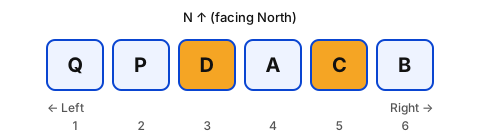
Six people A, B, P, Q, C and D are sitting in a straight line. They all are facing towards North. P is sitting immediately between Q and D. D is sitting third to the left of B. A sits second to the right of P. What is the position of C with respect to D?
छह व्यक्ति A, B, P, Q, C और D एक सीधी पंक्ति में बैठे हैं। वे सभी उत्तर की ओर मुख किए हुए हैं। P, Q और D के ठीक बीच में बैठा है। D, B के बाएँ तीसरे स्थान पर बैठा है। A, P के दाएँ दूसरे स्थान पर बैठा है। D के सापेक्ष C का स्थान क्या है?
  1. AImmediate leftठीक बाएँ
  2. BSecond to the leftबाएँ दूसरा
  3. CSecond to the rightदाएँ दूसरा
  4. DImmediate rightठीक दाएँ
Show answer

Concept: Facing north, "left" is our left. Fix the most restrictive clue first and test the two ways P can sit between Q and D.

  1. Let D be at position d; then B is at d+3 (third to the right of D). P is next to D with Q on the other side.
  2. If P is to the right of D, A (second right of P) would land on B's seat – impossible. So P is left of D, Q left of P, and A is just right of D.
  3. Q P D A _ B needs six seats: Q1, P2, D3, A4, B6 → C at 5. C is second to the right of D.

Trick: When "A is k-th right of P" collides with another fixed person, flip the side – only one case survives.

Answer: (C) Second to the right

अवधारणा: उत्तर की ओर मुख होने पर "बायाँ" हमारा बायाँ है। सबसे सख़्त सूचना पहले लगाएँ और P के दोनों संभावित स्थान जाँचें।

  1. माना D स्थान d पर है; तो B d+3 पर (D के दाएँ तीसरा)। P, D के बगल में और Q दूसरी ओर।
  2. यदि P, D के दाएँ हो तो A (P के दाएँ दूसरा) B की सीट पर आ जाएगा – असंभव। अतः P, D के बाएँ, Q उसके बाएँ और A, D के ठीक दाएँ।
  3. Q P D A _ B के लिए छह सीटें: Q1, P2, D3, A4, B6 → C 5 पर। C, D के दाएँ दूसरे स्थान पर है।

ट्रिक: जब "A, P के दाएँ k-वाँ" किसी तय व्यक्ति से टकराए, तो दिशा पलटें – केवल एक स्थिति बचती है।

उत्तर: (C) Second to the right

RRB NTPC Undergraduate CBT 1General Intelligence and ReasoningLinear seating arrangementRRB NTPC Undergraduate CBT 1 2025 · 9 May Shift 2 →
Q7770.
If 2 is added to each odd digit and 1 is subtracted from each even digit in the number 5718624, how many digits will appear more than once in the new number thus formed?
यदि संख्या 5718624 में प्रत्येक विषम अंक में 2 जोड़ा जाए और प्रत्येक सम अंक में से 1 घटाया जाए, तो इस प्रकार बनी नई संख्या में कितने अंक एक से अधिक बार आएँगे?
  1. AOneएक
  2. BThreeतीन
  3. CNoneकोई नहीं
  4. DTwoदो
Show answer

Concept: Change each digit by the rule, then count digits that repeat.

  1. 5 7 1 8 6 2 4: odd digits +2 → 5→7, 7→9, 1→3; even digits −1 → 8→7, 6→5, 2→1, 4→3.
  2. New number: 7 9 3 7 5 1 3. Digits 7 and 3 appear twice each → Two digits appear more than once.

Trick: Write the new digits directly below the old ones to avoid slips.

Answer: (D) Two

अवधारणा: नियम से हर अंक बदलें, फिर दोहराए गए अंक गिनें।

  1. 5 7 1 8 6 2 4: विषम +2 → 5→7, 7→9, 1→3; सम −1 → 8→7, 6→5, 2→1, 4→3।
  2. नई संख्या: 7 9 3 7 5 1 3। अंक 7 और 3 दो-दो बार → दो अंक एक से अधिक बार।

ट्रिक: नए अंक पुराने अंकों के ठीक नीचे लिखें, गलती नहीं होगी।

उत्तर: (D) Two

RRB NTPC Undergraduate CBT 1General Intelligence and ReasoningNumber operationsRRB NTPC Undergraduate CBT 1 2025 · 9 May Shift 2 →
Q7771.
Which of the following letter-number clusters will replace the question mark (?) in the given series to make it logically complete?
GDK 12 NKR 23 URY 34 BYF 45 ?
निम्नलिखित में से कौन-सा अक्षर-संख्या समूह दी गई शृंखला में प्रश्नचिह्न (?) के स्थान पर आकर उसे तार्किक रूप से पूर्ण करेगा?
GDK 12 NKR 23 URY 34 BYF 45 ?
  1. AJEK 55
  2. BKGM 55
  3. CIFM 56
  4. DSBU 56
Show answer

Concept: Check letters and numbers separately for a constant step.

  1. Letters: G→N→U→B (+7 each), D→K→R→Y (+7), K→R→Y→F (+7). Next: B+7 = I, Y+7 = F, F+7 = M → IFM.
  2. Numbers: 12, 23, 34, 45 (+11) → 56.

Trick: Use the circular alphabet: Y(25)+7 = 32 → 32−26 = 6 = F.

Answer: (C) IFM 56

अवधारणा: अक्षरों और संख्याओं को अलग-अलग देखकर स्थिर अंतर खोजें।

  1. अक्षर: G→N→U→B (+7), D→K→R→Y (+7), K→R→Y→F (+7)। अगला: B+7 = I, Y+7 = F, F+7 = M → IFM।
  2. संख्या: 12, 23, 34, 45 (+11) → 56।

ट्रिक: वृत्ताकार वर्णमाला प्रयोग करें: Y(25)+7 = 32 → 32−26 = 6 = F।

उत्तर: (C) IFM 56

RRB NTPC Undergraduate CBT 1General Intelligence and ReasoningAlphanumeric seriesRRB NTPC Undergraduate CBT 1 2025 · 9 May Shift 2 →
Q7772.
Read the given statement(s) and conclusions carefully. Assuming that the information given in the statements is true, even if it appears to be at variance with commonly known facts, decide which of the given conclusions logically follow(s) from the statement(s).
Statements:
Some fans are cars.
No car is a bus.
Conclusions:
(I) Some fans are buses.
(II) Some cars are fans.
दिए गए कथन(कथनों) और निष्कर्षों को ध्यानपूर्वक पढ़िए। यह मानते हुए कि कथनों में दी गई जानकारी सत्य है, भले ही वह सामान्यतः ज्ञात तथ्यों से भिन्न प्रतीत होती हो, निर्णय कीजिए कि दिए गए निष्कर्षों में से कौन-सा/कौन-से निष्कर्ष कथन(कथनों) का तार्किक रूप से अनुसरण करता है/करते हैं।
कथन:
कुछ पंखे, कार हैं।
कोई कार, बस नहीं है।
निष्कर्ष:
(I) कुछ पंखे, बस हैं।
(II) कुछ कार, पंखे हैं।
  1. AOnly conclusion (I) followsकेवल निष्कर्ष (I) अनुसरण करता है
  2. BOnly conclusion (II) followsकेवल निष्कर्ष (II) अनुसरण करता है
  3. CNeither conclusion (I) nor (II) followsन तो निष्कर्ष (I) और न ही (II) अनुसरण करता है
  4. DBoth conclusions (I) and (II) followनिष्कर्ष (I) और (II) दोनों अनुसरण करते हैं
Show answer

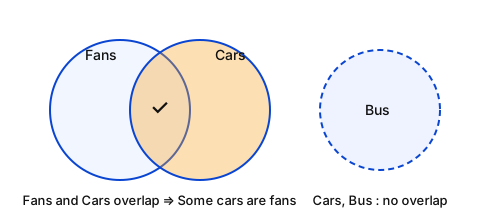
Concept: Draw the Venn diagram for the statements; a conclusion follows only if it is true in every possible diagram.

  1. "Some fans are cars" → fans and cars overlap. "No car is a bus" → cars and buses are separate.
  2. Conclusion I (some fans are buses): fans may or may not touch buses – not definite, does not follow.
  3. Conclusion II (some cars are fans): the converse of "some fans are cars" is always true → follows.

Trick: "Some A are B" ⇔ "Some B are A" always; a negative statement + a "some" never gives a definite positive link.

Answer: (B) Only conclusion (II) follows

अवधारणा: कथनों का वेन आरेख बनाएँ; निष्कर्ष तभी मान्य है जब वह हर संभव आरेख में सत्य हो।

  1. "कुछ fans, cars हैं" → fans और cars का अंश साझा। "कोई car, bus नहीं" → cars और buses अलग।
  2. निष्कर्ष I (कुछ fans, buses हैं): fans, buses को छू भी सकते हैं, नहीं भी – निश्चित नहीं, मान्य नहीं।
  3. निष्कर्ष II (कुछ cars, fans हैं): "कुछ fans, cars हैं" का विलोम सदैव सत्य → मान्य।

ट्रिक: "कुछ A, B हैं" ⇔ "कुछ B, A हैं" हमेशा; नकारात्मक कथन + "कुछ" से निश्चित सकारात्मक संबंध नहीं बनता।

उत्तर: (B) Only conclusion (II) follows

RRB NTPC Undergraduate CBT 1General Intelligence and ReasoningSyllogismRRB NTPC Undergraduate CBT 1 2025 · 9 May Shift 2 →
Q7773.
Which of the following letter-number clusters will replace the question mark (?) in the given series to make it logically complete?
MHL21 OJN29 QLP37 SNR45 ?
निम्नलिखित में से कौन-सा अक्षर-संख्या समूह दी गई शृंखला में प्रश्नचिह्न (?) के स्थान पर आकर उसे तार्किक रूप से पूर्ण करेगा?
MHL21 OJN29 QLP37 SNR45 ?
  1. AUPS54
  2. BUPS53
  3. CUPT53
  4. DUPT54
Show answer

Concept: Each letter position and the number move by a fixed step.

  1. Letters: M→O→Q→S (+2), H→J→L→N (+2), L→N→P→R (+2) → next S+2 = U, N+2 = P, R+2 = T → UPT.
  2. Numbers: 21, 29, 37, 45 (+8) → 53.

Trick: Options differ only in the third letter (S/T) and number (53 or 54) – check just those two.

Answer: (C) UPT53

अवधारणा: हर अक्षर स्थान और संख्या एक स्थिर अंतर से बढ़ती है।

  1. अक्षर: M→O→Q→S (+2), H→J→L→N (+2), L→N→P→R (+2) → अगला S+2 = U, N+2 = P, R+2 = T → UPT।
  2. संख्या: 21, 29, 37, 45 (+8) → 53।

ट्रिक: विकल्प केवल तीसरे अक्षर (S/T) और संख्या (53 या 54) में भिन्न हैं – बस वही जाँचें।

उत्तर: (C) UPT53

RRB NTPC Undergraduate CBT 1General Intelligence and ReasoningAlphanumeric seriesRRB NTPC Undergraduate CBT 1 2025 · 9 May Shift 2 →
Q7774.
If ‘+’ means ‘−’, ‘−’ means ‘×’, ‘×’ means ‘÷’, ‘÷’ means ‘+’, then what will come in place of the question mark (?) in the following equation?
322 × 23 − 14 ÷ 463 + 232 = ?
यदि ‘+’ का अर्थ ‘−’ है, ‘−’ का अर्थ ‘×’ है, ‘×’ का अर्थ ‘÷’ है, ‘÷’ का अर्थ ‘+’ है, तो निम्नलिखित समीकरण में प्रश्नचिह्न (?) के स्थान पर क्या आएगा?
322 × 23 − 14 ÷ 463 + 232 = ?
  1. A35
  2. B298
  3. C760
  4. D427
Show answer

Concept: Replace each symbol by its real meaning, then apply BODMAS.

  1. 322×23−14÷463+232 becomes 322÷23×14+463−232.
  2. 322÷23=14; 14×14=196.
  3. 196+463−232=659−232=427.

Trick: Rewrite the whole expression first, then solve ÷ and × before + and −.

Answer: (D) 427

अवधारणा: हर चिह्न को उसके वास्तविक अर्थ से बदलें, फिर BODMAS लगाएँ।

  1. 322×23−14÷463+232 बनता है 322÷23×14+463−232।
  2. 322÷23=14; 14×14=196।
  3. 196+463−232=659−232=427।

ट्रिक: पहले पूरा व्यंजक दोबारा लिखें, फिर ÷ और × को + और − से पहले हल करें।

उत्तर: (D) 427

RRB NTPC Undergraduate CBT 1General Intelligence and ReasoningMathematical operations (symbol substitution)RRB NTPC Undergraduate CBT 1 2025 · 9 May Shift 2 →
Q7775.
Town G is to the west of Town H. Town I is to the north of Town G. Town J is to the east of Town I. Town K is to the south of Town J. Town H is to the north-east of Town K. What is the position of Town G with respect to Town J?
नगर G, नगर H के पश्चिम में है। नगर I, नगर G के उत्तर में है। नगर J, नगर I के पूर्व में है। नगर K, नगर J के दक्षिण में है। नगर H, नगर K के उत्तर-पूर्व में है। नगर J के सापेक्ष नगर G की स्थिति क्या है?
  1. ASouth-westदक्षिण-पश्चिम
  2. BSouth-eastदक्षिण-पूर्व
  3. CNorth-eastउत्तर-पूर्व
  4. DNorth-westउत्तर-पश्चिम
Show answer

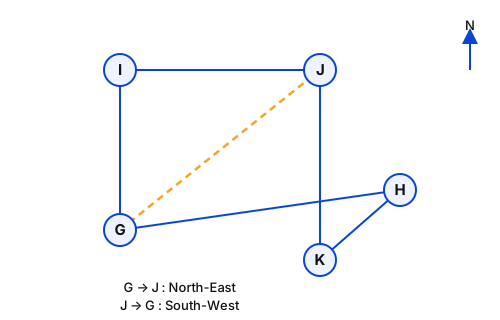
Concept: Plot the towns on a rough map with north upwards; relative direction is read from the first town towards the second.

  1. I is north of G, and J is east of I → J is to the north-east corner of the rectangle whose south-west corner is G.
  2. H (east of G) and K (south of J) only confirm the picture; they do not change G–J.
  3. From J, G lies down-left, i.e. G is to the south-west of J.

Trick: "G w.r.t. J" = stand at J and look for G; opposite of (J w.r.t. G = north-east).

Answer: (A) South-west

अवधारणा: उत्तर ऊपर रखकर कस्बों का मोटा नक्शा बनाएँ; सापेक्ष दिशा पहले कस्बे से दूसरे की ओर देखी जाती है।

  1. I, G के उत्तर में और J, I के पूर्व में → J उस आयत का उत्तर-पूर्व कोना है जिसका दक्षिण-पश्चिम कोना G है।
  2. H (G के पूर्व) और K (J के दक्षिण) केवल चित्र की पुष्टि करते हैं; G–J नहीं बदलते।
  3. J से G नीचे-बाएँ है, अर्थात G, J के दक्षिण-पश्चिम में।

ट्रिक: "J के सापेक्ष G" = J पर खड़े होकर G देखें; (G के सापेक्ष J = उत्तर-पूर्व) का उल्टा।

उत्तर: (A) South-west

RRB NTPC Undergraduate CBT 1General Intelligence and ReasoningDirection senseRRB NTPC Undergraduate CBT 1 2025 · 9 May Shift 2 →
Q7776.
In a certain code language,
A × B means ‘A is the son of B’,
A = B means ‘A is the brother of B’,
A + B means ‘A is the wife of B’ and
A − B means ‘A is the father of B’.
How is S related to Z if ‘S = W × R + T − Z’?
एक निश्चित कूट भाषा में,
A × B का अर्थ है ‘A, B का पुत्र है’,
A = B का अर्थ है ‘A, B का भाई है’,
A + B का अर्थ है ‘A, B की पत्नी है’ और
A − B का अर्थ है ‘A, B का पिता है’।
यदि ‘S = W × R + T − Z’ है, तो S, Z से किस प्रकार संबंधित है?
  1. AFatherपिता
  2. BSonपुत्र
  3. CBrotherभाई
  4. DHusbandपति
Show answer

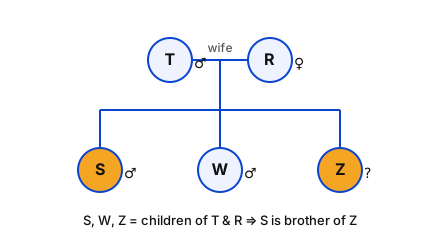
Concept: Decode pairwise from left to right and build the family tree.

  1. S = W → S is brother of W; W × R → W is son of R; R + T → R is wife of T; T − Z → T is father of Z.
  2. So T and R are the parents; S, W and Z are their children.
  3. S is male (brother), hence S is the brother of Z.

Trick: Symbols between consecutive letters each give one relation – chain them, do not skip.

Answer: (C) Brother

अवधारणा: बाएँ से दाएँ जोड़ी-जोड़ी कोड खोलें और वंश-वृक्ष बनाएँ।

  1. S = W → S, W का भाई; W × R → W, R का पुत्र; R + T → R, T की पत्नी; T − Z → T, Z का पिता।
  2. अतः T और R माता-पिता हैं; S, W और Z उनकी संतानें।
  3. S पुरुष है (भाई), इसलिए S, Z का भाई है।

ट्रिक: लगातार अक्षरों के बीच का हर चिह्न एक संबंध देता है – श्रृंखला बनाएँ, कोई छोड़ें नहीं।

उत्तर: (C) Brother

RRB NTPC Undergraduate CBT 1General Intelligence and ReasoningBlood relations (coded)RRB NTPC Undergraduate CBT 1 2025 · 9 May Shift 2 →
Q7777.
Based on the English alphabetical order, three of the following four letter-cluster pairs are alike in a certain way and thus form a group. Which is the one that does not belong to that group? (Note: The odd one out is not based on the number of
consonants/vowels or their position in the letter cluster.)
अंग्रेज़ी वर्णमाला क्रम के आधार पर, निम्नलिखित चार अक्षर-समूह युग्मों में से तीन किसी निश्चित प्रकार से एक समान हैं और इस प्रकार एक समूह बनाते हैं। वह कौन-सा है जो उस समूह से संबंधित नहीं है? (नोट: असंगत युग्म व्यंजनों/स्वरों की संख्या या अक्षर-समूह में उनकी स्थिति पर आधारित
नहीं है।)
  1. AOL-JQ
  2. BUR-PW
  3. CXU-SY
  4. DRO-MT
Show answer

Concept: Compare the position differences between corresponding letters of each pair.

  1. OL–JQ: O−5 = J, L+5 = Q. UR–PW: U−5 = P, R+5 = W. RO–MT: R−5 = M, O+5 = T.
  2. XU–SY: X−5 = S but U+4 = Y (U+5 would be Z) → pattern broken.

Trick: Pattern (−5, +5) – check the second letter of each pair quickly.

Answer: (C) XU-SY

अवधारणा: हर युग्म के संगत अक्षरों के स्थान-अंतर की तुलना करें।

  1. OL–JQ: O−5 = J, L+5 = Q। UR–PW: U−5 = P, R+5 = W। RO–MT: R−5 = M, O+5 = T।
  2. XU–SY: X−5 = S पर U+4 = Y (U+5 होता Z) → पैटर्न टूटा।

ट्रिक: पैटर्न (−5, +5) – हर युग्म का दूसरा अक्षर जल्दी जाँचें।

उत्तर: (C) XU-SY

RRB NTPC Undergraduate CBT 1General Intelligence and ReasoningOdd one out (letter pairs)RRB NTPC Undergraduate CBT 1 2025 · 9 May Shift 2 →
Q7778.
In the following triad, each group of letters is related to the subsequent one following a certain logic. Select, from the given options, the one which follows the same logic. SAID - AISD - DIAS
MODE - ODME - EDOM
निम्नलिखित त्रिक में, अक्षरों का प्रत्येक समूह एक निश्चित तर्क के अनुसार अपने बाद वाले समूह से संबंधित है। दिए गए विकल्पों में से उस विकल्प का चयन कीजिए जो समान तर्क का अनुसरण करता है। SAID - AISD - DIAS
MODE - ODME - EDOM
  1. AHOGS - OHGS - SOGH
  2. BTONG - ONTG - GNOT
  3. CUGLY - GLUY - GLYU
  4. DMIND - MNID - DNIM
Show answer

Concept: Find how positions 1-2-3-4 are shuffled in each step.

  1. SAID → AISD: order 2-3-1-4; AISD → DIAS = reverse of SAID (4-3-2-1). MODE → ODME (2-3-1-4) → EDOM (reverse) confirms.
  2. TONG → 2-3-1-4 gives ONTG ✓; reverse of TONG = GNOT ✓.
  3. HOGS→OHGS swaps only first two; UGLY→GLYU is not the reverse; MIND→MNID fails the first step.

Trick: Third word = first word written backwards – test that first, it eliminates fast.

Answer: (B) TONG - ONTG - GNOT

अवधारणा: देखें कि हर चरण में स्थान 1-2-3-4 कैसे बदलते हैं।

  1. SAID → AISD: क्रम 2-3-1-4; AISD → DIAS = SAID का उल्टा (4-3-2-1)। MODE → ODME (2-3-1-4) → EDOM (उल्टा) से पुष्टि।
  2. TONG → 2-3-1-4 से ONTG ✓; TONG का उल्टा = GNOT ✓।
  3. HOGS→OHGS में केवल पहले दो बदले; UGLY→GLYU उल्टा नहीं; MIND→MNID पहला चरण ही गलत।

ट्रिक: तीसरा शब्द = पहला शब्द उल्टा – इसे पहले जाँचें, विकल्प जल्दी कटते हैं।

उत्तर: (B) TONG - ONTG - GNOT

RRB NTPC Undergraduate CBT 1General Intelligence and ReasoningLetter cluster analogyRRB NTPC Undergraduate CBT 1 2025 · 9 May Shift 2 →
Q7779.
Seven people H, I, J, K, W, Y and Z are sitting in a row facing north. Only J sits to the left of W. Only four people sit between J and Y. Only I sits between K and H and K is not an immediate neighbor of Y. How many people sit to the right of Z?
सात व्यक्ति H, I, J, K, W, Y और Z उत्तर की ओर मुख करके एक पंक्ति में बैठे हैं। W के बाएँ केवल J बैठा है। J और Y के बीच केवल चार व्यक्ति बैठे हैं। K और H के बीच केवल I बैठा है और K, Y का निकटतम पड़ोसी नहीं है। Z के दाएँ कितने व्यक्ति बैठे हैं?
  1. AThreeतीन
  2. BOneएक
  3. CNoneकोई नहीं
  4. DTwoदो
Show answer

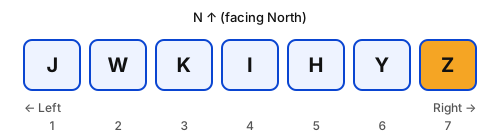
Concept: "Only J sits to the left of W" fixes both ends of the row at once.

  1. J is at position 1 (extreme left) and W at 2. Four people between J and Y → Y at 6.
  2. K–I–H (or H–I–K) must be consecutive in seats 3-4-5; K cannot be next to Y (seat 6), so K3, I4, H5.
  3. Z takes the last seat 7 → none sit to the right of Z.

Trick: "Only X sits to the left of Y" ⇒ X is at the extreme left, Y second.

Answer: (C) None

अवधारणा: "W के बाएँ केवल J बैठा है" – इससे पंक्ति के दोनों छोर एक साथ तय हो जाते हैं।

  1. J स्थान 1 (बाएँ छोर) पर और W 2 पर। J और Y के बीच चार लोग → Y 6 पर।
  2. K–I–H (या H–I–K) सीट 3-4-5 पर लगातार; K, Y (सीट 6) का पड़ोसी नहीं, अतः K3, I4, H5।
  3. Z अंतिम सीट 7 पर → Z के दाएँ कोई नहीं।

ट्रिक: "Y के बाएँ केवल X" ⇒ X बाएँ छोर पर, Y दूसरे स्थान पर।

उत्तर: (C) None

RRB NTPC Undergraduate CBT 1General Intelligence and ReasoningLinear seating arrangementRRB NTPC Undergraduate CBT 1 2025 · 9 May Shift 2 →
Q7780.
What should come in place of ‘?’ in the given series?
38 55 74 95 118 ?
दी गई शृंखला में ‘?’ के स्थान पर क्या आना चाहिए?
38 55 74 95 118 ?
  1. A161
  2. B143
  3. C155
  4. D152
Show answer

Concept: Take successive differences and look for a pattern.

  1. 55−38=17, 74−55=19, 95−74=21, 118−95=23 – differences are consecutive odd numbers.
  2. Next difference = 25 → 118+25=143.

Trick: Equal second differences (2, 2, 2…) → next term is just previous + (last difference + 2).

Answer: (B) 143

अवधारणा: क्रमागत अंतर निकालें और पैटर्न देखें।

  1. 55−38=17, 74−55=19, 95−74=21, 118−95=23 – अंतर क्रमागत विषम संख्याएँ हैं।
  2. अगला अंतर = 25 → 118+25=143।

ट्रिक: द्वितीय अंतर समान (2, 2, 2…) → अगला पद = पिछला + (अंतिम अंतर + 2)।

उत्तर: (B) 143

RRB NTPC Undergraduate CBT 1General Intelligence and ReasoningNumber seriesRRB NTPC Undergraduate CBT 1 2025 · 9 May Shift 2 →