Question bank

Q&A: practice questions with answers

Search questions on any topic. Filter by exam category, exam, subject and topic, try the question, then open the answer and explanation.

Courses – airGurukul

8,495 questions found.

Q7781.
WT 16 is related to XW -1 in a certain way. In the same way, DE 9 is related to EH -8. To which of the following is NK 19 related, following the same logic?
WT 16, XW -1 से एक निश्चित प्रकार से संबंधित है। उसी प्रकार, DE 9, EH -8 से संबंधित है। समान तर्क का अनुसरण करते हुए, NK 19 निम्नलिखित में से किससे संबंधित है?
  1. AUY 1
  2. BNJ 7
  3. CON 2
  4. DTY 5
Show answer

Concept: Find the shift of each letter and the change in the number from the two given pairs.

  1. WT 16 → XW −1: W+1 = X, T+3 = W, 16−17 = −1. DE 9 → EH −8: D+1 = E, E+3 = H, 9−17 = −8.
  2. Apply to NK 19: N+1 = O, K+3 = N, 19−17 = 2 → ON 2.

Trick: Rule: (+1, +3, −17); the number part alone (19−17 = 2) picks the option.

Answer: (C) ON 2

अवधारणा: दिए गए दो युग्मों से हर अक्षर का शिफ्ट और संख्या का परिवर्तन निकालें।

  1. WT 16 → XW −1: W+1 = X, T+3 = W, 16−17 = −1। DE 9 → EH −8: D+1 = E, E+3 = H, 9−17 = −8।
  2. NK 19 पर लगाएँ: N+1 = O, K+3 = N, 19−17 = 2 → ON 2।

ट्रिक: नियम: (+1, +3, −17); अकेला संख्या भाग (19−17 = 2) ही विकल्प चुन देता है।

उत्तर: (C) ON 2
RRB NTPC Undergraduate CBT 1General Intelligence and ReasoningLetter-number analogyRRB NTPC Undergraduate CBT 1 2025 · 9 May Shift 2 →
Q7782.
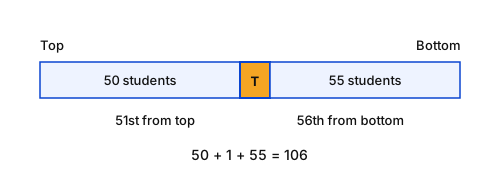
Tus ranked 56th from the bottom and 51st from the top in his class. How many students are there in his class?
तुस अपनी कक्षा में नीचे से 56वें और ऊपर से 51वें स्थान पर है। उसकी कक्षा में कितने विद्यार्थी हैं?
  1. A107
  2. B106
  3. C105
  4. D108
Show answer

Concept: When one person's rank is given from both ends, total = (rank from top) + (rank from bottom) − 1, since the person is counted twice.

  1. 51st from top → 50 students above; 56th from bottom → 55 students below.
  2. Total = 50+1+55=51+56−1=106.

Trick: Top + Bottom − 1 (same person counted in both).

Answer: (B) 106

अवधारणा: जब एक व्यक्ति का स्थान दोनों ओर से दिया हो, कुल = (ऊपर से स्थान) + (नीचे से स्थान) − 1, क्योंकि वह दो बार गिना गया है।

  1. ऊपर से 51वाँ → ऊपर 50 छात्र; नीचे से 56वाँ → नीचे 55 छात्र।
  2. कुल = 50+1+55=51+56−1=106।

ट्रिक: ऊपर + नीचे − 1 (एक ही व्यक्ति दोनों में गिना गया)।

उत्तर: (B) 106

RRB NTPC Undergraduate CBT 1General Intelligence and ReasoningRankingRRB NTPC Undergraduate CBT 1 2025 · 9 May Shift 2 →
Q7783.
QQ 5 is related to VR -6 in a certain way. In the same way, LV 12 is related to QW 1. To which of the following is ES 16 related, following the same logic?
QQ 5, VR -6 से एक निश्चित प्रकार से संबंधित है। उसी प्रकार, LV 12, QW 1 से संबंधित है। समान तर्क का अनुसरण करते हुए, ES 16 निम्नलिखित में से किससे संबंधित है?
  1. AYT 4
  2. BJT 5
  3. CUG 3
  4. DRW 1
Show answer

Concept: Work out the letter shifts and the number change from the given pairs.

  1. QQ 5 → VR −6: Q+5 = V, Q+1 = R, 5−11 = −6. LV 12 → QW 1: L+5 = Q, V+1 = W, 12−11 = 1.
  2. ES 16: E+5 = J, S+1 = T, 16−11 = 5 → JT 5.

Trick: Rule (+5, +1, −11); "16−11 = 5" alone separates JT 5 from the rest.

Answer: (B) JT 5

अवधारणा: दिए गए युग्मों से अक्षर शिफ्ट और संख्या परिवर्तन निकालें।

  1. QQ 5 → VR −6: Q+5 = V, Q+1 = R, 5−11 = −6। LV 12 → QW 1: L+5 = Q, V+1 = W, 12−11 = 1।
  2. ES 16: E+5 = J, S+1 = T, 16−11 = 5 → JT 5।

ट्रिक: नियम (+5, +1, −11); अकेला "16−11 = 5" ही JT 5 को अलग कर देता है।

उत्तर: (B) JT 5

RRB NTPC Undergraduate CBT 1General Intelligence and ReasoningLetter-number analogyRRB NTPC Undergraduate CBT 1 2025 · 9 May Shift 2 →
Q7784.
In a certain code language, "EUOA" is coded as "53" and "YFMP" is coded as "71". What is the code for "RIZB" in that given language?
एक निश्चित कूट भाषा में, "EUOA" को "53" के रूप में कूटबद्ध किया जाता है और "YFMP" को "71" के रूप में कूटबद्ध किया जाता है। उस कूट भाषा में "RIZB" का कूट क्या है?
  1. A56
  2. B66
  3. C60
  4. D58
Show answer

Concept: Try the sum of alphabetical positions and see what constant links it to the code.

  1. EUOA: 5+21+15+1=42; code 53 → 42+11. YFMP: 25+6+13+16=60; code 71 → 60+11.
  2. RIZB: 18+9+26+2=55; code = 55+11=66.

Trick: Code = (sum of positions) + 11 – always test "sum + constant" first in 4-letter number codes.

Answer: (B) 66

अवधारणा: वर्णमाला स्थानों का योग लें और देखें कोड से कौन-सा स्थिरांक जोड़ता है।

  1. EUOA: 5+21+15+1=42; कोड 53 → 42+11। YFMP: 25+6+13+16=60; कोड 71 → 60+11।
  2. RIZB: 18+9+26+2=55; कोड = 55+11=66।

ट्रिक: कोड = (स्थानों का योग) + 11 – 4-अक्षरी संख्या कोड में पहले "योग + स्थिरांक" जाँचें।

उत्तर: (B) 66

RRB NTPC Undergraduate CBT 1General Intelligence and ReasoningCoding–Decoding (number code)RRB NTPC Undergraduate CBT 1 2025 · 9 May Shift 2 →
Q7785.
What should come in place of '?' in the given series based on the English alphabetical order?
TGA WJD ZMG CPJ ?
अंग्रेज़ी वर्णमाला क्रम के आधार पर दी गई शृंखला में '?' के स्थान पर क्या आना चाहिए?
TGA WJD ZMG CPJ ?
  1. AFSM
  2. BERL
  3. CDPN
  4. DGTC
Show answer

Concept: Compare the same position across consecutive clusters.

  1. First letters: T→W→Z→C (+3); second: G→J→M→P (+3); third: A→D→G→J (+3).
  2. Next: C+3 = F, P+3 = S, J+3 = M → FSM.

Trick: Every letter +3; within a cluster the letters also drop by 13 and 6 (T−13 = G, G−6 = A) – a quick double check.

Answer: (A) FSM

अवधारणा: लगातार समूहों में समान स्थान के अक्षरों की तुलना करें।

  1. पहले अक्षर: T→W→Z→C (+3); दूसरे: G→J→M→P (+3); तीसरे: A→D→G→J (+3)।
  2. अगला: C+3 = F, P+3 = S, J+3 = M → FSM।

ट्रिक: हर अक्षर +3; समूह के भीतर भी अक्षर 13 और 6 घटते हैं (T−13 = G, G−6 = A) – त्वरित जाँच।

उत्तर: (A) FSM

RRB NTPC Undergraduate CBT 1General Intelligence and ReasoningLetter seriesRRB NTPC Undergraduate CBT 1 2025 · 9 May Shift 2 →
Q7786.
Select the set in which the numbers are related in the same way as are the numbers of the following sets.
(Note: Operations should be performed on the whole numbers, without breaking down the numbers into their constituent digits. E.g. 13 – Operations on 13 such as
adding/subtracting/multiplying to 13 can be performed. Breaking down 13 into 1 and 3 and then performing mathematical operations on 1 and 3 is not allowed.)
(163, 186, 23)
(144, 200, 56)
उस समुच्चय का चयन कीजिए जिसमें संख्याएँ उसी प्रकार संबंधित हैं जिस प्रकार निम्नलिखित समुच्चयों की संख्याएँ संबंधित हैं।
(नोट: संक्रियाएँ पूर्ण संख्याओं पर की जानी चाहिए, संख्याओं को उनके घटक अंकों में तोड़े बिना। उदाहरण के लिए 13 – 13 पर संक्रियाएँ जैसे
13 में जोड़ना/घटाना/गुणा करना किया जा सकता है। 13 को 1 और 3 में तोड़कर फिर 1 और 3 पर गणितीय संक्रियाएँ करने की अनुमति नहीं है।)
(163, 186, 23)
(144, 200, 56)
  1. A(141, 229, 98)
  2. B(113, 178, 65)
  3. C(135, 187, 62)
  4. D(201, 243, 43)
Show answer

Concept: Test simple relations among the three numbers – here the third is the difference of the first two.

  1. 186−163=23 ✓ and 200−144=56 ✓, so (second − first) = third.
  2. Options: 229−141=88 ✗, 178−113=65 ✓, 187−135=52 ✗, 243−201=42 ✗.

Trick: In (a, b, c) sets always check b − a, a + b and a × b first.

Answer: (B) (113, 178, 65)

अवधारणा: तीनों संख्याओं में सरल संबंध जाँचें – यहाँ तीसरी = पहली दो का अंतर।

  1. 186−163=23 ✓ और 200−144=56 ✓, अतः (दूसरी − पहली) = तीसरी।
  2. विकल्प: 229−141=88 ✗, 178−113=65 ✓, 187−135=52 ✗, 243−201=42 ✗।

ट्रिक: (a, b, c) समुच्चय में हमेशा पहले b − a, a + b और a × b जाँचें।

उत्तर: (B) (113, 178, 65)

RRB NTPC Undergraduate CBT 1General Intelligence and ReasoningNumber analogy (triplets)RRB NTPC Undergraduate CBT 1 2025 · 9 May Shift 2 →
Q7787.
Based on the English alphabetical order, three of the following four are alike in a certain way and thus form a group. Which is the one that does not belong to that group? (Note: The odd man out is not based on the number of consonants/vowels or their position in the letter cluster.)
अंग्रेज़ी वर्णमाला क्रम के आधार पर, निम्नलिखित चार में से तीन किसी निश्चित प्रकार से एक समान हैं और इस प्रकार एक समूह बनाते हैं। वह कौन-सा है जो उस समूह से संबंधित नहीं है? (नोट: असंगत विकल्प व्यंजनों/स्वरों की संख्या या अक्षर-समूह में उनकी स्थिति पर आधारित नहीं है।)
  1. AFGC
  2. BBCY
  3. CLNI
  4. DNOK
Show answer

Concept: Write the alphabetical positions and compare the gaps.

  1. FGC: 6, 7, 3 → +1, −4. BCY: 2, 3, 25 → +1, −4 (3−4 = −1 → wraps to 25 = Y). NOK: 14, 15, 11 → +1, −4.
  2. LNI: 12, 14, 9 → +2, −5 → different pattern.

Trick: Three options share "+1, −4"; LNI is the only one whose first two letters are not consecutive.

Answer: (C) LNI

अवधारणा: वर्णमाला स्थान लिखकर अंतर तुलना करें।

  1. FGC: 6, 7, 3 → +1, −4। BCY: 2, 3, 25 → +1, −4 (3−4 = −1 → घूमकर 25 = Y)। NOK: 14, 15, 11 → +1, −4।
  2. LNI: 12, 14, 9 → +2, −5 → अलग पैटर्न।

ट्रिक: तीन विकल्पों में "+1, −4"; केवल LNI के पहले दो अक्षर लगातार नहीं हैं।

उत्तर: (C) LNI

RRB NTPC Undergraduate CBT 1General Intelligence and ReasoningOdd one out (letter clusters)RRB NTPC Undergraduate CBT 1 2025 · 9 May Shift 2 →
Q7788.
Refer to the following letter series and answer the question that follows. Counting to be done from left to right only.
(Left) U L Y M R D E L C D A E H R O H F X L D W H (Right)
How many such vowels are there, each of which is immediately preceded by a consonant and also immediately followed by a consonant?
निम्नलिखित अक्षर शृंखला को देखिए और उसके बाद दिए गए प्रश्न का उत्तर दीजिए। गिनती केवल बाएँ से दाएँ की ओर की जानी है।
(बाएँ) U L Y M R D E L C D A E H R O H F X L D W H (दाएँ)
ऐसे कितने स्वर हैं, जिनमें से प्रत्येक के ठीक पहले एक व्यंजन है और ठीक बाद भी एक व्यंजन है?
  1. AFourचार
  2. BTwoदो
  3. COneएक
  4. DThreeतीन
Show answer

Concept: Mark each vowel and inspect its immediate neighbours; Y is treated as a consonant.

  1. Series: U L Y M R D E L C D A E H R O H F X L D W H. Vowels: U, E, A, E, O.
  2. U has no letter before it; A is followed by vowel E; E (12th) is preceded by vowel A – all fail.
  3. E (7th): D–E–L ✓ and O (15th): R–O–H ✓ → Two.

Trick: Circle the vowels first, then check only their two neighbours.

Answer: (B) Two

अवधारणा: हर स्वर पर निशान लगाएँ और उसके दोनों पड़ोसी देखें; Y व्यंजन माना जाता है।

  1. श्रृंखला: U L Y M R D E L C D A E H R O H F X L D W H। स्वर: U, E, A, E, O।
  2. U से पहले कोई अक्षर नहीं; A के बाद स्वर E; E (12वाँ) से पहले स्वर A – तीनों अयोग्य।
  3. E (7वाँ): D–E–L ✓ और O (15वाँ): R–O–H ✓ → दो।

ट्रिक: पहले स्वरों पर गोला लगाएँ, फिर केवल उनके दो पड़ोसी जाँचें।

उत्तर: (B) Two

RRB NTPC Undergraduate CBT 1General Intelligence and ReasoningLetter series countingRRB NTPC Undergraduate CBT 1 2025 · 9 May Shift 2 →
Q7789.
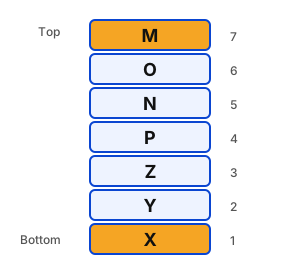
Seven boxes M, N, O, P, X, Y and Z are kept one over the other but not necessarily in the same order. Y is kept second from the bottom. Only three boxes are kept between Y and O. X is kept at one of the positions below Y. Only N is kept between O and P. M is kept at one of the positions above O. How many boxes are kept between X and M?
सात बक्से M, N, O, P, X, Y और Z एक के ऊपर एक रखे गए हैं, लेकिन आवश्यक नहीं कि इसी क्रम में हों। Y नीचे से दूसरे स्थान पर रखा गया है। Y और O के बीच केवल तीन बक्से रखे गए हैं। X, Y के नीचे किसी एक स्थान पर रखा गया है। O और P के बीच केवल N रखा गया है। M, O के ऊपर किसी एक स्थान पर रखा गया है। X और M के बीच कितने बक्से रखे गए हैं?
  1. AThreeतीन
  2. BOneएक
  3. CFourचार
  4. DFiveपाँच
Show answer

Concept: Number the positions 1 (bottom) to 7 (top) and place the fixed boxes first.

  1. Y = 2. Three boxes between Y and O → O = 6. X below Y → X = 1.
  2. Only N between O and P → P = 4, N = 5 (position 8 does not exist). M above O → M = 7; Z takes 3.
  3. Order (bottom→top): X Y Z P N O M. Between X (1) and M (7): Y, Z, P, N, O = Five.

Trick: "k boxes between A and B" means the positions differ by k + 1.

Answer: (D) Five

अवधारणा: स्थान 1 (नीचे) से 7 (ऊपर) तक गिनें और पहले निश्चित बॉक्स रखें।

  1. Y = 2। Y और O के बीच तीन बॉक्स → O = 6। X, Y से नीचे → X = 1।
  2. O और P के बीच केवल N → P = 4, N = 5 (स्थान 8 नहीं है)। M, O से ऊपर → M = 7; Z 3 पर।
  3. क्रम (नीचे→ऊपर): X Y Z P N O M। X (1) और M (7) के बीच: Y, Z, P, N, O = पाँच।

ट्रिक: "A और B के बीच k बॉक्स" = स्थानों का अंतर k + 1।

उत्तर: (D) Five

RRB NTPC Undergraduate CBT 1General Intelligence and ReasoningBox arrangement (stacking)RRB NTPC Undergraduate CBT 1 2025 · 9 May Shift 2 →
Q7790.
​Based on the English alphabetical order, three of the following four letter-clusters are alike in a certain way and thus form a group. Which is the one that DOES NOT belong to that group?
(Note: The odd one out is not based on the number of consonants/vowels or their position in the letter-cluster.)
​अंग्रेज़ी वर्णमाला क्रम के आधार पर, निम्नलिखित चार अक्षर-समूहों में से तीन किसी निश्चित प्रकार से एक समान हैं और इस प्रकार एक समूह बनाते हैं। वह कौन-सा है जो उस समूह से संबंधित नहीं है?
(नोट: असंगत विकल्प व्यंजनों/स्वरों की संख्या या अक्षर-समूह में उनकी स्थिति पर आधारित नहीं है।)
  1. ATPR
  2. BNJK
  3. CPLN
  4. DVRT
Show answer

Concept: Convert to positions and compare the two gaps.

  1. TPR: 20, 16, 18 → −4, +2. PLN: 16, 12, 14 → −4, +2. VRT: 22, 18, 20 → −4, +2.
  2. NJK: 14, 10, 11 → −4, +1 → odd one.

Trick: Third letter = first − 2 in the group (T→R, P→N, V→T) but N→K is −3.

Answer: (B) NJK

अवधारणा: स्थानों में बदलकर दोनों अंतर तुलना करें।

  1. TPR: 20, 16, 18 → −4, +2। PLN: 16, 12, 14 → −4, +2। VRT: 22, 18, 20 → −4, +2।
  2. NJK: 14, 10, 11 → −4, +1 → असंगत।

ट्रिक: समूह में तीसरा अक्षर = पहला − 2 (T→R, P→N, V→T) पर N→K में −3 है।

उत्तर: (B) NJK

RRB NTPC Undergraduate CBT 1General Intelligence and ReasoningOdd one out (letter clusters)RRB NTPC Undergraduate CBT 1 2025 · 9 May Shift 2 →
Q7791.
What should come in place of ‘?’ in the given series?
90 91 ? 126 190 315
दी गई शृंखला में ‘?’ के स्थान पर क्या आना चाहिए?
90 91 ? 126 190 315
  1. A101
  2. B91
  3. C99
  4. D111
Show answer

Concept: Look at the differences – they are perfect cubes.

  1. 91−90=1=13, 190−126=64=43, 315−190=125=53. So the differences are 13,23,33,43,53.
  2. Missing term = 91+23=99; check: 99+33=126 ✓.

Trick: Differences 1, 8, 27, 64, 125 – memorise cubes up to 10.

Answer: (C) 99

अवधारणा: अंतर देखें – वे पूर्ण घन हैं।

  1. 91−90=1=13, 190−126=64=43, 315−190=125=53। अतः अंतर 13,23,33,43,53 हैं।
  2. लुप्त पद = 91+23=99; जाँच: 99+33=126 ✓।

ट्रिक: अंतर 1, 8, 27, 64, 125 – 10 तक के घन याद रखें।

उत्तर: (C) 99

RRB NTPC Undergraduate CBT 1General Intelligence and ReasoningNumber seriesRRB NTPC Undergraduate CBT 1 2025 · 9 May Shift 2 →
Q7792.
Read the given statements and conclusions carefully. You have to take the given statements to be true even if they seem to be at variance from commonly known facts. You have to decide which conclusions logically follow/s from the given statements. Statements: All routers are dongles. All routers are phones.
Conclusion (I) : Some dongles are phones
Conclusion (II) : All phones are routers
दिए गए कथनों और निष्कर्षों को ध्यानपूर्वक पढ़िए। आपको दिए गए कथनों को सत्य मानना है, भले ही वे सामान्यतः ज्ञात तथ्यों से भिन्न प्रतीत होते हों। आपको निर्णय करना है कि दिए गए कथनों का कौन-सा/कौन-से निष्कर्ष तार्किक रूप से अनुसरण करता है/करते हैं। कथन: सभी राउटर, डोंगल हैं। सभी राउटर, फ़ोन हैं।
निष्कर्ष (I) : कुछ डोंगल, फ़ोन हैं
निष्कर्ष (II) : सभी फ़ोन, राउटर हैं
  1. ANeither conclusion (I) nor (II) followsन तो निष्कर्ष (I) और न ही (II) अनुसरण करता है
  2. BOnly conclusion (I) followsकेवल निष्कर्ष (I) अनुसरण करता है
  3. CBoth conclusions (I) and (II) followनिष्कर्ष (I) और (II) दोनों अनुसरण करते हैं
  4. DOnly conclusion (II) followsकेवल निष्कर्ष (II) अनुसरण करता है
Show answer

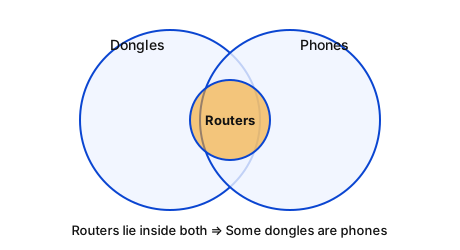
Concept: Draw the diagram: "All routers are dongles" and "All routers are phones" put the routers circle inside both dongles and phones.

  1. Since routers lie in both sets, dongles and phones must overlap at least there → Conclusion I "Some dongles are phones" follows.
  2. Conclusion II "All phones are routers" reverses an "All" statement – phones may extend far beyond routers → does not follow.

Trick: All A are B + All A are C ⇒ Some B are C (A is the common part); "All" never converts to "All".

Answer: (B) Only conclusion (I) follows

अवधारणा: आरेख बनाएँ: "सभी routers, dongles हैं" और "सभी routers, phones हैं" – routers का वृत्त dongles और phones दोनों के अंदर।

  1. routers दोनों समुच्चयों में हैं, अतः dongles और phones कम से कम वहाँ साझा → निष्कर्ष I "कुछ dongles, phones हैं" मान्य।
  2. निष्कर्ष II "सभी phones, routers हैं" – "सभी" कथन का उल्टा; phones, routers से बहुत बड़े हो सकते हैं → मान्य नहीं।

ट्रिक: सभी A, B हैं + सभी A, C हैं ⇒ कुछ B, C हैं (A साझा भाग); "सभी" कभी उल्टा "सभी" नहीं बनता।

उत्तर: (B) Only conclusion (I) follows

RRB NTPC Undergraduate CBT 1General Intelligence and ReasoningSyllogismRRB NTPC Undergraduate CBT 1 2025 · 9 May Shift 2 →
Q7793.
In a certain code language,
A x B means ‘A is the mother of B’,
A ≠ B means ‘A is the wife of B’,
A ÷ B means ‘A is the daughter of B’ and
A ₹ B means ‘A is the father of B’.
Based on the above, how is C related to M if 'C ÷ D ≠ E ₹ L x M'?
एक निश्चित कूट भाषा में,
A x B का अर्थ है ‘A, B की माता है’,
A ≠ B का अर्थ है ‘A, B की पत्नी है’,
A ÷ B का अर्थ है ‘A, B की पुत्री है’ और
A ₹ B का अर्थ है ‘A, B का पिता है’।
उपरोक्त के आधार पर, यदि 'C ÷ D ≠ E ₹ L x M' है, तो C, M से किस प्रकार संबंधित है?
  1. ASon's wife's sisterपुत्र की पत्नी की बहन
  2. BSon's wifeपुत्र की पत्नी
  3. CWife's sisterपत्नी की बहन
  4. DMother's sisterमाता की बहन
Show answer

Concept: Decode each adjacent pair and draw the tree.

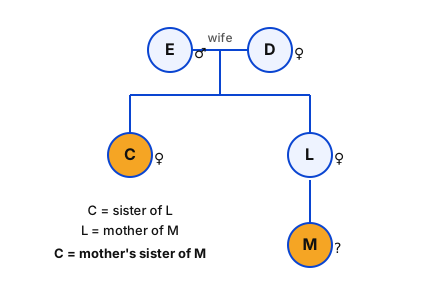
  1. C ÷ D → C is daughter of D; D ≠ E → D is wife of E; E ₹ L → E is father of L; L x M → L is mother of M.
  2. D and E are a couple; their children are C and L (both female). L is M's mother.
  3. C is the sister of M's mother → mother's sister (maternal aunt).

Trick: Daughter of D, who is wife of E, father of L ⇒ C and L are siblings; then go one level down to M.

Answer: (D) Mother's sister

अवधारणा: हर पड़ोसी जोड़ी को खोलें और वृक्ष बनाएँ।

  1. C ÷ D → C, D की पुत्री; D ≠ E → D, E की पत्नी; E ₹ L → E, L का पिता; L x M → L, M की माता।
  2. D और E दंपति हैं; उनकी संतानें C और L (दोनों स्त्री)। L, M की माता है।
  3. C, M की माता की बहन → माता की बहन (मौसी)।

ट्रिक: C, D की पुत्री; D, E की पत्नी; E, L का पिता ⇒ C और L बहनें; फिर एक स्तर नीचे M।

उत्तर: (D) Mother's sister

RRB NTPC Undergraduate CBT 1General Intelligence and ReasoningBlood relations (coded)RRB NTPC Undergraduate CBT 1 2025 · 9 May Shift 2 →
Q7794.
Seven boxes B, C, D, E, Q, R and S are kept one over the other but not necessarily in the same order. Only one box is kept above R. Only two boxes are kept between R and S. Only three boxes are kept between D and S. Only Q is kept below C. B is not kept immediately above S. How many boxes are kept between E and Q?
सात बक्से B, C, D, E, Q, R और S एक के ऊपर एक रखे गए हैं, लेकिन आवश्यक नहीं कि इसी क्रम में हों। R के ऊपर केवल एक बक्सा रखा गया है। R और S के बीच केवल दो बक्से रखे गए हैं। D और S के बीच केवल तीन बक्से रखे गए हैं। C के नीचे केवल Q रखा गया है। B, S के ठीक ऊपर नहीं रखा गया है। E और Q के बीच कितने बक्से रखे गए हैं?
  1. AThreeतीन
  2. BOneएक
  3. CTwoदो
  4. DFourचार
Show answer

Concept: Number positions 1 (bottom) to 7 (top) and place fixed boxes first.

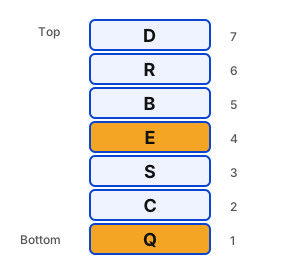
  1. Only one box above R → R = 6. Two boxes between R and S → S = 3. Three boxes between D and S → D = 7.
  2. Only Q below C → Q = 1, C = 2. Remaining B and E go to 4 and 5; B is not immediately above S (not 4) → B = 5, E = 4.
  3. Order (bottom→top): Q C S E B R D. Between E (4) and Q (1): C and S = Two.

Trick: Clues like "only one above" / "only X below" fix the ends instantly – start there.

Answer: (C) Two

अवधारणा: स्थान 1 (नीचे) से 7 (ऊपर) तक गिनें और निश्चित बॉक्स पहले रखें।

  1. R के ऊपर केवल एक → R = 6। R और S के बीच दो → S = 3। D और S के बीच तीन → D = 7।
  2. C के नीचे केवल Q → Q = 1, C = 2। बचे B, E स्थान 4, 5 पर; B, S के ठीक ऊपर नहीं (4 नहीं) → B = 5, E = 4।
  3. क्रम (नीचे→ऊपर): Q C S E B R D। E (4) और Q (1) के बीच: C और S = दो।

ट्रिक: "ऊपर केवल एक" / "नीचे केवल X" जैसी सूचनाएँ छोर तुरंत तय करती हैं – वहीं से शुरू करें।

उत्तर: (C) Two

RRB NTPC Undergraduate CBT 1General Intelligence and ReasoningBox arrangement (stacking)RRB NTPC Undergraduate CBT 1 2025 · 9 May Shift 2 →
Q7795.
If 2 is added to each even digit and 1 is subtracted from each odd digit in the number 63145729, then how many digits will appear more than once in the new number thus formed?
यदि संख्या 63145729 में प्रत्येक सम अंक में 2 जोड़ा जाए और प्रत्येक विषम अंक में से 1 घटाया जाए, तो इस प्रकार बनी नई संख्या में कितने अंक एक से अधिक बार आएँगे?
  1. AThreeतीन
  2. BTwoदो
  3. COneएक
  4. DFourचार
Show answer

Concept: Apply the rule digit by digit, then count repeated digits.

  1. 6 3 1 4 5 7 2 9: even +2 → 6→8, 4→6, 2→4; odd −1 → 3→2, 1→0, 5→4, 7→6, 9→8.
  2. New number: 8 2 0 6 4 6 4 8. Digits 8, 6 and 4 each appear twice → Three digits appear more than once.

Trick: Write new digits below the old ones; 0 counts as a digit but here it appears once.

Answer: (A) Three

अवधारणा: नियम अंक-दर-अंक लगाएँ, फिर दोहराए गए अंक गिनें।

  1. 6 3 1 4 5 7 2 9: सम +2 → 6→8, 4→6, 2→4; विषम −1 → 3→2, 1→0, 5→4, 7→6, 9→8।
  2. नई संख्या: 8 2 0 6 4 6 4 8। अंक 8, 6 और 4 दो-दो बार → तीन अंक एक से अधिक बार।

ट्रिक: नए अंक पुराने के नीचे लिखें; 0 भी अंक है पर यहाँ एक बार ही आया।

उत्तर: (A) Three

RRB NTPC Undergraduate CBT 1General Intelligence and ReasoningNumber operationsRRB NTPC Undergraduate CBT 1 2025 · 9 May Shift 2 →
Q7796.
Which session of the UN Climate Change Conference was held in Baku, Azerbaijan, in November 2024?
संयुक्त राष्ट्र जलवायु परिवर्तन सम्मेलन का कौन-सा सत्र नवंबर 2024 में बाकू, अज़रबैजान में आयोजित किया गया था?
  1. ACOP27
  2. BCOP28
  3. CCOP29
  4. DCOP26
Show answer

Concept: The annual UN Climate Change Conference (COP) is numbered consecutively; the host changes every year.

  1. COP29 was held in Baku, Azerbaijan, 11–22 November 2024; it agreed a new climate-finance goal of US$300 billion a year by 2035.
  2. COP27 – Sharm el-Sheikh (2022); COP28 – Dubai (2023); COP26 – Glasgow (2021).

Yaad rakhein: Glasgow 26 → Sharm 27 → Dubai 28 → Baku 29 → Belém (Brazil) 30 in 2025.

Answer: (C) COP29

अवधारणा: संयुक्त राष्ट्र जलवायु सम्मेलन (COP) क्रमानुसार गिना जाता है; मेज़बान हर वर्ष बदलता है।

  1. COP29 बाकू, अज़रबैजान में 11–22 नवंबर 2024 को हुआ; इसमें 2035 तक US$300 बिलियन प्रतिवर्ष का नया जलवायु-वित्त लक्ष्य तय हुआ।
  2. COP27 – शर्म अल-शेख (2022); COP28 – दुबई (2023); COP26 – ग्लासगो (2021)।

याद रखें: ग्लासगो 26 → शर्म 27 → दुबई 28 → बाकू 29 → बेलेम (ब्राज़ील) 30 (2025)।

उत्तर: (C) COP29

RRB NTPC Undergraduate CBT 1General AwarenessCurrent Affairs – COP29RRB NTPC Undergraduate CBT 1 2025 · 9 May Shift 1 →
Q7797.
Through his renowned work Jnaneshwari, Sant Gyaneshwar rendered the Bhagavad Gita into which regional language?
संत ज्ञानेश्वर ने अपनी प्रसिद्ध रचना 'ज्ञानेश्वरी' के माध्यम से भगवद्गीता का किस क्षेत्रीय भाषा में अनुवाद किया?
  1. AMalayalamमलयालम
  2. BMarathiमराठी
  3. CPunjabiपंजाबी
  4. DOdiaओड़िया
Show answer

Concept: Sant Jnaneshwar (Dnyaneshwar, 13th century) was a Marathi Bhakti saint of the Varkari tradition of Maharashtra.

  1. His Jnaneshwari (c. 1290) is a commentary on the Bhagavad Gita written in Marathi, making the Gita accessible to common people.
  2. He also wrote Amrutanubhav; his samadhi is at Alandi near Pune.

Yaad rakhein: Maharashtra saints – Jnaneshwar, Namdev, Eknath, Tukaram → Marathi.

Answer: (B) Marathi

अवधारणा: संत ज्ञानेश्वर (13वीं सदी) महाराष्ट्र की वारकरी परंपरा के मराठी भक्ति संत थे।

  1. उनकी ज्ञानेश्वरी (लगभग 1290) भगवद्गीता पर मराठी में लिखी टीका है, जिसने गीता को आम लोगों तक पहुँचाया।
  2. उन्होंने अमृतानुभव भी लिखा; उनकी समाधि पुणे के पास आलंदी में है।

याद रखें: महाराष्ट्र के संत – ज्ञानेश्वर, नामदेव, एकनाथ, तुकाराम → मराठी।

उत्तर: (B) Marathi

RRB NTPC Undergraduate CBT 1General AwarenessBhakti saints – JnaneshwarRRB NTPC Undergraduate CBT 1 2025 · 9 May Shift 1 →
Q7798.
According to the Constitution of India, Citizenship by incorporation of territory applies when _________________.
भारत के संविधान के अनुसार, क्षेत्र के समाविष्ट होने (incorporation of territory) द्वारा नागरिकता तब लागू होती है जब _________________।
  1. AIndia acquires new territoryभारत नया क्षेत्र अर्जित करता है
  2. BA citizen moves from one state to anotherकोई नागरिक एक राज्य से दूसरे राज्य में जाता है
  3. CA foreigner resides for five yearsकोई विदेशी पाँच वर्ष तक निवास करता है
  4. DA state is divided into twoकोई राज्य दो भागों में विभाजित होता है
Show answer

Concept: The Citizenship Act, 1955 provides five ways of acquiring citizenship: birth, descent, registration, naturalisation and incorporation of territory.

  1. Section 7: if any new territory becomes part of India, the Government of India specifies which persons of that territory become Indian citizens (e.g. Goa, Daman & Diu 1962, Sikkim 1975, Pondicherry).
  2. Moving between states or residing for some years relates to domicile/naturalisation, not incorporation.

Yaad rakhein: "Incorporation" = territory joins India → its people get citizenship by notification.

Answer: (A) India acquires new territory

अवधारणा: नागरिकता अधिनियम, 1955 नागरिकता प्राप्ति के पाँच तरीके देता है: जन्म, वंश, पंजीकरण, देशीयकरण और क्षेत्र का समावेश।

  1. धारा 7: यदि कोई नया क्षेत्र भारत का भाग बनता है, तो भारत सरकार अधिसूचित करती है कि उस क्षेत्र के कौन लोग भारतीय नागरिक होंगे (जैसे गोवा, दमन-दीव 1962, सिक्किम 1975, पुदुचेरी)।
  2. राज्य बदलना या कुछ वर्ष निवास करना अधिवास/देशीयकरण से जुड़ा है, समावेश से नहीं।

याद रखें: "समावेश" = क्षेत्र भारत में मिला → वहाँ के लोगों को अधिसूचना से नागरिकता।

उत्तर: (A) India acquires new territory

RRB NTPC Undergraduate CBT 1General AwarenessCitizenship Act 1955RRB NTPC Undergraduate CBT 1 2025 · 9 May Shift 1 →
Q7799.
Which body’s Chairperson was appointed on 1 September 2025, with Ajay Seth taking over the role?
1 सितंबर 2025 को किस निकाय के अध्यक्ष की नियुक्ति की गई, जिसमें अजय सेठ ने यह पदभार संभाला?
  1. AReserve Bank of India (RBI)भारतीय रिज़र्व बैंक (RBI)
  2. BNITI Aayogनीति आयोग
  3. CSecurities and Exchange Board of India (SEBI)भारतीय प्रतिभूति और विनिमय बोर्ड (SEBI)
  4. DInsurance Regulatory and Development Authority of India (IRDAI)भारतीय बीमा विनियामक और विकास प्राधिकरण (IRDAI)
Show answer

Concept: IRDAI (Hyderabad) regulates India's insurance sector; its chairperson is appointed by the Central Government.

  1. Ajay Seth, former Finance Secretary and Secretary (Economic Affairs), took charge as IRDAI Chairman on 1 September 2025, succeeding Debasish Panda (whose term ended in March 2025).
  2. RBI Governor is Sanjay Malhotra (Dec 2024) and SEBI Chairman is Tuhin Kanta Pandey (Mar 2025) – both finance-ministry officers, hence the tempting wrong options.

Yaad rakhein: 2025 regulators: RBI – Malhotra, SEBI – Pandey, IRDAI – Ajay Seth.

Answer: (D) Insurance Regulatory and Development Authority of India (IRDAI)

अवधारणा: IRDAI (हैदराबाद) भारत के बीमा क्षेत्र का नियामक है; इसके अध्यक्ष की नियुक्ति केंद्र सरकार करती है।

  1. पूर्व वित्त सचिव व आर्थिक कार्य सचिव अजय सेठ ने 1 सितंबर 2025 को IRDAI अध्यक्ष का पदभार संभाला; उनसे पहले देबाशीष पांडा थे (कार्यकाल मार्च 2025 में समाप्त)।
  2. RBI गवर्नर संजय मल्होत्रा (दिसंबर 2024) और SEBI अध्यक्ष तुहिन कांत पांडे (मार्च 2025) – दोनों वित्त मंत्रालय के अधिकारी, इसलिए गलत विकल्प भ्रमित करते हैं।

याद रखें: 2025 नियामक: RBI – मल्होत्रा, SEBI – पांडे, IRDAI – अजय सेठ।

उत्तर: (D) Insurance Regulatory and Development Authority of India (IRDAI)

RRB NTPC Undergraduate CBT 1General AwarenessCurrent Affairs – IRDAI ChairpersonRRB NTPC Undergraduate CBT 1 2025 · 9 May Shift 1 →
Q7800.
What does RAM stand for in a computer system?
कंप्यूटर प्रणाली में RAM का पूर्ण रूप क्या है?
  1. ARead-Only Access Memory
  2. BRandom Access Memory
  3. CRead Access Memory
  4. DRandom Allocation Memory
Show answer

Concept: RAM is the main working memory of a computer where the CPU reads and writes data currently in use.

  1. RAM = Random Access Memory – any location can be accessed directly in equal time.
  2. It is volatile (contents lost when power is off), unlike ROM (Read-Only Memory).

Yaad rakhein: RAM – temporary, read/write; ROM – permanent, read-only.

Answer: (B) Random Access Memory

अवधारणा: RAM कंप्यूटर की मुख्य कार्यशील मेमोरी है जहाँ CPU वर्तमान में उपयोग हो रहे डेटा को पढ़ता-लिखता है।

  1. RAM = Random Access Memory – किसी भी स्थान को सीधे, समान समय में पढ़ा जा सकता है।
  2. यह volatile है (बिजली बंद होने पर डेटा मिट जाता है), जबकि ROM (Read-Only Memory) स्थायी है।

याद रखें: RAM – अस्थायी, पढ़ना/लिखना; ROM – स्थायी, केवल पढ़ना।

उत्तर: (B) Random Access Memory

RRB NTPC Undergraduate CBT 1General AwarenessComputer – memoryRRB NTPC Undergraduate CBT 1 2025 · 9 May Shift 1 →