Question bank

Q&A: practice questions with answers

Search questions on any topic. Filter by exam category, exam, subject and topic, try the question, then open the answer and explanation.

Courses – airGurukul

8,495 questions found.

Q7841.
Simplify: 15+12cot2A−12cos2A
सरल कीजिए: 15+12cot2A−12cos2A
  1. A4
  2. B3
  3. C5
  4. D7
Show answer

Concept: 1cot2A=tan2A, 1cos2A=sec2A and sec2A−tan2A=1.

  1. Expression =15+12tan2A−12sec2A.
  2. =15−12(sec2A−tan2A)=15−12=3.

Yaad rakhein: 1+tan2A=sec2A – whenever tan2 and sec2 appear with equal coefficients, they collapse to a constant.

Answer: (B) 3

अवधारणा: 1cot2A=tan2A, 1cos2A=sec2A तथा sec2A−tan2A=1।

  1. व्यंजक =15+12tan2A−12sec2A।
  2. =15−12(sec2A−tan2A)=15−12=3।

याद रखें: 1+tan2A=sec2A – जब tan2 और sec2 समान गुणांक के साथ आएँ, तो वे एक अचर में बदल जाते हैं।

उत्तर: (B) 3
RRB NTPC Undergraduate CBT 1MathematicsTrigonometric identityRRB NTPC Undergraduate CBT 1 2025 · 9 May Shift 1 →
Q7842.
The sum of two positive numbers is 35 and their product is 286. The positive difference between them is:
दो धनात्मक संख्याओं का योग 35 है और उनका गुणनफल 286 है। उनके बीच का धनात्मक अंतर है:
  1. A8
  2. B9
  3. C18
  4. D14
Show answer

Concept: (a−b)2=(a+b)2−4ab.

  1. (a−b)2=352−4×286=1225−1144=81.
  2. a−b=9 (numbers are 22 and 13).

Trick: Factor 286 =2×11×13 → pair 22×13 sums to 35, difference 9.

Answer: (B) 9

अवधारणा: (a−b)2=(a+b)2−4ab।

  1. (a−b)2=352−4×286=1225−1144=81।
  2. a−b=9 (संख्याएँ 22 और 13)।

ट्रिक: 286 =2×11×13 → जोड़ा 22×13 का योग 35, अंतर 9।

उत्तर: (B) 9

RRB NTPC Undergraduate CBT 1MathematicsSum, product & differenceRRB NTPC Undergraduate CBT 1 2025 · 9 May Shift 1 →
Q7843.
The average of five numbers 7, 11, 15, x, and 23 is 15. What is the value of x?
पाँच संख्याओं 7, 11, 15, x और 23 का औसत 15 है। x का मान क्या है?
  1. A19
  2. B17
  3. C23
  4. D21
Show answer

Concept: Sum = Average × count.

  1. Total =15×5=75.
  2. x=75−(7+11+15+23)=75−56=19.

Trick: Deviations from 15: −8,−4,0,+8 sum to −4, so x=15+4=19.

Answer: (A) 19

अवधारणा: योग = औसत × संख्याओं की गिनती।

  1. कुल =15×5=75।
  2. x=75−(7+11+15+23)=75−56=19।

ट्रिक: 15 से विचलन: −8,−4,0,+8 का योग −4, अतः x=15+4=19।

उत्तर: (A) 19

RRB NTPC Undergraduate CBT 1MathematicsAverage – missing numberRRB NTPC Undergraduate CBT 1 2025 · 9 May Shift 1 →
Q7844.
The average of 8 numbers is 45. If each number is decreased by 4, what will the new average be?
8 संख्याओं का औसत 45 है। यदि प्रत्येक संख्या में 4 की कमी कर दी जाए, तो नया औसत क्या होगा?
  1. A8
  2. B41
  3. C45
  4. D37
Show answer

Concept: If every observation changes by the same amount k, the average changes by exactly k.

  1. Each of the 8 numbers decreases by 4.
  2. New average =45−4=41.

Trick: No need of the count 8 – it is a distractor; average simply shifts by 4.

Answer: (B) 41

अवधारणा: यदि हर संख्या में समान परिवर्तन k हो, तो औसत में भी ठीक k का परिवर्तन होता है।

  1. 8 में से हर संख्या 4 घटती है।
  2. नया औसत =45−4=41।

ट्रिक: संख्या 8 की ज़रूरत ही नहीं – वह भटकाने के लिए है; औसत बस 4 घट जाता है।

उत्तर: (B) 41

RRB NTPC Undergraduate CBT 1MathematicsAverage – uniform changeRRB NTPC Undergraduate CBT 1 2025 · 9 May Shift 1 →
Q7845.
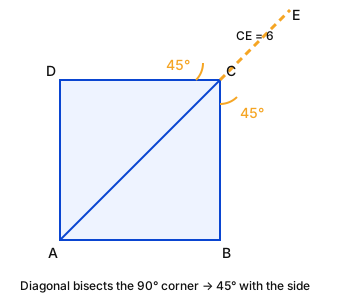
If a square’s diagonal is extended by 6 units beyond a vertex, forming a triangle outside the square, what is the angle between this extension and the adjacent side of the square?
यदि किसी वर्ग के विकर्ण को एक शीर्ष से आगे 6 इकाई बढ़ाया जाए, जिससे वर्ग के बाहर एक त्रिभुज बने, तो इस बढ़ाए गए भाग और वर्ग की आसन्न भुजा के बीच का कोण क्या होगा?
  1. A30 degrees30 डिग्री
  2. B45 degrees45 डिग्री
  3. C90 degrees90 डिग्री
  4. D60 degrees60 डिग्री
Show answer

Concept: The diagonal of a square bisects its right angles, so it makes 45∘ with each side. Extending the diagonal does not change the line, so the angle with the side-line stays 45∘ (acute angle).

  1. In square ABCD, diagonal AC makes ∠ACB=45∘.
  2. Extension CE is the same straight line; the acute angle between CE and side BC (produced) is also 45∘.
  3. The length 6 units does not matter – angles are independent of it.

Yaad rakhein: Diagonal of a square ↔ 45∘ with every side; diagonal of a rectangle ↔ not 45∘ in general.

Answer: (B) 45 degrees

अवधारणा: वर्ग का विकर्ण उसके समकोणों को समद्विभाजित करता है, अतः हर भुजा से 45∘ बनाता है। विकर्ण को बढ़ाने से रेखा नहीं बदलती, इसलिए भुजा-रेखा से कोण 45∘ (न्यून कोण) ही रहता है।

  1. वर्ग ABCD में विकर्ण AC से ∠ACB=45∘।
  2. विस्तार CE वही सीधी रेखा है; CE और भुजा BC (बढ़ाई गई) के बीच न्यून कोण भी 45∘।
  3. 6 इकाई की लंबाई का कोण पर कोई प्रभाव नहीं।

याद रखें: वर्ग का विकर्ण ↔ हर भुजा से 45∘; आयत के विकर्ण में ऐसा सामान्यतः नहीं होता।

उत्तर: (B) 45 degrees

RRB NTPC Undergraduate CBT 1MathematicsSquare – diagonal angleRRB NTPC Undergraduate CBT 1 2025 · 9 May Shift 1 →
Q7846.
The sum of the ages of a daughter and her mother is 76 years. After 4 years, the age of the mother will be three times that of the daughter. What is the present age (in years) of the mother?
एक पुत्री और उसकी माता की आयु का योग 76 वर्ष है। 4 वर्ष बाद, माता की आयु पुत्री की आयु की तीन गुनी होगी। माता की वर्तमान आयु (वर्षों में) क्या है?
  1. A17
  2. B18
  3. C57
  4. D59
Show answer

Concept: Form equations for present and future ages; both ages increase by the same number of years.

  1. Let daughter =d, mother =76−d.
  2. After 4 years: 80−d=3(d+4)⇒80−d=3d+12⇒d=17.
  3. Mother =76−17=59.

Trick: After 4 years total =84 in ratio 3:1 → mother =63, daughter =21; subtract 4 → 59 and 17.

Answer: (D) 59

अवधारणा: वर्तमान और भविष्य की आयु के समीकरण बनाएँ; दोनों की आयु समान वर्ष बढ़ती है।

  1. पुत्री =d, माता =76−d।
  2. 4 वर्ष बाद: 80−d=3(d+4)⇒80−d=3d+12⇒d=17।
  3. माता =76−17=59।

ट्रिक: 4 वर्ष बाद कुल =84, अनुपात 3:1 → माता =63, पुत्री =21; 4 घटाएँ → 59 और 17।

उत्तर: (D) 59

RRB NTPC Undergraduate CBT 1MathematicsAges – linear equationsRRB NTPC Undergraduate CBT 1 2025 · 9 May Shift 1 →
Q7847.
Two bags contain marbles in the ratio 5 : 7. If 12 marbles are transferred from the second bag to the first bag, the ratio of marbles in the two bags becomes 7 : 5. Find the original number of marbles in the second bag.
दो थैलों में कंचे 5 : 7 के अनुपात में हैं। यदि दूसरे थैले से 12 कंचे पहले थैले में स्थानांतरित कर दिए जाएँ, तो दोनों थैलों में कंचों का अनुपात 7 : 5 हो जाता है। दूसरे थैले में कंचों की मूल संख्या ज्ञात कीजिए।
  1. A68
  2. B42
  3. C63
  4. D72
Show answer

Concept: Let the quantities be 5x and 7x; the total stays the same after transfer.

  1. 5x+127x−12=75⇒25x+60=49x−84.
  2. 24x=144⇒x=6.
  3. Second bag originally =7×6=42.

Trick: Total =12 parts both times; the ratio flips 5:7→7:5, so 12 marbles =2 parts → 1 part =6.

Answer: (B) 42

अवधारणा: मात्राएँ 5x और 7x लें; स्थानांतरण के बाद कुल संख्या समान रहती है।

  1. 5x+127x−12=75⇒25x+60=49x−84।
  2. 24x=144⇒x=6।
  3. दूसरे थैले में मूलतः =7×6=42।

ट्रिक: कुल दोनों बार =12 भाग; अनुपात 5:7→7:5 पलटा, अतः 12 कंचे =2 भाग → 1 भाग =6।

उत्तर: (B) 42

RRB NTPC Undergraduate CBT 1MathematicsRatio – transfer problemRRB NTPC Undergraduate CBT 1 2025 · 9 May Shift 1 →
Q7848.
Girish scored 448 marks in an examination and was 64 marks short of 16% of maximum marks. In the same examination, his friend scored 672 marks. What is the percentage of marks scored by his friend?
गिरीश ने एक परीक्षा में 448 अंक प्राप्त किए और वह अधिकतम अंकों के 16% से 64 अंक कम रहा। उसी परीक्षा में, उसके मित्र ने 672 अंक प्राप्त किए। उसके मित्र द्वारा प्राप्त अंकों का प्रतिशत क्या है?
  1. A19%
  2. B24%
  3. C22%
  4. D21%
Show answer

Concept: First find the maximum marks from the given percentage condition.

  1. 16% of max =448+64=512⇒max=512×10016=3200.
  2. Friend: 6723200×100=21%.

Trick: 672=512+160; 512=16% and 160=5% of 3200 → 21%.

Answer: (D) 21%

अवधारणा: पहले दी गई प्रतिशत शर्त से अधिकतम अंक निकालें।

  1. अधिकतम का 16% =448+64=512⇒अधिकतम=512×10016=3200।
  2. मित्र: 6723200×100=21%।

ट्रिक: 672=512+160; 3200 का 512=16% और 160=5% → 21%।

उत्तर: (D) 21%

RRB NTPC Undergraduate CBT 1MathematicsPercentage – maximum marksRRB NTPC Undergraduate CBT 1 2025 · 9 May Shift 1 →
Q7849.
A and B can complete a task in 20 days and 25 days, respectively. They started working together, but B left after 5 days. How many more days will A take to finish the remaining work?
A और B एक कार्य को क्रमशः 20 दिनों और 25 दिनों में पूरा कर सकते हैं। उन्होंने एक साथ कार्य करना शुरू किया, लेकिन B ने 5 दिनों के बाद कार्य छोड़ दिया। शेष कार्य को पूरा करने में A को और कितने दिन लगेंगे?
  1. A12 days12 दिन
  2. B11 days11 दिन
  3. C10 days10 दिन
  4. D9 days9 दिन
Show answer

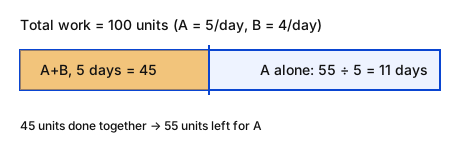
Concept: Take total work = LCM of days; work per day = efficiency.

  1. Total work =LCM(20,25)=100 units; A =5/day, B =4/day.
  2. 5 days together: 9×5=45 units done; 55 remain.
  3. A alone: 555=11 days.

Trick: Remaining fraction =1−5(120+125)=1120 → A needs 1120×20=11 days.

Answer: (B) 11 days

अवधारणा: कुल कार्य = दिनों का ल.स. लें; प्रतिदिन कार्य = दक्षता।

  1. कुल कार्य =LCM(20,25)=100 इकाई; A =5/दिन, B =4/दिन।
  2. 5 दिन साथ: 9×5=45 इकाई हुआ; 55 शेष।
  3. A अकेला: 555=11 दिन।

ट्रिक: शेष अंश =1−5(120+125)=1120 → A को 1120×20=11 दिन।

उत्तर: (B) 11 days

RRB NTPC Undergraduate CBT 1MathematicsTime & Work – one leavesRRB NTPC Undergraduate CBT 1 2025 · 9 May Shift 1 →
Q7850.
The perimeter of a rectangle is 56 cm. Its length is 4 cm more than twice its breadth. Find the breadth.
एक आयत का परिमाप 56 cm है। इसकी लंबाई, इसकी चौड़ाई के दोगुने से 4 cm अधिक है। चौड़ाई ज्ञात कीजिए।
  1. A6 cm
  2. B12 cm
  3. C10 cm
  4. D8 cm
Show answer

Concept: Perimeter =2(l+b).

  1. l=2b+4, so 2(2b+4+b)=56⇒3b+4=28.
  2. b=8 cm (and l=20 cm).

Trick: l+b=28; check option (D): b=8⇒l=20, sum 28 ✓.

Answer: (D) 8 cm

अवधारणा: परिमाप =2(l+b)।

  1. l=2b+4, अतः 2(2b+4+b)=56⇒3b+4=28।
  2. b=8 cm (तथा l=20 cm)।

ट्रिक: l+b=28; विकल्प (D) जाँचें: b=8⇒l=20, योग 28 ✓।

उत्तर: (D) 8 cm

RRB NTPC Undergraduate CBT 1MathematicsRectangle – perimeterRRB NTPC Undergraduate CBT 1 2025 · 9 May Shift 1 →
Q7851.
A sum of ₹8,000 is invested at a compound interest rate of 12.5% per annum for 2 years, compounded annually. What is the compound interest earned?
₹8,000 की एक धनराशि 12.5% वार्षिक चक्रवृद्धि ब्याज की दर से 2 वर्षों के लिए निवेश की जाती है, जिसमें ब्याज वार्षिक रूप से संयोजित होता है। अर्जित चक्रवृद्धि ब्याज क्या है?
  1. A₹2,000
  2. B₹2,500
  3. C₹2,250
  4. D₹2,125
Show answer

Concept: 12.5%=18, so amount multiplies by 98 each year.

  1. Amount =8000×98×98=125×81=10125.
  2. CI =10125−8000=2125.

Trick: Effective 2-year rate =12.5+12.5+12.5×12.5100=26.5625% → 8000×0.265625=2125.

Answer: (D) ₹2,125

अवधारणा: 12.5%=18, अतः राशि हर वर्ष 98 गुना होती है।

  1. मिश्रधन =8000×98×98=125×81=10125।
  2. CI =10125−8000=2125।

ट्रिक: 2 वर्ष की प्रभावी दर =12.5+12.5+12.5×12.5100=26.5625% → 8000×0.265625=2125।

उत्तर: (D) ₹2,125

RRB NTPC Undergraduate CBT 1MathematicsCompound Interest – 2 yearsRRB NTPC Undergraduate CBT 1 2025 · 9 May Shift 1 →
Q7852.
If the compound interest on a sum for 2 years at 5% per annum is ₹102.50, what is the sum?
यदि किसी धनराशि पर 5% वार्षिक दर से 2 वर्षों का चक्रवृद्धि ब्याज ₹102.50 है, तो वह धनराशि क्या है?
  1. A₹1,000
  2. B₹1,025
  3. C₹950
  4. D₹1,100
Show answer

Concept: For 2 years, effective CI rate =2r+r2100.

  1. At 5%: 10+0.25=10.25%.
  2. P×10.25100=102.50⇒P=1000.

Yaad rakhein: 5% for 2 years =10.25%; 10% for 2 years =21% – memorise these.

Answer: (A) ₹1,000

अवधारणा: 2 वर्ष के लिए प्रभावी CI दर =2r+r2100।

  1. 5% पर: 10+0.25=10.25%।
  2. P×10.25100=102.50⇒P=1000।

याद रखें: 2 वर्ष में 5% =10.25%; 10% =21% – ये कंठस्थ रखें।

उत्तर: (A) ₹1,000

RRB NTPC Undergraduate CBT 1MathematicsCompound Interest – find principalRRB NTPC Undergraduate CBT 1 2025 · 9 May Shift 1 →
Q7853.
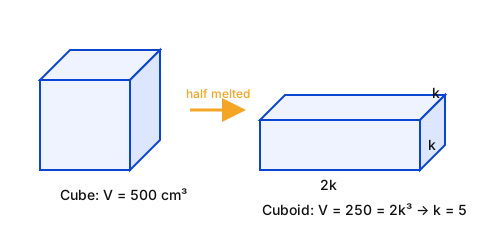
A solid cube is melted and half of its material is recast into a cuboid whose length, breadth, and height are in the ratio 2 : 1 : 1. The difference between the volume of the original cube and the cuboid formed is 250 cm3. Find the total surface area of the cuboid.
एक ठोस घन को पिघलाया जाता है और उसकी आधी सामग्री को एक ऐसे घनाभ में ढाला जाता है जिसकी लंबाई, चौड़ाई और ऊँचाई 2 : 1 : 1 के अनुपात में हैं। मूल घन के आयतन और बने हुए घनाभ के आयतन का अंतर 250 cm3 है। घनाभ का कुल पृष्ठीय क्षेत्रफल ज्ञात कीजिए।
  1. A100 cm2
  2. B120 cm2
  3. C80 cm2
  4. D250 cm2
Show answer

Concept: Melting preserves volume; TSA of cuboid =2(lb+bh+hl).

  1. Cuboid volume =V2, so V−V2=250⇒V=500, cuboid =250 cm3.
  2. Dimensions 2k,k,k: 2k3=250⇒k=5 → 10×5×5.
  3. TSA =2(50+25+50)=250 cm2.

Trick: For a 2k×k×k cuboid, TSA =10k2 and volume =2k3.

Answer: (D) 250 cm2

अवधारणा: पिघलाने पर आयतन समान रहता है; घनाभ का TSA =2(lb+bh+hl)।

  1. घनाभ का आयतन =V2, अतः V−V2=250⇒V=500, घनाभ =250 cm3।
  2. विमाएँ 2k,k,k: 2k3=250⇒k=5 → 10×5×5।
  3. TSA =2(50+25+50)=250 cm2।

ट्रिक: 2k×k×k घनाभ के लिए TSA =10k2 और आयतन =2k3।

उत्तर: (D) 250 cm2

RRB NTPC Undergraduate CBT 1MathematicsMensuration – cube to cuboidRRB NTPC Undergraduate CBT 1 2025 · 9 May Shift 1 →
Q7854.
A shopkeeper offers the following schemes on toys of the same marked price. (A) Successive discounts of 5% and 30% on any number of toys bought.
(B) Successive discounts of 18%, 15% and 5% on any number of toys bought. (C) 11% discount on the first 5 toys and 47% discount on each toy thereon.
(D) 2 toys free of cost on buying 5 toys.
A customer wants to buy 5 toys. Which of the above schemes is the least beneficial to her?
एक दुकानदार समान अंकित मूल्य वाले खिलौनों पर निम्नलिखित योजनाएँ प्रदान करता है। (A) खरीदे गए किसी भी संख्या के खिलौनों पर 5% और 30% की क्रमिक छूट।
(B) खरीदे गए किसी भी संख्या के खिलौनों पर 18%, 15% और 5% की क्रमिक छूट। (C) पहले 5 खिलौनों पर 11% छूट और उसके बाद प्रत्येक खिलौने पर 47% छूट।
(D) 5 खिलौने खरीदने पर 2 खिलौने निःशुल्क।
एक ग्राहक 5 खिलौने खरीदना चाहती है। उपरोक्त में से कौन-सी योजना उसके लिए सबसे कम लाभदायक है?
  1. AB
  2. BD
  3. CC
  4. DA
Show answer

Concept: Convert every scheme into an effective discount on 5 toys (MP ₹100 each, total ₹500).

  1. (A) 0.95×0.70=0.665 → pays ₹332.5 (discount 33.5%).
  2. (B) 0.82×0.85×0.95≈0.662 → pays ≈ ₹331 (discount ≈ 33.8%).
  3. (C) only 11% on all 5 toys → pays ₹445; the 47% part never applies.
  4. (D) 2 free with 5 → 7 toys for ₹500, effective discount 27≈28.6% per toy.

Trick: Scheme C's big 47% starts only from the 6th toy – for exactly 5 toys it is the weakest offer.

Answer: (C) C

अवधारणा: हर योजना को 5 खिलौनों (MP ₹100 प्रत्येक, कुल ₹500) पर प्रभावी छूट में बदलें।

  1. (A) 0.95×0.70=0.665 → ₹332.5 देने होंगे (छूट 33.5%)।
  2. (B) 0.82×0.85×0.95≈0.662 → ≈ ₹331 (छूट ≈ 33.8%)।
  3. (C) पाँचों पर केवल 11% → ₹445; 47% वाला भाग लागू ही नहीं होता।
  4. (D) 5 पर 2 मुफ्त → ₹500 में 7 खिलौने, प्रति खिलौना प्रभावी छूट 27≈28.6%।

ट्रिक: योजना C की 47% छूट छठे खिलौने से शुरू होती है – ठीक 5 खिलौनों पर यह सबसे कमज़ोर ऑफ़र है।

उत्तर: (C) C

RRB NTPC Undergraduate CBT 1MathematicsDiscount schemes comparisonRRB NTPC Undergraduate CBT 1 2025 · 9 May Shift 1 →
Q7855.
Simplify {(1424)÷(149)}÷(37×149+58)+910÷3124 of 2410
सरल कीजिए {(1424)÷(149)}÷(37×149+58)+910÷3124 of 2410
  1. A1337
  2. B1831
  3. C1433
  4. D1726
Show answer

Concept: Brackets first, then "of", then ÷ and ×, then + and −.

  1. 1424÷149=924=38.
  2. 37×149+58=23+58=3124; so 38÷3124=931.
  3. 3124 of 2410=3110; 910÷3110=931.
  4. Sum =931+931=1831.

Trick: Both halves give 931 – spotting the repeated 31 saves time.

Answer: (B) 1831

अवधारणा: पहले कोष्ठक, फिर "of", फिर ÷ और ×, फिर + और −।

  1. 1424÷149=924=38।
  2. 37×149+58=23+58=3124; अतः 38÷3124=931।
  3. 3124 of 2410=3110; 910÷3110=931।
  4. योग =931+931=1831।

ट्रिक: दोनों भाग 931 देते हैं – 31 की पुनरावृत्ति पहचानें, समय बचेगा।

उत्तर: (B) 1831

RRB NTPC Undergraduate CBT 1MathematicsSimplification – BODMAS fractionsRRB NTPC Undergraduate CBT 1 2025 · 9 May Shift 1 →
Q7856.
Simplify: 5.25+2.75−35−25×1020
सरल कीजिए: 5.25+2.75−35−25×1020
  1. A8.2
  2. B7.2
  3. C5.2
  4. D6.2
Show answer

Concept: Do multiplication before subtraction (BODMAS).

  1. 25×1020=15=0.2.
  2. 5.25+2.75=8; 8−0.6−0.2=7.2.

Trick: 5.25+2.75 is a neat 8; the rest is just 0.6+0.2.

Answer: (B) 7.2

अवधारणा: घटाने से पहले गुणा करें (BODMAS)।

  1. 25×1020=15=0.2।
  2. 5.25+2.75=8; 8−0.6−0.2=7.2।

ट्रिक: 5.25+2.75 सीधा 8 है; बाकी केवल 0.6+0.2।

उत्तर: (B) 7.2

RRB NTPC Undergraduate CBT 1MathematicsSimplification – decimals & fractionsRRB NTPC Undergraduate CBT 1 2025 · 9 May Shift 1 →
Q7857.
An altitude of 122 cm is drawn to the base of an isosceles triangle. The perimeter of this triangle is 48 cm. Find the area of the triangle.
एक समद्विबाहु त्रिभुज के आधार पर 122 cm का एक शीर्षलंब खींचा जाता है। इस त्रिभुज का परिमाप 48 cm है। त्रिभुज का क्षेत्रफल ज्ञात कीजिए।
  1. A602 cm2
  2. B362 cm2
  3. C122 cm2
  4. D722 cm2
Show answer

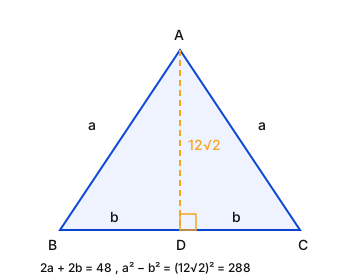
Concept: The altitude to the base of an isosceles triangle bisects the base; use Pythagoras and a2−b2=(a−b)(a+b).

  1. Equal side a, half-base b: 2a+2b=48⇒a+b=24.
  2. a2−b2=(122)2=288⇒a−b=28824=12 → a=18, b=6.
  3. Area =12×12×122=722 cm2.

Trick: a+b and a2−b2 known → a−b in one division; no need to solve quadratics.

Answer: (D) 722 cm2

अवधारणा: समद्विबाहु त्रिभुज में आधार पर शीर्षलंब आधार को समद्विभाजित करता है; पाइथागोरस और a2−b2=(a−b)(a+b) प्रयोग करें।

  1. समान भुजा a, आधा आधार b: 2a+2b=48⇒a+b=24।
  2. a2−b2=(122)2=288⇒a−b=28824=12 → a=18, b=6।
  3. क्षेत्रफल =12×12×122=722 cm2।

ट्रिक: a+b और a2−b2 ज्ञात → एक भाग से a−b; द्विघात हल करने की ज़रूरत नहीं।

उत्तर: (D) 722 cm2

RRB NTPC Undergraduate CBT 1MathematicsIsosceles triangle – areaRRB NTPC Undergraduate CBT 1 2025 · 9 May Shift 1 →
Q7858.
Find the third proportional to 6 and 12.
6 और 12 का तृतीयानुपाती ज्ञात कीजिए।
  1. A24
  2. B36
  3. C18
  4. D48
Show answer

Concept: Third proportional to a and b is c with a:b::b:c, i.e. c=b2a.

  1. c=1226=1446=24.

Yaad rakhein: Third proportional =b2a; mean proportional =ab – do not mix them.

Answer: (A) 24

अवधारणा: a और b का तृतीयानुपाती c है जहाँ a:b::b:c, अर्थात् c=b2a।

  1. c=1226=1446=24।

याद रखें: तृतीयानुपाती =b2a; मध्यानुपाती =ab – दोनों में भ्रम न करें।

उत्तर: (A) 24

RRB NTPC Undergraduate CBT 1MathematicsThird proportionalRRB NTPC Undergraduate CBT 1 2025 · 9 May Shift 1 →
Q7859.
Three numbers in the ratio 2 : 5 : 7 are taken as the first, second, and third terms, respectively. If their fourth proportional is 140, find the middle number.
2 : 5 : 7 के अनुपात में तीन संख्याओं को क्रमशः पहला, दूसरा और तीसरा पद लिया जाता है। यदि उनका चतुर्थानुपाती 140 है, तो बीच वाली संख्या ज्ञात कीजिए।
  1. A50
  2. B35
  3. C30
  4. D40
Show answer

Concept: Fourth proportional to a,b,c is d=bca.

  1. Numbers 2k,5k,7k: d=5k×7k2k=35k2.
  2. 35k2=140⇒k=8.
  3. Middle number =5k=40 (numbers are 16, 40, 56).

Trick: Check: 16:40=56:140 (both =2:5) ✓.

Answer: (D) 40

अवधारणा: a,b,c का चतुर्थानुपाती d=bca।

  1. संख्याएँ 2k,5k,7k: d=5k×7k2k=35k2।
  2. 35k2=140⇒k=8।
  3. मध्य संख्या =5k=40 (संख्याएँ 16, 40, 56)।

ट्रिक: जाँच: 16:40=56:140 (दोनों =2:5) ✓।

उत्तर: (D) 40

RRB NTPC Undergraduate CBT 1MathematicsFourth proportional with ratioRRB NTPC Undergraduate CBT 1 2025 · 9 May Shift 1 →
Q7860.
A bus covers 90 km in 3 hours. If the speed of the bus is increased by 5 kmph, find the time taken to cover a distance of 70 km?
एक बस 3 घंटे में 90 km की दूरी तय करती है। यदि बस की चाल 5 kmph बढ़ा दी जाए, तो 70 km की दूरी तय करने में लगने वाला समय ज्ञात कीजिए।
  1. A3 hours3 घंटे
  2. B2.5 hours2.5 घंटे
  3. C3.5 hours3.5 घंटे
  4. D2 hours2 घंटे
Show answer

Concept: Time =DistanceSpeed.

  1. Original speed =903=30km/h; new speed =35km/h.
  2. Time =7035=2 hours.

Trick: 70=2×35 – the numbers are chosen to cancel cleanly.

Answer: (D) 2 hours

अवधारणा: समय =दूरीचाल।

  1. मूल चाल =903=30km/h; नई चाल =35km/h।
  2. समय =7035=2 घंटे।

ट्रिक: 70=2×35 – संख्याएँ सीधे कट जाती हैं।

उत्तर: (D) 2 hours

RRB NTPC Undergraduate CBT 1MathematicsSpeed, time & distanceRRB NTPC Undergraduate CBT 1 2025 · 9 May Shift 1 →