Question bank

Q&A: practice questions with answers

Search questions on any topic. Filter by exam category, exam, subject and topic, try the question, then open the answer and explanation.

Courses – airGurukul

8,495 questions found.

Q7861.
The price of an article is increased by 25%. By what percentage should the increased price be reduced so that it becomes equal to the original price?
किसी वस्तु के मूल्य में 25% की वृद्धि की जाती है। बढ़े हुए मूल्य में कितने प्रतिशत की कमी की जानी चाहिए ताकि वह मूल मूल्य के बराबर हो जाए?
  1. A22%
  2. B20%
  3. C30%
  4. D25%
Show answer

Concept: To undo an increase of r%, reduce by r100+r×100%.

  1. 25125×100=20%.
  2. Check: 125×0.8=100 ✓.

Yaad rakhein: 25%=14 up → 15=20% down; 20% up → 1623% down.

Answer: (B) 20%

अवधारणा: r% की वृद्धि को निरस्त करने के लिए r100+r×100% की कमी करें।

  1. 25125×100=20%।
  2. जाँच: 125×0.8=100 ✓।

याद रखें: 25%=14 वृद्धि → 15=20% कमी; 20% वृद्धि → 1623% कमी।

उत्तर: (B) 20%

RRB NTPC Undergraduate CBT 1MathematicsPercentage – reverse changeRRB NTPC Undergraduate CBT 1 2025 · 9 May Shift 1 →
Q7862.
In a division sum, the divisor is 5 times the quotient and 4 times the remainder. If the remainder is 15, what is the dividend?
एक भाग के प्रश्न में, भाजक भागफल का 5 गुना और शेषफल का 4 गुना है। यदि शेषफल 15 है, तो भाज्य क्या है?
  1. A740
  2. B734
  3. C739
  4. D735
Show answer

Concept: Dividend = Divisor × Quotient + Remainder.

  1. Divisor =4×15=60; quotient =605=12.
  2. Dividend =60×12+15=735.

Trick: Remainder 15 must be less than the divisor 60 – a quick sanity check.

Answer: (D) 735

अवधारणा: भाज्य = भाजक × भागफल + शेषफल।

  1. भाजक =4×15=60; भागफल =605=12।
  2. भाज्य =60×12+15=735।

ट्रिक: शेष 15 भाजक 60 से छोटा होना चाहिए – त्वरित जाँच।

उत्तर: (D) 735

RRB NTPC Undergraduate CBT 1MathematicsDivision algorithmRRB NTPC Undergraduate CBT 1 2025 · 9 May Shift 1 →
Q7863.
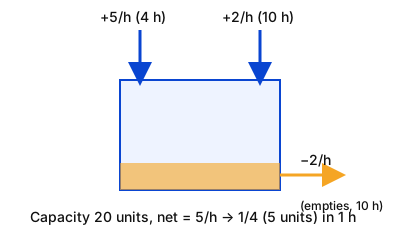
Two taps can fill a cistern in 4 hours and 10 hours, respectively. A third tap can empty it in 10 hours. How long (in hours) will it take to fill one-fourth of the empty cistern if all the taps are opened together?
दो नल एक टंकी को क्रमशः 4 घंटे और 10 घंटे में भर सकते हैं। एक तीसरा नल इसे 10 घंटे में खाली कर सकता है। यदि सभी नल एक साथ खोल दिए जाएँ, तो खाली टंकी के एक-चौथाई भाग को भरने में कितना समय (घंटों में) लगेगा?
  1. A2
  2. B3
  3. C1
  4. D4
Show answer

Concept: Take capacity = LCM of the times; add filling rates, subtract emptying rate.

  1. Capacity =LCM(4,10,10)=20 units; rates +5,+2,−2 per hour → net 5/h.
  2. One-fourth =5 units → time =55=1 hour.

Trick: The 10-h filler and 10-h emptier cancel, leaving just the 4-h tap: quarter of 4 h = 1 h.

Answer: (C) 1

अवधारणा: क्षमता = समयों का ल.स. लें; भरने की दरें जोड़ें, खाली करने की दर घटाएँ।

  1. क्षमता =LCM(4,10,10)=20 इकाई; दरें +5,+2,−2 प्रति घंटा → नेट 5/घंटा।
  2. एक-चौथाई =5 इकाई → समय =55=1 घंटा।

ट्रिक: 10 घंटे वाला भरने वाला और 10 घंटे वाला खाली करने वाला नल कट जाते हैं, बचा केवल 4 घंटे वाला: 4 का चौथाई = 1 घंटा।

उत्तर: (C) 1

RRB NTPC Undergraduate CBT 1MathematicsPipes & CisternsRRB NTPC Undergraduate CBT 1 2025 · 9 May Shift 1 →
Q7864.
If x2×x3=xa and x2xb=x1, what is the value of a+b?
यदि x2×x3=xa और x2xb=x1 है, तो a+b का मान क्या है?
  1. A7
  2. B6
  3. C4
  4. D5
Show answer

Concept: xm×xn=xm+n and xmxn=xm−n.

  1. x2×x3=x5⇒a=5.
  2. x2xb=x1⇒2−b=1⇒b=1.
  3. a+b=6.

Yaad rakhein: Multiply → add powers; divide → subtract powers.

Answer: (B) 6

अवधारणा: xm×xn=xm+n तथा xmxn=xm−n।

  1. x2×x3=x5⇒a=5।
  2. x2xb=x1⇒2−b=1⇒b=1।
  3. a+b=6।

याद रखें: गुणा → घात जोड़ें; भाग → घात घटाएँ।

उत्तर: (B) 6

RRB NTPC Undergraduate CBT 1MathematicsLaws of indicesRRB NTPC Undergraduate CBT 1 2025 · 9 May Shift 1 →
Q7865.
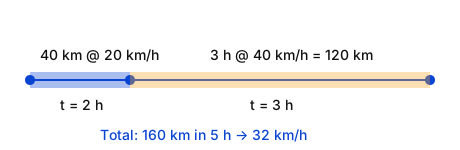
Ritu covers a distance of 40 km at 20 km/h and another distance at 40 km/h in 3 hours. Find the average speed for the whole journey.
रितु 40 km की दूरी 20 km/h की चाल से और एक अन्य दूरी 40 km/h की चाल से कुल 3 घंटे में तय करती है। पूरी यात्रा के लिए औसत चाल ज्ञात कीजिए।
  1. A32 km/h
  2. B26 km/h
  3. C31 km/h
  4. D38 km/h
Show answer

Concept: Average speed =Total distanceTotal time (never the average of speeds).

  1. Part 1: 40 km at 20 km/h → 2 h.
  2. Part 2: 3 h at 40 km/h → 120 km.
  3. Average =40+1202+3=1605=32km/h.

Trick: Time-weighted: 2×20+3×405=32.

Answer: (A) 32 km/h

अवधारणा: औसत चाल =कुल दूरीकुल समय (चालों का औसत कभी नहीं)।

  1. भाग 1: 40 km, 20 km/h → 2 घंटे।
  2. भाग 2: 3 घंटे, 40 km/h → 120 km।
  3. औसत =40+1202+3=1605=32km/h।

ट्रिक: समय-भारित: 2×20+3×405=32।

उत्तर: (A) 32 km/h

RRB NTPC Undergraduate CBT 1MathematicsAverage speedRRB NTPC Undergraduate CBT 1 2025 · 9 May Shift 1 →
Q7866.
What should come in place of ? in the given series based on the English alphabetical order?
FCZ YVS ROL KHE ?
अंग्रेज़ी वर्णमाला क्रम पर आधारित दी गई शृंखला में ? के स्थान पर क्या आना चाहिए?
FCZ YVS ROL KHE ?
  1. ADAX
  2. BDZW
  3. CDFG
  4. DDBW
Show answer

Concept: Compare corresponding letters of consecutive terms using positions A=1 … Z=26 (wrap around after A).

  1. F(6) → Y(25) → R(18) → K(11): each step −7 (6−7 = −1 → 25).
  2. C(3) → V(22) → O(15) → H(8): each −7. Z(26) → S(19) → L(12) → E(5): each −7.
  3. Next: K(11)−7 = D(4), H(8)−7 = A(1), E(5)−7 = −2 → 24 = X.

Trick: Going back 7 is the same as going forward 19; when the number goes below 1, add 26.

Answer: (A) DAX

अवधारणा: क्रमागत पदों के संगत अक्षरों की तुलना स्थान-संख्या A=1 … Z=26 से करें (A से पीछे जाने पर Z पर लौटें)।

  1. F(6) → Y(25) → R(18) → K(11): प्रत्येक चरण −7 (6−7 = −1 → 25)।
  2. C(3) → V(22) → O(15) → H(8): प्रत्येक −7। Z(26) → S(19) → L(12) → E(5): प्रत्येक −7।
  3. अगला: K(11)−7 = D(4), H(8)−7 = A(1), E(5)−7 = −2 → 24 = X।

ट्रिक: 7 पीछे जाना = 19 आगे जाना; संख्या 1 से कम हो जाए तो 26 जोड़ दें।

उत्तर: (A) DAX

RRB NTPC Undergraduate CBT 1General Intelligence and ReasoningLetter SeriesRRB NTPC Undergraduate CBT 1 2025 · 9 May Shift 1 →
Q7867.
BO 7 is related to EI -7 in a certain way. In the same way, CS 10 is related to FM -4. To which of the following is IJ 20 related, following the same logic?
BO 7, EI -7 से एक निश्चित प्रकार से संबंधित है। उसी प्रकार, CS 10, FM -4 से संबंधित है। समान तर्क का अनुसरण करते हुए, IJ 20 निम्नलिखित में से किससे संबंधित है?
  1. AGJ 9
  2. BOP -3
  3. CHT -6
  4. DLD 6
Show answer

Concept: Find the rule applied to each letter and the number separately, then apply it to the new term.

  1. BO 7 → EI −7: B(2)+3 = E(5); O(15)−6 = I(9); 7−14 = −7.
  2. Check: CS 10 → FM −4: C+3 = F; S(19)−6 = M(13); 10−14 = −4. ✓
  3. IJ 20: I(9)+3 = L(12); J(10)−6 = D(4); 20−14 = 6 → LD 6.

Trick: First letter +3, second letter −6, number −14 – verify with the second pair before applying.

Answer: (D) LD 6

अवधारणा: प्रत्येक अक्षर और संख्या पर अलग-अलग लागू नियम खोजें, फिर नए पद पर लागू करें।

  1. BO 7 → EI −7: B(2)+3 = E(5); O(15)−6 = I(9); 7−14 = −7।
  2. जाँच: CS 10 → FM −4: C+3 = F; S(19)−6 = M(13); 10−14 = −4। ✓
  3. IJ 20: I(9)+3 = L(12); J(10)−6 = D(4); 20−14 = 6 → LD 6।

ट्रिक: पहला अक्षर +3, दूसरा −6, संख्या −14 – लागू करने से पहले दूसरे युग्म से नियम पक्का करें।

उत्तर: (D) LD 6

RRB NTPC Undergraduate CBT 1General Intelligence and ReasoningLetter–Number AnalogyRRB NTPC Undergraduate CBT 1 2025 · 9 May Shift 1 →
Q7868.
What should come in place of '?' in the given series based on the English alphabetical order?
CGT FJW IMZ LPC ?
अंग्रेज़ी वर्णमाला क्रम पर आधारित दी गई शृंखला में '?' के स्थान पर क्या आना चाहिए?
CGT FJW IMZ LPC ?
  1. AOSF
  2. BORF
  3. CNRE
  4. DQTC
Show answer

Concept: Check the difference between corresponding letters of successive terms.

  1. C(3) → F(6) → I(9) → L(12): +3 each time.
  2. G(7) → J(10) → M(13) → P(16): +3. T(20) → W(23) → Z(26) → C(3): +3 (wrapping).
  3. Next term: L+3 = O, P+3 = S, C+3 = F → OSF.

Trick: When every letter moves by the same +3, just add 3 to the last term.

Answer: (A) OSF

अवधारणा: क्रमागत पदों के संगत अक्षरों का अंतर देखें।

  1. C(3) → F(6) → I(9) → L(12): हर बार +3।
  2. G(7) → J(10) → M(13) → P(16): +3। T(20) → W(23) → Z(26) → C(3): +3 (Z के बाद A से)।
  3. अगला पद: L+3 = O, P+3 = S, C+3 = F → OSF।

ट्रिक: जब हर अक्षर समान +3 से बढ़े, तो अंतिम पद में बस 3 जोड़ें।

उत्तर: (A) OSF

RRB NTPC Undergraduate CBT 1General Intelligence and ReasoningLetter SeriesRRB NTPC Undergraduate CBT 1 2025 · 9 May Shift 1 →
Q7869.
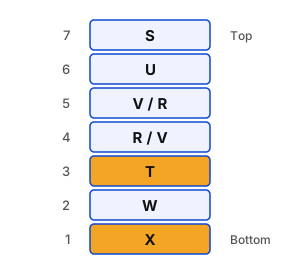
Seven boxes R, S, T, U, V, W and X are kept one over the other but not necessarily in the same order. V is kept neither at the top nor at the bottom. Only three boxes are kept between U and W. R is kept one of the positions between S and T. W is kept second from the bottom and immediately below T.
How many boxes are kept between X and T?
सात बक्से R, S, T, U, V, W और X एक के ऊपर एक रखे गए हैं, लेकिन आवश्यक नहीं कि इसी क्रम में हों। V न तो सबसे ऊपर और न ही सबसे नीचे रखा गया है। U और W के बीच केवल तीन बक्से रखे गए हैं। R, S और T के बीच की किसी एक स्थिति पर रखा गया है। W नीचे से दूसरे स्थान पर और T के ठीक नीचे रखा गया है।
X और T के बीच कितने बक्से रखे गए हैं?
  1. AFOURचार
  2. BTHREEतीन
  3. CONEएक
  4. DTWOदो
Show answer

Concept: Number the positions 1 (bottom) to 7 (top) and place the definite clues first.

  1. W is second from the bottom → W = 2; T is immediately above W → T = 3.
  2. Three boxes between U and W → U = 6.
  3. R lies between S and T, and V is neither at top nor bottom → R and V occupy 4 and 5 (in either order), S = 7, so X = 1 (bottom).
  4. Between X (1) and T (3) there is only W → one box.

Trick: Start with fixed-position clues ("second from bottom"), then "exactly n between" clues; the leftover box falls into the last empty slot.

Answer: (C) ONE

अवधारणा: स्थानों को 1 (नीचे) से 7 (ऊपर) तक क्रमांकित करें और पहले निश्चित संकेत रखें।

  1. W नीचे से दूसरा → W = 2; T, W के ठीक ऊपर → T = 3।
  2. U और W के बीच तीन बॉक्स → U = 6।
  3. R, S और T के बीच है और V न ऊपर न नीचे → R और V स्थान 4 और 5 पर (किसी भी क्रम में), S = 7, अतः X = 1 (सबसे नीचे)।
  4. X (1) और T (3) के बीच केवल W → एक बॉक्स।

ट्रिक: पहले निश्चित स्थान वाले संकेत ("नीचे से दूसरा"), फिर "बीच में n बॉक्स" वाले संकेत; बचा हुआ बॉक्स अंतिम खाली स्थान पर आता है।

उत्तर: (C) एक (ONE)

RRB NTPC Undergraduate CBT 1General Intelligence and ReasoningBox ArrangementRRB NTPC Undergraduate CBT 1 2025 · 9 May Shift 1 →
Q7870.
Refer to the following letter series and answer the question that follows. Counting to be done from left to right only.
(Left) S Z E C A O Q M D P U I J L N X K D (Right)
How many such vowels are there, each of which is immediately preceded by a consonant and also immediately followed by a vowel?
निम्नलिखित अक्षर शृंखला को देखिए और उसके बाद दिए गए प्रश्न का उत्तर दीजिए। गिनती केवल बाएँ से दाएँ की जानी है।
(बायाँ) S Z E C A O Q M D P U I J L N X K D (दायाँ)
ऐसे कितने स्वर हैं, जिनमें से प्रत्येक के ठीक पहले एक व्यंजन और ठीक बाद एक स्वर है?
  1. ATwoदो
  2. BNoneकोई नहीं
  3. CThreeतीन
  4. DOneएक
Show answer

Concept: Locate every vowel and check its immediate left (must be a consonant) and immediate right (must be a vowel).

  1. Series: S Z E C A O Q M D P U I J L N X K D. Vowels: E, A, O, U, I.
  2. E: Z before, C after (consonant) ✗. A: C before, O after ✓. O: A before (vowel) ✗.
  3. U: P before, I after ✓. I: U before (vowel) ✗.
  4. Pairs found: C-A-O and P-U-I → two.

Trick: Look only at adjacent vowel pairs (AO, UI); the first vowel of each such pair qualifies if a consonant precedes it.

Answer: (A) Two

अवधारणा: हर स्वर को खोजें और उसके ठीक बाएँ (व्यंजन होना चाहिए) तथा ठीक दाएँ (स्वर होना चाहिए) की जाँच करें।

  1. श्रृंखला: S Z E C A O Q M D P U I J L N X K D। स्वर: E, A, O, U, I।
  2. E: पहले Z, बाद C (व्यंजन) ✗। A: पहले C, बाद O ✓। O: पहले A (स्वर) ✗।
  3. U: पहले P, बाद I ✓। I: पहले U (स्वर) ✗।
  4. मिले युग्म: C-A-O और P-U-I → दो।

ट्रिक: केवल सटे हुए स्वर-युग्म (AO, UI) देखें; ऐसे युग्म का पहला स्वर तभी गिना जाएगा जब उससे पहले व्यंजन हो।

उत्तर: (A) दो (Two)

RRB NTPC Undergraduate CBT 1General Intelligence and ReasoningLetter Series – CountingRRB NTPC Undergraduate CBT 1 2025 · 9 May Shift 1 →
Q7871.
In a certain code language, "SFOR" is coded as "116" and "WILA" is coded as "90". What is the code for "GMVC" in that given language?
एक निश्चित कूट भाषा में, "SFOR" को "116" के रूप में कूटबद्ध किया जाता है और "WILA" को "90" के रूप में कूटबद्ध किया जाता है। उसी भाषा में "GMVC" का कूट क्या है?
  1. A120
  2. B95
  3. C110
  4. D90
Show answer

Concept: Add the alphabetical positions of the letters and see how the sum relates to the code.

  1. SFOR: S(19)+F(6)+O(15)+R(18) = 58; 58×2=116 ✓.
  2. WILA: W(23)+I(9)+L(12)+A(1) = 45; 45×2=90 ✓.
  3. GMVC: G(7)+M(13)+V(22)+C(3) = 45; 45×2=90.

Trick: Same letter-sum as WILA (45) → same code 90; no need to multiply again.

Answer: (D) 90

अवधारणा: अक्षरों की वर्णमाला स्थान-संख्याएँ जोड़ें और देखें कि योग का कोड से क्या संबंध है।

  1. SFOR: S(19)+F(6)+O(15)+R(18) = 58; 58×2=116 ✓।
  2. WILA: W(23)+I(9)+L(12)+A(1) = 45; 45×2=90 ✓।
  3. GMVC: G(7)+M(13)+V(22)+C(3) = 45; 45×2=90।

ट्रिक: WILA जैसा ही योग (45) → वही कोड 90; दोबारा गुणा करने की ज़रूरत नहीं।

उत्तर: (D) 90

RRB NTPC Undergraduate CBT 1General Intelligence and ReasoningCoding–DecodingRRB NTPC Undergraduate CBT 1 2025 · 9 May Shift 1 →
Q7872.
Select the set in which the numbers are related in the same way as are the numbers of the following sets.
(NOTE: Operations should be performed on the whole numbers, without breaking down the numbers into their constituent digits. E.g. 13 – Operations on 13 such as adding / subtracting /multiplying etc. to 13 can be performed. Breaking down 13 into 1 and 3 and then performing mathematical operations on 1 and 3 is not allowed.)
(5, 3, 16)
(6, 3, 19)
उस समुच्चय का चयन कीजिए जिसमें संख्याएँ उसी प्रकार संबंधित हैं जिस प्रकार निम्नलिखित समुच्चयों की संख्याएँ संबंधित हैं।
(नोट: संक्रियाएँ पूर्ण संख्याओं पर की जानी चाहिए, संख्याओं को उनके घटक अंकों में तोड़े बिना। उदाहरण के लिए 13 – 13 पर संक्रियाएँ जैसे 13 में जोड़ना / घटाना / गुणा करना आदि की जा सकती हैं। 13 को 1 और 3 में तोड़कर फिर 1 और 3 पर गणितीय संक्रियाएँ करने की अनुमति नहीं है।)
(5, 3, 16)
(6, 3, 19)
  1. A(3, 5, 15)
  2. B(1, 7, 8)
  3. C(7, 3, 20)
  4. D(4, 6, 21)
Show answer

Concept: Find one rule connecting the first two numbers to the third in both given sets.

  1. (5, 3, 16): 5×3+1=16. (6, 3, 19): 6×3+1=19. Rule: a×b+1=c.
  2. (3, 5, 15): 16≠15 ✗. (1, 7, 8): 1×7+1=8 ✓.
  3. (7, 3, 20): 22 ✗. (4, 6, 21): 25 ✗.

Trick: Third number is just one more than the product – test a×b+1 on each option.

Answer: (B) (1, 7, 8)

अवधारणा: दोनों दिए गए समुच्चयों में पहली दो संख्याओं को तीसरी से जोड़ने वाला एक नियम खोजें।

  1. (5, 3, 16): 5×3+1=16। (6, 3, 19): 6×3+1=19। नियम: a×b+1=c।
  2. (3, 5, 15): 16≠15 ✗। (1, 7, 8): 1×7+1=8 ✓।
  3. (7, 3, 20): 22 ✗। (4, 6, 21): 25 ✗।

ट्रिक: तीसरी संख्या = गुणनफल + 1 – हर विकल्प पर a×b+1 जाँचें।

उत्तर: (B) (1, 7, 8)

RRB NTPC Undergraduate CBT 1General Intelligence and ReasoningNumber AnalogyRRB NTPC Undergraduate CBT 1 2025 · 9 May Shift 1 →
Q7873.
In a certain code language,
A + B means ‘A is the husband of B’,
A - B means ‘A is the brother of B’,
A × B means ‘A is the mother of B’, and
A ÷ B means ‘A is the sister of B’.
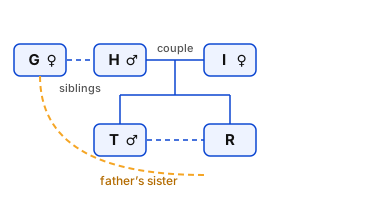
Based on the above, how is G related to R if ‘G ÷ H + I × T - R’?
एक निश्चित कूट भाषा में,
A + B का अर्थ है 'A, B का पति है',
A - B का अर्थ है 'A, B का भाई है',
A × B का अर्थ है 'A, B की माता है', और
A ÷ B का अर्थ है 'A, B की बहन है'।
उपरोक्त के आधार पर, यदि 'G ÷ H + I × T - R' है, तो G, R से किस प्रकार संबंधित है?
  1. ABrother’s wifeभाई की पत्नी
  2. BMother’s sisterमाता की बहन
  3. CFather’s motherपिता की माता
  4. DFather’s sisterपिता की बहन
Show answer

Concept: Decode the chain from left to right and build a family tree.

  1. G ÷ H: G is the sister of H. H + I: H is the husband of I.
  2. I × T: I is the mother of T, so H is T's father. T − R: T is the brother of R.
  3. Hence H is R's father and G, being H's sister, is R's father's sister.

Trick: Follow the chain: the person just before "mother/father" symbols is the parent; the sibling of a parent is an aunt/uncle.

Answer: (D) Father's sister

अवधारणा: श्रृंखला को बाएँ से दाएँ पढ़ें और परिवार-वृक्ष बनाएँ।

  1. G ÷ H: G, H की बहन है। H + I: H, I का पति है।
  2. I × T: I, T की माँ है, अतः H, T का पिता है। T − R: T, R का भाई है।
  3. इसलिए H, R का पिता है और G (H की बहन) R के पिता की बहन (बुआ) है।

ट्रिक: "माँ/पिता" चिह्न से ठीक पहले वाला व्यक्ति माता-पिता है; माता-पिता का भाई/बहन = मामा/बुआ।

उत्तर: (D) पिता की बहन (बुआ)

RRB NTPC Undergraduate CBT 1General Intelligence and ReasoningBlood RelationsRRB NTPC Undergraduate CBT 1 2025 · 9 May Shift 1 →
Q7874.
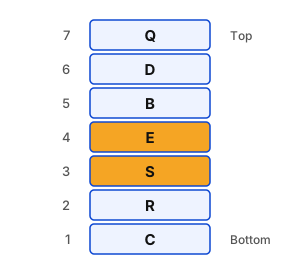
Seven boxes B, C, D, E, Q, R and S are kept one over the other but not necessarily in the same order. No box is kept below C. Only two boxes are kept between E and C. Only Q is kept above D. S is kept at some place below B but at some place above R. Which box is kept immediately above S?
सात बक्से B, C, D, E, Q, R और S एक के ऊपर एक रखे गए हैं, लेकिन आवश्यक नहीं कि इसी क्रम में हों। C के नीचे कोई बक्सा नहीं रखा गया है। E और C के बीच केवल दो बक्से रखे गए हैं। D के ऊपर केवल Q रखा गया है। S, B के नीचे किसी स्थान पर लेकिन R के ऊपर किसी स्थान पर रखा गया है। S के ठीक ऊपर कौन-सा बक्सा रखा गया है?
  1. AB
  2. BE
  3. CR
  4. DD
Show answer

Concept: Number positions 1 (bottom) to 7 (top); use the fixed clues first.

  1. No box below C → C = 1. Two boxes between E and C → E = 4.
  2. Only Q is above D → Q = 7, D = 6.
  3. Remaining 2, 3, 5 for B, S, R with B above S above R → B = 5, S = 3, R = 2.
  4. Immediately above S (3) is position 4 = E.

Trick: "Only X is above Y" fixes two slots at once (top and second from top).

Answer: (B) E

अवधारणा: स्थान 1 (नीचे) से 7 (ऊपर) तक क्रमांकित करें; पहले निश्चित संकेत लगाएँ।

  1. C के नीचे कोई बॉक्स नहीं → C = 1। E और C के बीच दो बॉक्स → E = 4।
  2. D के ऊपर केवल Q → Q = 7, D = 6।
  3. शेष 2, 3, 5 में B, S, R; B ऊपर, फिर S, फिर R → B = 5, S = 3, R = 2।
  4. S (3) के ठीक ऊपर स्थान 4 = E।

ट्रिक: "Y के ऊपर केवल X" से एक साथ दो स्थान तय हो जाते हैं (सबसे ऊपर और ऊपर से दूसरा)।

उत्तर: (B) E

RRB NTPC Undergraduate CBT 1General Intelligence and ReasoningBox ArrangementRRB NTPC Undergraduate CBT 1 2025 · 9 May Shift 1 →
Q7875.
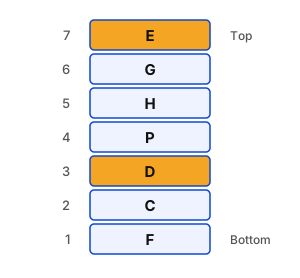
Seven boxes C,D,E,F,G,H and P are kept one over the other but not necessarily in the same order. C is kept second from the bottom. Only three boxes are kept between C and G. F is kept at one of the positions below C. Only H is kept between G and P. E is kept at one of the positions above G. How many boxes are kept between D and E?
सात बक्से C, D, E, F, G, H और P एक के ऊपर एक रखे गए हैं, लेकिन आवश्यक नहीं कि इसी क्रम में हों। C नीचे से दूसरे स्थान पर रखा गया है। C और G के बीच केवल तीन बक्से रखे गए हैं। F, C के नीचे की किसी एक स्थिति पर रखा गया है। G और P के बीच केवल H रखा गया है। E, G के ऊपर की किसी एक स्थिति पर रखा गया है। D और E के बीच कितने बक्से रखे गए हैं?
  1. AThreeतीन
  2. BFourचार
  3. CTwoदो
  4. DOneएक
Show answer

Concept: Number positions 1 (bottom) to 7 (top) and fill the definite clues first.

  1. C is second from the bottom → C = 2. Three boxes between C and G → G = 6.
  2. F is below C → F = 1.
  3. Only H between G and P → P = 4, H = 5 (P cannot be at 8).
  4. E is above G → E = 7; the last box D = 3.
  5. Between D (3) and E (7): P, H, G → three boxes.

Trick: Count boxes between positions as |p1−p2|−1; here 7−3−1=3.

Answer: (A) Three

अवधारणा: स्थान 1 (नीचे) से 7 (ऊपर) तक क्रमांकित करें और पहले निश्चित संकेत भरें।

  1. C नीचे से दूसरा → C = 2। C और G के बीच तीन बॉक्स → G = 6।
  2. F, C के नीचे → F = 1।
  3. G और P के बीच केवल H → P = 4, H = 5 (P स्थान 8 पर नहीं हो सकता)।
  4. E, G के ऊपर → E = 7; अंतिम बॉक्स D = 3।
  5. D (3) और E (7) के बीच: P, H, G → तीन बॉक्स।

ट्रिक: दो स्थानों के बीच बॉक्स = |p1−p2|−1; यहाँ 7−3−1=3।

उत्तर: (A) तीन (Three)

RRB NTPC Undergraduate CBT 1General Intelligence and ReasoningBox ArrangementRRB NTPC Undergraduate CBT 1 2025 · 9 May Shift 1 →
Q7876.
In a certain code language,
A @ B means ‘A is the mother of B’,
A & B means ‘A is the husband of B’,
A # B means ‘A is the father of B’,
A % B means ‘A is the son of B’ and
A * B means ‘A is the daughter of B’.
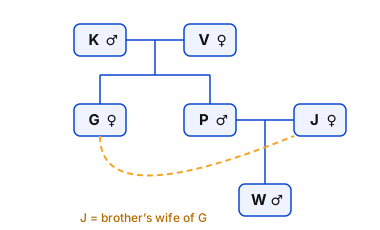
If G * K & V @ P # W % J, then how is J related to G?
एक निश्चित कूट भाषा में,
A @ B का अर्थ है 'A, B की माता है',
A & B का अर्थ है 'A, B का पति है',
A # B का अर्थ है 'A, B का पिता है',
A % B का अर्थ है 'A, B का पुत्र है' और
A * B का अर्थ है 'A, B की पुत्री है'।
यदि G * K & V @ P # W % J है, तो J, G से किस प्रकार संबंधित है?
  1. AMother’s brother’s sonमाता के भाई का पुत्र
  2. BBrother’s wifeभाई की पत्नी
  3. CBrother’s daughterभाई की पुत्री
  4. DSister’s sonबहन का पुत्र
Show answer

Concept: Decode each symbol step by step and draw the family tree.

  1. G * K: G is the daughter of K. K & V: K is the husband of V → G is the daughter of K and V.
  2. V @ P: V is the mother of P → P is G's brother (son of K and V).
  3. P # W: P is the father of W. W % J: W is the son of J → J is W's mother, i.e. P's wife.
  4. So J is the wife of G's brother → brother's wife.

Trick: Two parents named for the same child (P father of W, W son of J) ⇒ P and J are husband and wife.

Answer: (B) Brother's wife

अवधारणा: हर चिह्न को क्रम से समझें और परिवार-वृक्ष बनाएँ।

  1. G * K: G, K की बेटी है। K & V: K, V का पति है → G, K और V की बेटी।
  2. V @ P: V, P की माँ है → P, G का भाई है (K और V का बेटा)।
  3. P # W: P, W का पिता है। W % J: W, J का बेटा है → J, W की माँ यानी P की पत्नी।
  4. अतः J, G के भाई की पत्नी (भाभी) है।

ट्रिक: एक ही संतान के दो अभिभावक (P पिता, J माँ) ⇒ P और J पति-पत्नी।

उत्तर: (B) भाई की पत्नी (भाभी)

RRB NTPC Undergraduate CBT 1General Intelligence and ReasoningBlood RelationsRRB NTPC Undergraduate CBT 1 2025 · 9 May Shift 1 →
Q7877.
Based on the English alphabetical order, three of the following four letter-cluster pairs are alike in a certain way and thus form a group. Which is the one that does not belong to that group?
(Note: The odd one out is not based on the number of consonants/vowels or their position in the letter-cluster pairs.)
अंग्रेज़ी वर्णमाला क्रम के आधार पर, निम्नलिखित चार अक्षर-समूह युग्मों में से तीन एक निश्चित प्रकार से समान हैं और इस प्रकार एक समूह बनाते हैं। वह कौन-सा है जो उस समूह से संबंधित नहीं है?
(नोट: असंगत का निर्धारण व्यंजनों/स्वरों की संख्या या अक्षर-समूह युग्मों में उनकी स्थिति के आधार पर नहीं किया गया है।)
  1. ARL-IQ
  2. BOI – EN
  3. CVP – MU
  4. DCW-TB
Show answer

Concept: Find the position-shift from the first cluster to the second, letter by letter, in each pair.

  1. RL–IQ: R(18)→I(9) = −9; L(12)→Q(17) = +5.
  2. VP–MU: V(22)→M(13) = −9; P(16)→U(21) = +5. CW–TB: C(3)→T(20) = −9 (3−9 = −6 → 20); W(23)→B(2) = +5 (28 → 2).
  3. OI–EN: O(15)→E(5) = −10; I(9)→N(14) = +5. The first-letter shift differs.

Trick: Pattern (−9, +5) in three pairs; OI–EN breaks it with −10.

Answer: (B) OI – EN

अवधारणा: हर युग्म में पहले समूह से दूसरे समूह तक प्रत्येक अक्षर का स्थान-परिवर्तन देखें।

  1. RL–IQ: R(18)→I(9) = −9; L(12)→Q(17) = +5।
  2. VP–MU: V(22)→M(13) = −9; P(16)→U(21) = +5। CW–TB: C(3)→T(20) = −9 (3−9 = −6 → 20); W(23)→B(2) = +5 (28 → 2)।
  3. OI–EN: O(15)→E(5) = −10; I(9)→N(14) = +5। पहले अक्षर का परिवर्तन भिन्न है।

ट्रिक: तीन युग्मों में पैटर्न (−9, +5); OI–EN में −10 होने से यह विषम है।

उत्तर: (B) OI – EN

RRB NTPC Undergraduate CBT 1General Intelligence and ReasoningOdd One Out – Letter PairsRRB NTPC Undergraduate CBT 1 2025 · 9 May Shift 1 →
Q7878.
What should come in place of ‘?’ in the given series?
217 190 165 142 121 102 ?
दी गई शृंखला में '?' के स्थान पर क्या आना चाहिए?
217 190 165 142 121 102 ?
  1. A92
  2. B87
  3. C90
  4. D85
Show answer

Concept: Take successive differences and look for a pattern in them.

  1. 217 → 190 → 165 → 142 → 121 → 102: differences −27,−25,−23,−21,−19.
  2. Differences decrease by 2 each time, so the next difference is −17.
  3. 102−17=85.

Trick: Consecutive odd numbers subtracted (27, 25, 23 …) – a very common second-level pattern.

Answer: (D) 85

अवधारणा: क्रमागत अंतर निकालें और उनमें पैटर्न खोजें।

  1. 217 → 190 → 165 → 142 → 121 → 102: अंतर −27,−25,−23,−21,−19।
  2. अंतर हर बार 2 घटता है, अतः अगला अंतर −17।
  3. 102−17=85।

ट्रिक: क्रमागत विषम संख्याएँ (27, 25, 23 …) घटाई जा रही हैं – यह बहुत सामान्य द्वितीय-स्तर पैटर्न है।

उत्तर: (D) 85

RRB NTPC Undergraduate CBT 1General Intelligence and ReasoningNumber SeriesRRB NTPC Undergraduate CBT 1 2025 · 9 May Shift 1 →
Q7879.
What should come in place of the question mark (?) in the given series based on the English alphabetical order?
ACE DFH GIK JLN ?
अंग्रेज़ी वर्णमाला क्रम पर आधारित दी गई शृंखला में प्रश्नचिह्न (?) के स्थान पर क्या आना चाहिए?
ACE DFH GIK JLN ?
  1. AOQS
  2. BMPQ
  3. CMOQ
  4. DNQT
Show answer

Concept: Within each term the letters are alternate (A, C, E), and each term shifts by a fixed amount.

  1. A(1) → D(4) → G(7) → J(10): +3 each time.
  2. C → F → I → L: +3; E → H → K → N: +3.
  3. Next: J+3 = M, L+3 = O, N+3 = Q → MOQ.

Trick: The series is just ACE, DFH, GIK, JLN, MOQ – every letter +3; option MPQ is a trap (P breaks the +2 gap inside the term).

Answer: (C) MOQ

अवधारणा: हर पद में अक्षर एक-एक छोड़कर हैं (A, C, E), और हर पद निश्चित मात्रा से आगे बढ़ता है।

  1. A(1) → D(4) → G(7) → J(10): हर बार +3।
  2. C → F → I → L: +3; E → H → K → N: +3।
  3. अगला: J+3 = M, L+3 = O, N+3 = Q → MOQ।

ट्रिक: श्रृंखला ACE, DFH, GIK, JLN, MOQ – हर अक्षर +3; विकल्प MPQ जाल है (P पद के भीतर +2 के अंतर को तोड़ता है)।

उत्तर: (C) MOQ

RRB NTPC Undergraduate CBT 1General Intelligence and ReasoningLetter SeriesRRB NTPC Undergraduate CBT 1 2025 · 9 May Shift 1 →
Q7880.
BGKM is related to HKMN in a certain way based on the English alphabetical order. In the same way, FHNP is related to LLPQ .
To which of the following is NRTX related, following the same logic?
अंग्रेज़ी वर्णमाला क्रम के आधार पर BGKM, HKMN से एक निश्चित प्रकार से संबंधित है। उसी प्रकार, FHNP, LLPQ से संबंधित है।
समान तर्क का अनुसरण करते हुए, NRTX निम्नलिखित में से किससे संबंधित है?
  1. AGFLN
  2. BTVVY
  3. CSWYC
  4. DTXZD
Show answer

Concept: Find the shift applied to each letter position in the given pairs and apply the same shifts.

  1. BGKM → HKMN: B+6 = H, G+4 = K, K+2 = M, M+1 = N → shifts (+6, +4, +2, +1).
  2. Check FHNP → LLPQ: F+6 = L, H+4 = L, N+2 = P, P+1 = Q ✓.
  3. NRTX: N(14)+6 = T(20), R(18)+4 = V(22), T(20)+2 = V(22), X(24)+1 = Y(25) → TVVY.

Trick: Shifts need not be equal – write them as a list (+6, +4, +2, +1) and reuse.

Answer: (B) TVVY

अवधारणा: दिए गए युग्मों में हर अक्षर-स्थान पर लागू परिवर्तन खोजें और वही परिवर्तन लागू करें।

  1. BGKM → HKMN: B+6 = H, G+4 = K, K+2 = M, M+1 = N → परिवर्तन (+6, +4, +2, +1)।
  2. जाँच FHNP → LLPQ: F+6 = L, H+4 = L, N+2 = P, P+1 = Q ✓।
  3. NRTX: N(14)+6 = T(20), R(18)+4 = V(22), T(20)+2 = V(22), X(24)+1 = Y(25) → TVVY।

ट्रिक: परिवर्तन बराबर होना ज़रूरी नहीं – सूची (+6, +4, +2, +1) लिखें और दोहराएँ।

उत्तर: (B) TVVY

RRB NTPC Undergraduate CBT 1General Intelligence and ReasoningLetter Cluster AnalogyRRB NTPC Undergraduate CBT 1 2025 · 9 May Shift 1 →