Question bank

Q&A: practice questions with answers

Search questions on any topic. Filter by exam category, exam, subject and topic, try the question, then open the answer and explanation.

Courses – airGurukul

8,495 questions found.

Q781.
Based on the English alphabetical order, three of the following four letter-cluster pairs are alike in a certain way and thus form a group. Which letter-cluster pair DOES NOT belong to that group?
(Note: The odd one out is not based on the number of consonants/vowels or their position in the letter-cluster.)
अंग्रेज़ी वर्णमाला क्रम के आधार पर, निम्नलिखित चार अक्षर-समूह युग्मों में से तीन किसी निश्चित प्रकार से एकसमान हैं और इस प्रकार एक समूह बनाते हैं। कौन-सा अक्षर-समूह युग्म उस समूह से संबंधित नहीं है?
(नोट: असंगत, अक्षर-समूह में व्यंजनों/स्वरों की संख्या या उनके स्थान पर आधारित नहीं है।)
  1. AFH-KD
  2. BMO-RL
  3. CIK-NG
  4. DCE-HA
Show answer

Concept: Write position values and compare the change from the first pair to the second.

  1. FH-KD: F+5 = K, H−4 = D.
  2. IK-NG: I+5 = N, K−4 = G.
  3. CE-HA: C+5 = H, E−4 = A.
  4. MO-RL: M+5 = R but O−3 = L ✗.

Trick: Pattern: (+5, −4); MO-RL gives (+5, −3).

Answer: (B) MO-RL

अवधारणा: स्थानीय मान लिखकर पहले युग्म से दूसरे युग्म का बदलाव देखें।

  1. FH-KD: F+5 = K, H−4 = D।
  2. IK-NG: I+5 = N, K−4 = G।
  3. CE-HA: C+5 = H, E−4 = A।
  4. MO-RL: M+5 = R पर O−3 = L ✗।

ट्रिक: नियम: (+5, −4); MO-RL में (+5, −3)।

उत्तर: (B) MO-RL
RRB NTPC Undergraduate CBT 1General Intelligence and ReasoningOdd One Out (Letter Pairs)RRB NTPC Undergraduate CBT 1 2024 · 22 Aug Shift 2 →
Q782.
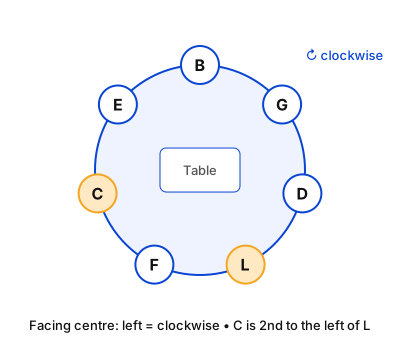
Seven people, B, C, D, E, F, G and L, are sitting around a circular table facing the centre of the table. Only three people sit between B and F when counted from the left of B. Only three people sit between D and E when counted from the right of E. G sits to the immediate right of D. C is an immediate neighbour of E as well as F. Who sits to the second to the left of L?
सात व्यक्ति, B, C, D, E, F, G और L, एक वृत्ताकार मेज़ के चारों ओर मेज़ के केंद्र की ओर मुख करके बैठे हैं। B के बाएँ से गिनने पर B और F के बीच केवल तीन व्यक्ति बैठे हैं। E के दाएँ से गिनने पर D और E के बीच केवल तीन व्यक्ति बैठे हैं। G, D के ठीक दाएँ बैठा है। C, E और F दोनों का निकटतम पड़ोसी है। L के बाएँ से दूसरे स्थान पर कौन बैठा है?
  1. AF
  2. BE
  3. CC
  4. DB
Show answer

Concept: Facing the centre: left = clockwise, right = anticlockwise.

  1. Place B; F is 4th clockwise from B (three between).
  2. C sits next to F and E next to C; C on F's anticlockwise side forces G onto F, so C, E go clockwise after F.
  3. D is 4th anticlockwise from E; G is immediately right (anticlockwise) of D.
  4. Clockwise order: B, G, D, L, F, C, E.
  5. Second to the left (clockwise) of L is C.

Trick: Draw seats numbered clockwise; 'left' = +1, 'right' = −1.

Answer: (C) C

अवधारणा: केंद्र की ओर मुख होने पर: बायाँ = दक्षिणावर्त, दायाँ = वामावर्त।

  1. B रखें; F, B से दक्षिणावर्त चौथा (बीच में तीन)।
  2. C, F का और E, C का पड़ोसी; दूसरा विकल्प G को F पर ले आता है, अतः C, E दक्षिणावर्त F के बाद।
  3. D, E से वामावर्त चौथा; G, D के ठीक दाएँ।
  4. दक्षिणावर्त क्रम: B, G, D, L, F, C, E।
  5. L के बाएँ से दूसरा = C।

ट्रिक: सीटें दक्षिणावर्त क्रमांकित करें; बायाँ = +1, दायाँ = −1।

उत्तर: (C) C

RRB NTPC Undergraduate CBT 1General Intelligence and ReasoningCircular ArrangementRRB NTPC Undergraduate CBT 1 2024 · 22 Aug Shift 2 →
Q783.
If 1 is added to each odd digit and 2 is subtracted from each even digit in the number 3851764, what will be the sum of the digits that are second from the left and second from the right?
यदि संख्या 3851764 के प्रत्येक विषम अंक में 1 जोड़ा जाए और प्रत्येक सम अंक में से 2 घटाया जाए, तो बाएँ से दूसरे और दाएँ से दूसरे अंकों का योगफल क्या होगा?
  1. A12
  2. B6
  3. C10
  4. D8
Show answer

Concept: Apply the rule digit by digit, then read the asked positions.

  1. 3851764: 3→4, 8→6, 5→6, 1→2, 7→8, 6→4, 4→2.
  2. New number: 4 6 6 2 8 4 2.
  3. Second from left =6, second from right =4; sum =10.

Trick: Only the two needed digits matter: 8→6 and 6→4.

Answer: (C) 10

अवधारणा: नियम हर अंक पर लगाएँ, फिर पूछे गए स्थान पढ़ें।

  1. 3851764: 3→4, 8→6, 5→6, 1→2, 7→8, 6→4, 4→2।
  2. नई संख्या: 4 6 6 2 8 4 2।
  3. बाएँ से दूसरा =6, दाएँ से दूसरा =4; योग =10।

ट्रिक: केवल ज़रूरी दो अंक बदलें: 8→6 और 6→4।

उत्तर: (C) 10

RRB NTPC Undergraduate CBT 1General Intelligence and ReasoningNumber OperationsRRB NTPC Undergraduate CBT 1 2024 · 22 Aug Shift 2 →
Q784.
Based on the English alphabetical order, three of the following four letter-cluster pairs are alike in a certain way and thus form a group. Which letter-cluster pair DOES NOT belong to that group?
(Note: The odd one out is not based on the number of consonants/vowels or their position in the letter-cluster.)
अंग्रेज़ी वर्णमाला क्रम के आधार पर, निम्नलिखित चार अक्षर-समूह युग्मों में से तीन किसी निश्चित प्रकार से एकसमान हैं और इस प्रकार एक समूह बनाते हैं। कौन-सा अक्षर-समूह युग्म उस समूह से संबंधित नहीं है?
(नोट: असंगत, अक्षर-समूह में व्यंजनों/स्वरों की संख्या या उनके स्थान पर आधारित नहीं है।)
  1. AOQ -TV
  2. BVX-AC
  3. CGI-LM
  4. DKM-PR
Show answer

Concept: Compare the gaps inside and between the clusters.

  1. OQ-TV: O+2 = Q, Q+3 = T, T+2 = V.
  2. VX-AC: V+2 = X, X+3 = A (cyclic), A+2 = C.
  3. KM-PR: K+2 = M, M+3 = P, P+2 = R.
  4. GI-LM: G+2 = I, I+3 = L but L+1 = M ✗.

Trick: Pattern (+2, +3, +2); GI-LM breaks at the last step.

Answer: (C) GI-LM

अवधारणा: क्लस्टरों के भीतर और बीच के अंतर की तुलना करें।

  1. OQ-TV: +2, +3, +2।
  2. VX-AC: +2, +3 (चक्रीय), +2।
  3. KM-PR: +2, +3, +2।
  4. GI-LM: +2, +3, पर अंतिम +1 ✗।

ट्रिक: नियम (+2, +3, +2); GI-LM अंत में टूटता है।

उत्तर: (C) GI-LM

RRB NTPC Undergraduate CBT 1General Intelligence and ReasoningOdd One Out (Letter Pairs)RRB NTPC Undergraduate CBT 1 2024 · 22 Aug Shift 2 →
Q785.
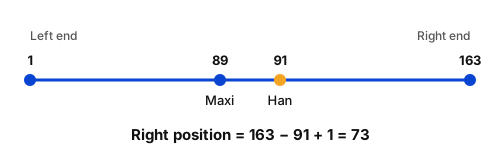
In a row of 163 students facing north, Mr. Maxi is 89th from the left end. If Mr. Han is 2nd to the right of Mr. Maxi, what is Mr. Han's position from the right end of the line?
उत्तर की ओर मुख करके खड़े 163 विद्यार्थियों की एक पंक्ति में, श्री मैक्सी बाएँ छोर से 89वें स्थान पर हैं। यदि श्री हान, श्री मैक्सी के दाएँ से दूसरे स्थान पर हैं, तो पंक्ति के दाएँ छोर से श्री हान का स्थान क्या है?
  1. A72nd72वाँ
  2. B75th75वाँ
  3. C73rd73वाँ
  4. D74th74वाँ
Show answer

Concept: Position from right =total−position from left+1.

  1. Han is 2nd to the right of Maxi ⇒ 89+2=91st from left.
  2. From right =163−91+1=73rd.

Trick: Left + Right − 1 = Total.

Answer: (C) 73rd

अवधारणा: दाएँ से स्थान =कुल−बाएँ से स्थान+1।

  1. हान, मैक्सी के दाएँ दूसरा ⇒ बाएँ से 89+2=91वाँ।
  2. दाएँ से =163−91+1=73वाँ।

ट्रिक: बायाँ + दायाँ − 1 = कुल।

उत्तर: (C) 73rd

RRB NTPC Undergraduate CBT 1General Intelligence and ReasoningRanking / PositionRRB NTPC Undergraduate CBT 1 2024 · 22 Aug Shift 2 →
Q786.
Read the given statements and conclusions carefully. Assuming that the information given in the statements is true, even if it appears to be at variance with commonly known facts, decide which of the given conclusion(s) logically follow(s) from the statements.
Statements:
Some trees are plants.
Some plants are graphs.
Conclusions:
(I): Some trees are graphs.
(II): All graphs are plants.
दिए गए कथनों और निष्कर्षों को ध्यानपूर्वक पढ़िए। यह मानते हुए कि कथनों में दी गई जानकारी सत्य है, भले ही वह सामान्य रूप से ज्ञात तथ्यों से भिन्न प्रतीत होती हो, निर्णय लीजिए कि दिए गए निष्कर्षों में से कौन-सा/से निष्कर्ष तार्किक रूप से कथनों का अनुसरण करता है/करते हैं।
कथन:
कुछ वृक्ष, पौधे हैं।
कुछ पौधे, ग्राफ़ हैं।
निष्कर्ष:
(I): कुछ वृक्ष, ग्राफ़ हैं।
(II): सभी ग्राफ़, पौधे हैं।
  1. ANeither conclusion (I) nor (II) follows.न तो निष्कर्ष (I) और न ही (II) अनुसरण करता है।
  2. BOnly conclusion (II) follows.केवल निष्कर्ष (II) अनुसरण करता है।
  3. COnly conclusion (I) follows.केवल निष्कर्ष (I) अनुसरण करता है।
  4. DBoth conclusions (I) and (II) follow.निष्कर्ष (I) और (II) दोनों अनुसरण करते हैं।
Show answer

Concept: Two 'some' statements give no definite conclusion between the end terms.

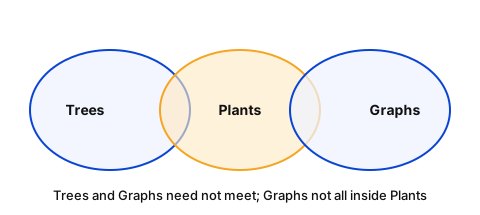
  1. Trees–Plants and Plants–Graphs overlap partly; Trees and Graphs may not meet ⇒ I does not follow.
  2. Only 'some plants are graphs' is known; 'all graphs are plants' is not certain ⇒ II does not follow.

Yaad rakhein: Some + Some = no conclusion.

Answer: (A) Neither conclusion (I) nor (II) follows.

अवधारणा: दो 'कुछ' कथनों से अंतिम पदों के बीच कोई निश्चित निष्कर्ष नहीं निकलता।

  1. Trees और Graphs का मिलना आवश्यक नहीं ⇒ I अनुसरण नहीं करता।
  2. केवल 'कुछ plants graphs हैं' ज्ञात है; 'सभी graphs plants हैं' निश्चित नहीं ⇒ II भी नहीं।

याद रखें: कुछ + कुछ = कोई निष्कर्ष नहीं।

उत्तर: (A) न तो (I) न ही (II) अनुसरण करता है।

RRB NTPC Undergraduate CBT 1General Intelligence and ReasoningSyllogismRRB NTPC Undergraduate CBT 1 2024 · 22 Aug Shift 2 →
Q787.
In the following triads, each group of letters is related to the subsequent one following a certain logic. Select from the given options, the one which follows the same logic. DIMS - SIDM - IMDS
COLT - TOCL - OLCT
निम्नलिखित त्रिकों में, अक्षरों का प्रत्येक समूह एक निश्चित तर्क के अनुसार अपने बाद वाले समूह से संबंधित है। दिए गए विकल्पों में से उसका चयन कीजिए जो समान तर्क का अनुसरण करता है। DIMS - SIDM - IMDS
COLT - TOCL - OLCT
  1. AGUYS - SUGY - YUGS
  2. BFROG - GRFO - ROFG
  3. CTIME - ITME - EIMT
  4. DFOUR - FUOR - RUOF
Show answer

Concept: Find the position shuffle from word 1 to word 2 and from word 2 to word 3.

  1. DIMS → SIDM: letters 4, 2, 1, 3; SIDM → IMDS: letters 2, 4, 3, 1.
  2. COLT → TOCL → OLCT follows the same ✓.
  3. FROG → GRFO (4, 2, 1, 3) → ROFG (2, 4, 3, 1) ✓.

Trick: Shortcut: word 3 = letters 2, 3, 1, 4 of word 1 (FROG → R O F G).

Answer: (B) FROG - GRFO - ROFG

अवधारणा: पहले से दूसरे शब्द और दूसरे से तीसरे शब्द में अक्षरों का स्थान-परिवर्तन देखें।

  1. DIMS → SIDM: क्रम 4, 2, 1, 3; SIDM → IMDS: क्रम 2, 4, 3, 1।
  2. COLT → TOCL → OLCT भी यही ✓।
  3. FROG → GRFO → ROFG ✓।

ट्रिक: शॉर्टकट: तीसरा शब्द = पहले शब्द के अक्षर 2, 3, 1, 4।

उत्तर: (B) FROG - GRFO - ROFG

RRB NTPC Undergraduate CBT 1General Intelligence and ReasoningLetter Rearrangement (Triads)RRB NTPC Undergraduate CBT 1 2024 · 22 Aug Shift 2 →
Q788.
Seven boxes, A, B, C, D, K, L and O, are kept one over the other, but not necessarily in the same order. Only D is kept above C. Only L is kept between C and B. Only A is kept below K. How many boxes are kept between O and A?
सात बक्से, A, B, C, D, K, L और O, एक के ऊपर एक रखे गए हैं, परंतु आवश्यक नहीं कि इसी क्रम में हों। C के ऊपर केवल D रखा गया है। C और B के बीच केवल L रखा गया है। K के नीचे केवल A रखा गया है। O और A के बीच कितने बक्से रखे गए हैं?
  1. AThreeतीन
  2. BTwoदो
  3. COneएक
  4. DFourचार
Show answer

Concept: Use 'only' clues to fix exact positions from top and bottom.

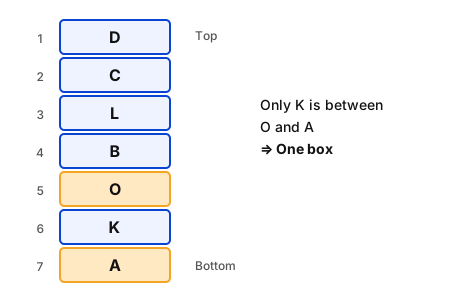
  1. Only D above C ⇒ D 1st, C 2nd from top.
  2. Only L between C and B ⇒ L 3rd, B 4th.
  3. Only A below K ⇒ A 7th (bottom), K 6th.
  4. O takes 5th place; between O and A only K ⇒ one box.

Trick: 'Only X above Y' fixes Y at position 2 from top.

Answer: (C) One

अवधारणा: 'केवल' वाले संकेतों से ऊपर व नीचे से सटीक स्थान तय करें।

  1. केवल D, C के ऊपर ⇒ D 1st, C 2nd (ऊपर से)।
  2. C और B के बीच केवल L ⇒ L 3rd, B 4th।
  3. केवल A, K के नीचे ⇒ A 7th, K 6th।
  4. O 5th; O और A के बीच केवल K ⇒ एक बॉक्स।

ट्रिक: 'केवल X, Y के ऊपर' ⇒ Y ऊपर से दूसरा।

उत्तर: (C) एक

RRB NTPC Undergraduate CBT 1General Intelligence and ReasoningBox StackingRRB NTPC Undergraduate CBT 1 2024 · 22 Aug Shift 2 →
Q789.
Which of the following letter-number clusters will replace the question mark (?) in the given series to make it logically complete?
KFU-15 IIQ-22 ? EOI-42 CRE-55
निम्नलिखित में से कौन-सा अक्षर-संख्या समूह दी गई श्रृंखला में प्रश्न चिह्न (?) का स्थान लेकर उसे तार्किक रूप से पूर्ण बनाएगा?
KFU-15 IIQ-22 ? EOI-42 CRE-55
  1. AHGL-31
  2. BKJG-32
  3. CKLJ-30
  4. DGLM-31
Show answer

Concept: Track each letter position and the number separately.

  1. 1st letters: K, I, ?, E, C (−2) ⇒ G.
  2. 2nd letters: F, I, ?, O, R (+3) ⇒ L.
  3. 3rd letters: U, Q, ?, I, E (−4) ⇒ M.
  4. Numbers: 15, 22, ?, 42, 55 with gaps 7, 9, 11, 13 ⇒ 31.

Trick: Odd-number gaps: +7,+9,+11,+13.

Answer: (D) GLM-31

अवधारणा: हर अक्षर-स्थान और संख्या को अलग से देखें।

  1. पहले अक्षर: K, I, ?, E, C (−2) ⇒ G।
  2. दूसरे: F, I, ?, O, R (+3) ⇒ L।
  3. तीसरे: U, Q, ?, I, E (−4) ⇒ M।
  4. संख्याएँ: 15, 22, ?, 42, 55; अंतर 7, 9, 11, 13 ⇒ 31।

ट्रिक: अंतर क्रमागत विषम संख्याएँ: +7,+9,+11,+13।

उत्तर: (D) GLM-31

RRB NTPC Undergraduate CBT 1General Intelligence and ReasoningAlpha-numeric SeriesRRB NTPC Undergraduate CBT 1 2024 · 22 Aug Shift 2 →
Q790.
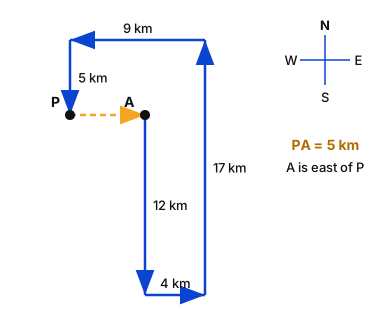
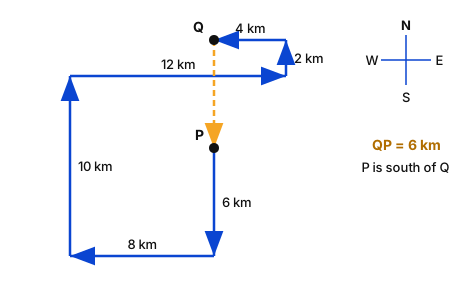
Alexander starts from Point A and drives 12 km towards the south. He then takes a left turn and drives 4 km, then turns left and drives 17 km. He then takes a left turn and drives 9 km. He takes a final left turn, drives 5 km and stops at Point P. How far (shortest distance) and in which direction should he drive in order to reach Point A again? (All turns are 90-degree turns only unless specified.)
अलेक्जेंडर बिंदु A से चलना शुरू करता है और दक्षिण की ओर 12 km गाड़ी चलाता है। फिर वह बाएँ मुड़ता है और 4 km गाड़ी चलाता है, फिर बाएँ मुड़ता है और 17 km गाड़ी चलाता है। फिर वह बाएँ मुड़ता है और 9 km गाड़ी चलाता है। वह अंतिम बार बाएँ मुड़ता है, 5 km गाड़ी चलाता है और बिंदु P पर रुक जाता है। पुनः बिंदु A तक पहुँचने के लिए उसे कितनी दूरी (न्यूनतम दूरी) और किस दिशा में गाड़ी चलानी चाहिए? (जब तक निर्दिष्ट न हो, सभी मोड़ केवल 90-डिग्री के मोड़ हैं।)
  1. A5 km to the eastपूर्व की ओर 5 km
  2. B3 km to the eastपूर्व की ओर 3 km
  3. C2 km to the eastपूर्व की ओर 2 km
  4. D4 km to the eastपूर्व की ओर 4 km
Show answer

Concept: Take A as origin and track net east–west and north–south movement.

  1. South 12 → left (east) 4 → left (north) 17 → left (west) 9 → left (south) 5.
  2. North–south: −12+17−5=0.
  3. East–west: 4−9=−5 ⇒ P is 5 km west of A.
  4. To return: 5 km towards the east.

Trick: When the vertical moves cancel, the answer is just the net horizontal shift.

Answer: (A) 5 km to the east

अवधारणा: A को मूल बिंदु मानकर पूर्व–पश्चिम व उत्तर–दक्षिण की शुद्ध दूरी निकालें।

  1. दक्षिण 12 → बाएँ (पूर्व) 4 → बाएँ (उत्तर) 17 → बाएँ (पश्चिम) 9 → बाएँ (दक्षिण) 5।
  2. उत्तर–दक्षिण: −12+17−5=0।
  3. पूर्व–पश्चिम: 4−9=−5 ⇒ P, A से 5 km पश्चिम।
  4. वापसी: 5 km पूर्व की ओर।

ट्रिक: ऊर्ध्व चालें कटें तो केवल क्षैतिज अंतर बचता है।

उत्तर: (A) 5 km पूर्व की ओर

RRB NTPC Undergraduate CBT 1General Intelligence and ReasoningDirection and DistanceRRB NTPC Undergraduate CBT 1 2024 · 22 Aug Shift 2 →
Q791.
Based on the English alphabetical order, three of the following four letter-cluster pairs are alike in a certain way and thus form a group. Which letter-cluster pair DOES NOT belong to that group?
(Note: The odd one out is not based on the number of consonants/vowels or their position in the letter-cluster.)
अंग्रेज़ी वर्णमाला क्रम के आधार पर, निम्नलिखित चार अक्षर-समूह युग्मों में से तीन किसी निश्चित प्रकार से एकसमान हैं और इस प्रकार एक समूह बनाते हैं। कौन-सा अक्षर-समूह युग्म उस समूह से संबंधित नहीं है?
(नोट: असंगत, अक्षर-समूह में व्यंजनों/स्वरों की संख्या या उनके स्थान पर आधारित नहीं है।)
  1. AJM-QG
  2. BEH-LC
  3. CLO-SJ
  4. DOR-VM
Show answer

Concept: Compare how the second pair is formed from the first.

  1. EH-LC: E+7 = L, H−5 = C.
  2. LO-SJ: L+7 = S, O−5 = J.
  3. OR-VM: O+7 = V, R−5 = M.
  4. JM-QG: J+7 = Q but M−6 = G ✗.

Trick: Pattern (+7, −5); JM-QG gives (+7, −6).

Answer: (A) JM-QG

अवधारणा: दूसरे युग्म का पहले युग्म से संबंध देखें।

  1. EH-LC: E+7 = L, H−5 = C।
  2. LO-SJ: L+7 = S, O−5 = J।
  3. OR-VM: O+7 = V, R−5 = M।
  4. JM-QG: J+7 = Q पर M−6 = G ✗।

ट्रिक: नियम (+7, −5); JM-QG में (+7, −6)।

उत्तर: (A) JM-QG

RRB NTPC Undergraduate CBT 1General Intelligence and ReasoningOdd One Out (Letter Pairs)RRB NTPC Undergraduate CBT 1 2024 · 22 Aug Shift 2 →
Q792.
Select the pair that follows the same pattern as that followed by the two pairs given below. Both pairs follow the same pattern.
FEI−HGK
YXB−AZD
उस युग्म का चयन कीजिए जो उसी पैटर्न का अनुसरण करता है जिसका अनुसरण नीचे दिए गए दो युग्म करते हैं। दोनों युग्म समान पैटर्न का अनुसरण करते हैं।
FEI−HGK
YXB−AZD
  1. AWVZ−YXB
  2. BSRV−TTW
  3. CSQT−UTX
  4. DSQT−TSW
Show answer

Concept: Find the change from each letter of cluster 1 to cluster 2.

  1. FEI → HGK: each letter +2.
  2. YXB → AZD: each +2 (cyclic) ✓.
  3. WVZ → YXB: W+2 = Y, V+2 = X, Z+2 = B ✓.

Trick: Also check the internal gaps (−1, +4) match: W V Z has them too.

Answer: (A) WVZ−YXB

अवधारणा: पहले क्लस्टर के हर अक्षर से दूसरे क्लस्टर तक का बदलाव देखें।

  1. FEI → HGK: प्रत्येक +2।
  2. YXB → AZD: प्रत्येक +2 (चक्रीय) ✓।
  3. WVZ → YXB: W→Y, V→X, Z→B (प्रत्येक +2) ✓।

ट्रिक: आंतरिक अंतर (−1, +4) भी मिलाएँ।

उत्तर: (A) WVZ−YXB

RRB NTPC Undergraduate CBT 1General Intelligence and ReasoningLetter AnalogyRRB NTPC Undergraduate CBT 1 2024 · 22 Aug Shift 2 →
Q793.
Select the set in which the numbers are related in the same way as are the numbers of the following sets.
(NOTE: Operations should be performed on the whole numbers, without breaking down the numbers into their constituent digits. E.g. 13 – Operations on 13 such as adding to/subtracting from/multiplying with 13 can be performed. Breaking down 13 into 1 and 3 and then performing mathematical operations on 1 and 3 is not allowed.)
(46, 41, 26)
(77, 72, 57)
उस समुच्चय का चयन कीजिए जिसकी संख्याएँ उसी प्रकार संबंधित हैं जिस प्रकार निम्नलिखित समुच्चयों की संख्याएँ संबंधित हैं।
(नोट: संख्याओं को उनके घटक अंकों में विभक्त किए बिना, संक्रियाएँ पूर्ण संख्याओं पर की जानी चाहिए। उदाहरण 13 – 13 पर संक्रियाएँ जैसे 13 में जोड़ना/घटाना/गुणा करना आदि की जा सकती हैं। 13 को 1 और 3 में विभक्त करके फिर 1 और 3 पर गणितीय संक्रियाएँ करने की अनुमति नहीं है।)
(46, 41, 26)
(77, 72, 57)
  1. A(59, 54, 34)
  2. B(93, 88, 83)
  3. C(81, 71, 61)
  4. D(62, 57, 42)
Show answer

Concept: Find the operation linking the three numbers of each set.

  1. 46−5=41, 41−15=26.
  2. 77−5=72, 72−15=57 ✓.
  3. (62,57,42): 62−5=57, 57−15=42 ✓.
  4. Others fail, e.g. 54−34=20.

Trick: Rule: second = first −5, third = second −15.

Answer: (D) (62, 57, 42)

अवधारणा: हर समूह की तीनों संख्याओं का संबंध खोजें।

  1. 46−5=41, 41−15=26।
  2. 77−5=72, 72−15=57 ✓।
  3. (62,57,42): 62−5=57, 57−15=42 ✓।
  4. अन्य विफल, जैसे 54−34=20।

ट्रिक: नियम: दूसरी = पहली −5, तीसरी = दूसरी −15।

उत्तर: (D) (62, 57, 42)

RRB NTPC Undergraduate CBT 1General Intelligence and ReasoningNumber Analogy (Sets)RRB NTPC Undergraduate CBT 1 2024 · 22 Aug Shift 2 →
Q794.
Refer to the following number and symbol series and answer the question that follows. Counting to be done from left to right only.
(Left) # 3 % 7 $ 5 * & 4 β 9 Ω 4 9 μ 8 @ $ 1 π 3 (Right)
How many such symbols are there that are immediately preceded by a number and also immediately followed by another number?
निम्नलिखित संख्या और प्रतीक श्रृंखला को देखिए और उसके बाद दिए गए प्रश्न का उत्तर दीजिए। गिनती केवल बाएँ से दाएँ की जानी है।
(बाएँ) # 3 % 7 $ 5 * & 4 β 9 Ω 4 9 μ 8 @ $ 1 π 3 (दाएँ)
ऐसे कितने प्रतीक हैं जिनके ठीक पहले एक संख्या है और ठीक बाद भी एक अन्य संख्या है?
  1. AThreeतीन
  2. BFiveपाँच
  3. COneएक
  4. DSixछह
Show answer

Concept: Check every symbol: the element just before and just after must both be numbers.

  1. 3 % 7 ✓, 7 $ 5 ✓, 4 β 9 ✓, 9 Ω 4 ✓, 9 μ 8 ✓, 1 π 3 ✓.
  2. Fail: 5 * &, * & 4, 8 @ $, @ $ 1 (a symbol on one side).
  3. Total =6.

Trick: Mark the pattern 'number–symbol–number' while scanning once from left to right.

Answer: (D) Six

अवधारणा: हर प्रतीक जाँचें: उसके ठीक पहले और ठीक बाद दोनों संख्या होनी चाहिए।

  1. 3 % 7 ✓, 7 $ 5 ✓, 4 β 9 ✓, 9 Ω 4 ✓, 9 μ 8 ✓, 1 π 3 ✓।
  2. असफल: 5 * &, * & 4, 8 @ $, @ $ 1।
  3. कुल =6।

ट्रिक: एक बार बाएँ से दाएँ 'संख्या–प्रतीक–संख्या' चिह्नित करें।

उत्तर: (D) छह

RRB NTPC Undergraduate CBT 1General Intelligence and ReasoningSymbol–Number SeriesRRB NTPC Undergraduate CBT 1 2024 · 22 Aug Shift 2 →
Q795.
Geeta starts from Point P and drives 6 km towards south. Then, she takes a right turn, drives 8 km, turns right again and drives 10 km. She then takes a right turn and drives 12 km. Then, she takes a left turn and drives 2 km; she takes a left turn again and drives 4 km and stops at Point Q. How far (shortest distance) and towards which direction should she drive in order to reach Point P again? (All turns are 90-degree turns only, unless specified.)
गीता बिंदु P से चलना शुरू करती है और दक्षिण की ओर 6 km गाड़ी चलाती है। फिर, वह दाएँ मुड़ती है, 8 km गाड़ी चलाती है, फिर से दाएँ मुड़ती है और 10 km गाड़ी चलाती है। फिर वह दाएँ मुड़ती है और 12 km गाड़ी चलाती है। फिर, वह बाएँ मुड़ती है और 2 km गाड़ी चलाती है; वह फिर से बाएँ मुड़ती है और 4 km गाड़ी चलाती है और बिंदु Q पर रुक जाती है। पुनः बिंदु P तक पहुँचने के लिए उसे कितनी दूरी (न्यूनतम दूरी) और किस दिशा में गाड़ी चलानी चाहिए? (जब तक निर्दिष्ट न हो, सभी मोड़ केवल 90-डिग्री के मोड़ हैं।)
  1. A8 km towards southदक्षिण की ओर 8 km
  2. B4 km towards northउत्तर की ओर 4 km
  3. C4 km towards southदक्षिण की ओर 4 km
  4. D6 km towards southदक्षिण की ओर 6 km
Show answer

Concept: Take P as origin and track net movement.

  1. South 6 → right (west) 8 → right (north) 10 → right (east) 12 → left (north) 2 → left (west) 4.
  2. East–west: −8+12−4=0.
  3. North–south: −6+10+2=6 ⇒ Q is 6 km north of P.
  4. To return: 6 km towards south.

Trick: East–west cancels, so only the net north shift remains.

Answer: (D) 6 km towards south

अवधारणा: P को मूल बिंदु मानकर शुद्ध विस्थापन निकालें।

  1. दक्षिण 6 → दाएँ (पश्चिम) 8 → दाएँ (उत्तर) 10 → दाएँ (पूर्व) 12 → बाएँ (उत्तर) 2 → बाएँ (पश्चिम) 4।
  2. पूर्व–पश्चिम: −8+12−4=0।
  3. उत्तर–दक्षिण: −6+10+2=6 ⇒ Q, P से 6 km उत्तर।
  4. वापसी: 6 km दक्षिण की ओर।

ट्रिक: पूर्व–पश्चिम कट जाता है, केवल उत्तर का अंतर बचता है।

उत्तर: (D) 6 km दक्षिण की ओर

RRB NTPC Undergraduate CBT 1General Intelligence and ReasoningDirection and DistanceRRB NTPC Undergraduate CBT 1 2024 · 22 Aug Shift 2 →
Q796.
Read the given statements and conclusions carefully. Assuming that the information given in the statements is true, even if it appears to be at variance with commonly known facts, decide which of the given conclusions logically follow(s) from the statements.
Statements:
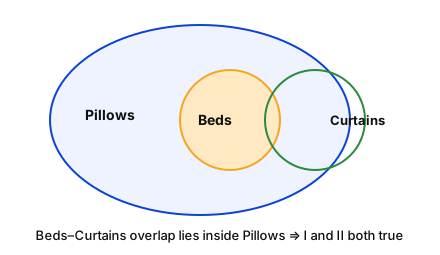
All beds are pillows.
Some beds are curtains.
Conclusions:
(I) Some pillows are curtains.
(II) Some curtains are beds.
दिए गए कथनों और निष्कर्षों को ध्यानपूर्वक पढ़िए। यह मानते हुए कि कथनों में दी गई जानकारी सत्य है, भले ही वह सामान्य रूप से ज्ञात तथ्यों से भिन्न प्रतीत होती हो, निर्णय लीजिए कि दिए गए निष्कर्षों में से कौन-सा/से निष्कर्ष तार्किक रूप से कथनों का अनुसरण करता है/करते हैं।
कथन:
सभी बिस्तर, तकिए हैं।
कुछ बिस्तर, पर्दे हैं।
निष्कर्ष:
(I) कुछ तकिए, पर्दे हैं।
(II) कुछ पर्दे, बिस्तर हैं।
  1. ANeither conclusion I nor II follows.न तो निष्कर्ष I और न ही II अनुसरण करता है।
  2. BOnly conclusion II follows.केवल निष्कर्ष II अनुसरण करता है।
  3. COnly conclusion I follows.केवल निष्कर्ष I अनुसरण करता है।
  4. DBoth conclusions I and II follow.निष्कर्ष I और II दोनों अनुसरण करते हैं।
Show answer

Concept: All A are B + Some A are C ⇒ Some B are C; 'Some' statements can be converted.

  1. Beds that are curtains are also pillows ⇒ some pillows are curtains: I follows.
  2. 'Some beds are curtains' converts to 'some curtains are beds': II follows.

Yaad rakhein: Some A–C is reversible: Some C–A.

Answer: (D) Both conclusions I and II follow.

अवधारणा: सभी A, B हैं + कुछ A, C हैं ⇒ कुछ B, C हैं; 'कुछ' कथन उलटा जा सकता है।

  1. जो beds curtains हैं वे pillows भी हैं ⇒ I अनुसरण करता है।
  2. 'कुछ beds curtains हैं' ⇒ 'कुछ curtains beds हैं': II अनुसरण करता है।

याद रखें: 'कुछ A, C हैं' उलटने पर 'कुछ C, A हैं'।

उत्तर: (D) I और II दोनों अनुसरण करते हैं।

RRB NTPC Undergraduate CBT 1General Intelligence and ReasoningSyllogismRRB NTPC Undergraduate CBT 1 2024 · 22 Aug Shift 2 →
Q797.
What should come in place of the question mark (?) in the given series?
14 16 20 28 44 ?
दी गई श्रृंखला में प्रश्न चिह्न (?) के स्थान पर क्या आना चाहिए?
14 16 20 28 44 ?
  1. A83
  2. B76
  3. C96
  4. D63
Show answer

Concept: Check differences between consecutive terms.

  1. Differences: 2,4,8,16 (doubling).
  2. Next difference =32.
  3. 44+32=76.

Trick: Doubling differences ⇒ add 25=32.

Answer: (B) 76

अवधारणा: क्रमागत पदों का अंतर देखें।

  1. अंतर: 2,4,8,16 (दोगुना)।
  2. अगला अंतर =32।
  3. 44+32=76।

ट्रिक: अंतर दोगुना ⇒ 32 जोड़ें।

उत्तर: (B) 76

RRB NTPC Undergraduate CBT 1General Intelligence and ReasoningNumber SeriesRRB NTPC Undergraduate CBT 1 2024 · 22 Aug Shift 2 →
Q798.
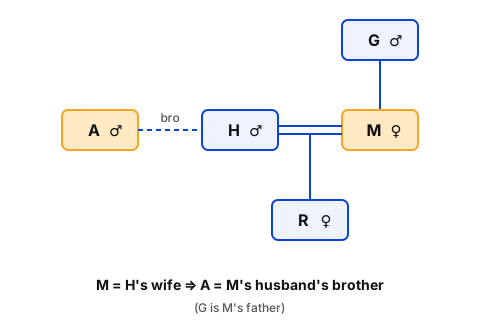
A is the brother of H. H is the father of R. R is the daughter of M. G is the father of M. How is A related to M?
A, H का भाई है। H, R का पिता है। R, M की पुत्री है। G, M का पिता है। A का M से क्या संबंध है?
  1. ADaughter's husband's brotherपुत्री के पति का भाई
  2. BHusband's fatherपति का पिता
  3. CHusband's brotherपति का भाई
  4. DDaughter's husband's fatherपुत्री के पति का पिता
Show answer

Concept: Link the statements in a family tree; parents of the same child are a couple.

  1. H is the father of R and R is the daughter of M ⇒ M is R's mother, i.e. H's wife.
  2. A is H's brother ⇒ A is M's husband's brother.
  3. G (M's father) is extra information.

Trick: Father + mother of the same child ⇒ husband–wife.

Answer: (C) Husband's brother

अवधारणा: कथनों को परिवार वृक्ष में जोड़ें; एक ही संतान के माता-पिता दंपति होते हैं।

  1. H, R का पिता और R, M की बेटी ⇒ M, R की माँ यानी H की पत्नी।
  2. A, H का भाई ⇒ A, M के पति का भाई (देवर/जेठ)।
  3. G (M का पिता) अतिरिक्त जानकारी है।

ट्रिक: एक ही संतान के पिता + माता ⇒ पति–पत्नी।

उत्तर: (C) Husband's brother (पति का भाई)

RRB NTPC Undergraduate CBT 1General Intelligence and ReasoningBlood RelationsRRB NTPC Undergraduate CBT 1 2024 · 22 Aug Shift 2 →
Q799.
If 1 is subtracted from each even digit of the number 36719542, then what will be the product of digits that are repeated more than once in the new number formed?
यदि संख्या 36719542 के प्रत्येक सम अंक में से 1 घटाया जाए, तो इस प्रकार बनी नई संख्या में एक से अधिक बार आने वाले अंकों का गुणनफल क्या होगा?
  1. A6
  2. B5
  3. C15
  4. D3
Show answer

Concept: Change only the even digits, then find digits that repeat.

  1. 36719542: 6→5, 4→3, 2→1 ⇒ 3 5 7 1 9 5 3 1.
  2. Repeated digits: 3, 5, 1.
  3. Product =3×5×1=15.

Trick: Take each repeated digit once in the product.

Answer: (C) 15

अवधारणा: केवल सम अंक बदलें, फिर दोहराए अंक खोजें।

  1. 36719542: 6→5, 4→3, 2→1 ⇒ 3 5 7 1 9 5 3 1।
  2. दोहराए अंक: 3, 5, 1।
  3. गुणनफल =3×5×1=15।

ट्रिक: हर दोहराए अंक को एक बार लें।

उत्तर: (C) 15

RRB NTPC Undergraduate CBT 1General Intelligence and ReasoningNumber OperationsRRB NTPC Undergraduate CBT 1 2024 · 22 Aug Shift 2 →
Q800.
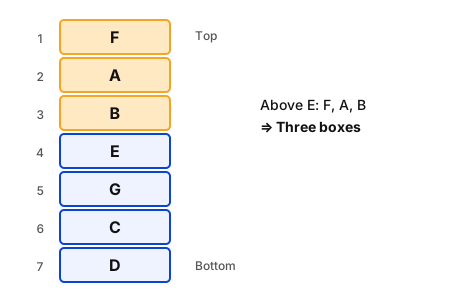
Seven boxes A, B, C, D, E, F and G are kept one over the other but not necessarily in the same order. Only four boxes are kept between A and D. Only F is kept above A. Only two boxes are kept between B and C. E is kept immediately above G. C is not kept immediately above E. How many boxes are kept above E?
सात बक्से A, B, C, D, E, F और G एक के ऊपर एक रखे गए हैं, परंतु आवश्यक नहीं कि इसी क्रम में हों। A और D के बीच केवल चार बक्से रखे गए हैं। A के ऊपर केवल F रखा गया है। B और C के बीच केवल दो बक्से रखे गए हैं। E, G के ठीक ऊपर रखा गया है। C, E के ठीक ऊपर नहीं रखा गया है। E के ऊपर कितने बक्से रखे गए हैं?
  1. AFourचार
  2. BOneएक
  3. CThreeतीन
  4. DTwoदो
Show answer

Concept: Use 'only' clues first, then test the remaining cases.

  1. Only F above A ⇒ F 1st, A 2nd (from top).
  2. Four between A and D ⇒ D 7th.
  3. B and C with two between in places 3–6 ⇒ 3rd and 6th; E, G (E just above G) take 4th, 5th.
  4. C 3rd would be just above E ✗ ⇒ B 3rd, C 6th.
  5. Above E: F, A, B ⇒ three boxes.

Trick: Order (top→bottom): F A B E G C D.

Answer: (C) Three

अवधारणा: पहले 'केवल' वाले संकेत, फिर शेष स्थितियाँ जाँचें।

  1. केवल F, A के ऊपर ⇒ F 1st, A 2nd (ऊपर से)।
  2. A और D के बीच चार ⇒ D 7th।
  3. B, C के बीच दो ⇒ 3rd और 6th; E, G (E ठीक ऊपर) ⇒ 4th, 5th।
  4. C 3rd हो तो E के ठीक ऊपर ✗ ⇒ B 3rd, C 6th।
  5. E के ऊपर: F, A, B ⇒ तीन बॉक्स।

ट्रिक: क्रम (ऊपर→नीचे): F A B E G C D।

उत्तर: (C) तीन

RRB NTPC Undergraduate CBT 1General Intelligence and ReasoningBox StackingRRB NTPC Undergraduate CBT 1 2024 · 22 Aug Shift 2 →