Question bank

Q&A: practice questions with answers

Search questions on any topic. Filter by exam category, exam, subject and topic, try the question, then open the answer and explanation.

Courses – airGurukul

8,495 questions found.

Q8141.
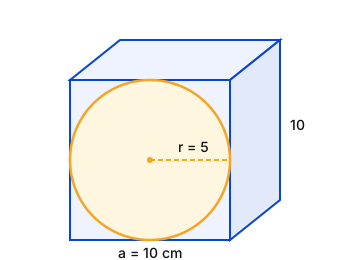
The length of each edge of a cube is 10 cm. If a sphere is inscribed inside the cube, what is the ratio of the surface area of the sphere to the outer surface area of the cube?
एक घन के प्रत्येक किनारे की लंबाई 10 cm है। यदि घन के अंदर एक गोला अंतर्निहित किया जाए, तो गोले के पृष्ठीय क्षेत्रफल और घन के बाह्य पृष्ठीय क्षेत्रफल का अनुपात क्या है?
  1. Aπ:3
  2. Bπ:6
  3. C6:π
  4. D3:π
Show answer

Concept: A sphere inscribed in a cube of edge a has diameter a, so radius r=a2.

  1. a=10cm⇒r=5cm.
  2. Surface area of sphere =4πr2=4π×25=100π.
  3. Surface area of cube =6a2=600.
  4. Ratio =100π:600=π:6.

Trick: For any inscribed sphere, 4π(a/2)26a2=π6 – independent of the edge length.

Answer: (B) π:6

अवधारणा: भुजा a के घन में अंतर्गत गोले का व्यास a होता है, अतः त्रिज्या r=a2।

  1. a=10cm⇒r=5cm।
  2. गोले का पृष्ठीय क्षेत्रफल =4πr2=4π×25=100π।
  3. घन का पृष्ठीय क्षेत्रफल =6a2=600।
  4. अनुपात =100π:600=π:6।

ट्रिक: किसी भी अंतर्गत गोले के लिए 4π(a/2)26a2=π6 – भुजा पर निर्भर नहीं।

उत्तर: (B) π:6

RRB NTPC Undergraduate CBT 1MathematicsSphere inscribed in cubeRRB NTPC Undergraduate CBT 1 2025 · 8 May Shift 1 →
Q8142.
Pipe A can fill a cistern in 12 hours and another pipe B can empty it in 18 hours. Pipe A is opened first and after 4 hours, pipe B is also opened. In how much total time will the cistern be filled?
पाइप A एक टंकी को 12 घंटे में भर सकता है और दूसरा पाइप B उसे 18 घंटे में खाली कर सकता है। पहले पाइप A खोला जाता है और 4 घंटे बाद पाइप B भी खोल दिया जाता है। टंकी कुल कितने समय में भर जाएगी?
  1. A36 hours36 घंटे
  2. B32 hours32 घंटे
  3. C28 hours28 घंटे
  4. D24 hours24 घंटे
Show answer

Concept: Take capacity =LCM(12,18)=36 units. A fills 3 units/h, B empties 2 units/h.

  1. First 4 hours (only A): 4×3=12 units filled.
  2. Remaining 36−12=24 units; net rate with both =3−2=1 unit/h.
  3. Time for remaining =24 h; total =4+24=28 hours.

Trick: Fractions: A alone does 412=13; remaining 23 at net 136/h takes 24 h.

Answer: (C) 28 hours

अवधारणा: क्षमता =LCM(12,18)=36 इकाई लें। A भरता है 3 इकाई/घंटा, B खाली करता है 2 इकाई/घंटा।

  1. पहले 4 घंटे (केवल A): 4×3=12 इकाई भरी।
  2. शेष 36−12=24 इकाई; दोनों के साथ शुद्ध दर =3−2=1 इकाई/घंटा।
  3. शेष का समय =24 घंटे; कुल =4+24=28 घंटे।

ट्रिक: भिन्न से: A अकेले 412=13 भरता है; शेष 23 शुद्ध दर 136/घंटा से 24 घंटे में।

उत्तर: (C) 28 घंटे

RRB NTPC Undergraduate CBT 1MathematicsPipes and cisternsRRB NTPC Undergraduate CBT 1 2025 · 8 May Shift 1 →
Q8143.
Which of the following ratios is the greatest?
a) 7 : 11
b) 9 : 14
c) 11 : 18
d) 13 : 21
निम्नलिखित में से कौन-सा अनुपात सबसे बड़ा है?
a) 7 : 11
b) 9 : 14
c) 11 : 18
d) 13 : 21
  1. A9 : 14
  2. B11 : 18
  3. C7 : 11
  4. D13 : 21
Show answer

Concept: Convert each ratio to a decimal (or compare with a common benchmark) to find the greatest.

  1. 711≈0.636, 914≈0.643.
  2. 1118≈0.611, 1321≈0.619.
  3. Greatest is 914, i.e. 9:14.

Trick: Compare with 23: 914 is short of it by only 142, the smallest gap among all four.

Answer: (A) 9 : 14

अवधारणा: प्रत्येक अनुपात को दशमलव में बदलकर (या एक साझा मानक से तुलना कर) सबसे बड़ा ज्ञात करें।

  1. 711≈0.636, 914≈0.643।
  2. 1118≈0.611, 1321≈0.619।
  3. सबसे बड़ा 914 है, यानी 9:14।

ट्रिक: 23 से तुलना करें: 914 उससे केवल 142 कम है – चारों में सबसे छोटा अंतर।

उत्तर: (A) 9 : 14

RRB NTPC Undergraduate CBT 1MathematicsComparison of ratiosRRB NTPC Undergraduate CBT 1 2025 · 8 May Shift 1 →
Q8144.
Find the value of m which satisfies
(146)8×(614)3×(146)10=(614)9m+9.
m का वह मान ज्ञात कीजिए जो
(146)8×(614)3×(146)10=(614)9m+9 को संतुष्ट करता है।
  1. A−289
  2. B−329
  3. C−83
  4. D−259
Show answer

Concept: (614)k=(146)−k; with equal bases, equate the exponents.

  1. LHS =(146)8×(146)−3×(146)10=(146)15.
  2. RHS =(614)9m+9=(146)−(9m+9).
  3. 15=−(9m+9)⇒9m=−24⇒m=−83.

Trick: Flip every reciprocal base to a single base first, then just add the powers.

Answer: (C) −83

अवधारणा: (614)k=(146)−k; आधार समान होने पर घातांक बराबर रखें।

  1. LHS =(146)8×(146)−3×(146)10=(146)15।
  2. RHS =(614)9m+9=(146)−(9m+9)।
  3. 15=−(9m+9)⇒9m=−24⇒m=−83।

ट्रिक: पहले हर व्युत्क्रम आधार को एक ही आधार में बदलें, फिर केवल घात जोड़ें।

उत्तर: (C) −83

RRB NTPC Undergraduate CBT 1MathematicsLaws of exponentsRRB NTPC Undergraduate CBT 1 2025 · 8 May Shift 1 →
Q8145.
If sinA=57, find the value of 5cosecA−7sinA26secA+7cos2A.
यदि sinA=57 है, तो 5cosecA−7sinA26secA+7cos2A का मान ज्ञात कीजिए।
  1. A923
  2. B1473
  3. C319
  4. D1146
Show answer

Concept: From sinA=57: cosA=1−2549=267, cosecA=75, secA=726.

  1. Numerator: 5×75−7×57=7−5=2.
  2. Denominator: 26×726+7×2449=7+247=737.
  3. Value =2÷737=1473.

Trick: The coefficients are chosen so that 5cosecA and 26secA become whole numbers (7 each) – look for such cancellations.

Answer: (B) 1473

अवधारणा: sinA=57 से: cosA=1−2549=267, cosecA=75, secA=726।

  1. अंश: 5×75−7×57=7−5=2।
  2. हर: 26×726+7×2449=7+247=737।
  3. मान =2÷737=1473।

ट्रिक: गुणांक ऐसे चुने हैं कि 5cosecA और 26secA पूर्ण संख्या (7-7) बन जाएँ – ऐसे कटान पहचानें।

उत्तर: (B) 1473

RRB NTPC Undergraduate CBT 1MathematicsTrigonometric ratiosRRB NTPC Undergraduate CBT 1 2025 · 8 May Shift 1 →
Q8146.
A sum of money amounts to ₹4,600 in 3 years at 5% simple interest per annum. What is the sum?
कोई धनराशि 5% वार्षिक साधारण ब्याज की दर से 3 वर्षों में ₹4,600 हो जाती है। वह धनराशि क्या है?
  1. A₹4,200
  2. B₹3,800
  3. C₹3,500
  4. D₹4,000
Show answer

Concept: Amount =P(1+RT100).

  1. 1+5×3100=1.15.
  2. P=46001.15=4000.
  3. Check: SI on ₹4,000 for 3 years at 5% =600; amount =4600.

Trick: 3 years at 5% =15%; so amount =115% of P → P=4600×100115.

Answer: (D) ₹4,000

अवधारणा: मिश्रधन =P(1+RT100)।

  1. 1+5×3100=1.15।
  2. P=46001.15=4000।
  3. जाँच: ₹4,000 पर 3 वर्ष, 5% का SI =600; मिश्रधन =4600।

ट्रिक: 3 वर्ष × 5% =15%; अतः मिश्रधन =P का 115% → P=4600×100115।

उत्तर: (D) ₹4,000

RRB NTPC Undergraduate CBT 1MathematicsSimple interestRRB NTPC Undergraduate CBT 1 2025 · 8 May Shift 1 →
Q8147.
Which of the following pairs of numbers is not coprime?
निम्नलिखित में से कौन-सा संख्या-युग्म सह-अभाज्य (coprime) नहीं है?
  1. A(127, 257)
  2. B(173, 351)
  3. C(177, 827)
  4. D(171, 273)
Show answer

Concept: Two numbers are co-prime when their HCF is 1.

  1. 171=32×19 and 273=3×7×13 – common factor 3, so not co-prime.
  2. 127, 257, 173 and 827 are primes; 351=33×13, 177=3×59 – no common factor in those pairs.

Trick: Use the digit-sum test: 1+7+1=9 and 2+7+3=12 are both multiples of 3 – spot the common factor instantly.

Answer: (D) (171, 273)

अवधारणा: दो संख्याएँ सह-अभाज्य (co-prime) होती हैं जब उनका HCF 1 हो।

  1. 171=32×19 और 273=3×7×13 – उभयनिष्ठ गुणनखंड 3, अतः सह-अभाज्य नहीं।
  2. 127, 257, 173 और 827 अभाज्य हैं; 351=33×13, 177=3×59 – उन युग्मों में कोई उभयनिष्ठ गुणनखंड नहीं।

ट्रिक: अंक-योग जाँच: 1+7+1=9 और 2+7+3=12 दोनों 3 के गुणज – उभयनिष्ठ गुणनखंड तुरंत दिखता है।

उत्तर: (D) (171, 273)

RRB NTPC Undergraduate CBT 1MathematicsCo-prime numbersRRB NTPC Undergraduate CBT 1 2025 · 8 May Shift 1 →
Q8148.
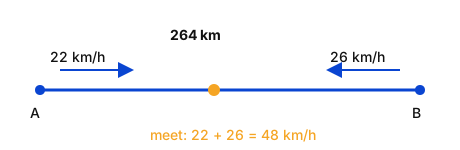
Two buses start at the same time from two towns that are 264 km apart and travel towards each other along the same highway. The first bus travels at a speed of 22 km/h, while the second bus travels at a speed of 26 km/h. After how much time will they meet?
दो बसें एक ही समय पर 264 km की दूरी पर स्थित दो कस्बों से चलती हैं और एक ही राजमार्ग पर एक-दूसरे की ओर यात्रा करती हैं। पहली बस 22 km/h की चाल से चलती है, जबकि दूसरी बस 26 km/h की चाल से चलती है। वे कितने समय बाद मिलेंगी?
  1. A6.25 hours6.25 घंटे
  2. B6.5 hours6.5 घंटे
  3. C5.5 hours5.5 घंटे
  4. D5 hours5 घंटे
Show answer

Concept: For objects moving towards each other, relative speed = sum of speeds.

  1. Relative speed =22+26=48km/h.
  2. Time =26448=5.5 hours.

Trick: 48×5=240, remaining 24 km is half an hour more → 5.5 h.

Answer: (C) 5.5 hours

अवधारणा: एक-दूसरे की ओर चलने पर सापेक्ष चाल = चालों का योग।

  1. सापेक्ष चाल =22+26=48km/h।
  2. समय =26448=5.5 घंटे।

ट्रिक: 48×5=240, शेष 24 km आधे घंटे में → 5.5 घंटे।

उत्तर: (C) 5.5 घंटे

RRB NTPC Undergraduate CBT 1MathematicsRelative speedRRB NTPC Undergraduate CBT 1 2025 · 8 May Shift 1 →
Q8149.
If the simple interest on ₹5,000 for T years at 6% p.a. equals the simple interest on ₹7,500 for 4 years at 4% per annum, then find the value of T.
यदि ₹5,000 पर T वर्षों के लिए 6% वार्षिक दर से साधारण ब्याज, ₹7,500 पर 4 वर्षों के लिए 4% वार्षिक दर से साधारण ब्याज के बराबर है, तो T का मान ज्ञात कीजिए।
  1. A4
  2. B2
  3. C1
  4. D3
Show answer

Concept: SI=PRT100; equate the two interests.

  1. 5000×6×T100=7500×4×4100.
  2. 300T=1200⇒T=4.

Trick: Compare P×R×T products: 5000×6×T=7500×16 → T=12000030000=4.

Answer: (A) 4

अवधारणा: SI=PRT100; दोनों ब्याज बराबर रखें।

  1. 5000×6×T100=7500×4×4100।
  2. 300T=1200⇒T=4।

ट्रिक: P×R×T गुणनफल की तुलना करें: 5000×6×T=7500×16 → T=12000030000=4।

उत्तर: (A) 4

RRB NTPC Undergraduate CBT 1MathematicsSimple interestRRB NTPC Undergraduate CBT 1 2025 · 8 May Shift 1 →
Q8150.
Chitra gets a discount of 40% on a water cooler whose marked price is ₹2,200. Since she pays by credit card, she gets an additional 20% discount. How much does she pay (in ₹)?
चित्रा को एक वाटर कूलर पर 40% की छूट मिलती है जिसका अंकित मूल्य ₹2,200 है। चूँकि वह क्रेडिट कार्ड से भुगतान करती है, इसलिए उसे 20% की अतिरिक्त छूट मिलती है। वह कितना भुगतान करती है (₹ में)?
  1. A1,055
  2. B1,059
  3. C1,058
  4. D1,056
Show answer

Concept: Successive discounts multiply: price =MP×(1−d1)(1−d2).

  1. After 40%: 2200×0.6=1320.
  2. After further 20%: 1320×0.8=1056.

Trick: Combined discount =40+20−40×20100=52%; pay 48% of 2200 =1056.

Answer: (D) 1,056

अवधारणा: क्रमिक छूट गुणा होती हैं: मूल्य =MP×(1−d1)(1−d2)।

  1. 40% के बाद: 2200×0.6=1320।
  2. आगे 20% के बाद: 1320×0.8=1056।

ट्रिक: संयुक्त छूट =40+20−40×20100=52%; 2200 का 48% =1056 देना होगा।

उत्तर: (D) 1,056

RRB NTPC Undergraduate CBT 1MathematicsSuccessive discountsRRB NTPC Undergraduate CBT 1 2025 · 8 May Shift 1 →
Q8151.
A student initially scored equal marks in Mathematics and Physics. Later, the marks in Mathematics increase by 20% of the original Mathematics marks, while the marks in Physics decrease by 10% of the original Physics marks. Taking the initial total marks as the base, what is the overall percentage change in the total marks?
एक विद्यार्थी ने प्रारंभ में गणित और भौतिकी में समान अंक प्राप्त किए। बाद में, गणित के अंक मूल गणित अंकों के 20% से बढ़ जाते हैं, जबकि भौतिकी के अंक मूल भौतिकी अंकों के 10% से घट जाते हैं। प्रारंभिक कुल अंकों को आधार मानते हुए, कुल अंकों में समग्र प्रतिशत परिवर्तन क्या है?
  1. A10% increase10% वृद्धि
  2. B5% decrease5% कमी
  3. C5% increase5% वृद्धि
  4. DNo changeकोई परिवर्तन नहीं
Show answer

Concept: Assume equal marks of 100 each; compute the new total.

  1. Maths: 100→120; Physics: 100→90.
  2. New total =210 against original 200.
  3. Change =10200×100=5% increase.

Trick: Equal weights → overall change is the simple average of +20% and −10%, i.e. +5%.

Answer: (C) 5% increase

अवधारणा: दोनों के 100-100 अंक मानकर नया योग निकालें।

  1. गणित: 100→120; भौतिकी: 100→90।
  2. नया योग =210, मूल 200।
  3. परिवर्तन =10200×100=5% वृद्धि।

ट्रिक: समान भार → कुल परिवर्तन +20% और −10% का साधारण औसत, यानी +5%।

उत्तर: (C) 5% वृद्धि

RRB NTPC Undergraduate CBT 1MathematicsPercentage changeRRB NTPC Undergraduate CBT 1 2025 · 8 May Shift 1 →
Q8152.
Simplify: 3+653−212−32+50
सरल कीजिए: 3+653−212−32+50
  1. A3
  2. B5
  3. C2
  4. D6
Show answer

Concept: Reduce each surd to its simplest form, then factorise the numerator.

  1. 212=43, 32=42, 50=52.
  2. Denominator =53−43−42+52=3+2.
  3. Numerator 3+6=3(3+2).
  4. Fraction =3.

Trick: Take 3 common from 3+6 – the bracket matches the denominator, no rationalisation needed.

Answer: (A) 3

अवधारणा: हर करणी को सरलतम रूप में लाएँ, फिर अंश का गुणनखंड करें।

  1. 212=43, 32=42, 50=52।
  2. हर =53−43−42+52=3+2।
  3. अंश 3+6=3(3+2)।
  4. भिन्न =3।

ट्रिक: 3+6 से 3 उभयनिष्ठ लें – कोष्ठक हर से मेल खाता है, परिमेयकरण की ज़रूरत नहीं।

उत्तर: (A) 3

RRB NTPC Undergraduate CBT 1MathematicsSurds simplificationRRB NTPC Undergraduate CBT 1 2025 · 8 May Shift 1 →
Q8153.
The largest four-digit number which when divided by 15, 12 and 14 leaves remainder 5 in each case is:
चार अंकों की वह सबसे बड़ी संख्या, जिसे 15, 12 और 14 से विभाजित करने पर प्रत्येक स्थिति में शेषफल 5 बचता है, है:
  1. A9595
  2. B9192
  3. C9665
  4. D9988
Show answer

Concept: Required number = (largest 4-digit multiple of LCM) + remainder.

  1. LCM(15,12,14)=420.
  2. 9999÷420=23 remainder 339 → largest multiple =9999−339=9660.
  3. Number =9660+5=9665.

Trick: Options check: 9665−5=9660=420×23 – divisible by 15, 12 and 14.

Answer: (C) 9665

अवधारणा: अभीष्ट संख्या = (LCM का सबसे बड़ा 4-अंकीय गुणज) + शेषफल।

  1. LCM(15,12,14)=420।
  2. 9999÷420=23 शेष 339 → सबसे बड़ा गुणज =9999−339=9660।
  3. संख्या =9660+5=9665।

ट्रिक: विकल्प जाँच: 9665−5=9660=420×23 – 15, 12 और 14 से विभाज्य।

उत्तर: (C) 9665

RRB NTPC Undergraduate CBT 1MathematicsLCM with common remainderRRB NTPC Undergraduate CBT 1 2025 · 8 May Shift 1 →
Q8154.
Three friends Arshdeep, Sandeep and Avtar are on a trip by a car. Arshdeep drives during the first 3 hours at an average speed of 52 km/hr. Sandeep drives during the next 4 hours at an average speed of 65 km/hr. Avtar drives for the next 3 hours at an average speed of 76 km/hr. They reached their destination after exactly 10 hours. Their average speed during the journey was:
तीन मित्र अर्शदीप, संदीप और अवतार कार से यात्रा पर हैं। अर्शदीप पहले 3 घंटे 52 km/hr की औसत चाल से गाड़ी चलाता है। संदीप अगले 4 घंटे 65 km/hr की औसत चाल से गाड़ी चलाता है। अवतार अगले 3 घंटे 76 km/hr की औसत चाल से गाड़ी चलाता है। वे ठीक 10 घंटे बाद अपने गंतव्य पर पहुँचे। यात्रा के दौरान उनकी औसत चाल थी:
  1. A64.4 km/hr
  2. B60.2 km/hr
  3. C56.4 km/hr
  4. D65.2 km/hr
Show answer

Concept: Average speed =total distancetotal time.

  1. Distances: 3×52=156, 4×65=260, 3×76=228 km.
  2. Total =644 km in 10 hours.
  3. Average speed =64410=64.4km/h.

Trick: This is a time-weighted average: 3(52)+4(65)+3(76)10 – never average the three speeds directly.

Answer: (A) 64.4 km/hr

अवधारणा: औसत चाल =कुल दूरीकुल समय।

  1. दूरियाँ: 3×52=156, 4×65=260, 3×76=228 km।
  2. कुल =644 km, 10 घंटे में।
  3. औसत चाल =64410=64.4km/h।

ट्रिक: यह समय-भारित औसत है: 3(52)+4(65)+3(76)10 – तीनों चालों का सीधा औसत कभी न लें।

उत्तर: (A) 64.4 km/hr

RRB NTPC Undergraduate CBT 1MathematicsAverage speedRRB NTPC Undergraduate CBT 1 2025 · 8 May Shift 1 →
Q8155.
The present ages of two sisters are in the ratio 5:7. After 4 years, their ages will be in the ratio 6:8. Find the present age of the younger sister.
दो बहनों की वर्तमान आयु का अनुपात 5:7 है। 4 वर्ष बाद, उनकी आयु का अनुपात 6:8 हो जाएगा। छोटी बहन की वर्तमान आयु ज्ञात कीजिए।
  1. A22 years22 वर्ष
  2. B20 years20 वर्ष
  3. C18 years18 वर्ष
  4. D24 years24 वर्ष
Show answer

Concept: Let present ages be 5x and 7x; add 4 years and use the new ratio.

  1. 5x+47x+4=68=34.
  2. 20x+16=21x+12⇒x=4.
  3. Younger sister =5×4=20 years.

Trick: Check: 24:32=6:8 ✓.

Answer: (B) 20 years

अवधारणा: वर्तमान आयु 5x और 7x लें; 4 वर्ष जोड़कर नया अनुपात लगाएँ।

  1. 5x+47x+4=68=34।
  2. 20x+16=21x+12⇒x=4।
  3. छोटी बहन =5×4=20 वर्ष।

ट्रिक: जाँच: 24:32=6:8 ✓।

उत्तर: (B) 20 वर्ष

RRB NTPC Undergraduate CBT 1MathematicsRatio of agesRRB NTPC Undergraduate CBT 1 2025 · 8 May Shift 1 →
Q8156.
A cricketer has scored an average of 55 runs in 9 matches. In the 10th match, he scores 85 runs. What is his new average?
एक क्रिकेटर ने 9 मैचों में औसतन 55 रन बनाए हैं। 10वें मैच में वह 85 रन बनाता है। उसका नया औसत क्या है?
  1. A57
  2. B58
  3. C56
  4. D55
Show answer

Concept: New average =old total+new scorenew count.

  1. Runs in 9 matches =9×55=495.
  2. Total after 10th match =495+85=580.
  3. New average =58010=58.

Trick: Excess over old average =85−55=30, spread over 10 matches =+3 → 55+3=58.

Answer: (B) 58

अवधारणा: नया औसत =पुराना योग+नया स्कोरनई संख्या।

  1. 9 मैचों के रन =9×55=495।
  2. 10वें मैच के बाद कुल =495+85=580।
  3. नया औसत =58010=58।

ट्रिक: पुराने औसत से अधिकता =85−55=30, 10 मैचों में बँटकर +3 → 55+3=58।

उत्तर: (B) 58

RRB NTPC Undergraduate CBT 1MathematicsAverageRRB NTPC Undergraduate CBT 1 2025 · 8 May Shift 1 →
Q8157.
A bookseller bought 7 identical sets of books at ₹375 each. He sold 3 sets at a profit of 16% per set and the remaining sets at a profit of 24% per set. What was his total profit (in ₹) from selling all the sets?
एक पुस्तक विक्रेता ने ₹375 प्रति सेट की दर से पुस्तकों के 7 एक जैसे सेट खरीदे। उसने 3 सेट प्रति सेट 16% के लाभ पर और शेष सेट प्रति सेट 24% के लाभ पर बेचे। सभी सेट बेचने पर उसका कुल लाभ (₹ में) कितना था?
  1. A₹504
  2. B₹588
  3. C₹540
  4. D₹572
Show answer

Concept: Profit = cost × profit%, computed separately for each lot.

  1. 3 sets: 3×375×16100=180.
  2. 4 sets: 4×375×24100=360.
  3. Total profit =180+360=540.

Trick: Profit per set: 16% of 375 =60, 24% of 375 =90 → 3(60)+4(90)=540.

Answer: (C) ₹540

अवधारणा: लाभ = लागत × लाभ%, दोनों समूहों के लिए अलग-अलग।

  1. 3 सेट: 3×375×16100=180।
  2. 4 सेट: 4×375×24100=360।
  3. कुल लाभ =180+360=540।

ट्रिक: प्रति सेट लाभ: 375 का 16% =60, 24% =90 → 3(60)+4(90)=540।

उत्तर: (C) ₹540

RRB NTPC Undergraduate CBT 1MathematicsProfit and lossRRB NTPC Undergraduate CBT 1 2025 · 8 May Shift 1 →
Q8158.
A group of 3 adults and 4 children pay ₹380 for movie tickets. Another group of 2 adults and 3 children pay ₹270 for the same tickets. What is the price of one adult ticket?
3 वयस्कों और 4 बच्चों का एक समूह फ़िल्म के टिकटों के लिए ₹380 का भुगतान करता है। 2 वयस्कों और 3 बच्चों का दूसरा समूह उन्हीं टिकटों के लिए ₹270 का भुगतान करता है। एक वयस्क टिकट का मूल्य क्या है?
  1. A₹80
  2. B₹50
  3. C₹60
  4. D₹70
Show answer

Concept: Form two equations in adult price a and child price c and eliminate.

  1. 3a+4c=380 and 2a+3c=270.
  2. Multiply by 2 and 3: 6a+8c=760, 6a+9c=810 → c=50.
  3. 3a+200=380⇒a=60.

Trick: Subtract the equations: a+c=110; then 2(a+c)+c=270 gives c=50 directly.

Answer: (C) ₹60

अवधारणा: वयस्क मूल्य a और बच्चे का मूल्य c में दो समीकरण बनाकर विलोपन करें।

  1. 3a+4c=380 और 2a+3c=270।
  2. 2 और 3 से गुणा: 6a+8c=760, 6a+9c=810 → c=50।
  3. 3a+200=380⇒a=60।

ट्रिक: समीकरण घटाएँ: a+c=110; फिर 2(a+c)+c=270 से सीधे c=50।

उत्तर: (C) ₹60

RRB NTPC Undergraduate CBT 1MathematicsLinear equationsRRB NTPC Undergraduate CBT 1 2025 · 8 May Shift 1 →
Q8159.
A Company produces 1,520 packets of noodles in 5 hours. How many packets will it produce in 17 hours at the same rate?
एक कंपनी 5 घंटे में नूडल्स के 1,520 पैकेट बनाती है। समान दर से वह 17 घंटे में कितने पैकेट बनाएगी?
  1. A5,861
  2. B5,816
  3. C5,168
  4. D5,618
Show answer

Concept: Direct proportion – packets per hour stay constant.

  1. Rate =15205=304 packets/hour.
  2. In 17 hours: 304×17=5168.

Trick: 304×17=304×10+304×7=3040+2128=5168.

Answer: (C) 5,168

अवधारणा: सीधा अनुपात – प्रति घंटा पैकेट स्थिर रहते हैं।

  1. दर =15205=304 पैकेट/घंटा।
  2. 17 घंटे में: 304×17=5168।

ट्रिक: 304×17=304×10+304×7=3040+2128=5168।

उत्तर: (C) 5,168

RRB NTPC Undergraduate CBT 1MathematicsUnitary methodRRB NTPC Undergraduate CBT 1 2025 · 8 May Shift 1 →
Q8160.
The sum of all interior angles of a regular polygon is 1800°. How many diagonals does the polygon have?
एक सम बहुभुज के सभी अंतः कोणों का योग 1800° है। उस बहुभुज में कितने विकर्ण हैं?
  1. A51
  2. B50
  3. C53
  4. D54
Show answer

Concept: Sum of interior angles =(n−2)×180∘; diagonals =n(n−3)2.

  1. (n−2)×180=1800⇒n−2=10⇒n=12.
  2. Diagonals =12×92=54.

Yaad rakhein: Each vertex joins n−3 others by a diagonal; divide by 2 to avoid double counting.

Answer: (D) 54

अवधारणा: अंतःकोणों का योग =(n−2)×180∘; विकर्ण =n(n−3)2।

  1. (n−2)×180=1800⇒n−2=10⇒n=12।
  2. विकर्ण =12×92=54।

याद रखें: हर शीर्ष से n−3 विकर्ण निकलते हैं; दोहरी गिनती से बचने के लिए 2 से भाग दें।

उत्तर: (D) 54

RRB NTPC Undergraduate CBT 1MathematicsPolygon diagonalsRRB NTPC Undergraduate CBT 1 2025 · 8 May Shift 1 →