Question bank

Q&A: practice questions with answers

Search questions on any topic. Filter by exam category, exam, subject and topic, try the question, then open the answer and explanation.

Courses – airGurukul

8,495 questions found.

Q8161.
A, B, and C start a business by investing ₹60,000, ₹80,000, and ₹1,20,000, respectively. After one year, the total profit earned is ₹78,000. By how much does C’s share exceed B’s share?
A, B और C क्रमशः ₹60,000, ₹80,000 और ₹1,20,000 का निवेश करके एक व्यवसाय शुरू करते हैं। एक वर्ष बाद, अर्जित कुल लाभ ₹78,000 है। C का हिस्सा B के हिस्से से कितना अधिक है?
  1. A₹9,800
  2. B₹12,000
  3. C₹9,400
  4. D₹10,600
Show answer

Concept: Profit is shared in the ratio of investments (equal time).

  1. Ratio 60000:80000:120000=3:4:6 (total 13 parts).
  2. One part =7800013=6000.
  3. C − B =(6−4)×6000=12000.

Trick: Only the difference of parts matters: 2 parts × ₹6,000.

Answer: (B) ₹12,000

अवधारणा: समान समय पर लाभ निवेश के अनुपात में बँटता है।

  1. अनुपात 60000:80000:120000=3:4:6 (कुल 13 भाग)।
  2. एक भाग =7800013=6000।
  3. C − B =(6−4)×6000=12000।

ट्रिक: केवल भागों का अंतर चाहिए: 2 भाग × ₹6,000।

उत्तर: (B) ₹12,000

RRB NTPC Undergraduate CBT 1MathematicsPartnershipRRB NTPC Undergraduate CBT 1 2025 · 8 May Shift 1 →
Q8162.
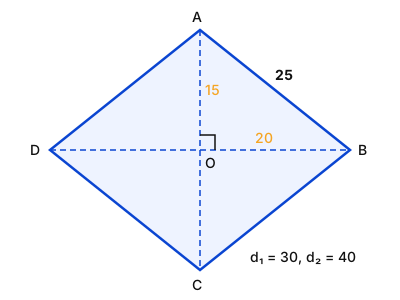
The diagonals of a rhombus are mutually perpendicular and bisect each other. One diagonal is 10 cm longer than the other. If the area of the rhombus is 600 cm², the perimeter (in cm) of the rhombus is:
एक समचतुर्भुज के विकर्ण परस्पर लंबवत होते हैं और एक-दूसरे को समद्विभाजित करते हैं। एक विकर्ण दूसरे से 10 cm लंबा है। यदि समचतुर्भुज का क्षेत्रफल 600 cm² है, तो समचतुर्भुज का परिमाप (cm में) है:
  1. A96 cm
  2. B84 cm
  3. C100 cm
  4. D120 cm
Show answer

Concept: Area =12d1d2; half-diagonals and a side form a right triangle.

  1. Let diagonals be d and d+10: 12d(d+10)=600⇒d2+10d−1200=0⇒d=30.
  2. Diagonals 30 cm and 40 cm; half-diagonals 15 and 20.
  3. Side =152+202=25 cm.
  4. Perimeter =4×25=100 cm.

Trick: Half-diagonals 15, 20 → the 3-4-5 triple scaled by 5 → side 25.

Answer: (C) 100 cm

अवधारणा: क्षेत्रफल =12d1d2; अर्ध-विकर्ण और भुजा समकोण त्रिभुज बनाते हैं।

  1. विकर्ण d और d+10 लें: 12d(d+10)=600⇒d2+10d−1200=0⇒d=30।
  2. विकर्ण 30 cm और 40 cm; अर्ध-विकर्ण 15 और 20।
  3. भुजा =152+202=25 cm।
  4. परिमाप =4×25=100 cm।

ट्रिक: अर्ध-विकर्ण 15, 20 → 3-4-5 त्रिक का 5 गुना → भुजा 25।

उत्तर: (C) 100 cm

RRB NTPC Undergraduate CBT 1MathematicsRhombusRRB NTPC Undergraduate CBT 1 2025 · 8 May Shift 1 →
Q8163.
A shopkeeper offers two successive discounts of 18% and 15% on a frock whose marked price is ₹1,000. What is the final selling price (in ₹) of the frock?
एक दुकानदार ₹1,000 अंकित मूल्य वाली एक फ्रॉक पर 18% और 15% की दो क्रमिक छूट देता है। फ्रॉक का अंतिम विक्रय मूल्य (₹ में) क्या है?
  1. A679
  2. B796
  3. C769
  4. D697
Show answer

Concept: Selling price =MP×(1−d1)(1−d2).

  1. After 18%: 1000×0.82=820.
  2. After 15%: 820×0.85=697.

Trick: Single equivalent discount =18+15−18×15100=30.3% → pay 69.7% of 1000.

Answer: (D) 697

अवधारणा: विक्रय मूल्य =MP×(1−d1)(1−d2)।

  1. 18% के बाद: 1000×0.82=820।
  2. 15% के बाद: 820×0.85=697।

ट्रिक: एकल समतुल्य छूट =18+15−18×15100=30.3% → 1000 का 69.7% देना होगा।

उत्तर: (D) 697

RRB NTPC Undergraduate CBT 1MathematicsSuccessive discountsRRB NTPC Undergraduate CBT 1 2025 · 8 May Shift 1 →
Q8164.
A shopkeeper offers the following schemes on toys of the same marked price. (A) Successive discounts of 43% and 19% on any number of toys bought.
(B) Successive discounts of 41%, 21% and 49% on any number of toys bought. (C) 35% discount on the first 5 toys and 3% discount on each toy thereon.
(D) 4 toys free of cost on buying 5 toys.
A customer wants to buy 5 toys. Which of the above schemes is the least beneficial to her?
एक दुकानदार समान अंकित मूल्य वाले खिलौनों पर निम्नलिखित योजनाएँ देता है। (A) खरीदे गए किसी भी संख्या के खिलौनों पर 43% और 19% की क्रमिक छूट।
(B) खरीदे गए किसी भी संख्या के खिलौनों पर 41%, 21% और 49% की क्रमिक छूट। (C) पहले 5 खिलौनों पर 35% छूट और उसके बाद प्रत्येक खिलौने पर 3% छूट।
(D) 5 खिलौने खरीदने पर 4 खिलौने निःशुल्क।
एक ग्राहक 5 खिलौने खरीदना चाहती है। उपरोक्त में से कौन-सी योजना उसके लिए सबसे कम लाभदायक है?
  1. AD
  2. BA
  3. CB
  4. DC
Show answer

Concept: Compare the effective price paid per toy (marked price =100) under each scheme.

  1. (A) 100×0.57×0.81=46.17 per toy.
  2. (B) 100×0.59×0.79×0.51≈23.77 per toy.
  3. (C) First 5 toys at 35% off → 65 per toy.
  4. (D) 9 toys for the price of 5 → 5009≈55.56 per toy.
  5. Highest effective price =65 → scheme (C) is least beneficial.

Trick: Convert every offer to "price per toy"; the largest number is the worst deal.

Answer: (D) C

अवधारणा: हर योजना में प्रति खिलौना प्रभावी मूल्य (अंकित मूल्य =100) की तुलना करें।

  1. (A) 100×0.57×0.81=46.17 प्रति खिलौना।
  2. (B) 100×0.59×0.79×0.51≈23.77 प्रति खिलौना।
  3. (C) पहले 5 खिलौनों पर 35% छूट → 65 प्रति खिलौना।
  4. (D) 5 के दाम में 9 खिलौने → 5009≈55.56 प्रति खिलौना।
  5. सबसे अधिक प्रभावी मूल्य =65 → योजना (C) सबसे कम लाभदायक।

ट्रिक: हर ऑफर को "प्रति खिलौना मूल्य" में बदलें; सबसे बड़ा अंक सबसे खराब सौदा।

उत्तर: (D) C

RRB NTPC Undergraduate CBT 1MathematicsComparing discount schemesRRB NTPC Undergraduate CBT 1 2025 · 8 May Shift 1 →
Q8165.
A tank can be filled by pipe P in 8 hours and by pipe Q in 4 hours. If they open alternately for one hour each with Q starting first, what is the total time taken to fill the tank?
एक टंकी को पाइप P द्वारा 8 घंटे में और पाइप Q द्वारा 4 घंटे में भरा जा सकता है। यदि उन्हें एक-एक घंटे के लिए बारी-बारी से खोला जाए और Q पहले शुरू हो, तो टंकी को भरने में कुल कितना समय लगेगा?
  1. A5 hours5 घंटे
  2. B4 hours and 40 minutes4 घंटे 40 मिनट
  3. C6 hours6 घंटे
  4. D5 hours and 20 minutes5 घंटे 20 मिनट
Show answer

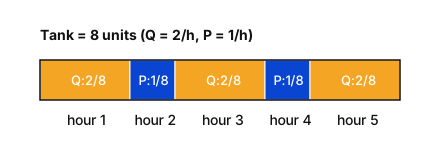
Concept: Take tank =LCM(8,4)=8 units; P fills 1 unit/h, Q fills 2 units/h.

  1. One cycle (Q then P) of 2 hours fills 2+1=3 units.
  2. After 2 cycles (4 h): 6 units; remaining 2 units.
  3. 5th hour is Q's turn: it fills exactly 2 units.
  4. Total time =5 hours.

Trick: In alternate-pipe problems, stop cycling when the remainder is less than one cycle and check whose turn it is.

Answer: (A) 5 hours

अवधारणा: टंकी =LCM(8,4)=8 इकाई लें; P 1 इकाई/घंटा, Q 2 इकाई/घंटा भरता है।

  1. एक चक्र (Q फिर P) 2 घंटे में 2+1=3 इकाई भरता है।
  2. 2 चक्र (4 घंटे) बाद: 6 इकाई; शेष 2 इकाई।
  3. 5वाँ घंटा Q की बारी: वह ठीक 2 इकाई भर देता है।
  4. कुल समय =5 घंटे।

ट्रिक: बारी-बारी वाले प्रश्नों में जब शेष एक चक्र से कम हो, चक्र रोककर देखें किसकी बारी है।

उत्तर: (A) 5 घंटे

RRB NTPC Undergraduate CBT 1MathematicsPipes – alternate fillingRRB NTPC Undergraduate CBT 1 2025 · 8 May Shift 1 →
Q8166.
What should come in place of '?' in the given series based on the English alphabetical order?
GJE ZCX SVQ LOJ ?
अंग्रेज़ी वर्णमाला क्रम के आधार पर दी गई शृंखला में '?' के स्थान पर क्या आना चाहिए?
GJE ZCX SVQ LOJ ?
  1. AEHC
  2. BBFU
  3. CLNJ
  4. DPRN
Show answer

Concept: Check each position of the clusters separately for a constant jump in the alphabet (A=1 … Z=26, cyclic).

  1. 1st letters: G → Z → S → L : each −7 (G(7)−7 = 0 → Z(26)). Next: L(12)−7 = 5 → E.
  2. 2nd letters: J → C → V → O : each −7. Next: O(15)−7 = 8 → H.
  3. 3rd letters: E → X → Q → J : each −7. Next: J(10)−7 = 3 → C.

Trick: Subtracting 7 is the same as adding 19; when you go below A, add 26 and continue.

Answer: (A) EHC

अवधारणा: क्लस्टर के प्रत्येक स्थान के अक्षर को अलग-अलग देखें और वर्णमाला में स्थिर अंतर (A=1 … Z=26, चक्रीय) खोजें।

  1. पहले अक्षर: G → Z → S → L : हर बार −7 (G(7)−7 = 0 → Z(26))। अगला: L(12)−7 = 5 → E।
  2. दूसरे अक्षर: J → C → V → O : हर बार −7। अगला: O(15)−7 = 8 → H।
  3. तीसरे अक्षर: E → X → Q → J : हर बार −7। अगला: J(10)−7 = 3 → C।

ट्रिक: 7 घटाना = 19 जोड़ना; A से नीचे जाने पर 26 जोड़कर आगे बढ़ें।

उत्तर: (A) EHC

RRB NTPC Undergraduate CBT 1General Intelligence and ReasoningLetter seriesRRB NTPC Undergraduate CBT 1 2025 · 8 May Shift 1 →
Q8167.
In a certain code language, ‘steak tooth badge’ is coded as ‘qj hc sv’ and ‘badge poet lemon’ is coded as ‘tz qj wv’. How is ‘badge’ coded in that language? (All codes are two- letter codes.)
एक निश्चित कूट भाषा में, 'steak tooth badge' को 'qj hc sv' के रूप में कूटबद्ध किया जाता है और 'badge poet lemon' को 'tz qj wv' के रूप में कूटबद्ध किया जाता है। उस भाषा में 'badge' को किस प्रकार कूटबद्ध किया जाएगा? (सभी कूट दो-अक्षर वाले कूट हैं।)
  1. Asv
  2. Btz
  3. Cqj
  4. Dhc
Show answer

Concept: When two coded sentences share exactly one word, the code common to both sentences is the code of that word.

  1. Sentence 1: steak tooth badge → qj hc sv.
  2. Sentence 2: badge poet lemon → tz qj wv.
  3. Only "badge" is common and only "qj" is common → badge = qj.

Trick: Match the common word with the common code; order of codes in a sentence does not matter.

Answer: (C) qj

अवधारणा: जब दो कूट वाक्यों में ठीक एक शब्द समान हो, तो दोनों वाक्यों में समान कोड उसी शब्द का कोड होता है।

  1. वाक्य 1: steak tooth badge → qj hc sv।
  2. वाक्य 2: badge poet lemon → tz qj wv।
  3. केवल "badge" समान है और केवल "qj" समान है → badge = qj।

ट्रिक: समान शब्द = समान कोड; वाक्य में कोड का क्रम मायने नहीं रखता।

उत्तर: (C) qj

RRB NTPC Undergraduate CBT 1General Intelligence and ReasoningCoding–decoding (common word)RRB NTPC Undergraduate CBT 1 2025 · 8 May Shift 1 →
Q8168.
In a certain code language,
A @ B means ‘A is the son of B’,
A ≤ B means ‘A is the wife of B’,
A £ B means ‘A is the father of B’ and
A ≠ B means ‘A is the brother of B’.
How is A related to P if ‘A @ D £ J ≠ L ≤ P’?
एक निश्चित कूट भाषा में,
A @ B का अर्थ है 'A, B का पुत्र है',
A ≤ B का अर्थ है 'A, B की पत्नी है',
A £ B का अर्थ है 'A, B का पिता है' और
A ≠ B का अर्थ है 'A, B का भाई है'।
यदि 'A @ D £ J ≠ L ≤ P' है, तो A, P से किस प्रकार संबंधित है?
  1. AWife’s mother’s motherपत्नी की माँ की माँ
  2. BWife’s brotherपत्नी का भाई
  3. CWife’s sisterपत्नी की बहन
  4. DWife’s motherपत्नी की माँ
Show answer

Concept: Decode each symbol step by step and build the family tree, then read the relation from P's side.

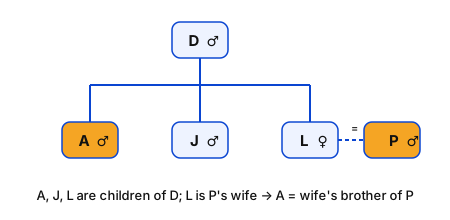
  1. A @ D : A is the son of D. D £ J : D is the father of J → A and J are brothers.
  2. J ≠ L : J is the brother of L → L is also a child of D, hence A's sister.
  3. L ≤ P : L is the wife of P → A is the brother of P's wife.

Trick: Children of the same father are siblings; the sister's husband sees you as "wife's brother" (saala).

Answer: (B) Wife's brother

अवधारणा: हर प्रतीक को क्रम से डिकोड कर परिवार वृक्ष बनाएँ, फिर P की ओर से संबंध पढ़ें।

  1. A @ D : A, D का पुत्र है। D £ J : D, J का पिता है → A और J भाई हैं।
  2. J ≠ L : J, L का भाई है → L भी D की संतान है, अत: A की बहन।
  3. L ≤ P : L, P की पत्नी है → A, P की पत्नी का भाई है।

ट्रिक: एक ही पिता की संतानें भाई-बहन हैं; बहन का पति आपको "पत्नी का भाई" (साला) मानेगा।

उत्तर: (B) पत्नी का भाई

RRB NTPC Undergraduate CBT 1General Intelligence and ReasoningBlood relations (coded)RRB NTPC Undergraduate CBT 1 2025 · 8 May Shift 1 →
Q8169.
Tuv ranked 27th from the top and 64th from the bottom in his class. How many students are there in his class?
तुव अपनी कक्षा में ऊपर से 27वें और नीचे से 64वें स्थान पर है। उसकी कक्षा में कितने विद्यार्थी हैं?
  1. A91
  2. B92
  3. C90
  4. D89
Show answer

Concept: If a person is mth from the top and nth from the bottom, total students =m+n−1 (the person is counted twice).

  1. m=27, n=64.
  2. Total =27+64−1=90.

Trick: Top rank + bottom rank − 1 = total (subtract 1 for the double-counted person).

Answer: (C) 90

अवधारणा: यदि कोई व्यक्ति ऊपर से mवाँ और नीचे से nवाँ है, तो कुल छात्र =m+n−1 (व्यक्ति दो बार गिना गया)।

  1. m=27, n=64।
  2. कुल =27+64−1=90।

ट्रिक: ऊपर से रैंक + नीचे से रैंक − 1 = कुल (दो बार गिने व्यक्ति के लिए 1 घटाएँ)।

उत्तर: (C) 90

RRB NTPC Undergraduate CBT 1General Intelligence and ReasoningRankingRRB NTPC Undergraduate CBT 1 2025 · 8 May Shift 1 →
Q8170.
Seven people, Q, M, B, L, E, F and G, are sitting in a row, facing north.
Only six people sit to the right of E. Only five people sit to the left of Q. Only three people sit between M and Q. B is the immediate neighbour of L and G. Only three people sit between F and L.
How many people sit between G and F?
सात व्यक्ति Q, M, B, L, E, F और G एक पंक्ति में उत्तर की ओर मुख करके बैठे हैं।
E के दाईं ओर केवल छह व्यक्ति बैठे हैं। Q के बाईं ओर केवल पाँच व्यक्ति बैठे हैं। M और Q के बीच केवल तीन व्यक्ति बैठे हैं। B, L और G का निकटतम पड़ोसी है। F और L के बीच केवल तीन व्यक्ति बैठे हैं।
G और F के बीच कितने व्यक्ति बैठे हैं?
  1. AOneएक
  2. BFourचार
  3. CThreeतीन
  4. DTwoदो
Show answer

Concept: Number the seats 1–7 from left to right (facing north, left = west). Place the people with fixed positions first.

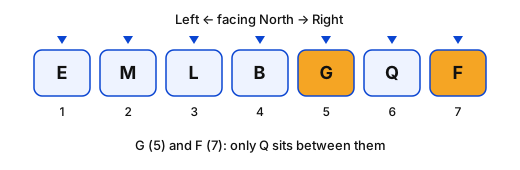
  1. Six people right of E → E at 1. Five people left of Q → Q at 6. Three between M and Q → M at 2.
  2. Seats 3, 4, 5, 7 remain for B, L, G, F. B is between L and G, so B at 4 with L, G at 3 and 5; F takes 7.
  3. Three between F(7) and L → L at 3, so G at 5. Order: E M L B G Q F.
  4. Between G(5) and F(7) sits only Q → one person.

Trick: "Only n people sit to the right/left" pins a person to an exact seat – start from such clues.

Answer: (A) One

अवधारणा: बाएँ से दाएँ सीटों को 1–7 नंबर दें (उत्तर की ओर मुख, बायाँ = पश्चिम)। पहले निश्चित स्थान वालों को बैठाएँ।

  1. E के दाएँ छह लोग → E सीट 1 पर। Q के बाएँ पाँच लोग → Q सीट 6 पर। M और Q के बीच तीन → M सीट 2 पर।
  2. सीट 3, 4, 5, 7 बची हैं B, L, G, F के लिए। B, L और G के बीच है → B सीट 4 पर, L और G सीट 3 व 5 पर; F सीट 7 पर।
  3. F(7) और L के बीच तीन → L सीट 3 पर, अत: G सीट 5 पर। क्रम: E M L B G Q F।
  4. G(5) और F(7) के बीच केवल Q → एक व्यक्ति।

ट्रिक: "केवल n लोग दाएँ/बाएँ बैठे हैं" व्यक्ति की सटीक सीट तय कर देता है – ऐसे सुराग से शुरू करें।

उत्तर: (A) एक

RRB NTPC Undergraduate CBT 1General Intelligence and ReasoningLinear seating arrangementRRB NTPC Undergraduate CBT 1 2025 · 8 May Shift 1 →
Q8171.
Ayush ranked 44th from the top and 25th from the bottom in his class. How many students are there in his class?
आयुष अपनी कक्षा में ऊपर से 44वें और नीचे से 25वें स्थान पर है। उसकी कक्षा में कितने विद्यार्थी हैं?
  1. A68
  2. B66
  3. C67
  4. D69
Show answer

Concept: Total students =(rank from top)+(rank from bottom)−1.

  1. Rank from top =44, from bottom =25.
  2. Total =44+25−1=68.

Trick: Add the two ranks and subtract 1 (Ayush himself is counted in both).

Answer: (A) 68

अवधारणा: कुल छात्र =(ऊपर से रैंक)+(नीचे से रैंक)−1।

  1. ऊपर से रैंक =44, नीचे से =25।
  2. कुल =44+25−1=68।

ट्रिक: दोनों रैंक जोड़कर 1 घटाएँ (आयुष स्वयं दोनों में गिना गया है)।

उत्तर: (A) 68

RRB NTPC Undergraduate CBT 1General Intelligence and ReasoningRankingRRB NTPC Undergraduate CBT 1 2025 · 8 May Shift 1 →
Q8172.
Which of the following options should come in place of the ‘?’ in the given series based on the English alphabetical order?
N 32, I 25, D 18, Y 11, ?
अंग्रेज़ी वर्णमाला क्रम के आधार पर दी गई शृंखला में '?' के स्थान पर निम्नलिखित में से कौन-सा विकल्प आना चाहिए?
N 32, I 25, D 18, Y 11, ?
  1. AT 4
  2. BZ 4
  3. CS 4
  4. DY 4
Show answer

Concept: Treat the letters and the numbers as two separate series.

  1. Letters: N(14) → I(9) → D(4) → Y(25) : each −5 (D−5 = −1 → wrap to 25 = Y). Next: Y(25)−5 = 20 → T.
  2. Numbers: 32 → 25 → 18 → 11 : each −7. Next: 11−7=4.
  3. So the next term is T 4.

Trick: Going backwards past A, add 26: 4−5=−1⇒−1+26=25 (Y).

Answer: (A) T 4

अवधारणा: अक्षरों और संख्याओं को दो अलग श्रृंखलाओं की तरह देखें।

  1. अक्षर: N(14) → I(9) → D(4) → Y(25) : हर बार −5 (D−5 = −1 → चक्र में 25 = Y)। अगला: Y(25)−5 = 20 → T।
  2. संख्याएँ: 32 → 25 → 18 → 11 : हर बार −7। अगला: 11−7=4।
  3. अत: अगला पद T 4।

ट्रिक: A से पीछे जाने पर 26 जोड़ें: 4−5=−1⇒−1+26=25 (Y)।

उत्तर: (A) T 4

RRB NTPC Undergraduate CBT 1General Intelligence and ReasoningLetter–number seriesRRB NTPC Undergraduate CBT 1 2025 · 8 May Shift 1 →
Q8173.
Based on the English alphabetical order, three of the following four letter-cluster pairs are alike in a certain way and thus form a group. Which is the one that does not belong to that group? (Note: The odd one out is not based on the number of
consonants/vowels or their position in the letter cluster.)
अंग्रेज़ी वर्णमाला क्रम के आधार पर, निम्नलिखित चार अक्षर-समूह युग्मों में से तीन किसी निश्चित प्रकार से एक समान हैं और इस प्रकार एक समूह बनाते हैं। वह कौन-सा है जो उस समूह से संबंधित नहीं है? (नोट: असंगत युग्म अक्षर-समूह में व्यंजनों/स्वरों की संख्या या उनकी
स्थिति पर आधारित नहीं है।)
  1. AFE−IH
  2. BLK−ON
  3. CCB−FE
  4. DKJ−MO
Show answer

Concept: Compare corresponding letters of the two clusters in each pair and find the jump.

  1. FE−IH : F→I (+3), E→H (+3).
  2. LK−ON : L→O (+3), K→N (+3). CB−FE : C→F (+3), B→E (+3).
  3. KJ−MO : K→M (+2), J→O (+5) – breaks the pattern.

Trick: In three pairs the second cluster is simply "each letter + 3"; the odd pair has unequal jumps.

Answer: (D) KJ−MO

अवधारणा: प्रत्येक जोड़े में दोनों क्लस्टर के संगत अक्षरों की तुलना कर अंतर निकालें।

  1. FE−IH : F→I (+3), E→H (+3)।
  2. LK−ON : L→O (+3), K→N (+3)। CB−FE : C→F (+3), B→E (+3)।
  3. KJ−MO : K→M (+2), J→O (+5) – पैटर्न टूटता है।

ट्रिक: तीन जोड़ों में दूसरा क्लस्टर "हर अक्षर + 3" है; विषम जोड़े में अंतर असमान है।

उत्तर: (D) KJ−MO

RRB NTPC Undergraduate CBT 1General Intelligence and ReasoningLetter-cluster analogy (odd one out)RRB NTPC Undergraduate CBT 1 2025 · 8 May Shift 1 →
Q8174.
Each vowel in the word REFERTILIZES is changed to the second letter immediately following it in the English alphabetical order, and each consonant is changed to the second letter immediately preceding it in the English alphabetical order. Which of the following letters will appear exactly twice in the group of letters thus formed?
शब्द REFERTILIZES के प्रत्येक स्वर को अंग्रेज़ी वर्णमाला क्रम में उसके ठीक बाद आने वाले दूसरे अक्षर से बदल दिया जाता है, और प्रत्येक व्यंजन को अंग्रेज़ी वर्णमाला क्रम में उसके ठीक पहले आने वाले दूसरे अक्षर से बदल दिया जाता है। इस प्रकार बने अक्षर-समूह में निम्नलिखित में से कौन-सा अक्षर ठीक दो बार आएगा?
  1. AR
  2. BK
  3. CX
  4. DG
Show answer

Concept: Vowel → +2 in the alphabet, consonant → −2. Convert every letter of REFERTILIZES and count.

  1. R→P, E→G, F→D, E→G, R→P, T→R, I→K, L→J, I→K, Z→X, E→G, S→Q.
  2. New group: P G D G P R K J K X G Q.
  3. Counts: G = 3, P = 2, K = 2, R = 1, X = 1. Among the options only K appears exactly twice.

Trick: Convert letter by letter in order and tally only the letters given in the options.

Answer: (B) K

अवधारणा: स्वर → वर्णमाला में +2, व्यंजन → −2। REFERTILIZES के हर अक्षर को बदलकर गिनें।

  1. R→P, E→G, F→D, E→G, R→P, T→R, I→K, L→J, I→K, Z→X, E→G, S→Q।
  2. नया समूह: P G D G P R K J K X G Q।
  3. गिनती: G = 3, P = 2, K = 2, R = 1, X = 1। विकल्पों में केवल K ठीक दो बार आता है।

ट्रिक: क्रम से एक-एक अक्षर बदलें और केवल विकल्पों में दिए अक्षरों की गिनती करें।

उत्तर: (B) K

RRB NTPC Undergraduate CBT 1General Intelligence and ReasoningLetter manipulationRRB NTPC Undergraduate CBT 1 2025 · 8 May Shift 1 →
Q8175.
KY 1 is related to MU 17 in a certain way. In the same way, FI 8 is related to HE 24. To which of the following is RF 3 related, following the same logic?
KY 1 किसी निश्चित प्रकार से MU 17 से संबंधित है। उसी प्रकार, FI 8, HE 24 से संबंधित है। समान तर्क का अनुसरण करते हुए, RF 3 निम्नलिखित में से किससे संबंधित है?
  1. AKL 5
  2. BKJ 7
  3. CTB 19
  4. DYG 9
Show answer

Concept: Find the rule for letters and number separately from both given pairs, then apply it.

  1. KY 1 → MU 17: K→M (+2), Y→U (−4), 1→17 (+16).
  2. FI 8 → HE 24: F→H (+2), I→E (−4), 8→24 (+16). Rule confirmed.
  3. RF 3: R+2 = T, F−4 = B, 3+16=19 → TB 19.

Trick: Verify the rule on both examples before applying; here (+2, −4, +16).

Answer: (C) TB 19

अवधारणा: दोनों दिए गए जोड़ों से अक्षरों और संख्या का नियम अलग-अलग निकालें, फिर लागू करें।

  1. KY 1 → MU 17: K→M (+2), Y→U (−4), 1→17 (+16)।
  2. FI 8 → HE 24: F→H (+2), I→E (−4), 8→24 (+16)। नियम पुष्ट।
  3. RF 3: R+2 = T, F−4 = B, 3+16=19 → TB 19।

ट्रिक: नियम को दोनों उदाहरणों पर जाँचकर ही लागू करें; यहाँ (+2, −4, +16)।

उत्तर: (C) TB 19

RRB NTPC Undergraduate CBT 1General Intelligence and ReasoningLetter–number analogyRRB NTPC Undergraduate CBT 1 2025 · 8 May Shift 1 →
Q8176.
Read the given statement(s) and conclusions carefully. Assuming that the information given in the statements is true, even if it appears to be at variance with commonly known facts, decide which of the given conclusions logically follow(s) from the statement(s).
Statements:
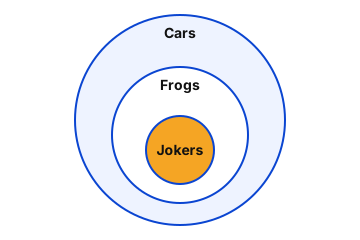
All jokers are frogs.
All frogs are cars.
Conclusions:
(I) Some cars are frogs.
(II) All jokers are cars.
दिए गए कथन(कथनों) और निष्कर्षों को ध्यानपूर्वक पढ़िए। यह मानते हुए कि कथनों में दी गई जानकारी सत्य है, भले ही वह सामान्यतः ज्ञात तथ्यों से भिन्न प्रतीत होती हो, निर्णय कीजिए कि दिए गए निष्कर्षों में से कौन-सा/कौन-से निष्कर्ष कथन(कथनों) का तार्किक रूप से अनुसरण करता है/करते हैं।
कथन:
सभी जोकर, मेंढक हैं।
सभी मेंढक, कार हैं।
निष्कर्ष:
(I) कुछ कार, मेंढक हैं।
(II) सभी जोकर, कार हैं।
  1. ANeither conclusion (I) nor (II) followsन तो निष्कर्ष (I) और न ही (II) अनुसरण करता है
  2. BBoth conclusions (I) and (II) followनिष्कर्ष (I) और (II) दोनों अनुसरण करते हैं
  3. COnly conclusion (II) followsकेवल निष्कर्ष (II) अनुसरण करता है
  4. DOnly conclusion (I) followsकेवल निष्कर्ष (I) अनुसरण करता है
Show answer

Concept: "All A are B" + "All B are C" ⇒ "All A are C". Also, "All B are C" lets us conclude "Some C are B".

  1. Jokers ⊂ Frogs ⊂ Cars, so all jokers are cars – conclusion II follows.
  2. Since every frog is a car, the frogs are a part of the cars, so some cars are frogs – conclusion I follows.

Trick: Two "All" statements chained give "All"; and every "All A are B" also gives "Some B are A".

Answer: (B) Both conclusions (I) and (II) follow

अवधारणा: "सभी A, B हैं" + "सभी B, C हैं" ⇒ "सभी A, C हैं"। साथ ही "सभी B, C हैं" से "कुछ C, B हैं" निकलता है।

  1. Jokers ⊂ Frogs ⊂ Cars, अत: सभी jokers, cars हैं – निष्कर्ष II सही।
  2. हर frog एक car है, इसलिए frogs, cars का हिस्सा हैं → कुछ cars, frogs हैं – निष्कर्ष I सही।

ट्रिक: दो "सभी" कथन जोड़ने पर "सभी" मिलता है; और हर "सभी A, B हैं" से "कुछ B, A हैं" भी निकलता है।

उत्तर: (B) निष्कर्ष (I) और (II) दोनों अनुसरण करते हैं

RRB NTPC Undergraduate CBT 1General Intelligence and ReasoningSyllogismRRB NTPC Undergraduate CBT 1 2025 · 8 May Shift 1 →
Q8177.
What should come in place of ‘?’ in the given series?
8 9 17 26 90 115 ?
दी गई शृंखला में '?' के स्थान पर क्या आना चाहिए?
8 9 17 26 90 115 ?
  1. A313
  2. B331
  3. C198
  4. D231
Show answer

Concept: Look at the differences between consecutive terms; here they alternate between squares and cubes.

  1. Differences: 9−8=1, 17−9=8, 26−17=9, 90−26=64, 115−90=25.
  2. Pattern: 12,23,32,43,52 → next difference 63=216.
  3. Next term =115+216=331.

Trick: Differences 1, 8, 9, 64, 25 – odd positions are squares, even positions cubes.

Answer: (B) 331

अवधारणा: क्रमागत पदों के अंतर देखें; यहाँ अंतर वर्ग और घन के बीच बारी-बारी बदलते हैं।

  1. अंतर: 9−8=1, 17−9=8, 26−17=9, 90−26=64, 115−90=25।
  2. पैटर्न: 12,23,32,43,52 → अगला अंतर 63=216।
  3. अगला पद =115+216=331।

ट्रिक: अंतर 1, 8, 9, 64, 25 – विषम स्थान पर वर्ग, सम स्थान पर घन।

उत्तर: (B) 331

RRB NTPC Undergraduate CBT 1General Intelligence and ReasoningNumber seriesRRB NTPC Undergraduate CBT 1 2025 · 8 May Shift 1 →
Q8178.
Refer to the following series and answer the question. (All numbers are single digit numbers only. Counting has to be done from left to right).
(Left) 2 9 3 3 8 4 7 2 4 2 8 9 9 7 4 9 9 4 6 7 7 (Right)
How many such odd digits are there each of which is immediately preceded by an odd digit and also immediately followed by a perfect square?
(NOTE: 1 is also a perfect square)
निम्नलिखित शृंखला को देखिए और प्रश्न का उत्तर दीजिए। (सभी संख्याएँ केवल एक अंक की संख्याएँ हैं। गिनती बाएँ से दाएँ की जानी है।)
(बाएँ) 2 9 3 3 8 4 7 2 4 2 8 9 9 7 4 9 9 4 6 7 7 (दाएँ)
ऐसे कितने विषम अंक हैं जिनमें से प्रत्येक के ठीक पहले एक विषम अंक है और ठीक बाद में एक पूर्ण वर्ग है?
(नोट: 1 भी एक पूर्ण वर्ग है)
  1. AThreeतीन
  2. BTwoदो
  3. CFourचार
  4. DOneएक
Show answer

Concept: We need an odd digit whose left neighbour is odd and right neighbour is a perfect square (1, 4 or 9). Scan odd–odd–square triplets.

  1. Series: 2 9 3 3 8 4 7 2 4 2 8 9 9 7 4 9 9 4 6 7 7.
  2. 9 7 4 (positions 13–15): 7 is odd, preceded by 9 (odd), followed by 4 (square) ✓.
  3. 9 9 4 (positions 16–18): 9 odd, preceded by 9, followed by 4 ✓.
  4. Other odd digits fail: e.g. 9 3 3 (next 3 not a square), 4 7 2 (preceded by even).

Trick: First mark the squares (1, 4, 9) in the series, then check only the digit just before each one.

Answer: (B) Two

अवधारणा: ऐसा विषम अंक चाहिए जिसके बाएँ विषम अंक और दाएँ पूर्ण वर्ग (1, 4 या 9) हो। विषम–विषम–वर्ग त्रिक खोजें।

  1. श्रृंखला: 2 9 3 3 8 4 7 2 4 2 8 9 9 7 4 9 9 4 6 7 7।
  2. 9 7 4 (स्थान 13–15): 7 विषम, पहले 9 (विषम), बाद में 4 (वर्ग) ✓।
  3. 9 9 4 (स्थान 16–18): 9 विषम, पहले 9, बाद में 4 ✓।
  4. अन्य विषम अंक शर्त पूरी नहीं करते: जैसे 9 3 3 (अगला 3 वर्ग नहीं), 4 7 2 (पहले सम अंक)।

ट्रिक: पहले श्रृंखला में वर्ग (1, 4, 9) चिह्नित करें, फिर केवल उनसे ठीक पहले वाले अंक की जाँच करें।

उत्तर: (B) दो

RRB NTPC Undergraduate CBT 1General Intelligence and ReasoningNumber series countingRRB NTPC Undergraduate CBT 1 2025 · 8 May Shift 1 →
Q8179.
In the following number-pairs, the second number is obtained by applying certain mathematical operations to the first number. Select the set in which the numbers are related in the same way as are the numbers of the following sets.
(NOTE: Operations should be performed on the whole numbers, without breaking down the numbers into their constituent digits. E.g. 13 – Operations on 13 such as adding / subtracting / multiplying etc. to 13 can be performed. Breaking down 13 into 1 and 3 and then performing mathematical operations on 1 and 3 is not allowed.)
18, 109
17, 103
निम्नलिखित संख्या-युग्मों में, दूसरी संख्या पहली संख्या पर कुछ निश्चित गणितीय संक्रियाएँ करके प्राप्त की गई है। उस समुच्चय का चयन कीजिए जिसमें संख्याएँ उसी प्रकार संबंधित हैं जिस प्रकार निम्नलिखित समुच्चयों की संख्याएँ संबंधित हैं।
(नोट: संक्रियाएँ पूर्ण संख्याओं पर की जानी चाहिए, संख्याओं को उनके घटक अंकों में तोड़े बिना। उदाहरण: 13 – 13 पर संक्रियाएँ जैसे 13 में जोड़ना / घटाना / गुणा करना आदि की जा सकती हैं। 13 को 1 और 3 में तोड़कर फिर 1 और 3 पर गणितीय संक्रियाएँ करने की अनुमति नहीं है।)
18, 109
17, 103
  1. A26, 130
  2. B24, 155
  3. C22, 133
  4. D19, 116
Show answer

Concept: Find one operation on the whole first number that gives the second in both given pairs.

  1. 18×6+1=109 and 17×6+1=103 → rule: second =6×first+1.
  2. Check options: 22×6+1=133 ✓.
  3. Others fail: 26→157 (not 130), 24→145 (not 155), 19→115 (not 116).

Trick: Second ÷ first ≈ 6 in both pairs → try 6n±k.

Answer: (C) 22, 133

अवधारणा: पहली संख्या (पूरी) पर ऐसी संक्रिया खोजें जो दोनों जोड़ों में दूसरी संख्या दे।

  1. 18×6+1=109 और 17×6+1=103 → नियम: दूसरी =6×पहली+1।
  2. विकल्प जाँचें: 22×6+1=133 ✓।
  3. बाकी गलत: 26→157 (130 नहीं), 24→145 (155 नहीं), 19→115 (116 नहीं)।

ट्रिक: दोनों जोड़ों में दूसरी ÷ पहली ≈ 6 → 6n±k आज़माएँ।

उत्तर: (C) 22, 133

RRB NTPC Undergraduate CBT 1General Intelligence and ReasoningNumber analogyRRB NTPC Undergraduate CBT 1 2025 · 8 May Shift 1 →
Q8180.
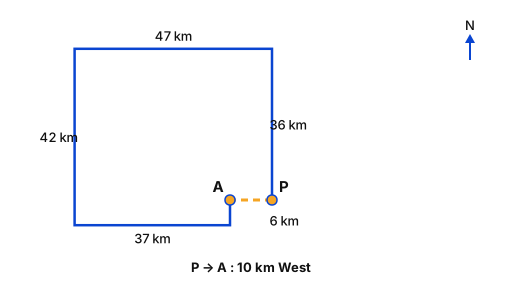
Mr. Yorly starts from Point A and drives 6 km towards South. He then takes a right turn, drives 37 km, turns right and drives 42 km. He then takes a right turn and drives 47 km. He takes a final right turn, drives 36 km and stops at Point P. How far (shortest distance) and towards which direction should he drive in order to reach Point A again?
(All turns are 90 degrees turns only unless specified.)
श्री योर्ली बिंदु A से चलना शुरू करते हैं और दक्षिण की ओर 6 km गाड़ी चलाते हैं। फिर वे दाएँ मुड़ते हैं, 37 km गाड़ी चलाते हैं, दाएँ मुड़ते हैं और 42 km गाड़ी चलाते हैं। फिर वे दाएँ मुड़ते हैं और 47 km गाड़ी चलाते हैं। वे अंतिम बार दाएँ मुड़ते हैं, 36 km गाड़ी चलाते हैं और बिंदु P पर रुकते हैं। पुनः बिंदु A पर पहुँचने के लिए उन्हें कितनी दूर (न्यूनतम दूरी) और किस दिशा में गाड़ी चलानी चाहिए?
(जब तक अन्यथा निर्दिष्ट न हो, सभी मोड़ केवल 90 डिग्री के मोड़ हैं।)
  1. A10 km to the Westपश्चिम की ओर 10 km
  2. B11 km to the Northउत्तर की ओर 11 km
  3. C12 km to the Eastपूर्व की ओर 12 km
  4. D15 km to the Southदक्षिण की ओर 15 km
Show answer

Concept: Take A as origin, track east–west and north–south displacements separately. Facing South, a right turn means West; facing West, right = North; facing North, right = East; facing East, right = South.

  1. 6 km South → (0, −6). Right → 37 km West → (−37, −6). Right → 42 km North → (−37, 36).
  2. Right → 47 km East → (10, 36). Right → 36 km South → P = (10, 0).
  3. P is 10 km east of A on the same east–west line, so he must drive 10 km West to reach A.

Trick: Net E–W =47−37=10 km east; net N–S =42−6−36=0 → straight back West.

Answer: (A) 10 km to the West

अवधारणा: A को मूल बिंदु मानकर पूर्व–पश्चिम और उत्तर–दक्षिण विस्थापन अलग-अलग गिनें। दक्षिण मुख में दायाँ मोड़ = पश्चिम; पश्चिम मुख में दायाँ = उत्तर; उत्तर में दायाँ = पूर्व; पूर्व में दायाँ = दक्षिण।

  1. 6 km दक्षिण → (0, −6)। दाएँ → 37 km पश्चिम → (−37, −6)। दाएँ → 42 km उत्तर → (−37, 36)।
  2. दाएँ → 47 km पूर्व → (10, 36)। दाएँ → 36 km दक्षिण → P = (10, 0)।
  3. P, A से 10 km पूर्व में उसी रेखा पर है, अत: A पहुँचने के लिए 10 km पश्चिम चलना होगा।

ट्रिक: शुद्ध पू–प =47−37=10 km पूर्व; शुद्ध उ–द =42−6−36=0 → सीधे पश्चिम लौटें।

उत्तर: (A) 10 km पश्चिम की ओर

RRB NTPC Undergraduate CBT 1General Intelligence and ReasoningDirection and distanceRRB NTPC Undergraduate CBT 1 2025 · 8 May Shift 1 →