Question bank

Q&A: practice questions with answers

Search questions on any topic. Filter by exam category, exam, subject and topic, try the question, then open the answer and explanation.

Courses – airGurukul

8,495 questions found.

Q8241.
The sum of two positive numbers is 30 and their product is 176. The positive difference between them is:
दो धनात्मक संख्याओं का योग 30 है और उनका गुणनफल 176 है। उनके बीच का धनात्मक अंतर है:
  1. A7
  2. B14
  3. C24
  4. D10
Show answer

Concept: (a−b)2=(a+b)2−4ab.

  1. (a−b)2=302−4×176=900−704=196.
  2. a−b=196=14.
  3. Check: numbers are 22 and 8; 22×8=176 ✓.

Trick: No need to find the numbers – jump straight from sum and product to the difference.

Answer: (B) 14

अवधारणा: (a−b)2=(a+b)2−4ab।

  1. (a−b)2=302−4×176=900−704=196।
  2. a−b=196=14।
  3. जाँच: संख्याएँ 22 और 8; 22×8=176 ✓।

ट्रिक: संख्याएँ निकालने की ज़रूरत नहीं – योग और गुणनफल से सीधे अंतर पर पहुँचें।

उत्तर: (B) 14
RRB NTPC Undergraduate CBT 1MathematicsAlgebraic identitiesRRB NTPC Undergraduate CBT 1 2025 · 7 May Shift 3 →
Q8242.
If 2cos2x−1=12 for 0∘<x<90∘, then the value of sec2x+cosecx+cot2x is
यदि 2cos2x−1=12 है, जहाँ 0∘<x<90∘ है, तो sec2x+cosecx+cot2x का मान है
  1. A11
  2. B5
  3. C9
  4. D7
Show answer

Concept: 2cos2x−1=cos2x; find x and then plug standard values.

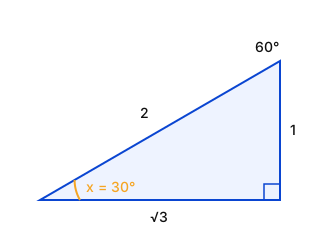
  1. cos2x=12⇒2x=60∘⇒x=30∘.
  2. sec2x=sec60∘=2, cosecx=cosec30∘=2, cot2x=cot230∘=(3)2=3.
  3. Sum =2+2+3=7.

Trick: Whenever you see 2cos2x−1, read it as cos2x – the double-angle form saves a step.

Answer: (D) 7

अवधारणा: 2cos2x−1=cos2x; पहले x निकालें, फिर मानक मान रखें।

  1. cos2x=12⇒2x=60∘⇒x=30∘।
  2. sec2x=sec60∘=2, cosecx=cosec30∘=2, cot2x=cot230∘=(3)2=3।
  3. योग =2+2+3=7।

ट्रिक: 2cos2x−1 दिखे तो उसे cos2x पढ़ें – द्विकोण (double-angle) रूप एक चरण बचाता है।

उत्तर: (D) 7

RRB NTPC Undergraduate CBT 1MathematicsTrigonometryRRB NTPC Undergraduate CBT 1 2025 · 7 May Shift 3 →
Q8243.
A shopkeeper offers the following schemes on toys of the same marked price. (A) Successive discounts of 39% and 3% on any number of toys bought.
(B) Successive discounts of 36%, 13% and 8% on any number of toys bought. (C) 18% discount on the first 2 toys and 41% discount on each toy thereon.
(D) 5 toys free of cost on buying 7 toys.
A customer wants to buy 7 toys. Which of the above schemes is the least beneficial to her?
एक दुकानदार समान अंकित मूल्य वाले खिलौनों पर निम्नलिखित योजनाएँ प्रस्तुत करता है। (A) खरीदे गए किसी भी संख्या के खिलौनों पर 39% और 3% की क्रमिक छूट।
(B) खरीदे गए किसी भी संख्या के खिलौनों पर 36%, 13% और 8% की क्रमिक छूट। (C) पहले 2 खिलौनों पर 18% छूट और उसके बाद प्रत्येक खिलौने पर 41% छूट।
(D) 7 खिलौने खरीदने पर 5 खिलौने निःशुल्क।
एक ग्राहक 7 खिलौने खरीदना चाहती है। उपरोक्त योजनाओं में से कौन-सी उसके लिए सबसे कम लाभदायक है?
  1. AA
  2. BC
  3. CD
  4. DB
Show answer

Concept: Take marked price ₹100 per toy and compute what the customer pays for 7 toys under each scheme; the highest payment is the least beneficial.

  1. (A) 100×0.61×0.97=59.17 per toy → 7×59.17=414.19.
  2. (B) 100×0.64×0.87×0.92=51.23 per toy → 358.58.
  3. (C) 2×82+5×59=164+295=459.
  4. (D) 12 toys for the price of 7 → effective price per toy =712×100=58.33 → 7×58.33=408.33.
  5. Highest payment is scheme (C) = ₹459.

Trick: Successive discounts a% and b% equal a single discount of a+b−ab100; "m free on n" means a discount of mm+n.

Answer: (B) C

अवधारणा: प्रति खिलौना अंकित मूल्य ₹100 मानकर हर योजना में 7 खिलौनों का भुगतान निकालें; सबसे अधिक भुगतान वाली योजना सबसे कम लाभदायक है।

  1. (A) 100×0.61×0.97=59.17 प्रति खिलौना → 7×59.17=414.19।
  2. (B) 100×0.64×0.87×0.92=51.23 प्रति खिलौना → 358.58।
  3. (C) 2×82+5×59=164+295=459।
  4. (D) 7 के मूल्य में 12 खिलौने → प्रभावी मूल्य प्रति खिलौना =712×100=58.33 → 7×58.33=408.33।
  5. सबसे अधिक भुगतान योजना (C) = ₹459।

ट्रिक: क्रमिक छूट a% और b% = एकल छूट a+b−ab100; "n पर m मुफ्त" = mm+n की छूट।

उत्तर: (B) C

RRB NTPC Undergraduate CBT 1MathematicsSuccessive discountsRRB NTPC Undergraduate CBT 1 2025 · 7 May Shift 3 →
Q8244.
The salary of an employee is increased by 5% in the first year and again by 5% in the second year. What is the overall percentage increase in the salary after two years?
एक कर्मचारी के वेतन में पहले वर्ष 5% और दूसरे वर्ष फिर से 5% की वृद्धि की जाती है। दो वर्षों के बाद वेतन में कुल प्रतिशत वृद्धि कितनी है?
  1. A10%
  2. B10.25%
  3. C11.5%
  4. D11%
Show answer

Concept: Two successive changes of a% and b% give a net change of a+b+ab100.

  1. Net =5+5+5×5100=10+0.25=10.25%.
  2. Check: 100→105→110.25, i.e. 10.25% more.

Trick: Equal increases r% twice =2r+r2100 – same as 2-year compound interest.

Answer: (B) 10.25%

अवधारणा: a% और b% के दो क्रमिक परिवर्तनों का कुल परिवर्तन a+b+ab100 होता है।

  1. कुल =5+5+5×5100=10+0.25=10.25%।
  2. जाँच: 100→105→110.25, अर्थात् 10.25% अधिक।

ट्रिक: दो बार r% की समान वृद्धि =2r+r2100 – 2 वर्ष के चक्रवृद्धि ब्याज जैसा।

उत्तर: (B) 10.25%

RRB NTPC Undergraduate CBT 1MathematicsSuccessive percentage changeRRB NTPC Undergraduate CBT 1 2025 · 7 May Shift 3 →
Q8245.
A 104-metre-long train crosses another 94-metre-long train running in the same direction in 16.2 seconds. If the speed of the first train is 61 kmph, what is the speed of the second train in kmph?
104 मीटर लंबी एक रेलगाड़ी समान दिशा में चल रही 94 मीटर लंबी दूसरी रेलगाड़ी को 16.2 सेकंड में पार करती है। यदि पहली रेलगाड़ी की चाल 61 किमी/घंटा है, तो दूसरी रेलगाड़ी की चाल किमी/घंटा में क्या है?
  1. A105 km/hr105 किमी/घंटा
  2. B109 km/hr109 किमी/घंटा
  3. C17 km/hr17 किमी/घंटा
  4. D101 km/hr101 किमी/घंटा
Show answer

Concept: Same direction: relative speed = difference of speeds; distance covered = sum of lengths.

  1. Distance =104+94=198m in 16.2s.
  2. Relative speed =19816.2=1109m/s=1109×185=44km/h.
  3. The first train overtakes, so it is faster: 61−v=44⇒v=17km/h.

Trick: 185 converts m/s to km/h; 19816.2×185 simplifies neatly to 44.

Answer: (C) 17 km/hr

अवधारणा: समान दिशा: सापेक्ष चाल = चालों का अंतर; तय दूरी = लंबाइयों का योग।

  1. दूरी =104+94=198m, समय 16.2s।
  2. सापेक्ष चाल =19816.2=1109m/s=1109×185=44km/h।
  3. पहली रेलगाड़ी पार करती है, अतः तेज़ है: 61−v=44⇒v=17km/h।

ट्रिक: 185 से m/s को km/h में बदलें; 19816.2×185 सीधे 44 देता है।

उत्तर: (C) 17 km/hr

RRB NTPC Undergraduate CBT 1MathematicsTrains – relative speedRRB NTPC Undergraduate CBT 1 2025 · 7 May Shift 3 →
Q8246.
Ravi spends 70% of his income. If his income increases by 25% and his expenditure increases by 10%, by what percentage do his savings increase?
रवि अपनी आय का 70% खर्च करता है। यदि उसकी आय 25% बढ़ जाती है और उसका व्यय 10% बढ़ जाता है, तो उसकी बचत में कितने प्रतिशत की वृद्धि होती है?
  1. ASavings increase by 60%बचत में 60% की वृद्धि
  2. BSavings increase by 50%बचत में 50% की वृद्धि
  3. CSavings increase by 40%बचत में 40% की वृद्धि
  4. DSavings increase by 30%बचत में 30% की वृद्धि
Show answer

Concept: Savings = Income − Expenditure; take income =100.

  1. Old: income 100, expenditure 70, savings 30.
  2. New: income 125, expenditure 70×1.1=77, savings 125−77=48.
  3. Increase =48−3030×100=60%.

Trick: Always assume income 100 – the spend/save split then needs no fractions.

Answer: (A) Savings increase by 60%

अवधारणा: बचत = आय − व्यय; आय =100 मानें।

  1. पहले: आय 100, व्यय 70, बचत 30।
  2. बाद में: आय 125, व्यय 70×1.1=77, बचत 125−77=48।
  3. वृद्धि =48−3030×100=60%।

ट्रिक: आय हमेशा 100 मानें – खर्च/बचत का बँटवारा बिना भिन्न के निकल आता है।

उत्तर: (A) Savings increase by 60%

RRB NTPC Undergraduate CBT 1MathematicsPercentage – income & savingsRRB NTPC Undergraduate CBT 1 2025 · 7 May Shift 3 →
Q8247.
The fourth proportional to 1.2, 4.8, and 7.15 is:
1.2, 4.8 और 7.15 का चतुर्थानुपाती है:
  1. A28.4
  2. B28.6
  3. C28.2
  4. D28.8
Show answer

Concept: Fourth proportional d to a,b,c: a:b=c:d⇒d=bca.

  1. d=4.8×7.151.2.
  2. 4.81.2=4, so d=4×7.15=28.6.

Trick: Cancel first (4.8÷1.2=4), multiply last – avoids decimal multiplication.

Answer: (B) 28.6

अवधारणा: a,b,c का चतुर्थानुपाती d: a:b=c:d⇒d=bca।

  1. d=4.8×7.151.2।
  2. 4.81.2=4, अतः d=4×7.15=28.6।

ट्रिक: पहले काटें (4.8÷1.2=4), बाद में गुणा करें – दशमलव गुणा से बचत।

उत्तर: (B) 28.6

RRB NTPC Undergraduate CBT 1MathematicsProportionRRB NTPC Undergraduate CBT 1 2025 · 7 May Shift 3 →
Q8248.
Given the data set: 12, 36, 22, 27, 31, 17. What is the median value?
दिया गया डेटा समुच्चय: 12, 36, 22, 27, 31, 17। माध्यिका (median) का मान क्या है?
  1. A26.5
  2. B24.5
  3. C22
  4. D27
Show answer

Concept: Median is the middle value of the sorted data; for an even count, average the two middle values.

  1. Sorted: 12, 17, 22, 27, 31, 36 (6 values).
  2. Middle two: 3rd and 4th =22 and 27.
  3. Median =22+272=24.5.

Trick: Even number of terms → median is never one of the data values unless the middle pair is equal; 22 and 27 are distractors.

Answer: (B) 24.5

अवधारणा: माध्यिका (median) क्रमबद्ध आँकड़ों का मध्य मान है; सम संख्या में बीच के दो मानों का औसत लें।

  1. क्रम में: 12, 17, 22, 27, 31, 36 (6 मान)।
  2. बीच के दो: तीसरा और चौथा =22 और 27।
  3. माध्यिका =22+272=24.5।

ट्रिक: सम पदों में माध्यिका प्रायः कोई दिया हुआ मान नहीं होती; 22 और 27 भ्रमित करने के लिए हैं।

उत्तर: (B) 24.5

RRB NTPC Undergraduate CBT 1MathematicsStatistics – medianRRB NTPC Undergraduate CBT 1 2025 · 7 May Shift 3 →
Q8249.
The total surface area of a cube having side 86 cm is:
86 cm भुजा वाले एक घन का कुल पृष्ठीय क्षेत्रफल है:
  1. A44,294 cm2
  2. B44,376 cm2
  3. C44,462 cm2
  4. D44,325 cm2
Show answer

Concept: Total surface area of a cube =6a2.

  1. 862=(86)2=7396 (since 862=(90−4)2=8100−720+16).
  2. TSA =6×7396=44376cm2.

Trick: Last digit check: 62 ends in 6, 6×6=36 → answer must end in 6. Only one option does.

Answer: (B) 44,376 cm2

अवधारणा: घन का सम्पूर्ण पृष्ठीय क्षेत्रफल =6a2।

  1. 862=7396 (क्योंकि 862=(90−4)2=8100−720+16)।
  2. TSA =6×7396=44376cm2।

ट्रिक: अंतिम अंक जाँच: 62 का अंत 6, 6×6=36 → उत्तर 6 पर समाप्त होगा। केवल एक विकल्प ऐसा है।

उत्तर: (B) 44,376 cm2

RRB NTPC Undergraduate CBT 1MathematicsMensuration – cubeRRB NTPC Undergraduate CBT 1 2025 · 7 May Shift 3 →
Q8250.
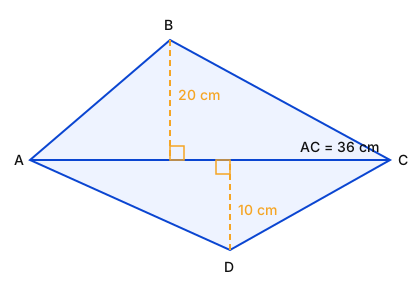
A quadrilateral has one diagonal of length 36 cm, and the perpendiculars from the other two vertices to this diagonal are 20 cm and 10 cm. What is the area of this quadrilateral?
एक चतुर्भुज के एक विकर्ण की लंबाई 36 cm है, और अन्य दो शीर्षों से इस विकर्ण पर डाले गए लंब 20 cm और 10 cm हैं। इस चतुर्भुज का क्षेत्रफल क्या है?
  1. A360 cm²
  2. B600 cm²
  3. C540 cm²
  4. D480 cm²
Show answer

Concept: Area of a quadrilateral =12×d×(h1+h2), where h1,h2 are the perpendiculars on diagonal d.

  1. d=36, h1=20, h2=10.
  2. Area =12×36×(20+10)=18×30=540cm2.

Trick: The diagonal splits the figure into two triangles sharing the same base – add the heights, not the areas separately.

Answer: (C) 540 cm²

अवधारणा: चतुर्भुज का क्षेत्रफल =12×d×(h1+h2), जहाँ h1,h2 विकर्ण d पर लम्ब हैं।

  1. d=36, h1=20, h2=10।
  2. क्षेत्रफल =12×36×(20+10)=18×30=540cm2।

ट्रिक: विकर्ण आकृति को समान आधार वाले दो त्रिभुजों में बाँटता है – ऊँचाइयाँ जोड़ें, क्षेत्रफल अलग-अलग नहीं।

उत्तर: (C) 540 cm²

RRB NTPC Undergraduate CBT 1MathematicsArea of quadrilateralRRB NTPC Undergraduate CBT 1 2025 · 7 May Shift 3 →
Q8251.
During a sale, 40% of the goods are sold at a profit of 10%. Of the remaining goods, 25% are sold at a profit of 15%, and the rest are sold at a loss of 29%. If there is an overall loss of x%, find the value of x.
एक सेल के दौरान, 40% वस्तुएँ 10% लाभ पर बेची जाती हैं। शेष वस्तुओं में से 25% वस्तुएँ 15% लाभ पर बेची जाती हैं, और बाकी 29% हानि पर बेची जाती हैं। यदि कुल मिलाकर x% की हानि होती है, तो x का मान ज्ञात कीजिए।
  1. A1.5
  2. B2
  3. C6.8
  4. D3.5
Show answer

Concept: Take total cost =100 and find the total selling price part by part.

  1. 40 at 10% profit → 40×1.10=44.
  2. Remaining 60: 25%, i.e. 15, at 15% profit → 15×1.15=17.25.
  3. Rest 45 at 29% loss → 45×0.71=31.95.
  4. Total SP =44+17.25+31.95=93.2 → loss =6.8%.

Trick: Weighted average: 0.4(10)+0.15(15)+0.45(−29)=4+2.25−13.05=−6.8.

Answer: (C) 6.8

अवधारणा: कुल लागत =100 मानकर भाग-भाग में कुल विक्रय मूल्य निकालें।

  1. 40 पर 10% लाभ → 40×1.10=44।
  2. शेष 60 का 25% = 15, 15% लाभ पर → 15×1.15=17.25।
  3. बाकी 45 पर 29% हानि → 45×0.71=31.95।
  4. कुल SP =44+17.25+31.95=93.2 → हानि =6.8%।

ट्रिक: भारित औसत: 0.4(10)+0.15(15)+0.45(−29)=4+2.25−13.05=−6.8।

उत्तर: (C) 6.8

RRB NTPC Undergraduate CBT 1MathematicsProfit & loss – mixed saleRRB NTPC Undergraduate CBT 1 2025 · 7 May Shift 3 →
Q8252.
Two numbers are in the ratio 4 : 5. If their LCM is 240, what is the sum of the two numbers?
दो संख्याएँ 4 : 5 के अनुपात में हैं। यदि उनका LCM 240 है, तो दोनों संख्याओं का योग क्या है?
  1. A108
  2. B96
  3. C120
  4. D100
Show answer

Concept: Numbers in ratio 4:5 are 4x and 5x (co-prime parts), so their LCM =20x.

  1. 20x=240⇒x=12.
  2. Numbers: 48 and 60; sum =108.

Trick: For co-prime ratio terms, LCM = product of terms ×x and HCF =x.

Answer: (A) 108

अवधारणा: 4:5 अनुपात की संख्याएँ 4x और 5x (सह-अभाज्य भाग), अतः LCM =20x।

  1. 20x=240⇒x=12।
  2. संख्याएँ 48 और 60; योग =108।

ट्रिक: सह-अभाज्य अनुपात पदों के लिए LCM = पदों का गुणनफल ×x और HCF =x।

उत्तर: (A) 108

RRB NTPC Undergraduate CBT 1MathematicsLCM & ratioRRB NTPC Undergraduate CBT 1 2025 · 7 May Shift 3 →
Q8253.
The sum of the present ages of a mother and her daughter is 50 years. Five years ago, the mother's age was 7 times the daughter's age. What is the present age of the mother?
एक माँ और उसकी बेटी की वर्तमान आयु का योग 50 वर्ष है। पाँच वर्ष पहले, माँ की आयु बेटी की आयु की 7 गुनी थी। माँ की वर्तमान आयु क्या है?
  1. A40 years40 वर्ष
  2. B38 years38 वर्ष
  3. C35 years35 वर्ष
  4. D42 years42 वर्ष
Show answer

Concept: Write the present ages as m and d and use both conditions.

  1. m+d=50 and m−5=7(d−5)⇒m=7d−30.
  2. 7d−30+d=50⇒8d=80⇒d=10.
  3. m=50−10=40 years. Check: 35=7×5 ✓.

Trick: Five years ago the sum was 50−10=40 and it split in ratio 7:1 → 35 and 5; add 5 back.

Answer: (A) 40 years

अवधारणा: वर्तमान आयु m और d मानकर दोनों शर्तें लगाएँ।

  1. m+d=50 तथा m−5=7(d−5)⇒m=7d−30।
  2. 7d−30+d=50⇒8d=80⇒d=10।
  3. m=50−10=40 वर्ष। जाँच: 35=7×5 ✓।

ट्रिक: पाँच वर्ष पहले योग 50−10=40 था और 7:1 में बँटा → 35 और 5; 5 वापस जोड़ें।

उत्तर: (A) 40 years

RRB NTPC Undergraduate CBT 1MathematicsAgesRRB NTPC Undergraduate CBT 1 2025 · 7 May Shift 3 →
Q8254.
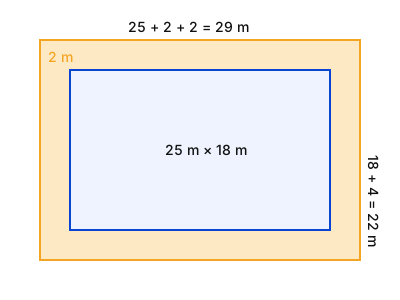
A rectangular garden has a length of 25 meters and a width of 18 meters. If a path of uniform width 2 meters is constructed around the outside of the garden, what is the perimeter of the outer edge of the path?
एक आयताकार बगीचे की लंबाई 25 मीटर और चौड़ाई 18 मीटर है। यदि बगीचे के बाहर चारों ओर 2 मीटर समान चौड़ाई का एक रास्ता बनाया जाता है, तो रास्ते के बाहरी किनारे का परिमाप क्या है?
  1. A86 meters86 मीटर
  2. B98 meters98 मीटर
  3. C112 meters112 मीटर
  4. D102 meters102 मीटर
Show answer

Concept: A path of width w outside a rectangle adds 2w to both the length and the width.

  1. Outer length =25+4=29m, outer width =18+4=22m.
  2. Perimeter =2(29+22)=2×51=102m.

Trick: Outer perimeter = inner perimeter +8w: 86+16=102.

Answer: (D) 102 meters

अवधारणा: आयत के बाहर w चौड़ाई का पथ लंबाई और चौड़ाई दोनों में 2w जोड़ देता है।

  1. बाहरी लंबाई =25+4=29m, बाहरी चौड़ाई =18+4=22m।
  2. परिमाप =2(29+22)=2×51=102m।

ट्रिक: बाहरी परिमाप = भीतरी परिमाप +8w: 86+16=102।

उत्तर: (D) 102 meters

RRB NTPC Undergraduate CBT 1MathematicsMensuration – pathRRB NTPC Undergraduate CBT 1 2025 · 7 May Shift 3 →
Q8255.
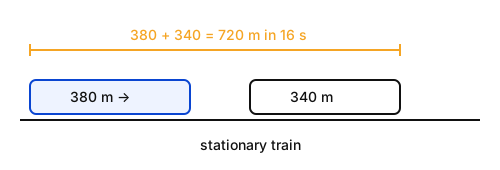
A train, 380 meters long, crosses a stationary train of length 340 m in 16 seconds. Find the speed of the train.
380 मीटर लंबी एक रेलगाड़ी 340 m लंबी एक स्थिर रेलगाड़ी को 16 सेकंड में पार करती है। रेलगाड़ी की चाल ज्ञात कीजिए।
  1. A162 km/h162 किमी/घंटा
  2. B164 km/h164 किमी/घंटा
  3. C166 km/h166 किमी/घंटा
  4. D160 km/h160 किमी/घंटा
Show answer

Concept: To cross a stationary train, the moving train covers the sum of both lengths.

  1. Distance =380+340=720m in 16s.
  2. Speed =72016=45m/s.
  3. 45×185=162km/h.

Trick: Multiples of 5 m/s convert cleanly: 45m/s=9×18=162km/h.

Answer: (A) 162 km/h

अवधारणा: खड़ी रेलगाड़ी को पार करने में चलती रेलगाड़ी दोनों लंबाइयों का योग तय करती है।

  1. दूरी =380+340=720m, समय 16s।
  2. चाल =72016=45m/s।
  3. 45×185=162km/h।

ट्रिक: 5 के गुणज m/s आसानी से बदलते हैं: 45m/s=9×18=162km/h।

उत्तर: (A) 162 km/h

RRB NTPC Undergraduate CBT 1MathematicsTrainsRRB NTPC Undergraduate CBT 1 2025 · 7 May Shift 3 →
Q8256.
Simplify: (1.5×0.2)0.3
सरल कीजिए: (1.5×0.2)0.3
  1. A10
  2. B1
  3. C0.1
  4. D0.01
Show answer

Concept: Multiply the numerator first, then divide.

  1. 1.5×0.2=0.30.
  2. 0.30.3=1.

Trick: 1.5×0.2: 15×2=30 with two decimal places → 0.30.

Answer: (B) 1

अवधारणा: पहले अंश का गुणा करें, फिर भाग दें।

  1. 1.5×0.2=0.30।
  2. 0.30.3=1।

ट्रिक: 1.5×0.2: 15×2=30, दो दशमलव स्थान → 0.30।

उत्तर: (B) 1

RRB NTPC Undergraduate CBT 1MathematicsDecimalsRRB NTPC Undergraduate CBT 1 2025 · 7 May Shift 3 →
Q8257.
The cost price of 25 articles is the same as the selling price of x articles. If the profit is 25%, then the value of x is:
25 वस्तुओं का क्रय मूल्य x वस्तुओं के विक्रय मूल्य के बराबर है। यदि लाभ 25% है, तो x का मान है:
  1. A23
  2. B18
  3. C20
  4. D16
Show answer

Concept: If CP of a articles = SP of b articles, profit%=a−bb×100.

  1. Let CP of each article be ₹1: 25=x×SP.
  2. Profit 25%⇒SP=1.25.
  3. x=251.25=20.

Trick: 25−xx=14⇒100−4x=x⇒x=20.

Answer: (C) 20

अवधारणा: यदि a वस्तुओं का CP = b वस्तुओं का SP, तो लाभ%=a−bb×100।

  1. प्रत्येक वस्तु का CP ₹1 मानें: 25=x×SP।
  2. लाभ 25%⇒SP=1.25।
  3. x=251.25=20।

ट्रिक: 25−xx=14⇒100−4x=x⇒x=20।

उत्तर: (C) 20

RRB NTPC Undergraduate CBT 1MathematicsProfit & loss – articlesRRB NTPC Undergraduate CBT 1 2025 · 7 May Shift 3 →
Q8258.
What is the mode of the following data?
40, 41, 42, 51, 45, 43, 45, 43, 51, 40, 51, 54, 46, 50, 55, 47, 42, 46
निम्नलिखित आँकड़ों का बहुलक (mode) क्या है?
40, 41, 42, 51, 45, 43, 45, 43, 51, 40, 51, 54, 46, 50, 55, 47, 42, 46
  1. A41
  2. B51
  3. C40
  4. D42
Show answer

Concept: Mode is the value that occurs most often.

  1. Frequencies: 40 → 2, 41 → 1, 42 → 2, 43 → 2, 45 → 2, 46 → 2, 51 → 3, others → 1.
  2. 51 appears 3 times, the maximum.

Trick: Tally only the values that repeat; one value with 3 occurrences stands out quickly.

Answer: (B) 51

अवधारणा: बहुलक (mode) वह मान है जो सबसे अधिक बार आता है।

  1. बारंबारता: 40 → 2, 41 → 1, 42 → 2, 43 → 2, 45 → 2, 46 → 2, 51 → 3, शेष → 1।
  2. 51 तीन बार आता है, जो अधिकतम है।

ट्रिक: केवल दोहराए गए मानों की गिनती करें; 3 बार वाला मान तुरंत दिख जाता है।

उत्तर: (B) 51

RRB NTPC Undergraduate CBT 1MathematicsStatistics – modeRRB NTPC Undergraduate CBT 1 2025 · 7 May Shift 3 →
Q8259.
Simplify: 30 + [{-9 × (26 - 11 + 6)}]
सरल कीजिए: 30 + [{-9 × (26 - 11 + 6)}]
  1. A-160
  2. B-162
  3. C-159
  4. D-161
Show answer

Concept: Solve the innermost bracket first, then multiply, then add.

  1. (26−11+6)=21.
  2. −9×21=−189.
  3. 30+(−189)=−159.

Trick: Left-to-right inside the bracket: 26−11=15, then +6=21 – do not subtract 17 from 26.

Answer: (C) -159

अवधारणा: सबसे भीतरी कोष्ठक पहले, फिर गुणा, फिर जोड़।

  1. (26−11+6)=21।
  2. −9×21=−189।
  3. 30+(−189)=−159।

ट्रिक: कोष्ठक में बाएँ से दाएँ: 26−11=15, फिर +6=21 – 26 में से 17 न घटाएँ।

उत्तर: (C) -159

RRB NTPC Undergraduate CBT 1MathematicsSimplification – BODMASRRB NTPC Undergraduate CBT 1 2025 · 7 May Shift 3 →
Q8260.
A tank is normally filled by pipe A in 10 hours. Due to a leak, the tank takes 12 hours to fill. Find the time taken by the leak alone to empty a full tank.
एक टंकी सामान्यतः पाइप A द्वारा 10 घंटे में भर जाती है। एक रिसाव के कारण टंकी को भरने में 12 घंटे लगते हैं। अकेले रिसाव द्वारा भरी हुई टंकी को खाली करने में लगने वाला समय ज्ञात कीजिए।
  1. A60 hours60 घंटे
  2. B40 hours40 घंटे
  3. C30 hours30 घंटे
  4. D80 hours80 घंटे
Show answer

Concept: Leak's rate = filling rate of A − net filling rate.

  1. A fills 110 per hour; with leak net is 112 per hour.
  2. Leak empties 110−112=6−560=160 per hour.
  3. Leak alone empties the tank in 60 hours.

Trick: Leak time =10×1212−10=60.

Answer: (A) 60 hours

अवधारणा: रिसाव की दर = A की भरने की दर − शुद्ध भरने की दर।

  1. A प्रति घंटा 110 भरता है; रिसाव के साथ शुद्ध 112 प्रति घंटा।
  2. रिसाव 110−112=6−560=160 प्रति घंटा खाली करता है।
  3. रिसाव अकेले 60 घंटे में टंकी खाली करेगा।

ट्रिक: रिसाव समय =10×1212−10=60।

उत्तर: (A) 60 hours

RRB NTPC Undergraduate CBT 1MathematicsPipes & cisternsRRB NTPC Undergraduate CBT 1 2025 · 7 May Shift 3 →