Question bank

Q&A: practice questions with answers

Search questions on any topic. Filter by exam category, exam, subject and topic, try the question, then open the answer and explanation.

Courses – airGurukul

8,495 questions found.

Q8281.
Based on the English alphabetical order, three of the following four are alike in a certain way and thus form a group. Which is the one that does not belong to that group? (Note: The odd man out is not based on the number of consonants/vowels or their position in the letter cluster.)
अंग्रेज़ी वर्णमाला क्रम के आधार पर, निम्नलिखित चार में से तीन किसी निश्चित प्रकार से समान हैं और इस प्रकार एक समूह बनाते हैं। वह कौन-सा है जो उस समूह से संबंधित नहीं है? (नोट: असंगत अक्षर-समूह व्यंजनों/स्वरों की संख्या या अक्षर-समूह में उनकी स्थिति पर आधारित नहीं है।)
  1. APMO
  2. BXTW
  3. CFBE
  4. DJFI
Show answer

Concept: Compare the gaps from the first letter to the other two letters in each cluster.

  1. XTW: X(24) → T(20) is −4, X → W(23) is −1. FBE: −4,−1. JFI: −4,−1.
  2. PMO: P(16) → M(13) is −3, P → O(15) is −1 – the first gap differs.

Trick: First letter minus 4 = second letter in three clusters (X-T, F-B, J-F); P-M is only 3 apart.

Answer: (A) PMO

अवधारणा: हर समूह में पहले अक्षर से बाकी दो अक्षरों तक का अंतर मिलाएँ।

  1. XTW: X(24) → T(20) = −4, X → W(23) = −1। FBE: −4,−1। JFI: −4,−1।
  2. PMO: P(16) → M(13) = −3, P → O(15) = −1 – पहला अंतर अलग है।

ट्रिक: तीन समूहों में पहला अक्षर −4 = दूसरा अक्षर (X-T, F-B, J-F); P-M में अंतर केवल 3।

उत्तर: (A) PMO
RRB NTPC Undergraduate CBT 1General Intelligence and ReasoningLetter Cluster – Odd One OutRRB NTPC Undergraduate CBT 1 2025 · 7 May Shift 3 →
Q8282.
Each of the digits in the number 3516472 is arranged in the ascending order from left to right. The position(s) of how many digits will remain unchanged as compared to that in the original number?
संख्या 3516472 के प्रत्येक अंक को बाएँ से दाएँ आरोही क्रम में व्यवस्थित किया जाता है। मूल संख्या की तुलना में कितने अंकों की स्थिति अपरिवर्तित रहेगी?
  1. ATwoदो
  2. BOneएक
  3. CThreeतीन
  4. DZeroशून्य
Show answer

Concept: Sort the digits in ascending order and compare each position with the original number.

  1. Original: 3 5 1 6 4 7 2; ascending: 1 2 3 4 5 6 7.
  2. Position-wise: 3→1, 5→2, 1→3, 6→4, 4→5, 7→6, 2→7 – no column matches.
  3. So zero digits keep their position.

Trick: With digits 1–7 the sorted number is always 1234567 – just check whether digit d sits at place d in the original.

Answer: (D) Zero

अवधारणा: अंकों को आरोही क्रम में लिखें और हर स्थान मूल संख्या से मिलाएँ।

  1. मूल: 3 5 1 6 4 7 2; आरोही: 1 2 3 4 5 6 7।
  2. स्थान-वार: 3→1, 5→2, 1→3, 6→4, 4→5, 7→6, 2→7 – कोई स्तंभ नहीं मिलता।
  3. अतः शून्य अंक अपनी जगह रहते हैं।

ट्रिक: अंक 1–7 हों तो क्रमबद्ध संख्या हमेशा 1234567 होती है – बस देखें कि मूल में अंक d स्थान d पर है या नहीं।

उत्तर: (D) Zero

RRB NTPC Undergraduate CBT 1General Intelligence and ReasoningDigit ArrangementRRB NTPC Undergraduate CBT 1 2025 · 7 May Shift 3 →
Q8283.
In a certain code language, ‘PRIME’ is coded as ‘37862’ and ‘REMAP’ is coded as ‘87423’. What is the code for ‘A’ in the given code language?
एक निश्चित कूट भाषा में, 'PRIME' को '37862' लिखा जाता है और 'REMAP' को '87423' लिखा जाता है। दी गई कूट भाषा में 'A' का कूट क्या है?
  1. A3
  2. B4
  3. C7
  4. D2
Show answer

Concept: Letters common to both words get the codes common to both; the leftover letter gets the leftover digit.

  1. PRIME = 37862 and REMAP = 87423 share the letters P, R, M, E and the digits 3, 7, 8, 2.
  2. In PRIME the extra letter is I → extra digit 6. In REMAP the extra letter is A → extra digit 4.

Trick: Cancel common letters against common digits – whatever remains is the answer.

Answer: (B) 4

अवधारणा: दोनों शब्दों में साझा अक्षरों को साझा कोड मिलते हैं; बचा अक्षर = बचा अंक।

  1. PRIME = 37862 और REMAP = 87423 में साझा अक्षर P, R, M, E और साझा अंक 3, 7, 8, 2 हैं।
  2. PRIME में अतिरिक्त अक्षर I → अतिरिक्त अंक 6। REMAP में अतिरिक्त अक्षर A → अतिरिक्त अंक 4।

ट्रिक: साझा अक्षरों को साझा अंकों से काट दें – जो बचे वही उत्तर।

उत्तर: (B) 4

RRB NTPC Undergraduate CBT 1General Intelligence and ReasoningCoding-DecodingRRB NTPC Undergraduate CBT 1 2025 · 7 May Shift 3 →
Q8284.
Select the triad which follows the same pattern as that followed by the two triads given below. Both triads follow the same pattern.
JL – MO – PR
EG – HJ – KM
उस त्रिक (triad) का चयन कीजिए जो नीचे दिए गए दो त्रिकों द्वारा अनुसरण किए गए पैटर्न का ही अनुसरण करता है। दोनों त्रिक समान पैटर्न का अनुसरण करते हैं।
JL – MO – PR
EG – HJ – KM
  1. ACH – GK – JO
  2. BDP – GS – JU
  3. CNF – RJ – TL
  4. DMO – PR – SU
Show answer

Concept: Find the pattern within each pair and between consecutive pairs.

  1. JL – MO – PR: inside each pair the gap is +2 (J→L, M→O, P→R); first letters J, M, P go +3. EG – HJ – KM: same (+2 inside, +3 across).
  2. MO – PR – SU: M→O +2, P→R +2, S→U +2; M, P, S go +3 ✓.
  3. CH, DP, NF have internal gaps of 5, 12, −8 – they fail at once.

Trick: Check the internal gap of the first pair only – three options are out in one look.

Answer: (D) MO – PR – SU

अवधारणा: हर जोड़े के भीतर और लगातार जोड़ों के बीच का पैटर्न खोजें।

  1. JL – MO – PR: हर जोड़े में अंतर +2 (J→L, M→O, P→R); पहले अक्षर J, M, P में +3। EG – HJ – KM: वही (+2 भीतर, +3 आगे)।
  2. MO – PR – SU: M→O +2, P→R +2, S→U +2; M, P, S में +3 ✓।
  3. CH, DP, NF के भीतरी अंतर 5, 12, −8 – तुरंत गलत।

ट्रिक: केवल पहले जोड़े का भीतरी अंतर देखें – तीन विकल्प एक नज़र में बाहर।

उत्तर: (D) MO – PR – SU

RRB NTPC Undergraduate CBT 1General Intelligence and ReasoningLetter Triad PatternRRB NTPC Undergraduate CBT 1 2025 · 7 May Shift 3 →
Q8285.
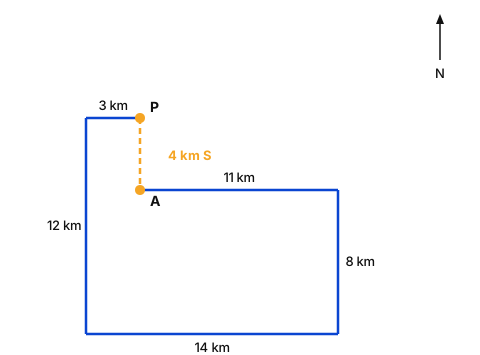
Neha starts from Point A and drives 11 km towards the east. She then takes a right turn, drives 8 km, turns right and drives 14 km. She then takes a right turn and drives 12 km. She takes a final right turn, drives 3 km and stops at Point P. How far (shortest distance) and towards which direction should she drive in order to reach Point A again? (All turns are 90-degree turns only unless specified.)
नेहा बिंदु A से चलना शुरू करती है और पूर्व की ओर 11 km गाड़ी चलाती है। फिर वह दाएँ मुड़ती है, 8 km चलती है, दाएँ मुड़ती है और 14 km चलती है। फिर वह दाएँ मुड़ती है और 12 km चलती है। अंत में वह दाएँ मुड़ती है, 3 km चलती है और बिंदु P पर रुक जाती है। बिंदु A पर पुनः पहुँचने के लिए उसे कितनी दूर (न्यूनतम दूरी) और किस दिशा में गाड़ी चलानी चाहिए? (जब तक अन्यथा न कहा जाए, सभी मोड़ केवल 90 डिग्री के हैं।)
  1. A4 km to the south4 km दक्षिण की ओर
  2. B2 km to the north2 km उत्तर की ओर
  3. C3 km to the south3 km दक्षिण की ओर
  4. D1 km to the north1 km उत्तर की ओर
Show answer

Concept: Take A as origin; a right turn from east → south → west → north → east. Track east-west and north-south totals separately.

  1. East 11 → right (south) 8 → right (west) 14 → right (north) 12 → right (east) 3.
  2. East-west: 11−14+3=0 km, so P is directly above/below A. North-south: −8+12=+4 km north.
  3. P is 4 km north of A, so she must drive 4 km south to reach A.

Trick: Net E–W =0 means the answer is purely north or south – just net the N–S legs.

Answer: (A) 4 km to the south

अवधारणा: A को मूल बिंदु लें; पूर्व से दायाँ मोड़ → दक्षिण → पश्चिम → उत्तर → पूर्व। पूर्व-पश्चिम और उत्तर-दक्षिण योग अलग-अलग रखें।

  1. पूर्व 11 → दायाँ (दक्षिण) 8 → दायाँ (पश्चिम) 14 → दायाँ (उत्तर) 12 → दायाँ (पूर्व) 3।
  2. पूर्व-पश्चिम: 11−14+3=0 km, अतः P ठीक A के ऊपर/नीचे है। उत्तर-दक्षिण: −8+12=+4 km उत्तर।
  3. P, A से 4 km उत्तर में है, अतः A पहुँचने के लिए 4 km दक्षिण चलना होगा।

ट्रिक: शुद्ध E–W =0 का मतलब उत्तर या दक्षिण ही उत्तर है – बस N–S भाग जोड़ें।

उत्तर: (A) 4 km to the south

RRB NTPC Undergraduate CBT 1General Intelligence and ReasoningDirection SenseRRB NTPC Undergraduate CBT 1 2025 · 7 May Shift 3 →
Q8286.
What should come in place of the question mark (?) in the given series to make it logically complete?
MU1, NQ4, PN16, SL64, ?
दी गई श्रृंखला को तार्किक रूप से पूर्ण करने के लिए प्रश्नचिह्न (?) के स्थान पर क्या आना चाहिए?
MU1, NQ4, PN16, SL64, ?
  1. ARJ256
  2. BSJ258
  3. CSK256
  4. DWK256
Show answer

Concept: Treat the first letter, second letter and number as three separate series.

  1. First letters M, N, P, S: +1,+2,+3 → next +4: S + 4 = W.
  2. Second letters U, Q, N, L: −4,−3,−2 → next −1: L − 1 = K.
  3. Numbers 1,4,16,64: ×4 → 256. Term = WK256.

Trick: Only option D starts with W – the first-letter series alone settles it.

Answer: (D) WK256

अवधारणा: पहला अक्षर, दूसरा अक्षर और संख्या – तीन अलग श्रृंखलाएँ मानें।

  1. पहले अक्षर M, N, P, S: +1,+2,+3 → अगला +4: S + 4 = W।
  2. दूसरे अक्षर U, Q, N, L: −4,−3,−2 → अगला −1: L − 1 = K।
  3. संख्याएँ 1,4,16,64: ×4 → 256। पद = WK256।

ट्रिक: केवल विकल्प D W से शुरू होता है – पहले अक्षर की श्रृंखला ही फैसला कर देती है।

उत्तर: (D) WK256

RRB NTPC Undergraduate CBT 1General Intelligence and ReasoningAlphanumeric SeriesRRB NTPC Undergraduate CBT 1 2025 · 7 May Shift 3 →
Q8287.
Each vowel in the word CURRENT is changed to the letter immediately following it in the English alphabetical order and each consonant is changed to the letter immediately preceding it in the English alphabetical order. Which of the following letters will be fourth from the left in the new group of letters thus formed?
शब्द CURRENT के प्रत्येक स्वर को अंग्रेज़ी वर्णमाला क्रम में उसके ठीक बाद वाले अक्षर में बदल दिया जाता है और प्रत्येक व्यंजन को अंग्रेज़ी वर्णमाला क्रम में उसके ठीक पहले वाले अक्षर में बदल दिया जाता है। इस प्रकार बने नए अक्षर-समूह में बाएँ से चौथा अक्षर निम्नलिखित में से कौन-सा होगा?
  1. AP
  2. BQ
  3. CR
  4. DS
Show answer

Concept: Vowels move one step forward, consonants one step back; then read the required position.

  1. CURRENT: C→B, U→V, R→Q, R→Q, E→F, N→M, T→S.
  2. New group: B V Q Q F M S.
  3. Fourth from the left = Q.

Trick: Only the 4th letter is asked – the 4th letter of CURRENT is R (consonant) → R − 1 = Q. No need to convert the whole word.

Answer: (B) Q

अवधारणा: स्वर एक कदम आगे, व्यंजन एक कदम पीछे; फिर माँगा गया स्थान पढ़ें।

  1. CURRENT: C→B, U→V, R→Q, R→Q, E→F, N→M, T→S।
  2. नया समूह: B V Q Q F M S।
  3. बाएँ से चौथा = Q।

ट्रिक: केवल चौथा अक्षर पूछा है – CURRENT का चौथा अक्षर R (व्यंजन) → R − 1 = Q। पूरा शब्द बदलने की ज़रूरत नहीं।

उत्तर: (B) Q

RRB NTPC Undergraduate CBT 1General Intelligence and ReasoningLetter CodingRRB NTPC Undergraduate CBT 1 2025 · 7 May Shift 3 →
Q8288.
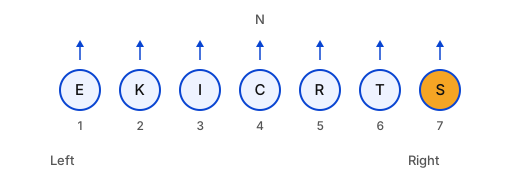
Seven people, S, T, I, C, K, E and R, are sitting in a row, facing north. Only E sits to the left of K. Only four people sit between E and T. Only C sits between I and R, and I is not an immediate neighbor of T. Who sits at the extreme right of the line?
सात व्यक्ति S, T, I, C, K, E और R एक पंक्ति में उत्तर की ओर मुख करके बैठे हैं। K के बाएँ केवल E बैठा है। E और T के बीच केवल चार व्यक्ति बैठे हैं। I और R के बीच केवल C बैठा है, और I, T का निकटतम पड़ोसी नहीं है। पंक्ति के सबसे दाएँ छोर पर कौन बैठा है?
  1. AS
  2. BE
  3. CK
  4. DI
Show answer

Concept: Number seats 1–7 from the left (all face north, so right = higher number).

  1. 'Only E sits to the left of K' → E = 1, K = 2. Four people between E and T → T = 6.
  2. I, C, R are consecutive with C in the middle; free seats 3, 4, 5, 7 → they take 3, 4, 5. I is not next to T (6) → I = 3, C = 4, R = 5.
  3. S takes the last seat, 7 – the extreme right.

Trick: 'Only X sits to the left of Y' pins X and Y to seats 1 and 2 – the strongest clue, start there.

Answer: (A) S

अवधारणा: बाएँ से सीटें 1–7 क्रमांकित करें (सब उत्तर की ओर, अतः दाएँ = बड़ी संख्या)।

  1. 'K के बाएँ केवल E बैठा है' → E = 1, K = 2। E और T के बीच चार लोग → T = 6।
  2. I, C, R लगातार हैं, C बीच में; खाली सीटें 3, 4, 5, 7 → वे 3, 4, 5 लेते हैं। I T (6) का पड़ोसी नहीं → I = 3, C = 4, R = 5।
  3. S अंतिम सीट 7 पर – दाएँ छोर।

ट्रिक: 'Y के बाएँ केवल X' X और Y को सीट 1 और 2 पर जड़ देता है – सबसे मज़बूत संकेत, वहीं से शुरू करें।

उत्तर: (A) S

RRB NTPC Undergraduate CBT 1General Intelligence and ReasoningLinear Seating ArrangementRRB NTPC Undergraduate CBT 1 2025 · 7 May Shift 3 →
Q8289.
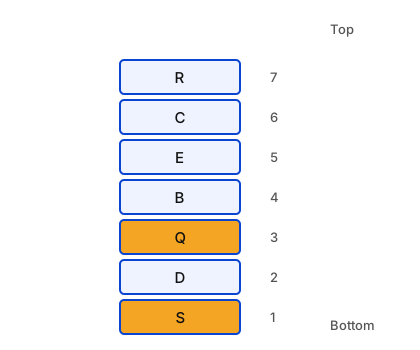
Seven boxes B, C, D, E, Q, R and S are kept one over the other but not necessarily in the same order. Only five boxes are kept above D. Only three boxes are kept between D and C. Only four boxes are kept between C and S. Only E is kept between C and B. R is kept at one of the positions above C. How many boxes are kept between Q and S?
सात बक्से B, C, D, E, Q, R और S एक के ऊपर एक रखे गए हैं, लेकिन आवश्यक नहीं कि इसी क्रम में हों। D के ऊपर केवल पाँच बक्से रखे हैं। D और C के बीच केवल तीन बक्से रखे हैं। C और S के बीच केवल चार बक्से रखे हैं। C और B के बीच केवल E रखा है। R, C के ऊपर किसी एक स्थान पर रखा है। Q और S के बीच कितने बक्से रखे हैं?
  1. AThreeतीन
  2. BOneएक
  3. CFourचार
  4. DTwoदो
Show answer

Concept: Number positions 1 (bottom) to 7 (top) and convert each 'between' clue into a distance.

  1. Five boxes above D → D = 2. Three between D and C → C = 6. Four between C and S → S = 1.
  2. Only E between C and B → B = 4, E = 5 (B = 8 is impossible). R above C → R = 7.
  3. Q takes the last place, 3. Between Q (3) and S (1) there is only D → one box.

Trick: 'n boxes between' = distance n+1; choose the side that stays within 1–7.

Answer: (B) One

अवधारणा: स्थान 1 (नीचे) से 7 (ऊपर) तक क्रमांकित करें और हर 'बीच में' संकेत को दूरी में बदलें।

  1. D के ऊपर पाँच बॉक्स → D = 2। D और C के बीच तीन → C = 6। C और S के बीच चार → S = 1।
  2. C और B के बीच केवल E → B = 4, E = 5 (B = 8 संभव नहीं)। R C के ऊपर → R = 7।
  3. Q अंतिम स्थान 3 पर। Q (3) और S (1) के बीच केवल D → एक बॉक्स।

ट्रिक: 'n बॉक्स बीच में' = दूरी n+1; वही दिशा चुनें जो 1–7 के भीतर रहे।

उत्तर: (B) One

RRB NTPC Undergraduate CBT 1General Intelligence and ReasoningBox ArrangementRRB NTPC Undergraduate CBT 1 2025 · 7 May Shift 3 →
Q8290.
In a certain code language,
A + B means ‘A is the son of B’,
A – B means ‘A is the brother of B’,
A x B means ‘A is the wife of B’ and
A ÷ B means ‘A is the father of B’.
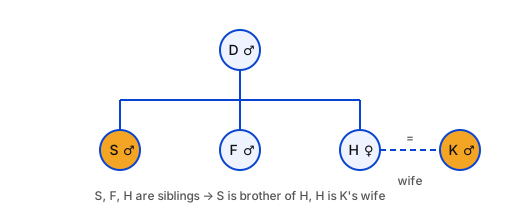
Based on the above, how is S related to K if ‘S + D ÷ F – H x K’?
एक निश्चित कूट भाषा में,
A + B का अर्थ है 'A, B का पुत्र है',
A – B का अर्थ है 'A, B का भाई है',
A x B का अर्थ है 'A, B की पत्नी है' और
A ÷ B का अर्थ है 'A, B का पिता है'।
उपरोक्त के आधार पर, यदि 'S + D ÷ F – H x K' है, तो S, K से किस प्रकार संबंधित है?
  1. AWife's brotherपत्नी का भाई
  2. BFatherपिता
  3. CBrotherभाई
  4. DWife's fatherपत्नी का पिता
Show answer

Concept: Decode the expression pair by pair, then build the family tree.

  1. S + D: S is the son of D. D ÷ F: D is the father of F → S and F are siblings. F – H: F is the brother of H → H is also D's child, so S is H's brother.
  2. H × K: H is the wife of K.
  3. So S is the brother of K's wife → K's wife's brother (brother-in-law).

Trick: Gender from the code: 'son', 'brother' make S, F male; 'wife' makes H female – then the relation reads off the tree.

Answer: (A) Wife's brother

अवधारणा: व्यंजक को जोड़ी-जोड़ी खोलें, फिर वंश-वृक्ष बनाएँ।

  1. S + D: S, D का पुत्र। D ÷ F: D, F का पिता → S और F भाई-बहन। F – H: F, H का भाई → H भी D की संतान, अतः S, H का भाई।
  2. H × K: H, K की पत्नी।
  3. अतः S, K की पत्नी का भाई → साला (wife's brother)।

ट्रिक: कोड से लिंग: 'पुत्र', 'भाई' से S, F पुरुष; 'पत्नी' से H स्त्री – फिर संबंध वृक्ष से सीधे पढ़ें।

उत्तर: (A) Wife's brother

RRB NTPC Undergraduate CBT 1General Intelligence and ReasoningBlood RelationsRRB NTPC Undergraduate CBT 1 2025 · 7 May Shift 3 →
Q8291.
Refer to the following letter series and answer the question that follows. Counting to be done from left to right only.
(Left) Z Q M H J E K D E L K Z V N E A T Q R Z U (Right)
How many such consonants are there, each of which is immediately preceded by a consonant and also immediately followed by a vowel?
निम्नलिखित अक्षर श्रृंखला को देखिए और उसके बाद दिए गए प्रश्न का उत्तर दीजिए। गिनती केवल बाएँ से दाएँ की जानी है।
(बायाँ) Z Q M H J E K D E L K Z V N E A T Q R Z U (दायाँ)
ऐसे कितने व्यंजन हैं, जिनमें से प्रत्येक के ठीक पहले एक व्यंजन है और ठीक बाद एक स्वर है?
  1. AFourचार
  2. BTwoदो
  3. CThreeतीन
  4. DOneएक
Show answer

Concept: Look for the pattern consonant–consonant–vowel and count the middle letter.

  1. Vowels present: E (positions 6, 9, 15), A (16), U (21). Check the letter just before each vowel and the one before that.
  2. H J E (4–6) ✓; K D E (7–9) ✓; V N E (13–15) ✓; R Z U (19–21) ✓. Before A (16) is E (a vowel) – not counted.
  3. Total = 4.

Trick: Start from each vowel and look two letters back – far faster than scanning every consonant.

Answer: (A) Four

अवधारणा: व्यंजन–व्यंजन–स्वर पैटर्न खोजें और बीच वाला अक्षर गिनें।

  1. स्वर: E (स्थान 6, 9, 15), A (16), U (21)। हर स्वर से ठीक पहले और उससे पहले का अक्षर देखें।
  2. H J E (4–6) ✓; K D E (7–9) ✓; V N E (13–15) ✓; R Z U (19–21) ✓। A (16) से पहले E (स्वर) है – नहीं गिना।
  3. कुल = 4।

ट्रिक: हर स्वर से दो अक्षर पीछे देखें – हर व्यंजन जाँचने से कहीं तेज़।

उत्तर: (A) Four

RRB NTPC Undergraduate CBT 1General Intelligence and ReasoningLetter Series CountingRRB NTPC Undergraduate CBT 1 2025 · 7 May Shift 3 →
Q8292.
Which of the following letter-number clusters will replace the question mark (?) in the given series to make it logically complete?
NFG 49, PIK 36, RLO 25, TOS 16, ?
दी गई श्रृंखला को तार्किक रूप से पूर्ण करने के लिए निम्नलिखित में से कौन-सा अक्षर-संख्या समूह प्रश्नचिह्न (?) के स्थान पर आएगा?
NFG 49, PIK 36, RLO 25, TOS 16, ?
  1. AVRW 9
  2. BUSV 10
  3. CUSW 9
  4. DVRV 10
Show answer

Concept: Split into three letter series and one number series.

  1. 1st letters N, P, R, T (+2) → V; 2nd letters F, I, L, O (+3) → R; 3rd letters G, K, O, S (+4) → W.
  2. Numbers 49,36,25,16=72,62,52,42 → 32=9.
  3. Next term: VRW 9.

Trick: Perfect squares counting down → next is 9; this alone leaves A and C, and the first letter V picks A.

Answer: (A) VRW 9

अवधारणा: तीन अक्षर-श्रृंखलाओं और एक संख्या-श्रृंखला में बाँटें।

  1. पहले अक्षर N, P, R, T (+2) → V; दूसरे F, I, L, O (+3) → R; तीसरे G, K, O, S (+4) → W।
  2. संख्याएँ 49,36,25,16=72,62,52,42 → 32=9।
  3. अगला पद: VRW 9।

ट्रिक: घटते पूर्ण वर्ग → अगला 9; इससे A और C बचते हैं, पहला अक्षर V से A चुनें।

उत्तर: (A) VRW 9

RRB NTPC Undergraduate CBT 1General Intelligence and ReasoningAlphanumeric SeriesRRB NTPC Undergraduate CBT 1 2025 · 7 May Shift 3 →
Q8293.
In a certain code language,
J × Q means ‘J is the sister of Q’,
J ÷ Q means ‘J is the father of Q’,
J + Q means ‘J is the husband of Q’ and
J – Q means ‘J is the mother of Q’.
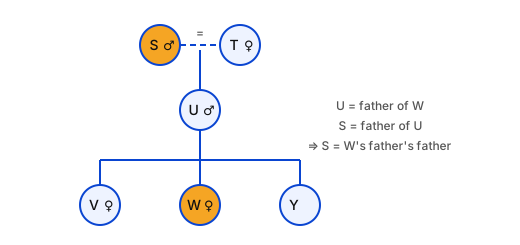
Based on the above, how is S related to W if ‘S + T – U ÷ V × W × Y’?
एक निश्चित कूट भाषा में,
J × Q का अर्थ है 'J, Q की बहन है',
J ÷ Q का अर्थ है 'J, Q का पिता है',
J + Q का अर्थ है 'J, Q का पति है' और
J – Q का अर्थ है 'J, Q की माता है'।
उपरोक्त के आधार पर, यदि 'S + T – U ÷ V × W × Y' है, तो S, W से किस प्रकार संबंधित है?
  1. AMother's brotherमाता का भाई
  2. BFather's fatherपिता का पिता
  3. CWife's brotherपत्नी का भाई
  4. DMother's fatherमाता का पिता
Show answer

Concept: Decode each symbol, note genders, and climb the family tree from W to S.

  1. S + T: S is the husband of T. T – U: T is the mother of U → S is U's father.
  2. U ÷ V: U is the father of V. V × W: V is the sister of W → U is also W's father.
  3. So S is the father of W's father → father's father (paternal grandfather). W × Y only tells that W is female.

Trick: 'Husband of the mother' = father; stack two father-steps and you get the grandfather.

Answer: (B) Father's father

अवधारणा: हर चिह्न खोलें, लिंग नोट करें और W से S तक वंश-वृक्ष में ऊपर चढ़ें।

  1. S + T: S, T का पति। T – U: T, U की माँ → S, U का पिता।
  2. U ÷ V: U, V का पिता। V × W: V, W की बहन → U, W का भी पिता।
  3. अतः S, W के पिता का पिता → दादा (father's father)। W × Y केवल बताता है कि W स्त्री है।

ट्रिक: 'माँ का पति' = पिता; दो पिता-चरण जोड़ने पर दादा मिलता है।

उत्तर: (B) Father's father

RRB NTPC Undergraduate CBT 1General Intelligence and ReasoningBlood RelationsRRB NTPC Undergraduate CBT 1 2025 · 7 May Shift 3 →
Q8294.
Which of the following letter-number clusters will replace the question mark (?) in the given series to make it logically complete?
EAW 91 XTP 98 QMI 105 JFB 112 ?
दी गई श्रृंखला को तार्किक रूप से पूर्ण करने के लिए निम्नलिखित में से कौन-सा अक्षर-संख्या समूह प्रश्नचिह्न (?) के स्थान पर आएगा?
EAW 91 XTP 98 QMI 105 JFB 112 ?
  1. ACYU 119
  2. BCXT 118
  3. CCZT 119
  4. DCLV 118
Show answer

Concept: Each letter moves by a fixed step (wrapping Z → A) and the number changes by a constant.

  1. E → X → Q → J: each −7 (E(5) − 7 = −2 → X(24)). Next: J(10) − 7 = C(3).
  2. A → T → M → F: −7 → F(6) − 7 = −1 → Y(25). W → P → I → B: −7 → B(2) − 7 = −5 → U(21).
  3. Numbers 91,98,105,112: +7 → 119. Term: CYU 119.

Trick: Every letter −7 and number +7 – one step for all; when the count goes below 1, add 26.

Answer: (A) CYU 119

अवधारणा: हर अक्षर एक निश्चित कदम चलता है (Z के बाद A) और संख्या स्थिर अंतर से बदलती है।

  1. E → X → Q → J: हर बार −7 (E(5) − 7 = −2 → X(24))। अगला: J(10) − 7 = C(3)।
  2. A → T → M → F: −7 → F(6) − 7 = −1 → Y(25)। W → P → I → B: −7 → B(2) − 7 = −5 → U(21)।
  3. संख्याएँ 91,98,105,112: +7 → 119। पद: CYU 119।

ट्रिक: हर अक्षर −7 और संख्या +7 – सबके लिए एक ही कदम; गिनती 1 से नीचे जाए तो 26 जोड़ें।

उत्तर: (A) CYU 119

RRB NTPC Undergraduate CBT 1General Intelligence and ReasoningAlphanumeric SeriesRRB NTPC Undergraduate CBT 1 2025 · 7 May Shift 3 →
Q8295.
In a certain code language, ‘van elf sand’ is coded as 'ld ii ne' and ‘elf poem desk’ is coded as ‘ir le ii’. How is ‘elf’ coded in the given language? (All codes are two-letter codes.)
एक निश्चित कूट भाषा में, 'van elf sand' को 'ld ii ne' लिखा जाता है और 'elf poem desk' को 'ir le ii' लिखा जाता है। दी गई भाषा में 'elf' को कैसे लिखा जाएगा? (सभी कूट दो-अक्षर वाले कूट हैं।)
  1. Ane
  2. Bir
  3. Cii
  4. Dld
Show answer

Concept: A word common to two sentences has the code common to both coded sentences.

  1. 'van elf sand' = ld ii ne and 'elf poem desk' = ir le ii.
  2. The only common word is 'elf'; the only common code is 'ii'.
  3. Hence elf = ii.

Trick: Match common words with common codes first – one glance solves most sentence-coding questions.

Answer: (C) ii

अवधारणा: दो वाक्यों में साझा शब्द का कोड दोनों कूट-वाक्यों में साझा कोड होता है।

  1. 'van elf sand' = ld ii ne और 'elf poem desk' = ir le ii।
  2. एकमात्र साझा शब्द 'elf'; एकमात्र साझा कोड 'ii'।
  3. अतः elf = ii।

ट्रिक: पहले साझा शब्दों को साझा कोड से मिलाएँ – एक नज़र में अधिकांश वाक्य-कूट प्रश्न हल।

उत्तर: (C) ii

RRB NTPC Undergraduate CBT 1General Intelligence and ReasoningCoding-DecodingRRB NTPC Undergraduate CBT 1 2025 · 7 May Shift 3 →
Q8296.
Which extremist leader authored the famous work, Gita Rahasya?
किस उग्रवादी (गरम दल के) नेता ने प्रसिद्ध कृति 'गीता रहस्य' की रचना की?
  1. ABipin Chandra Palबिपिन चंद्र पाल
  2. BAurobindo Ghoseअरविंद घोष
  3. CBal Gangadhar Tilakबाल गंगाधर तिलक
  4. DLala Lajpat Raiलाला लाजपत राय
Show answer

Concept: Bal Gangadhar Tilak wrote Shrimad Bhagavad Gita Rahasya while imprisoned in Mandalay (Burma) jail, 1908–1914.

  1. The book interprets the Gita as a call to selfless action (karma yoga).
  2. Tilak was one of the "Lal-Bal-Pal" trio of extremist leaders; Aurobindo wrote essays on the Gita, but not Gita Rahasya.

Yaad rakhein: Tilak → Gita Rahasya, Kesari, Mahratta; "Swaraj is my birthright".

Answer: (C) Bal Gangadhar Tilak

अवधारणा: बाल गंगाधर तिलक ने मांडले (बर्मा) जेल में 1908–1914 के दौरान श्रीमद्भगवद्गीता रहस्य लिखी।

  1. पुस्तक गीता को निष्काम कर्म (कर्मयोग) के आह्वान के रूप में प्रस्तुत करती है।
  2. तिलक "लाल-बाल-पाल" गरम दल त्रयी में थे; अरविंद घोष ने गीता पर निबंध लिखे, पर गीता रहस्य नहीं।

याद रखें: तिलक → गीता रहस्य, केसरी, मराठा; "स्वराज मेरा जन्मसिद्ध अधिकार है"।

उत्तर: (C) Bal Gangadhar Tilak

RRB NTPC Undergraduate CBT 1General AwarenessModern History – Extremist LeadersRRB NTPC Undergraduate CBT 1 2025 · 7 May Shift 2 →
Q8297.
Which launch vehicle will be used for Chandrayaan-5?
चंद्रयान-5 के लिए किस प्रक्षेपण यान (launch vehicle) का उपयोग किया जाएगा?
  1. AGSLV Mk III
  2. BH3-24L
  3. CPSLV-C45
  4. DGSLV Mk II
Show answer

Concept: Chandrayaan-5, also called LUPEX (Lunar Polar Exploration), is a joint ISRO–JAXA mission to the Moon's south pole.

  1. JAXA provides the launch vehicle – Japan's H3 rocket (H3-24L configuration) – and the rover; ISRO builds the lander.
  2. The Indian government approved the mission in March 2025; launch is targeted around 2027–28.
  3. GSLV Mk III (LVM3) launched Chandrayaan-2 and 3, not this mission.

Yaad rakhein: Chandrayaan-4 → sample return (LVM3); Chandrayaan-5/LUPEX → with Japan on H3.

Answer: (B) H3-24L

अवधारणा: चंद्रयान-5, जिसे LUPEX (Lunar Polar Exploration) भी कहते हैं, चंद्रमा के दक्षिणी ध्रुव के लिए ISRO–JAXA का संयुक्त मिशन है।

  1. JAXA प्रक्षेपण यान – जापान का H3 रॉकेट (H3-24L विन्यास) – और रोवर देगा; ISRO लैंडर बनाएगा।
  2. भारत सरकार ने मार्च 2025 में मिशन को मंज़ूरी दी; प्रक्षेपण लक्ष्य लगभग 2027–28।
  3. GSLV Mk III (LVM3) से चंद्रयान-2 और 3 छोड़े गए थे, यह मिशन नहीं।

याद रखें: चंद्रयान-4 → नमूना वापसी (LVM3); चंद्रयान-5/LUPEX → जापान के साथ H3 पर।

उत्तर: (B) H3-24L

RRB NTPC Undergraduate CBT 1General AwarenessSpace – Chandrayaan-5 (LUPEX)RRB NTPC Undergraduate CBT 1 2025 · 7 May Shift 2 →
Q8298.
What does CD stand for in computer terminology?
कंप्यूटर शब्दावली में CD का पूर्ण रूप क्या है?
  1. ACompact DiscCompact Disc (कॉम्पैक्ट डिस्क)
  2. BCurrent DirectoriesCurrent Directories (करंट डायरेक्टरीज़)
  3. CControl DatamineControl Datamine (कंट्रोल डेटामाइन)
  4. DColor DisplayColor Display (कलर डिस्प्ले)
Show answer

Concept: CD stands for Compact Disc – an optical storage medium (about 700 MB) read by laser.

  1. Variants: CD-ROM (read only), CD-R (recordable), CD-RW (rewritable).
  2. The other options are made-up expansions; "cd" in a command prompt means "change directory", which is not among the options.

Yaad rakhein: CD → Compact Disc; DVD → Digital Versatile Disc.

Answer: (A) Compact Disc

अवधारणा: CD का अर्थ Compact Disc है – लेज़र से पढ़ा जाने वाला ऑप्टिकल भंडारण माध्यम (लगभग 700 MB)।

  1. प्रकार: CD-ROM (केवल पढ़ने योग्य), CD-R (रिकॉर्ड योग्य), CD-RW (पुनर्लेखन योग्य)।
  2. अन्य विकल्प काल्पनिक विस्तार हैं; कमांड प्रॉम्प्ट में "cd" का अर्थ "change directory" है, जो विकल्पों में नहीं है।

याद रखें: CD → Compact Disc; DVD → Digital Versatile Disc।

उत्तर: (A) Compact Disc

RRB NTPC Undergraduate CBT 1General AwarenessComputer Awareness – AbbreviationsRRB NTPC Undergraduate CBT 1 2025 · 7 May Shift 2 →
Q8299.
In a cross between true-breeding red-flowered and true breeding white-flowered plants, the Filial 1 (F1) progeny was pink. This is a case of which type of inheritance?
शुद्ध नस्ल (true-breeding) के लाल पुष्प वाले और शुद्ध नस्ल के सफ़ेद पुष्प वाले पौधों के बीच संकरण में प्रथम संतति पीढ़ी (F1) की संतति गुलाबी थी। यह किस प्रकार की वंशागति (inheritance) का उदाहरण है?
  1. AComplete Dominanceपूर्ण प्रभाविता (Complete Dominance)
  2. BCo-dominanceसह-प्रभाविता (Co-dominance)
  3. CSex-linkageलिंग-सहलग्नता (Sex-linkage)
  4. DIncomplete Dominanceअपूर्ण प्रभाविता (Incomplete Dominance)
Show answer

Concept: In incomplete dominance neither allele is fully dominant, so the F1 shows an intermediate (blended) phenotype.

  1. Red × white → pink F1 is the classic snapdragon (Antirrhinum) / Mirabilis example.
  2. Co-dominance would show both colours together (e.g. AB blood group), not a blend; complete dominance would give all red.

Yaad rakhein: Blend (pink) → incomplete dominance; both expressed → co-dominance.

Answer: (D) Incomplete Dominance

अवधारणा: अपूर्ण प्रभाविता (incomplete dominance) में कोई भी एलील पूर्णतः प्रभावी नहीं होता, अतः F1 में मध्यवर्ती (मिश्रित) लक्षण दिखता है।

  1. लाल × सफ़ेद → गुलाबी F1, स्नैपड्रैगन (Antirrhinum) / गुलबास का प्रसिद्ध उदाहरण है।
  2. सह-प्रभाविता में दोनों रंग साथ दिखते (जैसे AB रक्त समूह), मिश्रण नहीं; पूर्ण प्रभाविता में सभी लाल होते।

याद रखें: मिश्रण (गुलाबी) → अपूर्ण प्रभाविता; दोनों व्यक्त → सह-प्रभाविता।

उत्तर: (D) Incomplete Dominance

RRB NTPC Undergraduate CBT 1General AwarenessBiology – InheritanceRRB NTPC Undergraduate CBT 1 2025 · 7 May Shift 2 →
Q8300.
The members of the Railway Convention Committee are nominated by which of the following authorities of India?
रेलवे कन्वेंशन समिति (Railway Convention Committee) के सदस्यों को भारत के निम्नलिखित में से किस प्राधिकारी द्वारा नामित किया जाता है?
  1. AThe Prime Minister of Indiaभारत के प्रधानमंत्री
  2. BThe Chairman of the Rajya Sabhaराज्यसभा के सभापति
  3. CThe President of Indiaभारत के राष्ट्रपति
  4. DThe Speaker of the Lok Sabhaलोकसभा के अध्यक्ष
Show answer

Concept: The Railway Convention Committee is an ad hoc parliamentary committee that reviews the rate of dividend payable by Railways and related finances.

  1. It has 18 members – 12 from Lok Sabha nominated by the Speaker and 6 from Rajya Sabha nominated by the Chairman; the Speaker constitutes the committee.
  2. The President and Prime Minister have no role in nominating members of parliamentary committees.

Yaad rakhein: Most Lok Sabha committee members are nominated by the Speaker; Rajya Sabha members by the Chairman.

Answer: (D) The Speaker of the Lok Sabha

अवधारणा: रेलवे कन्वेंशन समिति एक तदर्थ (ad hoc) संसदीय समिति है जो रेलवे द्वारा देय लाभांश दर और संबंधित वित्त की समीक्षा करती है।

  1. इसमें 18 सदस्य होते हैं – लोकसभा के 12 सदस्य अध्यक्ष (Speaker) द्वारा और राज्यसभा के 6 सदस्य सभापति द्वारा मनोनीत; समिति का गठन लोकसभा अध्यक्ष करते हैं।
  2. राष्ट्रपति और प्रधानमंत्री की संसदीय समितियों के सदस्य मनोनीत करने में कोई भूमिका नहीं।

याद रखें: लोकसभा समिति सदस्यों का मनोनयन अध्यक्ष; राज्यसभा सदस्यों का सभापति द्वारा।

उत्तर: (D) The Speaker of the Lok Sabha

RRB NTPC Undergraduate CBT 1General AwarenessPolity – Parliamentary CommitteesRRB NTPC Undergraduate CBT 1 2025 · 7 May Shift 2 →