Question bank

Q&A: practice questions with answers

Search questions on any topic. Filter by exam category, exam, subject and topic, try the question, then open the answer and explanation.

Courses – airGurukul

8,495 questions found.

Q8341.
If 9x−9x−1=72, then the value of 2x−12x+3 is:
यदि 9x−9x−1=72 है, तो 2x−12x+3 का मान है:
  1. A34
  2. B35
  3. C38
  4. D37
Show answer

Concept: 9x−1=9x9; take 9x common.

  1. 9x−9x9=72⇒9x·89=72
  2. 9x=81=92⇒x=2
  3. 2x−12x+3=4−14+3=37

Trick: an−an−1=an−1(a−1); here 9x−1×8=72⇒9x−1=9, so x=2 at once.

Answer: (D) 37

अवधारणा: 9x−1=9x9; 9x उभयनिष्ठ लें।

  1. 9x−9x9=72⇒9x·89=72
  2. 9x=81=92⇒x=2
  3. 2x−12x+3=4−14+3=37

ट्रिक: an−an−1=an−1(a−1); यहाँ 9x−1×8=72⇒9x−1=9, अतः तुरंत x=2।

उत्तर: (D) 37

RRB NTPC Undergraduate CBT 1MathematicsIndices (Exponents)RRB NTPC Undergraduate CBT 1 2025 · 7 May Shift 2 →
Q8342.
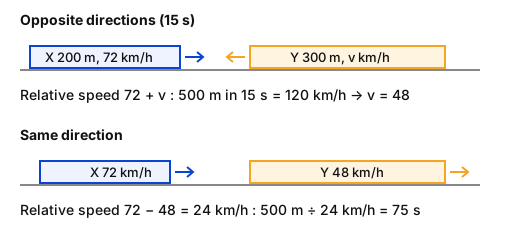
Two trains, X and Y, are running on parallel tracks. Train X is 200 m long and travels at 72 km/hr. Train Y is 300 m long. If the trains are traveling in opposite directions, they pass each other completely in 15 seconds. If the trains were traveling in the same direction, how long would it take for the faster train to overtake the slower one?
दो रेलगाड़ियाँ, X और Y, समानांतर पटरियों पर चल रही हैं। रेलगाड़ी X 200 m लंबी है और 72 km/hr की चाल से चलती है। रेलगाड़ी Y 300 m लंबी है। यदि रेलगाड़ियाँ विपरीत दिशाओं में चल रही हों, तो वे एक-दूसरे को 15 सेकंड में पूरी तरह पार कर लेती हैं। यदि रेलगाड़ियाँ एक ही दिशा में चल रही होतीं, तो तेज़ रेलगाड़ी को धीमी रेलगाड़ी को पार करने में कितना समय लगता?
  1. A75 seconds75 सेकंड
  2. B78 seconds78 सेकंड
  3. C67.5 seconds67.5 सेकंड
  4. D72 seconds72 सेकंड
Show answer

Concept: Opposite directions: relative speed = sum; same direction: difference. Distance to cross = sum of lengths.

  1. Total length =200+300=500 m; crossing in 15 s ⇒ relative speed =50015=1003 m/s =120 km/h
  2. Speed of Y =120−72=48 km/h
  3. Same direction: relative speed =72−48=24 km/h =203 m/s
  4. Time =500÷203=75 s

Trick: Relative speeds are 120 and 24 (ratio 5:1), so time becomes 15×5=75 s.

Answer: (A) 75 seconds

अवधारणा: विपरीत दिशा: सापेक्ष चाल = योग; समान दिशा: अंतर। पार करने की दूरी = लंबाइयों का योग।

  1. कुल लंबाई =200+300=500 m; 15 s में पार ⇒ सापेक्ष चाल =50015=1003 m/s =120 km/h
  2. Y की चाल =120−72=48 km/h
  3. समान दिशा: सापेक्ष चाल =72−48=24 km/h =203 m/s
  4. समय =500÷203=75 s

ट्रिक: सापेक्ष चालें 120 और 24 (अनुपात 5:1), अतः समय 15×5=75 s।

उत्तर: (A) 75 seconds

RRB NTPC Undergraduate CBT 1MathematicsTrains – Relative SpeedRRB NTPC Undergraduate CBT 1 2025 · 7 May Shift 2 →
Q8343.
The ages of two siblings add up to 44 years. If one sibling is 4 years younger than twice the other's age, what is the difference between their ages?
दो भाई-बहनों की आयु का योग 44 वर्ष है। यदि एक की आयु दूसरे की आयु के दोगुने से 4 वर्ष कम है, तो उनकी आयु में कितना अंतर है?
  1. A14 years14 वर्ष
  2. B10 years10 वर्ष
  3. C12 years12 वर्ष
  4. D8 years8 वर्ष
Show answer

Concept: Form a linear equation from the given relation.

  1. Let the younger be x; the other =2x−4
  2. x+2x−4=44⇒3x=48⇒x=16
  3. Ages 16 and 28; difference =12 years

Trick: Difference =(2x−4)−x=x−4; with x=16 it is 12.

Answer: (C) 12 years

अवधारणा: दिए संबंध से रैखिक समीकरण बनाएँ।

  1. छोटे की आयु x; दूसरे की =2x−4
  2. x+2x−4=44⇒3x=48⇒x=16
  3. आयु 16 और 28; अंतर =12 वर्ष

ट्रिक: अंतर =(2x−4)−x=x−4; x=16 पर यह 12 है।

उत्तर: (C) 12 years

RRB NTPC Undergraduate CBT 1MathematicsProblems on AgesRRB NTPC Undergraduate CBT 1 2025 · 7 May Shift 2 →
Q8344.
A shopkeeper marks an item at ₹4,000. During a festival, he first offers a discount of 25% on the marked price. After a week, he increases the discounted price by 20% to earn more profit. What is the final selling price of the item after these successive changes?
एक दुकानदार एक वस्तु का अंकित मूल्य ₹4,000 रखता है। एक त्योहार के दौरान, वह पहले अंकित मूल्य पर 25% की छूट देता है। एक सप्ताह बाद, अधिक लाभ कमाने के लिए वह छूट वाले मूल्य को 20% बढ़ा देता है। इन क्रमिक परिवर्तनों के बाद वस्तु का अंतिम विक्रय मूल्य क्या है?
  1. A₹3,500
  2. B₹3,600
  3. C₹3,700
  4. D₹3,400
Show answer

Concept: Apply each change on the latest price: −25% then +20%.

  1. After 25% discount: 4000×34=3000
  2. After 20% increase: 3000×65=3600

Trick: Net change =−25+20−25×20100=−10%; 4000×0.9=3600.

Answer: (B) ₹3,600

अवधारणा: हर परिवर्तन नवीनतम मूल्य पर लगाएँ: पहले −25% फिर +20%।

  1. 25% छूट के बाद: 4000×34=3000
  2. 20% वृद्धि के बाद: 3000×65=3600

ट्रिक: शुद्ध परिवर्तन =−25+20−25×20100=−10%; 4000×0.9=3600।

उत्तर: (B) ₹3,600

RRB NTPC Undergraduate CBT 1MathematicsSuccessive Percentage ChangeRRB NTPC Undergraduate CBT 1 2025 · 7 May Shift 2 →
Q8345.
Simplify
10.5−[6.5−{3.3−(3.2−2.2−1.8―)}]
सरल कीजिए
10.5−[6.5−{3.3−(3.2−2.2−1.8―)}]
  1. A0
  2. B4.5
  3. C10.5
  4. D1
Show answer

Concept: Order: bar (vinculum) → ( ) → { } → [ ].

  1. Bar: 2.2−1.8=0.4; so (3.2−0.4)=2.8
  2. {3.3−2.8}=0.5
  3. [6.5−0.5]=6
  4. 10.5−6=4.5

Trick: Solve the bar first – treating 3.2−2.2−1.8 left to right gives a wrong value.

Answer: (B) 4.5

अवधारणा: क्रम: रेखा (bar) → ( ) → { } → [ ]।

  1. रेखा: 2.2−1.8=0.4; अतः (3.2−0.4)=2.8
  2. {3.3−2.8}=0.5
  3. [6.5−0.5]=6
  4. 10.5−6=4.5

ट्रिक: पहले रेखा हल करें – 3.2−2.2−1.8 को बाएँ से दाएँ करने पर उत्तर गलत आता है।

उत्तर: (B) 4.5

RRB NTPC Undergraduate CBT 1MathematicsSimplification (BODMAS)RRB NTPC Undergraduate CBT 1 2025 · 7 May Shift 2 →
Q8346.
Four numbers a, b, c and d satisfy the relation
(a + 2) : (b − 2) = (c + 4) : (d − 4).
If a = 6, b = 8 and c = 12, find the value of d.
चार संख्याएँ a, b, c और d संबंध
(a + 2) : (b − 2) = (c + 4) : (d − 4) को संतुष्ट करती हैं।
यदि a = 6, b = 8 और c = 12 है, तो d का मान ज्ञात कीजिए।
  1. A20
  2. B14
  3. C16
  4. D18
Show answer

Concept: In a:b=c:d, product of extremes = product of means.

  1. (6+2):(8−2)=(12+4):(d−4)⇒8:6=16:(d−4)
  2. 8(d−4)=96⇒d−4=12
  3. d=16

Trick: 8:6 doubled is 16:12, so d−4=12 directly.

Answer: (C) 16

अवधारणा: a:b=c:d में बाह्य पदों का गुणनफल = मध्य पदों का गुणनफल।

  1. (6+2):(8−2)=(12+4):(d−4)⇒8:6=16:(d−4)
  2. 8(d−4)=96⇒d−4=12
  3. d=16

ट्रिक: 8:6 का दुगुना 16:12, अतः सीधे d−4=12।

उत्तर: (C) 16

RRB NTPC Undergraduate CBT 1MathematicsRatio and ProportionRRB NTPC Undergraduate CBT 1 2025 · 7 May Shift 2 →
Q8347.
If sin6A= cos12A, find the value of tan9A + cot9A.
यदि sin6A = cos12A है, तो tan9A + cot9A का मान ज्ञात कीजिए।
  1. A-2
  2. B2
  3. C0
  4. D1
Show answer

Concept: If sinα=cosβ (acute), then α+β=90∘.

  1. 6A+12A=90∘⇒A=5∘
  2. 9A=45∘
  3. tan45∘+cot45∘=1+1=2

Trick: 9A is exactly half of 18A=90∘, so 9A=45∘ without finding A.

Answer: (B) 2

अवधारणा: यदि sinα=cosβ (न्यून कोण), तो α+β=90∘।

  1. 6A+12A=90∘⇒A=5∘
  2. 9A=45∘
  3. tan45∘+cot45∘=1+1=2

ट्रिक: 9A, 18A=90∘ का ठीक आधा है, अतः बिना A निकाले 9A=45∘।

उत्तर: (B) 2

RRB NTPC Undergraduate CBT 1MathematicsTrigonometry – Complementary AnglesRRB NTPC Undergraduate CBT 1 2025 · 7 May Shift 2 →
Q8348.
A television is marked at ₹50,000. A retailer gives a 15% discount on the first 70% of the price and a 5% discount on the rest. What is the total percentage discount offered?
एक टेलीविज़न का अंकित मूल्य ₹50,000 है। एक खुदरा विक्रेता मूल्य के पहले 70% भाग पर 15% की छूट और शेष पर 5% की छूट देता है। दी गई कुल प्रतिशत छूट क्या है?
  1. A11%
  2. B10%
  3. C13%
  4. D12%
Show answer

Concept: Total discount % = weighted sum of the discounts on each part.

  1. On 70% of price: 15%×0.7=10.5%
  2. On remaining 30%: 5%×0.3=1.5%
  3. Total =10.5+1.5=12%

Trick: The ₹50,000 is a distraction – percentages alone give the answer.

Answer: (D) 12%

अवधारणा: कुल छूट % = प्रत्येक भाग पर छूट का भारित योग।

  1. मूल्य के 70% पर: 15%×0.7=10.5%
  2. शेष 30% पर: 5%×0.3=1.5%
  3. कुल =10.5+1.5=12%

ट्रिक: ₹50,000 केवल भटकाने के लिए है – प्रतिशत से ही उत्तर मिल जाता है।

उत्तर: (D) 12%

RRB NTPC Undergraduate CBT 1MathematicsDiscount – Weighted PercentageRRB NTPC Undergraduate CBT 1 2025 · 7 May Shift 2 →
Q8349.
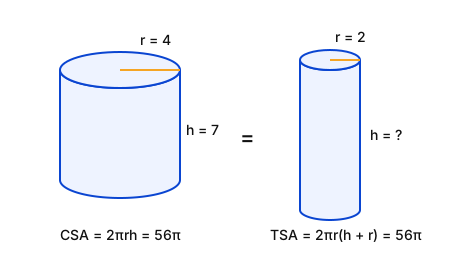
The curved surface area of a solid cylinder is numerically equal to the total surface area of another cylinder whose radius is half of the first cylinder. If the height and radius of the first cylinder are 7 cm and 4 cm, respectively. find the curved surface area of the second cylinder.
एक ठोस बेलन का वक्र पृष्ठीय क्षेत्रफल संख्यात्मक रूप से एक अन्य बेलन के संपूर्ण पृष्ठीय क्षेत्रफल के बराबर है, जिसकी त्रिज्या पहले बेलन की त्रिज्या की आधी है। यदि पहले बेलन की ऊँचाई और त्रिज्या क्रमशः 7 cm और 4 cm हैं, तो दूसरे बेलन का वक्र पृष्ठीय क्षेत्रफल ज्ञात कीजिए।
  1. A52πcm2
  2. B48πcm2
  3. C65πcm2
  4. D42πcm2
Show answer

Concept: CSA =2πrh, TSA =2πr(h+r).

  1. CSA of first =2π×4×7=56π
  2. Second cylinder: r=2; TSA =2π×2(h+2)=56π⇒h+2=14⇒h=12
  3. CSA of second =2π×2×12=48πcm2

Trick: CSA of second = TSA − two circles =56π−2π(2)2=48π.

Answer: (B) 48πcm2

अवधारणा: वक्र पृष्ठ (CSA) =2πrh, कुल पृष्ठ (TSA) =2πr(h+r)।

  1. पहले का CSA =2π×4×7=56π
  2. दूसरा बेलन: r=2; TSA =2π×2(h+2)=56π⇒h+2=14⇒h=12
  3. दूसरे का CSA =2π×2×12=48πcm2

ट्रिक: दूसरे का CSA = TSA − दो वृत्त =56π−2π(2)2=48π।

उत्तर: (B) 48πcm2

RRB NTPC Undergraduate CBT 1MathematicsMensuration – CylinderRRB NTPC Undergraduate CBT 1 2025 · 7 May Shift 2 →
Q8350.
Which of the following digits should replace X so that the three-digit number 2X2 is divisible by 4?
निम्नलिखित में से किस अंक को X के स्थान पर रखा जाए ताकि तीन अंकों की संख्या 2X2, 4 से विभाज्य हो?
  1. A1
  2. B4
  3. C0
  4. D2
Show answer

Concept: A number is divisible by 4 if its last two digits form a multiple of 4.

  1. Last two digits of 2X2 are X2.
  2. Options: 12 ✓, 42 ✗, 02 ✗, 22 ✗
  3. So X=1 (212 =4×53).

Trick: Two-digit multiples of 4 ending in 2: 12, 32, 52, 72, 92 – tens digit is always odd.

Answer: (A) 1

अवधारणा: कोई संख्या 4 से विभाज्य है यदि उसके अंतिम दो अंक 4 के गुणज हों।

  1. 2X2 के अंतिम दो अंक X2 हैं।
  2. विकल्प: 12 ✓, 42 ✗, 02 ✗, 22 ✗
  3. अतः X=1 (212 =4×53)।

ट्रिक: 2 पर समाप्त 4 के दो-अंकीय गुणज: 12, 32, 52, 72, 92 – दहाई अंक सदैव विषम।

उत्तर: (A) 1

RRB NTPC Undergraduate CBT 1MathematicsDivisibility RulesRRB NTPC Undergraduate CBT 1 2025 · 7 May Shift 2 →
Q8351.
A retailer buys 60 pens and sells them at the purchase price of 72 pens. Determine his profit percentage.
एक खुदरा विक्रेता 60 पेन खरीदता है और उन्हें 72 पेन के क्रय मूल्य पर बेच देता है। उसका लाभ प्रतिशत ज्ञात कीजिए।
  1. A12%
  2. B15%
  3. C16%
  4. D20%
Show answer

Concept: When SP of m articles = CP of n articles, profit%=n−mm×100.

  1. CP of 60 pens is recovered as CP of 72 pens: gain =72−60=12 pens
  2. Profit%=1260×100=20%

Trick: Profit is always on cost: 1260, not 1272 (which gives the wrong 16.67%).

Answer: (D) 20%

अवधारणा: जब m वस्तुओं का SP = n वस्तुओं का CP, तो लाभ%=n−mm×100।

  1. 60 पेनों की लागत के बदले 72 पेनों की लागत मिली: लाभ =72−60=12 पेन
  2. लाभ%=1260×100=20%

ट्रिक: लाभ सदैव लागत पर: 1260, न कि 1272 (जो गलत 16.67% देता है)।

उत्तर: (D) 20%

RRB NTPC Undergraduate CBT 1MathematicsProfit and LossRRB NTPC Undergraduate CBT 1 2025 · 7 May Shift 2 →
Q8352.
A transaction code 92419 is not divisible by 13. To make it divisible by 13, the least digit should be appended at the end of the number. What is that digit?
एक लेन-देन कोड 92419, 13 से विभाज्य नहीं है। इसे 13 से विभाज्य बनाने के लिए संख्या के अंत में सबसे छोटा कौन-सा अंक जोड़ा जाना चाहिए? वह अंक क्या है?
  1. A6
  2. B2
  3. C5
  4. D4
Show answer

Concept: Appending digit d gives 92419×10+d=924190+d; find the remainder of 924190 on division by 13.

  1. 924190÷13: 13×71091=924183, remainder =7
  2. Need 7+d divisible by 13 ⇒d=6
  3. 924196=13×71092 ✓

Trick: Remainder r after appending ⇒ digit =13−r (if r≠0).

Answer: (A) 6

अवधारणा: अंक d जोड़ने पर संख्या 92419×10+d=924190+d; 924190 को 13 से भाग देने पर शेष निकालें।

  1. 924190÷13: 13×71091=924183, शेष =7
  2. 7+d को 13 से विभाज्य होना चाहिए ⇒d=6
  3. 924196=13×71092 ✓

ट्रिक: अंक जोड़ने के बाद शेष r हो तो अंक =13−r (r≠0 पर)।

उत्तर: (A) 6

RRB NTPC Undergraduate CBT 1MathematicsDivisibility by 13RRB NTPC Undergraduate CBT 1 2025 · 7 May Shift 2 →
Q8353.
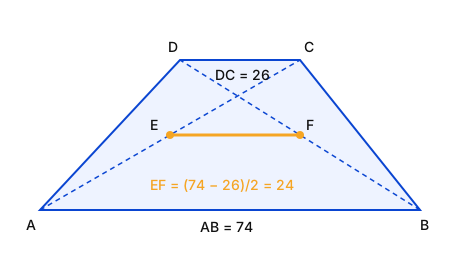
ABCD is a quadrilateral in which AB ∥ DC, and E and F are the mid points of the diagonals AC and BD, respectively. If AB = 74 cm, BC = 91 cm, DC = 26 cm, and AD = 39 cm, then what is the length (in cm) of EF?
ABCD एक चतुर्भुज है जिसमें AB ∥ DC है, और E तथा F क्रमशः विकर्णों AC और BD के मध्य-बिंदु हैं। यदि AB = 74 cm, BC = 91 cm, DC = 26 cm और AD = 39 cm है, तो EF की लंबाई (cm में) क्या है?
  1. A25
  2. B22
  3. C21
  4. D24
Show answer

Concept: In a trapezium with parallel sides a and b, the segment joining the midpoints of the diagonals is parallel to them and equals a−b2.

  1. AB=74, DC=26 (parallel sides)
  2. EF=74−262=482=24 cm
  3. The sides BC=91 and AD=39 are not needed.

Trick: Midpoints of non-parallel sides →a+b2; midpoints of diagonals →a−b2.

Answer: (D) 24

अवधारणा: समलंब में समांतर भुजाएँ a और b हों तो विकर्णों के मध्यबिंदुओं को मिलाने वाला खंड उनके समांतर और a−b2 के बराबर होता है।

  1. AB=74, DC=26 (समांतर भुजाएँ)
  2. EF=74−262=482=24 cm
  3. भुजाएँ BC=91 और AD=39 की आवश्यकता नहीं।

ट्रिक: असमांतर भुजाओं के मध्यबिंदु →a+b2; विकर्णों के मध्यबिंदु →a−b2।

उत्तर: (D) 24

RRB NTPC Undergraduate CBT 1MathematicsTrapezium – Midpoints of DiagonalsRRB NTPC Undergraduate CBT 1 2025 · 7 May Shift 2 →
Q8354.
A train runs at 72 km/h for 3 hours and then at 60 km/h for 1.5 hours. What is the average speed of the train?
एक रेलगाड़ी 3 घंटे तक 72 km/h की चाल से और फिर 1.5 घंटे तक 60 km/h की चाल से चलती है। रेलगाड़ी की औसत चाल क्या है?
  1. A65 km/h
  2. B66 km/h
  3. C68 km/h
  4. D67 km/h
Show answer

Concept: Average speed =total distancetotal time.

  1. Distance =72×3+60×1.5=216+90=306 km
  2. Time =3+1.5=4.5 h
  3. Average speed =3064.5=68 km/h

Trick: Weighted by time 3:1.5=2:1: 2×72+603=68.

Answer: (C) 68 km/h

अवधारणा: औसत चाल =कुल दूरीकुल समय।

  1. दूरी =72×3+60×1.5=216+90=306 km
  2. समय =3+1.5=4.5 h
  3. औसत चाल =3064.5=68 km/h

ट्रिक: समय के भार 3:1.5=2:1 से: 2×72+603=68।

उत्तर: (C) 68 km/h

RRB NTPC Undergraduate CBT 1MathematicsAverage SpeedRRB NTPC Undergraduate CBT 1 2025 · 7 May Shift 2 →
Q8355.
If the principal is ₹1000, the rate is 5% per annum, and the time is 2 years, what is the simple interest?
यदि मूलधन ₹1000, दर 5% वार्षिक और समय 2 वर्ष है, तो साधारण ब्याज क्या है?
  1. A₹100
  2. B₹200
  3. C₹50
  4. D₹500
Show answer

Concept: SI=P×R×T100.

  1. SI=1000×5×2100=100

Trick: 5% of 1000 is 50 per year; two years give ₹100.

Answer: (A) ₹100

अवधारणा: SI=P×R×T100।

  1. SI=1000×5×2100=100

ट्रिक: 1000 का 5% = 50 प्रति वर्ष; दो वर्ष में ₹100।

उत्तर: (A) ₹100

RRB NTPC Undergraduate CBT 1MathematicsSimple InterestRRB NTPC Undergraduate CBT 1 2025 · 7 May Shift 2 →
Q8356.
If 5 and 10 are given, what is the third proportional to these numbers?
यदि 5 और 10 दिए गए हैं, तो इन संख्याओं का तृतीयानुपाती (third proportional) क्या है?
  1. A30
  2. B15
  3. C25
  4. D20
Show answer

Concept: Third proportional to a and b is c with a:b=b:c, i.e. c=b2a.

  1. c=1025=1005=20

Trick: 5→10 is doubling, so 10→20.

Answer: (D) 20

अवधारणा: a और b का तृतीयानुपाती c है जहाँ a:b=b:c, अर्थात c=b2a।

  1. c=1025=1005=20

ट्रिक: 5→10 दुगुना है, अतः 10→20।

उत्तर: (D) 20

RRB NTPC Undergraduate CBT 1MathematicsThird ProportionalRRB NTPC Undergraduate CBT 1 2025 · 7 May Shift 2 →
Q8357.
Evaluate 243 + (-7)3 + (-17)3
243 + (-7)3 + (-17)3 का मान ज्ञात कीजिए
  1. A8345
  2. B8396
  3. C8450
  4. D8568
Show answer

Concept: If a+b+c=0, then a3+b3+c3=3abc.

  1. 24+(−7)+(−17)=0
  2. 3abc=3×24×(−7)×(−17)=3×24×119
  3. =72×119=8568

Trick: Check the sum first – if zero, never cube the numbers.

Answer: (D) 8568

अवधारणा: यदि a+b+c=0, तो a3+b3+c3=3abc।

  1. 24+(−7)+(−17)=0
  2. 3abc=3×24×(−7)×(−17)=3×24×119
  3. =72×119=8568

ट्रिक: पहले योग जाँचें – शून्य हो तो घन निकालने की ज़रूरत नहीं।

उत्तर: (D) 8568

RRB NTPC Undergraduate CBT 1MathematicsAlgebraic Identity (a³+b³+c³)RRB NTPC Undergraduate CBT 1 2025 · 7 May Shift 2 →
Q8358.
Trains from Delhi, Lucknow, and Jaipur depart every 12 minutes, 18 minutes, and 27 minutes, respectively. If all depart together at 6:00 am, when will they depart together again?
दिल्ली, लखनऊ और जयपुर से रेलगाड़ियाँ क्रमशः प्रत्येक 12 मिनट, 18 मिनट और 27 मिनट पर रवाना होती हैं। यदि सभी सुबह 6:00 बजे एक साथ रवाना होती हैं, तो वे पुनः एक साथ कब रवाना होंगी?
  1. A7:40 amसुबह 7:40 बजे
  2. B7:36 amसुबह 7:36 बजे
  3. C7:48 amसुबह 7:48 बजे
  4. D7:24 amसुबह 7:24 बजे
Show answer

Concept: They depart together again after the LCM of the intervals.

  1. 12=22×3, 18=2×32, 27=33
  2. LCM =22×33=108 min =1 h 48 min
  3. 6:00+1:48=7:48 am

Trick: LCM must be a multiple of 27 and 4: 108.

Answer: (C) 7:48 am

अवधारणा: अंतरालों के ल.स. के बाद वे फिर एक साथ छूटेंगी।

  1. 12=22×3, 18=2×32, 27=33
  2. ल.स. =22×33=108 मिनट =1 घं. 48 मि.
  3. 6:00+1:48=7:48 am

ट्रिक: ल.स. 27 और 4 दोनों का गुणज होना चाहिए: 108।

उत्तर: (C) 7:48 am

RRB NTPC Undergraduate CBT 1MathematicsLCM – Time IntervalsRRB NTPC Undergraduate CBT 1 2025 · 7 May Shift 2 →
Q8359.
The sum of two numbers is 72. If the larger number is increased by 8 and the smaller number is decreased by 6, then the resulting numbers are in the ratio 3 : 2, respectively. Find the smaller of the original two numbers.
दो संख्याओं का योग 72 है। यदि बड़ी संख्या में 8 की वृद्धि की जाए और छोटी संख्या में 6 की कमी की जाए, तो परिणामी संख्याएँ क्रमशः 3 : 2 के अनुपात में हो जाती हैं। मूल दो संख्याओं में से छोटी संख्या ज्ञात कीजिए।
  1. A35.6
  2. B32.5
  3. C34.2
  4. D35
Show answer

Concept: Let the numbers be L and S with L+S=72; set up the ratio equation.

  1. L+8S−6=32⇒2L+16=3S−18
  2. Put L=72−S: 144−2S+16=3S−18⇒5S=178
  3. S=35.6

Trick: Total after change =72+8−6=74; smaller changed =25×74=29.6, so S=29.6+6=35.6.

Answer: (A) 35.6

अवधारणा: संख्याएँ L और S, L+S=72; अनुपात समीकरण बनाएँ।

  1. L+8S−6=32⇒2L+16=3S−18
  2. L=72−S रखें: 144−2S+16=3S−18⇒5S=178
  3. S=35.6

ट्रिक: परिवर्तन के बाद योग =72+8−6=74; छोटी नई संख्या =25×74=29.6, अतः S=29.6+6=35.6।

उत्तर: (A) 35.6

RRB NTPC Undergraduate CBT 1MathematicsRatio – Linear EquationsRRB NTPC Undergraduate CBT 1 2025 · 7 May Shift 2 →
Q8360.
If 40% of a number exceeds 25% of it by 36, then the number is:
यदि किसी संख्या का 40%, उसके 25% से 36 अधिक है, तो वह संख्या है:
  1. A240
  2. B280
  3. C220
  4. D260
Show answer

Concept: Difference of percentages of the same number equals a percentage of it.

  1. 40%−25%=15% of the number =36
  2. Number =36×10015=240

Trick: 15%→36, so 5%→12 and 100%→240.

Answer: (A) 240

अवधारणा: एक ही संख्या के प्रतिशतों का अंतर भी उसी का प्रतिशत होता है।

  1. 40%−25%=15% संख्या का =36
  2. संख्या =36×10015=240

ट्रिक: 15%→36, अतः 5%→12 और 100%→240।

उत्तर: (A) 240

RRB NTPC Undergraduate CBT 1MathematicsPercentageRRB NTPC Undergraduate CBT 1 2025 · 7 May Shift 2 →