Question bank

Q&A: practice questions with answers

Search questions on any topic. Filter by exam category, exam, subject and topic, try the question, then open the answer and explanation.

Courses – airGurukul

8,495 questions found.

Q8361.
A shopkeeper offers the following schemes on toys of the same marked price. (A) Successive discounts of 44% and 12% on any number of toys bought.
(B) Successive discounts of 18%, 43% and 23% on any number of toys bought. (C) 8% discount on the first 4 toys and 38% discount on each toy thereon.
(D) On buying ten items, the customer is billed for only seven items.
A customer wants to buy 10 toys. Which of the above schemes is the least beneficial to her?
एक दुकानदार समान अंकित मूल्य वाले खिलौनों पर निम्नलिखित योजनाएँ प्रस्तुत करता है। (A) खरीदे गए किसी भी संख्या के खिलौनों पर 44% और 12% की क्रमिक छूट।
(B) खरीदे गए किसी भी संख्या के खिलौनों पर 18%, 43% और 23% की क्रमिक छूट। (C) पहले 4 खिलौनों पर 8% की छूट और उसके बाद प्रत्येक खिलौने पर 38% की छूट।
(D) दस वस्तुएँ खरीदने पर ग्राहक से केवल सात वस्तुओं का बिल लिया जाता है।
एक ग्राहक 10 खिलौने खरीदना चाहती है। उपरोक्त योजनाओं में से कौन-सी उसके लिए सबसे कम लाभकारी है?
  1. AB
  2. BA
  3. CC
  4. DD
Show answer

Concept: Compute the fraction of marked price actually paid for 10 toys; the scheme with the highest payment is least beneficial.

  1. (A) 0.56×0.88=0.4928→ pays 49.3%
  2. (B) 0.82×0.57×0.77≈0.36→ pays 36%
  3. (C) 4×0.92+6×0.6210=3.68+3.7210=0.74→ pays 74%
  4. (D) pays for 7 of 10 →70%

Trick: Only (C) and (D) are close; 74%>70%, so (C) costs the most.

Answer: (C) C

अवधारणा: 10 खिलौनों के लिए अंकित मूल्य का वास्तव में चुकाया भाग निकालें; जिसमें सबसे अधिक भुगतान, वह सबसे कम लाभदायक।

  1. (A) 0.56×0.88=0.4928→ भुगतान 49.3%
  2. (B) 0.82×0.57×0.77≈0.36→ भुगतान 36%
  3. (C) 4×0.92+6×0.6210=3.68+3.7210=0.74→ भुगतान 74%
  4. (D) 10 में से 7 का भुगतान →70%

ट्रिक: केवल (C) और (D) पास-पास हैं; 74%>70%, अतः (C) सबसे महँगी।

उत्तर: (C) C
RRB NTPC Undergraduate CBT 1MathematicsComparing Discount SchemesRRB NTPC Undergraduate CBT 1 2025 · 7 May Shift 2 →
Q8362.
The average of k numbers is x. If 48 is subtracted from each of any two of the numbers, then we get (x-12) as the new average. Find the value of k.
k संख्याओं का औसत x है। यदि इनमें से किन्हीं दो संख्याओं में से प्रत्येक में से 48 घटा दिया जाए, तो नया औसत (x-12) प्राप्त होता है। k का मान ज्ञात कीजिए।
  1. A8
  2. B10
  3. C3
  4. D5
Show answer

Concept: Decrease in average =total decreasek.

  1. Total decrease =48×2=96
  2. New average =x−12⇒96k=12
  3. k=8

Trick: Average falls by 12 while sum falls by 96 ⇒96÷12=8 numbers.

Answer: (A) 8

अवधारणा: औसत में कमी =कुल कमीk।

  1. कुल कमी =48×2=96
  2. नया औसत =x−12⇒96k=12
  3. k=8

ट्रिक: योग 96 घटा और औसत 12 घटा ⇒96÷12=8 संख्याएँ।

उत्तर: (A) 8

RRB NTPC Undergraduate CBT 1MathematicsAverage – Change in SumRRB NTPC Undergraduate CBT 1 2025 · 7 May Shift 2 →
Q8363.
The speeds of two cars are in the ratio 5 : 7. The faster car covers 140 km in 2 hours. How much distance will the slower car cover in the same time?
दो कारों की चालों का अनुपात 5 : 7 है। तेज़ कार 2 घंटे में 140 km की दूरी तय करती है। धीमी कार उतने ही समय में कितनी दूरी तय करेगी?
  1. A140 km
  2. B90 km
  3. C100 km
  4. D70 km
Show answer

Concept: In equal time, distance ∝ speed.

  1. Faster car: 140 km corresponds to ratio part 7, so one part =20 km
  2. Slower car: 5×20=100 km

Trick: Distances in the same time are in the ratio 5:7 directly.

Answer: (C) 100 km

अवधारणा: समान समय में दूरी ∝ चाल।

  1. तेज़ कार: 140 km अनुपात के 7 भाग, अतः एक भाग =20 km
  2. धीमी कार: 5×20=100 km

ट्रिक: समान समय में दूरियाँ सीधे 5:7 के अनुपात में।

उत्तर: (C) 100 km

RRB NTPC Undergraduate CBT 1MathematicsRatio of SpeedsRRB NTPC Undergraduate CBT 1 2025 · 7 May Shift 2 →
Q8364.
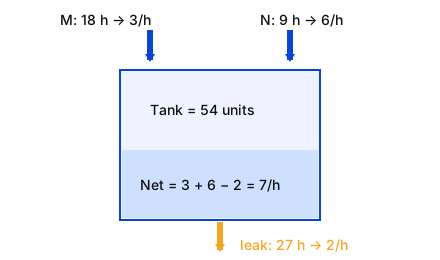
A tank is being filled by two taps, M and N. M fills the tank completely in 18 hours and N fills it in 9 hours. A leakage at the bottom of the tank can empty the completely filled tank in 27 hours. How long will it take to fill the empty tank completely if both taps are opened while the leakage continues?
एक टंकी को दो नलों, M और N, द्वारा भरा जा रहा है। M टंकी को 18 घंटे में पूरी तरह भरता है और N इसे 9 घंटे में भरता है। टंकी के तल में एक रिसाव पूरी भरी हुई टंकी को 27 घंटे में खाली कर सकता है। यदि रिसाव जारी रहते हुए दोनों नल खोल दिए जाएँ, तो खाली टंकी को पूरी तरह भरने में कितना समय लगेगा?
  1. A647 hours647 घंटे
  2. B757 hours757 घंटे
  3. C657 hours657 घंटे
  4. D737 hours737 घंटे
Show answer

Concept: Take tank capacity = LCM of times as units; add inlet rates, subtract the leak.

  1. Capacity =LCM(18,9,27)=54 units
  2. M =3/h, N =6/h, leak =−2/h; net =3+6−2=7/h
  3. Time =547=757 hours

Trick: Without the leak it takes 6 h; the leak slows it, so the answer must exceed 6 h – rules out nothing but confirms direction.

Answer: (B) 757 hours

अवधारणा: टंकी की क्षमता = समयों का ल.स. इकाई मानें; भरने की दरें जोड़ें, रिसाव घटाएँ।

  1. क्षमता =ल.स.(18,9,27)=54 इकाई
  2. M =3/h, N =6/h, रिसाव =−2/h; शुद्ध =3+6−2=7/h
  3. समय =547=757 घंटे

ट्रिक: बिना रिसाव 6 घंटे लगते; रिसाव से समय बढ़ेगा, अतः उत्तर 6 घंटे से अधिक होना चाहिए।

उत्तर: (B) 757 hours

RRB NTPC Undergraduate CBT 1MathematicsPipes and Cisterns – LeakRRB NTPC Undergraduate CBT 1 2025 · 7 May Shift 2 →
Q8365.
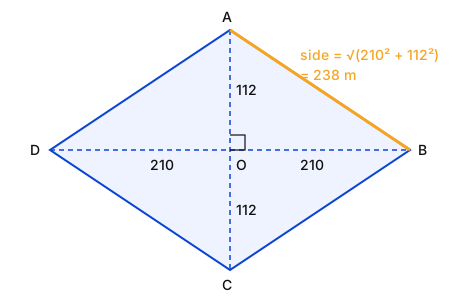
The diagonals of a rhombus-shaped field are 224 m and 420 m long. What is the perimeter (in m) of the field?
एक समचतुर्भुजाकार खेत के विकर्ण 224 m और 420 m लंबे हैं। खेत का परिमाप (m में) क्या है?
  1. A952
  2. B922
  3. C904
  4. D944
Show answer

Concept: Diagonals of a rhombus bisect each other at right angles; side =(d12)2+(d22)2.

  1. Half-diagonals =112 m and 210 m
  2. Side =1122+2102=12544+44100=56644=238 m
  3. Perimeter =4×238=952 m

Trick: 112:210=8:15, a Pythagorean triplet (8,15,17) scaled by 14 ⇒ side =17×14=238.

Answer: (A) 952

अवधारणा: समचतुर्भुज के विकर्ण एक-दूसरे को समकोण पर समद्विभाजित करते हैं; भुजा =(d12)2+(d22)2।

  1. अर्ध-विकर्ण =112 m और 210 m
  2. भुजा =1122+2102=12544+44100=56644=238 m
  3. परिमाप =4×238=952 m

ट्रिक: 112:210=8:15, पाइथागोरस त्रिक (8,15,17) का 14 गुना ⇒ भुजा =17×14=238।

उत्तर: (A) 952

RRB NTPC Undergraduate CBT 1MathematicsRhombus – PerimeterRRB NTPC Undergraduate CBT 1 2025 · 7 May Shift 2 →
Q8366.
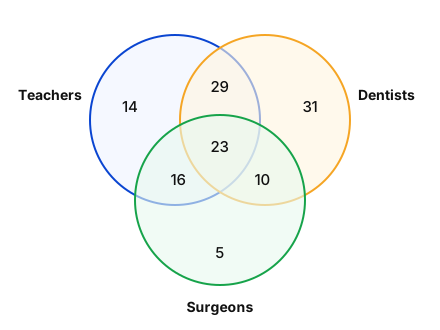
Study the given diagram carefully and answer the question. The numbers in different sections indicate the number of persons. (NOTE: You have to take the given data to be true even if it seems to be at variance from commonly known facts.)
How many such Teachers are there who are also Dentists but not Surgeons?
दिए गए आरेख का ध्यानपूर्वक अध्ययन कीजिए और प्रश्न का उत्तर दीजिए। विभिन्न भागों में दी गई संख्याएँ व्यक्तियों की संख्या दर्शाती हैं। (नोट: आपको दिए गए आँकड़ों को सत्य मानना है, भले ही वे सामान्यतः ज्ञात तथ्यों से भिन्न प्रतीत होते हों।)
ऐसे कितने शिक्षक (Teachers) हैं जो दंत चिकित्सक (Dentists) भी हैं परंतु शल्य चिकित्सक (Surgeons) नहीं हैं?
  1. A14
  2. B5
  3. C29
  4. D16
Show answer

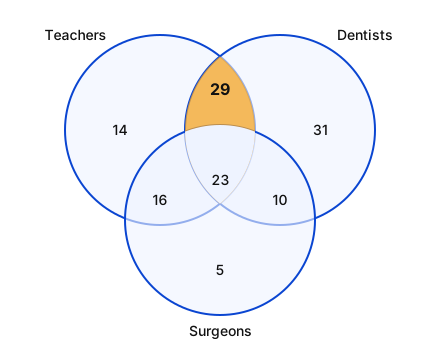
Concept: In a three-circle Venn diagram, "Teachers who are also Dentists but not Surgeons" is the part of the Teacher–Dentist overlap that lies outside the Surgeons circle.

  1. The Teachers and Dentists circles overlap in two regions: one inside Surgeons (23) and one outside Surgeons (29).
  2. We need only the region outside the Surgeons circle → 29.
  3. 14 = only Teachers, 16 = Teachers and Surgeons only, 5 = only Surgeons – none of these fit the condition.

Trick: "A and B but not C" → take the A∩B lens and drop the central (all-three) number.

Answer: (C) 29

अवधारणा: तीन वृत्तों के वेन आरेख में "ऐसे Teachers जो Dentists भी हैं पर Surgeons नहीं" = Teacher–Dentist के उभयनिष्ठ भाग का वह हिस्सा जो Surgeons वृत्त के बाहर है।

  1. Teachers और Dentists वृत्त दो क्षेत्रों में मिलते हैं: एक Surgeons के अंदर (23) और एक Surgeons के बाहर (29)।
  2. हमें केवल Surgeons वृत्त से बाहर वाला क्षेत्र चाहिए → 29।
  3. 14 = केवल Teachers, 16 = Teachers और Surgeons, 5 = केवल Surgeons – ये शर्त पूरी नहीं करते।

ट्रिक: "A और B पर C नहीं" → A∩B वाला हिस्सा लें और बीच वाली (तीनों की) संख्या छोड़ दें।

उत्तर: (C) 29

RRB NTPC Undergraduate CBT 1General Intelligence and ReasoningVenn diagram – reading regionsRRB NTPC Undergraduate CBT 1 2025 · 7 May Shift 2 →
Q8367.
What should come in place of '?' in the given series based on the English alphabetical order?
MFJ JCG GZD DWA ?
अंग्रेज़ी वर्णमाला क्रम के आधार पर दी गई शृंखला में '?' के स्थान पर क्या आना चाहिए?
MFJ JCG GZD DWA ?
  1. AAKR
  2. BATZ
  3. CATX
  4. DASY
Show answer

Concept: Write the alphabet positions and check how each letter of a cluster moves to the next cluster.

  1. 1st letters: M(13) → J(10) → G(7) → D(4) → ? : each time −3, so next = A(1).
  2. 2nd letters: F(6) → C(3) → Z(26) → W(23) → ? : −3 each, so next = T(20).
  3. 3rd letters: J(10) → G(7) → D(4) → A(1) → ? : −3, so next = X(24).
  4. Required cluster = ATX.

Trick: All three letters fall by 3 – check only one letter of each option: the first letter must be A and the last must be X.

Answer: (C) ATX

अवधारणा: अक्षरों के स्थान (position) लिखें और देखें कि हर अक्षर अगले समूह में कितना बदलता है।

  1. पहले अक्षर: M(13) → J(10) → G(7) → D(4) → ? : हर बार −3, अतः अगला A(1)।
  2. दूसरे अक्षर: F(6) → C(3) → Z(26) → W(23) → ? : −3, अतः T(20)।
  3. तीसरे अक्षर: J(10) → G(7) → D(4) → A(1) → ? : −3, अतः X(24)।
  4. अभीष्ट समूह = ATX।

ट्रिक: तीनों अक्षर 3 घटते हैं – विकल्पों में केवल पहला अक्षर A और अंतिम X जाँचें।

उत्तर: (C) ATX

RRB NTPC Undergraduate CBT 1General Intelligence and ReasoningLetter-cluster seriesRRB NTPC Undergraduate CBT 1 2025 · 7 May Shift 2 →
Q8368.
Each of the digits in the number 52178436 is arranged in ascending order from left to right. What will be the sum of the digits that are third from the left and third from the right in the number thus formed?
संख्या 52178436 के प्रत्येक अंक को बाएँ से दाएँ आरोही क्रम में व्यवस्थित किया जाता है। इस प्रकार बनी संख्या में बाएँ से तीसरे और दाएँ से तीसरे अंकों का योग क्या होगा?
  1. A11
  2. B8
  3. C9
  4. D10
Show answer

Concept: Rearrange the digits in increasing order and then count positions from both ends.

  1. Digits of 52178436 in ascending order: 1 2 3 4 5 6 7 8.
  2. Third from the left = 3; third from the right = 6.
  3. Sum =3+6=9.

Trick: The eight digits here are exactly 1–8, so the ascending number is simply 12345678 – no sorting effort needed.

Answer: (C) 9

अवधारणा: अंकों को बढ़ते क्रम में लिखें और फिर दोनों सिरों से स्थान गिनें।

  1. 52178436 के अंक आरोही क्रम में: 1 2 3 4 5 6 7 8।
  2. बाएँ से तीसरा = 3; दाएँ से तीसरा = 6।
  3. योग =3+6=9।

ट्रिक: यहाँ आठों अंक ठीक 1–8 हैं, इसलिए आरोही संख्या सीधे 12345678 है – छाँटने की ज़रूरत नहीं।

उत्तर: (C) 9

RRB NTPC Undergraduate CBT 1General Intelligence and ReasoningDigit arrangementRRB NTPC Undergraduate CBT 1 2025 · 7 May Shift 2 →
Q8369.
Each of the digits in the number 36857219 is arranged in the ascending order from left to right. What will be the sum of the digits which are second from the left and third from the right in the new number thus formed?
संख्या 36857219 के प्रत्येक अंक को बाएँ से दाएँ आरोही क्रम में व्यवस्थित किया जाता है। इस प्रकार बनी नई संख्या में बाएँ से दूसरे और दाएँ से तीसरे अंकों का योग क्या होगा?
  1. A11
  2. B9
  3. C10
  4. D8
Show answer

Concept: Sort the digits in ascending order, then read the required positions.

  1. Digits of 36857219 in ascending order: 1 2 3 5 6 7 8 9 (note: no 4).
  2. Second from the left = 2; third from the right = 7.
  3. Sum =2+7=9.

Trick: Write the sorted digits in a line and count from the right by pointing with a finger – most errors come from miscounting "third from the right".

Answer: (B) 9

अवधारणा: अंकों को आरोही क्रम में लगाएँ और फिर माँगे गए स्थान पढ़ें।

  1. 36857219 के अंक आरोही क्रम में: 1 2 3 5 6 7 8 9 (ध्यान दें: 4 नहीं है)।
  2. बाएँ से दूसरा = 2; दाएँ से तीसरा = 7।
  3. योग =2+7=9।

ट्रिक: छाँटे हुए अंक एक पंक्ति में लिखकर दाएँ से उँगली रखकर गिनें – ज़्यादातर गलती "दाएँ से तीसरा" गिनने में होती है।

उत्तर: (B) 9

RRB NTPC Undergraduate CBT 1General Intelligence and ReasoningDigit arrangementRRB NTPC Undergraduate CBT 1 2025 · 7 May Shift 2 →
Q8370.
Refer to the following letter series and answer the question that follows. Counting to be done from left to right only.
(Left) K D D U R V U D E C Q D V A D R D G D E D Z D J (Right)
How many such D’s are there, each of which is immediately preceded by a vowel and also immediately followed by a consonant?
निम्नलिखित अक्षर शृंखला को देखिए और उसके बाद दिए गए प्रश्न का उत्तर दीजिए। गिनती केवल बाएँ से दाएँ की जानी है।
(बाएँ) K D D U R V U D E C Q D V A D R D G D E D Z D J (दाएँ)
ऐसे कितने D हैं, जिनमें से प्रत्येक के ठीक पहले एक स्वर और ठीक बाद एक व्यंजन है?
  1. AFourचार
  2. BTwoदो
  3. CThreeतीन
  4. DFiveपाँच
Show answer

Concept: Check every D in the series: the letter just before it must be a vowel (A, E, I, O, U) and the letter just after it must be a consonant.

  1. Series: K D D U R V U D E C Q D V A D R D G D E D Z D J.
  2. D's with a vowel before them: UDE (after it is E, a vowel – rejected), ADR (R is a consonant – accepted), EDZ (Z is a consonant – accepted).
  3. All other D's have a consonant before them (K, D, Q, R, G, Z) – rejected.
  4. Count = 2.

Trick: First underline the vowels (U, U, E, A, E) – only the D's right after a vowel need checking.

Answer: (B) Two

अवधारणा: श्रृंखला के हर D को जाँचें: ठीक पहले का अक्षर स्वर (A, E, I, O, U) और ठीक बाद का अक्षर व्यंजन होना चाहिए।

  1. श्रृंखला: K D D U R V U D E C Q D V A D R D G D E D Z D J।
  2. जिन D से पहले स्वर है: UDE (बाद में E स्वर – अस्वीकृत), ADR (R व्यंजन – स्वीकृत), EDZ (Z व्यंजन – स्वीकृत)।
  3. बाकी सभी D से पहले व्यंजन (K, D, Q, R, G, Z) हैं – अस्वीकृत।
  4. संख्या = 2।

ट्रिक: पहले स्वरों (U, U, E, A, E) को रेखांकित करें – केवल स्वर के ठीक बाद वाले D जाँचने हैं।

उत्तर: (B) दो (Two)

RRB NTPC Undergraduate CBT 1General Intelligence and ReasoningLetter series – counting with conditionsRRB NTPC Undergraduate CBT 1 2025 · 7 May Shift 2 →
Q8371.
Select the pair which follows the same pattern as that followed by the two sets of pairs given below. Both pairs follow the same pattern.
DIP : GLS
BST : EVW
उस युग्म का चयन कीजिए जो नीचे दिए गए दो युग्मों के समान पैटर्न का अनुसरण करता है। दोनों युग्म समान पैटर्न का अनुसरण करते हैं।
DIP : GLS
BST : EVW
  1. ATEL : VHP
  2. BHKD : KNG
  3. CCIG : FKJ
  4. DEHL : IFP
Show answer

Concept: Find the shift applied to each letter of the first cluster to get the second cluster.

  1. DIP → GLS: D+3 = G, I+3 = L, P+3 = S. BST → EVW: B+3 = E, S+3 = V, T+3 = W. Rule: every letter +3.
  2. HKD → KNG: H+3 = K, K+3 = N, D+3 = G ✓.
  3. TEL → VHP is (+2, +3, +4); CIG → FKJ is (+3, +2, +3); EHL → IFP is (+4, −2, +4) – none follow the rule.

Trick: Test only the first letter of each option for "+3": T→V (+2 ✗), H→K ✓, C→F ✓, E→I ✗; then check the second letter of the two survivors.

Answer: (B) HKD : KNG

अवधारणा: पहले समूह के हर अक्षर पर लगे बदलाव (shift) से दूसरा समूह मिलता है – वही नियम विकल्पों में खोजें।

  1. DIP → GLS: D+3 = G, I+3 = L, P+3 = S। BST → EVW: B+3 = E, S+3 = V, T+3 = W। नियम: हर अक्षर +3।
  2. HKD → KNG: H+3 = K, K+3 = N, D+3 = G ✓।
  3. TEL → VHP में (+2, +3, +4); CIG → FKJ में (+3, +2, +3); EHL → IFP में (+4, −2, +4) – कोई नियम पर खरा नहीं।

ट्रिक: हर विकल्प के केवल पहले अक्षर पर "+3" जाँचें: T→V (+2 ✗), H→K ✓, C→F ✓, E→I ✗; फिर बचे दो में दूसरा अक्षर देखें।

उत्तर: (B) HKD : KNG

RRB NTPC Undergraduate CBT 1General Intelligence and ReasoningLetter analogyRRB NTPC Undergraduate CBT 1 2025 · 7 May Shift 2 →
Q8372.
In a certain code language,
A + B means ‘A is the son of B’,
A – B means ‘A is the brother of B’,
A x B means ‘A is the wife of B’ and
A ÷ B means ‘A is the father of B’.
Based on the above, how is S related to K if ‘S – D + F ÷ H x K’?
एक निश्चित कूट भाषा में,
A + B का अर्थ है 'A, B का पुत्र है',
A – B का अर्थ है 'A, B का भाई है',
A x B का अर्थ है 'A, B की पत्नी है' और
A ÷ B का अर्थ है 'A, B का पिता है'।
उपरोक्त के आधार पर, यदि 'S – D + F ÷ H x K' है, तो S, K से किस प्रकार संबंधित है?
  1. ABrotherभाई
  2. BWife's fatherपत्नी का पिता
  3. CWife's brotherपत्नी का भाई
  4. DFatherपिता
Show answer

Concept: Decode each symbol from left to right and build the family tree.

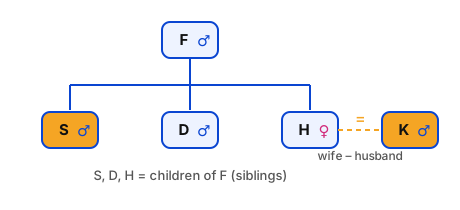
  1. S – D: S is the brother of D. D + F: D is the son of F. So S is also a son of F.
  2. F ÷ H: F is the father of H. H × K: H is the wife of K, so H is female and K is her husband.
  3. S and H are children of the same father F, so S is H's brother; H is K's wife.
  4. Hence S is K's wife's brother.

Trick: Draw one generation line for all children of F (S, D, H); the person at the far end (K) is only connected by marriage, so the answer must contain "wife's".

Answer: (C) Wife's brother

अवधारणा: हर चिह्न को बाएँ से दाएँ डिकोड करें और वंश-वृक्ष बनाएँ।

  1. S – D: S, D का भाई है। D + F: D, F का पुत्र है। अतः S भी F का पुत्र है।
  2. F ÷ H: F, H का पिता है। H × K: H, K की पत्नी है, अतः H स्त्री है और K उसका पति।
  3. S और H एक ही पिता F की संतानें हैं, अतः S, H का भाई है; H, K की पत्नी है।
  4. इसलिए S, K की पत्नी का भाई है।

ट्रिक: F की सभी संतानों (S, D, H) को एक ही पीढ़ी-रेखा में रखें; अंतिम व्यक्ति (K) केवल विवाह से जुड़ा है, इसलिए उत्तर में "पत्नी का" आना ही है।

उत्तर: (C) पत्नी का भाई (Wife's brother)

RRB NTPC Undergraduate CBT 1General Intelligence and ReasoningBlood relations – codedRRB NTPC Undergraduate CBT 1 2025 · 7 May Shift 2 →
Q8373.
What should come in place of ‘?’ in the given series?
67 70 ? 85 97 112
दी गई शृंखला में '?' के स्थान पर क्या आना चाहिए?
67 70 ? 85 97 112
  1. A82
  2. B78
  3. C76
  4. D80
Show answer

Concept: Find the differences between consecutive terms; they often form a simple pattern.

  1. 70−67=3, 97−85=12, 112−97=15 → differences are multiples of 3: 3, 6, 9, 12, 15.
  2. So ? =70+6=76, and check: 76+9=85 ✓.

Trick: When the last two differences are 12 and 15, go backwards in steps of 3 (9, 6, 3) to fill the gap.

Answer: (C) 76

अवधारणा: लगातार पदों के अंतर निकालें; वे प्रायः एक सरल पैटर्न बनाते हैं।

  1. 70−67=3, 97−85=12, 112−97=15 → अंतर 3 के गुणज हैं: 3, 6, 9, 12, 15।
  2. अतः ? =70+6=76; जाँच: 76+9=85 ✓।

ट्रिक: अंतिम दो अंतर 12 और 15 हों तो 3-3 घटाते हुए पीछे चलें (9, 6, 3) और खाली जगह भरें।

उत्तर: (C) 76

RRB NTPC Undergraduate CBT 1General Intelligence and ReasoningNumber series – differencesRRB NTPC Undergraduate CBT 1 2025 · 7 May Shift 2 →
Q8374.
Each vowel in the word CURRENT is changed to the letter immediately following it in the English alphabetical order and each consonant is changed to the letter immediately preceding it in the English alphabetical order. Which of the following letters will be third from the right in the new group of letters thus formed?
शब्द CURRENT के प्रत्येक स्वर को अंग्रेज़ी वर्णमाला क्रम में उसके ठीक बाद वाले अक्षर में और प्रत्येक व्यंजन को अंग्रेज़ी वर्णमाला क्रम में उसके ठीक पहले वाले अक्षर में बदल दिया जाता है। इस प्रकार बने नए अक्षर-समूह में निम्नलिखित में से कौन-सा अक्षर दाएँ से तीसरा होगा?
  1. AG
  2. BE
  3. CF
  4. DH
Show answer

Concept: Apply the rule letter by letter: vowel → next letter, consonant → previous letter.

  1. C U R R E N T → C−1 = B, U+1 = V, R−1 = Q, R−1 = Q, E+1 = F, N−1 = M, T−1 = S.
  2. New group: B V Q Q F M S.
  3. Third from the right: S (1st), M (2nd), F (3rd).

Trick: Only the vowels U and E move forward; every other letter steps back one – write the new letters directly under the word.

Answer: (C) F

अवधारणा: नियम हर अक्षर पर लगाएँ: स्वर → अगला अक्षर, व्यंजन → पिछला अक्षर।

  1. C U R R E N T → C−1 = B, U+1 = V, R−1 = Q, R−1 = Q, E+1 = F, N−1 = M, T−1 = S।
  2. नया समूह: B V Q Q F M S।
  3. दाएँ से तीसरा: S (पहला), M (दूसरा), F (तीसरा)।

ट्रिक: केवल स्वर U और E आगे बढ़ते हैं; बाकी हर अक्षर एक पीछे – नए अक्षर सीधे शब्द के नीचे लिखें।

उत्तर: (C) F

RRB NTPC Undergraduate CBT 1General Intelligence and ReasoningLetter operations on a wordRRB NTPC Undergraduate CBT 1 2025 · 7 May Shift 2 →
Q8375.
Select the set in which the numbers are related in the same way as are the numbers of the following sets.
(NOTE: Operations should be performed on the whole numbers, without breaking down the numbers into their constituent digits. E.g. 13 – Operations on 13 such as
adding/subtracting/multiplying to 13 can be performed. Breaking down 13 into 1 and 3 and then performing mathematical operations on 1 and 3 is not allowed.)
(2, 7, 14)
(3, 16, 48)
उस समुच्चय का चयन कीजिए जिसमें संख्याएँ उसी प्रकार संबंधित हैं जिस प्रकार निम्नलिखित समुच्चयों की संख्याएँ संबंधित हैं।
(नोट: संक्रियाएँ पूर्ण संख्याओं पर की जानी चाहिए, संख्याओं को उनके घटक अंकों में तोड़े बिना। उदाहरण के लिए 13 – 13 पर संक्रियाएँ जैसे
13 में जोड़ना/घटाना/गुणा करना किया जा सकता है। 13 को 1 और 3 में तोड़कर फिर 1 और 3 पर गणितीय संक्रियाएँ करने की अनुमति नहीं है।)
(2, 7, 14)
(3, 16, 48)
  1. A(4, 6, 20)
  2. B(5, 3, 15)
  3. C(8, 6, 56)
  4. D(6, 7, 48)
Show answer

Concept: Find one operation that links the three numbers of each given set.

  1. (2, 7, 14): 2×7=14. (3, 16, 48): 3×16=48. Rule: third number = product of the first two.
  2. (5, 3, 15): 5×3=15 ✓.
  3. (4, 6, 20): 24≠20; (8, 6, 56): 48≠56; (6, 7, 48): 42≠48.

Trick: When the third number is clearly bigger, test multiplication of the first two before anything else.

Answer: (B) (5, 3, 15)

अवधारणा: ऐसी एक संक्रिया खोजें जो हर समुच्चय की तीनों संख्याओं को जोड़ती हो।

  1. (2, 7, 14): 2×7=14। (3, 16, 48): 3×16=48। नियम: तीसरी संख्या = पहली दो का गुणनफल।
  2. (5, 3, 15): 5×3=15 ✓।
  3. (4, 6, 20): 24≠20; (8, 6, 56): 48≠56; (6, 7, 48): 42≠48।

ट्रिक: तीसरी संख्या स्पष्ट रूप से बड़ी हो तो सबसे पहले पहली दो का गुणा जाँचें।

उत्तर: (B) (5, 3, 15)

RRB NTPC Undergraduate CBT 1General Intelligence and ReasoningNumber set analogyRRB NTPC Undergraduate CBT 1 2025 · 7 May Shift 2 →
Q8376.
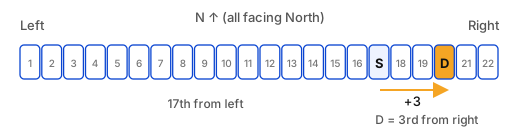
In a row of 22 students facing North, Sunil is 17th from the left end. If Deepak is 3rd to the right of Sunil, what is Deepak's position from the right end of the row?
उत्तर की ओर मुख किए 22 छात्रों की एक पंक्ति में, सुनील बाएँ छोर से 17वें स्थान पर है। यदि दीपक, सुनील के दाएँ तीसरे स्थान पर है, तो पंक्ति के दाएँ छोर से दीपक का स्थान क्या है?
  1. A4thचौथा
  2. B1stपहला
  3. C3rdतीसरा
  4. D2ndदूसरा
Show answer

Concept: In a row of n people, position from the right =n−(position from left)+1.

  1. Sunil is 17th from the left. Deepak is 3rd to his right → Deepak is 17+3=20th from the left.
  2. Position from the right =22−20+1=3rd.

Trick: Left position + Right position =n+1; so 20+R=23⇒R=3.

Answer: (C) 3rd

अवधारणा: n लोगों की पंक्ति में दाएँ से स्थान =n−(बाएँ से स्थान)+1।

  1. सुनील बाएँ से 17वाँ है। दीपक उसके दाएँ तीसरा → दीपक बाएँ से 17+3=20वाँ।
  2. दाएँ से स्थान =22−20+1=3रा।

ट्रिक: बाएँ स्थान + दाएँ स्थान =n+1; अतः 20+R=23⇒R=3।

उत्तर: (C) तीसरा (3rd)

RRB NTPC Undergraduate CBT 1General Intelligence and ReasoningLinear arrangement – position in a rowRRB NTPC Undergraduate CBT 1 2025 · 7 May Shift 2 →
Q8377.
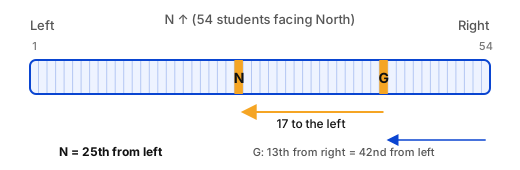
In a row of 54 students facing the north, Gagan is 13th from the right end. If Nitin is 17th to the left of Gagan, what is Nitin's position from the left end of the line?
उत्तर की ओर मुख किए 54 छात्रों की एक पंक्ति में, गगन दाएँ छोर से 13वें स्थान पर है। यदि नितिन, गगन के बाएँ 17वें स्थान पर है, तो पंक्ति के बाएँ छोर से नितिन का स्थान क्या है?
  1. A23rd23वाँ
  2. B25th25वाँ
  3. C27th27वाँ
  4. D30th30वाँ
Show answer

Concept: Convert every position to "from the left" first, then move along the row.

  1. Gagan is 13th from the right in a row of 54 → from the left he is 54−13+1=42nd.
  2. Nitin is 17th to the left of Gagan → 42−17=25th from the left.

Trick: "To the left" means subtract from the left-position; "to the right" means add.

Answer: (B) 25th

अवधारणा: पहले हर स्थान को "बाएँ से" में बदलें, फिर पंक्ति में आगे-पीछे चलें।

  1. 54 की पंक्ति में गगन दाएँ से 13वाँ → बाएँ से 54−13+1=42वाँ।
  2. नितिन गगन के बाएँ 17वाँ → बाएँ से 42−17=25वाँ।

ट्रिक: "बाएँ" का अर्थ बाएँ-स्थान में से घटाना; "दाएँ" का अर्थ जोड़ना।

उत्तर: (B) 25वाँ (25th)

RRB NTPC Undergraduate CBT 1General Intelligence and ReasoningLinear arrangement – position in a rowRRB NTPC Undergraduate CBT 1 2025 · 7 May Shift 2 →
Q8378.
Refer to the following series and answer the question. (Counting to be done from left to right only.) (All numbers are single-digit numbers only.)
(Left) 4 6 2 9 1 4 9 7 1 7 6 5 3 6 4 1 4 3 8 4 2 2 3 9 9 7 6 (Right)
How many such even digits are there, each of which is immediately preceded by a perfect square and immediately followed by an odd digit? (NOTE: 1 is also a perfect square.)
निम्नलिखित शृंखला को देखिए और प्रश्न का उत्तर दीजिए। (गिनती केवल बाएँ से दाएँ की जानी है।) (सभी संख्याएँ केवल एक-अंकीय संख्याएँ हैं।)
(बाएँ) 4 6 2 9 1 4 9 7 1 7 6 5 3 6 4 1 4 3 8 4 2 2 3 9 9 7 6 (दाएँ)
ऐसे कितने सम अंक हैं, जिनमें से प्रत्येक के ठीक पहले एक पूर्ण वर्ग और ठीक बाद एक विषम अंक है? (नोट: 1 भी एक पूर्ण वर्ग है।)
  1. AThreeतीन
  2. BTwoदो
  3. COneएक
  4. DNoneकोई नहीं
Show answer

Concept: Perfect-square digits are 1, 4 and 9. We need an even digit whose left neighbour is 1, 4 or 9 and whose right neighbour is odd.

  1. Series: 4 6 2 9 1 4 9 7 1 7 6 5 3 6 4 1 4 3 8 4 2 2 3 9 9 7 6.
  2. Even digits with 1, 4 or 9 before them: 4-6-2 (next 2 is even ✗), 1-4-9 (9 odd ✓), 1-4-3 (3 odd ✓), 4-2-2 (next 2 even ✗).
  3. Count = 2.

Trick: Circle every 1, 4, 9 first; only the digit immediately after each circle needs to be tested.

Answer: (B) Two

अवधारणा: पूर्ण वर्ग अंक 1, 4 और 9 हैं। हमें ऐसा सम अंक चाहिए जिसके बाएँ 1, 4 या 9 हो और दाएँ विषम अंक।

  1. श्रृंखला: 4 6 2 9 1 4 9 7 1 7 6 5 3 6 4 1 4 3 8 4 2 2 3 9 9 7 6।
  2. जिन सम अंकों से पहले 1, 4 या 9 है: 4-6-2 (अगला 2 सम ✗), 1-4-9 (9 विषम ✓), 1-4-3 (3 विषम ✓), 4-2-2 (अगला 2 सम ✗)।
  3. संख्या = 2।

ट्रिक: पहले हर 1, 4, 9 पर गोला लगाएँ; केवल गोले के ठीक बाद वाला अंक जाँचना है।

उत्तर: (B) दो (Two)

RRB NTPC Undergraduate CBT 1General Intelligence and ReasoningNumber series – counting with conditionsRRB NTPC Undergraduate CBT 1 2025 · 7 May Shift 2 →
Q8379.
JDHK is related to OIMP in a certain way based on the English alphabetical order. In the same way, MGKN is related to RLPS. To which of the following is PJNQ related, following the same logic?
अंग्रेज़ी वर्णमाला क्रम के आधार पर JDHK एक निश्चित प्रकार से OIMP से संबंधित है। उसी प्रकार, MGKN, RLPS से संबंधित है। समान तर्क का अनुसरण करते हुए PJNQ निम्नलिखित में से किससे संबंधित है?
  1. AOUVS
  2. BOUSV
  3. CUOSV
  4. DUOVS
Show answer

Concept: Compare the positions of corresponding letters in the two given pairs to find the shift.

  1. JDHK → OIMP: J(10)+5 = O(15), D(4)+5 = I(9), H(8)+5 = M(13), K(11)+5 = P(16). Rule: +5 to every letter.
  2. MGKN → RLPS: M+5 = R, G+5 = L, K+5 = P, N+5 = S ✓ (same rule).
  3. PJNQ → P+5 = U, J+5 = O, N+5 = S, Q+5 = V → UOSV.

Trick: Options differ only in the order of the same letters – keep the letters in sequence (U, O, S, V) and don't let the look-alike options confuse you.

Answer: (C) UOSV

अवधारणा: दिए गए दोनों युग्मों में संगत अक्षरों के स्थान मिलाकर बदलाव (shift) खोजें।

  1. JDHK → OIMP: J(10)+5 = O(15), D(4)+5 = I(9), H(8)+5 = M(13), K(11)+5 = P(16)। नियम: हर अक्षर में +5।
  2. MGKN → RLPS: M+5 = R, G+5 = L, K+5 = P, N+5 = S ✓ (वही नियम)।
  3. PJNQ → P+5 = U, J+5 = O, N+5 = S, Q+5 = V → UOSV।

ट्रिक: विकल्पों में वही अक्षर अलग क्रम में हैं – अक्षरों का क्रम (U, O, S, V) बनाए रखें, मिलते-जुलते विकल्पों से भ्रमित न हों।

उत्तर: (C) UOSV

RRB NTPC Undergraduate CBT 1General Intelligence and ReasoningLetter-cluster analogyRRB NTPC Undergraduate CBT 1 2025 · 7 May Shift 2 →
Q8380.
Based on the English alphabetical order, three of the following four letter-cluster pairs are alike in a certain way and thus form a group. Which is the one that does not belong to that group? (Note: The odd one out is not based on the number of
consonants/vowels or their position in the letter cluster.)
अंग्रेज़ी वर्णमाला क्रम के आधार पर, निम्नलिखित चार अक्षर-समूह युग्मों में से तीन एक निश्चित प्रकार से समान हैं और इस प्रकार एक समूह बनाते हैं। वह कौन-सा है जो उस समूह से संबंधित नहीं है? (नोट: असंगत युग्म व्यंजनों/स्वरों की संख्या या अक्षर-समूह में उनके स्थान पर
आधारित नहीं है।)
  1. AEH-JB
  2. BLO-QJ
  3. COR-TM
  4. DHK-MF
Show answer

Concept: Find the position relation inside each pair and see which pair breaks it.

  1. LO–QJ: L+3 = O, O+2 = Q, and J = L−2. OR–TM: O+3 = R, R+2 = T, M = O−2. HK–MF: H+3 = K, K+2 = M, F = H−2.
  2. Pattern: 2nd = 1st+3, 3rd = 2nd+2, 4th = 1st−2.
  3. EH–JB: E+3 = H ✓, H+2 = J ✓, but B = E−3 (should be C = E−2) ✗.

Trick: When the first three letters match the pattern in all options, check only the last letter: L→J, O→M, H→F are all "−2", E→B is "−3".

Answer: (A) EH–JB

अवधारणा: हर युग्म के अंदर स्थानों का संबंध निकालें और देखें कौन-सा युग्म उसे तोड़ता है।

  1. LO–QJ: L+3 = O, O+2 = Q, और J = L−2। OR–TM: O+3 = R, R+2 = T, M = O−2। HK–MF: H+3 = K, K+2 = M, F = H−2।
  2. पैटर्न: दूसरा = पहला+3, तीसरा = दूसरा+2, चौथा = पहला−2।
  3. EH–JB: E+3 = H ✓, H+2 = J ✓, पर B = E−3 (होना चाहिए C = E−2) ✗।

ट्रिक: जब पहले तीन अक्षर सब विकल्पों में पैटर्न पर हों, तो केवल अंतिम अक्षर जाँचें: L→J, O→M, H→F सब "−2", E→B "−3"।

उत्तर: (A) EH–JB

RRB NTPC Undergraduate CBT 1General Intelligence and ReasoningOdd one out – letter-cluster pairsRRB NTPC Undergraduate CBT 1 2025 · 7 May Shift 2 →