Question bank

Q&A: practice questions with answers

Search questions on any topic. Filter by exam category, exam, subject and topic, try the question, then open the answer and explanation.

Courses – airGurukul

8,495 questions found.

Q941.
After allowing a discount of 28%, an article is available for ₹3,240. Its marked price is _______.
28% की छूट देने के बाद, एक वस्तु ₹3,240 में उपलब्ध है। इसका अंकित मूल्य _______ है।
  1. A₹4,147
  2. B₹4,450
  3. C₹4,332
  4. D₹4,500
Show answer

Concept: Selling price after discount =MP×100−Discount%100.

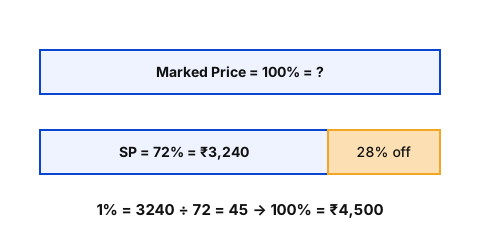
  1. After a 28% discount, SP =72% of MP.
  2. 72% of MP = ₹3240
  3. MP =3240×10072=45×100= ₹4500

Trick: Check: 10% of 4500 = 450; 28% = 1260; 4500−1260=3240 ✓.

Answer: (D) ₹4,500

अवधारणा: छूट के बाद विक्रय मूल्य =अंकित मूल्य×100−छूट%100।

  1. 28% छूट के बाद SP = MP का 72%।
  2. MP का 72% = ₹3240
  3. MP =3240×10072=45×100= ₹4500

ट्रिक: जाँच: 4500 का 28% = 1260; 4500−1260=3240 ✓।

उत्तर: (D) ₹4,500

RRB NTPC Undergraduate CBT 1MathematicsDiscountRRB NTPC Undergraduate CBT 1 2024 · 21 Aug Shift 3 →
Q942.
If the 6-digit number N84M69 is divisible by 11, then which of the options below can give a possible correct relation between M and N?
यदि 6-अंकीय संख्या N84M69, 11 से विभाज्य है, तो नीचे दिए गए विकल्पों में से कौन-सा M और N के बीच एक संभावित सही संबंध दे सकता है?
  1. AM + N = 7
  2. BM - N = 1
  3. CM = N
  4. DM - N = -7
Show answer

Concept: A number is divisible by 11 if (sum of digits at odd places) − (sum of digits at even places) is 0 or a multiple of 11.

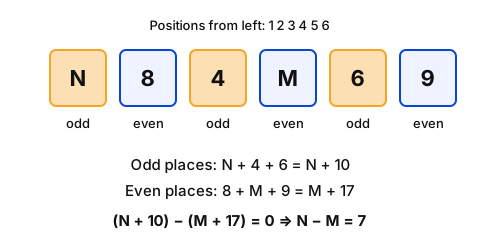
  1. Odd places: N+4+6=N+10; even places: 8+M+9=M+17.
  2. Difference: (N+10)−(M+17)=N−M−7.
  3. N−M−7=0⇒N−M=7, i.e. M−N=−7 (e.g. N=9,M=2: 984269 =11×89479).
  4. N−M−7=−11 gives M−N=4, not an option; +11 is impossible for digits.

Trick: Write the digits with alternate + and − signs: N−8+4−M+6−9=N−M−7.

Answer: (D) M−N=−7

अवधारणा: कोई संख्या 11 से विभाज्य है यदि (विषम स्थानों के अंकों का योग) − (सम स्थानों के अंकों का योग) 0 या 11 का गुणज हो।

  1. विषम स्थान: N+4+6=N+10; सम स्थान: 8+M+9=M+17।
  2. अंतर: (N+10)−(M+17)=N−M−7।
  3. N−M−7=0⇒N−M=7, अर्थात M−N=−7 (जैसे N=9,M=2: 984269 =11×89479)।
  4. N−M−7=−11 से M−N=4 मिलता है जो विकल्प में नहीं है; +11 अंकों के लिए असंभव है।

ट्रिक: अंकों पर बारी-बारी से + और − लगाएँ: N−8+4−M+6−9=N−M−7।

उत्तर: (D) M−N=−7

RRB NTPC Undergraduate CBT 1MathematicsDivisibility by 11RRB NTPC Undergraduate CBT 1 2024 · 21 Aug Shift 3 →
Q943.
Pipe A can fill a tank in 12 hours, pipe B can fill the same tank in 22 hours and pipe C can fill the same tank in 8 hours. The time taken by them to fill the same tank if they operate together is::
पाइप A एक टंकी को 12 घंटे में, पाइप B उसी टंकी को 22 घंटे में और पाइप C उसी टंकी को 8 घंटे में भर सकता है। यदि वे एक साथ कार्य करें, तो उसी टंकी को भरने में उनके द्वारा लिया गया समय है:
  1. A46367 hours46367 घंटे
  2. B36367 hours36367 घंटे
  3. C26367 hours26367 घंटे
  4. D56367 hours56367 घंटे
Show answer

Concept: Take tank capacity = LCM of times; each pipe's efficiency =capacitytime.

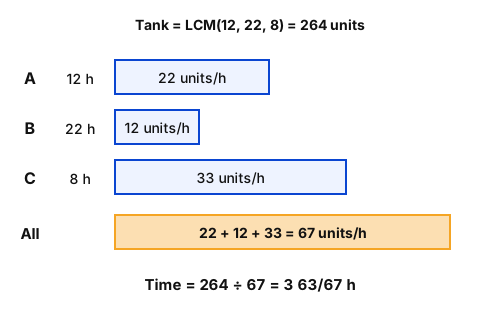
  1. LCM(12,22,8)=264 units.
  2. A =26412=22, B =26422=12, C =2648=33 units/h.
  3. Together =22+12+33=67 units/h.
  4. Time =26467=36367 hours.

Trick: All options end in 6367; only the whole part matters: 67×3=201<264<268, so it is 3.

Answer: (B) 36367 hours

अवधारणा: टंकी की क्षमता = समयों का LCM लें; प्रत्येक पाइप की दक्षता =क्षमतासमय।

  1. LCM(12,22,8)=264 इकाई।
  2. A =26412=22, B =26422=12, C =2648=33 इकाई/घंटा।
  3. एक साथ =22+12+33=67 इकाई/घंटा।
  4. समय =26467=36367 घंटे।

ट्रिक: सभी विकल्पों में 6367 है; केवल पूर्णांक भाग देखें: 67×3=201<264<268, अतः 3।

उत्तर: (B) 36367 घंटे

RRB NTPC Undergraduate CBT 1MathematicsPipes and CisternsRRB NTPC Undergraduate CBT 1 2024 · 21 Aug Shift 3 →
Q944.
A train that is 220 m long overtakes a man moving at a speed of 10 km/hr (in same direction) in 44 seconds. How much time (in seconds) will it take this train to completely cross another train of a length of 315 m, moving in the opposite direction at a speed of 79 km/hr?
220 m लंबी एक ट्रेन, 10 km/hr की चाल से (समान दिशा में) चल रहे एक व्यक्ति को 44 सेकंड में पार करती है। यह ट्रेन विपरीत दिशा में 79 km/hr की चाल से चल रही 315 m लंबी दूसरी ट्रेन को पूरी तरह पार करने में कितना समय (सेकंड में) लेगी?
  1. A14
  2. B32
  3. C28
  4. D18
Show answer

Concept: Same direction: relative speed = difference; opposite direction: relative speed = sum. 1km/h=518m/s.

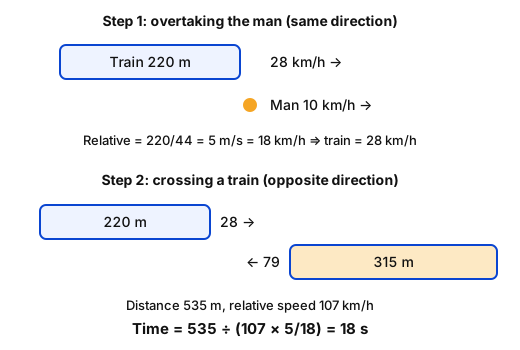
  1. Overtaking the man: relative speed =22044=5m/s=5×185=18km/h.
  2. Train speed =18+10=28km/h.
  3. Opposite train: relative speed =28+79=107km/h=107×518m/s; distance =220+315=535m.
  4. Time =535×18107×5=5×185=18s.

Trick: 535=5×10⁷ – the numbers are chosen to cancel neatly.

Answer: (D) 18

अवधारणा: समान दिशा: सापेक्ष चाल = अंतर; विपरीत दिशा: सापेक्ष चाल = योग। 1km/h=518m/s।

  1. आदमी को पार करना: सापेक्ष चाल =22044=5m/s=18km/h।
  2. रेलगाड़ी की चाल =18+10=28km/h।
  3. विपरीत दिशा की रेलगाड़ी: सापेक्ष चाल =28+79=107km/h=107×518m/s; दूरी =220+315=535m।
  4. समय =535×18107×5=18s।

ट्रिक: 535=5×10⁷ – संख्याएँ आसानी से कट जाती हैं।

उत्तर: (D) 18

RRB NTPC Undergraduate CBT 1MathematicsTrains – Relative SpeedRRB NTPC Undergraduate CBT 1 2024 · 21 Aug Shift 3 →
Q945.
A sum of ₹15,625 amounts to ₹24,389 in 3 years at a certain rate of interest per annum, compounded annually. The rate of interest per annum is:
₹15,625 की एक राशि, वार्षिक रूप से चक्रवृद्धि होने वाली एक निश्चित वार्षिक ब्याज दर पर 3 वर्षों में ₹24,389 हो जाती है। वार्षिक ब्याज दर है:
  1. A14%
  2. B16%
  3. C19%
  4. D15%
Show answer

Concept: A=P(1+R100)n.

  1. 2438915625=(1+R100)3
  2. 15625=253 and 24389=293, so (2925)3=(1+R100)3.
  3. 1+R100=2925⇒R100=425⇒R=16%.

Trick: Know cubes up to 30: 253=15625, 293=24389. Rate =29−2525×100=16%.

Answer: (B) 16%

अवधारणा: A=P(1+R100)n।

  1. 2438915625=(1+R100)3
  2. 15625=253 और 24389=293, अतः (2925)3=(1+R100)3।
  3. 1+R100=2925⇒R=16%।

ट्रिक: 30 तक के घन याद रखें: 253=15625, 293=24389। दर =29−2525×100=16%।

उत्तर: (B) 16%

RRB NTPC Undergraduate CBT 1MathematicsCompound InterestRRB NTPC Undergraduate CBT 1 2024 · 21 Aug Shift 3 →
Q946.
Find the value of [868 ÷ {26 + 6 × (3 − 7)}].
[868 ÷ {26 + 6 × (3 − 7)}] का मान ज्ञात कीजिए।
  1. A432
  2. B435
  3. C431
  4. D434
Show answer

Concept: BODMAS: solve innermost brackets first, then multiplication/division, then addition/subtraction.

  1. (3−7)=−4
  2. 6×(−4)=−24
  3. {26−24}=2
  4. 868÷2=434

Trick: Watch the negative sign: 6×(−4) is −24, not +24.

Answer: (D) 434

अवधारणा: BODMAS: पहले सबसे भीतरी कोष्ठक, फिर गुणा/भाग, फिर जोड़/घटाव।

  1. (3−7)=−4
  2. 6×(−4)=−24
  3. {26−24}=2
  4. 868÷2=434

ट्रिक: ऋण चिह्न पर ध्यान दें: 6×(−4)=−24 है, +24 नहीं।

उत्तर: (D) 434

RRB NTPC Undergraduate CBT 1MathematicsSimplification (BODMAS)RRB NTPC Undergraduate CBT 1 2024 · 21 Aug Shift 3 →
Q947.
Sapna invested ₹21,700 on simple interest, partly at 3% per annum and partly at 12% per annum. If she earns equal interests from the two investments after 7 years, then find the sum invested at 3% per annum (in ₹).
सपना ने ₹21,700 साधारण ब्याज पर निवेश किए, कुछ भाग 3% वार्षिक दर पर और कुछ भाग 12% वार्षिक दर पर। यदि 7 वर्षों के बाद उसे दोनों निवेशों से समान ब्याज प्राप्त होता है, तो 3% वार्षिक दर पर निवेश की गई राशि (₹ में) ज्ञात कीजिए।
  1. A17,360
  2. B17,357
  3. C17,361
  4. D17,358
Show answer

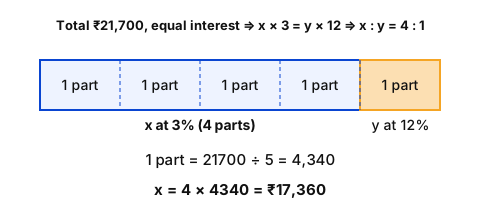
Concept: SI=P×R×T100. Equal SI for the same time ⇒ principal ∝1rate.

  1. Let x at 3% and y at 12%: x×3×7100=y×12×7100⇒3x=12y.
  2. x:y=4:1 (5 parts in total).
  3. 1 part =217005=4340, so x=4×4340=17360.

Trick: Equal interest: ratio of sums = inverse ratio of rates =12:3=4:1.

Answer: (A) 17,360

अवधारणा: SI=P×R×T100। समान समय में समान ब्याज ⇒ मूलधन ∝1दर।

  1. मान लें 3% पर x और 12% पर y: x×3×7100=y×12×7100⇒3x=12y।
  2. x:y=4:1 (कुल 5 भाग)।
  3. 1 भाग =217005=4340, अतः x=4×4340=17360।

ट्रिक: समान ब्याज: राशियों का अनुपात = दरों का व्युत्क्रम अनुपात =12:3=4:1।

उत्तर: (A) 17,360

RRB NTPC Undergraduate CBT 1MathematicsSimple InterestRRB NTPC Undergraduate CBT 1 2024 · 21 Aug Shift 3 →
Q948.
Which of the following is the greatest number that, when dividing 183, 127 and 211, leaves the same remainder each time?
निम्नलिखित में से वह सबसे बड़ी संख्या कौन-सी है, जिससे 183, 127 और 211 को विभाजित करने पर प्रत्येक बार समान शेषफल प्राप्त होता है?
  1. A25
  2. B28
  3. C30
  4. D32
Show answer

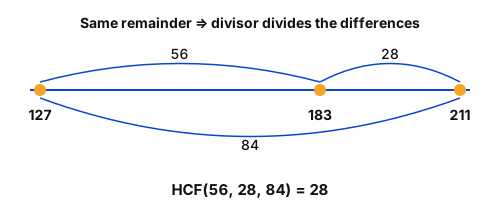
Concept: If a number leaves the same remainder with a, b, c, it divides their differences. Greatest such number = HCF of the differences.

  1. Differences: 183−127=56, 211−183=28, 211−127=84.
  2. HCF(56,28,84)=28.
  3. Check: 127=4×28+15, 183=6×28+15, 211=7×28+15 – remainder 15 each time.

Trick: HCF of |a−b| and |b−c| is enough: HCF(56,28)=28.

Answer: (B) 28

अवधारणा: यदि कोई संख्या a, b, c में समान शेषफल छोड़ती है, तो वह उनके अंतरों को विभाजित करती है। सबसे बड़ी संख्या = अंतरों का HCF।

  1. अंतर: 183−127=56, 211−183=28, 211−127=84।
  2. HCF(56,28,84)=28।
  3. जाँच: 127=4×28+15, 183=6×28+15, 211=7×28+15 – हर बार शेषफल 15।

ट्रिक: दो अंतरों का HCF काफ़ी है: HCF(56,28)=28।

उत्तर: (B) 28

RRB NTPC Undergraduate CBT 1MathematicsHCF – Same RemainderRRB NTPC Undergraduate CBT 1 2024 · 21 Aug Shift 3 →
Q949.
Simplify: sinAtanA1−cosA
सरल कीजिए: sinAtanA1−cosA
  1. A1+secA
  2. B1+sinA
  3. C1+cosA
  4. D1+cosecA
Show answer

Concept: Use tanA=sinAcosA and sin2A=1−cos2A=(1−cosA)(1+cosA).

  1. sinAtanA1−cosA=sin2AcosA(1−cosA)
  2. =(1−cosA)(1+cosA)cosA(1−cosA)=1+cosAcosA
  3. =secA+1=1+secA

Trick: Put A=60∘: 32×312=3, and 1+sec60∘=1+2=3 ✓.

Answer: (A) 1+secA

अवधारणा: tanA=sinAcosA और sin2A=1−cos2A=(1−cosA)(1+cosA) का प्रयोग करें।

  1. sinAtanA1−cosA=sin2AcosA(1−cosA)
  2. =(1−cosA)(1+cosA)cosA(1−cosA)=1+cosAcosA
  3. =secA+1

ट्रिक: A=60∘ रखें: 32×312=3, और 1+sec60∘=3 ✓।

उत्तर: (A) 1+secA

RRB NTPC Undergraduate CBT 1MathematicsTrigonometric IdentitiesRRB NTPC Undergraduate CBT 1 2024 · 21 Aug Shift 3 →
Q950.
The product of two consecutive natural numbers is 182. The greater of the two numbers is:
दो क्रमागत प्राकृत संख्याओं का गुणनफल 182 है। दोनों में से बड़ी संख्या है:
  1. A14
  2. B26
  3. C7
  4. D27
Show answer

Concept: Product of consecutive numbers n(n+1) lies close to n2, so look near 182.

  1. 182≈13.5, so try 13 and 14.
  2. 13×14=182 ✓
  3. The greater number is 14.

Trick: Unit digit 2 comes from 3×4 – so the numbers end in 3 and 4: 13, 14.

Answer: (A) 14

अवधारणा: क्रमागत संख्याओं का गुणनफल n(n+1), n2 के निकट होता है, अतः 182 के पास देखें।

  1. 182≈13.5, अतः 13 और 14 आज़माएँ।
  2. 13×14=182 ✓
  3. बड़ी संख्या 14 है।

ट्रिक: इकाई अंक 2 = 3×4 से – संख्याएँ 3 और 4 पर समाप्त: 13, 14।

उत्तर: (A) 14

RRB NTPC Undergraduate CBT 1MathematicsNumber SystemRRB NTPC Undergraduate CBT 1 2024 · 21 Aug Shift 3 →
Q951.
If the third proportional of 25 and 35 be x, then what is the value of x?
यदि 25 और 35 का तृतीयानुपाती x है, तो x का मान क्या है?
  1. A52
  2. B51
  3. C49
  4. D50
Show answer

Concept: If x is the third proportional of a and b, then a:b=b:x, i.e. x=b2a.

  1. 25:35=35:x
  2. x=35225=122525=49

Trick: Third proportional =(second)2first.

Answer: (C) 49

अवधारणा: यदि a और b का तृतीय समानुपाती (third proportional) x है, तो a:b=b:x, अर्थात x=b2a।

  1. 25:35=35:x
  2. x=35225=122525=49

ट्रिक: तृतीय समानुपाती =(दूसरी संख्या)2पहली संख्या।

उत्तर: (C) 49

RRB NTPC Undergraduate CBT 1MathematicsThird proportionalRRB NTPC Undergraduate CBT 1 2024 · 21 Aug Shift 3 →
Q952.
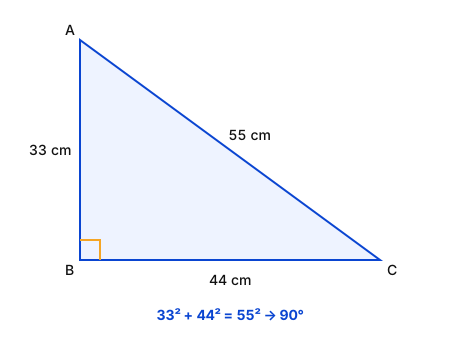
The sides of a triangle are 44 cm, 33 cm, and 55 cm. What is its area? (in cm2 )
एक त्रिभुज की भुजाएँ 44 cm, 33 cm और 55 cm हैं। इसका क्षेत्रफल क्या है? (cm2 में)
  1. A732
  2. B726
  3. C742
  4. D749
Show answer

Concept: Check for a Pythagorean triplet first; then area =12×base×height.

  1. 33:44:55=3:4:5 (each ×11), so the triangle is right-angled.
  2. 332+442=1089+1936=3025=552
  3. Area =12×33×44=726cm2

Trick: Spot 3:4:5 multiples – no need for Heron's formula.

Answer: (B) 726

अवधारणा: पहले पाइथागोरस त्रिक (triplet) देखें; फिर क्षेत्रफल =12×आधार×ऊँचाई।

  1. 33:44:55=3:4:5 (प्रत्येक ×11), अतः त्रिभुज समकोण है।
  2. 332+442=1089+1936=3025=552
  3. क्षेत्रफल =12×33×44=726cm2

ट्रिक: 3:4:5 के गुणज पहचानें – हीरोन सूत्र की ज़रूरत नहीं।

उत्तर: (B) 726

RRB NTPC Undergraduate CBT 1MathematicsArea of triangleRRB NTPC Undergraduate CBT 1 2024 · 21 Aug Shift 3 →
Q953.
A number, when increased by 60%, gives 3570. The number is:
एक संख्या में 60% की वृद्धि करने पर 3570 प्राप्त होता है। वह संख्या है:
  1. A4462.5
  2. B1115.625
  3. C2231.25
  4. D6693.75
Show answer

Concept: After a 60% increase, the number becomes 160% of itself.

  1. 1.6×N=3570
  2. N=35701.6=2231.25

Trick: Divide by the multiplying factor 1+r100.

Answer: (C) 2231.25

अवधारणा: 60% वृद्धि के बाद संख्या अपनी 160% हो जाती है।

  1. 1.6×N=3570
  2. N=35701.6=2231.25

ट्रिक: गुणक 1+r100 से भाग दें।

उत्तर: (C) 2231.25

RRB NTPC Undergraduate CBT 1MathematicsPercentage increaseRRB NTPC Undergraduate CBT 1 2024 · 21 Aug Shift 3 →
Q954.
The number of prime numbers lying between 306 and 313, both included, is:
306 और 313 (दोनों सम्मिलित) के बीच स्थित अभाज्य संख्याओं की संख्या है:
  1. A2
  2. B5
  3. C3
  4. D4
Show answer

Concept: Test each number from 306 to 313 for divisibility by primes up to 313≈17.

  1. 306, 308, 310, 312 are even; 309=3×10³.
  2. 307, 311 and 313 have no prime factor up to 17, so they are prime.
  3. Count =3

Trick: Only odd numbers not ending in 5 need checking.

Answer: (C) 3

अवधारणा: 306 से 313 तक प्रत्येक संख्या को 313≈17 तक के अभाज्य अंकों से जाँचें।

  1. 306, 308, 310, 312 सम हैं; 309=3×10³।
  2. 307, 311 और 313 का 17 तक कोई अभाज्य गुणनखंड नहीं, अतः ये अभाज्य हैं।
  3. संख्या =3

ट्रिक: केवल वे विषम संख्याएँ जाँचें जो 5 पर समाप्त न हों।

उत्तर: (C) 3

RRB NTPC Undergraduate CBT 1MathematicsPrime numbersRRB NTPC Undergraduate CBT 1 2024 · 21 Aug Shift 3 →
Q955.
A jacket is marked at ₹12,000. Store A offers two successive discounts of 15% and 10%. Store B offers two successive discounts of 10% and 15%. A customer wants to know which store provides a better deal and by how much?
एक जैकेट का अंकित मूल्य ₹12,000 है। स्टोर A, 15% और 10% की दो क्रमिक छूट देता है। स्टोर B, 10% और 15% की दो क्रमिक छूट देता है। एक ग्राहक जानना चाहता है कि कौन-सा स्टोर बेहतर सौदा देता है और कितने से?
  1. AStore A; by ₹150स्टोर A; ₹150 से
  2. BStore A; by ₹100स्टोर A; ₹100 से
  3. CStore B; by ₹100स्टोर B; ₹100 से
  4. DBoth stores A and B offer the same priceस्टोर A और B दोनों समान मूल्य देते हैं
Show answer

Concept: Successive discounts multiply, so their order does not change the final price.

  1. Store A: 12000×0.85×0.90=9180
  2. Store B: 12000×0.90×0.85=9180
  3. Both prices are ₹9,180.

Trick: Equivalent discount of a% and b% =a+b−ab100=23.5% either way.

Answer: (D) Both stores A and B offer the same price

अवधारणा: क्रमिक छूट गुणा होती हैं, इसलिए क्रम बदलने से अंतिम मूल्य नहीं बदलता।

  1. स्टोर A: 12000×0.85×0.90=9180
  2. स्टोर B: 12000×0.90×0.85=9180
  3. दोनों मूल्य ₹9,180 हैं।

ट्रिक: a% और b% की समतुल्य छूट =a+b−ab100=23.5%, किसी भी क्रम में।

उत्तर: (D) दोनों स्टोर A और B समान मूल्य देते हैं

RRB NTPC Undergraduate CBT 1MathematicsSuccessive discountsRRB NTPC Undergraduate CBT 1 2024 · 21 Aug Shift 3 →
Q956.
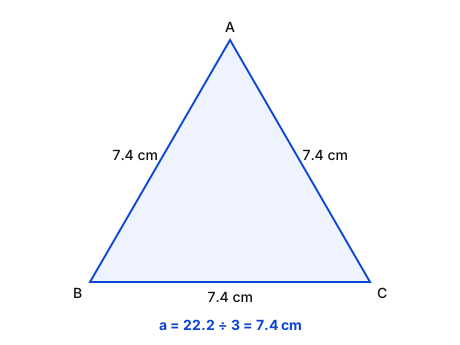
The perimeter of an equilateral triangle ABC is 22.2 cm. What is the area of triangle (in cm2)?
एक समबाहु त्रिभुज ABC का परिमाप 22.2 cm है। त्रिभुज का क्षेत्रफल (cm2 में) क्या है?
  1. A13.693
  2. B14.933
  3. C12.763
  4. D11.363
Show answer

Concept: Area of an equilateral triangle =34a2.

  1. a=22.23=7.4cm
  2. a2=54.76
  3. Area =34×54.76=13.693cm2

Trick: a24=(a2)2=3.72=13.69.

Answer: (A) 13.693

अवधारणा: समबाहु त्रिभुज का क्षेत्रफल =34a2।

  1. a=22.23=7.4cm
  2. a2=54.76
  3. क्षेत्रफल =34×54.76=13.693cm2

ट्रिक: a24=(a2)2=3.72=13.69।

उत्तर: (A) 13.693

RRB NTPC Undergraduate CBT 1MathematicsEquilateral triangle areaRRB NTPC Undergraduate CBT 1 2024 · 21 Aug Shift 3 →
Q957.
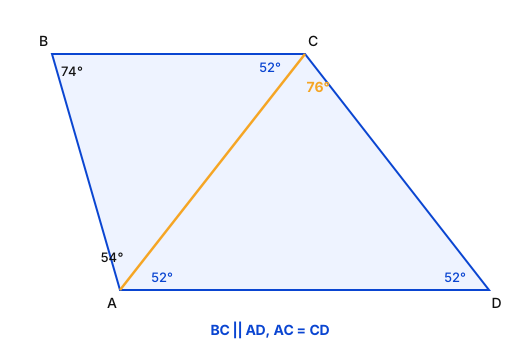
ABCD is a trapezium in which BC∥AD and AC=CD. If ∠ABC=74∘ and ∠BAC=54∘, then what is the measure of ∠ACD (in degree)?
ABCD एक समलंब चतुर्भुज है जिसमें BC∥AD और AC=CD है। यदि ∠ABC=74∘ और ∠BAC=54∘ है, तो ∠ACD की माप (डिग्री में) क्या है?
  1. A76°
  2. B91°
  3. C85°
  4. D82°
Show answer

Concept: Use the angle sum of a triangle, alternate angles of parallel lines and equal base angles of an isosceles triangle.

  1. In △ABC: ∠BCA=180∘−74∘−54∘=52∘
  2. BC∥AD ⇒ ∠CAD=∠BCA=52∘ (alternate angles)
  3. AC=CD ⇒ ∠CDA=∠CAD=52∘
  4. ∠ACD=180∘−52∘−52∘=76∘

Trick: Diagonal + parallel sides ⇒ look for alternate angles first.

Answer: (A) 76∘

अवधारणा: त्रिभुज का कोण योग, समांतर रेखाओं के एकांतर कोण (alternate angles) और समद्विबाहु त्रिभुज के समान आधार कोण का प्रयोग करें।

  1. △ABC में: ∠BCA=180∘−74∘−54∘=52∘
  2. BC∥AD ⇒ ∠CAD=∠BCA=52∘ (एकांतर कोण)
  3. AC=CD ⇒ ∠CDA=∠CAD=52∘
  4. ∠ACD=180∘−52∘−52∘=76∘

ट्रिक: विकर्ण + समांतर भुजाएँ ⇒ पहले एकांतर कोण खोजें।

उत्तर: (A) 76∘

RRB NTPC Undergraduate CBT 1MathematicsTrapezium anglesRRB NTPC Undergraduate CBT 1 2024 · 21 Aug Shift 3 →
Q958.
If 3 times Mary’s present age is 18 years more than 5 times Diya's present age, and 2 times Diya's present age is 3 years less than Mary's present age, then what is the difference (in years) between the ages of Mary and Diya?
यदि मैरी की वर्तमान आयु का 3 गुना, दीया की वर्तमान आयु के 5 गुने से 18 वर्ष अधिक है, और दीया की वर्तमान आयु का 2 गुना, मैरी की वर्तमान आयु से 3 वर्ष कम है, तो मैरी और दीया की आयु के बीच अंतर (वर्षों में) क्या है?
  1. A12
  2. B16
  3. C15
  4. D11
Show answer

Concept: Form two linear equations from the statements and solve.

  1. 3M=5D+18 and 2D=M−3, i.e. M=2D+3
  2. 3(2D+3)=5D+18⇒6D+9=5D+18⇒D=9
  3. M=2×9+3=21
  4. Difference =21−9=12 years

Trick: Substitute the simpler equation into the other one.

Answer: (A) 12

अवधारणा: कथनों से दो रैखिक समीकरण बनाकर हल करें।

  1. 3M=5D+18 और 2D=M−3, अर्थात M=2D+3
  2. 3(2D+3)=5D+18⇒6D+9=5D+18⇒D=9
  3. M=2×9+3=21
  4. अंतर =21−9=12 वर्ष

ट्रिक: सरल समीकरण को दूसरे में प्रतिस्थापित करें।

उत्तर: (A) 12

RRB NTPC Undergraduate CBT 1MathematicsProblems on agesRRB NTPC Undergraduate CBT 1 2024 · 21 Aug Shift 3 →
Q959.
Find the value of x satisfying: 5(5x2 − 6) − 5(5x2 + 2x − 4) = 20
x का वह मान ज्ञात कीजिए जो समीकरण को संतुष्ट करता है: 5(5x2 − 6) − 5(5x2 + 2x − 4) = 20
  1. A2
  2. B1
  3. C−3
  4. D−1
Show answer

Concept: Expand the brackets; the x2 terms cancel and a linear equation remains.

  1. 25x2−30−25x2−10x+20=20
  2. −10x−10=20
  3. −10x=30⇒x=−3

Trick: Check: 5(45−6)−5(45−6−4)=195−175=20 ✓

Answer: (C) −3

अवधारणा: कोष्ठक खोलें; x2 के पद कट जाते हैं और रैखिक समीकरण बचता है।

  1. 25x2−30−25x2−10x+20=20
  2. −10x−10=20
  3. −10x=30⇒x=−3

ट्रिक: जाँच: 5(45−6)−5(45−6−4)=195−175=20 ✓

उत्तर: (C) −3

RRB NTPC Undergraduate CBT 1MathematicsLinear equationRRB NTPC Undergraduate CBT 1 2024 · 21 Aug Shift 3 →
Q960.
The average weight of Mandar, Ketan and Tushar is 45 kg. If the average weight of Mandar and Ketan is 44 kg and that of Ketan and Tushar is 45 kg, then the weight of Ketan (in kg) is:
मंदार, केतन और तुषार का औसत भार 45 kg है। यदि मंदार और केतन का औसत भार 44 kg है तथा केतन और तुषार का औसत भार 45 kg है, तो केतन का भार (kg में) है:
  1. A53
  2. B63
  3. C43
  4. D58
Show answer

Concept: Total = average × count; the common person is counted in both pair sums.

  1. M+K+T=3×45=135
  2. M+K=88, K+T=90
  3. K=(M+K)+(K+T)−(M+K+T)=88+90−135=43kg

Trick: Sum of the two pairs minus the total gives the common member.

Answer: (C) 43

अवधारणा: कुल = औसत × संख्या; साझा व्यक्ति दोनों जोड़ों के योग में आता है।

  1. M+K+T=3×45=135
  2. M+K=88, K+T=90
  3. K=(M+K)+(K+T)−(M+K+T)=88+90−135=43kg

ट्रिक: दोनों जोड़ों का योग − कुल योग = साझा सदस्य।

उत्तर: (C) 43

RRB NTPC Undergraduate CBT 1MathematicsAverageRRB NTPC Undergraduate CBT 1 2024 · 21 Aug Shift 3 →