Question bank

Q&A: practice questions with answers

Search questions on any topic. Filter by exam category, exam, subject and topic, try the question, then open the answer and explanation.

Courses – airGurukul

8,495 questions found.

Q1041.
Sapna invested ₹20,300 on simple interest, partly at 11% per annum and partly at 3% per annum. If she earns equal interests from the two investments after 5 years, then find the sum invested at 11% per annum (in ₹).
सपना ने ₹20,300 साधारण ब्याज पर निवेश किए, जिसका कुछ भाग 11% वार्षिक दर पर और कुछ भाग 3% वार्षिक दर पर था। यदि 5 वर्ष बाद उसे दोनों निवेशों से समान ब्याज प्राप्त होता है, तो 11% वार्षिक दर पर निवेश की गई राशि (₹ में) ज्ञात कीजिए।
  1. A4,350
  2. B4,351
  3. C4,347
  4. D4,352
Show answer

Concept: For the same time, equal simple interest means P1R1=P2R2, i.e. principal is inversely proportional to rate.
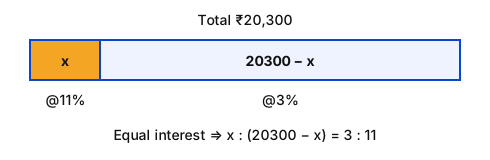
  1. Let ₹x be at 11% and ₹(20300−x) at 3%, both for 5 years.
  2. x×11×5100=(20300−x)×3×5100⇒11x=60900−3x
  3. 14x=60900⇒x=4350

Trick: Ratio of sums =3:11 (inverse of rates). Sum at 11%=314×20300=4350.

Answer: (A) 4,350

अवधारणा: समान समय के लिए बराबर साधारण ब्याज का अर्थ P1R1=P2R2, अर्थात मूलधन दर के व्युत्क्रमानुपाती है।

  1. माना ₹x को 11% पर और ₹(20300−x) को 3% पर 5 वर्ष के लिए लगाया।
  2. x×11×5100=(20300−x)×3×5100⇒11x=60900−3x
  3. 14x=60900⇒x=4350

ट्रिक: राशियों का अनुपात =3:11 (दरों का उल्टा)। 11% वाली राशि =314×20300=4350।

उत्तर: (A) 4,350

RRB NTPC Undergraduate CBT 1MathematicsSimple InterestRRB NTPC Undergraduate CBT 1 2024 · 21 Aug Shift 1 →
Q1042.
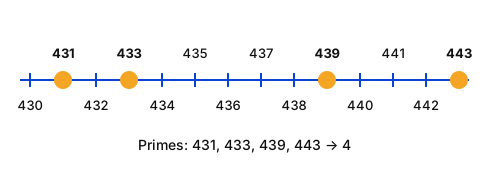
The number of prime numbers lying between 430 and 443, both included, is:
430 और 443 के बीच (दोनों को सम्मिलित करते हुए) स्थित अभाज्य संख्याओं की संख्या कितनी है?
  1. A4
  2. B2
  3. C3
  4. D5
Show answer

Concept: To test a number n for primality, check divisibility by primes up to n; here 443<21, so test 2, 3, 5, 7, 11, 13, 17, 19.

  1. Even numbers and those ending in 5 are out; left: 431, 433, 437, 439, 441, 443.
  2. 441=212 (divisible by 3) and 437=19×23 — not prime.
  3. 431, 433, 439, 443 pass all tests — prime.

Trick: After removing evens and multiples of 5, check only 3, 7, 11, 13, 17, 19 on the remaining odd numbers.

Answer: (A) 4

अवधारणा: किसी संख्या n के अभाज्य होने की जाँच के लिए n तक की अभाज्य संख्याओं से भाग देखें; यहाँ 443<21, अतः 2, 3, 5, 7, 11, 13, 17, 19 से जाँचें।

  1. सम संख्याएँ और 5 पर समाप्त होने वाली हटाएँ; बचीं: 431, 433, 437, 439, 441, 443।
  2. 441=212 (3 से विभाज्य) और 437=19×23 — अभाज्य नहीं।
  3. 431, 433, 439, 443 सभी जाँच में सफल — अभाज्य।

ट्रिक: सम और 5 के गुणज हटाकर बची विषम संख्याओं को केवल 3, 7, 11, 13, 17, 19 से जाँचें।

उत्तर: (A) 4

RRB NTPC Undergraduate CBT 1MathematicsNumber System – Prime NumbersRRB NTPC Undergraduate CBT 1 2024 · 21 Aug Shift 1 →
Q1043.
By how much is 65% of 65 greater than 15 of 25?
65% × 65 का मान, 15 × 25 के मान से कितना अधिक है?
  1. A31.25
  2. B37.25
  3. C35.25
  4. D34.25
Show answer

Concept: x% of y=x100×y; 'greater by' means take the difference.

  1. 65% of 65=65×65100=4225100=42.25
  2. 15 of 25=5
  3. Difference =42.25−5=37.25

Trick: 652=4225 (number ending in 5: 6×7=42, then 25) → 42.25.

Answer: (B) 37.25

अवधारणा: y का x%=x100×y; 'कितना अधिक' का अर्थ है अंतर निकालना।

  1. 65 का 65%=65×65100=4225100=42.25
  2. 25 का 15=5
  3. अंतर =42.25−5=37.25

ट्रिक: 652=4225 (5 पर ख़त्म संख्या: 6×7=42, फिर 25) → 42.25।

उत्तर: (B) 37.25

RRB NTPC Undergraduate CBT 1MathematicsPercentageRRB NTPC Undergraduate CBT 1 2024 · 21 Aug Shift 1 →
Q1044.
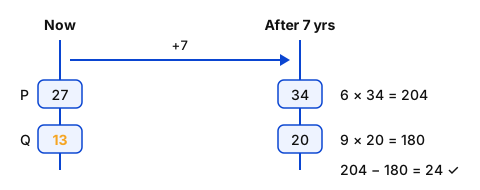
Two times the present age of P exceeds the present age of Q by 41 years. After 7 years, nine times Q’s age will be 24 years less than six times P’s age at that time. What is the present age (in years) of Q?
P की वर्तमान आयु का दोगुना, Q की वर्तमान आयु से 41 वर्ष अधिक है। 7 वर्ष बाद, Q की आयु का नौ गुना, उस समय P की आयु के छह गुने से 24 वर्ष कम होगा। Q की वर्तमान आयु (वर्षों में) क्या है?
  1. A19
  2. B22
  3. C20
  4. D13
Show answer

Concept: Form two equations from the two conditions and solve them together.

  1. Present: 2P−Q=41 … (i)
  2. After 7 years: 9(Q+7)=6(P+7)−24⇒9Q+63=6P+18⇒2P−3Q=15 … (ii)
  3. (i) − (ii): 2Q=26⇒Q=13, and P=27.

Trick: Check options: Q=13⇒P=27; after 7 years 6×34−9×20=204−180=24 ✓.

Answer: (D) 13

अवधारणा: दोनों शर्तों से दो समीकरण बनाकर साथ हल करें।

  1. वर्तमान: 2P−Q=41 … (i)
  2. 7 वर्ष बाद: 9(Q+7)=6(P+7)−24⇒9Q+63=6P+18⇒2P−3Q=15 … (ii)
  3. (i) − (ii): 2Q=26⇒Q=13, और P=27।

ट्रिक: विकल्प जाँचें: Q=13⇒P=27; 7 वर्ष बाद 6×34−9×20=204−180=24 ✓।

उत्तर: (D) 13

RRB NTPC Undergraduate CBT 1MathematicsProblems on AgesRRB NTPC Undergraduate CBT 1 2024 · 21 Aug Shift 1 →
Q1045.
Evaluate: (-9) - (-60) ÷ (-10) + (-3) × 7
मान ज्ञात कीजिए: (-9) - (-60) ÷ (-10) + (-3) × 7
  1. A-35
  2. B-38
  3. C-36
  4. D-39
Show answer

Concept: By BODMAS, do division and multiplication first, then addition and subtraction, keeping track of signs.

  1. (−60)÷(−10)=6
  2. (−3)×7=−21
  3. (−9)−6+(−21)=−9−6−21=−36

Trick: Negative ÷ negative = positive; then '− positive' subtracts.

Answer: (C) −36

अवधारणा: BODMAS के अनुसार पहले भाग और गुणा, फिर जोड़ और घटाव करें; चिह्नों का ध्यान रखें।

  1. (−60)÷(−10)=6
  2. (−3)×7=−21
  3. (−9)−6+(−21)=−9−6−21=−36

ट्रिक: ऋणात्मक ÷ ऋणात्मक = धनात्मक; फिर '− धनात्मक' घटता है।

उत्तर: (C) −36

RRB NTPC Undergraduate CBT 1MathematicsSimplification – BODMASRRB NTPC Undergraduate CBT 1 2024 · 21 Aug Shift 1 →
Q1046.
The LCM of the numbers 14.2 and 0.05 is:
संख्याओं 14.2 और 0.05 का LCM (लघुत्तम समापवर्त्य) क्या है?
  1. A14.2
  2. B0.142
  3. C142
  4. D1.42
Show answer

Concept: Make decimal places equal, find the LCM of the numbers without decimals, then put back the same decimal places.

  1. 14.2=14.20=1420100 and 0.05=5100
  2. LCM(1420,5)=1420 (since 1420 is a multiple of 5)
  3. LCM =1420100=14.2

Trick: If the bigger number is a multiple of the smaller (14.2=284×0.05), the bigger number itself is the LCM.

Answer: (A) 14.2

अवधारणा: दशमलव स्थान बराबर करें, बिना दशमलव की संख्याओं का LCM निकालें, फिर उतने ही दशमलव स्थान लगाएँ।

  1. 14.2=14.20=1420100 और 0.05=5100
  2. LCM(1420,5)=1420 (क्योंकि 1420, 5 का गुणज है)
  3. LCM =1420100=14.2

ट्रिक: यदि बड़ी संख्या छोटी का गुणज हो (14.2=284×0.05), तो बड़ी संख्या ही LCM है।

उत्तर: (A) 14.2

RRB NTPC Undergraduate CBT 1MathematicsLCM of DecimalsRRB NTPC Undergraduate CBT 1 2024 · 21 Aug Shift 1 →
Q1047.
Find the mean proportional of 400 and 4.
400 और 4 का मध्यानुपाती ज्ञात कीजिए।
  1. A37
  2. B39
  3. C40
  4. D41
Show answer

Concept: Mean proportional of a and b is x where a:x=x:b, so x=ab.

  1. x=400×4
  2. =1600=40

Trick: 400×4=20×2=40.

Answer: (C) 40

अवधारणा: a और b का मध्यानुपाती x वह है जिसमें a:x=x:b, अतः x=ab।

  1. x=400×4
  2. =1600=40

ट्रिक: 400×4=20×2=40।

उत्तर: (C) 40

RRB NTPC Undergraduate CBT 1MathematicsRatio – Mean ProportionalRRB NTPC Undergraduate CBT 1 2024 · 21 Aug Shift 1 →
Q1048.
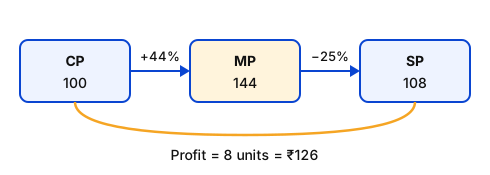
A shopkeeper lists the price of a fan at 44% above its cost price and offers a 25% discount on its list price. If he earns a profit of ₹126, then what is the list price (in ₹) of the fan?
एक दुकानदार एक पंखे का मूल्य उसके क्रय मूल्य से 44% अधिक अंकित करता है और उसके सूची मूल्य पर 25% की छूट देता है। यदि उसे ₹126 का लाभ होता है, तो पंखे का सूची मूल्य (₹ में) क्या है?
  1. A1,968
  2. B2,192
  3. C2,098
  4. D2,268
Show answer

Concept: Take CP =100 units and apply mark-up and discount one after another.

  1. MP =100×1.44=144 units
  2. SP =144×0.75=108 units, so profit =8 units
  3. 8 units=126⇒1 unit=15.75
  4. MP =144×15.75=2268

Trick: Net profit %=44−25−44×25100=8%; MP =1448×126=18×126=2268.

Answer: (D) 2,268

अवधारणा: क्रय मूल्य (CP) =100 इकाई मानें और अंकन (mark-up) व छूट क्रम से लगाएँ।

  1. अंकित मूल्य (MP) =100×1.44=144 इकाई
  2. विक्रय मूल्य (SP) =144×0.75=108 इकाई, अतः लाभ =8 इकाई
  3. 8 इकाई=126⇒1 इकाई=15.75
  4. MP =144×15.75=2268

ट्रिक: शुद्ध लाभ %=44−25−44×25100=8%; MP =1448×126=18×126=2268।

उत्तर: (D) 2,268

RRB NTPC Undergraduate CBT 1MathematicsProfit, Loss and DiscountRRB NTPC Undergraduate CBT 1 2024 · 21 Aug Shift 1 →
Q1049.
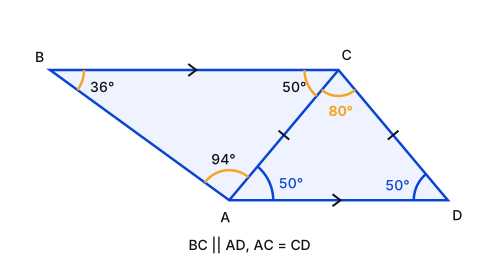
ABCD is a trapezium in which BC∥AD and AC=CD. If ∠ABC=36∘ and ∠BAC=94∘, then what is the measure of ∠ACD (in degree)?
ABCD एक समलंब चतुर्भुज है, जिसमें BC∥AD और AC=CD है। यदि ∠ABC=36∘ और ∠BAC=94∘ है, तो ∠ACD का माप (डिग्री में) क्या है?
  1. A159°
  2. B186°
  3. C80°
  4. D163°
Show answer

Concept: Use the angle-sum of a triangle, alternate angles between parallel lines, and equal angles opposite equal sides.

  1. In △ABC: ∠BCA=180∘−36∘−94∘=50∘
  2. BC∥AD with transversal AC: ∠CAD=∠BCA=50∘ (alternate angles)
  3. AC=CD⇒∠CDA=∠CAD=50∘
  4. In △ACD: ∠ACD=180∘−50∘−50∘=80∘

Trick: ∠ACD=180∘−2×∠BCA when AC=CD and BC∥AD.

Answer: (C) 80∘

अवधारणा: त्रिभुज के कोणों का योग, समांतर रेखाओं के एकांतर कोण और बराबर भुजाओं के सामने बराबर कोण का उपयोग करें।

  1. △ABC में: ∠BCA=180∘−36∘−94∘=50∘
  2. BC∥AD और तिर्यक रेखा AC: ∠CAD=∠BCA=50∘ (एकांतर कोण)
  3. AC=CD⇒∠CDA=∠CAD=50∘
  4. △ACD में: ∠ACD=180∘−50∘−50∘=80∘

ट्रिक: जब AC=CD और BC∥AD, तब ∠ACD=180∘−2×∠BCA।

उत्तर: (C) 80∘

RRB NTPC Undergraduate CBT 1MathematicsGeometry – Trapezium and TrianglesRRB NTPC Undergraduate CBT 1 2024 · 21 Aug Shift 1 →
Q1050.
A bus travelling at 84 km/hr completes a journey in 20 hours. What should its speed be to cover the same distance in 10 hours?
84 km/hr की चाल से चलने वाली एक बस 20 घंटे में एक यात्रा पूरी करती है। समान दूरी 10 घंटे में तय करने के लिए उसकी चाल कितनी होनी चाहिए?
  1. A167 km/hr
  2. B165 km/hr
  3. C171 km/hr
  4. D168 km/hr
Show answer

Concept: For a fixed distance, speed is inversely proportional to time: S1T1=S2T2.

  1. Distance =84×20=1680km
  2. Required speed =168010=168km/hr

Trick: Time halved (20→10) ⇒ speed doubled: 84×2=168.

Answer: (D) 168km/hr

अवधारणा: निश्चित दूरी के लिए चाल समय के व्युत्क्रमानुपाती होती है: S1T1=S2T2।

  1. दूरी =84×20=1680km
  2. आवश्यक चाल =168010=168km/hr

ट्रिक: समय आधा (20→10) ⇒ चाल दोगुनी: 84×2=168।

उत्तर: (D) 168km/hr

RRB NTPC Undergraduate CBT 1MathematicsSpeed, Time and DistanceRRB NTPC Undergraduate CBT 1 2024 · 21 Aug Shift 1 →
Q1051.
X, Y and Z invested a sum in the ratio of 19 : 88 : 18, respectively. If they earned a total profit of ₹2,200 at the end of the year, what is the difference between the shares of Y and Z?
X, Y और Z ने क्रमशः 19 : 88 : 18 के अनुपात में एक राशि का निवेश किया। यदि वर्ष के अंत में उन्होंने कुल ₹2,200 का लाभ अर्जित किया, तो Y और Z के हिस्सों के बीच का अंतर क्या है?
  1. A₹1,181
  2. B₹1,391
  3. C₹1,302
  4. D₹1,232
Show answer

Concept: Profit is shared in the ratio of investment.

  1. Sum of ratio terms =19+88+18=125.
  2. One part =2200125=17.6.
  3. Difference of Y and Z =(88−18)×17.6=70×17.6=1232.

Trick: Work with the ratio difference only: 70 parts ×17.6.

Answer: (D) ₹1,232

अवधारणा: लाभ निवेश के अनुपात में बँटता है।

  1. अनुपात का योग =19+88+18=125।
  2. एक भाग =2200125=17.6।
  3. Y और Z का अंतर =(88−18)×17.6=70×17.6=1232।

ट्रिक: सिर्फ़ अनुपात के अंतर से काम करें: 70 भाग ×17.6।

उत्तर: (D) ₹1,232

RRB NTPC Undergraduate CBT 1MathematicsPartnershipRRB NTPC Undergraduate CBT 1 2024 · 21 Aug Shift 1 →
Q1052.
Find the simple interest on ₹4,000 at 7.5% per annum rate of interest deposited on 9 February 2024 and withdrawn on 10 April 2024.
9 फ़रवरी 2024 को जमा की गई और 10 अप्रैल 2024 को निकाली गई ₹4,000 की राशि पर 7.5% वार्षिक ब्याज दर से साधारण ब्याज ज्ञात कीजिए।
  1. A₹51
  2. B₹48
  3. C₹49
  4. D₹50
Show answer

Concept: SI=P×R×T100; for dates count the days (exclude the deposit day, include the withdrawal day). 2024 is a leap year (366 days).

  1. Days: February 29−9=20, March 31, April 10 → total 61 days.
  2. T=61366=16 year.
  3. SI=4000×7.5×1100×6=3006=50.

Trick: 61 days of a leap year is exactly 16 year, so SI =16 of yearly interest ₹300.

Answer: (D) ₹50

अवधारणा: SI=P×R×T100; तारीखों में दिन गिनें (जमा का दिन छोड़ें, निकासी का दिन जोड़ें)। 2024 लीप वर्ष है (366 दिन)।

  1. दिन: फ़रवरी 29−9=20, मार्च 31, अप्रैल 10 → कुल 61 दिन।
  2. T=61366=16 वर्ष।
  3. SI=4000×7.5×1100×6=3006=50।

ट्रिक: लीप वर्ष के 61 दिन ठीक 16 वर्ष हैं, इसलिए SI = वार्षिक ब्याज ₹300 का 16।

उत्तर: (D) ₹50

RRB NTPC Undergraduate CBT 1MathematicsSimple InterestRRB NTPC Undergraduate CBT 1 2024 · 21 Aug Shift 1 →
Q1053.
The marks scored by 10 students are given below.
18, 10, 15, 18, 18, 13, 20, 18, 17, 19
The mode of the given data is:
10 विद्यार्थियों द्वारा प्राप्त अंक नीचे दिए गए हैं।
18, 10, 15, 18, 18, 13, 20, 18, 17, 19
दिए गए आँकड़ों का बहुलक क्या है?
  1. A18
  2. B15
  3. C10
  4. D13
Show answer

Concept: Mode is the value that occurs most often in the data.

  1. Count each value: 18 occurs 4 times.
  2. 10, 15, 13, 20, 17, 19 each occur only once.
  3. So the most frequent value is 18.

Trick: Sort the data: 10, 13, 15, 17, 18, 18, 18, 18, 19, 20 – the repeated block is the mode.

Answer: (A) 18

अवधारणा: बहुलक (Mode) वह मान है जो आँकड़ों में सबसे अधिक बार आता है।

  1. गिनती करें: 18 चार बार आता है।
  2. 10, 15, 13, 20, 17, 19 केवल एक-एक बार आते हैं।
  3. अतः सबसे अधिक बार आने वाला मान 18 है।

ट्रिक: आँकड़ों को क्रम में लिखें: 10, 13, 15, 17, 18, 18, 18, 18, 19, 20 – दोहराया गया मान ही बहुलक है।

उत्तर: (A) 18

RRB NTPC Undergraduate CBT 1MathematicsModeRRB NTPC Undergraduate CBT 1 2024 · 21 Aug Shift 1 →
Q1054.
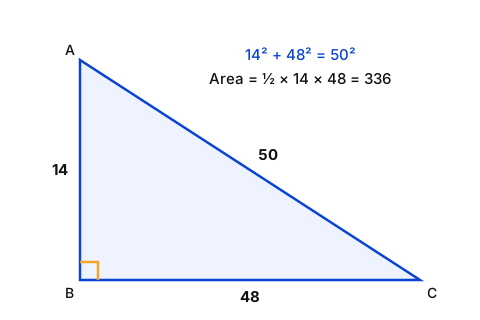
The sides of a triangle are 14 cm, 48 cm, and 50 cm. What is its area? (in cm2 )
एक त्रिभुज की भुजाएँ 14 cm, 48 cm और 50 cm हैं। इसका क्षेत्रफल क्या है? (cm2 में)
  1. A321
  2. B324
  3. C336
  4. D314
Show answer

Concept: If a2+b2=c2, the triangle is right-angled and area =12×a×b.

  1. 142+482=196+2304=2500=502, so it is a right triangle.
  2. Legs are 14 and 48 (hypotenuse 50).
  3. Area =12×14×48=336cm2.

Trick: 14,48,50=2×(7,24,25) – a known Pythagorean triplet.

Answer: (C) 336

अवधारणा: यदि a2+b2=c2 हो तो त्रिभुज समकोण है और क्षेत्रफल =12×a×b।

  1. 142+482=196+2304=2500=502, अतः समकोण त्रिभुज।
  2. भुजाएँ 14 और 48 (कर्ण 50)।
  3. क्षेत्रफल =12×14×48=336cm2।

ट्रिक: 14,48,50=2×(7,24,25) – प्रसिद्ध पाइथागोरस त्रिक (triplet)।

उत्तर: (C) 336

RRB NTPC Undergraduate CBT 1MathematicsArea of TriangleRRB NTPC Undergraduate CBT 1 2024 · 21 Aug Shift 1 →
Q1055.
Which of the following numbers divides 44,43,48,269?
निम्नलिखित में से कौन-सी संख्या 44,43,48,269 को विभाजित करती है?
  1. A12
  2. B9
  3. C10
  4. D19
Show answer

Concept: Use divisibility rules to eliminate, then divide directly.

  1. 444348269 is odd, so it is not divisible by 12 or 10.
  2. Digit sum =4+4+4+3+4+8+2+6+9=44, not a multiple of 9.
  3. 444348269÷19=23386751 exactly, since 19×23386751=444348269.

Trick: Eliminate by last digit and digit sum first – only one option remains to test.

Answer: (D) 19

अवधारणा: विभाज्यता के नियमों से विकल्प हटाएँ, फिर सीधे भाग दें।

  1. 444348269 विषम है, अतः 12 या 10 से विभाज्य नहीं।
  2. अंकों का योग =4+4+4+3+4+8+2+6+9=44, जो 9 का गुणज नहीं।
  3. 444348269÷19=23386751 पूर्ण रूप से, क्योंकि 19×23386751=444348269।

ट्रिक: पहले अंतिम अंक और अंकों के योग से विकल्प हटाएँ – केवल एक बचता है।

उत्तर: (D) 19

RRB NTPC Undergraduate CBT 1MathematicsDivisibilityRRB NTPC Undergraduate CBT 1 2024 · 21 Aug Shift 1 →
Q1056.
M and N start a business. M invests ₹64,000 more than N for 2 months and N invests for 3 months. M's share is ₹552 more than that of N, out of a total profit of ₹1,656. Find the capital contributed by M.
M और N एक व्यवसाय शुरू करते हैं। M, N से ₹64,000 अधिक राशि 2 महीने के लिए निवेश करता है और N, 3 महीने के लिए निवेश करता है। ₹1,656 के कुल लाभ में से M का हिस्सा N के हिस्से से ₹552 अधिक है। M द्वारा लगाई गई पूँजी ज्ञात कीजिए।
  1. A₹95,898
  2. B₹96,000
  3. C₹95,804
  4. D₹95,828
Show answer

Concept: Profit ratio = capital × time.

  1. Let N's share =x; M's =x+552; 2x+552=1656⇒x=552, M's =1104. Ratio =2:1.
  2. Let N's capital =n, M's =n+64000.
  3. 2(n+64000)3n=21⇒2n+128000=6n⇒n=32000.
  4. M's capital =32000+64000=96000.

Trick: Check option: M ₹96,000 for 2 months =192000; N ₹32,000 for 3 months =96000 → 2:1 ✓.

Answer: (B) ₹96,000

अवधारणा: लाभ का अनुपात = पूँजी × समय।

  1. N का हिस्सा =x, M का =x+552; 2x+552=1656⇒x=552, M का =1104। अनुपात =2:1।
  2. N की पूँजी =n, M की =n+64000।
  3. 2(n+64000)3n=21⇒2n+128000=6n⇒n=32000।
  4. M की पूँजी =32000+64000=96000।

ट्रिक: विकल्प जाँचें: M ₹96,000 × 2 माह =192000; N ₹32,000 × 3 माह =96000 → 2:1 ✓।

उत्तर: (B) ₹96,000

RRB NTPC Undergraduate CBT 1MathematicsPartnershipRRB NTPC Undergraduate CBT 1 2024 · 21 Aug Shift 1 →
Q1057.
The number 889897 is divisible by which of the following?
संख्या 889897 निम्नलिखित में से किससे विभाज्य है?
  1. A52
  2. B64
  3. C69
  4. D59
Show answer

Concept: Eliminate even divisors, then test the remaining options.

  1. 889897 is odd, so 52 and 64 are out.
  2. Digit sum =49, not divisible by 3, so 69=3×23 is out.
  3. 889897÷59=15083 exactly (59×15083=889897).

Trick: Odd number → no even divisor; digit sum not a multiple of 3 → no multiple of 3.

Answer: (D) 59

अवधारणा: सम भाजक हटाएँ, फिर बचे विकल्प जाँचें।

  1. 889897 विषम है, अतः 52 और 64 बाहर।
  2. अंकों का योग =49, 3 से विभाज्य नहीं, अतः 69=3×23 बाहर।
  3. 889897÷59=15083 पूर्ण रूप से (59×15083=889897)।

ट्रिक: विषम संख्या → कोई सम भाजक नहीं; अंक-योग 3 का गुणज नहीं → 3 का कोई गुणज नहीं।

उत्तर: (D) 59

RRB NTPC Undergraduate CBT 1MathematicsDivisibilityRRB NTPC Undergraduate CBT 1 2024 · 21 Aug Shift 1 →
Q1058.
A can do a work in 16 days and B can do the same work in 18 days. If they work on it together for 4 days, then what fraction of the work is left?
A किसी कार्य को 16 दिनों में और B उसी कार्य को 18 दिनों में कर सकता है। यदि वे एक साथ 4 दिनों तक उस पर कार्य करते हैं, तो कार्य का कितना भाग शेष रह जाता है?
  1. A2936
  2. B1936
  3. C2536
  4. D1736
Show answer

Concept: Work done in one day = 1days; add rates when working together.

  1. One-day work =116+118=9+8144=17144.
  2. In 4 days =4×17144=1736.
  3. Work left =1−1736=1936.

Trick: LCM method: total work =144 units, A =9, B =8 per day; 4 days =68; left =76 → 76144=1936.

Answer: (B) 1936

अवधारणा: एक दिन का कार्य =1दिन; साथ काम करने पर दरें जोड़ें।

  1. एक दिन का कार्य =116+118=9+8144=17144।
  2. 4 दिन में =4×17144=1736।
  3. शेष कार्य =1−1736=1936।

ट्रिक: LCM विधि: कुल कार्य =144 इकाई, A =9, B =8 प्रतिदिन; 4 दिन में 68; शेष 76 → 76144=1936।

उत्तर: (B) 1936

RRB NTPC Undergraduate CBT 1MathematicsTime and WorkRRB NTPC Undergraduate CBT 1 2024 · 21 Aug Shift 1 →
Q1059.
The population of a district is 350000, out of which 175000 are males. 36% of the population is literate. If 22% males are literate, then what percentage of females are literate?
एक जिले की जनसंख्या 350000 है, जिसमें से 175000 पुरुष हैं। जनसंख्या का 36% साक्षर है। यदि 22% पुरुष साक्षर हैं, तो कितने प्रतिशत महिलाएँ साक्षर हैं?
  1. A50%
  2. B53%
  3. C48%
  4. D47%
Show answer

Concept: Literate females = total literate − literate males.

  1. Total literate =36% of 350000=126000.
  2. Literate males =22% of 175000=38500.
  3. Females =350000−175000=175000; literate females =126000−38500=87500.
  4. Percentage =87500175000×100=50%.

Trick: Males and females are equal, so overall 36% is their average: 22+x2=36⇒x=50.

Answer: (A) 50%

अवधारणा: साक्षर महिलाएँ = कुल साक्षर − साक्षर पुरुष।

  1. कुल साक्षर =350000 का 36%=126000।
  2. साक्षर पुरुष =175000 का 22%=38500।
  3. महिलाएँ =175000; साक्षर महिलाएँ =126000−38500=87500।
  4. प्रतिशत =87500175000×100=50%।

ट्रिक: पुरुष और महिलाएँ बराबर हैं, अतः 36% दोनों का औसत है: 22+x2=36⇒x=50।

उत्तर: (A) 50%

RRB NTPC Undergraduate CBT 1MathematicsPercentageRRB NTPC Undergraduate CBT 1 2024 · 21 Aug Shift 1 →
Q1060.
Hema can do a certain piece of work in 30 days. Hema and Raji can together do the same work in 25 days, and Hema, Raji and Smitha can do the same work together in 10 days. In how many days can Hema and Smitha do the same work together?
हेमा एक निश्चित कार्य को 30 दिनों में कर सकती है। हेमा और राजी मिलकर उसी कार्य को 25 दिनों में कर सकती हैं, तथा हेमा, राजी और स्मिता मिलकर उसी कार्य को 10 दिनों में कर सकती हैं। हेमा और स्मिता मिलकर उसी कार्य को कितने दिनों में कर सकती हैं?
  1. A757
  2. B689
  3. C847
  4. D718
Show answer

Concept: Subtract one-day work rates to isolate each person.

  1. Smitha's rate =110−125=5−250=350.
  2. Hema + Smitha =130+350=5+9150=14150=775.
  3. Days =757.

Trick: LCM of 30, 25, 10 =150 units: H =5, H+R =6, H+R+S =15 → S =9; H+S =14 → 15014=757.

Answer: (A) 757 days

अवधारणा: एक दिन के कार्य की दरें घटाकर प्रत्येक की दर निकालें।

  1. स्मिता की दर =110−125=5−250=350।
  2. हेमा + स्मिता =130+350=5+9150=14150=775।
  3. दिन =757।

ट्रिक: 30, 25, 10 का LCM =150 इकाई: H =5, H+R =6, H+R+S =15 → S =9; H+S =14 → 15014=757।

उत्तर: (A) 757 दिन

RRB NTPC Undergraduate CBT 1MathematicsTime and WorkRRB NTPC Undergraduate CBT 1 2024 · 21 Aug Shift 1 →