Question bank

Q&A: practice questions with answers

Search questions on any topic. Filter by exam category, exam, subject and topic, try the question, then open the answer and explanation.

Courses – airGurukul

8,495 questions found.

Q1141.
I bought two frocks for ₹1,200. I sold the first frock at a loss of 7% and the second at a profit of 23%. If overall I made neither profit nor loss, find the cost price (in ₹) of the first frock.
मैंने दो फ्रॉक ₹1,200 में खरीदे। मैंने पहला फ्रॉक 7% की हानि पर और दूसरा 23% के लाभ पर बेचा। यदि कुल मिलाकर मुझे न तो लाभ हुआ और न ही हानि, तो पहले फ्रॉक का क्रय मूल्य (₹ में) ज्ञात कीजिए।
  1. A944
  2. B904
  3. C920
  4. D940
Show answer

Concept: Overall no profit no loss ⇒ loss amount on the first frock = profit amount on the second frock.
  1. Let CP of first =x, second =1200−x.
  2. 7100x=23100(1200−x)
  3. 7x=27600−23x⇒30x=27600⇒x=920
  4. Check: loss =64.4, profit on 280=64.4 ✓

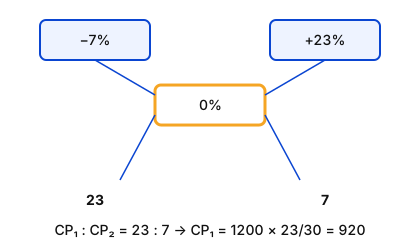
Trick: Alligation: (−7) and (+23) around 0 give ratio 23:7, so first =1200×2330=920.

Answer: (C) ₹920

अवधारणा: कुल न लाभ न हानि ⇒ पहली फ्रॉक पर हानि की राशि = दूसरी फ्रॉक पर लाभ की राशि।

  1. माना पहली का क्रय मूल्य =x, दूसरी का =1200−x.
  2. 7100x=23100(1200−x)
  3. 7x=27600−23x⇒30x=27600⇒x=920
  4. जाँच: हानि =64.4, 280 पर लाभ =64.4 ✓

ट्रिक: मिश्रण नियम: (−7) और (+23) के बीच 0 → अनुपात 23:7, पहली =1200×2330=920।

उत्तर: (C) ₹920

RRB NTPC Undergraduate CBT 1MathematicsProfit and Loss – No Profit No LossRRB NTPC Undergraduate CBT 1 2024 · 20 Aug Shift 3 →
Q1142.
Find the value of cos6θ+sin6θ+3sin2θcos2θcosecθsecθ((sinθ+cosθ)2−1).
cos6θ+sin6θ+3sin2θcos2θcosecθsecθ((sinθ+cosθ)2−1) का मान ज्ञात कीजिए।
  1. A−12
  2. B14
  3. C13
  4. D12
Show answer

Concept: Use a3+b3=(a+b)3−3ab(a+b) with a=sin2θ, b=cos2θ, a+b=1.

  1. Numerator: sin6θ+cos6θ=1−3sin2θcos2θ, so numerator =1−3sin2θcos2θ+3sin2θcos2θ=1.
  2. (sinθ+cosθ)2−1=2sinθcosθ.
  3. Denominator =1sinθcosθ×2sinθcosθ=2.
  4. Value =12.

Trick: Put θ=45∘: numerator =18+18+34=1, denominator =2·2(2−1)=2 → 12.

Answer: (D) 12

अवधारणा: a3+b3=(a+b)3−3ab(a+b) लें, जहाँ a=sin2θ, b=cos2θ, a+b=1.

  1. अंश: sin6θ+cos6θ=1−3sin2θcos2θ, अतः अंश =1.
  2. (sinθ+cosθ)2−1=2sinθcosθ.
  3. हर =1sinθcosθ×2sinθcosθ=2.
  4. मान =12.

ट्रिक: θ=45∘ रखें: अंश =18+18+34=1, हर =2·2(2−1)=2 → 12।

उत्तर: (D) 12

RRB NTPC Undergraduate CBT 1MathematicsTrigonometric IdentitiesRRB NTPC Undergraduate CBT 1 2024 · 20 Aug Shift 3 →
Q1143.
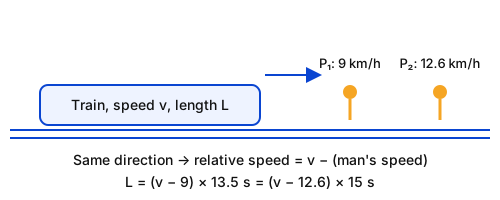
A train overtakes two persons walking along a railway track. The first person walks at 9 km/hr and the second at 12.6 km/hr. The train takes 13.5 and 15 seconds respectively to overtake them. If both persons are walking in the direction in which the train is moving, what is the speed of the train?
एक रेलगाड़ी रेल पटरी के साथ-साथ चल रहे दो व्यक्तियों को पार करती है। पहला व्यक्ति 9 km/hr की चाल से और दूसरा 12.6 km/hr की चाल से चलता है। रेलगाड़ी उन्हें पार करने में क्रमशः 13.5 और 15 सेकंड का समय लेती है। यदि दोनों व्यक्ति उसी दिशा में चल रहे हैं जिस दिशा में रेलगाड़ी चल रही है, तो रेलगाड़ी की चाल क्या है?
  1. A35 km/hr
  2. B44 km/hr
  3. C45 km/hr
  4. D38 km/hr
Show answer

Concept: When a train overtakes a man moving in the same direction, it covers its own length L at the relative speed (train − man).

  1. Let train speed =vkm/h.
  2. L=(v−9)×13.5=(v−12.6)×15 (same units on both sides, so 518 cancels).
  3. 13.5v−121.5=15v−189⇒1.5v=67.5⇒v=45.
  4. Length =(45−9)×518×13.5=135m ✓

Trick: Times ratio 13.5:15=9:10 ⇒ relative speeds 10:9; (v−9)−(v−12.6)=3.6 is 1 part, so v−9=36, v=45.

Answer: (C) 45km/h

अवधारणा: एक ही दिशा में चल रहे व्यक्ति को पार करते समय रेलगाड़ी अपनी लंबाई L सापेक्ष चाल (रेल − व्यक्ति) से तय करती है।

  1. माना रेल की चाल =vkm/h.
  2. L=(v−9)×13.5=(v−12.6)×15 (दोनों ओर समान इकाई, 518 कट जाता है)।
  3. 13.5v−121.5=15v−189⇒1.5v=67.5⇒v=45.
  4. लंबाई =(45−9)×518×13.5=135m ✓

ट्रिक: समय अनुपात 9:10 ⇒ सापेक्ष चाल 10:9; अंतर 3.6 = 1 भाग, अतः v−9=36, v=45।

उत्तर: (C) 45km/h

RRB NTPC Undergraduate CBT 1MathematicsTrains – Overtaking PersonsRRB NTPC Undergraduate CBT 1 2024 · 20 Aug Shift 3 →
Q1144.
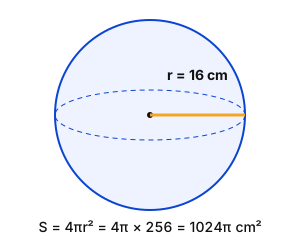
The radius of a sphere is 16 cm. Find its surface area.
एक गोले की त्रिज्या 16 cm है। इसका पृष्ठीय क्षेत्रफल ज्ञात कीजिए।
  1. A768π cm2
  2. B341π cm2
  3. C512π cm2
  4. D1024π cm2
Show answer

Concept: Surface area of a sphere =4πr2.

  1. r=16cm⇒r2=256.
  2. S=4π×256=1024πcm2.

Trick: Sphere surface area = 4 × (area of its great circle πr2); 3πr2=768π is the total surface area of a hemisphere – a common trap.

Answer: (D) 1024πcm2

अवधारणा: गोले का पृष्ठीय क्षेत्रफल =4πr2.

  1. r=16cm⇒r2=256.
  2. S=4π×256=1024πcm2.

ट्रिक: गोले का पृष्ठ = 4 × (बड़े वृत्त का क्षेत्रफल πr2); 768π=3πr2 अर्धगोले के कुल पृष्ठ वाला भ्रम है।

उत्तर: (D) 1024πcm2

RRB NTPC Undergraduate CBT 1MathematicsMensuration – SphereRRB NTPC Undergraduate CBT 1 2024 · 20 Aug Shift 3 →
Q1145.
Which of the following numbers divides 747579723?
निम्नलिखित में से कौन-सी संख्या 747579723 को विभाजित करती है?
  1. A13
  2. B11
  3. C9
  4. D8
Show answer

Concept: Divisibility by 11: (sum of digits at odd places) − (sum at even places) must be 0 or a multiple of 11.

  1. Digits: 7 4 7 5 7 9 7 2 3. Odd places: 7+7+7+7+3=31; even places: 4+5+9+2=20.
  2. Difference =31−20=11 ⇒ divisible by 11 (747579723=11×67961793).
  3. Digit sum =51 is not a multiple of 9; last three digits 723 are odd, so not divisible by 8; 747579723÷13 leaves remainder 7.

Trick: Check 11 by alternating sum quickly; check 9 by digit sum – one test each.

Answer: (B) 11

अवधारणा: 11 से विभाज्यता: (विषम स्थानों के अंकों का योग) − (सम स्थानों का योग) =0 या 11 का गुणज हो।

  1. अंक: 7 4 7 5 7 9 7 2 3. विषम स्थान: 7+7+7+7+3=31; सम स्थान: 4+5+9+2=20.
  2. अंतर =31−20=11 ⇒ 11 से विभाज्य (747579723=11×67961793)।
  3. अंकों का योग =51, 9 का गुणज नहीं; अंतिम तीन अंक 723 विषम, अतः 8 से नहीं; 13 से भाग देने पर शेष 7।

ट्रिक: 11 के लिए एकांतर योग, 9 के लिए अंकों का योग – एक-एक जाँच।

उत्तर: (B) 11

RRB NTPC Undergraduate CBT 1MathematicsDivisibility RulesRRB NTPC Undergraduate CBT 1 2024 · 20 Aug Shift 3 →
Q1146.
Find the value of 57−8 ÷ 5717 × 57−18.
57−8 ÷ 5717 × 57−18 का मान ज्ञात कीजिए।
  1. A57−36
  2. B57−46
  3. C57−45
  4. D57−43
Show answer

Concept: Same base: am÷an=am−n and am×an=am+n; work left to right.

  1. 57−8÷5717=57−8−17=57−25.
  2. 57−25×57−18=57−25−18=57−43.

Trick: Just add the exponents with signs: −8−17−18=−43.

Answer: (D) 57−43

अवधारणा: समान आधार: am÷an=am−n तथा am×an=am+n; बाएँ से दाएँ हल करें।

  1. 57−8÷5717=57−8−17=57−25.
  2. 57−25×57−18=57−25−18=57−43.

ट्रिक: चिह्न सहित घातांक जोड़ें: −8−17−18=−43।

उत्तर: (D) 57−43

RRB NTPC Undergraduate CBT 1MathematicsLaws of ExponentsRRB NTPC Undergraduate CBT 1 2024 · 20 Aug Shift 3 →
Q1147.
The HCF of two numbers is 16 and their LCM is 240. If one number is 48, find the other number.
दो संख्याओं का महत्तम समापवर्तक (HCF) 16 और लघुत्तम समापवर्त्य (LCM) 240 है। यदि एक संख्या 48 है, तो दूसरी संख्या ज्ञात कीजिए।
  1. A64
  2. B72
  3. C80
  4. D70
Show answer

Concept: For two numbers: HCF×LCM=product of the numbers.

  1. 16×240=48×x
  2. x=384048=80
  3. Check: HCF(48,80)=16, LCM=240 ✓

Trick: Both numbers must be multiples of 16: 64, 80 qualify, but only 80 gives LCM 240.

Answer: (C) 80

अवधारणा: दो संख्याओं के लिए: HCF×LCM=संख्याओं का गुणनफल.

  1. 16×240=48×x
  2. x=384048=80
  3. जाँच: HCF(48,80)=16, LCM=240 ✓

ट्रिक: दोनों संख्याएँ 16 की गुणज होंगी: 64 व 80 में से केवल 80 से LCM 240 आता है।

उत्तर: (C) 80

RRB NTPC Undergraduate CBT 1MathematicsHCF and LCMRRB NTPC Undergraduate CBT 1 2024 · 20 Aug Shift 3 →
Q1148.
The selling price of 40 books is equal to the cost price of 28 books. Find the loss or gain percentage.
40 पुस्तकों का विक्रय मूल्य 28 पुस्तकों के क्रय मूल्य के बराबर है। हानि या लाभ प्रतिशत ज्ञात कीजिए।
  1. A30% loss30% हानि
  2. B30% gain30% लाभ
  3. C10012% gain10012% लाभ
  4. D10012% loss10012% हानि
Show answer

Concept: If SP of a articles = CP of b articles with a>b, there is a loss: Loss%=a−ba×100.

  1. Let CP of 1 book = ₹1 ⇒ SP of 40 books = CP of 28 books = ₹28.
  2. CP of 40 books = ₹40 ⇒ loss = ₹12.
  3. Loss%=1240×100=30% (not 10012%, which wrongly divides by the loss).

Trick: More articles sold for the money ⇒ loss; divide the difference by the larger number.

Answer: (A) 30% loss

अवधारणा: यदि a वस्तुओं का विक्रय मूल्य = b वस्तुओं का क्रय मूल्य और a>b हो, तो हानि: हानि%=a−ba×100.

  1. माना 1 पुस्तक का CP = ₹1 ⇒ 40 पुस्तकों का SP = 28 पुस्तकों का CP = ₹28.
  2. 40 पुस्तकों का CP = ₹40 ⇒ हानि = ₹12.
  3. हानि%=1240×100=30% (10012% नहीं)।

ट्रिक: पैसे से अधिक वस्तुएँ बिकीं ⇒ हानि; अंतर को बड़ी संख्या से भाग दें।

उत्तर: (A) 30% हानि

RRB NTPC Undergraduate CBT 1MathematicsProfit and Loss – ArticlesRRB NTPC Undergraduate CBT 1 2024 · 20 Aug Shift 3 →
Q1149.
Hema can complete a work in 30 days. Hema and Raji together can complete the same work in 22 days, and Hema, Raji and Smita together can complete it in 15 days. In how many days can Hema and Smita together complete the same work?
हेमा किसी कार्य को 30 दिनों में पूरा कर सकती है। हेमा और राजी मिलकर उसी कार्य को 22 दिनों में पूरा कर सकती हैं, और हेमा, राजी और स्मिता मिलकर इसे 15 दिनों में पूरा कर सकती हैं। हेमा और स्मिता मिलकर उसी कार्य को कितने दिनों में पूरा कर सकती हैं?
  1. A623
  2. B553
  3. C515
  4. D454
Show answer

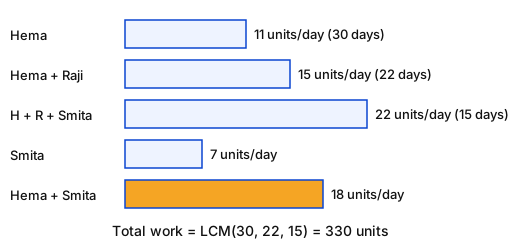
Concept: Take total work = LCM of the days and find each person's work per day.

  1. Total work =LCM(30,22,15)=330 units.
  2. Hema =33030=11; H + R =33022=15; H + R + S =33015=22 units/day.
  3. Smita =22−15=7 ⇒ Hema + Smita =11+7=18 units/day.
  4. Days =33018=553=1813.

Trick: Smita's rate = (all three) − (Hema + Raji); Raji's own rate is never needed.

Answer: (B) 553 days

अवधारणा: कुल कार्य = दिनों का LCM मानकर प्रत्येक का एक दिन का कार्य निकालें।

  1. कुल कार्य =LCM(30,22,15)=330 इकाई।
  2. हेमा =33030=11; H + R =33022=15; H + R + S =33015=22 इकाई/दिन।
  3. स्मिता =22−15=7 ⇒ हेमा + स्मिता =11+7=18 इकाई/दिन।
  4. दिन =33018=553=1813.

ट्रिक: स्मिता = (तीनों) − (हेमा + राजी); राजी की अलग दर की ज़रूरत नहीं।

उत्तर: (B) 553 दिन

RRB NTPC Undergraduate CBT 1MathematicsTime and WorkRRB NTPC Undergraduate CBT 1 2024 · 20 Aug Shift 3 →
Q1150.
Sapna invested a sum of ₹21,900 at simple interest, partly at 14% per annum and partly at 10% per annum. If she receives equal interest from both investments after 2 years, find the amount (in ₹) invested at 14% per annum.
सपना ने ₹21,900 की राशि साधारण ब्याज पर निवेश की, जिसका एक भाग 14% वार्षिक दर पर और शेष भाग 10% वार्षिक दर पर था। यदि 2 वर्ष बाद उसे दोनों निवेशों से समान ब्याज प्राप्त होता है, तो 14% वार्षिक दर पर निवेश की गई राशि (₹ में) ज्ञात कीजिए।
  1. A9,123
  2. B9,128
  3. C9,124
  4. D9,125
Show answer

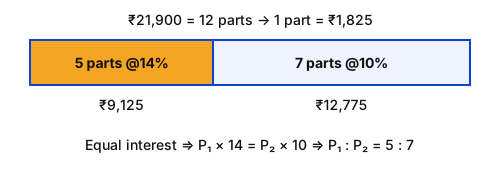
Concept: Equal simple interest for the same time ⇒ P1R1=P2R2, i.e. principal is inversely proportional to rate.

  1. P1×14×2=P2×10×2⇒P1:P2=10:14=5:7.
  2. Total parts =12 ⇒ 1 part =2190012=1825.
  3. P1=5×1825=9125 (check: 9125×0.28=2555=12775×0.20 ✓).

Trick: Swap the rates to get the ratio: at 14% : at 10% =10:14.

Answer: (D) ₹9,125

अवधारणा: समान समय में समान साधारण ब्याज ⇒ P1R1=P2R2, अर्थात् मूलधन दर के व्युत्क्रमानुपाती।

  1. P1×14×2=P2×10×2⇒P1:P2=10:14=5:7.
  2. कुल भाग =12 ⇒ 1 भाग =2190012=1825.
  3. P1=5×1825=9125 (जाँच: 9125×0.28=2555=12775×0.20 ✓)।

ट्रिक: अनुपात के लिए दरें उलट दें: 14% वाला : 10% वाला =10:14।

उत्तर: (D) ₹9,125

RRB NTPC Undergraduate CBT 1MathematicsSimple Interest – Division of SumRRB NTPC Undergraduate CBT 1 2024 · 20 Aug Shift 3 →
Q1151.
Find the average of the first 167 even numbers.
प्रथम 167 सम संख्याओं का औसत ज्ञात कीजिए।
  1. A169
  2. B167.5
  3. C168.5
  4. D168
Show answer

Concept: Average of the first n even numbers =n+1.

  1. Sum of first n even numbers =n(n+1).
  2. Average =n(n+1)n=n+1.
  3. Here n=167, so average =167+1=168.

Trick: First n even numbers → average n+1; first n odd numbers → average n.

Answer: (D) 168

अवधारणा: प्रथम n सम संख्याओं का औसत =n+1 होता है।

  1. प्रथम n सम संख्याओं का योग =n(n+1)।
  2. औसत =n(n+1)n=n+1।
  3. यहाँ n=167, अतः औसत =167+1=168।

ट्रिक: प्रथम n सम संख्याएँ → औसत n+1; प्रथम n विषम संख्याएँ → औसत n।

उत्तर: (D) 168

RRB NTPC Undergraduate CBT 1MathematicsAverage of even numbersRRB NTPC Undergraduate CBT 1 2024 · 20 Aug Shift 3 →
Q1152.
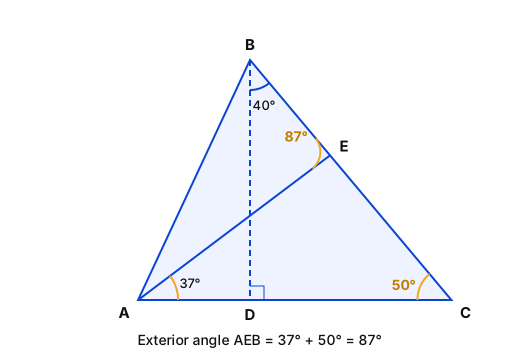
In △ABC, BD ⟂ AC at D and ∠DBC = 40°. E is a point on BC such that ∠CAE = 37°. What is the measure of ∠AEB?
△ABC में, BD ⟂ AC है, जो AC से D पर मिलती है, और ∠DBC = 40° है। BC पर E एक ऐसा बिंदु है कि ∠CAE = 37° है। ∠AEB का माप क्या है?
  1. A99°
  2. B87°
  3. C83°
  4. D78°
Show answer

Concept: Angle sum of a triangle is 180∘; an exterior angle equals the sum of the two opposite interior angles.

  1. In right △BDC: ∠BCD=180∘−90∘−40∘=50∘.
  2. In △AEC: ∠EAC=37∘, ∠ECA=50∘.
  3. ∠AEB is the exterior angle of △AEC at E: ∠AEB=37∘+50∘=87∘.

Trick: ∠C=90∘−∠DBC directly, then add ∠CAE.

Answer: (B) 87∘

अवधारणा: त्रिभुज के कोणों का योग 180∘ होता है; बहिष्कोण (exterior angle) = दोनों सम्मुख अंतःकोणों का योग।

  1. समकोण △BDC में: ∠BCD=180∘−90∘−40∘=50∘।
  2. △AEC में: ∠EAC=37∘, ∠ECA=50∘।
  3. ∠AEB, △AEC का E पर बहिष्कोण है: ∠AEB=37∘+50∘=87∘।

ट्रिक: सीधे ∠C=90∘−∠DBC निकालें, फिर ∠CAE जोड़ दें।

उत्तर: (B) 87∘

RRB NTPC Undergraduate CBT 1MathematicsTriangle – exterior angleRRB NTPC Undergraduate CBT 1 2024 · 20 Aug Shift 3 →
Q1153.
By how much is 65% of 65 more than 35 of 55?
65 का 65%, 55 के 35 से कितना अधिक है?
  1. A9.25
  2. B3.25
  3. C7.25
  4. D6.25
Show answer

Concept: Convert each part to a number and subtract.

  1. 65% of 65=65×65100=42.25
  2. 35 of 55=33
  3. Difference =42.25−33=9.25

Trick: 652=4225, so 65% of 65 is simply 42.25.

Answer: (A) 9.25

अवधारणा: दोनों भागों का मान निकालकर घटाएँ।

  1. 65 का 65%=65×65100=42.25
  2. 55 का 35=33
  3. अंतर =42.25−33=9.25

ट्रिक: 652=4225, अतः 65 का 65% सीधे 42.25 है।

उत्तर: (A) 9.25

RRB NTPC Undergraduate CBT 1MathematicsPercentage and fractionRRB NTPC Undergraduate CBT 1 2024 · 20 Aug Shift 3 →
Q1154.
In an election between two candidates, 92% of the registered voters cast their votes and 20% of the votes were found invalid. The winning candidate got 75% of the valid votes and won the election by a margin of 322 votes. How many voters were registered in all?
दो उम्मीदवारों के बीच हुए एक चुनाव में, 92% पंजीकृत मतदाताओं ने अपने मत डाले और 20% मत अवैध पाए गए। विजेता उम्मीदवार को 75% वैध मत मिले और वह 322 मतों के अंतर से चुनाव जीत गया। कुल कितने मतदाता पंजीकृत थे?
  1. A875
  2. B3123
  3. C873
  4. D877
Show answer

Concept: Margin = (winner% − loser%) of valid votes.

  1. Let registered voters =N. Votes cast =0.92N; valid =0.8×0.92N=0.736N.
  2. Winner 75%, loser 25% → margin =50% of valid =0.368N.
  3. 0.368N=322⇒N=3220.368=875.

Trick: Check options: 875×0.92×0.8×0.5=322 ✔.

Answer: (A) 875

अवधारणा: जीत का अंतर = (विजेता% − पराजित%) × वैध मत।

  1. माना पंजीकृत मतदाता =N। डाले गए मत =0.92N; वैध मत =0.8×0.92N=0.736N।
  2. विजेता 75%, पराजित 25% → अंतर = वैध मतों का 50%=0.368N।
  3. 0.368N=322⇒N=3220.368=875।

ट्रिक: विकल्प जाँचें: 875×0.92×0.8×0.5=322 ✔।

उत्तर: (A) 875

RRB NTPC Undergraduate CBT 1MathematicsPercentage – electionsRRB NTPC Undergraduate CBT 1 2024 · 20 Aug Shift 3 →
Q1155.
Find the total surface area of a cube of side 40 cm.
40 cm भुजा वाले एक घन का संपूर्ण पृष्ठीय क्षेत्रफल ज्ञात कीजिए।
  1. A9632 cm2
  2. B9628 cm2
  3. C9600 cm2
  4. D9564 cm2
Show answer

Concept: Total surface area of a cube =6a2.

  1. a=40cm, so a2=1600.
  2. TSA =6×1600=9600cm2.

Yaad rakhein: Cube has 6 equal square faces; lateral surface area =4a2.

Answer: (C) 9600cm2

अवधारणा: घन का संपूर्ण पृष्ठीय क्षेत्रफल =6a2।

  1. a=40cm, अतः a2=1600।
  2. संपूर्ण पृष्ठीय क्षेत्रफल =6×1600=9600cm2।

याद रखें: घन के 6 समान वर्गाकार फलक होते हैं; पार्श्व पृष्ठीय क्षेत्रफल =4a2।

उत्तर: (C) 9600cm2

RRB NTPC Undergraduate CBT 1MathematicsMensuration – cubeRRB NTPC Undergraduate CBT 1 2024 · 20 Aug Shift 3 →
Q1156.
P, Q and R started a business by investing ₹2,030, ₹1,700 and ₹1,010 respectively. If Q's share in the profit earned by them is ₹975, then what is the difference (in ₹) between the profits earned by P and R?
P, Q और R ने क्रमशः ₹2,030, ₹1,700 और ₹1,010 का निवेश करके एक व्यवसाय शुरू किया। यदि उनके द्वारा अर्जित लाभ में Q का हिस्सा ₹975 है, तो P और R द्वारा अर्जित लाभ के बीच का अंतर (₹ में) क्या है?
  1. A₹585
  2. B₹586
  3. C₹584
  4. D₹583
Show answer

Concept: For equal time, profit is shared in the ratio of investments.

  1. Ratio P:Q:R=2030:1700:1010=203:170:101.
  2. Q's 170 parts = ₹975 → 1 part =975170.
  3. P−R=203−101=102 parts =975×102170=975×0.6=585.

Trick: 102170=35, so the difference is 35 of Q's share.

Answer: (A) ₹585

अवधारणा: समान समय के लिए लाभ निवेश के अनुपात में बँटता है।

  1. अनुपात P:Q:R=2030:1700:1010=203:170:101।
  2. Q के 170 भाग = ₹975 → 1 भाग =975170।
  3. P−R=203−101=102 भाग =975×102170=975×0.6=585।

ट्रिक: 102170=35, अतः अंतर = Q के हिस्से का 35।

उत्तर: (A) ₹585

RRB NTPC Undergraduate CBT 1MathematicsPartnershipRRB NTPC Undergraduate CBT 1 2024 · 20 Aug Shift 3 →
Q1157.
If x is the third proportional to 32 and 24, then find the value of x.
यदि x, 32 और 24 का तृतीयानुपाती है, तो x का मान ज्ञात कीजिए।
  1. A17
  2. B20
  3. C16
  4. D18
Show answer

Concept: Third proportional to a and b is x where a:b=b:x, i.e. x=b2a.

  1. x=24232=57632
  2. x=18

Yaad rakhein: Third proportional =b2a; mean proportional =ab.

Answer: (D) 18

अवधारणा: a और b का तृतीयानुपाती x है यदि a:b=b:x, अर्थात् x=b2a।

  1. x=24232=57632
  2. x=18

याद रखें: तृतीयानुपाती =b2a; मध्यानुपाती =ab।

उत्तर: (D) 18

RRB NTPC Undergraduate CBT 1MathematicsThird proportionalRRB NTPC Undergraduate CBT 1 2024 · 20 Aug Shift 3 →
Q1158.
The cost of 7 pens and 8 pencils is ₹230. If the price of a pen decreases by ₹1 per pen and the price of a pencil increases by ₹7 per pencil, then the cost of 14 pens and 4 pencils becomes ₹150. What will be the original cost of 8 pens and 8 pencils?
7 पेन और 8 पेंसिलों का मूल्य ₹230 है। यदि एक पेन का मूल्य ₹1 प्रति पेन कम हो जाता है और एक पेंसिल का मूल्य ₹7 प्रति पेंसिल बढ़ जाता है, तो 14 पेन और 4 पेंसिलों का मूल्य ₹150 हो जाता है। 8 पेन और 8 पेंसिलों का मूल मूल्य क्या होगा?
  1. A₹230
  2. B₹228
  3. C₹232
  4. D₹229
Show answer

Concept: Form two linear equations in pen price p and pencil price c.

  1. 7p+8c=230 …(1)
  2. 14(p−1)+4(c+7)=150⇒14p+4c=136⇒7p+2c=68 …(2)
  3. (1) − (2): 6c=162⇒c=27; then 7p=230−216=14⇒p=2.
  4. 8p+8c=8(2+27)=232

Trick: Halve the second equation to match the 7p term and subtract directly.

Answer: (C) ₹232

अवधारणा: पेन का मूल्य p और पेंसिल का मूल्य c लेकर दो रैखिक समीकरण बनाएँ।

  1. 7p+8c=230 …(1)
  2. 14(p−1)+4(c+7)=150⇒14p+4c=136⇒7p+2c=68 …(2)
  3. (1) − (2): 6c=162⇒c=27; फिर 7p=230−216=14⇒p=2।
  4. 8p+8c=8(2+27)=232

ट्रिक: दूसरे समीकरण को 2 से भाग देकर 7p पद बराबर करें और सीधे घटाएँ।

उत्तर: (C) ₹232

RRB NTPC Undergraduate CBT 1MathematicsLinear equationsRRB NTPC Undergraduate CBT 1 2024 · 20 Aug Shift 3 →
Q1159.
Find the number of prime numbers between 389 and 403, both numbers included.
389 और 403 के बीच (दोनों संख्याओं को सम्मिलित करते हुए) अभाज्य संख्याओं की संख्या ज्ञात कीजिए।
  1. A6
  2. B3
  3. C1
  4. D8
Show answer

Concept: Test odd numbers for divisibility by primes up to 403≈20 (2, 3, 5, 7, 11, 13, 17, 19).

  1. Odd numbers: 389, 391, 393, 395, 397, 399, 401, 403.
  2. 391=17×23, 393=3×131, 395=5×79, 399=3×133, 403=13×31 → composite.
  3. 389, 397, 401 are prime → 3 primes.

Trick: Digit sum divisible by 3 (393, 399) and ending in 5 (395) are removed at once.

Answer: (B) 3

अवधारणा: विषम संख्याओं की 403≈20 तक के अभाज्यों (2, 3, 5, 7, 11, 13, 17, 19) से विभाज्यता जाँचें।

  1. विषम संख्याएँ: 389, 391, 393, 395, 397, 399, 401, 403।
  2. 391=17×23, 393=3×131, 395=5×79, 399=3×133, 403=13×31 → भाज्य।
  3. 389, 397, 401 अभाज्य हैं → 3 अभाज्य संख्याएँ।

ट्रिक: अंकों का योग 3 से विभाज्य (393, 399) और 5 पर समाप्त (395) संख्याएँ तुरंत हटाएँ।

उत्तर: (B) 3

RRB NTPC Undergraduate CBT 1MathematicsPrime numbersRRB NTPC Undergraduate CBT 1 2024 · 20 Aug Shift 3 →
Q1160.
₹28,000 is divided among A, B and C such that 2 times A's share = 9 times B's share = 6 times C's share. Find A's share.
₹28,000 को A, B और C के बीच इस प्रकार बाँटा जाता है कि A के हिस्से का 2 गुना = B के हिस्से का 9 गुना = C के हिस्से का 6 गुना हो। A का हिस्सा ज्ञात कीजिए।
  1. A₹17,845
  2. B₹18,195
  3. C₹18,140
  4. D₹18,000
Show answer

Concept: If 2A=9B=6C=k, then A:B:C=12:19:16.

  1. Multiply by LCM 18: A:B:C=9:2:3; total =14 parts.
  2. A's share =914×28000=18000.

Trick: Shares are inversely proportional to the multipliers 2, 9, 6.

Answer: (D) ₹18,000

अवधारणा: यदि 2A=9B=6C=k, तो A:B:C=12:19:16।

  1. LCM 18 से गुणा करें: A:B:C=9:2:3; कुल =14 भाग।
  2. A का हिस्सा =914×28000=18000।

ट्रिक: हिस्से गुणकों 2, 9, 6 के व्युत्क्रमानुपाती होते हैं।

उत्तर: (D) ₹18,000

RRB NTPC Undergraduate CBT 1MathematicsRatio – division of moneyRRB NTPC Undergraduate CBT 1 2024 · 20 Aug Shift 3 →