Question bank

Q&A: practice questions with answers

Search questions on any topic. Filter by exam category, exam, subject and topic, try the question, then open the answer and explanation.

Courses – airGurukul

8,495 questions found.

Q1361.
The number 788973289 is divisible by which of the following?
संख्या 788973289 निम्नलिखित में से किससे विभाज्य है?
  1. A12
  2. B7
  3. C13
  4. D18
Show answer

Concept: Rule for 7, 11, 13: make groups of three digits from the right and take the alternating sum; if it is divisible by 13, so is the number.

  1. The number is odd ⇒ not divisible by 12 or 18.
  2. Groups: 788 | 973 | 289 ⇒ 289−973+788=104
  3. 104=13×8 ⇒ divisible by 13 (but 104÷7 is not exact, so not by 7)

Trick: 7×11×13=1001 – the three-digit alternating-sum test works for all three.

Answer: (C) 13

अवधारणा: 7, 11, 13 का नियम: दाएँ से तीन-तीन अंकों के समूह बनाकर एकांतर योग लें; वह 13 से विभाज्य हो तो संख्या भी।

  1. संख्या विषम है ⇒ 12 या 18 से विभाज्य नहीं।
  2. समूह: 788 | 973 | 289 ⇒ 289−973+788=104
  3. 104=13×8 ⇒ 13 से विभाज्य (7 से नहीं)

ट्रिक: 7×11×13=1001 – तीन अंकों वाला एकांतर योग तीनों के लिए काम करता है।

उत्तर: (C) 13
RRB NTPC Undergraduate CBT 1MathematicsDivisibilityRRB NTPC Undergraduate CBT 1 2024 · 20 Aug Shift 1 →
Q1362.
Find the simple interest (in ₹) if a sum of ₹400 is borrowed for 4.5 years at 8% per annum rate of interest.
यदि ₹400 की राशि 8% वार्षिक ब्याज दर पर 4.5 वर्षों के लिए उधार ली जाती है, तो साधारण ब्याज (₹ में) ज्ञात कीजिए।
  1. A124
  2. B194
  3. C144
  4. D244
Show answer

Concept: SI=P×R×T100.

  1. SI=400×8×4.5100
  2. =4×8×4.5=144

Trick: Yearly interest =8% of 400 =32; 32×4.5=144.

Answer: (C) 144

अवधारणा: साधारण ब्याज SI=P×R×T100।

  1. SI=400×8×4.5100
  2. =4×8×4.5=144

ट्रिक: एक वर्ष का ब्याज =32; 32×4.5=144।

उत्तर: (C) 144

RRB NTPC Undergraduate CBT 1MathematicsSimple interestRRB NTPC Undergraduate CBT 1 2024 · 20 Aug Shift 1 →
Q1363.
56 tube lights were purchased for ₹56, and 20 tube lights broke in transit. The trader sold the remaining tube lights at ₹4.60 each. Find his profit.
56 ट्यूब लाइटें ₹56 में खरीदी गईं, और पारगमन में 20 ट्यूब लाइटें टूट गईं। व्यापारी ने शेष ट्यूब लाइटें ₹4.60 प्रति नग की दर से बेचीं। उसका लाभ ज्ञात कीजिए।
  1. A₹112.50
  2. B₹112.60
  3. C₹109.60
  4. D₹120.80
Show answer

Concept: Profit = Selling price of the unbroken items − Total cost price.

  1. Unbroken tube lights =56−20=36
  2. SP =36×4.60=165.60
  3. Profit =165.60−56=109.60

Trick: Broken items add to cost but earn nothing – always subtract them before computing SP.

Answer: (C) ₹109.60

अवधारणा: लाभ = बची वस्तुओं का विक्रय मूल्य − कुल क्रय मूल्य।

  1. साबुत ट्यूबलाइट =56−20=36
  2. विक्रय मूल्य =36×4.60=165.60
  3. लाभ =165.60−56=109.60

ट्रिक: टूटी वस्तुओं की लागत लगती है पर बिक्री नहीं होती।

उत्तर: (C) ₹109.60

RRB NTPC Undergraduate CBT 1MathematicsProfit and lossRRB NTPC Undergraduate CBT 1 2024 · 20 Aug Shift 1 →
Q1364.
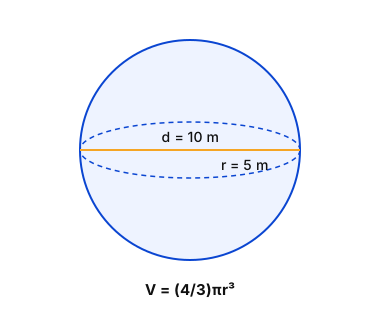
A spherical tank has a diameter of 10 metres. What is the volume of the spherical tank? (Use π = 3.141)
एक गोलाकार टंकी का व्यास 10 मीटर है। गोलाकार टंकी का आयतन कितना है? (π = 3.141 का प्रयोग कीजिए)
  1. A423.5 cubic metre423.5 घन मीटर
  2. B523.5 cubic metre523.5 घन मीटर
  3. C492.6 cubic metre492.6 घन मीटर
  4. D504.8 cubic metre504.8 घन मीटर
Show answer

Concept: Volume of a sphere =43πr3, radius = half the diameter.

  1. r=102=5m
  2. V=43×3.141×125
  3. V=1570.53=523.5m3

Trick: With d given: V=πd36=3.141×10006=523.5.

Answer: (B) 523.5 cubic metre

अवधारणा: गोले का आयतन =43πr3, त्रिज्या = व्यास का आधा।

  1. r=5m
  2. V=43×3.141×125
  3. V=523.5m3

ट्रिक: व्यास से सीधे: V=πd36=523.5।

उत्तर: (B) 523.5 घन मीटर

RRB NTPC Undergraduate CBT 1MathematicsMensuration – sphereRRB NTPC Undergraduate CBT 1 2024 · 20 Aug Shift 1 →
Q1365.
A can lay railway track between two given stations in 16 days and B can do the same job in 11 days. With the help of C, they did the job in 3 days only. Then, C alone can do the job in
A दो दिए गए स्टेशनों के बीच रेलवे ट्रैक 16 दिनों में बिछा सकता है और B वही कार्य 11 दिनों में कर सकता है। C की सहायता से उन्होंने यह कार्य केवल 3 दिनों में पूरा किया। तो, C अकेला यह कार्य कितने दिनों में कर सकता है?
  1. A95395 days95395 दिन
  2. B135395 days135395 दिन
  3. C55395 days55395 दिन
  4. D115395 days115395 दिन
Show answer

Concept: One-day work adds up: 1A+1B+1C=1together.

  1. 1C=13−116−111
  2. LCM 528: 176−33−48528=95528
  3. C alone =52895=55395 days

Trick: C must take more than 3 days but be fastest of the three (A, B are slow), so the answer is just above 5.

Answer: (C) 55395 days

अवधारणा: एक दिन का काम जुड़ता है: 1A+1B+1C=1मिलकर।

  1. 1C=13−116−111
  2. LCM 528: 176−33−48528=95528
  3. C अकेला =52895=55395 दिन

ट्रिक: C को 3 दिन से अधिक लगेगा, पर A, B धीमे हैं, अतः उत्तर 5 के आसपास।

उत्तर: (C) 55395 दिन

RRB NTPC Undergraduate CBT 1MathematicsTime and workRRB NTPC Undergraduate CBT 1 2024 · 20 Aug Shift 1 →
Q1366.
Simplify the following.
4((34)x2−26x+17)−3(x2+4x−14)
निम्नलिखित को सरल कीजिए।
4((34)x2−26x+17)−3(x2+4x−14)
  1. A−116x+110
  2. B−116x−110
  3. C116x−10
  4. D116x+110
Show answer

Concept: Expand each bracket and combine like terms.

  1. 4(34x2−26x+17)=3x2−104x+68
  2. −3(x2+4x−14)=−3x2−12x+42
  3. Sum: (3−3)x2+(−104−12)x+(68+42)=−116x+110

Trick: The x2 terms cancel; check the constant: 68+42=110 (positive).

Answer: (A) −116x+110

अवधारणा: हर कोष्ठक खोलकर समान पद जोड़ें।

  1. 4(34x2−26x+17)=3x2−104x+68
  2. −3(x2+4x−14)=−3x2−12x+42
  3. योग: −116x+110

ट्रिक: x2 वाले पद कट जाते हैं; अचर पद 68+42=110।

उत्तर: (A) −116x+110

RRB NTPC Undergraduate CBT 1MathematicsAlgebraic simplificationRRB NTPC Undergraduate CBT 1 2024 · 20 Aug Shift 1 →
Q1367.
7 years ago, the age of a father was 13 years more than twice his son's age. After how many years, from now, will he be twice his son's age?
7 वर्ष पहले, पिता की आयु उसके पुत्र की आयु के दोगुने से 13 वर्ष अधिक थी। अब से कितने वर्ष बाद उसकी आयु उसके पुत्र की आयु की दोगुनी होगी?
  1. A4
  2. B8
  3. C7
  4. D6
Show answer

Concept: Write present ages from the past condition, then form the future condition.

  1. Let son = S, father = F now. F−7=2(S−7)+13⇒F=2S+6
  2. After n years: F+n=2(S+n)
  3. 2S+6+n=2S+2n⇒n=6

Trick: Father is "2 × son + 6" now; the extra 6 years is exactly the time needed for "twice".

Answer: (D) 6

अवधारणा: भूतकाल की शर्त से वर्तमान आयु लिखें, फिर भविष्य की शर्त बनाइए।

  1. पुत्र =S, पिता =F. F−7=2(S−7)+13⇒F=2S+6
  2. n वर्ष बाद: F+n=2(S+n)
  3. 2S+6+n=2S+2n⇒n=6

ट्रिक: पिता अभी "2 × पुत्र + 6" है; 6 वर्ष बाद दोगुना।

उत्तर: (D) 6

RRB NTPC Undergraduate CBT 1MathematicsProblems on agesRRB NTPC Undergraduate CBT 1 2024 · 20 Aug Shift 1 →
Q1368.
What smallest number should be added to 57846 so that the sum is completely divisible by 58?
57846 में कौन-सी सबसे छोटी संख्या जोड़ी जानी चाहिए ताकि योगफल 58 से पूर्णतः विभाज्य हो?
  1. A38
  2. B43
  3. C41
  4. D42
Show answer

Concept: Number to add = divisor − remainder.

  1. 57846÷58: 58×997=57826, remainder =20
  2. Add 58−20=38
  3. 57846+38=57884=58×998 ✓

Trick: Smallest number to ADD = divisor − remainder; to SUBTRACT = remainder.

Answer: (A) 38

अवधारणा: जोड़ी जाने वाली संख्या = भाजक − शेषफल।

  1. 58×997=57826, शेष =20
  2. जोड़ें 58−20=38
  3. 57884=58×998 ✓

ट्रिक: जोड़ना हो तो भाजक − शेष; घटाना हो तो शेष।

उत्तर: (A) 38

RRB NTPC Undergraduate CBT 1MathematicsDivisibility – remainderRRB NTPC Undergraduate CBT 1 2024 · 20 Aug Shift 1 →
Q1369.
A bus travelling at 95 km/hr completes a journey in 10 hours. What should be in its speed to cover the same distance in 5 hours?
95 km/hr की चाल से चलने वाली एक बस किसी यात्रा को 10 घंटे में पूरा करती है। समान दूरी को 5 घंटे में तय करने के लिए उसकी चाल कितनी होनी चाहिए?
  1. A190 km/hr
  2. B182 km/hr
  3. C187 km/hr
  4. D193 km/hr
Show answer

Concept: For a fixed distance, speed is inversely proportional to time.

  1. Distance =95×10=950km
  2. Required speed =9505=190km/h

Trick: Time halved ⇒ speed doubled: 2×95=190.

Answer: (A) 190 km/hr

अवधारणा: निश्चित दूरी पर चाल, समय के व्युत्क्रमानुपाती होती है।

  1. दूरी =95×10=950km
  2. आवश्यक चाल =9505=190km/h

ट्रिक: समय आधा ⇒ चाल दोगुनी।

उत्तर: (A) 190 km/hr

RRB NTPC Undergraduate CBT 1MathematicsSpeed, time and distanceRRB NTPC Undergraduate CBT 1 2024 · 20 Aug Shift 1 →
Q1370.
Find the value of: [836 ÷ {30 + 2 × ( 7 − 3 )}].
इसका मान ज्ञात कीजिए: [836 ÷ {30 + 2 × ( 7 − 3 )}]।
  1. A20
  2. B21
  3. C22
  4. D27
Show answer

Concept: Solve innermost brackets first: ( ) → { } → [ ].

  1. (7−3)=4, 2×4=8
  2. {30+8}=38
  3. 836÷38=22

Trick: Check: 38×22=836.

Answer: (C) 22

अवधारणा: सबसे भीतरी कोष्ठक पहले: ( ) → { } → [ ]।

  1. (7−3)=4, 2×4=8
  2. {30+8}=38
  3. 836÷38=22

ट्रिक: जाँच: 38×22=836।

उत्तर: (C) 22

RRB NTPC Undergraduate CBT 1MathematicsSimplification (BODMAS)RRB NTPC Undergraduate CBT 1 2024 · 20 Aug Shift 1 →
Q1371.
What should come in place of the question mark (?) in the given series?
12 21 40 69 108 ?
दी गई श्रृंखला में प्रश्न चिह्न (?) के स्थान पर क्या आना चाहिए?
12 21 40 69 108 ?
  1. A157
  2. B143
  3. C137
  4. D149
Show answer

Concept: Look at the differences between consecutive terms.

  1. Differences: 21−12=9, 40−21=19, 69−40=29, 108−69=39
  2. Differences increase by 10; next difference =49
  3. 108+49=157

Trick: Differences 9, 19, 29, 39, 49 – all end in 9.

Answer: (A) 157

अवधारणा: क्रमागत पदों का अंतर देखें।

  1. अंतर: 9, 19, 29, 39
  2. अंतर 10-10 बढ़ रहा है; अगला अंतर =49
  3. 108+49=157

ट्रिक: अंतर 9, 19, 29, 39, 49।

उत्तर: (A) 157

RRB NTPC Undergraduate CBT 1General Intelligence and ReasoningNumber seriesRRB NTPC Undergraduate CBT 1 2024 · 20 Aug Shift 1 →
Q1372.
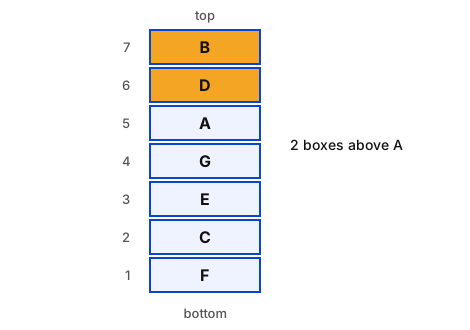
Seven boxes A, B, C, D, E, F and G are kept one over the other but not necessarily in the same order. Only three boxes are kept below G. Only two boxes are kept between G and F. Only B is kept above D. E is kept at some place below A and at some place above C. How many boxes are kept above A?
सात डिब्बे A, B, C, D, E, F और G एक के ऊपर एक रखे गए हैं, परंतु आवश्यक नहीं कि इसी क्रम में हों। G के नीचे केवल तीन डिब्बे रखे हैं। G और F के बीच केवल दो डिब्बे रखे हैं। D के ऊपर केवल B रखा है। E, A के नीचे किसी स्थान पर और C के ऊपर किसी स्थान पर रखा है। A के ऊपर कितने डिब्बे रखे हैं?
  1. AFourचार
  2. BTwoदो
  3. CThreeतीन
  4. DOneएक
Show answer

Concept: Number positions 1 (bottom) to 7 (top) and place the fixed boxes first.

  1. Three boxes below G ⇒ G at 4.
  2. Two boxes between G and F ⇒ F at 1 or 7. Only B is above D ⇒ B = 7, D = 6, so F = 1.
  3. C below E below A in the free slots 2, 3, 5 ⇒ C = 2, E = 3, A = 5.
  4. Above A: D and B ⇒ two boxes.

Trick: "Only X is above Y" fixes X at the top and Y just below it.

Answer: (B) Two

अवधारणा: स्थान 1 (नीचे) से 7 (ऊपर) तक मानें और पहले निश्चित बॉक्स रखें।

  1. G के नीचे तीन बॉक्स ⇒ G = 4।
  2. G और F के बीच दो ⇒ F = 1 या 7। केवल B, D के ऊपर ⇒ B = 7, D = 6, अतः F = 1।
  3. C < E < A, खाली स्थान 2, 3, 5 ⇒ C = 2, E = 3, A = 5।
  4. A के ऊपर D और B ⇒ दो बॉक्स।

ट्रिक: "केवल X, Y के ऊपर है" ⇒ X सबसे ऊपर, Y उसके ठीक नीचे।

उत्तर: (B) दो

RRB NTPC Undergraduate CBT 1General Intelligence and ReasoningBox arrangementRRB NTPC Undergraduate CBT 1 2024 · 20 Aug Shift 1 →
Q1373.
What should come in place of the question mark (?) in the given series based on the English alphabetical order?
UWZ SUX QSV OQT ?
अंग्रेज़ी वर्णमाला क्रम के आधार पर दी गई श्रृंखला में प्रश्न चिह्न (?) के स्थान पर क्या आना चाहिए?
UWZ SUX QSV OQT ?
  1. AMOS
  2. BMPS
  3. CMOR
  4. DMPR
Show answer

Concept: Track each letter position separately.

  1. 1st letters: U, S, Q, O → each −2 → M
  2. 2nd letters: W, U, S, Q → −2 → O
  3. 3rd letters: Z, X, V, T → −2 → R

Trick: Every letter moves back by 2, so just subtract 2 from OQT.

Answer: (C) MOR

अवधारणा: प्रत्येक स्थान के अक्षर अलग-अलग देखें।

  1. पहले अक्षर: U, S, Q, O → −2 → M
  2. दूसरे: W, U, S, Q → −2 → O
  3. तीसरे: Z, X, V, T → −2 → R

ट्रिक: हर अक्षर 2 पीछे जाता है – OQT से 2 घटाएँ।

उत्तर: (C) MOR

RRB NTPC Undergraduate CBT 1General Intelligence and ReasoningLetter seriesRRB NTPC Undergraduate CBT 1 2024 · 20 Aug Shift 1 →
Q1374.
In a certain code language, ‘close your window’ is written as ‘mb tb jb’ and ‘door or window ’ is coded as ‘lk mb fb’. How is ‘window’ coded in the given language?
एक निश्चित कूट भाषा में, ‘close your window’ को ‘mb tb jb’ लिखा जाता है और ‘door or window ’ को ‘lk mb fb’ कूटबद्ध किया जाता है। दी गई भाषा में ‘window’ को किस प्रकार कूटबद्ध किया जाता है?
  1. Amb
  2. Blk
  3. Cfb
  4. Dtb
Show answer

Concept: A word common to two sentences gets the code common to both.

  1. Common word in both sentences: "window".
  2. Common code in "mb tb jb" and "lk mb fb": "mb".
  3. So window = mb.

Trick: Match common words with common codes.

Answer: (A) mb

अवधारणा: दो वाक्यों में उभयनिष्ठ शब्द का कोड भी उभयनिष्ठ होता है।

  1. दोनों में उभयनिष्ठ शब्द: "window"।
  2. दोनों कोड में उभयनिष्ठ: "mb"।
  3. अतः window = mb।

ट्रिक: उभयनिष्ठ शब्द ↔ उभयनिष्ठ कोड।

उत्तर: (A) mb

RRB NTPC Undergraduate CBT 1General Intelligence and ReasoningCoding-decodingRRB NTPC Undergraduate CBT 1 2024 · 20 Aug Shift 1 →
Q1375.
Read the given statements and conclusions carefully. Assuming that the information given in the statements is true, even if it appears to be at variance with commonly known facts, decide which of the given conclusions logically follow(s) from the statements.
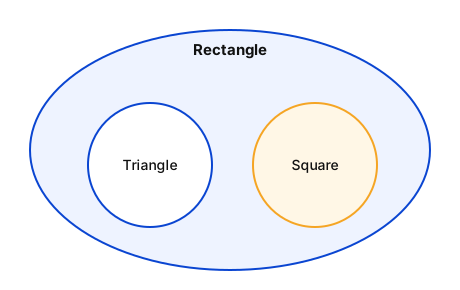
Statements: All triangle are rectangle. All square are rectangle.
Conclusion (I): Some triangle are square.
Conclusion (II): Some rectangle are square.
दिए गए कथनों और निष्कर्षों को ध्यानपूर्वक पढ़िए। कथनों में दी गई जानकारी को सत्य मानते हुए, भले ही वह सामान्यतः ज्ञात तथ्यों से भिन्न प्रतीत होती हो, निर्णय कीजिए कि दिए गए निष्कर्षों में से कौन-सा/कौन-से निष्कर्ष तार्किक रूप से कथनों का अनुसरण करता है/करते हैं।
कथन: सभी त्रिभुज, आयत हैं। सभी वर्ग, आयत हैं।
निष्कर्ष (I): कुछ त्रिभुज, वर्ग हैं।
निष्कर्ष (II): कुछ आयत, वर्ग हैं।
  1. ANeither conclusion (I) nor (II) follows.न तो निष्कर्ष (I) और न ही (II) अनुसरण करता है।
  2. BOnly conclusion (I) follows.केवल निष्कर्ष (I) अनुसरण करता है।
  3. CBoth conclusions (I) and (II) follow.निष्कर्ष (I) और (II) दोनों अनुसरण करते हैं।
  4. DOnly conclusion (II) follows.केवल निष्कर्ष (II) अनुसरण करता है।
Show answer

Concept: Draw the least-overlap Venn diagram; a conclusion follows only if it is true in every possible diagram.

  1. Triangle and Square both lie inside Rectangle, but they need not touch each other ⇒ I does not follow.
  2. All squares are rectangles ⇒ some rectangles are squares ⇒ II follows.

Trick: "All A are B" always gives "Some B are A" (conversion).

Answer: (D) Only conclusion (II) follows.

अवधारणा: न्यूनतम ओवरलैप वाला वेन आरेख बनाइए; निष्कर्ष तभी सही जब हर संभावित आरेख में सत्य हो।

  1. Triangle और Square दोनों Rectangle के अंदर हैं, पर आपस में मिलें यह ज़रूरी नहीं ⇒ I अनुसरण नहीं करता।
  2. सभी square, rectangle हैं ⇒ कुछ rectangle, square हैं ⇒ II अनुसरण करता है।

ट्रिक: "सभी A, B हैं" से हमेशा "कुछ B, A हैं" निकलता है।

उत्तर: (D) केवल निष्कर्ष (II) अनुसरण करता है।

RRB NTPC Undergraduate CBT 1General Intelligence and ReasoningSyllogismRRB NTPC Undergraduate CBT 1 2024 · 20 Aug Shift 1 →
Q1376.
In a certain code language,
A $ B means ‘A is the son of B’
A + B means ‘A is the brother of B’
A @ B means ‘A is the wife of B’
A ÷ B means ‘A is the father of B’
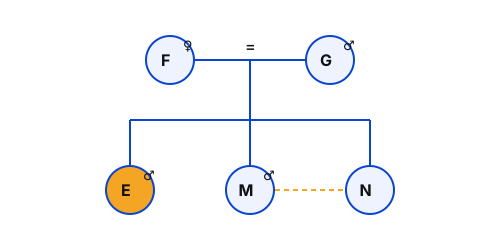
Based on the above, how is E related to N if ‘E $ F @ G ÷ M + N’?
एक निश्चित कूट भाषा में,
A $ B का अर्थ है ‘A, B का पुत्र है’
A + B का अर्थ है ‘A, B का भाई है’
A @ B का अर्थ है ‘A, B की पत्नी है’
A ÷ B का अर्थ है ‘A, B का पिता है’
उपरोक्त के आधार पर, यदि ‘E $ F @ G ÷ M + N’ है, तो E का N से क्या संबंध है?
  1. AMotherमाता
  2. BSisterबहन
  3. CFatherपिता
  4. DBrotherभाई
Show answer

Concept: Decode the expression step by step and build a family tree.

  1. E $ F: E is the son of F (E is male).
  2. F @ G: F is the wife of G ⇒ E is a son of G too.
  3. G ÷ M: G is the father of M; M + N: M is the brother of N ⇒ N is also a child of G.
  4. E (male) and N have the same parents ⇒ E is the brother of N.

Trick: The relation asked is of the first person: E’s gender is fixed by "son", so the answer is Brother.

Answer: (D) Brother

अवधारणा: व्यंजक को चरणबद्ध खोलें और वंश-वृक्ष बनाइए।

  1. E $ F: E, F का पुत्र है (E पुरुष)।
  2. F @ G: F, G की पत्नी ⇒ E, G का भी पुत्र।
  3. G ÷ M: G, M का पिता; M + N: M, N का भाई ⇒ N भी G की संतान।
  4. E (पुरुष) और N के माता-पिता एक ⇒ E, N का भाई है।

ट्रिक: E का लिंग "पुत्र" से तय है, अतः उत्तर भाई।

उत्तर: (D) भाई (Brother)

RRB NTPC Undergraduate CBT 1General Intelligence and ReasoningBlood relations (coded)RRB NTPC Undergraduate CBT 1 2024 · 20 Aug Shift 1 →
Q1377.
What should come in place of the question mark (?) in the given series based on the English alphabetical order?
GMR AGL UAF OUZ ?
अंग्रेज़ी वर्णमाला क्रम के आधार पर दी गई श्रृंखला में प्रश्न चिह्न (?) के स्थान पर क्या आना चाहिए?
GMR AGL UAF OUZ ?
  1. ATIO
  2. BTOI
  3. CITO
  4. DIOT
Show answer

Concept: Track each letter position; letters wrap around after A (A − 1 = Z).

  1. 1st letters: G, A, U, O → each −6 → I
  2. 2nd letters: M, G, A, U → −6 → O
  3. 3rd letters: R, L, F, Z → −6 → T

Trick: Moving back 6 from A: A→Z→Y→X→W→V→U.

Answer: (D) IOT

अवधारणा: प्रत्येक स्थान के अक्षर अलग देखें; A के बाद Z पर लौटते हैं।

  1. पहले अक्षर: G, A, U, O → −6 → I
  2. दूसरे: M, G, A, U → −6 → O
  3. तीसरे: R, L, F, Z → −6 → T

ट्रिक: A से 6 पीछे = U।

उत्तर: (D) IOT

RRB NTPC Undergraduate CBT 1General Intelligence and ReasoningLetter seriesRRB NTPC Undergraduate CBT 1 2024 · 20 Aug Shift 1 →
Q1378.
Refer to the following number and symbol series and answer the question that follows. Counting to be done from left to right only.
(Left) 3 * 8 & @ 9 $ 1 & 5 Ω 6 # 7 % 4 £ 2 (Right)
How many such symbols are there, each of which is immediately preceded by an odd number but NOT immediately followed by an even number?
निम्नलिखित संख्या और प्रतीक श्रृंखला को देखिए और उसके बाद दिए गए प्रश्न का उत्तर दीजिए। गणना केवल बाएँ से दाएँ की जानी है।
(बाएँ) 3 * 8 & @ 9 $ 1 & 5 Ω 6 # 7 % 4 £ 2 (दाएँ)
ऐसे कितने प्रतीक हैं, जिनमें से प्रत्येक के ठीक पहले एक विषम संख्या है, परंतु ठीक बाद एक सम संख्या नहीं है?
  1. AMore than twoदो से अधिक
  2. BOneएक
  3. CTwoदो
  4. DNoneकोई नहीं
Show answer

Concept: Check every symbol: the element just before must be odd and the element just after must NOT be even.

  1. 3 * 8: after is 8 (even) ✗
  2. 9 $ 1: after is 1 (odd) ✓
  3. 1 & 5: after is 5 (odd) ✓
  4. 5 Ω 6 ✗ (6 even); 7 % 4 ✗ (4 even)

Trick: First list "odd–symbol" spots, then strike out those followed by an even digit.

Answer: (C) Two

अवधारणा: हर प्रतीक जाँचें: ठीक पहले विषम संख्या हो और ठीक बाद सम संख्या न हो।

  1. 3 * 8: बाद में 8 (सम) ✗
  2. 9 $ 1: बाद में 1 (विषम) ✓
  3. 1 & 5: बाद में 5 ✓
  4. 5 Ω 6 ✗; 7 % 4 ✗

ट्रिक: पहले "विषम–प्रतीक" स्थान चुनें, फिर सम से पहले वाले हटाएँ।

उत्तर: (C) दो

RRB NTPC Undergraduate CBT 1General Intelligence and ReasoningNumber-symbol seriesRRB NTPC Undergraduate CBT 1 2024 · 20 Aug Shift 1 →
Q1379.
In the following triads, each group of letters is related to the subsequent one following a certain logic. Select from the given options, the one which follows the same logic. ROAM – MORA – OARM
CRIB – BRCI – RICB
निम्नलिखित त्रिकों में, अक्षरों का प्रत्येक समूह एक निश्चित तर्क के अनुसार अपने बाद वाले समूह से संबंधित है। दिए गए विकल्पों में से उस विकल्प का चयन कीजिए जो इसी तर्क का अनुसरण करता है। ROAM – MORA – OARM
CRIB – BRCI – RICB
  1. APING – PNIG – GNIP
  2. BFUME – EUFM – UMFE
  3. CSONG – OSNG – GONS
  4. DGUYS – SUGY – YUGS
Show answer

Concept: Find the position rearrangement in the given triads and apply it to the options.

  1. ROAM (1234) → MORA = 4, 2, 1, 3; MORA → OARM = 2nd, 4th, 3rd, 1st letters.
  2. Check CRIB → BRCI (4213) → RICB (2431) ✓
  3. FUME → EUFM (4213) → UMFE (2431) ✓

Trick: Write position numbers under the first word and read the new order.

Answer: (B) FUME – EUFM – UMFE

अवधारणा: दिए त्रिक में स्थानों का क्रम-परिवर्तन ज्ञात कर विकल्पों पर लागू करें।

  1. ROAM (1234) → MORA = 4, 2, 1, 3; MORA → OARM = 2, 4, 3, 1 क्रम।
  2. CRIB → BRCI → RICB ✓
  3. FUME → EUFM → UMFE ✓

ट्रिक: पहले शब्द के नीचे स्थान संख्या लिखें और नया क्रम पढ़ें।

उत्तर: (B) FUME – EUFM – UMFE

RRB NTPC Undergraduate CBT 1General Intelligence and ReasoningLetter rearrangement (triads)RRB NTPC Undergraduate CBT 1 2024 · 20 Aug Shift 1 →
Q1380.
Based on the English alphabetical order, three of the following four letter-cluster pairs are alike in a certain way and thus form a group. Which letter-cluster pair DOES NOT belong to that group?
(Note: The odd one out is not based on the number of consonants/vowels or their position in the letter-cluster.)
अंग्रेज़ी वर्णमाला क्रम के आधार पर, निम्नलिखित चार अक्षर-समूह युग्मों में से तीन किसी निश्चित प्रकार से एकसमान हैं और इस प्रकार एक समूह बनाते हैं। कौन-सा अक्षर-समूह युग्म उस समूह से संबंधित नहीं है?
(ध्यान दें: असंगत अक्षर-समूह, उस अक्षर-समूह में व्यंजनों/स्वरों की संख्या या उनके स्थान पर आधारित नहीं है।)
  1. AKN-GI
  2. BSV-OQ
  3. COR-KM
  4. DVY-RS
Show answer

Concept: Use alphabet positions within each cluster and across the pair.

  1. KN: +3; GI: +2; K→G −4. SV-OQ and OR-KM follow the same (+3, +2, −4).
  2. VY: +3 but RS: R→S is +1 (not +2).
  3. So VY-RS is the odd one.

Trick: Second cluster gap (+2) is the quickest check.

Answer: (D) VY-RS

अवधारणा: प्रत्येक समूह के अक्षरों की स्थिति संख्या देखें।

  1. KN: +3; GI: +2; K→G −4। SV-OQ, OR-KM भी (+3, +2, −4)।
  2. VY: +3 पर RS: +1 (न कि +2)।
  3. अतः VY-RS भिन्न है।

ट्रिक: दूसरे समूह का अंतर (+2) सबसे तेज़ जाँच है।

उत्तर: (D) VY-RS

RRB NTPC Undergraduate CBT 1General Intelligence and ReasoningOdd one out – letter pairsRRB NTPC Undergraduate CBT 1 2024 · 20 Aug Shift 1 →