Question bank

Q&A: practice questions with answers

Search questions on any topic. Filter by exam category, exam, subject and topic, try the question, then open the answer and explanation.

Courses – airGurukul

8,495 questions found.

Q1381.
If ‘A’ stands for ‘÷’, ‘B’ stands for ‘×’, ‘C’ stands for ‘+’ and ‘D’ stands for ‘−’, what will come in place of the question mark (?) in the following equation?
10 B 3 D 27 C 18 A 2 = ?
यदि ‘A’ का अर्थ ‘÷’, ‘B’ का अर्थ ‘×’, ‘C’ का अर्थ ‘+’ और ‘D’ का अर्थ ‘−’ है, तो निम्नलिखित समीकरण में प्रश्न चिह्न (?) के स्थान पर क्या आएगा?
10 B 3 D 27 C 18 A 2 = ?
  1. A18
  2. B7
  3. C25
  4. D12
Show answer

Concept: Replace letters with signs, then apply BODMAS.

  1. 10×3−27+18÷2
  2. =30−27+9
  3. =12

Trick: Do the ÷ (18 ÷ 2) before adding.

Answer: (D) 12

अवधारणा: अक्षरों को चिह्नों से बदलें, फिर BODMAS लगाएँ।

  1. 10×3−27+18÷2
  2. =30−27+9
  3. =12

ट्रिक: जोड़ने से पहले 18 ÷ 2 करें।

उत्तर: (D) 12
RRB NTPC Undergraduate CBT 1General Intelligence and ReasoningMathematical operationsRRB NTPC Undergraduate CBT 1 2024 · 20 Aug Shift 1 →
Q1382.
What should come in place of the question mark (?) in the given series?
6 24 27 108 111 ?
दी गई श्रृंखला में प्रश्न चिह्न (?) के स्थान पर क्या आना चाहिए?
6 24 27 108 111 ?
  1. A303
  2. B393
  3. C409
  4. D444
Show answer

Concept: Alternating operations: ×4 and +3.

  1. 6×4=24, 24+3=27
  2. 27×4=108, 108+3=111
  3. 111×4=444

Trick: Big jumps alternating with tiny ones signal an alternating × / + pattern.

Answer: (D) 444

अवधारणा: एकांतर संक्रियाएँ: ×4 और +3।

  1. 6×4=24, 24+3=27
  2. 27×4=108, 108+3=111
  3. 111×4=444

ट्रिक: बड़ी छलाँग और छोटी छलाँग बारी-बारी ⇒ × / + पैटर्न।

उत्तर: (D) 444

RRB NTPC Undergraduate CBT 1General Intelligence and ReasoningNumber seriesRRB NTPC Undergraduate CBT 1 2024 · 20 Aug Shift 1 →
Q1383.
Read the given statements and conclusions carefully. Assuming that the information given in the statements is true, even if it appears to be at variance with commonly known facts, decide which of the given conclusion(s) logically follow(s) from the statements.
Statements:
All rectangles are squares.
All squares are trapezoids.
Conclusions:
I. All trapezoids are rectangles.
II. Some trapezoids are rectangles.
दिए गए कथनों और निष्कर्षों को ध्यानपूर्वक पढ़िए। कथनों में दी गई जानकारी को सत्य मानते हुए, भले ही वह सामान्यतः ज्ञात तथ्यों से भिन्न प्रतीत होती हो, निर्णय कीजिए कि दिए गए निष्कर्षों में से कौन-सा/कौन-से निष्कर्ष तार्किक रूप से कथनों का अनुसरण करता है/करते हैं।
कथन:
सभी आयत, वर्ग हैं।
सभी वर्ग, समलंब हैं।
निष्कर्ष:
I. सभी समलंब, आयत हैं।
II. कुछ समलंब, आयत हैं।
  1. AOnly conclusion (I) follows.केवल निष्कर्ष (I) अनुसरण करता है।
  2. BBoth conclusions (I) and (II) follow.निष्कर्ष (I) और (II) दोनों अनुसरण करते हैं।
  3. CNeither conclusion (I) nor (II) follows.न तो निष्कर्ष (I) और न ही (II) अनुसरण करता है।
  4. DOnly conclusion (II) follows.केवल निष्कर्ष (II) अनुसरण करता है।
Show answer

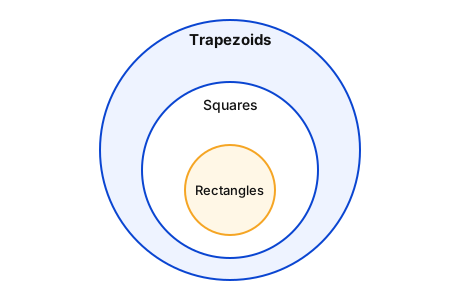
Concept: Chain the "All" statements: Rectangles ⊂ Squares ⊂ Trapezoids.

  1. All rectangles are trapezoids, but trapezoids may be much more ⇒ I (All trapezoids are rectangles) does not follow.
  2. Since all rectangles are trapezoids, some trapezoids are rectangles ⇒ II follows.

Trick: "All A are B" never gives "All B are A", but always gives "Some B are A".

Answer: (D) Only conclusion (II) follows.

अवधारणा: "सभी" कथनों को जोड़ें: Rectangles ⊂ Squares ⊂ Trapezoids।

  1. सभी rectangle, trapezoid हैं, पर सभी trapezoid, rectangle नहीं ⇒ I अनुसरण नहीं करता।
  2. अतः कुछ trapezoid, rectangle हैं ⇒ II अनुसरण करता है।

ट्रिक: "सभी A, B हैं" से "सभी B, A हैं" नहीं, पर "कुछ B, A हैं" अवश्य।

उत्तर: (D) केवल निष्कर्ष (II) अनुसरण करता है।

RRB NTPC Undergraduate CBT 1General Intelligence and ReasoningSyllogismRRB NTPC Undergraduate CBT 1 2024 · 20 Aug Shift 1 →
Q1384.
Based on the English alphabetical order, three of the following four letter-cluster pairs are alike in a certain way and thus form a group. Which letter-cluster pair DOES NOT belong to that group?
(Note: The odd one out is not based on the number of consonants/vowels or their position in the letter-cluster.)
अंग्रेज़ी वर्णमाला क्रम के आधार पर, निम्नलिखित चार अक्षर-समूह युग्मों में से तीन किसी निश्चित प्रकार से एकसमान हैं और इस प्रकार एक समूह बनाते हैं। कौन-सा अक्षर-समूह युग्म उस समूह से संबंधित नहीं है?
(ध्यान दें: असंगत अक्षर-समूह, उस अक्षर-समूह में व्यंजनों/स्वरों की संख्या या उनके स्थान पर आधारित नहीं है।)
  1. ASP-AV
  2. BJG-RM
  3. CQN-YT
  4. DBY-JF
Show answer

Concept: Use alphabet positions (with wrap-around Z → A).

  1. SP: S(19)→P(16) −3; AV: A(1)→V(22) −5 (backward); S→A +8.
  2. JG-RM: −3, −5, +8 ✓; QN-YT: −3, −5, +8 ✓
  3. BY-JF: B→Y −3 but J(10)→F(6) is −4 ✗

Trick: Check the second cluster’s gap first: −5 in three pairs, −4 in BY-JF.

Answer: (D) BY-JF

अवधारणा: अक्षरों की स्थिति संख्या लें (Z के बाद A)।

  1. SP: −3; AV: −5; S→A +8।
  2. JG-RM: −3, −5, +8 ✓; QN-YT ✓
  3. BY-JF: J→F −4 ✗

ट्रिक: दूसरे समूह का अंतर देखें: तीन में −5, BY-JF में −4।

उत्तर: (D) BY-JF

RRB NTPC Undergraduate CBT 1General Intelligence and ReasoningOdd one out – letter pairsRRB NTPC Undergraduate CBT 1 2024 · 20 Aug Shift 1 →
Q1385.
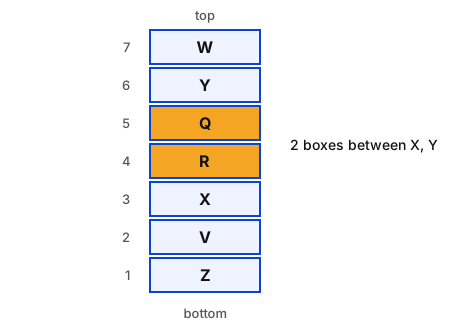
Seven boxes V, W, X, Y, Z, Q and R are kept one over the other but not necessarily in the same order. V is kept second from the bottom. Only three boxes are kept between V and Y. Z is kept at one of the positions below V. Only Q is kept between Y and R. W is kept at one of the positions above Y. How many boxes are kept between X and Y?
सात डिब्बे V, W, X, Y, Z, Q और R एक के ऊपर एक रखे गए हैं, परंतु आवश्यक नहीं कि इसी क्रम में हों। V नीचे से दूसरे स्थान पर रखा है। V और Y के बीच केवल तीन डिब्बे रखे हैं। Z, V के नीचे के किसी एक स्थान पर रखा है। Y और R के बीच केवल Q रखा है। W, Y के ऊपर के किसी एक स्थान पर रखा है। X और Y के बीच कितने डिब्बे रखे हैं?
  1. AThreeतीन
  2. BFourचार
  3. CTwoदो
  4. DOneएक
Show answer

Concept: Number positions 1 (bottom) to 7 (top) and fix definite clues first.

  1. V = 2. Three between V and Y ⇒ Y = 6. Z below V ⇒ Z = 1.
  2. Only Q between Y and R ⇒ Q = 5, R = 4 (R = 8 impossible).
  3. W above Y ⇒ W = 7; remaining X = 3.
  4. Between X (3) and Y (6): R, Q ⇒ two boxes.

Trick: "Only one box between" means positions differ by 2.

Answer: (C) Two

अवधारणा: स्थान 1 (नीचे) से 7 (ऊपर) मानें, पहले निश्चित संकेत लगाएँ।

  1. V = 2। V और Y के बीच तीन ⇒ Y = 6। Z, V के नीचे ⇒ Z = 1।
  2. Y और R के बीच केवल Q ⇒ Q = 5, R = 4।
  3. W, Y के ऊपर ⇒ W = 7; X = 3।
  4. X (3) और Y (6) के बीच R, Q ⇒ दो।

ट्रिक: "बीच में केवल एक" ⇒ स्थानों का अंतर 2।

उत्तर: (C) दो

RRB NTPC Undergraduate CBT 1General Intelligence and ReasoningBox arrangementRRB NTPC Undergraduate CBT 1 2024 · 20 Aug Shift 1 →
Q1386.
Hriday ranked 26th from the top and 38th from the bottom in his class. How many students are there in his class?
हृदय की अपनी कक्षा में ऊपर से 26वीं और नीचे से 38वीं रैंक है। उसकी कक्षा में कितने विद्यार्थी हैं?
  1. A61
  2. B63
  3. C64
  4. D62
Show answer

Concept: Total = rank from top + rank from bottom − 1.

  1. 26+38−1=63

Yaad rakhein: Subtract 1 because Hriday is counted in both ranks.

Answer: (B) 63

अवधारणा: कुल = ऊपर से रैंक + नीचे से रैंक − 1।

  1. 26+38−1=63

याद रखें: हृदय दोनों रैंकों में गिना गया है, इसलिए 1 घटाएँ।

उत्तर: (B) 63

RRB NTPC Undergraduate CBT 1General Intelligence and ReasoningRankingRRB NTPC Undergraduate CBT 1 2024 · 20 Aug Shift 1 →
Q1387.
Based on the English alphabetical order, three of the following four letter-cluster pairs are alike in a certain way and thus form a group. Which letter-cluster pair DOES NOT belong to that group?
(Note: The odd one out is not based on the number of consonants/vowels or their position in the letter-cluster.)
अंग्रेज़ी वर्णमाला क्रम के आधार पर, निम्नलिखित चार अक्षर-समूह युग्मों में से तीन किसी निश्चित प्रकार से एकसमान हैं और इस प्रकार एक समूह बनाते हैं। कौन-सा अक्षर-समूह युग्म उस समूह से संबंधित नहीं है?
(ध्यान दें: असंगत अक्षर-समूह, उस अक्षर-समूह में व्यंजनों/स्वरों की संख्या या उनके स्थान पर आधारित नहीं है।)
  1. ASO-LQ
  2. BPL-IN
  3. CVR-OT
  4. DMI-FL
Show answer

Concept: Use alphabet positions within and across clusters.

  1. SO: −4; LQ: +5; S→L −7.
  2. PL-IN: −4, +5, −7 ✓; VR-OT: −4, +5, −7 ✓
  3. MI-FL: −4, −7 but F(6)→L(12) is +6 ✗

Trick: Second cluster gap +5 in three pairs, +6 in MI-FL.

Answer: (D) MI-FL

अवधारणा: अक्षरों की स्थिति संख्या देखें।

  1. SO: −4; LQ: +5; S→L −7।
  2. PL-IN, VR-OT: −4, +5, −7 ✓
  3. MI-FL: F→L +6 ✗

ट्रिक: दूसरे समूह का अंतर तीन में +5, MI-FL में +6।

उत्तर: (D) MI-FL

RRB NTPC Undergraduate CBT 1General Intelligence and ReasoningOdd one out – letter pairsRRB NTPC Undergraduate CBT 1 2024 · 20 Aug Shift 1 →
Q1388.
What will come in place of ‘?’ in the following equation if ‘+’ and ‘−‘ are interchanged and ‘x’ and ‘÷’ are interchanged?
8 ÷ 6 + 78 × 6 − 17 = ?
यदि ‘+’ और ‘−‘ को आपस में बदल दिया जाए तथा ‘x’ और ‘÷’ को आपस में बदल दिया जाए, तो निम्नलिखित समीकरण में ‘?’ के स्थान पर क्या आएगा?
8 ÷ 6 + 78 × 6 − 17 = ?
  1. A52
  2. B66
  3. C45
  4. D59
Show answer

Concept: Swap the signs as told, then apply BODMAS.

  1. After swapping: 8×6−78÷6+17
  2. =48−13+17
  3. =52

Trick: Swap first, solve later – never solve the original expression.

Answer: (A) 52

अवधारणा: चिह्न बदलें, फिर BODMAS लगाएँ।

  1. बदलने के बाद: 8×6−78÷6+17
  2. =48−13+17
  3. =52

ट्रिक: पहले चिह्न बदलें, बाद में हल करें।

उत्तर: (A) 52

RRB NTPC Undergraduate CBT 1General Intelligence and ReasoningMathematical operationsRRB NTPC Undergraduate CBT 1 2024 · 20 Aug Shift 1 →
Q1389.
WPKD is related to BUPI in a certain way based on the English alphabetical order. In the same way, QJEX is related to VOJC. To which of the given options is FYTM related, following the same logic?
अंग्रेज़ी वर्णमाला क्रम के आधार पर WPKD एक निश्चित प्रकार से BUPI से संबंधित है। उसी प्रकार, QJEX, VOJC से संबंधित है। समान तर्क का अनुसरण करते हुए, FYTM दिए गए विकल्पों में से किससे संबंधित है?
  1. AKDYR
  2. BKDRY
  3. CKYRD
  4. DKYDR
Show answer

Concept: Find the shift of each letter (wrap Z → A).

  1. W→B, P→U, K→P, D→I: each +5. QJEX→VOJC also +5.
  2. FYTM: F+5 = K, Y+5 = D, T+5 = Y, M+5 = R

Trick: Y + 5 crosses Z: Y→Z→A→B→C→D.

Answer: (A) KDYR

अवधारणा: हर अक्षर का खिसकाव देखें (Z के बाद A)।

  1. W→B, P→U, K→P, D→I: हर अक्षर +5। QJEX→VOJC भी +5।
  2. FYTM: K, D, Y, R

ट्रिक: Y + 5: Y→Z→A→B→C→D।

उत्तर: (A) KDYR

RRB NTPC Undergraduate CBT 1General Intelligence and ReasoningLetter analogyRRB NTPC Undergraduate CBT 1 2024 · 20 Aug Shift 1 →
Q1390.
Refer to the following number and symbol series and answer the question that follows. Counting to be done from left to right only.
(Left) 9 4 4 @ 6 9 5 # * + 4 9 % \ & + < > > ^ # (Right)
How many such numbers are there, each of which is immediately preceded by a symbol and also immediately followed by another number?
निम्नलिखित संख्या और प्रतीक श्रृंखला को देखिए और उसके बाद दिए गए प्रश्न का उत्तर दीजिए। गणना केवल बाएँ से दाएँ की जानी है।
(बाएँ) 9 4 4 @ 6 9 5 # * + 4 9 % \ & + < > > ^ # (दाएँ)
ऐसी कितनी संख्याएँ हैं, जिनमें से प्रत्येक के ठीक पहले एक प्रतीक है और ठीक बाद भी एक अन्य संख्या है?
  1. ANoneकोई नहीं
  2. BThreeतीन
  3. COneएक
  4. DTwoदो
Show answer

Concept: Scan each number: the element just before must be a symbol and the one just after must be a number.

  1. @ 6 9: 6 preceded by @, followed by 9 ✓
  2. + 4 9: 4 preceded by +, followed by 9 ✓
  3. Other numbers fail (e.g. 9 after 6 is preceded by a number; 9 after 4 is followed by %).

Trick: Look for "symbol–number–number" triplets.

Answer: (D) Two

अवधारणा: हर संख्या जाँचें: ठीक पहले प्रतीक और ठीक बाद संख्या हो।

  1. @ 6 9: 6 ✓
  2. + 4 9: 4 ✓
  3. बाकी संख्याएँ शर्त पूरी नहीं करतीं।

ट्रिक: "प्रतीक–संख्या–संख्या" त्रिक खोजें।

उत्तर: (D) दो

RRB NTPC Undergraduate CBT 1General Intelligence and ReasoningNumber-symbol seriesRRB NTPC Undergraduate CBT 1 2024 · 20 Aug Shift 1 →
Q1391.
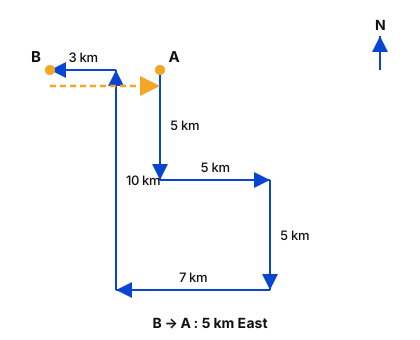
Person X starts from point A and drives 5 km towards the south. He then takes a left turn, drives 5 km, turns right and drives 5 km. He then takes a right turn and drives 7 km. He then takes a right turn, drives 10 km. He then takes a final left turn and drives 3 km and stops at point B. How far (shortest distance) and towards which direction should he drive in order to reach point A again? (All turns are 90 degrees unless specified)
व्यक्ति X बिंदु A से चलना शुरू करता है और दक्षिण की ओर 5 km गाड़ी चलाता है। फिर वह बाएँ मुड़ता है, 5 km गाड़ी चलाता है, दाएँ मुड़ता है और 5 km गाड़ी चलाता है। फिर वह दाएँ मुड़ता है और 7 km गाड़ी चलाता है। फिर वह दाएँ मुड़ता है, 10 km गाड़ी चलाता है। फिर वह अंतिम बार बाएँ मुड़ता है और 3 km गाड़ी चलाकर बिंदु B पर रुक जाता है। पुनः बिंदु A पर पहुँचने के लिए उसे कितनी दूर (न्यूनतम दूरी) और किस दिशा में गाड़ी चलानी चाहिए? (जब तक निर्दिष्ट न किया जाए, सभी मोड़ 90 डिग्री के हैं)
  1. A5 km west5 km पश्चिम
  2. B5 km east5 km पूर्व
  3. C3 km south3 km दक्षिण
  4. D5 km south5 km दक्षिण
Show answer

Concept: Place A at the origin (East = +x, North = +y) and track each move.

  1. 5 S → (0, −5); left = East 5 → (5, −5); right = South 5 → (5, −10)
  2. Right = West 7 → (−2, −10); right = North 10 → (−2, 0); left = West 3 → (−5, 0) = B
  3. B is 5 km west of A ⇒ drive 5 km east.

Trick: Net E–W: 5−7−3=−5; net N–S: −5−5+10=0.

Answer: (B) 5 km east

अवधारणा: A को मूल बिंदु मानें (पूर्व = +x, उत्तर = +y) और हर चाल लिखें।

  1. 5 दक्षिण → (0, −5); बाएँ = पूर्व 5 → (5, −5); दाएँ = दक्षिण 5 → (5, −10)
  2. दाएँ = पश्चिम 7 → (−2, −10); दाएँ = उत्तर 10 → (−2, 0); बाएँ = पश्चिम 3 → (−5, 0) = B
  3. B, A से 5 km पश्चिम ⇒ 5 km पूर्व जाना होगा।

ट्रिक: शुद्ध पूर्व–पश्चिम: 5−7−3=−5; उत्तर–दक्षिण: 0।

उत्तर: (B) 5 km पूर्व

RRB NTPC Undergraduate CBT 1General Intelligence and ReasoningDirection and distanceRRB NTPC Undergraduate CBT 1 2024 · 20 Aug Shift 1 →
Q1392.
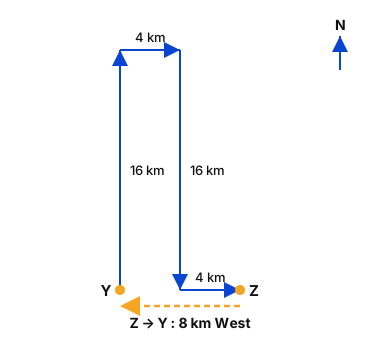
Manoj starts from Point Y and drives 16 km towards north. He then takes a right turn and drives 4 km. He then turns right and drives 16 km. He takes a final left turn, drives 4 km and stops at Point Z. How far (shortest distance) and towards which direction should he drive in order to reach Point Y again? (All turns are 90-degree turns only, unless specified.)
मनोज बिंदु Y से चलना शुरू करता है और उत्तर की ओर 16 km गाड़ी चलाता है। फिर वह दाएँ मुड़ता है और 4 km गाड़ी चलाता है। फिर वह दाएँ मुड़ता है और 16 km गाड़ी चलाता है। वह अंतिम बार बाएँ मुड़ता है, 4 km गाड़ी चलाता है और बिंदु Z पर रुक जाता है। पुनः बिंदु Y पर पहुँचने के लिए उसे कितनी दूर (न्यूनतम दूरी) और किस दिशा में गाड़ी चलानी चाहिए? (जब तक निर्दिष्ट न किया जाए, सभी मोड़ केवल 90 डिग्री के हैं।)
  1. A8 km towards west8 km पश्चिम की ओर
  2. B4 km towards north4 km उत्तर की ओर
  3. C4 km towards east4 km पूर्व की ओर
  4. D6 km towards north6 km उत्तर की ओर
Show answer

Concept: Track coordinates from Y (East = +x, North = +y).

  1. 16 N → (0, 16); right = East 4 → (4, 16)
  2. Right = South 16 → (4, 0); left = East 4 → (8, 0) = Z
  3. Z is 8 km east of Y ⇒ drive 8 km west.

Trick: North 16 and South 16 cancel; only the two East moves (4 + 4) remain.

Answer: (A) 8 km towards west

अवधारणा: Y से निर्देशांक लिखें (पूर्व = +x, उत्तर = +y)।

  1. 16 उत्तर → (0, 16); दाएँ = पूर्व 4 → (4, 16)
  2. दाएँ = दक्षिण 16 → (4, 0); बाएँ = पूर्व 4 → (8, 0) = Z
  3. Z, Y से 8 km पूर्व ⇒ 8 km पश्चिम जाना होगा।

ट्रिक: उत्तर 16 और दक्षिण 16 कट जाते हैं; पूर्व 4 + 4 बचे।

उत्तर: (A) 8 km पश्चिम की ओर

RRB NTPC Undergraduate CBT 1General Intelligence and ReasoningDirection and distanceRRB NTPC Undergraduate CBT 1 2024 · 20 Aug Shift 1 →
Q1393.
In the following number-pairs, the second number is obtained by applying certain mathematical operation(s) to the first number. Select the number-pair in which the numbers are related in the same way as are the numbers of the following pairs. (NOTE: Operations should be performed on the whole numbers, without breaking down the numbers into their constituent digits. E.g. 13 – Operations on 13 such as adding to/subtracting from/multiplying with 13 can be performed. Breaking down 13 into 1 and 3 and then performing mathematical operations on 1 and 3 is not allowed.)
27, 135
33, 165
निम्नलिखित संख्या-युग्मों में, पहली संख्या पर कुछ निश्चित गणितीय संक्रिया/संक्रियाएँ करके दूसरी संख्या प्राप्त की जाती है। उस संख्या-युग्म का चयन कीजिए जिसमें संख्याएँ उसी प्रकार संबंधित हैं जिस प्रकार निम्नलिखित युग्मों की संख्याएँ संबंधित हैं। (ध्यान दें: संक्रियाएँ संख्याओं को उनके घटक अंकों में विभाजित किए बिना, पूर्ण संख्याओं पर की जानी चाहिए। उदाहरण के लिए 13 – 13 पर संक्रियाएँ जैसे 13 में जोड़ना/13 में से घटाना/13 से गुणा करना आदि की जा सकती हैं। 13 को 1 और 3 में विभाजित करना और फिर 1 और 3 पर गणितीय संक्रियाएँ करना वर्जित है।)
27, 135
33, 165
  1. A22, 110
  2. B35, 180
  3. C29, 125
  4. D19, 105
Show answer

Concept: Find the rule from the given pairs and test the options.

  1. 27×5=135, 33×5=165 ⇒ second = first × 5
  2. 22×5=110 ✓
  3. 35×5=175≠180, 29×5=145≠125, 19×5=95≠105

Trick: Second number ÷ first number = 5 in both pairs.

Answer: (A) 22, 110

अवधारणा: दिए युग्मों से नियम निकालकर विकल्प जाँचें।

  1. 27×5=135, 33×5=165 ⇒ दूसरी = पहली × 5
  2. 22×5=110 ✓
  3. बाकी विकल्प नियम पर खरे नहीं।

ट्रिक: दोनों युग्मों में दूसरी ÷ पहली = 5।

उत्तर: (A) 22, 110

RRB NTPC Undergraduate CBT 1General Intelligence and ReasoningNumber-pair analogyRRB NTPC Undergraduate CBT 1 2024 · 20 Aug Shift 1 →
Q1394.
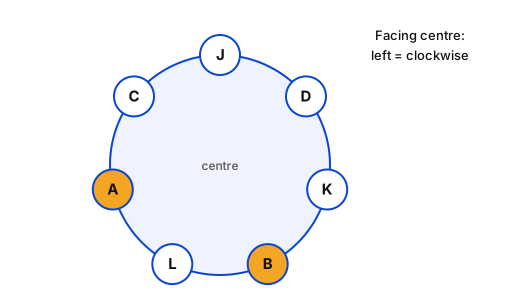
A, B, C, D, J, K and L are sitting around a circular table, facing the centre of the table. Only three people sit between J and L when counted from the left of J. Only three people sit between K and C when counted from the right of C. D sits to the immediate right of K. A is an immediate neighbour of C as well as L.
Who sits second to the left of B?
A, B, C, D, J, K और L एक वृत्ताकार मेज़ के चारों ओर मेज़ के केंद्र की ओर मुख करके बैठे हैं। J के बाएँ से गिनने पर J और L के बीच केवल तीन व्यक्ति बैठे हैं। C के दाएँ से गिनने पर K और C के बीच केवल तीन व्यक्ति बैठे हैं। D, K के ठीक दाएँ बैठा है। A, C और L दोनों का निकटतम पड़ोसी है।
B के बाएँ से दूसरे स्थान पर कौन बैठा है?
  1. AK
  2. BC
  3. CA
  4. DD
Show answer

Concept: Facing the centre, "left" is clockwise and "right" is anticlockwise. Fix J and place others.

  1. Going left of J: D, K, B, then L ⇒ three between J and L.
  2. Going right of C: A, L, B, then K ⇒ three between C and K; D is to the immediate right of K.
  3. A is between C and L ⇒ order (clockwise): J, D, K, B, L, A, C.
  4. Two places left of B: L then A.

Trick: "Immediate neighbour of both" ⇒ that person sits exactly between the two.

Answer: (C) A

अवधारणा: केंद्र की ओर मुख होने पर "बायाँ" = दक्षिणावर्त, "दायाँ" = वामावर्त। J को स्थिर रखें।

  1. J के बाएँ से: D, K, B, फिर L ⇒ J और L के बीच तीन।
  2. C के दाएँ से: A, L, B, फिर K ⇒ C और K के बीच तीन; D, K के ठीक दाएँ।
  3. A, C और L के बीच ⇒ क्रम (दक्षिणावर्त): J, D, K, B, L, A, C।
  4. B के बाएँ दूसरा: L के बाद A।

ट्रिक: "दोनों का निकटतम पड़ोसी" ⇒ वह दोनों के ठीक बीच बैठेगा।

उत्तर: (C) A

RRB NTPC Undergraduate CBT 1General Intelligence and ReasoningCircular seating arrangementRRB NTPC Undergraduate CBT 1 2024 · 20 Aug Shift 1 →
Q1395.
What should come in place of the question mark (?) in the given series?
491 492 496 505 521 ?
दी गई श्रृंखला में प्रश्न चिह्न (?) के स्थान पर क्या आना चाहिए?
491 492 496 505 521 ?
  1. A541
  2. B531
  3. C546
  4. D536
Show answer

Concept: Differences of consecutive terms are perfect squares.

  1. Differences: 1, 4, 9, 16 = 12,22,32,42
  2. Next difference =52=25
  3. 521+25=546

Trick: 1, 4, 9, 16 – spot squares instantly.

Answer: (C) 546

अवधारणा: क्रमागत पदों के अंतर पूर्ण वर्ग हैं।

  1. अंतर: 1, 4, 9, 16 = 12,22,32,42
  2. अगला अंतर =52=25
  3. 521+25=546

ट्रिक: 1, 4, 9, 16 – वर्ग पहचानें।

उत्तर: (C) 546

RRB NTPC Undergraduate CBT 1General Intelligence and ReasoningNumber seriesRRB NTPC Undergraduate CBT 1 2024 · 20 Aug Shift 1 →
Q1396.
AHJQ is related to DJMS in a certain way based on the English alphabetical order. In the same way, MPVY is related to PRYA. To which of the given options is VVEE related, following the same logic?
अंग्रेज़ी वर्णमाला क्रम के आधार पर AHJQ एक निश्चित प्रकार से DJMS से संबंधित है। उसी प्रकार, MPVY, PRYA से संबंधित है। समान तर्क का अनुसरण करते हुए, VVEE दिए गए विकल्पों में से किससे संबंधित है?
  1. AYGHJ
  2. BYGFT
  3. CYXHG
  4. DYXGH
Show answer

Concept: Find the shift of each letter position.

  1. A→D +3, H→J +2, J→M +3, Q→S +2 (pattern +3, +2, +3, +2).
  2. MPVY→PRYA follows the same (Y+2 = A).
  3. VVEE: V+3 = Y, V+2 = X, E+3 = H, E+2 = G

Trick: Alternating +3/+2 – apply in order to each letter.

Answer: (C) YXHG

अवधारणा: हर स्थान के अक्षर का खिसकाव देखें।

  1. A→D +3, H→J +2, J→M +3, Q→S +2।
  2. MPVY→PRYA भी यही (Y+2 = A)।
  3. VVEE: Y, X, H, G

ट्रिक: बारी-बारी +3/+2 लगाएँ।

उत्तर: (C) YXHG

RRB NTPC Undergraduate CBT 1General Intelligence and ReasoningLetter analogyRRB NTPC Undergraduate CBT 1 2024 · 20 Aug Shift 1 →
Q1397.
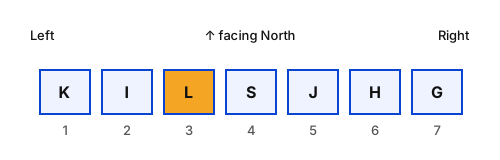
Seven people, G, H, I, J, K, L and S, are sitting in a row facing North. Only five people sit between K and G. H sits to the immediate left of G. Only one person sits between H and S. L sits at some place to the left of J but at some place to the right of I. Who sits third from the left end of the line?
सात व्यक्ति G, H, I, J, K, L और S एक पंक्ति में उत्तर की ओर मुख करके बैठे हैं। K और G के बीच केवल पाँच व्यक्ति बैठे हैं। H, G के ठीक बाएँ बैठा है। H और S के बीच केवल एक व्यक्ति बैठा है। L, J के बाएँ किसी स्थान पर परंतु I के दाएँ किसी स्थान पर बैठा है। पंक्ति के बाएँ छोर से तीसरे स्थान पर कौन बैठा है?
  1. AH
  2. BL
  3. CS
  4. DI
Show answer

Concept: Row of 7 facing North: left end = position 1. Five people between two persons ⇒ they sit at the two ends.

  1. K and G at positions 1 and 7. H is immediately left of G ⇒ G = 7, H = 6, K = 1.
  2. One person between H and S ⇒ S = 4.
  3. I < L < J in the free seats 2, 3, 5 ⇒ I = 2, L = 3, J = 5.
  4. Third from the left: L.

Trick: In a 7-seat row, "five between" always means the two ends.

Answer: (B) L

अवधारणा: 7 लोग उत्तर की ओर: बायाँ सिरा = स्थान 1। बीच में पाँच ⇒ दोनों सिरों पर।

  1. K और G स्थान 1 और 7 पर। H, G के ठीक बाएँ ⇒ G = 7, H = 6, K = 1।
  2. H और S के बीच एक ⇒ S = 4।
  3. I < L < J, खाली स्थान 2, 3, 5 ⇒ I = 2, L = 3, J = 5।
  4. बाएँ से तीसरा: L।

ट्रिक: 7 सीटों में "बीच में पाँच" ⇒ दोनों सिरे।

उत्तर: (B) L

RRB NTPC Undergraduate CBT 1General Intelligence and ReasoningLinear seating arrangementRRB NTPC Undergraduate CBT 1 2024 · 20 Aug Shift 1 →
Q1398.
If 1 is added to each even digit and 2 is subtracted from each odd digit in the number 9342865, then what will be the sum of the digits that are first from the left and first from the right in the new number thus formed?
यदि संख्या 9342865 में प्रत्येक सम अंक में 1 जोड़ा जाए और प्रत्येक विषम अंक में से 2 घटाया जाए, तो इस प्रकार बनी नई संख्या में बाएँ से पहले और दाएँ से पहले अंकों का योग क्या होगा?
  1. A9
  2. B10
  3. C8
  4. D7
Show answer

Concept: Change each digit as instructed and read the new number.

  1. 9→7, 3→1, 4→5, 2→3, 8→9, 6→7, 5→3 ⇒ 7153973
  2. First from left = 7, first from right = 3
  3. Sum =7+3=10

Trick: Only the two end digits matter: 9 → 7 and 5 → 3.

Answer: (B) 10

अवधारणा: हर अंक को निर्देश अनुसार बदलें और नई संख्या पढ़ें।

  1. 9→7, 3→1, 4→5, 2→3, 8→9, 6→7, 5→3 ⇒ 7153973
  2. बाएँ से पहला 7, दाएँ से पहला 3
  3. योग =10

ट्रिक: केवल दोनों सिरों के अंक बदलें: 9 → 7, 5 → 3।

उत्तर: (B) 10

RRB NTPC Undergraduate CBT 1General Intelligence and ReasoningDigit operationsRRB NTPC Undergraduate CBT 1 2024 · 20 Aug Shift 1 →
Q1399.
In a certain code language, ‘MUTE’ is coded as ‘4527’ and ‘TOPS’ is coded as ‘1346’. What is the code for ‘T’ in that language?
एक निश्चित कूट भाषा में, ‘MUTE’ को ‘4527’ और ‘TOPS’ को ‘1346’ के रूप में कूटबद्ध किया जाता है। उस भाषा में ‘T’ का कूट क्या है?
  1. A1
  2. B4
  3. C3
  4. D2
Show answer

Concept: The letter common to two words takes the digit common to their codes.

  1. Common letter in MUTE and TOPS: T.
  2. Common digit in 4527 and 1346: 4.
  3. So T = 4.

Trick: One common letter ↔ one common digit.

Answer: (B) 4

अवधारणा: दोनों शब्दों के उभयनिष्ठ अक्षर का कोड, दोनों कोड का उभयनिष्ठ अंक होगा।

  1. MUTE और TOPS में उभयनिष्ठ: T।
  2. 4527 और 1346 में उभयनिष्ठ: 4।
  3. अतः T = 4।

ट्रिक: एक उभयनिष्ठ अक्षर ↔ एक उभयनिष्ठ अंक।

उत्तर: (B) 4

RRB NTPC Undergraduate CBT 1General Intelligence and ReasoningCoding-decodingRRB NTPC Undergraduate CBT 1 2024 · 20 Aug Shift 1 →
Q1400.
If 1 is added to each even digit and 3 is subtracted from each odd digit in the number 6798245, what will be difference between the highest and second lowest digits thus formed?
यदि संख्या 6798245 में प्रत्येक सम अंक में 1 जोड़ा जाए और प्रत्येक विषम अंक में से 3 घटाया जाए, तो इस प्रकार बने सबसे बड़े और दूसरे सबसे छोटे अंक के बीच का अंतर क्या होगा?
  1. A7
  2. B8
  3. C6
  4. D9
Show answer

Concept: Change each digit as instructed, then sort the new digits.

  1. 6→7, 7→4, 9→6, 8→9, 2→3, 4→5, 5→2 ⇒ 7469352
  2. Sorted: 2, 3, 4, 5, 6, 7, 9 ⇒ highest 9, second lowest 3
  3. Difference =9−3=6

Trick: Sort the new digits before picking "second lowest".

Answer: (C) 6

अवधारणा: हर अंक को निर्देश अनुसार बदलें, फिर नए अंक क्रम में लगाएँ।

  1. 6→7, 7→4, 9→6, 8→9, 2→3, 4→5, 5→2 ⇒ 7469352
  2. क्रम: 2, 3, 4, 5, 6, 7, 9 ⇒ सबसे बड़ा 9, दूसरा सबसे छोटा 3
  3. अंतर =9−3=6

ट्रिक: "दूसरा सबसे छोटा" चुनने से पहले अंकों को क्रम में लगाएँ।

उत्तर: (C) 6

RRB NTPC Undergraduate CBT 1General Intelligence and ReasoningDigit operationsRRB NTPC Undergraduate CBT 1 2024 · 20 Aug Shift 1 →