Question bank

Q&A: practice questions with answers

Search questions on any topic. Filter by exam category, exam, subject and topic, try the question, then open the answer and explanation.

Courses – airGurukul

8,495 questions found.

Q1541.
The average of first 150 odd natural numbers, is:
प्रथम 150 विषम प्राकृत संख्याओं का औसत कितना है?
  1. A150.5
  2. B151
  3. C150
  4. D149.5
Show answer

Concept: Sum of first n odd natural numbers =n2, so their average =n2n=n.

  1. Here n=150.
  2. Sum =1502=22500.
  3. Average =22500150=150.

Trick: Average of first n odd numbers =n; of first n even numbers =n+1.

Answer: (C) 150

अवधारणा: पहली n विषम प्राकृत संख्याओं का योग =n2, अतः औसत =n2n=n।

  1. यहाँ n=150।
  2. योग =1502=22500।
  3. औसत =22500150=150।

ट्रिक: पहली n विषम संख्याओं का औसत =n; पहली n सम संख्याओं का औसत =n+1।

उत्तर: (C) 150

RRB NTPC Undergraduate CBT 1MathematicsAverageRRB NTPC Undergraduate CBT 1 2024 · 19 Aug Shift 2 →
Q1542.
If the interest earned during the 2nd year on a certain sum is ₹3,342, and the rate of interest is 20% per annum compounded annually, then the sum is:
यदि किसी निश्चित धनराशि पर दूसरे (2nd) वर्ष के दौरान अर्जित ब्याज ₹3,342 है, और ब्याज की दर 20% वार्षिक है, जो वार्षिक रूप से चक्रवृद्धि होती है, तो धनराशि ज्ञात कीजिए।
  1. A₹13,285
  2. B₹13,925
  3. C₹14,900
  4. D₹14,075
Show answer

Concept: With CI, the 2nd-year interest is the rate applied to (principal + 1st-year interest): I2=P×r100×(1+r100).

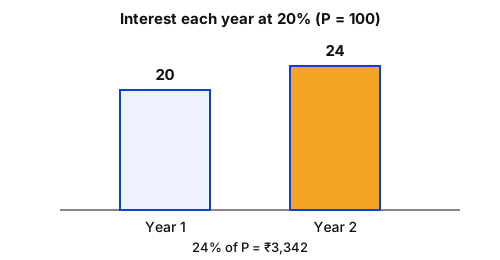
  1. Take P=100: 1st-year interest =20, amount =120.
  2. 2nd-year interest =20% of 120=24, i.e., 24% of P.
  3. 0.24P=3342⇒P=33420.24=13925.

Trick: 2nd-year CI =P×r100×100+r100; at 20% it is 625P.

Answer: (B) ₹13,925

अवधारणा: चक्रवृद्धि ब्याज में दूसरे वर्ष का ब्याज (मूलधन + पहले वर्ष का ब्याज) पर लगता है: I2=P×r100×(1+r100)।

  1. मान लें P=100: पहले वर्ष ब्याज =20, मिश्रधन =120।
  2. दूसरे वर्ष ब्याज =120 का 20%=24, अर्थात P का 24%।
  3. 0.24P=3342⇒P=33420.24=13925।

ट्रिक: दूसरे वर्ष का CI =P×r100×100+r100; 20% पर यह 625P है।

उत्तर: (B) ₹13,925

RRB NTPC Undergraduate CBT 1MathematicsCompound interestRRB NTPC Undergraduate CBT 1 2024 · 19 Aug Shift 2 →
Q1543.
If 2 times a son's age is added to his father's age, the sum is 36 years. If 2.5 times the father's age is added to the son's age, the sum is 72 years. What is the father's age (in years)?
यदि पुत्र की आयु के 2 गुने को उसके पिता की आयु में जोड़ा जाए, तो योग 36 वर्ष होता है। यदि पिता की आयु के 2.5 गुने को पुत्र की आयु में जोड़ा जाए, तो योग 72 वर्ष होता है। पिता की आयु (वर्षों में) कितनी है?
  1. A27
  2. B31
  3. C23
  4. D32
Show answer

Concept: Form two linear equations with son's age s and father's age f and solve.

  1. 2s+f=36 … (i) and s+2.5f=72 … (ii).
  2. Multiply (ii) by 2: 2s+5f=144.
  3. Subtract (i): 4f=108⇒f=27.
  4. Check: s=36−272=4.5 and 4.5+2.5×27=72 ✓.

Trick: Make the coefficient of s equal (×2) and subtract to remove s in one step.

Answer: (A) 27

अवधारणा: पुत्र की आयु s और पिता की आयु f लेकर दो रैखिक समीकरण बनाएँ।

  1. 2s+f=36 … (i) तथा s+2.5f=72 … (ii)।
  2. (ii) को 2 से गुणा: 2s+5f=144।
  3. (i) घटाएँ: 4f=108⇒f=27।
  4. जाँच: s=36−272=4.5 तथा 4.5+2.5×27=72 ✓।

ट्रिक: s के गुणांक बराबर करें (×2) और घटाएँ – s एक बार में हट जाएगा।

उत्तर: (A) 27

RRB NTPC Undergraduate CBT 1MathematicsProblems on agesRRB NTPC Undergraduate CBT 1 2024 · 19 Aug Shift 2 →
Q1544.
The HCF of two numbers is 9 and the product of the two numbers is 8100. How many pairs of numbers satisfy the given conditions?
दो संख्याओं का महत्तम समापवर्तक (HCF) 9 है और दोनों संख्याओं का गुणनफल 8100 है। ऐसी कितनी संख्या-युग्म दी गई शर्तों को संतुष्ट करते हैं?
  1. A5
  2. B3
  3. C2
  4. D4
Show answer

Concept: If HCF =h, the numbers are ha and hb where a,b are co-prime.

  1. 9a×9b=8100⇒ab=810081=100.
  2. Factor pairs of 100: (1,100),(2,50),(4,25),(5,20),(10,10).
  3. Co-prime pairs: only (1,100) and (4,25).
  4. Numbers: (9,900) and (36,225) – so 2 pairs.

Trick: Co-prime pairs with product p =2k−1, where k = number of distinct primes of p; 100=22×52 gives 21=2.

Answer: (C) 2

अवधारणा: यदि म.स. =h है, तो संख्याएँ ha और hb होंगी, जहाँ a,b सह-अभाज्य (co-prime) हैं।

  1. 9a×9b=8100⇒ab=810081=100।
  2. 100 के गुणनखंड युग्म: (1,100),(2,50),(4,25),(5,20),(10,10)।
  3. सह-अभाज्य युग्म: केवल (1,100) और (4,25)।
  4. संख्याएँ: (9,900) और (36,225) – अतः 2 युग्म।

ट्रिक: गुणनफल p वाले सह-अभाज्य युग्म =2k−1, जहाँ k = p के भिन्न अभाज्य गुणनखंड; 100=22×52 से 21=2।

उत्तर: (C) 2

RRB NTPC Undergraduate CBT 1MathematicsHCF and LCMRRB NTPC Undergraduate CBT 1 2024 · 19 Aug Shift 2 →
Q1545.
The product of two consecutive positive natural numbers is 650. The greater of the two numbers is:
दो क्रमागत धनात्मक प्राकृत संख्याओं का गुणनफल 650 है। दोनों संख्याओं में से बड़ी संख्या कौन-सी है?
  1. A29
  2. B43
  3. C26
  4. D31
Show answer

Concept: Two consecutive numbers n and n+1 lie close to product.

  1. 650≈25.5, so try 25 and 26.
  2. 25×26=650 ✓.
  3. Greater number =26.

Trick: Unit digit of 650 is 0: consecutive numbers ending in 5 and 6 give unit digit 0 (5×6=30).

Answer: (C) 26

अवधारणा: दो क्रमागत संख्याएँ n और n+1, गुणनफल के पास होती हैं।

  1. 650≈25.5, अतः 25 और 26 लें।
  2. 25×26=650 ✓।
  3. बड़ी संख्या =26।

ट्रिक: 650 का इकाई अंक 0 है: 5 और 6 पर समाप्त क्रमागत संख्याएँ इकाई अंक 0 देती हैं (5×6=30)।

उत्तर: (C) 26

RRB NTPC Undergraduate CBT 1MathematicsNumber systemRRB NTPC Undergraduate CBT 1 2024 · 19 Aug Shift 2 →
Q1546.
Prashant and Nisha have to travel from Delhi to Kanpur in their respective cars. Prashant is driving at 72 km/hr while Nisha is driving at 64 km/hr. Find the time taken by Nisha to reach Kanpur if Prashant takes 16 hours.
प्रशांत और निशा को अपनी-अपनी कारों से दिल्ली से कानपुर की यात्रा करनी है। प्रशांत 72 km/hr की चाल से गाड़ी चला रहा है, जबकि निशा 64 km/hr की चाल से गाड़ी चला रही है। यदि प्रशांत को 16 घंटे लगते हैं, तो निशा द्वारा कानपुर पहुँचने में लिया गया समय ज्ञात कीजिए।
  1. A24 hours24 घंटे
  2. B18 hours18 घंटे
  3. C8 hours8 घंटे
  4. D20 hours20 घंटे
Show answer

Concept: For the same distance, time is inversely proportional to speed: S1T1=S2T2.

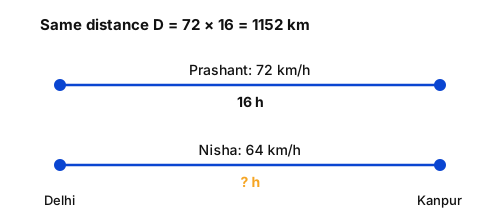
  1. Distance =72×16=1152km.
  2. Nisha's time =115264=18 hours.
  3. Check by ratio: T2=16×7264=16×98=18.

Trick: Speed ratio 72:64=9:8 ⇒ time ratio 8:9; 8→16 so 9→18.

Answer: (B) 18 hours

अवधारणा: समान दूरी के लिए समय, चाल के व्युत्क्रमानुपाती होता है: S1T1=S2T2।

  1. दूरी =72×16=1152km।
  2. निशा का समय =115264=18 घंटे।
  3. अनुपात से जाँच: T2=16×7264=16×98=18।

ट्रिक: चाल अनुपात 72:64=9:8 ⇒ समय अनुपात 8:9; 8→16 तो 9→18।

उत्तर: (B) 18 घंटे

RRB NTPC Undergraduate CBT 1MathematicsSpeed, time and distanceRRB NTPC Undergraduate CBT 1 2024 · 19 Aug Shift 2 →
Q1547.
An item is marked at ₹1,200. Successive discounts of 20% and 10% are given. What is the final selling price?
एक वस्तु का अंकित मूल्य ₹1,200 है। उस पर 20% और 10% की क्रमिक छूट दी जाती है। अंतिम विक्रय मूल्य क्या है?
  1. A₹864
  2. B₹960
  3. C₹900
  4. D₹880
Show answer

Concept: Successive discounts are applied one after another: SP=MP×100−d1100×100−d2100.

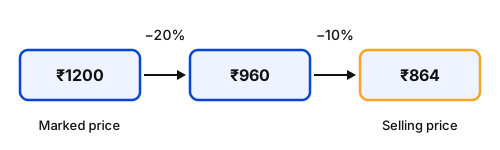
  1. After 20%: 1200×0.8=960.
  2. After 10%: 960×0.9=864.
  3. Equivalent single discount =20+10−20×10100=28%; 1200×0.72=864.

Trick: Two discounts a%,b% ⇒ single discount a+b−ab100 (not a+b).

Answer: (A) ₹864

अवधारणा: क्रमिक छूट एक के बाद एक लगती है: विक्रय मूल्य=अंकित मूल्य×100−d1100×100−d2100।

  1. 20% के बाद: 1200×0.8=960।
  2. 10% के बाद: 960×0.9=864।
  3. समतुल्य एकल छूट =20+10−20×10100=28%; 1200×0.72=864।

ट्रिक: दो छूट a%,b% ⇒ एकल छूट a+b−ab100 (न कि a+b)।

उत्तर: (A) ₹864

RRB NTPC Undergraduate CBT 1MathematicsSuccessive discountsRRB NTPC Undergraduate CBT 1 2024 · 19 Aug Shift 2 →
Q1548.
Find the simple interest (in ₹) on ₹1,200 at an interest rate of 3% per month in 7 months.
₹1,200 पर 3% प्रति माह की ब्याज दर से 7 महीने का साधारण ब्याज (₹ में) ज्ञात कीजिए।
  1. A252
  2. B41
  3. C21
  4. D42
Show answer

Concept: SI=P×R×T100, with R and T in the same time unit.

  1. P=1200, R=3% per month, T=7 months.
  2. SI=1200×3×7100=12×21=252.

Trick: Rate per month × months directly – no need to convert to years (3%×7=21% of 1200).

Answer: (A) 252

अवधारणा: साधारण ब्याज=P×R×T100, जहाँ R और T एक ही समय-इकाई में हों।

  1. P=1200, R=3% प्रति माह, T=7 माह।
  2. SI=1200×3×7100=12×21=252।

ट्रिक: मासिक दर × महीने सीधे – वर्षों में बदलने की ज़रूरत नहीं (3%×7=1200 का 21%)।

उत्तर: (A) 252

RRB NTPC Undergraduate CBT 1MathematicsSimple interestRRB NTPC Undergraduate CBT 1 2024 · 19 Aug Shift 2 →
Q1549.
The H.C.F. and the L.C.M. of two numbers are 51 and 306 respectively. If one of the numbers is 102, find the other one.
दो संख्याओं का म.स. (H.C.F.) और ल.स. (L.C.M.) क्रमशः 51 और 306 हैं। यदि उनमें से एक संख्या 102 है, तो दूसरी संख्या ज्ञात कीजिए।
  1. A102
  2. B204
  3. C175
  4. D153
Show answer

Concept: For two numbers: HCF×LCM=product of the numbers.

  1. 51×306=102×x.
  2. x=51×306102=3062=153.
  3. Check: 153=51×3, 102=51×2; HCF =51, LCM =51×6=306 ✓.

Trick: 102=2×51, so x=3062 instantly.

Answer: (D) 153

अवधारणा: दो संख्याओं के लिए: म.स.×ल.स.=संख्याओं का गुणनफल।

  1. 51×306=102×x।
  2. x=51×306102=3062=153।
  3. जाँच: 153=51×3, 102=51×2; म.स. =51, ल.स. =51×6=306 ✓।

ट्रिक: 102=2×51, अतः तुरंत x=3062।

उत्तर: (D) 153

RRB NTPC Undergraduate CBT 1MathematicsHCF and LCMRRB NTPC Undergraduate CBT 1 2024 · 19 Aug Shift 2 →
Q1550.
Nitin bought some sharpeners at the rate of ₹180/dozen. He sold them for ₹20 each. His profit percentage is ______% (rounded off to two decimal places).
नितिन ने ₹180/दर्जन की दर से कुछ शार्पनर खरीदे। उसने उन्हें ₹20 प्रति शार्पनर की दर से बेच दिया। उसका लाभ प्रतिशत ______% है (दो दशमलव स्थानों तक पूर्णांकित)।
  1. A33.33
  2. B35.33
  3. C31.33
  4. D37.33
Show answer

Concept: Find cost price per item, then Profit%=SP−CPCP×100.

  1. CP of one sharpener =18012= ₹15; SP = ₹20.
  2. Profit =20−15= ₹5.
  3. Profit%=515×100=33.33%.

Trick: Profit is 13 of CP ⇒ 3313%.

Answer: (A) 33.33

अवधारणा: प्रति वस्तु क्रय मूल्य निकालें, फिर लाभ%=विक्रय मूल्य−क्रय मूल्यक्रय मूल्य×100।

  1. एक शार्पनर का क्रय मूल्य =18012= ₹15; विक्रय मूल्य = ₹20।
  2. लाभ =20−15= ₹5।
  3. लाभ%=515×100=33.33%।

ट्रिक: लाभ क्रय मूल्य का 13 है ⇒ 3313%।

उत्तर: (A) 33.33

RRB NTPC Undergraduate CBT 1MathematicsProfit and lossRRB NTPC Undergraduate CBT 1 2024 · 19 Aug Shift 2 →
Q1551.
A can do a work in 17 days and B can do the same work in 19 days. If they work on it together for 6 days, then what fraction of the work is left?
A किसी कार्य को 17 दिनों में और B उसी कार्य को 19 दिनों में कर सकता है। यदि वे मिलकर 6 दिनों तक उस पर कार्य करते हैं, तो कार्य का कितना भाग शेष रह जाता है?
  1. A107323
  2. B109323
  3. C110323
  4. D104323
Show answer

Concept: One day's work of a person =1days; work done together in t days =t(1a+1b).

  1. One day's work of A + B =117+119=19+17323=36323.
  2. Work in 6 days =6×36323=216323.
  3. Work left =1−216323=107323.

Trick: Take total work =17×19=323 units; A does 19, B does 17 units/day → 36 units/day → 6×36=216 done, 323−216=107 left.

Answer: (A) 107323

अवधारणा: एक दिन का कार्य =1दिन; मिलकर t दिनों में कार्य =t(1a+1b)।

  1. A + B का एक दिन का कार्य =117+119=36323।
  2. 6 दिनों का कार्य =6×36323=216323।
  3. शेष कार्य =1−216323=107323।

ट्रिक: कुल कार्य =17×19=323 इकाई मानें; A 19, B 17 इकाई/दिन → 36 इकाई/दिन → 216 पूरा, 107 शेष।

उत्तर: (A) 107323

RRB NTPC Undergraduate CBT 1MathematicsTime and WorkRRB NTPC Undergraduate CBT 1 2024 · 19 Aug Shift 2 →
Q1552.
Aanya has to reach Bangalore which is 861 km away in 15 hours. His starting speed for 8 hours was 37 km/hr. For the next 136 km his speed was 34 km/hr. By what speed he must travel now so as to reach Bangalore in the decided time of 15 hours?
आन्या को 861 km दूर स्थित बैंगलोर 15 घंटे में पहुँचना है। प्रारंभिक 8 घंटों के लिए उसकी चाल 37 km/hr थी। अगले 136 km के लिए उसकी चाल 34 km/hr थी। निर्धारित 15 घंटे के समय में बैंगलोर पहुँचने के लिए अब उसे किस चाल से यात्रा करनी होगी?
  1. A141 km/hr
  2. B143 km/hr
  3. C147 km/hr
  4. D146 km/hr
Show answer

Concept: Distance = Speed × Time. Required speed =remaining distanceremaining time.

  1. First part: 37×8=296km.
  2. Second part: 136 km at 34 km/h takes 13634=4h.
  3. Covered =296+136=432km in 8+4=12h.
  4. Remaining: 861−432=429km in 15−12=3h → speed =4293=143km/h.

Trick: Keep a running total of distance and time; only the leftover part decides the new speed.

Answer: (B) 143 km/hr

अवधारणा: दूरी = चाल × समय। आवश्यक चाल =शेष दूरीशेष समय।

  1. पहला भाग: 37×8=296km।
  2. दूसरा भाग: 136 km, 34 km/h से → 13634=4h।
  3. कुल तय =432km, समय =12h।
  4. शेष 861−432=429km, 3h में → 4293=143km/h।

ट्रिक: दूरी और समय का चालू योग रखें; बची दूरी ÷ बचा समय = नई चाल।

उत्तर: (B) 143 km/hr

RRB NTPC Undergraduate CBT 1MathematicsSpeed, Time and DistanceRRB NTPC Undergraduate CBT 1 2024 · 19 Aug Shift 2 →
Q1553.
Evaluate: 16 + 12 ÷ 6 − 3 × 4
मान ज्ञात कीजिए: 16 + 12 ÷ 6 − 3 × 4
  1. A8
  2. B5
  3. C9
  4. D6
Show answer

Concept: BODMAS: Division and Multiplication are done before Addition and Subtraction.

  1. 12÷6=2 and 3×4=12.
  2. Expression becomes 16+2−12.
  3. =18−12=6.

Trick: Never go left to right blindly: first finish all ÷ and ×, then + and −.

Answer: (D) 6

अवधारणा: BODMAS: भाग और गुणा पहले, फिर जोड़ और घटाव।

  1. 12÷6=2 और 3×4=12।
  2. व्यंजक =16+2−12।
  3. =18−12=6।

ट्रिक: पहले सारे ÷ और × हल करें, फिर +, −।

उत्तर: (D) 6

RRB NTPC Undergraduate CBT 1MathematicsSimplification (BODMAS)RRB NTPC Undergraduate CBT 1 2024 · 19 Aug Shift 2 →
Q1554.
Find the value of x satisfying: 3(2x2 − 5) − 2(3x2 + 4x − 8) = 20
x का वह मान ज्ञात कीजिए जो निम्नलिखित को संतुष्ट करता है: 3(2x2 − 5) − 2(3x2 + 4x − 8) = 20
  1. A−298
  2. B−118
  3. C−198
  4. D−218
Show answer

Concept: Open the brackets; the x2 terms cancel, leaving a linear equation in x.

  1. 3(2x2−5)=6x2−15 and 2(3x2+4x−8)=6x2+8x−16.
  2. 6x2−15−6x2−8x+16=20 → 1−8x=20.
  3. −8x=19 → x=−198.

Trick: Check the sign when distributing the minus: −2(…−8) gives +16.

Answer: (C) −198

अवधारणा: कोष्ठक खोलें; x2 वाले पद कट जाते हैं और रैखिक समीकरण बचता है।

  1. 3(2x2−5)=6x2−15, 2(3x2+4x−8)=6x2+8x−16।
  2. 6x2−15−6x2−8x+16=20 → 1−8x=20।
  3. −8x=19 → x=−198।

ट्रिक: ऋण चिह्न बाँटते समय ध्यान: −2(…−8)=+16।

उत्तर: (C) −198

RRB NTPC Undergraduate CBT 1MathematicsLinear EquationsRRB NTPC Undergraduate CBT 1 2024 · 19 Aug Shift 2 →
Q1555.
Simplify the following.
18×(3×(32))÷13+66−74
निम्नलिखित को सरल कीजिए।
18×(3×(32))÷13+66−74
  1. A39113
  2. B38713
  3. C38213
  4. D38913
Show answer

Concept: BODMAS: brackets and powers first, then × / ÷ from left to right, then + / −.

  1. 32=9, so 3×9=27.
  2. 18×27=486, then 486÷13=48613.
  3. 66−74=−8=−10413.
  4. Total =486−10413=38213.

Trick: All options have denominator 13, so convert the integer part to thirteenths: 8=10413.

Answer: (C) 38213

अवधारणा: BODMAS: पहले कोष्ठक और घात, फिर बाएँ से दाएँ ×/÷, फिर +/−।

  1. 32=9, अतः 3×9=27।
  2. 18×27=486, 486÷13=48613।
  3. 66−74=−8=−10413।
  4. कुल =486−10413=38213।

ट्रिक: सभी विकल्पों का हर 13 है, इसलिए 8=10413 लिखकर घटाएँ।

उत्तर: (C) 38213

RRB NTPC Undergraduate CBT 1MathematicsSimplification (BODMAS)RRB NTPC Undergraduate CBT 1 2024 · 19 Aug Shift 2 →
Q1556.
If the 6-digit number N65M04 is divisible by 11, then which of the options below can give a possible correct relation between M and N?
यदि 6-अंकीय संख्या N65M04, 11 से विभाज्य है, तो नीचे दिए गए विकल्पों में से कौन-सा M और N के बीच संभावित सही संबंध दर्शा सकता है?
  1. AM - N = 1
  2. BM = N
  3. CM - N = -5
  4. DM + N = 5
Show answer

Concept: A number is divisible by 11 if (sum of digits at odd places) − (sum at even places) is 0 or a multiple of 11.

  1. Digits of N65M04: odd places (1st, 3rd, 5th) =N,5,0; even places =6,M,4.
  2. Difference =(N+5)−(10+M)=N−M−5.
  3. With single digits, N−M−5=0 gives N−M=5, i.e. M−N=−5 (e.g. N = 7, M = 2 → 765204 =11×69564).

Trick: Alternate sum from the right: 4−0+M−5+6−N must be 0 or ±11.

Answer: (C) M − N = −5

अवधारणा: किसी संख्या के विषम स्थानों के अंकों का योग − सम स्थानों का योग 0 या 11 का गुणज हो तो वह 11 से विभाज्य है।

  1. N65M04 में विषम स्थान =N,5,0; सम स्थान =6,M,4।
  2. अंतर =(N+5)−(10+M)=N−M−5।
  3. N−M−5=0 → N−M=5, अर्थात M−N=−5 (जैसे N = 7, M = 2 → 765204 =11×69564)।

ट्रिक: दाएँ से एकांतर योग: 4−0+M−5+6−N को 0 या ±11 होना चाहिए।

उत्तर: (C) M − N = −5

RRB NTPC Undergraduate CBT 1MathematicsDivisibility Rule of 11RRB NTPC Undergraduate CBT 1 2024 · 19 Aug Shift 2 →
Q1557.
1secA(1−tanA)+1cosecA(1−cotA) is equal to:
1secA(1−tanA)+1cosecA(1−cotA) किसके बराबर है?
  1. AcosAsinA
  2. B1cosAsinA
  3. CcosA−sinA
  4. DcosA+sinA
Show answer

Concept: Write everything in sinA and cosA and use a2−b2=(a−b)(a+b).

  1. 1secA(1−tanA)=cosA1−sinAcosA=cos2AcosA−sinA.
  2. 1cscA(1−cotA)=sinA1−cosAsinA=sin2AsinA−cosA=−sin2AcosA−sinA.
  3. Sum =cos2A−sin2AcosA−sinA=cosA+sinA.

Trick: Put A=0∘: expression =11×1+0=1; only cosA+sinA=1 matches.

Answer: (D) cosA+sinA

अवधारणा: सब कुछ sinA और cosA में लिखें तथा a2−b2=(a−b)(a+b) प्रयोग करें।

  1. पहला पद =cosA1−sinAcosA=cos2AcosA−sinA।
  2. दूसरा पद =sin2AsinA−cosA=−sin2AcosA−sinA।
  3. योग =cos2A−sin2AcosA−sinA=cosA+sinA।

ट्रिक: A=0∘ रखें: मान =1; केवल cosA+sinA=1 मेल खाता है।

उत्तर: (D) cosA+sinA

RRB NTPC Undergraduate CBT 1MathematicsTrigonometric IdentitiesRRB NTPC Undergraduate CBT 1 2024 · 19 Aug Shift 2 →
Q1558.
Which of the following numbers divides 311916399?
निम्नलिखित में से कौन-सी संख्या 311916399 को विभाजित करती है?
  1. A7
  2. B13
  3. C2
  4. D3
Show answer

Concept: A number is divisible by 3 if the sum of its digits is divisible by 3.

  1. Digit sum of 311916399 =3+1+1+9+1+6+3+9+9=42, and 42=3×14 → divisible by 3.
  2. Last digit 9 is odd → not divisible by 2.
  3. Direct division leaves remainder 4 by 7 and remainder 2 by 13.

Trick: Always test 2, 3, 5 first – they need only the last digit or the digit sum.

Answer: (D) 3

अवधारणा: यदि अंकों का योग 3 से विभाज्य हो तो संख्या 3 से विभाज्य होती है।

  1. 311916399 के अंकों का योग =42=3×14 → 3 से विभाज्य।
  2. अंतिम अंक 9 विषम है → 2 से विभाज्य नहीं।
  3. 7 से भाग देने पर शेष 4 और 13 से भाग देने पर शेष 2 बचता है।

ट्रिक: पहले 2, 3, 5 जाँचें – इनके लिए केवल अंतिम अंक या अंकों का योग चाहिए।

उत्तर: (D) 3

RRB NTPC Undergraduate CBT 1MathematicsDivisibility RulesRRB NTPC Undergraduate CBT 1 2024 · 19 Aug Shift 2 →
Q1559.
A shirt is marked at ₹800. A shopkeeper offers a discount of 25% on it. What is the selling price of the shirt after the discount?
एक कमीज़ का अंकित मूल्य ₹800 है। एक दुकानदार उस पर 25% की छूट देता है। छूट के बाद कमीज़ का विक्रय मूल्य क्या है?
  1. A₹600
  2. B₹650
  3. C₹700
  4. D₹750
Show answer

Concept: Selling price = Marked price ×100−discount%100.

  1. Discount =25% of ₹800 =25100×800=200 → ₹200.
  2. SP =800−200=600 → ₹600.

Trick: 25% off means pay 34: 34×800=600.

Answer: (A) ₹600

अवधारणा: विक्रय मूल्य = अंकित मूल्य ×100−छूट%100।

  1. छूट =800 का 25%=200 → ₹200।
  2. विक्रय मूल्य =800−200=600 → ₹600।

ट्रिक: 25% छूट = 34 चुकाना: 34×800=600।

उत्तर: (A) ₹600

RRB NTPC Undergraduate CBT 1MathematicsDiscountRRB NTPC Undergraduate CBT 1 2024 · 19 Aug Shift 2 →
Q1560.
In an election between two candidates, 80% of the registered voters cast their vote and 20% of the votes polled were found invalid. The winning candidate got 60% of the valid votes and won the election by a margin of 2144 votes. How many voters were
registered?
दो उम्मीदवारों के बीच हुए एक चुनाव में, 80% पंजीकृत मतदाताओं ने अपना मत डाला और डाले गए मतों में से 20% मत अवैध पाए गए। विजयी उम्मीदवार को वैध मतों के 60% मत मिले और उसने 2144 मतों के अंतर से चुनाव जीता। कितने मतदाता
पंजीकृत थे?
  1. A16749
  2. B16747
  3. C16753
  4. D16750
Show answer

Concept: Work in fractions of the registered voters V; the margin is (winner% − loser%) of valid votes.

  1. Votes polled =0.8V; valid =80% of 0.8V=0.64V.
  2. Winner 60%, loser 40% of valid → margin =20% of 0.64V=0.128V.
  3. 0.128V=2144 → V=21440.128=16750.

Trick: Margin fraction =0.8×0.8×0.2=0.128; 2144÷0.128=16750.

Answer: (D) 16750

अवधारणा: पंजीकृत मतदाता V के भिन्नों में काम करें; अंतर = (विजेता% − हारने वाले%) × वैध मत।

  1. डाले गए मत =0.8V; वैध =0.64V।
  2. अंतर =20% × 0.64V=0.128V।
  3. 0.128V=2144 → V=16750।

ट्रिक: अंतर का भिन्न =0.8×0.8×0.2=0.128; 2144÷0.128=16750।

उत्तर: (D) 16750

RRB NTPC Undergraduate CBT 1MathematicsPercentage – ElectionsRRB NTPC Undergraduate CBT 1 2024 · 19 Aug Shift 2 →