Question bank

Q&A: practice questions with answers

Search questions on any topic. Filter by exam category, exam, subject and topic, try the question, then open the answer and explanation.

Courses – airGurukul

8,495 questions found.

Q1661.
The largest six digit number which when divided by 3, 5, 7 and 9 leaves remainders 1, 3, 5 and 7, respectively, is:
छह अंकों की वह सबसे बड़ी संख्या, जिसे 3, 5, 7 और 9 से विभाजित करने पर क्रमशः 1, 3, 5 और 7 शेषफल प्राप्त होते हैं, है:
  1. A999808
  2. B999998
  3. C999893
  4. D999685
Show answer

Concept: If divisor − remainder is the same k for every divisor, number =LCM×n−k.

  1. 3−1=5−3=7−5=9−7=2, so k=2.
  2. LCM(3, 5, 7, 9) = 315.
  3. Largest 6-digit multiple of 315: 315×3174=999810 (since 999999=315×3174+189).
  4. Number =999810−2=999808.

Trick: Constant gap (divisor − remainder) ⇒ subtract that gap from the LCM multiple.

Answer: (A) 999808

अवधारणा: यदि हर भाजक में (भाजक − शेषफल) समान k हो, तो संख्या =LCM×n−k।

  1. 3−1=5−3=7−5=9−7=2, अतः k=2।
  2. LCM(3, 5, 7, 9) = 315।
  3. 315 का सबसे बड़ा 6-अंकीय गुणज: 315×3174=999810 (क्योंकि 999999=315×3174+189)।
  4. संख्या =999810−2=999808।

ट्रिक: समान अंतर (भाजक − शेषफल) हो तो LCM के गुणज से वही अंतर घटाएँ।

उत्तर: (A) 999808
RRB NTPC Undergraduate CBT 1MathematicsLCM – RemaindersRRB NTPC Undergraduate CBT 1 2024 · 19 Aug Shift 1 →
Q1662.
A man driving a car at a speed of 72 km/hr crosses a bridge in 4.9 minutes. Find the length of the bridge.
72 km/hr की चाल से कार चला रहा एक व्यक्ति 4.9 मिनट में एक पुल पार करता है। पुल की लंबाई ज्ञात कीजिए।
  1. A5.68 km
  2. B6.29 km
  3. C5.88 km
  4. D6.91 km
Show answer

Concept: Distance = Speed × Time (car length is negligible).

  1. Time =4.9min=4.960h.
  2. Distance =72×4.960=1.2×4.9=5.88km.

Trick: 72 km/h = 1.2 km per minute; 1.2×4.9=5.88.

Answer: (C) 5.88 km

अवधारणा: दूरी = चाल × समय (कार की लंबाई नगण्य)।

  1. समय =4.9min=4.960h।
  2. दूरी =72×4.960=1.2×4.9=5.88km।

ट्रिक: 72 km/h = 1.2 km प्रति मिनट; 1.2×4.9=5.88।

उत्तर: (C) 5.88 km

RRB NTPC Undergraduate CBT 1MathematicsSpeed, Distance and TimeRRB NTPC Undergraduate CBT 1 2024 · 19 Aug Shift 1 →
Q1663.
The number 966181 is divisible by which of the following?
संख्या 966181 निम्नलिखित में से किससे विभाज्य है?
  1. A36
  2. B38
  3. C30
  4. D37
Show answer

Concept: Eliminate by quick rules, then test the remaining divisor.

  1. 966181 is odd, so not divisible by 36, 38 or 30 (all even).
  2. Test 37: 37×26113=966181 exactly.

Trick: An odd number can never be divisible by an even number – three options go at once.

Answer: (D) 37

अवधारणा: त्वरित नियमों से विकल्प हटाएँ, फिर बचे भाजक की जाँच करें।

  1. 966181 विषम है, अतः 36, 38, 30 (सभी सम) से विभाज्य नहीं।
  2. 37 से जाँच: 37×26113=966181 पूर्णतः।

ट्रिक: विषम संख्या कभी सम संख्या से विभाज्य नहीं होती – तीन विकल्प तुरंत हटे।

उत्तर: (D) 37

RRB NTPC Undergraduate CBT 1MathematicsDivisibilityRRB NTPC Undergraduate CBT 1 2024 · 19 Aug Shift 1 →
Q1664.
Solve the following:
(cosec23∘−sin23∘)(tan23∘+cot23∘)(sec23∘−cos23∘)
निम्नलिखित को हल कीजिए:
(cosec23∘−sin23∘)(tan23∘+cot23∘)(sec23∘−cos23∘)
  1. A1
  2. Btan23∘
  3. Csin23∘
  4. D0
Show answer

Concept: Write everything in sinθ and cosθ (θ=23∘).

  1. cosecθ−sinθ=1−sin2θsinθ=cos2θsinθ.
  2. tanθ+cotθ=sin2θ+cos2θsinθcosθ=1sinθcosθ.
  3. secθ−cosθ=sin2θcosθ.
  4. Product =cos2θ·sin2θsinθ·sinθcosθ·cosθ=1.

Trick: The value does not depend on the angle – put θ=45∘: (2−12)(2)(2−12)=12×2=1.

Answer: (A) 1

अवधारणा: सब कुछ sinθ और cosθ में लिखें (θ=23∘)।

  1. cosecθ−sinθ=1−sin2θsinθ=cos2θsinθ।
  2. tanθ+cotθ=1sinθcosθ।
  3. secθ−cosθ=sin2θcosθ।
  4. गुणनफल =cos2θ·sin2θsinθ·sinθcosθ·cosθ=1।

ट्रिक: मान कोण पर निर्भर नहीं – θ=45∘ रखें: (2−12)(2)(2−12)=12×2=1।

उत्तर: (A) 1

RRB NTPC Undergraduate CBT 1MathematicsTrigonometric IdentitiesRRB NTPC Undergraduate CBT 1 2024 · 19 Aug Shift 1 →
Q1665.
The H.C.F. and the L.C.M. of two numbers are 3 and 672, respectively. If one of the numbers is 96, find the other one.
दो संख्याओं का म.स. (H.C.F.) और ल.स. (L.C.M.) क्रमशः 3 और 672 हैं। यदि उनमें से एक संख्या 96 है, तो दूसरी संख्या ज्ञात कीजिए।
  1. A3
  2. B48
  3. C94
  4. D21
Show answer

Concept: Product of two numbers = HCF × LCM.

  1. Other number =3×67296=201696=21.
  2. Check: HCF(96, 21) = 3, LCM = 672.

Trick: Other number = HCF×LCMgiven number.

Answer: (D) 21

अवधारणा: दो संख्याओं का गुणनफल = HCF × LCM।

  1. दूसरी संख्या =3×67296=201696=21।
  2. जाँच: HCF(96, 21) = 3, LCM = 672।

ट्रिक: दूसरी संख्या = HCF×LCMदी गई संख्या।

उत्तर: (D) 21

RRB NTPC Undergraduate CBT 1MathematicsHCF and LCMRRB NTPC Undergraduate CBT 1 2024 · 19 Aug Shift 1 →
Q1666.
A can do a work in 11 days and B can do the same work in 19 days. If they work on it together for 6 days, then what fraction of the work is left?
A किसी कार्य को 11 दिनों में कर सकता है और B उसी कार्य को 19 दिनों में कर सकता है। यदि वे दोनों मिलकर 6 दिनों तक उस पर कार्य करते हैं, तो कार्य का कितना भाग शेष रह जाता है?
  1. A32209
  2. B26209
  3. C24209
  4. D29209
Show answer

Concept: One-day work of A and B together =111+119.

  1. 111+119=30209.
  2. In 6 days: 180209 of the work.
  3. Left =1−180209=29209.

Trick: Total work = LCM 209 units; A = 19, B = 11 units/day; 6 days = 180 units; left 29.

Answer: (D) 29209

अवधारणा: A और B का एक दिन का कार्य =111+119।

  1. 111+119=30209।
  2. 6 दिनों में: 180209 कार्य।
  3. शेष =1−180209=29209।

ट्रिक: कुल कार्य = LCM 209 इकाई; A = 19, B = 11 इकाई/दिन; 6 दिन = 180 इकाई; शेष 29।

उत्तर: (D) 29209

RRB NTPC Undergraduate CBT 1MathematicsTime and WorkRRB NTPC Undergraduate CBT 1 2024 · 19 Aug Shift 1 →
Q1667.
Four times the present age of P exceeds the present age of Q by 19 years. After 7 years, twice the age of Q will be 47 years less than seven times the age of P at that time. What is the present age of Q (in years)?
P की वर्तमान आयु का चार गुना, Q की वर्तमान आयु से 19 वर्ष अधिक है। 7 वर्ष बाद, Q की आयु का दोगुना, उस समय P की आयु के सात गुने से 47 वर्ष कम होगा। Q की वर्तमान आयु (वर्षों में) क्या है?
  1. A91
  2. B86
  3. C85
  4. D79
Show answer

Concept: Form two linear equations in present ages P and Q.

  1. 4P−Q=19 … (i)
  2. After 7 years: 2(Q+7)=7(P+7)−47⇒2Q+14=7P+2⇒7P−2Q=12 … (ii)
  3. From (i) Q=4P−19: 7P−8P+38=12⇒P=26.
  4. Q=4×26−19=85.

Trick: Check: after 7 years P = 33, Q = 92; 7×33−47=184=2×92 ✓.

Answer: (C) 85

अवधारणा: वर्तमान आयु P और Q में दो रैखिक समीकरण बनाएँ।

  1. 4P−Q=19 … (i)
  2. 7 वर्ष बाद: 2(Q+7)=7(P+7)−47⇒7P−2Q=12 … (ii)
  3. (i) से Q=4P−19: 7P−8P+38=12⇒P=26।
  4. Q=4×26−19=85।

ट्रिक: जाँच: 7 वर्ष बाद P = 33, Q = 92; 7×33−47=184=2×92 ✓।

उत्तर: (C) 85

RRB NTPC Undergraduate CBT 1MathematicsProblems on AgesRRB NTPC Undergraduate CBT 1 2024 · 19 Aug Shift 1 →
Q1668.
A hollow spherical shell is made of a metal of density 7 g/cm3. Its internal and external radii are 1 cm and 2 cm, respectively. What is the weight (in grams) of the shell? (Use π=227, and round off your answer to the nearest gram.)
एक खोखला गोलीय कोश 7 g/cm3 घनत्व वाली धातु से बना है। इसकी आंतरिक और बाह्य त्रिज्याएँ क्रमशः 1 cm और 2 cm हैं। कोश का भार (ग्राम में) कितना है? (π=227 का प्रयोग कीजिए, और अपने उत्तर को निकटतम ग्राम तक पूर्णांकित कीजिए।)
  1. A273
  2. B205
  3. C221
  4. D214
Show answer

Concept: Volume of shell =43π(R3−r3); mass = density × volume.

  1. R3−r3=8−1=7.
  2. Volume =43×227×7=883cm3.
  3. Weight =7×883=6163≈205.33, i.e. 205 g.

Trick: Here density 7 cancels the 7 of π: weight =43×22×7=6163.

Answer: (B) 205

अवधारणा: कोश का आयतन =43π(R3−r3); द्रव्यमान = घनत्व × आयतन।

  1. R3−r3=8−1=7।
  2. आयतन =43×227×7=883cm3।
  3. भार =7×883=6163≈205.33, यानी 205 g।

ट्रिक: आयतन का 227 और R3−r3=7 आपस में सरल होते हैं: भार =6163।

उत्तर: (B) 205

RRB NTPC Undergraduate CBT 1MathematicsMensuration – Spherical ShellRRB NTPC Undergraduate CBT 1 2024 · 19 Aug Shift 1 →
Q1669.
Isha can do a certain piece of work in 22 days. Isha and Smriti can together do the same work in 11 days, and Isha, Smriti and Ashlesha can do the same work together in 10 days. In how many days can Isha and Ashlesha do the same work?
ईशा किसी कार्य को 22 दिनों में कर सकती है। ईशा और स्मृति मिलकर उसी कार्य को 11 दिनों में कर सकती हैं, और ईशा, स्मृति और आश्लेषा मिलकर उसी कार्य को 10 दिनों में कर सकती हैं। ईशा और आश्लेषा मिलकर उसी कार्य को कितने दिनों में कर सकती हैं?
  1. A643
  2. B494
  3. C553
  4. D615
Show answer

Concept: Find each person's one-day work from the given combinations.

  1. Isha =122; Isha + Smriti =111⇒ Smriti =122.
  2. Ashlesha =110−111=1110.
  3. Isha + Ashlesha =122+1110=6110=355.
  4. Days =553.

Trick: Total work = 110 units: Isha 5, Isha+Smriti 10, all three 11 ⇒ Ashlesha 1; Isha+Ashlesha 6 ⇒ 1106=553.

Answer: (C) 553

अवधारणा: दिए गए संयोजनों से प्रत्येक का एक दिन का कार्य निकालें।

  1. ईशा =122; ईशा + स्मृति =111⇒ स्मृति =122।
  2. आश्लेषा =110−111=1110।
  3. ईशा + आश्लेषा =122+1110=6110=355।
  4. दिन =553।

ट्रिक: कुल कार्य = 110 इकाई: ईशा 5, ईशा+स्मृति 10, तीनों 11 ⇒ आश्लेषा 1; ईशा+आश्लेषा 6 ⇒ 1106=553।

उत्तर: (C) 553

RRB NTPC Undergraduate CBT 1MathematicsTime and WorkRRB NTPC Undergraduate CBT 1 2024 · 19 Aug Shift 1 →
Q1670.
The value of 34+(11+37)−34 is
34+(11+37)−34 का मान है
  1. A516
  2. B211
  3. C1619
  4. D710
Show answer

Concept: Simplify the inner (continued) fraction first; +34 and −34 cancel.

  1. 1+37=107, so 110/7=710.
  2. Expression =34+710−34=710.

Trick: Spot +34 and −34 – they cancel; only the bracket remains.

Answer: (D) 710

अवधारणा: पहले भीतरी भिन्न को सरल करें; +34 और −34 कट जाते हैं।

  1. 1+37=107, अतः 110/7=710।
  2. व्यंजक =34+710−34=710।

ट्रिक: +34 और −34 कट जाते हैं; केवल कोष्ठक बचता है।

उत्तर: (D) 710

RRB NTPC Undergraduate CBT 1MathematicsSimplification – FractionsRRB NTPC Undergraduate CBT 1 2024 · 19 Aug Shift 1 →
Q1671.
Read the given statements and conclusions carefully. Assuming that the information given in the statements is true, even if it appears to be at variance with commonly known facts, decide which of the given conclusion(s) logically follow(s) from the statements.
Statements:
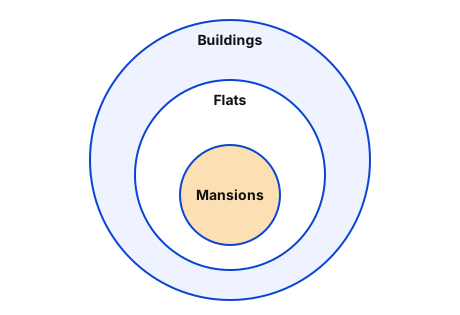
All mansions are flats.
All flats are buildings.
Conclusions:
(I) Some flats are mansions.
(II) All buildings are mansions.
दिए गए कथनों और निष्कर्षों को ध्यानपूर्वक पढ़िए। कथनों में दी गई जानकारी को सत्य मानते हुए, भले ही वह सामान्य रूप से ज्ञात तथ्यों से भिन्न प्रतीत होती हो, निर्णय लीजिए कि दिए गए निष्कर्षों में से कौन-सा/कौन-से निष्कर्ष कथनों का तार्किक रूप से अनुसरण करता है/करते हैं।
कथन:
सभी हवेलियाँ, फ़्लैट हैं।
सभी फ़्लैट, इमारतें हैं।
निष्कर्ष:
(I) कुछ फ़्लैट, हवेलियाँ हैं।
(II) सभी इमारतें, हवेलियाँ हैं।
  1. AOnly conclusion (I) follows.केवल निष्कर्ष (I) अनुसरण करता है।
  2. BNeither conclusion (I) nor (II) follows.न तो निष्कर्ष (I) और न ही (II) अनुसरण करता है।
  3. CBoth conclusions (I) and (II) follow.निष्कर्ष (I) और (II) दोनों अनुसरण करते हैं।
  4. DOnly conclusion (II) follows.केवल निष्कर्ष (II) अनुसरण करता है।
Show answer

Concept: Draw the possible Venn diagram; a conclusion follows only if it is true in every case.

  1. All mansions are flats ⇒ mansions lie inside flats, so some flats are mansions – (I) follows.
  2. Buildings may contain much more than mansions, so "All buildings are mansions" is not certain – (II) fails.

Trick: "All A are B" always gives "Some B are A" (conversion).

Answer: (A) Only conclusion (I) follows.

अवधारणा: संभव वेन आरेख बनाएँ; निष्कर्ष तभी सही है जब हर स्थिति में सत्य हो।

  1. सभी हवेलियाँ (mansions) फ्लैट हैं ⇒ हवेलियाँ फ्लैट के अंदर, अतः कुछ फ्लैट हवेलियाँ हैं – (I) सही।
  2. इमारतें (buildings) हवेलियों से बहुत अधिक हो सकती हैं, अतः "सभी इमारतें हवेलियाँ हैं" निश्चित नहीं – (II) गलत।

याद रखें: "सभी A, B हैं" से हमेशा "कुछ B, A हैं" निकलता है।

उत्तर: (A) केवल निष्कर्ष (I) अनुसरण करता है।

RRB NTPC Undergraduate CBT 1General Intelligence and ReasoningSyllogismRRB NTPC Undergraduate CBT 1 2024 · 19 Aug Shift 1 →
Q1672.
Which of the following letter-number clusters will replace the question mark (?) in the given series to make it logically complete?
EBF 11, JGK 17, OLP 23, TQU 29, ?
निम्नलिखित में से कौन-सा अक्षर-संख्या समूह दी गई श्रृंखला में प्रश्न चिह्न (?) के स्थान पर आकर उसे तार्किक रूप से पूर्ण करेगा?
EBF 11, JGK 17, OLP 23, TQU 29, ?
  1. AYUV 35
  2. BWUZ 35
  3. CYVZ 35
  4. DWVZ 24
Show answer

Concept: Check each letter position and the number separately.

  1. 1st letters: E, J, O, T → +5 → Y.
  2. 2nd letters: B, G, L, Q → +5 → V.
  3. 3rd letters: F, K, P, U → +5 → Z.
  4. Numbers: 11, 17, 23, 29 → +6 → 35.

Trick: All three letters move +5 together, so the answer must be Y?Z – only YVZ fits.

Answer: (C) YVZ 35

अवधारणा: प्रत्येक अक्षर-स्थान और संख्या को अलग से जाँचें।

  1. पहले अक्षर: E, J, O, T → +5 → Y।
  2. दूसरे अक्षर: B, G, L, Q → +5 → V।
  3. तीसरे अक्षर: F, K, P, U → +5 → Z।
  4. संख्याएँ: 11, 17, 23, 29 → +6 → 35।

ट्रिक: तीनों अक्षर +5 चलते हैं, अतः Y_Z वाला विकल्प – केवल YVZ।

उत्तर: (C) YVZ 35

RRB NTPC Undergraduate CBT 1General Intelligence and ReasoningLetter-Number SeriesRRB NTPC Undergraduate CBT 1 2024 · 19 Aug Shift 1 →
Q1673.
What should come in place of the question mark (?) in the given series?
103, 1000, 9970, 99670, 996670, ?
दी गई श्रृंखला में प्रश्न चिह्न (?) के स्थान पर क्या आना चाहिए?
103, 1000, 9970, 99670, 996670, ?
  1. A9999670
  2. B9966667
  3. C9966670
  4. D9996670
Show answer

Concept: Each term = previous term × 10 − 30.

  1. 103×10−30=1000; 1000×10−30=9970.
  2. 9970×10−30=99670; 99670×10−30=996670.
  3. Next =996670×10−30=9966670.

Trick: Each step adds one more 6 before "70": 9970, 99670, 996670 → 9966670.

Answer: (C) 9966670

अवधारणा: प्रत्येक पद = पिछला पद × 10 − 30।

  1. 103×10−30=1000; 1000×10−30=9970।
  2. 9970×10−30=99670; 99670×10−30=996670।
  3. अगला =996670×10−30=9966670।

ट्रिक: हर बार "70" से पहले एक 6 बढ़ता है: 996670 → 9966670।

उत्तर: (C) 9966670

RRB NTPC Undergraduate CBT 1General Intelligence and ReasoningNumber SeriesRRB NTPC Undergraduate CBT 1 2024 · 19 Aug Shift 1 →
Q1674.
BGSN is related to XLOS in a certain way based on the English alphabetical order. In the same way, TQKX is related to PVGC. To which of the given options is LACH related, following the same logic?
अंग्रेज़ी वर्णमाला क्रम के आधार पर BGSN एक निश्चित प्रकार से XLOS से संबंधित है। उसी प्रकार TQKX, PVGC से संबंधित है। समान तर्क का अनुसरण करते हुए LACH दिए गए विकल्पों में से किससे संबंधित है?
  1. AGEZN
  2. BHFYM
  3. CFGXO
  4. DGFYL
Show answer

Concept: Find the shift of each letter position.

  1. BGSN → XLOS: B−4=X, G+5=L, S−4=O, N+5=S.
  2. TQKX → PVGC follows −4, +5, −4, +5 (X+5 wraps to C).
  3. LACH: L−4=H, A+5=F, C−4=Y, H+5=M → HFYM.

Trick: Pattern −4, +5, −4, +5; wrap around Z→A when needed.

Answer: (B) HFYM

अवधारणा: हर अक्षर-स्थान का खिसकाव (shift) ज्ञात करें।

  1. BGSN → XLOS: B−4=X, G+5=L, S−4=O, N+5=S।
  2. TQKX → PVGC भी −4, +5, −4, +5 (X+5 घूमकर C)।
  3. LACH: L−4=H, A+5=F, C−4=Y, H+5=M → HFYM।

ट्रिक: पैटर्न −4, +5, −4, +5; Z के बाद फिर A से गिनें।

उत्तर: (B) HFYM

RRB NTPC Undergraduate CBT 1General Intelligence and ReasoningLetter AnalogyRRB NTPC Undergraduate CBT 1 2024 · 19 Aug Shift 1 →
Q1675.
What will come in the place of the question mark (?) in the following equation, if ‘+’ and ‘÷’ are interchanged and ‘−’ and ‘×’ are interchanged?
80 × 16 − 2 ÷ 12 + 4 = ?
यदि ‘+’ और ‘÷’ को आपस में बदल दिया जाए तथा ‘−’ और ‘×’ को आपस में बदल दिया जाए, तो निम्नलिखित समीकरण में प्रश्न चिह्न (?) के स्थान पर क्या आएगा?
80 × 16 − 2 ÷ 12 + 4 = ?
  1. A55
  2. B59
  3. C47
  4. D51
Show answer

Concept: Interchange the signs first, then apply BODMAS.

  1. After swapping: 80−16×2+12÷4.
  2. =80−32+3=51.

Trick: Rewrite the whole expression with new signs before calculating – avoids sign errors.

Answer: (D) 51

अवधारणा: पहले चिह्न बदलें, फिर BODMAS लगाएँ।

  1. बदलने के बाद: 80−16×2+12÷4।
  2. =80−32+3=51।

ट्रिक: गणना से पहले पूरा व्यंजक नए चिह्नों के साथ लिखें।

उत्तर: (D) 51

RRB NTPC Undergraduate CBT 1General Intelligence and ReasoningMathematical OperationsRRB NTPC Undergraduate CBT 1 2024 · 19 Aug Shift 1 →
Q1676.
Each of the digits in the number 7312648 is arranged in the ascending order from left to right. What will be the sum of the digits that are second from the left and second from the right in the new number thus formed?
संख्या 7312648 के प्रत्येक अंक को बाएँ से दाएँ आरोही क्रम में व्यवस्थित किया जाता है। इस प्रकार बनी नई संख्या में बाएँ से दूसरे और दाएँ से दूसरे अंकों का योग क्या होगा?
  1. A11
  2. B5
  3. C7
  4. D9
Show answer

Concept: Arrange the digits in ascending order and read the required positions.

  1. 7312648 → 1234678.
  2. 2nd from left = 2; 2nd from right = 7.
  3. Sum =2+7=9.

Trick: In ascending order, 2nd from left = 2nd smallest, 2nd from right = 2nd largest digit.

Answer: (D) 9

अवधारणा: अंकों को आरोही क्रम में लगाकर आवश्यक स्थान पढ़ें।

  1. 7312648 → 1234678।
  2. बाएँ से दूसरा = 2; दाएँ से दूसरा = 7।
  3. योग =2+7=9।

ट्रिक: आरोही क्रम में बाएँ से दूसरा = दूसरा सबसे छोटा, दाएँ से दूसरा = दूसरा सबसे बड़ा अंक।

उत्तर: (D) 9

RRB NTPC Undergraduate CBT 1General Intelligence and ReasoningDigit ArrangementRRB NTPC Undergraduate CBT 1 2024 · 19 Aug Shift 1 →
Q1677.
Read the given statements and conclusions carefully. Assuming that the information given in the statements is true, even if it appears to be at variance with commonly known facts, decide which of the given conclusion(s) logically follow(s) from the statements.
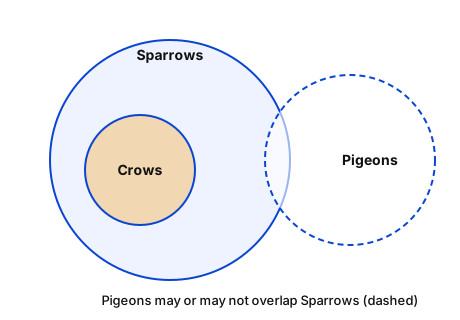
Statements: All crows are sparrows. No crow is a pigeon.
Conclusions (I): No sparrow is a pigeon.
Conclusions (II): Some pigeons are crows.
दिए गए कथनों और निष्कर्षों को ध्यानपूर्वक पढ़िए। कथनों में दी गई जानकारी को सत्य मानते हुए, भले ही वह सामान्य रूप से ज्ञात तथ्यों से भिन्न प्रतीत होती हो, निर्णय लीजिए कि दिए गए निष्कर्षों में से कौन-सा/कौन-से निष्कर्ष कथनों का तार्किक रूप से अनुसरण करता है/करते हैं।
कथन: सभी कौवे, गौरैया हैं। कोई कौवा, कबूतर नहीं है।
निष्कर्ष (I): कोई गौरैया, कबूतर नहीं है।
निष्कर्ष (II): कुछ कबूतर, कौवे हैं।
  1. ANeither conclusion (I) nor (II) follows.न तो निष्कर्ष (I) और न ही (II) अनुसरण करता है।
  2. BOnly conclusion (II) follows.केवल निष्कर्ष (II) अनुसरण करता है।
  3. CBoth conclusions (I) and (II) follow.निष्कर्ष (I) और (II) दोनों अनुसरण करते हैं।
  4. DOnly conclusion (I) follows.केवल निष्कर्ष (I) अनुसरण करता है।
Show answer

Concept: Draw the Venn diagram; test each conclusion against all possible cases.

  1. Crows lie inside sparrows; pigeons are outside crows but may overlap the rest of sparrows.
  2. (I) "No sparrow is a pigeon" – not certain (overlap possible).
  3. (II) "Some pigeons are crows" – contradicts "No crow is a pigeon".

Trick: A "No" statement can never give a "Some" conclusion between the same two terms.

Answer: (A) Neither conclusion (I) nor (II) follows.

अवधारणा: वेन आरेख बनाएँ; हर संभव स्थिति में निष्कर्ष जाँचें।

  1. कौवे (crows) गौरैया (sparrows) के अंदर; कबूतर (pigeons) कौवों से बाहर, पर शेष गौरैया से मिल सकते हैं।
  2. (I) "कोई गौरैया कबूतर नहीं" – निश्चित नहीं।
  3. (II) "कुछ कबूतर कौवे हैं" – "कोई कौवा कबूतर नहीं" के विपरीत।

याद रखें: "कोई नहीं" वाले कथन से उन्हीं दो पदों के बीच "कुछ" निष्कर्ष कभी नहीं निकलता।

उत्तर: (A) न तो (I) और न ही (II) अनुसरण करता है।

RRB NTPC Undergraduate CBT 1General Intelligence and ReasoningSyllogismRRB NTPC Undergraduate CBT 1 2024 · 19 Aug Shift 1 →
Q1678.
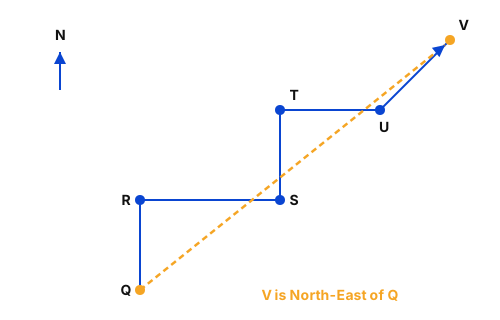
Town Q is to the south of Town R. Town S is to the east of Town R. Town T is to the north of Town S. Town U is to the east of Town T. Town V is to the north-east of Town U. What is the position of Town V with respect to Town Q?
नगर Q, नगर R के दक्षिण में है। नगर S, नगर R के पूर्व में है। नगर T, नगर S के उत्तर में है। नगर U, नगर T के पूर्व में है। नगर V, नगर U के उत्तर-पूर्व में है। नगर Q के सापेक्ष नगर V की स्थिति क्या है?
  1. ASouth-westदक्षिण-पश्चिम
  2. BNorth-eastउत्तर-पूर्व
  3. CSouth-eastदक्षिण-पूर्व
  4. DSouthदक्षिण
Show answer

Concept: Place the towns step by step on a grid with North up.

  1. Take R as origin; Q is below R; S is right of R.
  2. T is above S, U right of T, V up-right of U.
  3. V lies both to the east and to the north of Q, so V is North-East of Q.

Trick: Net movement from Q: eastward (S, U, V) and northward (R, T, V) ⇒ North-East.

Answer: (B) North-east

अवधारणा: उत्तर को ऊपर रखकर कस्बों को क्रम से ग्रिड पर रखें।

  1. R मूल बिंदु; Q, R के नीचे (दक्षिण); S, R के दाएँ (पूर्व)।
  2. T, S के उत्तर, U, T के पूर्व, V, U के उत्तर-पूर्व।
  3. V, Q से पूर्व और उत्तर दोनों ओर है, अतः उत्तर-पूर्व।

ट्रिक: Q से कुल चाल: पूर्व की ओर और उत्तर की ओर ⇒ उत्तर-पूर्व।

उत्तर: (B) उत्तर-पूर्व (North-east)

RRB NTPC Undergraduate CBT 1General Intelligence and ReasoningDirection SenseRRB NTPC Undergraduate CBT 1 2024 · 19 Aug Shift 1 →
Q1679.
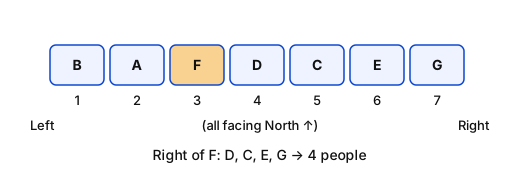
Seven people A, B, C, D, E, F and G are sitting in a row, facing the north. Only three people sit to the left of D. B sits third to the left of D. F sits to the right of A but left of D. E sits to the right of C but left of G. How many people sit to the right of F?
सात व्यक्ति A, B, C, D, E, F और G उत्तर की ओर मुख करके एक पंक्ति में बैठे हैं। D के बाईं ओर केवल तीन व्यक्ति बैठे हैं। B, D के बाईं ओर तीसरे स्थान पर बैठा है। F, A के दाईं ओर लेकिन D के बाईं ओर बैठा है। E, C के दाईं ओर लेकिन G के बाईं ओर बैठा है। F के दाईं ओर कितने व्यक्ति बैठे हैं?
  1. AFiveपाँच
  2. BThreeतीन
  3. CFourचार
  4. DTwoदो
Show answer

Concept: Fix the definite positions first, then place the others.

  1. Three people left of D ⇒ D at 4th; B third to left of D ⇒ B at 1st.
  2. F right of A and left of D ⇒ A 2nd, F 3rd.
  3. C, E, G in 5–7 with C < E < G ⇒ C 5th, E 6th, G 7th.
  4. Right of F: D, C, E, G = 4 people.

Trick: People to the right of position p in a row of 7 =7−p=7−3=4.

Answer: (C) Four

अवधारणा: पहले निश्चित स्थान तय करें, फिर बाकी लोगों को रखें।

  1. D के बाएँ तीन लोग ⇒ D चौथे; B, D के तीसरे बाएँ ⇒ B पहले।
  2. F, A के दाएँ और D के बाएँ ⇒ A दूसरे, F तीसरे।
  3. C, E, G स्थान 5–7 में क्रम से ⇒ C 5, E 6, G 7।
  4. F के दाएँ: D, C, E, G = 4 लोग।

ट्रिक: 7 की पंक्ति में स्थान p के दाएँ =7−p=7−3=4 लोग।

उत्तर: (C) चार

RRB NTPC Undergraduate CBT 1General Intelligence and ReasoningLinear Seating ArrangementRRB NTPC Undergraduate CBT 1 2024 · 19 Aug Shift 1 →
Q1680.
What should come in place of the question mark (?) in the given series?
10, 30, 90, 270, ?, 2430
दी गई श्रृंखला में प्रश्न चिह्न (?) के स्थान पर क्या आना चाहिए?
10, 30, 90, 270, ?, 2430
  1. A1080
  2. B540
  3. C810
  4. D720
Show answer

Concept: Each term is 3 times the previous term.

  1. 10×3=30, 30×3=90, 90×3=270.
  2. 270×3=810; check 810×3=2430 ✓.

Trick: Verify with the term after the blank: 2430÷3=810.

Answer: (C) 810

अवधारणा: प्रत्येक पद पिछले पद का 3 गुना है।

  1. 10×3=30, 30×3=90, 90×3=270।
  2. 270×3=810; जाँच 810×3=2430 ✓।

ट्रिक: रिक्त के बाद वाले पद से जाँचें: 2430÷3=810।

उत्तर: (C) 810

RRB NTPC Undergraduate CBT 1General Intelligence and ReasoningNumber SeriesRRB NTPC Undergraduate CBT 1 2024 · 19 Aug Shift 1 →