Question bank

Q&A: practice questions with answers

Search questions on any topic. Filter by exam category, exam, subject and topic, try the question, then open the answer and explanation.

Courses – airGurukul

8,495 questions found.

Q1961.
A sum of ₹625 is invested in a bank at 16% interest per annum compounded annually. On maturity, the amount payable becomes ₹841. Find the time period of the investment.
₹625 की राशि एक बैंक में 16% वार्षिक चक्रवृद्धि ब्याज (वार्षिक रूप से संयोजित) पर निवेश की जाती है। परिपक्वता पर देय मिश्रधन ₹841 हो जाता है। निवेश की समयावधि ज्ञात कीजिए।
  1. A1.5 years1.5 वर्ष
  2. B2.5 years2.5 वर्ष
  3. C2 years2 वर्ष
  4. D1 year1 वर्ष
Show answer

Concept: A=P(1+r100)n.

  1. 841625=(1.16)n
  2. 841625=(2925)2 and 2925=1.16
  3. So n=2 years

Trick: 841=292, 625=252 — the squares give the time instantly.

Answer: (C) 2 years

अवधारणा: A=P(1+r100)n।

  1. 841625=(1.16)n
  2. 841625=(2925)2, 2925=1.16
  3. अतः n=2 वर्ष

ट्रिक: 841=292, 625=252 — वर्ग देखते ही समय मिल जाता है।

उत्तर: (C) 2 वर्ष
RRB NTPC Undergraduate CBT 1MathematicsCompound interestRRB NTPC Undergraduate CBT 1 2024 · 18 Aug Shift 1 →
Q1962.
Find the difference between a single discount of 20% and two successive discounts of 10% and 10% on a gift of ₹600.
₹600 के एक उपहार पर 20% की एकल छूट और 10% तथा 10% की दो क्रमिक छूटों के बीच का अंतर ज्ञात कीजिए।
  1. A₹5
  2. B₹1
  3. C₹3
  4. D₹6
Show answer

Concept: Two successive 10% discounts =10+10−10×10100=19%.

  1. Single 20%: 0.20×600=120
  2. Successive: 0.19×600=114
  3. Difference =120−114=6

Trick: Difference =10×10100%=1% of 600 =6.

Answer: (D) ₹6

अवधारणा: दो क्रमिक 10% छूट =19%।

  1. एकल 20%: 120
  2. क्रमिक: 0.19×600=114
  3. अंतर =6

ट्रिक: अंतर =1% of 600 =6।

उत्तर: (D) ₹6

RRB NTPC Undergraduate CBT 1MathematicsSuccessive discountRRB NTPC Undergraduate CBT 1 2024 · 18 Aug Shift 1 →
Q1963.
Pipe P can fill 49 part of a tank in 20 hours, and pipe Q can fill 29 part of the same tank in 30 hours. Both P and Q were kept open for 3 hours, then both were closed. Pipe R alone was then opened and it emptied the water in the tank in 4 hours. Pipes P, Q and R together can fill the empty tank in:
पाइप P किसी टंकी का 49 भाग 20 घंटे में भर सकता है, और पाइप Q उसी टंकी का 29 भाग 30 घंटे में भर सकता है। P और Q दोनों को 3 घंटे के लिए खुला रखा गया, फिर दोनों को बंद कर दिया गया। इसके बाद केवल पाइप R को खोला गया और उसने टंकी का पानी 4 घंटे में खाली कर दिया। पाइप P, Q और R एक साथ खाली टंकी को कितने समय में भर सकते हैं?
  1. A117 hours117 घंटे
  2. B135 hours135 घंटे
  3. C115 hours115 घंटे
  4. D147 hours147 घंटे
Show answer

Concept: Find each pipe's full-tank time, then net rate.

  1. P: 49 in 20 h → full in 20×94=45 h; Q: 29 in 30 h → full in 135 h
  2. In 3 h: 3(145+1135)=3×4135=445 filled
  3. R empties 445 in 4 h → empties full tank in 45 h
  4. Together: 145+1135−145=1135 → 135 h

Trick: R cancels P exactly (both 45 h), so the net is just Q: 135 h.

Answer: (B) 135 hours

अवधारणा: हर पाइप का पूरा भरने/खाली करने का समय निकालें।

  1. P: 45 घंटे; Q: 135 घंटे
  2. 3 घंटे में भरा: 3×4135=445
  3. R, 445 को 4 घंटे में खाली करता है → पूरा 45 घंटे में
  4. मिलकर: 145+1135−145=1135 → 135 घंटे

ट्रिक: R और P दोनों 45 घंटे — एक-दूसरे को काट देते हैं, बचा Q: 135 घंटे।

उत्तर: (B) 135 hours

RRB NTPC Undergraduate CBT 1MathematicsPipes & cisternsRRB NTPC Undergraduate CBT 1 2024 · 18 Aug Shift 1 →
Q1964.
The value of 32+(11+58)−43 is
32+(11+58)−43 का मान है
  1. A5279
  2. B5485
  3. C6178
  4. D6871
Show answer

Concept: Simplify the complex fraction first, then take LCM.

  1. 1+58=138, so 113/8=813
  2. 32+813−43, LCM =78
  3. =117+48−10478=6178

Trick: Denominator must contain 13 and 6 → only 78 fits.

Answer: (C) 6178

अवधारणा: पहले जटिल भिन्न सरल करें, फिर LCM लें।

  1. 1+58=138, अतः 813
  2. 32+813−43, LCM =78
  3. =117+48−10478=6178

ट्रिक: हर में 13 और 6 दोनों चाहिए → केवल 78।

उत्तर: (C) 6178

RRB NTPC Undergraduate CBT 1MathematicsSimplification – fractionsRRB NTPC Undergraduate CBT 1 2024 · 18 Aug Shift 1 →
Q1965.
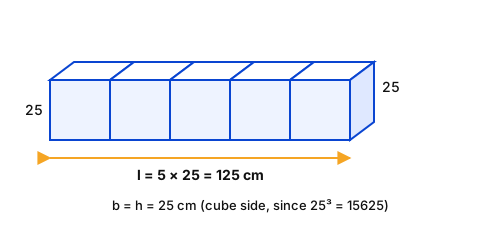
Five solid cubes, each of volume 15625 cm3, are joined end to end to form a cuboid. What is the lateral surface area (in cm2) of the cuboid?
प्रत्येक 15625 cm3 आयतन वाले पाँच ठोस घनों को सिरे से सिरा मिलाकर एक घनाभ बनाया जाता है। घनाभ का पार्श्व पृष्ठीय क्षेत्रफल (cm2 में) कितना है?
  1. A7593
  2. B7500
  3. C7591
  4. D7280
Show answer

Concept: Lateral surface area of cuboid =2h(l+b).

  1. Cube side =156253=25cm
  2. Cuboid: l=5×25=125, b=h=25
  3. LSA =2×25×(125+25)=7500cm2

Trick: LSA = 4 long faces =4×(125×25)=7500.

Answer: (B) 7500

अवधारणा: घनाभ का पार्श्व पृष्ठ क्षेत्रफल =2h(l+b)।

  1. घन की भुजा =156253=25cm
  2. घनाभ: l=125, b=h=25
  3. LSA =2×25×150=7500cm2

ट्रिक: 4 लंबे फलक =4×125×25=7500।

उत्तर: (B) 7500

RRB NTPC Undergraduate CBT 1MathematicsMensuration – cube & cuboidRRB NTPC Undergraduate CBT 1 2024 · 18 Aug Shift 1 →
Q1966.
In covering a distance of 112 km, Salaj takes 3 hours more than Kevin. If Salaj doubles his speed, then he would take 5 hours less than Kevin. Salaj's speed is:
112 km की दूरी तय करने में सलज, केविन से 3 घंटे अधिक लेता है। यदि सलज अपनी चाल दोगुनी कर दे, तो वह केविन से 5 घंटे कम लेगा। सलज की चाल है:
  1. A5 km/hr
  2. B7 km/hr
  3. C10 km/hr
  4. D6 km/hr
Show answer

Concept: Form two equations in Salaj's speed s and Kevin's time t.

  1. 112s=t+3
  2. 1122s=t−5
  3. Subtract: 56s=8⇒s=7km/h

Trick: Halving the time saves 8 h, so normal time =16 h; 11216=7.

Answer: (B) 7km/hr

अवधारणा: सलज की चाल s, केविन का समय t लेकर दो समीकरण।

  1. 112s=t+3
  2. 1122s=t−5
  3. घटाएँ: 56s=8⇒s=7km/h

ट्रिक: चाल दोगुनी → आधा समय बचा =8 घंटे, पूरा समय 16; 11216=7।

उत्तर: (B) 7km/hr

RRB NTPC Undergraduate CBT 1MathematicsSpeed, time & distanceRRB NTPC Undergraduate CBT 1 2024 · 18 Aug Shift 1 →
Q1967.
Simplify: 3((63)x2−22x+14)−6(x2+6x−15)
सरल कीजिए: 3((63)x2−22x+14)−6(x2+6x−15)
  1. A102x − 132
  2. B−102x + 132
  3. C−102x − 132
  4. D102x + 132
Show answer

Concept: Expand and collect like terms.

  1. 63=2: 3(2x2−22x+14)=6x2−66x+42
  2. −6(x2+6x−15)=−6x2−36x+90
  3. Sum =−102x+132

Trick: x2 terms cancel (6−6=0); just add x terms and constants.

Answer: (B) −102x+132

अवधारणा: कोष्ठक खोलकर समान पद जोड़ें।

  1. 3(2x2−22x+14)=6x2−66x+42
  2. −6(x2+6x−15)=−6x2−36x+90
  3. योग =−102x+132

ट्रिक: x2 पद कट जाते हैं; केवल x और अचर जोड़ें।

उत्तर: (B) −102x+132

RRB NTPC Undergraduate CBT 1MathematicsAlgebraic simplificationRRB NTPC Undergraduate CBT 1 2024 · 18 Aug Shift 1 →
Q1968.
If 3 times Mary’s present age is 29 years more than 5 times Diya's present age, and 2 times Diya's present age is 9 years less than Mary's present age, then what is the difference (in years) between the ages of Mary and Diya?
यदि मैरी की वर्तमान आयु का 3 गुना, दीया की वर्तमान आयु के 5 गुने से 29 वर्ष अधिक है, और दीया की वर्तमान आयु का 2 गुना, मैरी की वर्तमान आयु से 9 वर्ष कम है, तो मैरी और दीया की आयु में अंतर (वर्षों में) कितना है?
  1. A11
  2. B9
  3. C7
  4. D8
Show answer

Concept: Translate statements into equations.

  1. 3M=5D+29
  2. 2D=M−9⇒M=2D+9
  3. 3(2D+9)=5D+29⇒D=2, M=13
  4. Difference =13−2=11

Trick: Check: 3×13=39=5×2+29 ✓.

Answer: (A) 11

अवधारणा: कथनों को समीकरण में बदलें।

  1. 3M=5D+29
  2. M=2D+9
  3. 6D+27=5D+29⇒D=2, M=13
  4. अंतर =11

ट्रिक: जाँच: 39=10+29 ✓।

उत्तर: (A) 11

RRB NTPC Undergraduate CBT 1MathematicsProblems on agesRRB NTPC Undergraduate CBT 1 2024 · 18 Aug Shift 1 →
Q1969.
Select the pair that follows the same pattern as that followed by the two set of pairs given below. Both pairs follow the same pattern.
PFI : NGE
GKJ : ELF
उस युग्म का चयन कीजिए जो उसी पैटर्न का अनुसरण करता है जिसका अनुसरण नीचे दिए गए दो युग्मों द्वारा किया जाता है। दोनों युग्म एक ही पैटर्न का अनुसरण करते हैं।
PFI : NGE
GKJ : ELF
  1. AEEI : CGE
  2. BIDO : GEK
  3. CNCH : LDE
  4. DRNQ : PON
Show answer

Concept: Find the letter-shift pattern.

  1. PFI → NGE: P−2=N, F+1=G, I−4=E
  2. GKJ → ELF: −2,+1,−4 ✓
  3. IDO → GEK: I−2=G, D+1=E, O−4=K ✓

Trick: Check only the first letter (−2) to drop options, then verify the rest.

Answer: (B) IDO : GEK

अवधारणा: अक्षरों का खिसकाव (shift) पैटर्न देखें।

  1. PFI → NGE: −2,+1,−4
  2. GKJ → ELF: −2,+1,−4 ✓
  3. IDO → GEK: −2,+1,−4 ✓

ट्रिक: पहले अक्षर (−2) से विकल्प छाँटें, फिर बाकी जाँचें।

उत्तर: (B) IDO : GEK

RRB NTPC Undergraduate CBT 1General Intelligence and ReasoningLetter analogyRRB NTPC Undergraduate CBT 1 2024 · 18 Aug Shift 1 →
Q1970.
Based on the English alphabetical order, three of the following four letter-clusters are alike in a certain way and thus form a group. Which letter-cluster DOES NOT belong to that group?
(Note: The odd one out is not based on the number of consonants/vowels or their position in the letter-cluster.)
अंग्रेज़ी वर्णमाला क्रम के आधार पर, निम्नलिखित चार अक्षर-समूहों में से तीन किसी निश्चित प्रकार से एकसमान हैं और इस प्रकार एक समूह बनाते हैं। कौन-सा अक्षर-समूह उस समूह से संबंधित नहीं है?
(नोट: असंगत अक्षर-समूह, व्यंजनों/स्वरों की संख्या या अक्षर-समूह में उनके स्थान पर आधारित नहीं है।)
  1. AJCH
  2. BUNR
  3. CNGL
  4. DQJO
Show answer

Concept: Check gaps between consecutive letters.

  1. JCH: J−7=C, C+5=H; NGL: −7,+5; QJO: −7,+5
  2. UNR: U−7=N, but N+4=R ✗

Trick: Pattern is (−7,+5); UNR breaks it with +4.

Answer: (B) UNR

अवधारणा: क्रमागत अक्षरों का अंतर देखें।

  1. JCH, NGL, QJO: −7,+5
  2. UNR: −7, पर N+4=R ✗

ट्रिक: पैटर्न (−7,+5); UNR में +4 है।

उत्तर: (B) UNR

RRB NTPC Undergraduate CBT 1General Intelligence and ReasoningOdd one out – lettersRRB NTPC Undergraduate CBT 1 2024 · 18 Aug Shift 1 →
Q1971.
Aditya ranked 34th from the top and 44th from the bottom in his class. How many students are there in his class?
आदित्य अपनी कक्षा में ऊपर से 34वें और नीचे से 44वें स्थान पर है। उसकी कक्षा में कितने विद्यार्थी हैं?
  1. A76
  2. B78
  3. C77
  4. D79
Show answer

Concept: Total = rank from top + rank from bottom −1.

  1. Total =34+44−1=77

Yaad rakhein: The person is counted twice, so subtract 1.

Answer: (C) 77

अवधारणा: कुल = ऊपर से रैंक + नीचे से रैंक −1।

  1. कुल =34+44−1=77

याद रखें: व्यक्ति दो बार गिना जाता है, इसलिए 1 घटाएँ।

उत्तर: (C) 77

RRB NTPC Undergraduate CBT 1General Intelligence and ReasoningRankingRRB NTPC Undergraduate CBT 1 2024 · 18 Aug Shift 1 →
Q1972.
What should come in place of the question mark (?) in the given series?
451 450 442 415 351 ?
दी गई श्रृंखला में प्रश्न चिह्न (?) के स्थान पर क्या आना चाहिए?
451 450 442 415 351 ?
  1. A226
  2. B228
  3. C236
  4. D232
Show answer

Concept: Differences are cubes.

  1. 451−13=450, 450−23=442, 442−33=415, 415−43=351
  2. Next: 351−53=351−125=226

Trick: Differences 1, 8, 27, 64 → cubes; next is 125.

Answer: (A) 226

अवधारणा: अंतर घन (cubes) संख्याएँ हैं।

  1. −13,−23,−33,−43
  2. अगला: 351−125=226

ट्रिक: अंतर 1, 8, 27, 64 → घन; अगला 125।

उत्तर: (A) 226

RRB NTPC Undergraduate CBT 1General Intelligence and ReasoningNumber seriesRRB NTPC Undergraduate CBT 1 2024 · 18 Aug Shift 1 →
Q1973.
Pratik ranked 14th from the bottom and 27th from the top in his class. How many students are there in his class?
प्रतीक अपनी कक्षा में नीचे से 14वें और ऊपर से 27वें स्थान पर है। उसकी कक्षा में कितने विद्यार्थी हैं?
  1. A39
  2. B38
  3. C37
  4. D40
Show answer

Concept: Total = rank from top + rank from bottom −1.

  1. Total =27+14−1=40

Yaad rakhein: Never forget the −1; 41 is the common trap.

Answer: (D) 40

अवधारणा: कुल = ऊपर से रैंक + नीचे से रैंक −1।

  1. कुल =27+14−1=40

याद रखें: −1 कभी न भूलें।

उत्तर: (D) 40

RRB NTPC Undergraduate CBT 1General Intelligence and ReasoningRankingRRB NTPC Undergraduate CBT 1 2024 · 18 Aug Shift 1 →
Q1974.
Based on the English alphabetical order, three of the following four letter-clusters are alike in a certain way and thus form a group. Which letter-cluster DOES NOT belong to that group?
(Note: The odd one out is not based on the number of consonants/vowels or their position in the letter-cluster.)
अंग्रेज़ी वर्णमाला क्रम के आधार पर, निम्नलिखित चार अक्षर-समूहों में से तीन किसी निश्चित प्रकार से एकसमान हैं और इस प्रकार एक समूह बनाते हैं। कौन-सा अक्षर-समूह उस समूह से संबंधित नहीं है?
(नोट: असंगत अक्षर-समूह, व्यंजनों/स्वरों की संख्या या अक्षर-समूह में उनके स्थान पर आधारित नहीं है।)
  1. AGNJ
  2. BDKG
  3. CRYV
  4. DAHD
Show answer

Concept: Check gaps between consecutive letters.

  1. GNJ: G+7=N, N−4=J; DKG: +7,−4; AHD: +7,−4
  2. RYV: R+7=Y, but Y−3=V ✗

Trick: Pattern (+7,−4); RYV has −3.

Answer: (C) RYV

अवधारणा: क्रमागत अक्षरों का अंतर देखें।

  1. GNJ, DKG, AHD: +7,−4
  2. RYV: +7, पर Y−3=V ✗

ट्रिक: पैटर्न (+7,−4); RYV में −3।

उत्तर: (C) RYV

RRB NTPC Undergraduate CBT 1General Intelligence and ReasoningOdd one out – lettersRRB NTPC Undergraduate CBT 1 2024 · 18 Aug Shift 1 →
Q1975.
What should come in place of the question mark (?) in the given series based on the English alphabetical order?
YCS KOE WAQ IMC ?
अंग्रेज़ी वर्णमाला क्रम के आधार पर दी गई श्रृंखला में प्रश्न चिह्न (?) के स्थान पर क्या आना चाहिए?
YCS KOE WAQ IMC ?
  1. AYUO
  2. BYOU
  3. CUYO
  4. DUOY
Show answer

Concept: Each letter position moves +12 (cyclic).

  1. 1st: Y(25)→K(11)→W(23)→I(9)→U(21)
  2. 2nd: C→O→A→M→Y
  3. 3rd: S→E→Q→C→O
  4. Next term: UYO

Trick: +12 on a 26-letter cycle; 25+12=37−26=11 (K).

Answer: (C) UYO

अवधारणा: हर स्थान का अक्षर +12 (चक्रीय) बढ़ता है।

  1. पहला: Y→K→W→I→U
  2. दूसरा: C→O→A→M→Y
  3. तीसरा: S→E→Q→C→O
  4. अगला पद: UYO

ट्रिक: 26 से अधिक हो तो 26 घटाएँ: 25+12−26=11 (K)।

उत्तर: (C) UYO

RRB NTPC Undergraduate CBT 1General Intelligence and ReasoningAlphabet seriesRRB NTPC Undergraduate CBT 1 2024 · 18 Aug Shift 1 →
Q1976.
Read the given statements and conclusions carefully. Assuming that the information given in the statements is true, even if it appears to be at variance with commonly known facts, decide which of the given conclusions logically follow(s) from the statements.
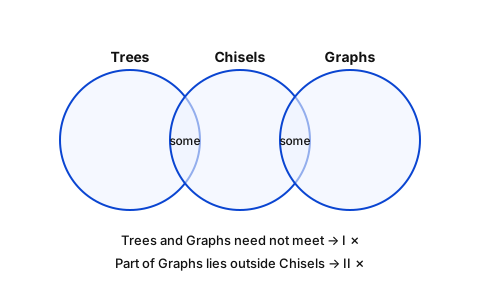
Statements: Some trees are chisels. Some chisels are graphs.
Conclusions (I): Some trees are graphs.
Conclusions (II): All graphs are chisels.
दिए गए कथनों और निष्कर्षों को ध्यानपूर्वक पढ़िए। यह मानते हुए कि कथनों में दी गई जानकारी सत्य है, भले ही वह सामान्यतः ज्ञात तथ्यों से भिन्न प्रतीत होती हो, निर्णय कीजिए कि दिए गए निष्कर्षों में से कौन-सा/से निष्कर्ष तार्किक रूप से कथनों का अनुसरण करता है/करते हैं।
कथन: कुछ पेड़, छेनियाँ हैं। कुछ छेनियाँ, ग्राफ़ हैं।
निष्कर्ष (I): कुछ पेड़, ग्राफ़ हैं।
निष्कर्ष (II): सभी ग्राफ़, छेनियाँ हैं।
  1. ANeither conclusion (I) nor (II) follows.न तो निष्कर्ष (I) और न ही (II) अनुसरण करता है।
  2. BBoth conclusions (I) and (II) follow.निष्कर्ष (I) और (II) दोनों अनुसरण करते हैं।
  3. COnly conclusion (II) follows.केवल निष्कर्ष (II) अनुसरण करता है।
  4. DOnly conclusion (I) follows.केवल निष्कर्ष (I) अनुसरण करता है।
Show answer

Concept: Two 'some' statements give no definite link between the end terms.

  1. Trees–Chisels overlap, Chisels–Graphs overlap; Trees and Graphs may not meet → I does not follow
  2. 'Some chisels are graphs' cannot become 'All graphs are chisels' → II does not follow

Trick: Some + Some = no conclusion.

Answer: (A) Neither conclusion (I) nor (II) follows.

अवधारणा: दो 'कुछ' कथनों से अंतिम पदों में निश्चित संबंध नहीं बनता।

  1. Trees और Graphs का मिलना आवश्यक नहीं → I अनुसरण नहीं करता
  2. 'कुछ chisels graphs हैं' से 'सभी graphs chisels हैं' नहीं निकलता → II नहीं

ट्रिक: कुछ + कुछ = कोई निष्कर्ष नहीं।

उत्तर: (A) न (I) न (II) अनुसरण करता है।

RRB NTPC Undergraduate CBT 1General Intelligence and ReasoningSyllogismRRB NTPC Undergraduate CBT 1 2024 · 18 Aug Shift 1 →
Q1977.
If + means −, − means ×, × means ÷ and ÷ means +, then what will come in place of the question mark (?) in the following equation?
17 ÷ 44 × 4 + 6 − 4 = ?
यदि + का अर्थ −, − का अर्थ ×, × का अर्थ ÷ और ÷ का अर्थ + है, तो निम्नलिखित समीकरण में प्रश्न चिह्न (?) के स्थान पर क्या आएगा?
17 ÷ 44 × 4 + 6 − 4 = ?
  1. A4
  2. B17
  3. C9
  4. D24
Show answer

Concept: Replace symbols, then apply BODMAS.

  1. 17÷44×4+6−4→17+44÷4−6×4
  2. =17+11−24=4

Trick: Do the swap carefully sign by sign before calculating.

Answer: (A) 4

अवधारणा: चिह्न बदलकर BODMAS लगाएँ।

  1. 17+44÷4−6×4
  2. =17+11−24=4

ट्रिक: गणना से पहले हर चिह्न ध्यान से बदलें।

उत्तर: (A) 4

RRB NTPC Undergraduate CBT 1General Intelligence and ReasoningMathematical operationsRRB NTPC Undergraduate CBT 1 2024 · 18 Aug Shift 1 →
Q1978.
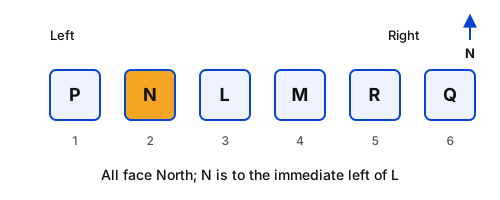
Six passengers L, M, N, P, Q and R are sitting on a bench in a straight line. They all are facing towards the north. M is sitting immediately between L and R. Q is sitting at the extreme right end of line. M is sitting second to the left of Q. R is sitting to the immediate left of Q. P is not an immediate neighbour of L. Who is sitting to the immediate left of L?
छह यात्री L, M, N, P, Q और R एक सीधी पंक्ति में एक बेंच पर बैठे हैं। उन सभी का मुख उत्तर की ओर है। M, L और R के ठीक बीच में बैठा है। Q पंक्ति के दाएँ छोर पर बैठा है। M, Q के बाएँ से दूसरे स्थान पर बैठा है। R, Q के ठीक बाएँ बैठा है। P, L का निकटतम पड़ोसी नहीं है। L के ठीक बाएँ कौन बैठा है?
  1. AN
  2. BR
  3. CP
  4. DM
Show answer

Concept: Fix the extreme position first, all face North (left = our left).

  1. Q at extreme right (6); R immediate left of Q (5); M second left of Q (4)
  2. M between L and R → L at 3
  3. P not next to L → P at 1, N at 2
  4. Order: P N L M R Q → immediate left of L is N

Trick: Start with 'extreme end' clues — they anchor the row.

Answer: (A) N

अवधारणा: पहले छोर वाला व्यक्ति रखें; सब उत्तर की ओर मुख, बायाँ = हमारा बायाँ।

  1. Q दाएँ छोर (6); R, Q के तुरंत बाएँ (5); M, Q के दूसरे बाएँ (4)
  2. M, L और R के बीच → L (3)
  3. P, L का पड़ोसी नहीं → P (1), N (2)
  4. क्रम: P N L M R Q → L के तुरंत बाएँ N

ट्रिक: 'छोर' वाले संकेत से शुरुआत करें।

उत्तर: (A) N

RRB NTPC Undergraduate CBT 1General Intelligence and ReasoningLinear seating arrangementRRB NTPC Undergraduate CBT 1 2024 · 18 Aug Shift 1 →
Q1979.
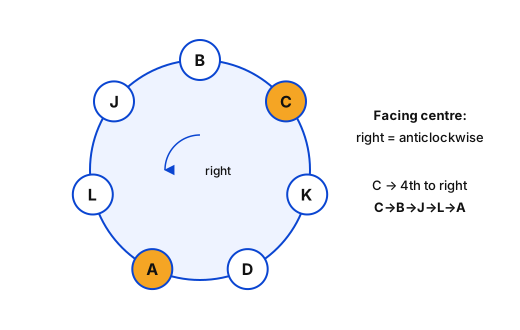
A, B, C, D, J, K and L are sitting around a circular table, facing the centre of the table. Only two people sit between K and J when counted from the right of K. Only three people sit between D and B when counted from the right of B. J sits to the immediate right of B. A sits to the immediate right of L.
Who sits fourth to the right of C?
A, B, C, D, J, K और L एक वृत्ताकार मेज़ के चारों ओर मेज़ के केंद्र की ओर मुख करके बैठे हैं। K के दाएँ से गिनने पर K और J के बीच केवल दो व्यक्ति बैठे हैं। B के दाएँ से गिनने पर D और B के बीच केवल तीन व्यक्ति बैठे हैं। J, B के ठीक दाएँ बैठा है। A, L के ठीक दाएँ बैठा है।
C के दाएँ से चौथे स्थान पर कौन बैठा है?
  1. AJ
  2. BA
  3. CD
  4. DL
Show answer

Concept: Facing centre: right = anticlockwise.

  1. J immediate right of B; K is 3rd to the left of J (two between, from K's right)
  2. D: three people between B and D from B's right
  3. A immediate right of L; fill: clockwise B, C, K, D, A, L, J
  4. 4th to the right of C: B, J, L, A → A

Trick: In a 7-seat circle, 4th to the right = 3rd to the left.

Answer: (B) A

अवधारणा: केंद्र की ओर मुख: दायाँ = वामावर्त (anticlockwise)।

  1. J, B के तुरंत दाएँ; K के दाएँ से गिनने पर K और J के बीच दो
  2. B के दाएँ से गिनने पर B और D के बीच तीन
  3. A, L के तुरंत दाएँ → दक्षिणावर्त: B, C, K, D, A, L, J
  4. C के चौथे दाएँ: B, J, L, A → A

ट्रिक: 7 सीटों में चौथा दायाँ = तीसरा बायाँ।

उत्तर: (B) A

RRB NTPC Undergraduate CBT 1General Intelligence and ReasoningCircular seating arrangementRRB NTPC Undergraduate CBT 1 2024 · 18 Aug Shift 1 →
Q1980.
In the following triads, each group of letters is related to the subsequent one following a certain logic. Select from the given options, the one which follows the same logic. CORD - RCOD - DROC
KIND - NKID - DNIK
निम्नलिखित त्रिकों में, अक्षरों का प्रत्येक समूह एक निश्चित तर्क का अनुसरण करते हुए अपने बाद वाले समूह से संबंधित है। दिए गए विकल्पों में से उसका चयन कीजिए जो उसी तर्क का अनुसरण करता है। CORD - RCOD - DROC
KIND - NKID - DNIK
  1. ATEAR - TAER - RAET
  2. BWANT - NWAT - TNAW
  3. CBEAT - EBAT - TEAB
  4. DSLAP - ASLP - LAPS
Show answer

Concept: Track letter positions 1-2-3-4.

  1. CORD → RCOD: order 3,1,2,4; → DROC: reverse 4,3,2,1
  2. KIND → NKID → DNIK ✓ same
  3. WANT → NWAT (3,1,2,4) → TNAW (4,3,2,1) ✓

Trick: Third term is always the exact reverse of the first — check that first.

Answer: (B) WANT - NWAT - TNAW

अवधारणा: अक्षरों की स्थिति 1-2-3-4 देखें।

  1. CORD → RCOD: क्रम 3,1,2,4; → DROC: उलटा
  2. KIND → NKID → DNIK ✓
  3. WANT → NWAT → TNAW ✓

ट्रिक: तीसरा पद हमेशा पहले का उलटा है — पहले यही जाँचें।

उत्तर: (B) WANT - NWAT - TNAW

RRB NTPC Undergraduate CBT 1General Intelligence and ReasoningLetter rearrangementRRB NTPC Undergraduate CBT 1 2024 · 18 Aug Shift 1 →