Question bank

Q&A: practice questions with answers

Search questions on any topic. Filter by exam category, exam, subject and topic, try the question, then open the answer and explanation.

Courses – airGurukul

494 questions found.

Q181.
Two resistors, R1= 10Ω and R2= 20Ω, are connected in series to a 12-V battery. What is the voltage across R2​?
दो प्रतिरोधक, R1= 10Ω और R2= 20Ω, एक 12-V बैटरी से श्रेणीक्रम में जोड़े गए हैं। R2​ के सिरों पर वोल्टता क्या है?
  1. A4 V
  2. B16 V
  3. C8 V
  4. D12 V
Show answer

Concept: In series, the same current flows through both resistors and the voltage divides in proportion to resistance: V2=VR2R1+R2.

  1. I=1210+20=0.4A.
  2. V2=IR2=0.4×20=8V (and V1=4V; 4+8=12 ✓).

Trick: Voltage splits in the ratio of resistances 10 : 20 = 1 : 2, so 12 V → 4 V and 8 V.

Answer: (C) 8 V

अवधारणा: श्रेणी में दोनों प्रतिरोधों से समान धारा बहती है और वोल्टेज प्रतिरोध के अनुपात में बँटता है: V2=VR2R1+R2।

  1. I=1210+20=0.4A।
  2. V2=IR2=0.4×20=8V (और V1=4V; 4+8=12 ✓)।

ट्रिक: वोल्टेज प्रतिरोधों के अनुपात 10 : 20 = 1 : 2 में बँटता है, अतः 12 V → 4 V और 8 V।

उत्तर: (C) 8 V
RRB Technician Grade I (Signal)Basic Science and EngineeringSeries circuit – voltage divisionRRB Technician Grade I (Signal) 2024 · 19 Dec Shift 3 →
Q182.
Which of the following correctly expresses the relationship between power, force, time and distance?
निम्नलिखित में से कौन-सा शक्ति, बल, समय और दूरी के बीच संबंध को सही रूप से व्यक्त करता है?
  1. AP = F/d × t
  2. BP = F × t/d
  3. CP = F × d × t
  4. DP = F × d/t
Show answer

Concept: Power is the rate of doing work: P=Wt, and work done by a force is W=F×d.

  1. Substitute W=F×d into P=Wt.
  2. P=F×dt, i.e. P=F×dt=F×v.
  3. Options A, B and C place t or d wrongly and do not give the unit watt (J/s).

Trick: Power = Force × Velocity, and velocity = distance/time.

Answer: (D) P=F×dt

अवधारणा: शक्ति (Power) कार्य करने की दर है: P=Wt, और बल द्वारा किया गया कार्य W=F×d।

  1. W=F×d को P=Wt में रखें।
  2. P=F×dt, अर्थात P=F×dt=F×v।
  3. विकल्प A, B और C में t या d गलत स्थान पर हैं, इनसे वाट (J/s) की इकाई नहीं बनती।

ट्रिक: शक्ति = बल × वेग, और वेग = दूरी/समय।

उत्तर: (D) P=F×dt

RRB Technician Grade I (Signal)Basic Science and EngineeringPower, work and forceRRB Technician Grade I (Signal) 2024 · 19 Dec Shift 3 →
Q183.
The SI unit of current, the Ampere, is defined based on _________.
धारा की SI इकाई, ऐम्पियर, को _________ के आधार पर परिभाषित किया जाता है।
  1. Athe force between two current-carrying conductorsदो धारावाही चालकों के बीच बल
  2. Bthe magnetic flux through a loopकिसी लूप से गुज़रने वाला चुंबकीय फ्लक्स
  3. Cthe electric potential differenceविद्युत विभवांतर
  4. Dthe force between two chargesदो आवेशों के बीच बल
Show answer

Concept: Classically the ampere was defined through the magnetic force between two parallel current-carrying conductors.

  1. One ampere is that constant current which, flowing in two infinitely long parallel conductors 1 m apart in vacuum, produces a force of 2×10⁻⁷N per metre of length between them.
  2. Since 2019 the SI fixes the ampere via the elementary charge e, but the force-between-conductors definition is the one asked in exams.
  3. Flux (weber), potential difference (volt) and force between charges (coulomb's law) define other quantities.

Yaad rakhein: Ampere ↔ force between two parallel wires = 2×10⁻⁷ N/m.

Answer: (A) the force between two current-carrying conductors

अवधारणा: ऐम्पियर की पारंपरिक परिभाषा दो समांतर धारावाही चालकों के बीच चुंबकीय बल (magnetic force) पर आधारित है।

  1. एक ऐम्पियर वह नियत धारा है जो निर्वात में 1 m दूरी पर रखे दो अनंत लंबे समांतर चालकों में बहने पर उनके बीच प्रति मीटर 2×10⁻⁷N बल उत्पन्न करती है।
  2. 2019 से SI में ऐम्पियर को मूल आवेश e से परिभाषित किया गया है, पर परीक्षा में यही बल वाली परिभाषा पूछी जाती है।
  3. फ्लक्स (वेबर), विभवांतर (वोल्ट) और आवेशों के बीच बल (कूलॉम नियम) अन्य राशियाँ परिभाषित करते हैं।

याद रखें: ऐम्पियर ↔ दो समांतर तारों के बीच बल = 2×10⁻⁷ N/m।

उत्तर: (A) the force between two current-carrying conductors

RRB Technician Grade I (Signal)Basic Science and EngineeringSI unit of currentRRB Technician Grade I (Signal) 2024 · 19 Dec Shift 3 →
Q184.
If a conductor moves through a uniform magnetic field, the induced potential difference is maximised when _____.
यदि कोई चालक एकसमान चुंबकीय क्षेत्र में गति करता है, तो प्रेरित विभवांतर अधिकतम होता है जब _____।
  1. Athe magnetic field is non-uniformचुंबकीय क्षेत्र असमान हो
  2. Bthe magnetic field is zeroचुंबकीय क्षेत्र शून्य हो
  3. Cthe conductor is parallel to the magnetic field linesचालक चुंबकीय क्षेत्र रेखाओं के समांतर हो
  4. Dthe conductor is perpendicular to the magnetic field linesचालक चुंबकीय क्षेत्र रेखाओं के लंबवत हो
Show answer

Concept: Motional emf e=Blvsinθ, where θ is the angle between the conductor's motion and the field.

  1. The emf is maximum when sinθ=1, i.e. the conductor cuts the field lines at 90∘ (perpendicular).
  2. Moving parallel to the field lines cuts no flux, so e=0 (option C is the minimum case).
  3. A zero field gives zero emf; non-uniformity is not required.

Trick: Maximum flux cutting = perpendicular motion; Fleming's right-hand rule needs field, motion and emf mutually perpendicular.

Answer: (D) the conductor is perpendicular to the magnetic field lines

अवधारणा: गतिक वि.वा.बल (motional emf) e=Blvsinθ, जहाँ θ चालक की गति और क्षेत्र के बीच का कोण है।

  1. emf अधिकतम तब है जब sinθ=1, अर्थात चालक क्षेत्र रेखाओं को 90∘ (लंबवत) पर काटे।
  2. क्षेत्र रेखाओं के समांतर चलने पर कोई फ्लक्स नहीं कटता, e=0 (विकल्प C न्यूनतम स्थिति है)।
  3. शून्य क्षेत्र से शून्य emf; असमान क्षेत्र की आवश्यकता नहीं।

ट्रिक: अधिकतम फ्लक्स कटना = लंबवत गति; फ्लेमिंग के दाएँ हाथ के नियम में क्षेत्र, गति और emf परस्पर लंबवत होते हैं।

उत्तर: (D) the conductor is perpendicular to the magnetic field lines

RRB Technician Grade I (Signal)Basic Science and EngineeringMotional EMFRRB Technician Grade I (Signal) 2024 · 19 Dec Shift 3 →
Q185.
The basic principle behind the working of an electric motor is the interaction between the ________.
विद्युत मोटर के कार्य करने का मूल सिद्धांत ________ के बीच की अन्योन्यक्रिया है।
  1. Amagnetic field and current-carrying conductorsचुंबकीय क्षेत्र और धारावाही चालक
  2. Bmagnetic field and heat energyचुंबकीय क्षेत्र और ऊष्मा ऊर्जा
  3. Celectric field and gravitational fieldविद्युत क्षेत्र और गुरुत्वीय क्षेत्र
  4. Delectric potential and light energyविद्युत विभव और प्रकाश ऊर्जा
Show answer

Concept: An electric motor converts electrical energy into mechanical energy using the force on a current-carrying conductor placed in a magnetic field (F=BIl).

  1. Current in the coil + external magnetic field → force (Fleming's left-hand rule) → torque → rotation.
  2. No heat, gravity or light interaction is involved in the basic principle; those options are distractors.

Yaad rakhein: Motor = left-hand rule (force); Generator = right-hand rule (emf).

Answer: (A) magnetic field and current-carrying conductors

अवधारणा: विद्युत मोटर चुंबकीय क्षेत्र में रखे धारावाही चालक पर लगने वाले बल (F=BIl) से विद्युत ऊर्जा को यांत्रिक ऊर्जा में बदलती है।

  1. कुंडली में धारा + बाहरी चुंबकीय क्षेत्र → बल (फ्लेमिंग का बायाँ हाथ नियम) → बल-आघूर्ण → घूर्णन।
  2. मूल सिद्धांत में ऊष्मा, गुरुत्व या प्रकाश की कोई भूमिका नहीं; वे विकल्प भटकाने वाले हैं।

याद रखें: मोटर = बायाँ हाथ (बल); जनित्र = दायाँ हाथ (emf)।

उत्तर: (A) magnetic field and current-carrying conductors

RRB Technician Grade I (Signal)Basic Science and EngineeringElectric motor principleRRB Technician Grade I (Signal) 2024 · 19 Dec Shift 3 →
Q186.
Select the most appropriate options to fill in the blanks.
The output voltage of L.V.D.T. transducer is practically ______ for displacements up to ____.
रिक्त स्थानों की पूर्ति के लिए सबसे उपयुक्त विकल्पों का चयन कीजिए।
L.V.D.T. ट्रांसड्यूसर की आउटपुट वोल्टता ____ तक के विस्थापनों के लिए व्यावहारिक रूप से ______ होती है।
  1. Aexponential; 5 mmचरघातांकी (exponential); 5 mm
  2. Blinear; 50 mmरैखिक (linear); 50 mm
  3. Cexponential; 50 mmचरघातांकी (exponential); 50 mm
  4. Dlinear; 5 mmरैखिक (linear); 5 mm
Show answer

Concept: An LVDT (Linear Variable Differential Transformer) is an inductive transducer whose output voltage varies linearly with core displacement within its rated range.

  1. Output = difference of the two secondary voltages; for small core movements it is directly proportional to displacement.
  2. Standard text statement: the output is practically linear for displacements up to about 5 mm; beyond that the curve bends.
  3. "Exponential" is wrong – an LVDT is prized precisely for its linearity.

Yaad rakhein: LVDT = Linear, range about ±5 mm, infinite resolution, no friction.

Answer: (D) linear; 5 mm

अवधारणा: LVDT (Linear Variable Differential Transformer) एक प्रेरकीय ट्रांसड्यूसर है जिसका आउटपुट वोल्टेज निर्धारित सीमा में कोर के विस्थापन के साथ रैखिक (linear) रूप से बदलता है।

  1. आउटपुट = दोनों द्वितीयक वोल्टेजों का अंतर; छोटे विस्थापन के लिए यह विस्थापन के समानुपाती होता है।
  2. मानक कथन: लगभग 5 mm तक के विस्थापन के लिए आउटपुट व्यावहारिक रूप से रैखिक है; उसके बाद वक्र मुड़ जाता है।
  3. "Exponential" गलत है – LVDT की खासियत ही उसकी रैखिकता है।

याद रखें: LVDT = Linear, परास लगभग ±5 mm, अनंत विभेदन, घर्षण-रहित।

उत्तर: (D) linear; 5 mm

RRB Technician Grade I (Signal)Basic Science and EngineeringLVDT transducerRRB Technician Grade I (Signal) 2024 · 19 Dec Shift 3 →
Q187.
What is the equivalent of 1 bar in the SI unit of pressure?
दाब की SI इकाई में 1 bar का तुल्य मान क्या है?
  1. A105 Pa
  2. B106 N/m2
  3. C10-5 Pa
  4. D104 psi
Show answer

Concept: The SI unit of pressure is the pascal (1Pa=1N/m2); the bar is a convenient metric unit close to atmospheric pressure.

  1. 1bar=105Pa=100kPa.
  2. Compare: 1atm=1.013×10⁵Pa=1.013bar; 1bar≈14.5psi.
  3. Option B (106N/m2) is 10 bar; option C is far too small.

Yaad rakhein: bar → 105 Pa, atm → 1.013×10⁵ Pa.

Answer: (A) 105 Pa

अवधारणा: दाब (pressure) का SI मात्रक पास्कल है (1Pa=1N/m2); बार एक सुविधाजनक मीट्रिक मात्रक है जो वायुमंडलीय दाब के लगभग बराबर है।

  1. 1bar=105Pa=100kPa।
  2. तुलना: 1atm=1.013×10⁵Pa=1.013bar; 1bar≈14.5psi।
  3. विकल्प B (106N/m2) = 10 bar; विकल्प C बहुत छोटा है।

याद रखें: bar → 105 Pa, atm → 1.013×10⁵ Pa।

उत्तर: (A) 105 Pa

RRB Technician Grade I (Signal)Basic Science and EngineeringUnits of pressureRRB Technician Grade I (Signal) 2024 · 19 Dec Shift 3 →
Q188.
If the velocity v of a body is expressed as v = at + bt2, where a and b are constants, the dimensions of b are ____________.
यदि किसी पिंड का वेग v, v = at + bt2 के रूप में व्यक्त किया जाता है, जहाँ a और b नियतांक हैं, तो b की विमाएँ ____________ हैं।
  1. A[LT−1]
  2. B[L]
  3. C[LT−3]
  4. D[LT−2]
Show answer

Concept: Only quantities with the same dimensions can be added, so each term of v=at+bt2 must have the dimensions of velocity [LT−1].

  1. [bt2]=[v]=[LT−1].
  2. [b]=[LT−1][T2]=[LT−3].
  3. Similarly [a]=[LT−2] (option D is the dimension of a, not b).

Trick: Principle of homogeneity – divide the dimension of the left side by the dimension of the multiplying power of t.

Answer: (C) [LT−3]

अवधारणा: केवल समान विमा वाली राशियाँ जोड़ी जा सकती हैं, अतः v=at+bt2 के हर पद की विमा वेग की विमा [LT−1] होनी चाहिए।

  1. [bt2]=[v]=[LT−1]।
  2. [b]=[LT−1][T2]=[LT−3]।
  3. इसी तरह [a]=[LT−2] (विकल्प D a की विमा है, b की नहीं)।

ट्रिक: विमीय समांगता का सिद्धांत – बाईं ओर की विमा को t की घात की विमा से भाग दें।

उत्तर: (C) [LT−3]

RRB Technician Grade I (Signal)Basic Science and EngineeringDimensional analysisRRB Technician Grade I (Signal) 2024 · 19 Dec Shift 3 →
Q189.
A wire loop is placed in a magnetic field that is increasing in magnitude but remains stationary. Using Fleming's Right-Hand Rule, what can be said about the induced current in the loop?
एक तार का लूप ऐसे चुंबकीय क्षेत्र में रखा गया है जिसका परिमाण बढ़ रहा है, परंतु लूप स्थिर रहता है। फ्लेमिंग के दक्षिण-हस्त नियम (Fleming's Right-Hand Rule) का उपयोग करते हुए, लूप में प्रेरित धारा के बारे में क्या कहा जा सकता है?
  1. AThe direction of the current depends on the material of the loopधारा की दिशा लूप के पदार्थ पर निर्भर करती है
  2. BThere is no induced current since the loop is stationaryकोई प्रेरित धारा नहीं होती क्योंकि लूप स्थिर है
  3. CThe current is induced counterclockwiseधारा वामावर्त (counterclockwise) दिशा में प्रेरित होती है
  4. DThe current is induced clockwiseधारा दक्षिणावर्त (clockwise) दिशा में प्रेरित होती है
Show answer

Concept: Fleming's right-hand rule gives the direction of current induced in a conductor that moves through a magnetic field (thumb = motion, forefinger = field, middle finger = current).

  1. The rule has three inputs: field, motion and current. The loop here is stationary, so there is no "motion" direction to point the thumb along.
  2. Hence Fleming's right-hand rule cannot assign any clockwise or anticlockwise direction, and within the frame of this rule no motional current arises.
  3. Note: a current due to the changing field is governed by Faraday's law and Lenz's law, not by Fleming's rule – that is why options C and D cannot be decided here.

Yaad rakhein: Fleming's right hand = motional emf (needs movement); changing field without motion = Faraday/Lenz.

Answer: (B) There is no induced current since the loop is stationary

अवधारणा: फ्लेमिंग का दायाँ हाथ नियम उस चालक में प्रेरित धारा की दिशा बताता है जो चुंबकीय क्षेत्र में गति करता है (अंगूठा = गति, तर्जनी = क्षेत्र, मध्यमा = धारा)।

  1. नियम के तीन इनपुट हैं: क्षेत्र, गति और धारा। यहाँ लूप स्थिर है, अतः अंगूठे के लिए कोई "गति" दिशा ही नहीं है।
  2. इसलिए फ्लेमिंग के नियम से दक्षिणावर्त या वामावर्त कोई दिशा तय नहीं हो सकती, और इस नियम के दायरे में कोई गतिक धारा नहीं बनती।
  3. ध्यान दें: बदलते क्षेत्र से बनने वाली धारा फैराडे और लेंज के नियम से तय होती है, फ्लेमिंग के नियम से नहीं – इसीलिए C और D यहाँ तय नहीं हो सकते।

याद रखें: फ्लेमिंग दायाँ हाथ = गतिक emf (गति ज़रूरी); बिना गति बदलता क्षेत्र = फैराडे/लेंज।

उत्तर: (B) There is no induced current since the loop is stationary

RRB Technician Grade I (Signal)Basic Science and EngineeringFleming's right-hand ruleRRB Technician Grade I (Signal) 2024 · 19 Dec Shift 3 →
Q190.
If a machine does 3000 J of work in 15 seconds, what is the power output of the machine?
यदि कोई मशीन 15 सेकंड में 3000 J कार्य करती है, तो मशीन का शक्ति उत्पादन (power output) क्या है?
  1. A450 W
  2. B5 W
  3. C200 W
  4. D5 mW
Show answer

Concept: P=Wt, with work in joules and time in seconds giving watts.

  1. P=3000J15s=200W.
  2. Option B (5 W) is the inverted ratio 153; option A would need 6750 J.

Trick: 3000÷15: 15×200=3000.

Answer: (C) 200 W

अवधारणा: P=Wt; कार्य जूल में और समय सेकंड में लेने पर शक्ति वाट में आती है।

  1. P=3000J15s=200W।
  2. विकल्प B (5 W) उल्टा अनुपात 153 है; विकल्प A के लिए 6750 J चाहिए।

ट्रिक: 3000÷15: 15×200=3000।

उत्तर: (C) 200 W

RRB Technician Grade I (Signal)Basic Science and EngineeringPower = work/timeRRB Technician Grade I (Signal) 2024 · 19 Dec Shift 3 →
Q191.
A 60-W lightbulb operates on a 120-V source. What is the current flowing through the bulb?
एक 60-W बल्ब 120-V स्रोत पर कार्य करता है। बल्ब से प्रवाहित धारा कितनी है?
  1. A0.5 A
  2. B1 A
  3. C2 A
  4. D1.5 A
Show answer

Concept: Electrical power P=VI, so I=PV.

  1. I=60W120V=0.5A.
  2. Bulb resistance (for interest): R=VI=1200.5=240Ω.

Trick: Watts ÷ Volts = Amperes.

Answer: (A) 0.5 A

अवधारणा: विद्युत शक्ति P=VI, अतः I=PV।

  1. I=60W120V=0.5A।
  2. बल्ब का प्रतिरोध: R=VI=1200.5=240Ω।

ट्रिक: वाट ÷ वोल्ट = ऐम्पियर।

उत्तर: (A) 0.5 A

RRB Technician Grade I (Signal)Basic Science and EngineeringOhm's law & powerRRB Technician Grade I (Signal) 2024 · 19 Dec Shift 3 →
Q192.
In a purely capacitive AC circuit, the power consumed over a complete cycle is _______.
एक विशुद्ध धारितीय (purely capacitive) AC परिपथ में, एक पूर्ण चक्र में उपभुक्त शक्ति _______ होती है।
  1. Aminimum but not zeroन्यूनतम परंतु शून्य नहीं
  2. Bmaximumअधिकतम
  3. Czeroशून्य
  4. Dequal to the apparent powerआभासी शक्ति (apparent power) के बराबर
Show answer

Concept: Average power P=VrmsIrmscosϕ. In a pure capacitor the current leads the voltage by 90∘, so cosϕ=cos90∘=0.

  1. Energy stored in the capacitor during one quarter cycle is returned to the source in the next quarter.
  2. Net energy consumed over a full cycle =0; only reactive power (VIsinϕ) flows.
  3. The same holds for a pure inductor.

Yaad rakhein: Pure L or pure C → power factor 0 → "wattless" current, zero real power.

Answer: (C) zero

अवधारणा: औसत शक्ति P=VrmsIrmscosϕ। शुद्ध संधारित्र में धारा वोल्टेज से 90∘ आगे होती है, अतः cosϕ=cos90∘=0।

  1. एक चौथाई चक्र में संधारित्र में संचित ऊर्जा अगले चौथाई चक्र में स्रोत को लौट जाती है।
  2. पूरे चक्र में कुल खपत ऊर्जा =0; केवल प्रतिघाती शक्ति (VIsinϕ) बहती है।
  3. शुद्ध प्रेरक के लिए भी यही सत्य है।

याद रखें: शुद्ध L या शुद्ध C → शक्ति गुणांक 0 → "wattless" धारा, वास्तविक शक्ति शून्य।

उत्तर: (C) zero

RRB Technician Grade I (Signal)Basic Science and EngineeringPower in capacitive AC circuitRRB Technician Grade I (Signal) 2024 · 19 Dec Shift 3 →
Q193.
The magnetic field at a point near a long, straight current-carrying conductor is directly proportional to _____.
एक लंबे, सीधे धारावाही चालक के निकट किसी बिंदु पर चुंबकीय क्षेत्र _____ के समानुपाती होता है।
  1. Athe inverse of the distance from the conductorचालक से दूरी के व्युत्क्रम
  2. Bthe square of the distance from the conductorचालक से दूरी के वर्ग
  3. Cthe square of the currentधारा के वर्ग
  4. Dthe current through the conductorचालक में प्रवाहित धारा
Show answer

Concept: For a long straight current-carrying wire, B=μ0I2πr.

  1. B∝I – directly proportional to the current (not its square).
  2. B∝1r – inversely proportional to the distance (option A says "inverse of distance", which is the same idea but the question's wording wants the direct proportionality; option B is wrong).
  3. Doubling the current doubles the field; doubling the distance halves it.

Yaad rakhein: Straight wire: B∝Ir; circular coil centre: B∝nIr.

Answer: (D) the current through the conductor

अवधारणा: लंबे सीधे धारावाही तार के लिए B=μ0I2πr।

  1. B∝I – धारा के अनुक्रमानुपाती (वर्ग के नहीं)।
  2. B∝1r – दूरी के व्युत्क्रमानुपाती (विकल्प A "inverse of distance" भी इसी बात को कहता है, पर प्रश्न अनुक्रमानुपात पूछ रहा है; विकल्प B गलत है)।
  3. धारा दोगुनी → क्षेत्र दोगुना; दूरी दोगुनी → क्षेत्र आधा।

याद रखें: सीधा तार: B∝Ir; वृत्ताकार कुंडली का केंद्र: B∝nIr।

उत्तर: (D) the current through the conductor

RRB Technician Grade I (Signal)Basic Science and EngineeringMagnetic field of a straight conductorRRB Technician Grade I (Signal) 2024 · 19 Dec Shift 3 →
Q194.
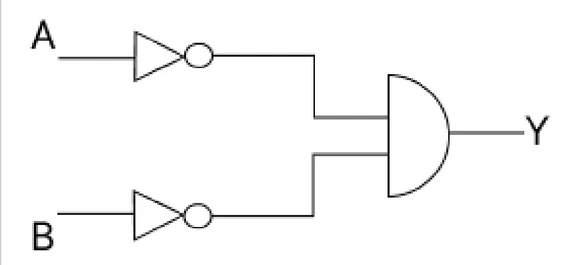
The given logic gate diagram is equivalent to _____.
दिया गया लॉजिक गेट आरेख _____ के तुल्य है।
  1. ANAND GATENAND गेट
  2. BOR GATEOR गेट
  3. CNOR GATENOR गेट
  4. DAND GATEAND गेट
Show answer

Concept: The figure shows two NOT gates feeding an AND gate: Y=A¯·B¯. By De Morgan's theorem A¯·B¯=A+B―.

  1. Truth table: output is 1 only when A=0 and B=0 (both inverted inputs become 1).
  2. "Output 1 only when all inputs are 0" is exactly the NOR gate.
  3. A NAND gate would be an OR with inverted inputs (A¯+B¯=AB―).

Yaad rakhein: Bubbled-input AND = NOR; bubbled-input OR = NAND.

Answer: (C) NOR GATE

अवधारणा: चित्र में दो NOT गेट एक AND गेट को इनपुट दे रहे हैं: Y=A¯·B¯। डी मॉर्गन प्रमेय से A¯·B¯=A+B―।

  1. सत्य सारणी: आउटपुट केवल तब 1 जब A=0 और B=0 (दोनों उल्टे इनपुट 1 बनते हैं)।
  2. "सभी इनपुट 0 होने पर ही आउटपुट 1" ठीक NOR गेट है।
  3. NAND गेट उल्टे इनपुट वाला OR होता (A¯+B¯=AB―)।

याद रखें: बबल-इनपुट AND = NOR; बबल-इनपुट OR = NAND।

उत्तर: (C) NOR GATE

RRB Technician Grade I (Signal)Basic Science and EngineeringLogic gates – De MorganRRB Technician Grade I (Signal) 2024 · 19 Dec Shift 3 →
Q195.
If the resistance R is constant and the voltage V across a resistor is tripled, how does the power P change?
यदि प्रतिरोध R स्थिर है और प्रतिरोधक के सिरों पर वोल्टता V तिगुनी कर दी जाती है, तो शक्ति P में क्या परिवर्तन होता है?
  1. AIt increases by nine times.यह नौ गुना बढ़ जाती है।
  2. BIt increases by one-third of its original.यह अपने मूल मान के एक-तिहाई से बढ़ जाती है।
  3. CIt increases by three times.यह तीन गुना बढ़ जाती है।
  4. DIt decreases by three times.यह तीन गुना घट जाती है।
Show answer

Concept: With R constant, P=V2R, so power varies as the square of the voltage.

  1. New voltage =3V → P′=(3V)2R=9V2R=9P.
  2. Option C (3 times) would be true for P=VI with fixed current, but here R is fixed so I also triples.

Trick: Fixed R: V × n ⇒ P × n2.

Answer: (A) It increases by nine times.

अवधारणा: R नियत होने पर P=V2R, अतः शक्ति वोल्टेज के वर्ग के अनुसार बदलती है।

  1. नया वोल्टेज =3V → P′=(3V)2R=9V2R=9P।
  2. विकल्प C (3 गुना) तब सही होता जब धारा नियत होती (P=VI), पर यहाँ R नियत है, अतः I भी तिगुनी हो जाती है।

ट्रिक: नियत R: V × n ⇒ P × n2।

उत्तर: (A) It increases by nine times.

RRB Technician Grade I (Signal)Basic Science and EngineeringPower and voltageRRB Technician Grade I (Signal) 2024 · 19 Dec Shift 3 →
Q196.
If the temperature of the surrounding medium increases, it will result in a/an _____ in the resistance of the thermistor and a/an _____ in the current.
यदि परिवेशी माध्यम का तापमान बढ़ता है, तो इसके परिणामस्वरूप थर्मिस्टर के प्रतिरोध में _____ और धारा में _____ होगी।
  1. Aincrease; increaseवृद्धि; वृद्धि
  2. Bdecrease; increaseकमी; वृद्धि
  3. Cdecrease; decreaseकमी; कमी
  4. Dincrease; decreaseवृद्धि; कमी
Show answer

Concept: A common thermistor is an NTC (negative temperature coefficient) device made of semiconductor oxides: its resistance falls as temperature rises.

  1. Higher temperature → more charge carriers → resistance decreases.
  2. With a fixed supply voltage, I=VR → current increases.
  3. Options A/D describe a metal (PTC) resistor, not the usual thermistor.

Yaad rakhein: Thermistor (NTC): hot → low R → high I.

Answer: (B) decrease; increase

अवधारणा: सामान्य थर्मिस्टर NTC (negative temperature coefficient) युक्ति है जो अर्धचालक ऑक्साइडों से बनती है: तापमान बढ़ने पर इसका प्रतिरोध घटता है।

  1. तापमान बढ़ा → आवेश वाहक बढ़े → प्रतिरोध घटता है।
  2. नियत वोल्टेज पर I=VR → धारा बढ़ती है।
  3. विकल्प A/D धातु (PTC) प्रतिरोधक का व्यवहार हैं, सामान्य थर्मिस्टर का नहीं।

याद रखें: थर्मिस्टर (NTC): गर्म → कम R → अधिक I।

उत्तर: (B) decrease; increase

RRB Technician Grade I (Signal)Basic Science and EngineeringThermistor (NTC)RRB Technician Grade I (Signal) 2024 · 19 Dec Shift 3 →
Q197.
A 2 kg object is dropped from a height of 10 m. Assuming no air resistance, what will be the object's speed just before it hits the ground?
2 kg की एक वस्तु को 10 m की ऊँचाई से गिराया जाता है। वायु प्रतिरोध न मानते हुए, ज़मीन से टकराने से ठीक पहले वस्तु की चाल क्या होगी?
  1. A25 m/s
  2. B20 m/s
  3. C14 m/s
  4. D10 m/s
Show answer

Concept: Potential energy converts fully into kinetic energy: mgh=12mv2⇒v=2gh (independent of mass).

  1. v=2×9.8×10=196=14m/s.
  2. The 2 kg mass does not affect the speed.
  3. With g=10: 200≈14.1 m/s – still option C.

Trick: v=2gh; for h=10 m, v≈14 m/s.

Answer: (C) 14 m/s

अवधारणा: स्थितिज ऊर्जा पूरी तरह गतिज ऊर्जा में बदलती है: mgh=12mv2⇒v=2gh (द्रव्यमान पर निर्भर नहीं)।

  1. v=2×9.8×10=196=14m/s।
  2. 2 kg द्रव्यमान चाल को प्रभावित नहीं करता।
  3. g=10 लेने पर: 200≈14.1 m/s – फिर भी विकल्प C।

ट्रिक: v=2gh; h=10 m के लिए v≈14 m/s।

उत्तर: (C) 14 m/s

RRB Technician Grade I (Signal)Basic Science and EngineeringFree fall – energy conservationRRB Technician Grade I (Signal) 2024 · 19 Dec Shift 3 →
Q198.
Quantisation error of an 8-bit A/D converter for an analog voltage in the range −1 to +1 volt is approximately equal to ____ mv.
−1 से +1 वोल्ट की रेंज में एक एनालॉग वोल्टता के लिए 8-बिट A/D कन्वर्टर की क्वांटीकरण त्रुटि (quantisation error) लगभग ____ mV के बराबर है।
  1. A0.4
  2. B0.1
  3. C2
  4. D0.3
Show answer

Concept: An n-bit ADC divides the input into 2n levels; the quantisation error is at most ±12 LSB.

  1. Taking the reference amplitude as 1 V: step (1 LSB) =128=1256≈3.9mV.
  2. Maximum quantisation error =12LSB≈1.95mV≈2mV.
  3. Among the options only 2 mV is of this order; 0.1–0.4 mV would need 10–12 bits.

Yaad rakhein: Resolution =Vref2n, error =±12 LSB.

Answer: (C) 2

अवधारणा: n-बिट ADC इनपुट को 2n स्तरों में बाँटता है; क्वांटीकरण त्रुटि अधिकतम ±12 LSB होती है।

  1. संदर्भ आयाम 1 V लेने पर: चरण (1 LSB) =128=1256≈3.9mV।
  2. अधिकतम क्वांटीकरण त्रुटि =12LSB≈1.95mV≈2mV।
  3. विकल्पों में केवल 2 mV इस कोटि का है; 0.1–0.4 mV के लिए 10–12 बिट चाहिए।

याद रखें: विभेदन =Vref2n, त्रुटि =±12 LSB।

उत्तर: (C) 2

RRB Technician Grade I (Signal)Basic Science and EngineeringA/D converter – quantisation errorRRB Technician Grade I (Signal) 2024 · 19 Dec Shift 3 →
Q199.
When performing the operation(1.23456 × 10³) + (1.234 × 10²), how many significant figures should be reported in the result, assuming no rounding errors?
संक्रिया (1.23456 × 10³) + (1.234 × 10²) करने पर, यह मानते हुए कि कोई पूर्णांकन (rounding) त्रुटि नहीं है, परिणाम में कितने सार्थक अंक (significant figures) रिपोर्ट किए जाने चाहिए?
  1. A3
  2. B4
  3. C2
  4. D5
Show answer

Concept: In addition/subtraction the result is reported to the least precise decimal place among the numbers (not the least number of significant figures).

  1. Write both in plain form: 1.23456×103=1234.56 (hundredths place); 1.234×102=123.4 (tenths place).
  2. Sum =1357.96; least precise place is the tenths → 1358.0.
  3. 1358.0 has 5 significant figures.

Trick: Add → match decimal places; multiply → match significant figures.

Answer: (D) 5

अवधारणा: जोड़/घटाव में परिणाम सबसे कम शुद्ध दशमलव स्थान तक लिखा जाता है (सबसे कम सार्थक अंकों तक नहीं)।

  1. सामान्य रूप में लिखें: 1.23456×103=1234.56 (सौवाँ स्थान); 1.234×102=123.4 (दसवाँ स्थान)।
  2. योग =1357.96; सबसे कम शुद्ध स्थान दसवाँ → 1358.0।
  3. 1358.0 में 5 सार्थक अंक हैं।

ट्रिक: जोड़ → दशमलव स्थान मिलाएँ; गुणा → सार्थक अंक मिलाएँ।

उत्तर: (D) 5

RRB Technician Grade I (Signal)Basic Science and EngineeringSignificant figures in additionRRB Technician Grade I (Signal) 2024 · 19 Dec Shift 3 →
Q200.
What is the work done when a constant force of 20 N is applied at an angle of 30° to the direction of displacement of 13 m?
जब 20 N का एक नियत बल 13 m के विस्थापन की दिशा से 30° के कोण पर लगाया जाता है, तो किया गया कार्य क्या है?
  1. A390 Joules390 जूल
  2. B225 Joules225 जूल
  3. C260 Joules260 जूल
  4. D185 Joules185 जूल
Show answer

Concept: W=Fdcosθ, where θ is the angle between force and displacement.

  1. W=20×13×cos30∘=260×32.
  2. =260×0.866≈225J.
  3. Option C (260 J) ignores the angle (cosθ=1).

Trick: cos30∘≈0.87 – take 87% of Fd.

Answer: (B) 225 Joules

अवधारणा: W=Fdcosθ, जहाँ θ बल और विस्थापन के बीच का कोण है।

  1. W=20×13×cos30∘=260×32।
  2. =260×0.866≈225J।
  3. विकल्प C (260 J) में कोण की उपेक्षा है (cosθ=1)।

ट्रिक: cos30∘≈0.87 – Fd का 87% लें।

उत्तर: (B) 225 Joules

RRB Technician Grade I (Signal)Basic Science and EngineeringWork done by a force at an angleRRB Technician Grade I (Signal) 2024 · 19 Dec Shift 3 →