Question bank

Q&A: practice questions with answers

Search questions on any topic. Filter by exam category, exam, subject and topic, try the question, then open the answer and explanation.

Courses – airGurukul

494 questions found.

Q301.
Who has been honoured with the Goldman Environmental Prize 2024?
गोल्डमैन पर्यावरण पुरस्कार (Goldman Environmental Prize) 2024 से किसे सम्मानित किया गया है?
  1. AJadav Payengजादव पायेंग
  2. BAlok Shuklaआलोक शुक्ला
  3. CManeka Gandhiमेनका गांधी
  4. DMedha Patkarमेधा पाटकर
Show answer

Concept: The Goldman Environmental Prize ("Green Nobel") honours grassroots environmental activists from six continental regions every year.

  1. For 2024 (Asia), it was awarded to Alok Shukla of Chhattisgarh for leading the community campaign that saved the Hasdeo Aranya forests from coal mining.
  2. Jadav Payeng ("Forest Man of India"), Medha Patkar (Narmada Bachao Andolan) and Maneka Gandhi are well-known environmentalists but not 2024 Goldman winners.

Yaad rakhein: Goldman 2024 → Alok Shukla → Hasdeo Aranya (Chhattisgarh).

Answer: (B) Alok Shukla

अवधारणा: Goldman Environmental Prize ("Green Nobel") हर वर्ष छह महाद्वीपीय क्षेत्रों के जमीनी पर्यावरण कार्यकर्ताओं को दिया जाता है।

  1. 2024 (एशिया) में यह छत्तीसगढ़ के आलोक शुक्ला को मिला, जिन्होंने हसदेव अरण्य के जंगलों को कोयला खनन से बचाने वाले सामुदायिक आंदोलन का नेतृत्व किया।
  2. जादव पायेंग ("Forest Man of India"), मेधा पाटकर (नर्मदा बचाओ आंदोलन) और मेनका गांधी प्रसिद्ध पर्यावरणविद हैं पर 2024 के Goldman विजेता नहीं।

याद रखें: Goldman 2024 → आलोक शुक्ला → हसदेव अरण्य (छत्तीसगढ़)।

उत्तर: (B) Alok Shukla
RRB Technician Grade I (Signal)General AwarenessAwards – Goldman Environmental Prize 2024RRB Technician Grade I (Signal) 2024 · 19 Dec Shift 1 →
Q302.
What is the name of the astronaut who was selected for the Axiom-4 mission to the International Space Station (ISS) in August 2024?
अगस्त 2024 में अंतर्राष्ट्रीय अंतरिक्ष स्टेशन (ISS) के लिए Axiom-4 मिशन हेतु चुने गए अंतरिक्ष यात्री का नाम क्या है?
  1. ASharmila Bhattacharyaशर्मिला भट्टाचार्य
  2. BAshwin Vasavadaअश्विन वासवदा
  3. CKamlesh Lullaकमलेश लुल्ला
  4. DShubhanshu Shuklaशुभांशु शुक्ला
Show answer

Concept: In August 2024, ISRO announced Group Captain Shubhanshu Shukla as the prime astronaut for the Axiom-4 (Ax-4) mission to the ISS, with Group Captain Prasanth Balakrishnan Nair as backup.

  1. Ax-4 was a joint ISRO–NASA–Axiom Space mission; Shukla later flew to the ISS on it in June 2025, becoming the first Indian on the ISS.
  2. Sharmila Bhattacharya, Ashwin Vasavada and Kamlesh Lulla are Indian-origin NASA scientists, not astronauts.

Trick: Shukla = Gaganyaan astronaut-designate + Axiom-4 pilot.

Answer: (D) Shubhanshu Shukla

अवधारणा: अगस्त 2024 में ISRO ने ग्रुप कैप्टन शुभांशु शुक्ला को ISS के Axiom-4 (Ax-4) मिशन के लिए मुख्य अंतरिक्ष यात्री चुना; ग्रुप कैप्टन प्रशांत बालकृष्णन नायर backup थे।

  1. Ax-4 ISRO–NASA–Axiom Space का संयुक्त मिशन था; शुक्ला जून 2025 में ISS पहुँचकर वहाँ जाने वाले पहले भारतीय बने।
  2. शर्मिला भट्टाचार्य, अश्विन वसावड़ा और कमलेश लुल्ला भारतीय मूल के NASA वैज्ञानिक हैं, अंतरिक्ष यात्री नहीं।

याद रखें: शुक्ला = गगनयान astronaut-designate + Axiom-4 pilot।

उत्तर: (D) शुभांशु शुक्ला

RRB Technician Grade I (Signal)General AwarenessAxiom-4 mission – Shubhanshu ShuklaRRB Technician Grade I (Signal) 2024 · 19 Dec Shift 1 →
Q303.
After Indian Hockey Federation was dismissed in 2008 by IOA, _________ was formed.
2008 में IOA द्वारा भारतीय हॉकी महासंघ (Indian Hockey Federation) को भंग किए जाने के बाद _________ का गठन किया गया।
  1. AIndian Hockeyइंडियन हॉकी
  2. BHockey Indiaहॉकी इंडिया
  3. CHockey Associationहॉकी एसोसिएशन
  4. DNational Hockey Federationनेशनल हॉकी फेडरेशन
Show answer

Concept: After the Indian Hockey Federation (IHF) was dissolved by the Indian Olympic Association in April 2008 (following a sting operation and India's failure to qualify for the Beijing Olympics), Hockey India was formed in 2009 as the new national governing body.

  1. Hockey India is recognised by FIH and the Government of India.
  2. 'Indian Hockey', 'Hockey Association' and 'National Hockey Federation' are not real national bodies.

Trick: IHF (old, till 2008) → Hockey India (new, 2009).

Answer: (B) Hockey India

अवधारणा: अप्रैल 2008 में भारतीय ओलंपिक संघ द्वारा Indian Hockey Federation (IHF) भंग किए जाने के बाद (स्टिंग ऑपरेशन और बीजिंग ओलंपिक के लिए क्वालीफाई न कर पाने पर) 2009 में Hockey India नई राष्ट्रीय संस्था के रूप में बनी।

  1. Hockey India को FIH और भारत सरकार से मान्यता प्राप्त है।
  2. 'Indian Hockey', 'Hockey Association', 'National Hockey Federation' वास्तविक राष्ट्रीय संस्थाएँ नहीं हैं।

याद रखें: IHF (पुरानी, 2008 तक) → Hockey India (नई, 2009)।

उत्तर: (B) Hockey India

RRB Technician Grade I (Signal)General AwarenessHockey IndiaRRB Technician Grade I (Signal) 2024 · 19 Dec Shift 1 →
Q304.
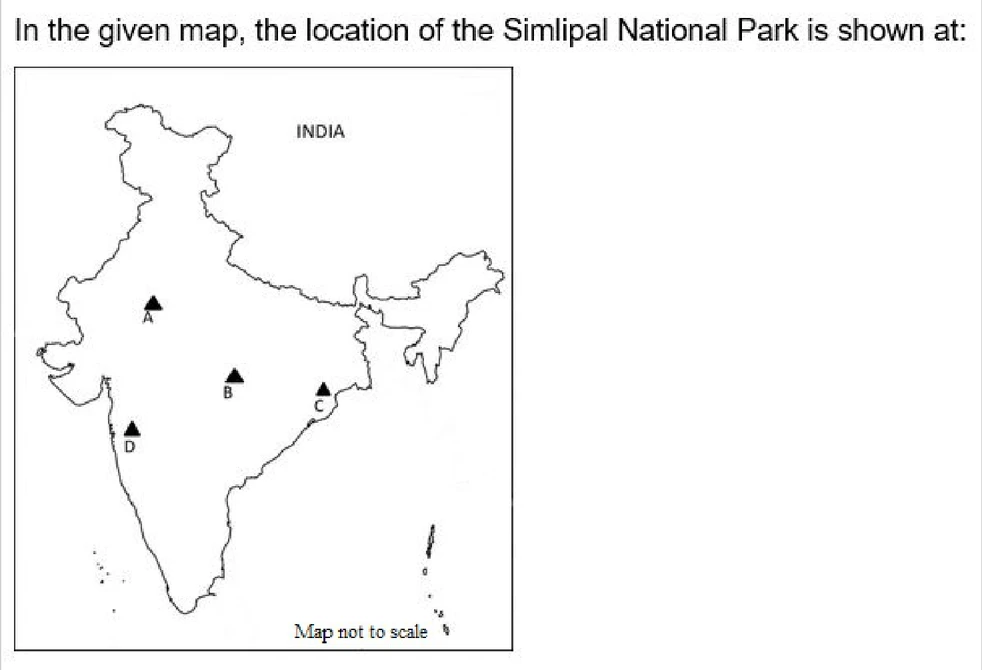
In the given map, the location of the Simlipal National Park is shown at:
दिए गए मानचित्र में सिमलीपाल राष्ट्रीय उद्यान की स्थिति किस पर दर्शाई गई है:
  1. AD
  2. BB
  3. CC
  4. DA
Show answer

Concept: Simlipal National Park (and Tiger Reserve, Biosphere Reserve) lies in Mayurbhanj district of northern Odisha, on the eastern coast of India.

  1. On the map, point C is in the Odisha region near the Bay of Bengal coast — this is Simlipal.
  2. A lies in Rajasthan (Ranthambore/Sariska area), B in central India (Madhya Pradesh – Kanha/Pench area), D near the Maharashtra coast (Sanjay Gandhi/Tadoba area).

Trick: Simlipal = Odisha = east coast, just below West Bengal.

Answer: (C) C

अवधारणा: सिमलीपाल राष्ट्रीय उद्यान (टाइगर रिज़र्व व बायोस्फीयर रिज़र्व) ओडिशा के मयूरभंज जिले में, भारत के पूर्वी तट पर स्थित है।

  1. मानचित्र में बिंदु C ओडिशा क्षेत्र में बंगाल की खाड़ी के पास है — यही सिमलीपाल है।
  2. A राजस्थान (रणथंभौर/सरिस्का क्षेत्र), B मध्य भारत (मध्य प्रदेश – कान्हा/पेंच), D महाराष्ट्र तट के पास है।

याद रखें: सिमलीपाल = ओडिशा = पूर्वी तट, पश्चिम बंगाल के ठीक नीचे।

उत्तर: (C) C

RRB Technician Grade I (Signal)General AwarenessSimlipal National Park – map locationRRB Technician Grade I (Signal) 2024 · 19 Dec Shift 1 →
Q305.
What was the unemployment rate (UR) in urban areas as of January – March 2024 for persons of age 15 years and above?
जनवरी – मार्च 2024 की अवधि में 15 वर्ष और उससे अधिक आयु के व्यक्तियों के लिए शहरी क्षेत्रों में बेरोज़गारी दर (UR) क्या थी?
  1. A67.18%
  2. B6.7%
  3. C48.35%
  4. D53.25%
Show answer

Concept: The quarterly Periodic Labour Force Survey (PLFS) bulletin of NSO/MoSPI reported the urban unemployment rate for persons aged 15+ (CWS) at 6.7% for January–March 2024.

  1. It was 6.5% in Oct–Dec 2023; female urban UR was 8.5% and male 6.1% in Jan–Mar 2024.
  2. Figures like 48–67% are labour force participation or worker-population ratios, not unemployment rates.

Trick: Urban UR in PLFS quarterly bulletins has stayed around 6–7% since 2023.

Answer: (B) 6.7%

अवधारणा: NSO/MoSPI के त्रैमासिक Periodic Labour Force Survey (PLFS) बुलेटिन के अनुसार जनवरी–मार्च 2024 में 15+ आयु के लिए शहरी बेरोज़गारी दर (CWS) 6.7% थी।

  1. अक्टूबर–दिसंबर 2023 में यह 6.5% थी; जनवरी–मार्च 2024 में शहरी महिला UR 8.5% और पुरुष 6.1%।
  2. 48–67% जैसे आँकड़े श्रम-बल भागीदारी या worker-population ratio हैं, बेरोज़गारी दर नहीं।

याद रखें: PLFS त्रैमासिक बुलेटिन में शहरी UR 2023 से लगभग 6–7% के बीच रही है।

उत्तर: (B) 6.7%

RRB Technician Grade I (Signal)General AwarenessPLFS urban unemployment rateRRB Technician Grade I (Signal) 2024 · 19 Dec Shift 1 →
Q306.
Which of the following is an ancient Jain text written by Acharya Umaswami that explains the Jain philosophy in the most systematic form acceptable to all sects of Jainism?
निम्नलिखित में से कौन-सा आचार्य उमास्वामी द्वारा लिखित एक प्राचीन जैन ग्रंथ है, जो जैन दर्शन को सबसे व्यवस्थित रूप में समझाता है और जैन धर्म के सभी संप्रदायों को स्वीकार्य है?
  1. ASvayambhu Stotraस्वयंभू स्तोत्र
  2. BAtthapahudaअट्ठपाहुड
  3. CTattvarthasutraतत्त्वार्थसूत्र
  4. DPravacanasaraप्रवचनसार
Show answer

Concept: The Tattvarthasutra (Tattvartha-adhigama-sutra), written in Sanskrit by Acharya Umaswati/Umaswami (c. 2nd–5th century CE), is the earliest systematic exposition of Jain philosophy and is accepted by both Digambara and Shvetambara sects.

  1. Its opening line 'Samyag-darshana-jnana-charitrani moksha-margah' gives the three jewels of Jainism.
  2. Svayambhu Stotra is by Samantabhadra; Atthapahuda and Pravachanasara are by Kundakunda.

Trick: Umaswami → Tattvarthasutra = 'Jain Bible' accepted by all sects.

Answer: (C) Tattvarthasutra

अवधारणा: तत्त्वार्थसूत्र (तत्त्वार्थाधिगम सूत्र), आचार्य उमास्वाति/उमास्वामी द्वारा संस्कृत में रचित (लगभग 2री–5वीं शताब्दी), जैन दर्शन का सबसे पहला व्यवस्थित ग्रंथ है जिसे दिगंबर और श्वेतांबर दोनों संप्रदाय मानते हैं।

  1. इसका पहला सूत्र 'सम्यग्दर्शनज्ञानचारित्राणि मोक्षमार्गः' जैन धर्म के त्रिरत्न बताता है।
  2. स्वयंभू स्तोत्र समंतभद्र की और अष्टपाहुड व प्रवचनसार कुंदकुंद की रचनाएँ हैं।

याद रखें: उमास्वामी → तत्त्वार्थसूत्र = सभी संप्रदायों को मान्य 'जैन बाइबिल'।

उत्तर: (C) तत्त्वार्थसूत्र

RRB Technician Grade I (Signal)General AwarenessJain literature – TattvarthasutraRRB Technician Grade I (Signal) 2024 · 19 Dec Shift 1 →
Q307.
Choose the correct statement related to government expenditure.
सरकारी व्यय से संबंधित सही कथन चुनिए।
  1. ARevenue expenditure directly contributes to GDP growth.राजस्व व्यय GDP वृद्धि में प्रत्यक्ष रूप से योगदान देता है।
  2. BRevenue expenditure impacts assets liability of the government.राजस्व व्यय सरकार की परिसंपत्तियों-देयताओं को प्रभावित करता है।
  3. CRevenue expenditure does not impact assets liability of the government.राजस्व व्यय सरकार की परिसंपत्तियों-देयताओं को प्रभावित नहीं करता है।
  4. DCapital expenditure directly contributes to GDP growth.पूंजीगत व्यय GDP वृद्धि में प्रत्यक्ष रूप से योगदान देता है।
Show answer

Concept: Capital expenditure creates assets (roads, railways, buildings) or reduces liabilities (loan repayment); it has a high multiplier and directly adds to GDP growth. Revenue expenditure (salaries, pensions, subsidies, interest) is for day-to-day running and creates no asset.

  1. Revenue expenditure does affect the asset–liability position (it is financed partly by borrowing but creates no asset) — so B and C are loosely worded, and A is wrong.
  2. Capital expenditure → asset creation → productive capacity → GDP.

Trick: Capex builds, Revex runs.

Answer: (D) Capital expenditure directly contributes to GDP growth.

अवधारणा: पूँजीगत व्यय (capital expenditure) परिसंपत्तियाँ बनाता है (सड़क, रेल, भवन) या देनदारी घटाता है (ऋण चुकाना); इसका गुणक प्रभाव अधिक है और यह सीधे GDP वृद्धि में योगदान देता है। राजस्व व्यय (वेतन, पेंशन, सब्सिडी, ब्याज) दैनिक संचालन के लिए है और कोई परिसंपत्ति नहीं बनाता।

  1. राजस्व व्यय परिसंपत्ति-देनदारी स्थिति को प्रभावित करता है (आंशिक रूप से उधार से वित्तपोषित, पर परिसंपत्ति नहीं बनाता) — अतः B, C अस्पष्ट और A गलत।
  2. पूँजीगत व्यय → परिसंपत्ति निर्माण → उत्पादक क्षमता → GDP।

याद रखें: Capex बनाता है, Revex चलाता है।

उत्तर: (D) पूँजीगत व्यय सीधे GDP वृद्धि में योगदान देता है।

RRB Technician Grade I (Signal)General AwarenessRevenue vs capital expenditureRRB Technician Grade I (Signal) 2024 · 19 Dec Shift 1 →
Q308.
What should come in place of the question mark (?) in the given series?
901 903 ? 913 921 931
दी गई श्रेणी में प्रश्नचिह्न (?) के स्थान पर क्या आना चाहिए?
901 903 ? 913 921 931
  1. A909
  2. B906
  3. C907
  4. D905
Show answer

Concept: Check the differences between consecutive terms; here they form an even-number pattern.

  1. 903−901=2, 913−?, 921−913=8, 931−921=10.
  2. Differences should be 2,4,6,8,10, so ?=903+4=907 (check: 913−907=6 ✓).

Trick: Known differences 2 … 8, 10 → the missing ones are 4 and 6.

Answer: (C) 907

अवधारणा: क्रमागत पदों के अंतर देखें; यहाँ वे सम संख्याओं का पैटर्न बनाते हैं।

  1. 903−901=2, 913−?, 921−913=8, 931−921=10।
  2. अंतर 2,4,6,8,10 होने चाहिए, अतः ?=903+4=907 (जाँच: 913−907=6 ✓)।

ट्रिक: ज्ञात अंतर 2 … 8, 10 → बीच के अंतर 4 और 6।

उत्तर: (C) 907

RRB Technician Grade I (Signal)General Intelligence and ReasoningNumber seriesRRB Technician Grade I (Signal) 2024 · 19 Dec Shift 1 →
Q309.
In the following number-pairs, the second number is obtained by applying certain mathematical operations to the first number. Which numbers should replace X and Y so that the pattern followed by the two numbers on the left side of :: is same as that on the right side of ::?
(NOTE: Operations should be performed on the whole numbers, without breaking down the numbers into their constituent digits. E.g. 13 – Operations on 13 such as
adding/subtracting/multiplying to 13 can be performed. Breaking down 13 into 1 and 3 and then performing mathematical operations on 1 and 3 is not allowed.)
X : 16.2 :: 23 : Y
निम्नलिखित संख्या-युग्मों में, दूसरी संख्या पहली संख्या पर कुछ निश्चित गणितीय संक्रियाएँ करके प्राप्त की गई है। X और Y के स्थान पर कौन-सी संख्याएँ आनी चाहिए ताकि :: के बाईं ओर की दो संख्याओं द्वारा अनुसरण किया गया पैटर्न :: के दाईं ओर के पैटर्न के समान हो?
(नोट: संक्रियाएँ पूर्ण संख्याओं पर की जानी चाहिए, संख्याओं को उनके घटक अंकों में तोड़े बिना। उदाहरण के लिए 13 – 13 पर संक्रियाएँ जैसे
13 में जोड़ना/घटाना/गुणा करना किया जा सकता है। 13 को 1 और 3 में तोड़कर फिर 1 और 3 पर गणितीय संक्रियाएँ करने की अनुमति नहीं है।)
X : 16.2 :: 23 : Y
  1. AX=19, Y=22.2
  2. BX=17, Y=22.2
  3. CX=19, Y=21.2
  4. DX=17, Y=21.2
Show answer

Concept: The same operation must take X→16.2 and 23→Y. Test each option.

  1. Option B: 17−0.8=16.2 and 23−0.8=22.2 ✓ (same rule: subtract 0.8).
  2. Option A: 19→16.2 is −2.8 but 23→22.2 is −0.8 ✗. Option D: 17→16.2 is −0.8 but 23→21.2 is −1.8 ✗. Option C fails both ways.

Trick: In X : Y analogies, plug the options and keep the one where both pairs share one rule.

Answer: (B) X=17, Y=22.2

अवधारणा: एक ही संक्रिया से X→16.2 और 23→Y होना चाहिए। हर विकल्प जाँचें।

  1. विकल्प B: 17−0.8=16.2 और 23−0.8=22.2 ✓ (एक ही नियम: 0.8 घटाना)।
  2. विकल्प A: 19→16.2 में −2.8 पर 23→22.2 में −0.8 ✗। विकल्प D: 17→16.2 में −0.8 पर 23→21.2 में −1.8 ✗। विकल्प C दोनों तरह गलत।

ट्रिक: X : Y सादृश्य में विकल्प रखकर देखें – जिसमें दोनों जोड़ों का नियम एक हो, वही सही।

उत्तर: (B) X=17, Y=22.2

RRB Technician Grade I (Signal)General Intelligence and ReasoningNumber analogyRRB Technician Grade I (Signal) 2024 · 19 Dec Shift 1 →
Q310.
UDVA is related to CLDI in a certain way based on the English alphabetical order. In the same way, AJBG is related to IRJO. To which of the following options is YHZE related, following the same logic?
अंग्रेज़ी वर्णमाला क्रम के आधार पर UDVA एक निश्चित प्रकार से CLDI से संबंधित है। उसी प्रकार AJBG, IRJO से संबंधित है। उसी तर्क का अनुसरण करते हुए YHZE निम्नलिखित में से किस विकल्प से संबंधित है?
  1. AGPHM
  2. BGTFY
  3. CGHYT
  4. DGBHY
Show answer

Concept: Compare letter positions (A=1 … Z=26); find the shift applied to each letter and apply it to the new word.

  1. UDVA → CLDI: U(21)+8=29→C(3), D(4)+8=L(12), V(22)+8=D(4), A(1)+8=I(9). Each letter moves +8.
  2. Check AJBG → IRJO: A+8=I, J+8=R, B+8=J, G+8=O ✓.
  3. YHZE: Y(25)+8=33→G(7), H(8)+8=P(16), Z(26)+8=34→H(8), E(5)+8=M(13) → GPHM.

Trick: +8 past Z wraps around (subtract 26).

Answer: (A) GPHM

अवधारणा: अक्षरों की स्थिति (A=1 … Z=26) तुलना करें; हर अक्षर पर लगा shift निकालकर नए शब्द पर लगाएँ।

  1. UDVA → CLDI: U(21)+8=29→C(3), D(4)+8=L(12), V(22)+8=D(4), A(1)+8=I(9)। हर अक्षर +8 बढ़ता है।
  2. जाँच AJBG → IRJO: A+8=I, J+8=R, B+8=J, G+8=O ✓।
  3. YHZE: Y(25)+8=33→G(7), H(8)+8=P(16), Z(26)+8=34→H(8), E(5)+8=M(13) → GPHM।

ट्रिक: Z के आगे +8 घूमकर आता है (26 घटाएँ)।

उत्तर: (A) GPHM

RRB Technician Grade I (Signal)General Intelligence and ReasoningLetter-cluster analogyRRB Technician Grade I (Signal) 2024 · 19 Dec Shift 1 →
Q311.
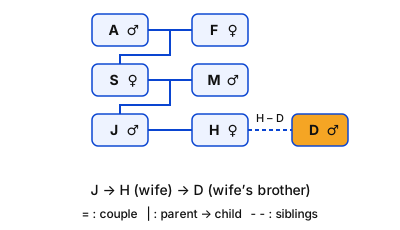
M, S, A, F, J, H and D are seven family members living in the same apartment. M is S’s husband. H is J’s wife. S is the mother of J and daughter of A. D is the brother of H. F is the wife of A. How is D related to J?
M, S, A, F, J, H और D एक परिवार के सात सदस्य हैं जो एक ही अपार्टमेंट में रहते हैं। M, S का पति है। H, J की पत्नी है। S, J की माता और A की पुत्री है। D, H का भाई है। F, A की पत्नी है। D, J से किस प्रकार संबंधित है?
  1. AWife’s brotherपत्नी का भाई
  2. BFatherपिता
  3. CHusbandपति
  4. DBrotherभाई
Show answer

Concept: Build the family tree generation by generation, then read the path from J to D.

  1. A (♂) and F (♀) are a couple; S is their daughter. M is S's husband.
  2. J is the son of S and M (J has a wife H, so J is male).
  3. D is the brother of H, and H is J's wife → D is J's wife's brother (brother-in-law).

Trick: Follow the chain J → wife (H) → her brother (D).

Answer: (A) Wife's brother

अवधारणा: पीढ़ी-दर-पीढ़ी वंश वृक्ष बनाएँ, फिर J से D तक का रास्ता पढ़ें।

  1. A (♂) और F (♀) दंपति हैं; S उनकी बेटी है। M, S का पति है।
  2. J, S और M का बेटा है (J की पत्नी H है, अतः J पुरुष)।
  3. D, H का भाई है और H, J की पत्नी → D, J की पत्नी का भाई (साला) है।

ट्रिक: श्रृंखला J → पत्नी (H) → उसका भाई (D) पकड़ें।

उत्तर: (A) Wife's brother

RRB Technician Grade I (Signal)General Intelligence and ReasoningBlood relations – family treeRRB Technician Grade I (Signal) 2024 · 19 Dec Shift 1 →
Q312.
Read the given statement and conclusions carefully and decide which of the given conclusions follow(s) from the statement.
Statement:
Book-reading is a very healthy habit because it keeps our learning process alive even after our college or school education.
Conclusions:
I. Nowadays, e-books are gaining far more popularity than hardcovers.
II. Students gain a lot of knowledge and improve language by keeping the habit of book-reading alive.
दिए गए कथन और निष्कर्षों को ध्यानपूर्वक पढ़िए और निर्णय लीजिए कि दिए गए निष्कर्षों में से कौन-सा/कौन-से निष्कर्ष कथन का अनुसरण करता है/करते हैं।
कथन:
पुस्तक पढ़ना एक बहुत ही स्वस्थ आदत है, क्योंकि यह हमारी कॉलेज या स्कूल की शिक्षा के बाद भी हमारी सीखने की प्रक्रिया को जीवित रखती है।
निष्कर्ष:
I. आजकल ई-पुस्तकें हार्डकवर पुस्तकों की तुलना में कहीं अधिक लोकप्रिय हो रही हैं।
II. विद्यार्थी पुस्तक पढ़ने की आदत को जीवित रखकर बहुत ज्ञान प्राप्त करते हैं और भाषा में सुधार करते हैं।
  1. AOnly conclusion I followsकेवल निष्कर्ष I अनुसरण करता है
  2. BNeither conclusion I nor II followsन तो निष्कर्ष I और न ही II अनुसरण करता है
  3. COnly conclusion II followsकेवल निष्कर्ष II अनुसरण करता है
  4. DBoth the conclusions followदोनों निष्कर्ष अनुसरण करते हैं
Show answer

Concept: A conclusion "follows" only if it is directly implied by the statement; it must not bring in new information.

  1. The statement says book-reading keeps learning alive even after formal education. Conclusion II (students gain knowledge and improve language by reading) is a direct implication → follows.
  2. Conclusion I talks about e-books vs hardcovers – nothing in the statement compares formats → does not follow.

Trick: Any conclusion that introduces a new topic (e-books, popularity) is out.

Answer: (C) Only conclusion II follows

अवधारणा: निष्कर्ष तभी "अनुसरण करता है" जब वह कथन से सीधे निकलता हो; उसमें नई जानकारी नहीं आनी चाहिए।

  1. कथन कहता है कि पुस्तक पढ़ना औपचारिक शिक्षा के बाद भी सीखने की प्रक्रिया जीवित रखता है। निष्कर्ष II (पढ़ने से छात्र ज्ञान पाते और भाषा सुधारते हैं) इसका सीधा अर्थ है → अनुसरण करता है।
  2. निष्कर्ष I e-book बनाम hardcover की बात करता है – कथन में प्रारूपों की कोई तुलना नहीं → अनुसरण नहीं करता।

ट्रिक: जो निष्कर्ष नया विषय (e-book, लोकप्रियता) लाए, वह बाहर।

उत्तर: (C) Only conclusion II follows

RRB Technician Grade I (Signal)General Intelligence and ReasoningStatement and conclusionsRRB Technician Grade I (Signal) 2024 · 19 Dec Shift 1 →
Q313.
In a certain code language,
‘R + S’ means ‘R is the mother of S’,
‘R @ S’ means ‘R is the husband of S’,
‘R # S’ means ‘R is the sister of S’ and
‘R % S’ means ‘R is the father of S’.
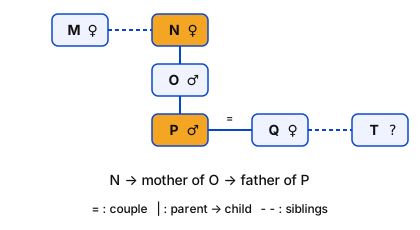
How is N related to P if ‘M # N + O % P @ Q # T’?
एक निश्चित कूट भाषा में,
‘R + S’ का अर्थ है ‘R, S की माता है’,
‘R @ S’ का अर्थ है ‘R, S का पति है’,
‘R # S’ का अर्थ है ‘R, S की बहन है’ और
‘R % S’ का अर्थ है ‘R, S का पिता है’।
यदि ‘M # N + O % P @ Q # T’ है, तो N, P से किस प्रकार संबंधित है?
  1. AFather’s sisterपिता की बहन
  2. BMotherमाता
  3. CSisterबहन
  4. DFather’s motherपिता की माता
Show answer

Concept: Decode the chain symbol by symbol and draw the tree; N and P are the two people to connect.

  1. M # N → M is the sister of N; N + O → N is the mother of O.
  2. O % P → O is the father of P; P @ Q → P is the husband of Q; Q # T → Q is the sister of T.
  3. N is the mother of O, and O is P's father → N is P's father's mother (grandmother).

Trick: Only the middle part "N + O % P" matters; the ends (M, Q, T) are distractions.

Answer: (D) Father's mother

अवधारणा: श्रृंखला को एक-एक प्रतीक से decode कर वृक्ष बनाएँ; N और P को जोड़ना है।

  1. M # N → M, N की बहन; N + O → N, O की माता।
  2. O % P → O, P का पिता; P @ Q → P, Q का पति; Q # T → Q, T की बहन।
  3. N, O की माता है और O, P का पिता → N, P की पिता की माता (दादी) है।

ट्रिक: केवल बीच का भाग "N + O % P" काम का है; सिरे (M, Q, T) भटकाने के लिए हैं।

उत्तर: (D) Father's mother

RRB Technician Grade I (Signal)General Intelligence and ReasoningCoded blood relationsRRB Technician Grade I (Signal) 2024 · 19 Dec Shift 1 →
Q314.
In this question, a question is followed by two statements numbered (I) and (II). You have to decide whether the data provided in the statements are sufficient to answer the question. Read both the statements and decide the appropriate answer.
Question: A, B, C, D and E are sitting around a circular table facing the centre. Who sits to the immediate right of A?
Statement (I): Only one person sits between D and C. E sits to the immediate right of D. Statement (II): B sits to the immediate left of D. Only one person sits between B and E. Only one person sits between E and C.
इस प्रश्न में, एक प्रश्न के बाद (I) और (II) क्रमांकित दो कथन दिए गए हैं। आपको यह निर्णय लेना है कि कथनों में दिए गए आँकड़े प्रश्न का उत्तर देने के लिए पर्याप्त हैं या नहीं। दोनों कथनों को पढ़िए और उपयुक्त उत्तर का चयन कीजिए।
प्रश्न: A, B, C, D और E एक वृत्ताकार मेज़ के चारों ओर केंद्र की ओर मुख करके बैठे हैं। A के ठीक दाईं ओर कौन बैठा है?
कथन (I): D और C के बीच केवल एक व्यक्ति बैठा है। E, D के ठीक दाईं ओर बैठा है। कथन (II): B, D के ठीक बाईं ओर बैठा है। B और E के बीच केवल एक व्यक्ति बैठा है। E और C के बीच केवल एक व्यक्ति बैठा है।
  1. AData in statements I and II together are sufficient to answer the question.कथन I और II के आँकड़े मिलाकर प्रश्न का उत्तर देने के लिए पर्याप्त हैं।
  2. BData in Statement I alone is sufficient to answer the question while data in statement II is not.कथन I के आँकड़े अकेले प्रश्न का उत्तर देने के लिए पर्याप्त हैं, जबकि कथन II के आँकड़े पर्याप्त नहीं हैं।
  3. CData in statements I and II together are NOT sufficient to answer the question.कथन I और II के आँकड़े मिलाकर भी प्रश्न का उत्तर देने के लिए पर्याप्त नहीं हैं।
  4. DData in Statement II alone is sufficient to answer the question while data in statement I is not.कथन II के आँकड़े अकेले प्रश्न का उत्तर देने के लिए पर्याप्त हैं, जबकि कथन I के आँकड़े पर्याप्त नहीं हैं।
Show answer

Concept: Five people face the centre, so "immediate right" means the anticlockwise neighbour. Test each statement alone.

  1. Statement I: E is to D's immediate right and one person sits between D and C. A and B can still swap places, so A's right neighbour is not fixed → not sufficient.
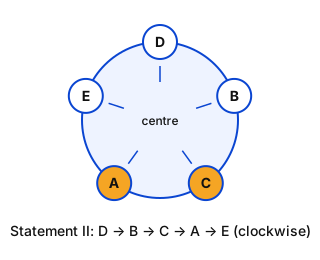
  2. Statement II: B is to D's immediate left; one person between B and E; one between E and C. Going clockwise this forces D, B, C, A, E (the alternative places E where B and D already sit).
  3. Then A's immediate right is C – a unique answer from II alone.

Trick: In data sufficiency, stop as soon as one statement fixes the arrangement uniquely; here II does, I does not.

Answer: (D) Data in Statement II alone is sufficient to answer the question while data in statement I is not.

अवधारणा: पाँच व्यक्ति केंद्र की ओर मुख किए हैं, अतः "तुरंत दाएँ" का अर्थ है घड़ी की विपरीत दिशा वाला पड़ोसी। हर कथन अकेले जाँचें।

  1. कथन I: E, D के तुरंत दाएँ है और D व C के बीच एक व्यक्ति है। A और B की जगह अभी भी बदल सकती है, अतः A का दायाँ पड़ोसी तय नहीं → अपर्याप्त।
  2. कथन II: B, D के तुरंत बाएँ; B व E के बीच एक; E व C के बीच एक। घड़ी की दिशा में इससे क्रम D, B, C, A, E बनता है (दूसरी संभावना में E की जगह पर B/D पहले से बैठे हैं)।
  3. तब A के तुरंत दाएँ C है – केवल II से अद्वितीय उत्तर।

ट्रिक: डेटा पर्याप्तता में जैसे ही एक कथन व्यवस्था को अद्वितीय रूप से तय कर दे, रुक जाएँ; यहाँ II करता है, I नहीं।

उत्तर: (D) Data in Statement II alone is sufficient to answer the question while data in statement I is not.

RRB Technician Grade I (Signal)General Intelligence and ReasoningData sufficiency – circular seatingRRB Technician Grade I (Signal) 2024 · 19 Dec Shift 1 →
Q315.
Based on the English alphabetical order, three of the following four letter-clusters are alike in a certain way and thus form a group. Which letter-cluster DOES NOT belong to that group?
(Note: The odd one out is not based on the number of consonants/vowels or their position in the letter-cluster.)
अंग्रेज़ी वर्णमाला क्रम के आधार पर, निम्नलिखित चार अक्षर-समूहों में से तीन एक निश्चित प्रकार से समान हैं और इस प्रकार एक समूह बनाते हैं। कौन-सा अक्षर-समूह उस समूह से संबंधित नहीं है?
(नोट: असंगत अक्षर-समूह व्यंजनों/स्वरों की संख्या या अक्षर-समूह में उनकी स्थिति पर आधारित नहीं है।)
  1. AEIRV
  2. BXBIO
  3. CKOVB
  4. DAELR
Show answer

Concept: Write the alphabet positions and check the gaps between consecutive letters.

  1. XBIO: X(24)→B(2)→I(9)→O(15): +4, +7, +6 (cyclic after Z)
  2. KOVB: 11→15→22→2: +4, +7, +6
  3. AELR: 1→5→12→18: +4, +7, +6
  4. EIRV: 5→9→18→22: +4, +9, +4 — different pattern

Trick: Use the EJOTY anchors (E=5, J=10, O=15, T=20, Y=25) to find positions fast; count past Z as wrapping to A.

Answer: (A) EIRV

अवधारणा: अक्षरों के स्थान लिखकर क्रमागत अक्षरों के अंतर देखें।

  1. XBIO: X(24)→B(2)→I(9)→O(15): +4, +7, +6 (Z के बाद A से)
  2. KOVB: 11→15→22→2: +4, +7, +6
  3. AELR: 1→5→12→18: +4, +7, +6
  4. EIRV: 5→9→18→22: +4, +9, +4 — अलग पैटर्न

ट्रिक: EJOTY (E=5, J=10, O=15, T=20, Y=25) से स्थान जल्दी निकालें; Z के बाद गिनती A से जारी रखें।

उत्तर: (A) EIRV

RRB Technician Grade I (Signal)General Intelligence and ReasoningLetter-cluster odd one outRRB Technician Grade I (Signal) 2024 · 19 Dec Shift 1 →
Q316.
Select the set in which the numbers are related in the same way as are the numbers of the following sets.
(NOTE: Operations should be performed on the whole numbers, without breaking down the numbers into its constituent digits. E.g., 13 – Operations on 13 such as
adding/deleting/multiplying etc. to 13 can be performed. Breaking down 13 into 1 and 3 and then performing mathematical operations on 1 and 3 is not allowed)
(5, 9, 52)
(11, 7, 90)
उस समुच्चय का चयन कीजिए जिसमें संख्याएँ उसी प्रकार संबंधित हैं जिस प्रकार निम्नलिखित समुच्चयों की संख्याएँ संबंधित हैं।
(नोट: संक्रियाएँ पूर्ण संख्याओं पर की जानी चाहिए, संख्याओं को उनके घटक अंकों में तोड़े बिना। उदाहरण के लिए, 13 – 13 पर संक्रियाएँ जैसे
13 में जोड़ना/घटाना/गुणा करना आदि किया जा सकता है। 13 को 1 और 3 में तोड़कर फिर 1 और 3 पर गणितीय संक्रियाएँ करने की अनुमति नहीं है)
(5, 9, 52)
(11, 7, 90)
  1. A(7, 13, 98)
  2. B(14, 4, 63)
  3. C(8, 11, 95)
  4. D(9, 6, 65)
Show answer

Concept: Find one rule relating the three numbers (a,b,c) of each given set and apply it to the options.

  1. (5,9,52): 5×(9+1)+2=50+2=52
  2. (11,7,90): 11×(7+1)+2=88+2=90 → rule: c=a×(b+1)+2
  3. (9,6,65): 9×7+2=65 ✓; A: 7×14+2=100, B: 14×5+2=72, C: 8×12+2=98 ✗

Trick: When c is close to a×b, check a×b± something or a×(b±1)± something.

Answer: (D) (9, 6, 65)

अवधारणा: दिए गए दोनों समूहों (a,b,c) में एक समान नियम खोजें और विकल्पों पर लागू करें।

  1. (5,9,52): 5×(9+1)+2=50+2=52
  2. (11,7,90): 11×(7+1)+2=88+2=90 → नियम: c=a×(b+1)+2
  3. (9,6,65): 9×7+2=65 ✓; A: 7×14+2=100, B: 14×5+2=72, C: 8×12+2=98 ✗

ट्रिक: जब c, a×b के पास हो तो a×b± कुछ या a×(b±1)± कुछ जाँचें।

उत्तर: (D) (9, 6, 65)

RRB Technician Grade I (Signal)General Intelligence and ReasoningNumber-set analogyRRB Technician Grade I (Signal) 2024 · 19 Dec Shift 1 →
Q317.
If ‘A’ stands for ‘÷’, ‘B’ stands for ‘×’, ‘C’ stands for ‘+’ and ‘D’ stands for ‘−’, then what will come in place of the question mark (?) in the following equation?
18 A 6 B 11 C 8 D 6 = ?
यदि ‘A’ का अर्थ ‘÷’, ‘B’ का अर्थ ‘×’, ‘C’ का अर्थ ‘+’ और ‘D’ का अर्थ ‘−’ है, तो निम्नलिखित समीकरण में प्रश्नचिह्न (?) के स्थान पर क्या आएगा?
18 A 6 B 11 C 8 D 6 = ?
  1. A35
  2. B33
  3. C36
  4. D34
Show answer

Concept: Replace the letters by the given operators and apply BODMAS.

  1. 18 A 6 B 11 C 8 D 6=18÷6×11+8−6
  2. 18÷6=3; 3×11=33
  3. 33+8−6=35

Trick: Do ÷ and × left to right first, then + and −.

Answer: (A) 35

अवधारणा: अक्षरों की जगह दिए गए चिह्न रखें और BODMAS लागू करें।

  1. 18 A 6 B 11 C 8 D 6=18÷6×11+8−6
  2. 18÷6=3; 3×11=33
  3. 33+8−6=35

ट्रिक: पहले ÷ और × बाएँ से दाएँ, फिर + और −।

उत्तर: (A) 35

RRB Technician Grade I (Signal)General Intelligence and ReasoningMathematical operations – symbol substitutionRRB Technician Grade I (Signal) 2024 · 19 Dec Shift 1 →
Q318.
Which of the following terms will replace the question mark (?) in the given series to make it logically complete?
PU16 QV18 RW22 SX28 ?
दी गई श्रेणी को तार्किक रूप से पूर्ण करने के लिए निम्नलिखित में से कौन-सा पद प्रश्नचिह्न (?) के स्थान पर आएगा?
PU16 QV18 RW22 SX28 ?
  1. ATZ36
  2. BTZ37
  3. CTY36
  4. DTY37
Show answer

Concept: Treat the letters and the numbers as separate series.

  1. First letters: P, Q, R, S → T; second letters: U, V, W, X → Y.
  2. Numbers: 16, 18, 22, 28: differences +2,+4,+6 → next +8: 28+8=36.
  3. Next term: TY36.

Trick: Check the letter part first — it eliminates two options (TZ) instantly.

Answer: (C) TY36

अवधारणा: अक्षरों और संख्याओं को अलग-अलग श्रृंखला मानें।

  1. पहले अक्षर: P, Q, R, S → T; दूसरे अक्षर: U, V, W, X → Y।
  2. संख्याएँ: 16, 18, 22, 28: अंतर +2,+4,+6 → अगला +8: 28+8=36।
  3. अगला पद: TY36।

ट्रिक: पहले अक्षर भाग देखें — दो विकल्प (TZ) तुरंत कट जाते हैं।

उत्तर: (C) TY36

RRB Technician Grade I (Signal)General Intelligence and ReasoningAlphanumeric seriesRRB Technician Grade I (Signal) 2024 · 19 Dec Shift 1 →
Q319.
Refer to the following letter, number and symbol series and answer the question that follows.
(Left) 6 2 8 # 7 \ 2 L % 9 3 3 \ / + H 2 $ S P # H (Right)
How many such symbols are there that are immediately preceded by a letter and immediately followed by a number?
निम्नलिखित अक्षर, संख्या और प्रतीक श्रेणी को देखिए और उसके बाद दिए गए प्रश्न का उत्तर दीजिए।
(बाएँ) 6 2 8 # 7 \ 2 L % 9 3 3 \ / + H 2 $ S P # H (दाएँ)
ऐसे कितने प्रतीक हैं जिनके ठीक पहले एक अक्षर और ठीक बाद एक संख्या है?
  1. AOneएक
  2. BTwoदो
  3. CFourचार
  4. DThreeतीन
Show answer

Concept: Scan each symbol and check its immediate left (must be a letter) and immediate right (must be a number).

  1. Symbols with neighbours: 8 # 7 (number–number), 7 \ 2 (number–number), L % 9 (letter–number ✓), 3 \ / , \ / +, / + H, 2 $ S (number–letter), P # H (letter–letter).
  2. Only L % 9 satisfies the condition.

Trick: Mark the symbols first, then look only at the two neighbours of each — do not re-read the whole series.

Answer: (A) One

अवधारणा: प्रत्येक प्रतीक के ठीक बाएँ (अक्षर होना चाहिए) और ठीक दाएँ (संख्या होनी चाहिए) को जाँचें।

  1. प्रतीक और पड़ोसी: 8 # 7 (संख्या–संख्या), 7 \ 2 (संख्या–संख्या), L % 9 (अक्षर–संख्या ✓), 3 \ /, \ / +, / + H, 2 $ S (संख्या–अक्षर), P # H (अक्षर–अक्षर)।
  2. केवल L % 9 शर्त पूरी करता है।

ट्रिक: पहले प्रतीक चिह्नित करें, फिर हर प्रतीक के केवल दो पड़ोसी देखें — पूरी श्रृंखला दोबारा न पढ़ें।

उत्तर: (A) एक

RRB Technician Grade I (Signal)General Intelligence and ReasoningLetter-number-symbol seriesRRB Technician Grade I (Signal) 2024 · 19 Dec Shift 1 →
Q320.
Six people P, Q, R, S, T and U live on six different floors of the same building. The bottom-most floor of the building is numbered as 1; the floor above it is numbered as 2 and so on. The topmost floor is numbered as 6.
P lives on an even-numbered floor but not on floor number 4. Only two people live between S and P. R lives immediately below T. U lives on an even-numbered floor. Q does not live on the bottom-most floor. How many people live between Q and S?
छह व्यक्ति P, Q, R, S, T और U एक ही भवन की छह अलग-अलग मंज़िलों पर रहते हैं। भवन की सबसे निचली मंज़िल की संख्या 1 है; उसके ऊपर की मंज़िल की संख्या 2 है और इसी प्रकार आगे। सबसे ऊपरी मंज़िल की संख्या 6 है।
P एक सम संख्या वाली मंज़िल पर रहता है, लेकिन मंज़िल संख्या 4 पर नहीं। S और P के बीच केवल दो व्यक्ति रहते हैं। R, T के ठीक नीचे रहता है। U एक सम संख्या वाली मंज़िल पर रहता है। Q सबसे निचली मंज़िल पर नहीं रहता है। Q और S के बीच कितने व्यक्ति रहते हैं?
  1. AThreeतीन
  2. BOneएक
  3. CFourचार
  4. DTwoदो
Show answer

Concept: Fix the most restricted person first (P: floor 2 or 6), then test each case against the remaining clues.

  1. Case P = 2 → S = 5 (two between). R–T must be consecutive from {1,3,4,6} → (3,4). Then Q and U take {1,6}; Q ≠ 1 so U = 1, but U must be even. ✗
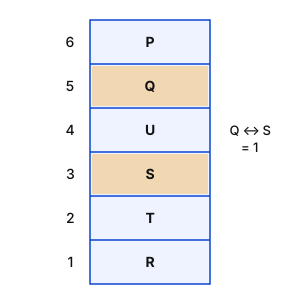
  2. Case P = 6 → S = 3. R–T consecutive from {1,2,4,5}: (4,5) forces Q = 1 ✗; so R = 1, T = 2, U = 4, Q = 5. ✓
  3. Floors: 1-R, 2-T, 3-S, 4-U, 5-Q, 6-P. Between Q (5) and S (3): only U → one person.

Trick: 'Only two people between X and Y' in 6 floors means they are at (1,4), (2,5) or (3,6).

Answer: (B) One

अवधारणा: सबसे अधिक बंधन वाले व्यक्ति (P: मंज़िल 2 या 6) को पहले रखें, फिर बाकी शर्तों से हर case जाँचें।

  1. Case P = 2 → S = 5 (बीच में दो)। R–T लगातार {1,3,4,6} से → (3,4)। तब Q, U को {1,6}; Q ≠ 1 अतः U = 1, पर U सम मंज़िल पर है। ✗
  2. Case P = 6 → S = 3। R–T लगातार {1,2,4,5} से: (4,5) लेने पर Q = 1 ✗; अतः R = 1, T = 2, U = 4, Q = 5। ✓
  3. मंज़िलें: 1-R, 2-T, 3-S, 4-U, 5-Q, 6-P। Q (5) और S (3) के बीच केवल U → एक व्यक्ति।

ट्रिक: 6 मंज़िलों में 'X और Y के बीच केवल दो' का अर्थ है जोड़ा (1,4), (2,5) या (3,6)।

उत्तर: (B) एक

RRB Technician Grade I (Signal)General Intelligence and ReasoningFloor-based puzzleRRB Technician Grade I (Signal) 2024 · 19 Dec Shift 1 →