Question bank

Q&A: practice questions with answers

Search questions on any topic. Filter by exam category, exam, subject and topic, try the question, then open the answer and explanation.

Courses – airGurukul

3,200 questions found.

Q2221.
Study the following pie-chart and answer the question that follows.
The following pie chart shows the breakup of the percentage marks of Student A in an exam.
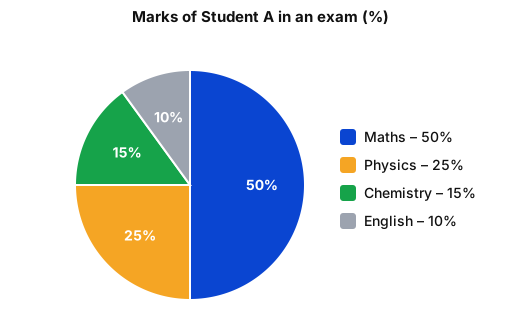
If the total marks scored by Student A are 260, then what are the total marks scored by the student in Physics and English in the exam?
निम्नलिखित पाई-चार्ट का अध्ययन कीजिए और उसके बाद दिए गए प्रश्न का उत्तर दीजिए।
निम्नलिखित पाई चार्ट एक परीक्षा में छात्र A के प्रतिशत अंकों का विवरण दर्शाता है।

यदि छात्र A द्वारा प्राप्त कुल अंक 260 हैं, तो छात्र द्वारा परीक्षा में भौतिकी (Physics) और अंग्रेज़ी (English) में प्राप्त कुल अंक कितने हैं?
  1. A85
  2. B91
  3. C95
  4. D87
Show answer

Concept: Marks of a subject =its %×total marks.

  1. From the chart: Physics =25%, English =10%.
  2. Together =35%.
  3. Marks =35100×260=91.

Trick: Add percentages first, then take one percentage of the total.

Answer: (B) 91

अवधारणा: किसी विषय के अंक =उसका %×कुल अंक।

  1. चार्ट से: भौतिकी =25%, अंग्रेज़ी =10%।
  2. कुल =35%।
  3. अंक =35100×260=91।

ट्रिक: पहले प्रतिशत जोड़ें, फिर कुल का एक बार प्रतिशत निकालें।

उत्तर: (B) 91
RRB Technician Grade IIIMathematicsData Interpretation – Pie ChartRRB Technician Grade III 2024 · 20 Dec Shift 2 →
Q2222.
Find the area of a regular hexagon (in cm2) with sides of length 6 cm.
6 cm लंबाई की भुजाओं वाले एक सम षट्भुज का क्षेत्रफल (cm2 में) ज्ञात कीजिए।
  1. A36
  2. B543
  3. C18
  4. D52
Show answer

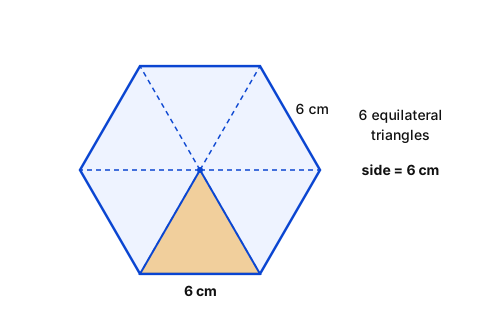
Concept: A regular hexagon splits into 6 equilateral triangles of the same side, so Area =6×34a2=332a2.

  1. Here a=6 cm, a2=36.
  2. Area =332×36=543 cm2.

Yaad rakhein: Hexagon area =332a2 – six equilateral triangles.

Answer: (B) 543

अवधारणा: सम षट्भुज समान भुजा वाले 6 समबाहु त्रिभुजों में बँटता है, अतः क्षेत्रफल =6×34a2=332a2।

  1. यहाँ a=6 सेमी, a2=36।
  2. क्षेत्रफल =332×36=543 cm2।

याद रखें: षट्भुज का क्षेत्रफल =332a2 – छह समबाहु त्रिभुज।

उत्तर: (B) 543

RRB Technician Grade IIIMathematicsMensuration – Regular HexagonRRB Technician Grade III 2024 · 20 Dec Shift 2 →
Q2223.
Evaluate the given expression.
6+6×6−6
दिए गए व्यंजक का मान ज्ञात कीजिए।
6+6×6−6
  1. A36
  2. B42
  3. C0
  4. D66
Show answer

Concept: Multiplication is done before addition and subtraction.

  1. 6×6=36.
  2. 6+36−6=36.

Trick: +6 and −6 cancel, leaving 6×6=36.

Answer: (A) 36

अवधारणा: जोड़ और घटाव से पहले गुणा किया जाता है।

  1. 6×6=36।
  2. 6+36−6=36।

ट्रिक: +6 और −6 कट जाते हैं, बचता है 6×6=36।

उत्तर: (A) 36

RRB Technician Grade IIIMathematicsBODMASRRB Technician Grade III 2024 · 20 Dec Shift 2 →
Q2224.
sec2A+(cosec2A−1)+(1+tan2A)−cot2A= ______.
sec2A+(cosec2A−1)+(1+tan2A)−cot2A= ______।
  1. A0
  2. B1
  3. C2sec2A
  4. Dcot2A
Show answer

Concept: cosec2A−1=cot2A and 1+tan2A=sec2A.

  1. Expression =sec2A+cot2A+sec2A−cot2A.
  2. cot2A terms cancel.
  3. Result =2sec2A.

Trick: Replace each bracket by its identity – opposite terms cancel.

Answer: (C) 2sec2A

अवधारणा: cosec2A−1=cot2A तथा 1+tan2A=sec2A।

  1. व्यंजक =sec2A+cot2A+sec2A−cot2A।
  2. cot2A पद कट जाते हैं।
  3. परिणाम =2sec2A।

ट्रिक: प्रत्येक कोष्ठक को सर्वसमिका से बदलें – विपरीत पद कट जाते हैं।

उत्तर: (C) 2sec2A

RRB Technician Grade IIIMathematicsTrigonometric IdentitiesRRB Technician Grade III 2024 · 20 Dec Shift 2 →
Q2225.
Select the greatest number from the given numbers.
450,2100,1625
दी गई संख्याओं में से सबसे बड़ी संख्या का चयन कीजिए।
450,2100,1625
  1. A450
  2. BAll are equalसभी बराबर हैं
  3. C2100
  4. D1625
Show answer

Concept: Write all numbers with the same base: (am)n=amn.

  1. 450=(22)50=2100.
  2. 1625=(24)25=2100.
  3. All three equal 2100.

Trick: Convert to base 2 – compare only exponents.

Answer: (B) All are equal

अवधारणा: सभी संख्याओं को एक ही आधार में लिखें: (am)n=amn।

  1. 450=(22)50=2100।
  2. 1625=(24)25=2100।
  3. तीनों 2100 के बराबर हैं।

ट्रिक: आधार 2 बनाएँ – केवल घातें तुलना करें।

उत्तर: (B) सभी बराबर हैं

RRB Technician Grade IIIMathematicsIndicesRRB Technician Grade III 2024 · 20 Dec Shift 2 →
Q2226.
In what duration will a sum of money double itself at 20% per annum simple interest?
20% वार्षिक साधारण ब्याज की दर से कोई धनराशि कितनी अवधि में स्वयं की दोगुनी हो जाएगी?
  1. A8 years8 वर्ष
  2. B12 years12 वर्ष
  3. C10 years10 वर्ष
  4. D5 years5 वर्ष
Show answer

Concept: A sum doubles when SI =P, i.e. R×T=100.

  1. P×20×T100=P.
  2. T=10020=5 years.

Yaad rakhein: Doubling time under SI =100R years.

Answer: (D) 5 years

अवधारणा: राशि दोगुनी तब होती है जब ब्याज =P, अर्थात R×T=100।

  1. P×20×T100=P।
  2. T=10020=5 वर्ष।

याद रखें: साधारण ब्याज पर दोगुना होने का समय =100R वर्ष।

उत्तर: (D) 5 वर्ष

RRB Technician Grade IIIMathematicsSimple InterestRRB Technician Grade III 2024 · 20 Dec Shift 2 →
Q2227.
In the following number-pairs, the second number is obtained by applying certain mathematical operations to the first number. Which numbers should replace X and Y so that the pattern followed by the two numbers on the left side of :: is the same as that on the right side of ::?
(NOTE: Operations should be performed on the whole numbers, without breaking down the numbers into its constituent digits. E.g. 13 - Operations on 13 such as adding/subtracting/multiplying etc. to 13 can be performed. Breaking down 13 into 1 and 3 and then performing mathematical operations on 1 and 3 is not allowed.)
X : 117 :: 15 : Y
निम्नलिखित संख्या-युग्मों में, दूसरी संख्या पहली संख्या पर कुछ गणितीय संक्रियाएँ करके प्राप्त की गई है। X और Y के स्थान पर कौन-सी संख्याएँ आनी चाहिए ताकि :: के बाईं ओर की दोनों संख्याओं द्वारा अपनाया गया पैटर्न वही हो जो :: के दाईं ओर का है?
(ध्यान दें: संक्रियाएँ पूर्ण संख्याओं पर की जानी चाहिए, संख्याओं को उनके घटक अंकों में तोड़े बिना। उदाहरण के लिए 13 - 13 पर संक्रियाएँ जैसे 13 में जोड़ना/घटाना/गुणा करना आदि किया जा सकता है। 13 को 1 और 3 में तोड़ना और फिर 1 और 3 पर गणितीय संक्रियाएँ करना वर्जित है।)
X : 117 :: 15 : Y
  1. AX = 7, Y = 193
  2. BX = 9, Y = 195
  3. CX = 9, Y = 193
  4. DX = 7, Y = 195
Show answer

Concept: Find one operation that turns the first number into the second and test each option.

  1. Try X =9: 9×13=117 ✓.
  2. Apply the same rule: Y=15×13=195.
  3. So X =9, Y =195.

Trick: 117=9×13 is a quick factor check; options with X =7 fail since 117 is not a multiple of 7.

Answer: (B) X = 9, Y = 195

अवधारणा: ऐसी एक संक्रिया खोजें जो पहली संख्या को दूसरी में बदले, फिर विकल्प जाँचें।

  1. X =9 लें: 9×13=117 ✓।
  2. यही नियम: Y=15×13=195।
  3. अतः X =9, Y =195।

ट्रिक: 117=9×13; X =7 वाले विकल्प गलत, क्योंकि 117, 7 का गुणज नहीं।

उत्तर: (B) X = 9, Y = 195

RRB Technician Grade IIIGeneral Intelligence and ReasoningNumber AnalogyRRB Technician Grade III 2024 · 20 Dec Shift 2 →
Q2228.
In a certain code language, ‘Pay The Tax’ is written as ‘Gi Si Di’, ‘File Tax Return’ is written as ‘Ri Zi Si’ and 'Keep The Tax File' is written as 'Qi Si Gi Zi'. How is ‘File’ coded in the given language?
एक निश्चित कूट भाषा में, ‘Pay The Tax’ को ‘Gi Si Di’ लिखा जाता है, ‘File Tax Return’ को ‘Ri Zi Si’ लिखा जाता है और 'Keep The Tax File' को 'Qi Si Gi Zi' लिखा जाता है। उसी भाषा में ‘File’ को किस प्रकार कूटबद्ध किया जाएगा?
  1. AGi
  2. BSi
  3. CZi
  4. DQi
Show answer

Concept: A word common to two sentences gets the code common to both.

  1. Tax is in all three sentences; Si is in all three codes → Tax = Si.
  2. Sentences 1 and 3 share The (and Tax); codes share Gi (and Si) → The = Gi.
  3. Sentences 2 and 3 share File (and Tax); codes share Zi (and Si) → File = Zi.

Trick: Compare sentence pairs and remove already-decoded words each time.

Answer: (C) Zi

अवधारणा: दो वाक्यों में साझा शब्द का कोड भी दोनों कोडों में साझा होता है।

  1. Tax तीनों वाक्यों में और Si तीनों कोडों में → Tax = Si।
  2. वाक्य 1 व 3 में The (और Tax) साझा; कोड में Gi (और Si) → The = Gi।
  3. वाक्य 2 व 3 में File (और Tax) साझा; कोड में Zi (और Si) → File = Zi।

ट्रिक: वाक्य-युग्मों की तुलना करें और पहले से ज्ञात कोड हटाते जाएँ।

उत्तर: (C) Zi

RRB Technician Grade IIIGeneral Intelligence and ReasoningCoding-DecodingRRB Technician Grade III 2024 · 20 Dec Shift 2 →
Q2229.
Read the given statements and conclusions carefully. You have to take the given statements to be true even if they seem to be at variance from commonly known facts and decide which conclusion(s) logically follow(s) from the given statements.
Statements:
Some cushions are bells.
All cushions are machines.
Conclusions:
(I) All machines are cushions.
(II) Some bells are machines.
दिए गए कथनों और निष्कर्षों को ध्यानपूर्वक पढ़ें। आपको दिए गए कथनों को सत्य मानना है, भले ही वे सामान्य रूप से ज्ञात तथ्यों से भिन्न प्रतीत होते हों, और निर्णय लें कि दिए गए कथनों से कौन-सा/कौन-से निष्कर्ष तार्किक रूप से अनुसरण करता है/करते हैं।
कथन:
कुछ कुशन, घंटियाँ हैं।
सभी कुशन, मशीनें हैं।
निष्कर्ष:
(I) सभी मशीनें, कुशन हैं।
(II) कुछ घंटियाँ, मशीनें हैं।
  1. AOnly conclusion (II) followsकेवल निष्कर्ष (II) अनुसरण करता है
  2. BBoth conclusions (I) and (II) followनिष्कर्ष (I) और (II) दोनों अनुसरण करते हैं
  3. COnly conclusion (I) followsकेवल निष्कर्ष (I) अनुसरण करता है
  4. DNeither conclusion (I) nor (II) followsन तो निष्कर्ष (I) और न ही (II) अनुसरण करता है
Show answer

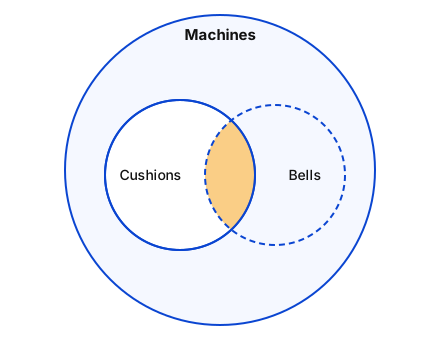
Concept: Draw the least-overlap Venn diagram allowed by the statements and test each conclusion.

  1. All cushions lie inside machines; some cushions overlap bells.
  2. The shaded part (cushion and bell) is also inside machines → some bells are machines: II follows.
  3. Machines may contain things that are not cushions → I does not follow.

Yaad rakhein: "All A are B" never gives "All B are A"; "Some A are C" + "All A are B" ⇒ "Some C are B".

Answer: (A) Only conclusion (II) follows

अवधारणा: कथनों के अनुसार न्यूनतम वेन आरेख बनाएँ और प्रत्येक निष्कर्ष जाँचें।

  1. सभी कुशन, मशीन के अंदर हैं; कुछ कुशन, बेल से मिलते हैं।
  2. छायांकित भाग (कुशन व बेल) मशीन के अंदर भी है → कुछ बेल मशीन हैं: II अनुसरण करता है।
  3. मशीन में कुशन के अलावा भी चीजें हो सकती हैं → I अनुसरण नहीं करता।

याद रखें: "सभी A, B हैं" से "सभी B, A हैं" कभी नहीं निकलता; "कुछ A, C हैं" + "सभी A, B हैं" ⇒ "कुछ C, B हैं"।

उत्तर: (A) केवल निष्कर्ष (II) अनुसरण करता है

RRB Technician Grade IIIGeneral Intelligence and ReasoningSyllogismRRB Technician Grade III 2024 · 20 Dec Shift 2 →
Q2230.
Seven people, A, B, D, L, X, Y and Z, are sitting in a row, facing north. Only Z sits to the right of D. Only three people sit to the left of A. Only three people sit between D and L. Y sits at some place to the left of X but at some place to the right of B. How many people sit between B and X?
सात व्यक्ति, A, B, D, L, X, Y और Z, उत्तर की ओर मुख करके एक पंक्ति में बैठे हैं। केवल Z, D के दाईं ओर बैठा है। A के बाईं ओर केवल तीन व्यक्ति बैठे हैं। D और L के बीच केवल तीन व्यक्ति बैठे हैं। Y, X के बाईं ओर किसी स्थान पर, लेकिन B के दाईं ओर किसी स्थान पर बैठा है। B और X के बीच कितने व्यक्ति बैठे हैं?
  1. AOneएक
  2. BTwoदो
  3. CThreeतीन
  4. DFourचार
Show answer

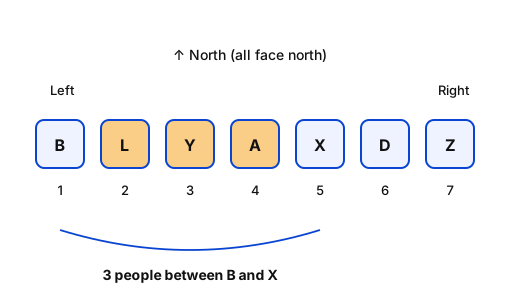
Concept: Fix the definite positions first (counting from the left, all facing north).

  1. Only Z is right of D → D is 6th, Z is 7th.
  2. Three people left of A → A is 4th.
  3. Three between D and L → L is 2nd.
  4. Seats 1, 3, 5 left: B, Y, X in order (Y between B and X) → B1, Y3, X5.
  5. Between B and X: L, Y, A = 3 people.

Trick: Clues with "only" fix exact seats – place them first.

Answer: (C) Three

अवधारणा: पहले निश्चित स्थान तय करें (बाएँ से गिनें, सभी उत्तर की ओर मुख)।

  1. केवल Z, D के दाएँ → D 6वाँ, Z 7वाँ।
  2. A के बाएँ तीन लोग → A चौथा।
  3. D और L के बीच तीन → L दूसरा।
  4. बचे स्थान 1, 3, 5: क्रम B, Y, X (Y बीच में) → B1, Y3, X5।
  5. B और X के बीच: L, Y, A = 3 लोग।

ट्रिक: "केवल" वाले संकेत सटीक स्थान देते हैं – उन्हें पहले रखें।

उत्तर: (C) तीन

RRB Technician Grade IIIGeneral Intelligence and ReasoningSeating Arrangement – LinearRRB Technician Grade III 2024 · 20 Dec Shift 2 →
Q2231.
Read the given statements and conclusions carefully. You have to take the given statements to be true even if they seem to be at variance from commonly known facts and decide which conclusion(s) logically follow(s) from the given statements.
Statements:
All shirts are pants.
All pants are ties.
No ties are jeans.
Conclusions:
(I) No jeans are pants.
(II) All pants are shirts.
दिए गए कथनों और निष्कर्षों को ध्यानपूर्वक पढ़ें। आपको दिए गए कथनों को सत्य मानना है, भले ही वे सामान्य रूप से ज्ञात तथ्यों से भिन्न प्रतीत होते हों, और निर्णय लें कि दिए गए कथनों से कौन-सा/कौन-से निष्कर्ष तार्किक रूप से अनुसरण करता है/करते हैं।
कथन:
सभी शर्ट, पैंट हैं।
सभी पैंट, टाई हैं।
कोई भी टाई, जींस नहीं है।
निष्कर्ष:
(I) कोई भी जींस, पैंट नहीं है।
(II) सभी पैंट, शर्ट हैं।
  1. AOnly conclusion (II) follows.केवल निष्कर्ष (II) अनुसरण करता है।
  2. BBoth conclusions (I) and (II) follow.निष्कर्ष (I) और (II) दोनों अनुसरण करते हैं।
  3. CNeither conclusion (I) nor (II) follows.न तो निष्कर्ष (I) और न ही (II) अनुसरण करता है।
  4. DOnly conclusion (I) follows.केवल निष्कर्ष (I) अनुसरण करता है।
Show answer

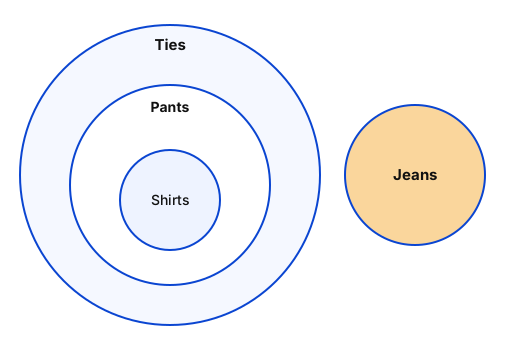
Concept: Draw nested circles for "All" and separate circles for "No".

  1. Shirts ⊂ Pants ⊂ Ties.
  2. No tie is jeans, so jeans lie fully outside ties – hence outside pants → I follows.
  3. Pants may contain non-shirts → II does not follow.

Yaad rakhein: If A is inside B and B has nothing in common with C, then A has nothing in common with C either.

Answer: (D) Only conclusion (I) follows.

अवधारणा: "सभी" के लिए नेस्टेड वृत्त और "कोई नहीं" के लिए अलग वृत्त बनाएँ।

  1. शर्ट ⊂ पैंट ⊂ टाई।
  2. कोई टाई जींस नहीं, अतः जींस टाई से बाहर – पैंट से भी बाहर → I अनुसरण करता है।
  3. पैंट में शर्ट के अलावा भी हो सकते हैं → II अनुसरण नहीं करता।

याद रखें: यदि A, B के अंदर है और B का C से कुछ भी साझा नहीं, तो A का भी C से कुछ साझा नहीं।

उत्तर: (D) केवल निष्कर्ष (I) अनुसरण करता है।

RRB Technician Grade IIIGeneral Intelligence and ReasoningSyllogismRRB Technician Grade III 2024 · 20 Dec Shift 2 →
Q2232.
Which of the following options should come in place of the question mark (?) in the given series to make it logically complete?
433, 414, 376, 319, 243, ?
दी गई श्रृंखला को तार्किक रूप से पूर्ण करने के लिए प्रश्न चिह्न (?) के स्थान पर निम्नलिखित में से कौन-सा विकल्प आना चाहिए?
433, 414, 376, 319, 243, ?
  1. A148
  2. B162
  3. C124
  4. D136
Show answer

Concept: Look at the differences between consecutive terms.

  1. Differences: 433−414=19, 414−376=38, 376−319=57, 319−243=76.
  2. They are multiples of 19: 19×1,19×2,19×3,19×4.
  3. Next difference =19×5=95 → 243−95=148.

Trick: If the first difference is a prime like 19, check whether the rest are its multiples.

Answer: (A) 148

अवधारणा: क्रमागत पदों का अंतर देखें।

  1. अंतर: 433−414=19, 414−376=38, 376−319=57, 319−243=76।
  2. ये 19 के गुणज हैं: 19×1,19×2,19×3,19×4।
  3. अगला अंतर =19×5=95 → 243−95=148।

ट्रिक: पहला अंतर 19 जैसा अभाज्य हो तो देखें कि बाकी उसके गुणज हैं या नहीं।

उत्तर: (A) 148

RRB Technician Grade IIIGeneral Intelligence and ReasoningNumber SeriesRRB Technician Grade III 2024 · 20 Dec Shift 2 →
Q2233.
In the following number-pairs, the second number is obtained by applying certain mathematical operations to the first number. Which numbers should replace X and Y so that the pattern followed by the two numbers on the left side of :: is the same as that on the right side of ::?
(NOTE: Operations should be performed on the whole numbers, without breaking down the numbers into its constituent digits. E.g. 13 - Operations on 13 such as adding/subtracting/multiplying etc. to 13 can be performed. Breaking down 13 into 1 and 3 and then performing mathematical operations on 1 and 3 is not allowed.)
X : 88 :: 12 : Y
निम्नलिखित संख्या-युग्मों में, दूसरी संख्या पहली संख्या पर कुछ गणितीय संक्रियाएँ करके प्राप्त की गई है। X और Y के स्थान पर कौन-सी संख्याएँ आनी चाहिए ताकि :: के बाईं ओर की दोनों संख्याओं द्वारा अपनाया गया पैटर्न वही हो जो :: के दाईं ओर का है?
(ध्यान दें: संक्रियाएँ पूर्ण संख्याओं पर की जानी चाहिए, संख्याओं को उनके घटक अंकों में तोड़े बिना। उदाहरण के लिए 13 - 13 पर संक्रियाएँ जैसे 13 में जोड़ना/घटाना/गुणा करना आदि किया जा सकता है। 13 को 1 और 3 में तोड़ना और फिर 1 और 3 पर गणितीय संक्रियाएँ करना वर्जित है।)
X : 88 :: 12 : Y
  1. AX = 14, Y = 132
  2. BX = 14, Y = 176
  3. CX = 8, Y = 152
  4. DX = 8, Y = 132
Show answer

Concept: Find the rule linking X and 88, then apply it to 12.

  1. Try X =8: 8×11=88 ✓.
  2. Then Y=12×11=132.
  3. X =14 fails since 88 is not a multiple of 14.

Trick: Factorise the given number: 88=8×11 suggests the rule "×11".

Answer: (D) X = 8, Y = 132

अवधारणा: X और 88 को जोड़ने वाला नियम खोजें, फिर 12 पर लगाएँ।

  1. X =8 लें: 8×11=88 ✓।
  2. तब Y=12×11=132।
  3. X =14 गलत, क्योंकि 88, 14 का गुणज नहीं।

ट्रिक: दी गई संख्या के गुणनखंड करें: 88=8×11 → नियम "×11"।

उत्तर: (D) X = 8, Y = 132

RRB Technician Grade IIIGeneral Intelligence and ReasoningNumber AnalogyRRB Technician Grade III 2024 · 20 Dec Shift 2 →
Q2234.
What will come in the place of ‘?’ in the following equation, if ‘÷’ and ‘×’ are interchanged?
8+7÷36×9−12=?
यदि ‘÷’ और ‘×’ को आपस में बदल दिया जाए, तो निम्नलिखित समीकरण में ‘?’ के स्थान पर क्या आएगा?
8+7÷36×9−12=?
  1. A25
  2. B24
  3. C19
  4. D21
Show answer

Concept: Interchange the signs first, then apply BODMAS.

  1. After swapping: 8+7×36÷9−12.
  2. 36÷9=4, 7×4=28.
  3. 8+28−12=24.

Trick: Rewrite the whole expression with new signs before calculating – avoids sign mistakes.

Answer: (B) 24

अवधारणा: पहले चिह्न बदलें, फिर BODMAS लगाएँ।

  1. बदलने पर: 8+7×36÷9−12।
  2. 36÷9=4, 7×4=28।
  3. 8+28−12=24।

ट्रिक: गणना से पहले पूरा व्यंजक नए चिह्नों के साथ दोबारा लिखें।

उत्तर: (B) 24

RRB Technician Grade IIIGeneral Intelligence and ReasoningMathematical OperationsRRB Technician Grade III 2024 · 20 Dec Shift 2 →
Q2235.
Based on the English alphabetical order, three of the following four letter-cluster pairs are alike in a certain way and thus form a group. Which pair does not belong to that group?
(Note: The odd one out is not based on the number of consonants/vowels or their position in the letter cluster.)
अंग्रेजी वर्णमाला क्रम के आधार पर, निम्नलिखित चार अक्षर-समूह युग्मों में से तीन किसी निश्चित प्रकार से एकसमान हैं और इस प्रकार एक समूह बनाते हैं। कौन-सा युग्म उस समूह से संबंधित नहीं है?
(ध्यान दें: असंगत युग्म, व्यंजनों/स्वरों की संख्या या अक्षर-समूह में उनके स्थान पर आधारित नहीं है।)
  1. ADA-CF
  2. BJG-IM
  3. CGD-FI
  4. DNK-MP
Show answer

Concept: Use letter positions (A = 1 … Z = 26) to find the pattern in each pair.

  1. DA-CF: D(4) → A(1) is −3, C(3) → F(6) is +3, and C = D − 1.
  2. GD-FI: 7 → 4 (−3), 6 → 9 (+3); NK-MP: 14 → 11 (−3), 13 → 16 (+3).
  3. JG-IM: 10 → 7 (−3) but 9 → 13 is +4 – breaks the pattern.

Trick: Check the second cluster's gap first – that is where the odd one usually differs.

Answer: (B) JG-IM

अवधारणा: अक्षरों के स्थान (A = 1 … Z = 26) से प्रत्येक युग्म का नियम खोजें।

  1. DA-CF: D(4) → A(1) −3, C(3) → F(6) +3, तथा C = D − 1।
  2. GD-FI: 7 → 4 (−3), 6 → 9 (+3); NK-MP: 14 → 11 (−3), 13 → 16 (+3)।
  3. JG-IM: 10 → 7 (−3) पर 9 → 13 में +4 – नियम टूटता है।

ट्रिक: पहले दूसरे समूह का अंतर देखें – विषम वहीं मिलता है।

उत्तर: (B) JG-IM

RRB Technician Grade IIIGeneral Intelligence and ReasoningLetter Pair – Odd One OutRRB Technician Grade III 2024 · 20 Dec Shift 2 →
Q2236.
Based on the English alphabetical order, three of the following four letter-clusters are alike in a certain way and thus form a group. Which letter-cluster does not belong to that group?
(Note: The odd one out is not based on the number of consonants/vowels or their position in the letter-cluster.)
अंग्रेजी वर्णमाला क्रम के आधार पर, निम्नलिखित चार अक्षर-समूहों में से तीन किसी निश्चित प्रकार से एकसमान हैं और इस प्रकार एक समूह बनाते हैं। कौन-सा अक्षर-समूह उस समूह से संबंधित नहीं है?
(ध्यान दें: असंगत अक्षर-समूह, व्यंजनों/स्वरों की संख्या या अक्षर-समूह में उनके स्थान पर आधारित नहीं है।)
  1. AAGH
  2. BZBD
  3. CQSU
  4. DMOQ
Show answer

Concept: Compare the gaps between consecutive letters.

  1. ZBD: Z → B (+2, wrapping), B → D (+2).
  2. QSU: +2, +2; MOQ: +2, +2.
  3. AGH: A → G is +6, G → H is +1 – different.

Trick: In a +2 pattern, "Z → B" is valid because the alphabet wraps around.

Answer: (A) AGH

अवधारणा: क्रमागत अक्षरों के बीच का अंतर देखें।

  1. ZBD: Z → B (+2, चक्रीय), B → D (+2)।
  2. QSU: +2, +2; MOQ: +2, +2।
  3. AGH: A → G +6, G → H +1 – भिन्न।

ट्रिक: वर्णमाला चक्रीय है, इसलिए +2 में "Z → B" सही है।

उत्तर: (A) AGH

RRB Technician Grade IIIGeneral Intelligence and ReasoningLetter Cluster – Odd One OutRRB Technician Grade III 2024 · 20 Dec Shift 2 →
Q2237.
In a certain code language,
A+B means ‘A is the brother of B’,
A−B means ‘A is the wife of B’,
A×B means ‘A is the father of B’,
and A÷B means ‘A is the sister of B’.
How is P related to T if ‘P×Q÷R−S×T’?
एक निश्चित कूट भाषा में,
A+B का अर्थ है ‘A, B का भाई है’,
A−B का अर्थ है ‘A, B की पत्नी है’,
A×B का अर्थ है ‘A, B का पिता है’,
और A÷B का अर्थ है ‘A, B की बहन है’।
यदि ‘P×Q÷R−S×T’ है, तो P का T से क्या संबंध है?
  1. AFather’s fatherपिता के पिता
  2. BMother’s brotherमाता के भाई
  3. CMother’s fatherमाता के पिता
  4. DFather’s brotherपिता के भाई
Show answer

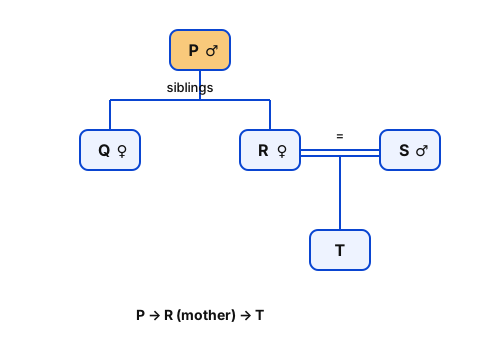
Concept: Decode each symbol step by step and build a family tree.

  1. P × Q: P is father of Q.
  2. Q ÷ R: Q is sister of R → P is also R's father.
  3. R − S: R is wife of S (R is female).
  4. S × T: S is father of T → R is T's mother.
  5. So P is the father of T's mother.

Trick: A sibling of your child is also your child – carry the parent across.

Answer: (C) Mother’s father

अवधारणा: प्रत्येक चिह्न को क्रम से डिकोड करें और वंश-वृक्ष बनाएँ।

  1. P × Q: P, Q का पिता है।
  2. Q ÷ R: Q, R की बहन है → P, R का भी पिता है।
  3. R − S: R, S की पत्नी है (R महिला)।
  4. S × T: S, T का पिता है → R, T की माता है।
  5. अतः P, T की माता का पिता (नाना) है।

ट्रिक: आपकी संतान का भाई/बहन भी आपकी संतान है – माता-पिता आगे ले जाएँ।

उत्तर: (C) माता के पिता

RRB Technician Grade IIIGeneral Intelligence and ReasoningBlood Relation – CodedRRB Technician Grade III 2024 · 20 Dec Shift 2 →
Q2238.
If ‘A’ stands for ‘+’, ‘B’ stands for ‘−’, ‘C’ stands for ‘÷’ and ‘D’ stands for ‘×’, what will come in place of the question mark ‘?’ in the following equation?
18 C 6 D 18 A 6 B 18 = ?
यदि ‘A’ का अर्थ ‘+’, ‘B’ का अर्थ ‘−’, ‘C’ का अर्थ ‘÷’ और ‘D’ का अर्थ ‘×’ है, तो निम्नलिखित समीकरण में प्रश्न चिह्न ‘?’ के स्थान पर क्या आएगा?
18 C 6 D 18 A 6 B 18 = ?
  1. A62
  2. B7
  3. C42
  4. D67
Show answer

Concept: Replace the letters with signs, then apply BODMAS.

  1. Expression: 18÷6×18+6−18.
  2. 18÷6=3, 3×18=54.
  3. 54+6−18=42.

Trick: Do ÷ and × from left to right before + and −.

Answer: (C) 42

अवधारणा: अक्षरों को चिह्नों से बदलें, फिर BODMAS लगाएँ।

  1. व्यंजक: 18÷6×18+6−18।
  2. 18÷6=3, 3×18=54।
  3. 54+6−18=42।

ट्रिक: ÷ और × बाएँ से दाएँ पहले, फिर + और −।

उत्तर: (C) 42

RRB Technician Grade IIIGeneral Intelligence and ReasoningMathematical OperationsRRB Technician Grade III 2024 · 20 Dec Shift 2 →
Q2239.
In a certain code language, ‘cant hurt me’ is written as ‘yk ja cm’ and ‘did he hurt’ is coded as ‘bt yo ja’. How is ‘hurt’ coded in the given language?
एक निश्चित कूट भाषा में, ‘cant hurt me’ को ‘yk ja cm’ लिखा जाता है और ‘did he hurt’ को ‘bt yo ja’ कूटबद्ध किया जाता है। दी गई भाषा में ‘hurt’ को किस प्रकार कूटबद्ध किया जाता है?
  1. Apr
  2. Bqe
  3. Cja
  4. Dcr
Show answer

Concept: The word common to both sentences has the code common to both.

  1. "hurt" appears in both sentences.
  2. The only common code is "ja".
  3. So hurt = ja.

Trick: One common word ↔ one common code.

Answer: (C) ja

अवधारणा: दोनों वाक्यों में साझा शब्द का कोड दोनों कोडों में साझा होता है।

  1. "hurt" दोनों वाक्यों में है।
  2. दोनों कोडों में साझा केवल "ja" है।
  3. अतः hurt = ja।

ट्रिक: एक साझा शब्द ↔ एक साझा कोड।

उत्तर: (C) ja

RRB Technician Grade IIIGeneral Intelligence and ReasoningCoding-DecodingRRB Technician Grade III 2024 · 20 Dec Shift 2 →
Q2240.
Refer to the given series and answer the question that follows (all numbers are single-digit numbers only).
(Left) 5 7 0 5 5 0 9 5 5 9 8 2 9 1 2 8 6 6 9 8 6 9 4 7 2 1 0 1 2 5 (Right)
What is the sum of the 10th digit from the left and the 4th digit from the right?
दी गई श्रृंखला का संदर्भ लेकर उसके बाद दिए गए प्रश्न का उत्तर दीजिए (सभी संख्याएँ केवल एक अंक वाली संख्याएँ हैं)।
(बाएँ) 5 7 0 5 5 0 9 5 5 9 8 2 9 1 2 8 6 6 9 8 6 9 4 7 2 1 0 1 2 5 (दाएँ)
बाएँ से 10वें अंक और दाएँ से 4थे अंक का योग क्या है?
  1. A10
  2. B9
  3. C8
  4. D11
Show answer

Concept: For n digits, the kth from the right is the (n−k+1)th from the left.

  1. 10th from the left: 5 7 0 5 5 0 9 5 5 9 → 9.
  2. 4th from the right: reading from the right 5, 2, 1, 0 → 0.
  3. Sum =9+0=9.

Trick: Count in groups of five to avoid miscounting long series.

Answer: (B) 9

अवधारणा: n अंकों में दाएँ से kवाँ अंक = बाएँ से (n−k+1)वाँ अंक।

  1. बाएँ से 10वाँ: 5 7 0 5 5 0 9 5 5 9 → 9।
  2. दाएँ से 4था: दाएँ से 5, 2, 1, 0 → 0।
  3. योग =9+0=9।

ट्रिक: लंबी श्रृंखला में पाँच-पाँच के समूह में गिनें।

उत्तर: (B) 9

RRB Technician Grade IIIGeneral Intelligence and ReasoningDigit SeriesRRB Technician Grade III 2024 · 20 Dec Shift 2 →