Question bank

Q&A: practice questions with answers

Search questions on any topic. Filter by exam category, exam, subject and topic, try the question, then open the answer and explanation.

Courses – airGurukul

3,200 questions found.

Q221.
The cost price of a toy is ₹210. What should be its MRP so that after a discount of 5% the shopkeeper gains 90%?
एक खिलौने का क्रय मूल्य ₹210 है। उसका अधिकतम खुदरा मूल्य (MRP) क्या होना चाहिए ताकि 5% की छूट देने के बाद भी दुकानदार को 90% का लाभ हो?
  1. A₹480
  2. B₹400
  3. C₹420
  4. D₹450
Show answer

Concept: SP=CP×100+Gain%100 and MRP=SP×100100−Discount%.

  1. SP=210×190100=399.
  2. MRP=399×10095=420.

Trick: One line: MRP=210×19095=210×2=420.

Answer: (C) ₹420

अवधारणा: विक्रय मूल्य=क्रय मूल्य×100+लाभ%100 और MRP=विक्रय मूल्य×100100−छूट%।

  1. SP=210×190100=399।
  2. MRP=399×10095=420।

ट्रिक: एक पंक्ति में: MRP=210×19095=210×2=420।

उत्तर: (C) ₹420

RRB Technician Grade IIIMathematicsProfit, Loss and DiscountRRB Technician Grade III 2024 · 30 Dec Shift 1 →
Q222.
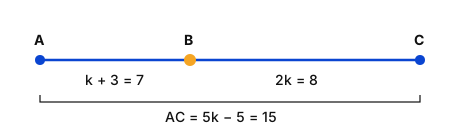
If AB = k + 3, BC = 2k and AC = 5k – 5, then for what value of ‘k’ does B lie on AC?
यदि AB = k + 3, BC = 2k और AC = 5k – 5 है, तो ‘k’ के किस मान के लिए B, AC पर स्थित होगा?
  1. A3
  2. B4
  3. C8
  4. D2
Show answer

Concept: If B lies on segment AC (between A and C), then AB+BC=AC.

  1. (k+3)+2k=5k−5.
  2. 3k+3=5k−5⇒2k=8⇒k=4.
  3. Check: AB=7, BC=8, AC=15 ✓.

Yaad rakhein: Betweenness rule: the two parts must add up to the whole.

Answer: (B) 4

अवधारणा: यदि B रेखाखंड AC पर (A और C के बीच) हो, तो AB+BC=AC।

  1. (k+3)+2k=5k−5।
  2. 3k+3=5k−5⇒2k=8⇒k=4।
  3. जाँच: AB=7, BC=8, AC=15 ✓।

याद रखें: बीच में स्थित बिंदु का नियम: दोनों भागों का योग = पूरा खंड।

उत्तर: (B) 4

RRB Technician Grade IIIMathematicsLine SegmentsRRB Technician Grade III 2024 · 30 Dec Shift 1 →
Q223.
If a 3-digit number 2y5 is divisible by 11, then the value of digit ‘y’ is:
यदि 3 अंकों की संख्या 2y5, 11 से विभाज्य है, तो अंक ‘y’ का मान है:
  1. A7
  2. B2
  3. C9
  4. D3
Show answer

Concept: A number is divisible by 11 if (sum of odd-place digits) − (sum of even-place digits) is 0 or a multiple of 11.

  1. For 2y5: (2+5)−y=7−y.
  2. 7−y=0⇒y=7 (a digit cannot make 7−y=±11).
  3. Check: 275=11×25 ✓.

Trick: For a 3-digit number abc, usually middle digit b=a+c (if a+c<10).

Answer: (A) 7

अवधारणा: कोई संख्या 11 से विभाज्य है यदि (विषम स्थानों के अंकों का योग) − (सम स्थानों के अंकों का योग) 0 या 11 का गुणज हो।

  1. 2y5 के लिए: (2+5)−y=7−y।
  2. 7−y=0⇒y=7 (अंक के लिए 7−y=±11 संभव नहीं)।
  3. जाँच: 275=11×25 ✓।

ट्रिक: 3 अंकों की संख्या abc में प्रायः बीच का अंक b=a+c (यदि a+c<10)।

उत्तर: (A) 7

RRB Technician Grade IIIMathematicsDivisibility by 11RRB Technician Grade III 2024 · 30 Dec Shift 1 →
Q224.
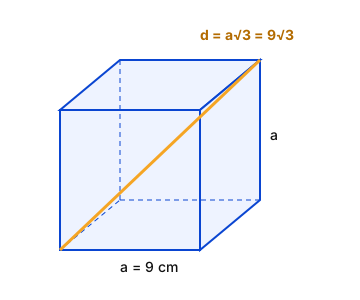
If the volume of a cube is 729 cm3, then the measure of the main diagonal of the cube will be:
यदि एक घन का आयतन 729 cm3 है, तो घन के मुख्य विकर्ण की माप होगी:
  1. A9 cm
  2. B7 cm
  3. C73 cm
  4. D93 cm
Show answer

Concept: For a cube of side a: V=a3 and main (body) diagonal d=a3.

  1. a3=729⇒a=9 cm.
  2. d=93 cm.

Yaad rakhein: Face diagonal =a2, body diagonal =a3.

Answer: (D) 93 cm

अवधारणा: भुजा a वाले घन के लिए: V=a3 तथा मुख्य विकर्ण d=a3।

  1. a3=729⇒a=9 cm।
  2. d=93 cm।

याद रखें: फलक विकर्ण =a2, मुख्य विकर्ण =a3।

उत्तर: (D) 93 cm

RRB Technician Grade IIIMathematicsCube – DiagonalRRB Technician Grade III 2024 · 30 Dec Shift 1 →
Q225.
A and B can do a piece of work in 12 days and 16 days, respectively. Both work for 3 days and then A goes away. Find how long will B take to complete the remaining work?
A और B किसी कार्य को क्रमशः 12 दिन और 16 दिन में कर सकते हैं। दोनों 3 दिन तक कार्य करते हैं और फिर A चला जाता है। ज्ञात कीजिए कि शेष कार्य को पूरा करने में B कितना समय लेगा?
  1. A12 days12 दिन
  2. B15 days15 दिन
  3. C10 days10 दिन
  4. D9 days9 दिन
Show answer

Concept: Work done = one-day work × days; the remaining work is finished by B alone.

  1. (A+B) one-day work =112+116=748.
  2. In 3 days: 2148=716; remaining =916.
  3. B's time =916×16=9 days.

Trick: LCM method: total work =48 units, A =4, B =3 per day; 3 days =21 units; left 27÷3=9.

Answer: (D) 9 days

अवधारणा: कार्य = एक दिन का कार्य × दिन; शेष कार्य B अकेले करता है।

  1. (A+B) का एक दिन का कार्य =112+116=748।
  2. 3 दिन में: 2148=716; शेष =916।
  3. B का समय =916×16=9 दिन।

ट्रिक: LCM विधि: कुल कार्य =48 इकाई, A =4, B =3 प्रति दिन; 3 दिन =21 इकाई; शेष 27÷3=9।

उत्तर: (D) 9 दिन

RRB Technician Grade IIIMathematicsTime and WorkRRB Technician Grade III 2024 · 30 Dec Shift 1 →
Q226.
Read the given statements and conclusions carefully. You have to take the given statements to be true even if they seem to be at variance from commonly known facts and decide which conclusion(s) logically follow(s) from the given statements.
Statements:
All hands are legs.
No leg is an eye.
Conclusions:
I. All legs are hands.
II. No hand is an eye.
दिए गए कथनों और निष्कर्षों को ध्यानपूर्वक पढ़िए। आपको दिए गए कथनों को सत्य मानना है, भले ही वे सामान्यतः ज्ञात तथ्यों से भिन्न प्रतीत होते हों, और निर्णय लीजिए कि कौन-सा/से निष्कर्ष तार्किक रूप से दिए गए कथनों का अनुसरण करता है/करते हैं।
कथन:
सभी हाथ, पैर हैं।
कोई पैर, आँख नहीं है।
निष्कर्ष:
I. सभी पैर, हाथ हैं।
II. कोई हाथ, आँख नहीं है।
  1. ABoth conclusions I and II followनिष्कर्ष I और II दोनों अनुसरण करते हैं
  2. BOnly conclusion I followsकेवल निष्कर्ष I अनुसरण करता है
  3. CNeither conclusion I nor II followsन तो निष्कर्ष I और न ही II अनुसरण करता है
  4. DOnly conclusion II followsकेवल निष्कर्ष II अनुसरण करता है
Show answer

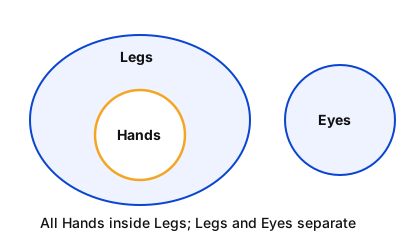
Concept: Draw the Venn diagram with the least possible overlap and test each conclusion.

  1. All hands are legs: Hands circle lies inside Legs.
  2. No leg is an eye: Legs and Eyes are separate, so Hands (inside Legs) cannot touch Eyes.
  3. II (No hand is an eye) follows. I (All legs are hands) is the converse of a universal – not definite.

Trick: 'All A are B' + 'No B is C' ⇒ 'No A is C' always follows.

Answer: (D) Only conclusion II follows

अवधारणा: न्यूनतम संभव ओवरलैप के साथ वेन आरेख बनाएँ और प्रत्येक निष्कर्ष जाँचें।

  1. सभी हाथ पैर हैं: हाथ का वृत्त पैर के अंदर।
  2. कोई पैर आँख नहीं: पैर और आँख अलग, इसलिए हाथ (जो पैर के अंदर है) आँख को नहीं छू सकता।
  3. II (कोई हाथ आँख नहीं) अनुसरण करता है। I (सभी पैर हाथ हैं) निश्चित नहीं।

ट्रिक: 'सभी A, B हैं' + 'कोई B, C नहीं' ⇒ 'कोई A, C नहीं' सदैव सही।

उत्तर: (D) केवल निष्कर्ष II अनुसरण करता है

RRB Technician Grade IIIGeneral Intelligence and ReasoningSyllogismRRB Technician Grade III 2024 · 30 Dec Shift 1 →
Q227.
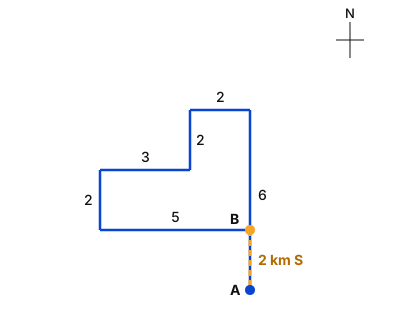
Ajit starts from point A and drives 6 km towards North. He then takes two simultaneous left turns and drives 2 km each. He then takes a right turn and drives 3 km.. He then takes a left turn and drives 2 km. He takes a final left turn and drives 5 km to reach a point B. How far (shortest distance) and towards which direction should he drive in order to reach Point A again? (All turns are 90 degrees turns only unless specified.)
अजीत बिंदु A से चलना शुरू करता है और उत्तर की ओर 6 km गाड़ी चलाता है। फिर वह लगातार दो बार बाएँ मुड़ता है और प्रत्येक बार 2 km गाड़ी चलाता है। फिर वह दाएँ मुड़ता है और 3 km गाड़ी चलाता है। फिर वह बाएँ मुड़ता है और 2 km गाड़ी चलाता है। अंत में वह बाएँ मुड़ता है और 5 km गाड़ी चलाकर बिंदु B पर पहुँचता है। पुनः बिंदु A तक पहुँचने के लिए उसे कितनी दूरी (न्यूनतम दूरी) तक और किस दिशा में गाड़ी चलानी चाहिए? (जब तक निर्दिष्ट न हो, सभी मोड़ केवल 90 डिग्री के हैं।)
  1. A2 km South2 km दक्षिण
  2. B2 km North2 km उत्तर
  3. C5 km West5 km पश्चिम
  4. D3 km South3 km दक्षिण
Show answer

Concept: Trace the path step by step, tracking the facing direction after each turn.

  1. A → 6 km North. Left (West) 2 km, left (South) 2 km.
  2. Right (West) 3 km, left (South) 2 km, left (East) 5 km to B.
  3. Net: West 2+3=5 and East 5 cancel; North 6−2−2=2 km.
  4. B is 2 km North of A, so he must drive 2 km South.

Trick: Add North–South and East–West separately; opposite directions cancel.

Answer: (A) 2 km South

अवधारणा: हर मोड़ के बाद मुख की दिशा ध्यान रखते हुए मार्ग बनाइए।

  1. A → 6 km उत्तर। बाएँ (पश्चिम) 2 km, बाएँ (दक्षिण) 2 km।
  2. दाएँ (पश्चिम) 3 km, बाएँ (दक्षिण) 2 km, बाएँ (पूर्व) 5 km से B।
  3. शुद्ध: पश्चिम 2+3=5 और पूर्व 5 कट जाते हैं; उत्तर 6−2−2=2 km।
  4. B, A से 2 km उत्तर में है, अतः उसे 2 km दक्षिण जाना होगा।

ट्रिक: उत्तर–दक्षिण और पूर्व–पश्चिम अलग-अलग जोड़ें; विपरीत दिशाएँ कट जाती हैं।

उत्तर: (A) 2 km दक्षिण

RRB Technician Grade IIIGeneral Intelligence and ReasoningDirection SenseRRB Technician Grade III 2024 · 30 Dec Shift 1 →
Q228.
Read the given statements and conclusions carefully. You have to take the given statements to be true even if they seem to be at variance from commonly known facts and decide which conclusion(s) logically follow(s) from the given statements.
Statements:
Some tablets are laptops.
All laptops are desktops.
Conclusions:
(I) Some desktops are tablets.
(II) No desktops are tablets.
दिए गए कथनों और निष्कर्षों को ध्यानपूर्वक पढ़िए। आपको दिए गए कथनों को सत्य मानना है, भले ही वे सामान्यतः ज्ञात तथ्यों से भिन्न प्रतीत होते हों, और निर्णय लीजिए कि कौन-सा/से निष्कर्ष तार्किक रूप से दिए गए कथनों का अनुसरण करता है/करते हैं।
कथन:
कुछ टैबलेट, लैपटॉप हैं।
सभी लैपटॉप, डेस्कटॉप हैं।
निष्कर्ष:
(I) कुछ डेस्कटॉप, टैबलेट हैं।
(II) कोई डेस्कटॉप, टैबलेट नहीं है।
  1. ABoth conclusions (I) and (II) followनिष्कर्ष (I) और (II) दोनों अनुसरण करते हैं
  2. BOnly conclusion (I) followsकेवल निष्कर्ष (I) अनुसरण करता है
  3. COnly conclusion (II) followsकेवल निष्कर्ष (II) अनुसरण करता है
  4. DNeither conclusion (I) nor (II) followsन तो निष्कर्ष (I) और न ही (II) अनुसरण करता है
Show answer

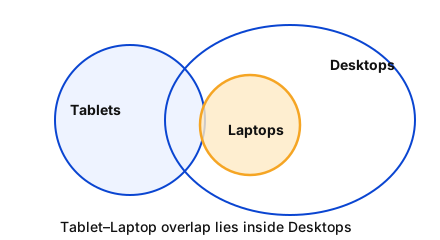
Concept: Use Venn diagrams; 'Some' + 'All' gives a definite 'Some' conclusion.

  1. Some tablets are laptops – Tablets and Laptops overlap.
  2. All laptops are desktops – Laptops lie inside Desktops, so the overlap part is also inside Desktops.
  3. Hence some desktops are tablets: I follows. II contradicts I, so it does not follow.

Trick: 'Some A are B' + 'All B are C' ⇒ 'Some A are C' (and 'Some C are A').

Answer: (B) Only conclusion (I) follows

अवधारणा: वेन आरेख बनाएँ; 'कुछ' + 'सभी' से निश्चित 'कुछ' निष्कर्ष मिलता है।

  1. कुछ टैबलेट लैपटॉप हैं – टैबलेट और लैपटॉप ओवरलैप।
  2. सभी लैपटॉप डेस्कटॉप हैं – लैपटॉप डेस्कटॉप के अंदर, अतः ओवरलैप भाग भी डेस्कटॉप में।
  3. अतः कुछ डेस्कटॉप टैबलेट हैं: I अनुसरण करता है। II, I का विरोधी है, अतः नहीं।

ट्रिक: 'कुछ A, B हैं' + 'सभी B, C हैं' ⇒ 'कुछ A, C हैं' (और 'कुछ C, A हैं')।

उत्तर: (B) केवल निष्कर्ष (I) अनुसरण करता है

RRB Technician Grade IIIGeneral Intelligence and ReasoningSyllogismRRB Technician Grade III 2024 · 30 Dec Shift 1 →
Q229.
Given below is a cause followed by possible effects numbered I, II and III. Read the cause carefully and decide which of the three can be a/the possible effect(s).
Cause:
The truckers' strike entered its 6th day today in State X, as they protested against the increase in diesel prices.
Effects:
(I) Supply of fruits and vegetables from neighbouring states has dropped drastically in the wholesale markets in the last week across many cities in State X.
(II) Demand for diesel vehicles has been steadily increasing in State X despite an increase in diesel prices.
(III) The auto rickshaw union in City Z has declared an increase in the starting fares for autos for 48 hours starting tomorrow morning at 6 a.m.
नीचे एक कारण और उसके बाद I, II और III क्रमांकित संभावित प्रभाव दिए गए हैं। कारण को ध्यानपूर्वक पढ़िए और निर्णय लीजिए कि तीनों में से कौन-सा/से संभावित प्रभाव हो सकता है/सकते हैं।
कारण:
राज्य X में डीज़ल की कीमतों में वृद्धि के विरोध में ट्रक चालकों की हड़ताल आज छठे दिन में प्रवेश कर गई।
प्रभाव:
(I) पिछले सप्ताह में राज्य X के कई शहरों के थोक बाज़ारों में पड़ोसी राज्यों से फलों और सब्ज़ियों की आपूर्ति में भारी गिरावट आई है।
(II) डीज़ल की कीमतों में वृद्धि के बावजूद राज्य X में डीज़ल वाहनों की माँग लगातार बढ़ रही है।
(III) शहर Z के ऑटो रिक्शा संघ ने कल सुबह 6 बजे से 48 घंटों के लिए ऑटो के प्रारंभिक किराए में वृद्धि की घोषणा की है।
  1. ABoth I and II can be the possible effectsI और II दोनों संभावित प्रभाव हो सकते हैं
  2. BBoth II and III can be the possible effectsII और III दोनों संभावित प्रभाव हो सकते हैं
  3. COnly I can be a possible effectकेवल I संभावित प्रभाव हो सकता है
  4. DOnly II can be a possible effectकेवल II संभावित प्रभाव हो सकता है
Show answer

Concept: An effect must follow directly from the cause (truckers' strike over diesel price rise).

  1. I: A truck strike stops movement of goods, so supply of fruits and vegetables drops – direct effect.
  2. II: Rising demand for diesel vehicles is not caused by a strike against diesel prices.
  3. III: Auto fare rise in one city for 48 hours is not linked to the truckers' strike.

Trick: Ask 'Did the strike itself cause this?' – only supply disruption passes.

Answer: (C) Only I can be a possible effect

अवधारणा: प्रभाव कारण (डीज़ल मूल्य वृद्धि पर ट्रक हड़ताल) से सीधे उत्पन्न होना चाहिए।

  1. I: ट्रक हड़ताल से माल ढुलाई रुकती है, इसलिए फल-सब्ज़ी की आपूर्ति घटती है – सीधा प्रभाव।
  2. II: डीज़ल वाहनों की बढ़ती माँग हड़ताल का परिणाम नहीं है।
  3. III: एक शहर में 48 घंटे के लिए ऑटो किराया वृद्धि का ट्रक हड़ताल से संबंध नहीं।

ट्रिक: पूछें 'क्या यह हड़ताल के कारण हुआ?' – केवल आपूर्ति बाधा सही बैठती है।

उत्तर: (C) केवल I संभावित प्रभाव हो सकता है

RRB Technician Grade IIIGeneral Intelligence and ReasoningCause and EffectRRB Technician Grade III 2024 · 30 Dec Shift 1 →
Q230.
In a certain code language, ‘RIFE’ is coded as ‘3647’ and ‘FORE’ is coded as ‘6438’. What is the code for ‘O’ in the given code language?
एक निश्चित कूट भाषा में, ‘RIFE’ को ‘3647’ के रूप में कूटबद्ध किया जाता है और ‘FORE’ को ‘6438’ के रूप में कूटबद्ध किया जाता है। उस कूट भाषा में ‘O’ के लिए कूट क्या है?
  1. A8
  2. B3
  3. C4
  4. D6
Show answer

Concept: Letters common to both words share the common digits; the leftover letter gets the leftover digit.

  1. RIFE = 3647, FORE = 6438.
  2. Common letters R, F, E ↔ common digits 3, 6, 4.
  3. Left in RIFE: I = 7; left in FORE: O = 8.

Trick: Strike out the common digits – the odd digit belongs to the odd letter.

Answer: (A) 8

अवधारणा: दोनों शब्दों के समान अक्षरों के कोड समान अंक होते हैं; बचा अक्षर = बचा अंक।

  1. RIFE = 3647, FORE = 6438।
  2. समान अक्षर R, F, E ↔ समान अंक 3, 6, 4।
  3. RIFE में बचा: I = 7; FORE में बचा: O = 8।

ट्रिक: समान अंक काट दें – बचा अंक बचे अक्षर का है।

उत्तर: (A) 8

RRB Technician Grade IIIGeneral Intelligence and ReasoningCoding–DecodingRRB Technician Grade III 2024 · 30 Dec Shift 1 →
Q231.
Which of the following options should come in place of the question mark (?) in the given series based on the English alphabetical order?
JMP, LOR, NQT, PSV, ?
अंग्रेज़ी वर्णमाला क्रम के आधार पर, दी गई शृंखला में प्रश्न चिह्न (?) के स्थान पर निम्नलिखित में से कौन-सा विकल्प आना चाहिए?
JMP, LOR, NQT, PSV, ?
  1. ARUX
  2. BUXR
  3. CURX
  4. DRXU
Show answer

Concept: Check each letter position separately for a fixed jump.

  1. 1st letters: J, L, N, P, R (+2).
  2. 2nd letters: M, O, Q, S, U (+2).
  3. 3rd letters: P, R, T, V, X (+2).

Trick: Every letter moves +2, so just add 2 to each letter of PSV.

Answer: (A) RUX

अवधारणा: हर स्थान के अक्षर को अलग से जाँचें।

  1. पहला अक्षर: J, L, N, P, R (+2)।
  2. दूसरा अक्षर: M, O, Q, S, U (+2)।
  3. तीसरा अक्षर: P, R, T, V, X (+2)।

ट्रिक: हर अक्षर +2 बढ़ता है, PSV के हर अक्षर में 2 जोड़ दें।

उत्तर: (A) RUX

RRB Technician Grade IIIGeneral Intelligence and ReasoningLetter SeriesRRB Technician Grade III 2024 · 30 Dec Shift 1 →
Q232.
If ‘A’ stands for ‘÷’, ‘B’ stands for ‘×’, ‘C’ stands for ‘+’ and ‘D’ stands for ‘−’, what will come in place of the question mark ‘?’ in the following equation?
2 B 18 D 20 A 4 C 15 = ?
यदि ‘A’ का अर्थ ‘÷’, ‘B’ का अर्थ ‘×’, ‘C’ का अर्थ ‘+’ और ‘D’ का अर्थ ‘−’ है, तो निम्नलिखित समीकरण में प्रश्न चिह्न ‘?’ के स्थान पर क्या आएगा?
2 B 18 D 20 A 4 C 15 = ?
  1. A48
  2. B47
  3. C46
  4. D45
Show answer

Concept: Replace letters by signs, then apply BODMAS.

  1. 2×18−20÷4+15.
  2. =36−5+15.
  3. =46.

Trick: Do ÷ and × first, then + and − from left to right.

Answer: (C) 46

अवधारणा: अक्षरों को चिह्नों से बदलें, फिर BODMAS लगाएँ।

  1. 2×18−20÷4+15।
  2. =36−5+15।
  3. =46।

ट्रिक: पहले ÷ और ×, फिर बाएँ से दाएँ + और −।

उत्तर: (C) 46

RRB Technician Grade IIIGeneral Intelligence and ReasoningMathematical OperationsRRB Technician Grade III 2024 · 30 Dec Shift 1 →
Q233.
In the following number-pairs, the second number is obtained by applying certain mathematical operations to the first number. Which numbers should replace X and Y so that the pattern followed by the two numbers on the left side of :: is the same as that on the right side of :: ?
(NOTE: Operations should be performed on the whole numbers, without breaking down the numbers into its constituent digits. E.g. 13 – Operations on 13 such as adding /subtracting /multiplying etc. to 13 can be performed. Breaking down 13 into 1 and 3 and then performing mathematical operations on 1 and 3 is not allowed.)
X : 114 :: 26 : Y
निम्नलिखित संख्या-युग्मों में, पहली संख्या पर कुछ गणितीय संक्रियाएँ करके दूसरी संख्या प्राप्त की जाती है। X और Y के स्थान पर कौन-सी संख्याएँ आनी चाहिए ताकि :: के बाईं ओर की दोनों संख्याओं द्वारा अनुसरित पैटर्न वही हो जो :: के दाईं ओर है?
(नोट: संक्रियाएँ संख्याओं को उनके घटक अंकों में विभाजित किए बिना, पूर्ण संख्याओं पर की जानी चाहिए। उदाहरण के लिए 13 – 13 पर संक्रियाएँ जैसे 13 में जोड़ना/घटाना/गुणा करना आदि किया जा सकता है। 13 को 1 और 3 में विभाजित करना और फिर 1 और 3 पर गणितीय संक्रियाएँ करना वर्जित है।)
X : 114 :: 26 : Y
  1. AX = 31, Y = 72
  2. BX = 39, Y = 86
  3. CX = 38, Y = 78
  4. DX = 42, Y = 84
Show answer

Concept: The same rule must link X → 114 and 26 → Y; test the options.

  1. Try (C): 38×3=114 ✓ and 26×3=78 ✓.
  2. Others fail, e.g. (B) 39×3=117≠114; (D) 42×3=126.

Trick: 114 is a multiple of 3 (114=3×38) – the 'multiply by 3' rule is the first to test.

Answer: (C) X = 38, Y = 78

अवधारणा: X → 114 और 26 → Y में एक ही नियम होना चाहिए; विकल्प जाँचें।

  1. (C) लें: 38×3=114 ✓ और 26×3=78 ✓।
  2. अन्य असफल, जैसे (B) 39×3=117≠114; (D) 42×3=126।

ट्रिक: 114, 3 का गुणज है (114=3×38) – पहले '3 से गुणा' नियम जाँचें।

उत्तर: (C) X = 38, Y = 78

RRB Technician Grade IIIGeneral Intelligence and ReasoningNumber AnalogyRRB Technician Grade III 2024 · 30 Dec Shift 1 →
Q234.
Select the set in which the numbers are related in the same way as are the numbers of the following sets.
(NOTE: Operations should be performed on the whole numbers, without breaking down the numbers into its constituent digits. E.g. 13 – Operations on 13 such as adding /subtracting /multiplying etc. to 13 can be performed. Breaking down 13 into 1 and 3 and then performing mathematical operations on 1 and 3 is not allowed.)
(32, 78, 93)
(29, 75, 90)
उस समुच्चय का चयन कीजिए जिसमें संख्याएँ उसी प्रकार संबंधित हैं जिस प्रकार निम्नलिखित समुच्चयों की संख्याएँ संबंधित हैं।
(नोट: संक्रियाएँ संख्याओं को उनके घटक अंकों में विभाजित किए बिना, पूर्ण संख्याओं पर की जानी चाहिए। उदाहरण के लिए 13 – 13 पर संक्रियाएँ जैसे 13 में जोड़ना/घटाना/गुणा करना आदि किया जा सकता है। 13 को 1 और 3 में विभाजित करना और फिर 1 और 3 पर गणितीय संक्रियाएँ करना वर्जित है।)
(32, 78, 93)
(29, 75, 90)
  1. A(43, 79, 94)
  2. B(25, 71, 76)
  3. C(35, 81, 92)
  4. D(38, 84, 99)
Show answer

Concept: Find the differences between consecutive numbers of each set.

  1. (32,78,93): 78−32=46, 93−78=15.
  2. (29,75,90): 46 and 15 again.
  3. (D) (38,84,99): 84−38=46, 99−84=15 ✓.

Trick: Rule: 2nd = 1st +46, 3rd = 2nd +15 – check the first gap, then the second.

Answer: (D) (38, 84, 99)

अवधारणा: हर समूह की क्रमागत संख्याओं का अंतर निकालें।

  1. (32,78,93): 78−32=46, 93−78=15।
  2. (29,75,90): फिर 46 और 15।
  3. (D) (38,84,99): 84−38=46, 99−84=15 ✓।

ट्रिक: नियम: दूसरी = पहली +46, तीसरी = दूसरी +15।

उत्तर: (D) (38, 84, 99)

RRB Technician Grade IIIGeneral Intelligence and ReasoningNumber TriadsRRB Technician Grade III 2024 · 30 Dec Shift 1 →
Q235.
If each vowel in the word PAINTER is changed to the nearest consonant succeeding it in the English alphabetical order and each consonant is changed to the nearest vowel succeeding it in English alphabetical order, then which of the following letters is repeated thrice in the new group of letters thus formed?
यदि शब्द PAINTER में प्रत्येक स्वर को अंग्रेज़ी वर्णमाला क्रम में उसके ठीक बाद आने वाले निकटतम व्यंजन में बदल दिया जाए और प्रत्येक व्यंजन को अंग्रेज़ी वर्णमाला क्रम में उसके बाद आने वाले निकटतम स्वर में बदल दिया जाए, तो इस प्रकार बने अक्षरों के नए समूह में निम्नलिखित में से कौन-सा अक्षर तीन बार दोहराया जाएगा?
  1. AO
  2. BU
  3. CF
  4. DB
Show answer

Concept: Vowel → next consonant after it; consonant → next vowel after it (vowels A, E, I, O, U).

  1. P → U, A → B, I → J, N → O.
  2. T → U, E → F, R → U.
  3. New group: U B J O U F U – U appears 3 times.

Trick: After P, R and T the next vowel is U for all three.

Answer: (B) U

अवधारणा: स्वर → उसके बाद का निकटतम व्यंजन; व्यंजन → उसके बाद का निकटतम स्वर (स्वर A, E, I, O, U)।

  1. P → U, A → B, I → J, N → O।
  2. T → U, E → F, R → U।
  3. नया समूह: U B J O U F U – U तीन बार।

ट्रिक: P, R और T के बाद अगला स्वर तीनों के लिए U है।

उत्तर: (B) U

RRB Technician Grade IIIGeneral Intelligence and ReasoningAlphabet CodingRRB Technician Grade III 2024 · 30 Dec Shift 1 →
Q236.
Based on the English alphabetical order, three of the following four letter-clusters are alike in a certain way and thus form a group. Which letter-cluster does not belong to that group?
(Note: The odd one out is not based on the number of consonants/vowels or their position in the letter-cluster.)
अंग्रेज़ी वर्णमाला क्रम के आधार पर, निम्नलिखित चार अक्षर-समूहों में से तीन किसी निश्चित प्रकार से एकसमान हैं और इस प्रकार एक समूह बनाते हैं। कौन-सा अक्षर-समूह उस समूह से संबंधित नहीं है?
(नोट: असंगत अक्षर-समूह, उस अक्षर-समूह में व्यंजनों/स्वरों की संख्या या उनके स्थान पर आधारित नहीं है।)
  1. ANKR
  2. BJGM
  3. CTQW
  4. DQNT
Show answer

Concept: Use alphabet positions and compare the gaps in each cluster.

  1. JGM: J−3=G, G+6=M. TQW: T−3=Q, Q+6=W. QNT: Q−3=N, N+6=T.
  2. NKR: N−3=K, but K+7=R (not +6).
  3. So NKR breaks the pattern −3,+6.

Trick: Write the gap pair (−3,+6) for each – the one with a different pair is odd.

Answer: (A) NKR

अवधारणा: अक्षरों की स्थिति लेकर हर समूह के अंतर की तुलना करें।

  1. JGM: J−3=G, G+6=M। TQW: T−3=Q, Q+6=W। QNT: Q−3=N, N+6=T।
  2. NKR: N−3=K, पर K+7=R (+6 नहीं)।
  3. अतः NKR प्रतिरूप −3,+6 को तोड़ता है।

ट्रिक: हर समूह का अंतर-युग्म (−3,+6) लिखें – अलग युग्म वाला विषम है।

उत्तर: (A) NKR

RRB Technician Grade IIIGeneral Intelligence and ReasoningOdd One Out – Letter ClustersRRB Technician Grade III 2024 · 30 Dec Shift 1 →
Q237.
XVYU is related to NLOK in a certain way based on the English alphabetical order. In the same way, USVR is related to KILH. To which of the following options is QORN related, following the same logic?
अंग्रेज़ी वर्णमाला क्रम के आधार पर XVYU एक निश्चित प्रकार से NLOK से संबंधित है। उसी प्रकार, USVR, KILH से संबंधित है। समान तर्क का अनुसरण करते हुए, QORN निम्नलिखित में से किस विकल्प से संबंधित है?
  1. AGEDH
  2. BHEDG
  3. CGEHD
  4. DHEGD
Show answer

Concept: Find the shift applied to each letter using alphabet positions.

  1. XVYU → NLOK: X(24)→N(14), V(22)→L(12), Y(25)→O(15), U(21)→K(11): each −10.
  2. USVR → KILH also −10 each.
  3. QORN: Q(17)→G(7), O(15)→E(5), R(18)→H(8), N(14)→D(4).

Trick: −10 is the same as +16 on the alphabet wheel; use EJOTY (5, 10, 15, 20, 25) to count fast.

Answer: (C) GEHD

अवधारणा: अक्षरों की स्थिति लेकर हर अक्षर पर लगा अंतर ज्ञात करें।

  1. XVYU → NLOK: X(24)→N(14), V(22)→L(12), Y(25)→O(15), U(21)→K(11): हर एक −10।
  2. USVR → KILH में भी हर अक्षर −10।
  3. QORN: Q(17)→G(7), O(15)→E(5), R(18)→H(8), N(14)→D(4)।

ट्रिक: तेज़ गिनती के लिए EJOTY (5, 10, 15, 20, 25) याद रखें।

उत्तर: (C) GEHD

RRB Technician Grade IIIGeneral Intelligence and ReasoningLetter AnalogyRRB Technician Grade III 2024 · 30 Dec Shift 1 →
Q238.
Refer to the given series and answer the question that follows (all numbers are single-digit numbers only, and all counting is to be done from left to right).
(Left) 4 0 8 3 5 6 2 1 6 4 1 4 3 8 7 9 0 6 9 3 4 1 3 0 2 7 1 8 8 9 (Right)
How many such odd digits are there, each of which is immediately preceded by an even digit and also immediately followed by an odd digit?
दी गई शृंखला को देखिए और उसके बाद पूछे गए प्रश्न का उत्तर दीजिए (सभी संख्याएँ केवल एक-अंकीय संख्याएँ हैं, और सभी गणना बाएँ से दाएँ की जानी है)।
(बाएँ) 4 0 8 3 5 6 2 1 6 4 1 4 3 8 7 9 0 6 9 3 4 1 3 0 2 7 1 8 8 9 (दाएँ)
ऐसे कितने विषम अंक हैं, जिनमें से प्रत्येक के ठीक पहले एक सम अंक है और ठीक बाद एक विषम अंक भी है?
  1. A6
  2. B5
  3. C4
  4. D3
Show answer

Concept: Look for the pattern even – odd – odd (the middle digit is counted).

  1. Scan left to right for an odd digit with an even digit before and an odd digit after.
  2. Matches: 8 3 5, 8 7 9, 6 9 3, 4 1 3, 2 7 1.
  3. Total =5.

Trick: Mark every odd digit first, then keep only those with E before and O after.

Answer: (B) 5

अवधारणा: सम – विषम – विषम प्रतिरूप खोजें (बीच का अंक गिना जाता है)।

  1. बाएँ से दाएँ देखें: विषम अंक जिसके पहले सम और बाद में विषम अंक हो।
  2. मिलान: 8 3 5, 8 7 9, 6 9 3, 4 1 3, 2 7 1।
  3. कुल =5।

ट्रिक: पहले हर विषम अंक चिह्नित करें, फिर केवल वे रखें जिनके पहले सम और बाद में विषम हो।

उत्तर: (B) 5

RRB Technician Grade IIIGeneral Intelligence and ReasoningNumber Series – ConditionsRRB Technician Grade III 2024 · 30 Dec Shift 1 →
Q239.
Seven people, A, B, E, F, P, Q and R, are sitting in a row, facing north. No one sits to the right of F. Only three people sit between F and E. Only two people sit between E and P. A sits third to the left of R. Q sits to the immediate right of R. How many people sit between B and P?
सात व्यक्ति A, B, E, F, P, Q और R एक पंक्ति में उत्तर की ओर मुख करके बैठे हैं। F के दाईं ओर कोई नहीं बैठा है। F और E के बीच केवल तीन व्यक्ति बैठे हैं। E और P के बीच केवल दो व्यक्ति बैठे हैं। A, R के बाईं ओर तीसरे स्थान पर बैठा है। Q, R के ठीक दाईं ओर बैठा है। B और P के बीच कितने व्यक्ति बैठे हैं?
  1. AFourचार
  2. BTwoदो
  3. CThreeतीन
  4. DOneएक
Show answer

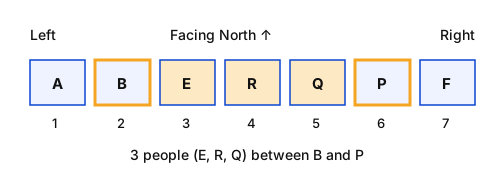
Concept: Fix definite positions first (people facing North: left to right = positions 1 to 7).

  1. No one to the right of F ⇒ F = 7. Three between F and E ⇒ E = 3.
  2. Two between E and P ⇒ P = 6.
  3. R, Q adjacent (Q right of R) with A third left of R ⇒ R = 4, Q = 5, A = 1; B = 2.
  4. Order: A B E R Q P F. Between B and P: E, R, Q = 3.

Trick: Start from the extreme person (F at the right end) – everything else hangs on it.

Answer: (C) Three

अवधारणा: पहले निश्चित स्थान तय करें (उत्तर की ओर मुख: बाएँ से दाएँ स्थान 1 से 7)।

  1. F के दाएँ कोई नहीं ⇒ F = 7। F और E के बीच तीन ⇒ E = 3।
  2. E और P के बीच दो ⇒ P = 6।
  3. R, Q सटे (Q, R के दाएँ) और A, R के तीसरे बाएँ ⇒ R = 4, Q = 5, A = 1; B = 2।
  4. क्रम: A B E R Q P F। B और P के बीच: E, R, Q = 3।

ट्रिक: छोर वाले व्यक्ति (दाएँ छोर पर F) से शुरू करें – बाकी उसी पर टिकते हैं।

उत्तर: (C) तीन

RRB Technician Grade IIIGeneral Intelligence and ReasoningLinear Seating ArrangementRRB Technician Grade III 2024 · 30 Dec Shift 1 →
Q240.
In a certain code language, ‘AMBER’ is coded as ‘79612’ and ‘UMBRA’ is coded as ‘12659’. What is the code for ‘U’ in the given code language?
एक निश्चित कूट भाषा में, ‘AMBER’ को ‘79612’ के रूप में कूटबद्ध किया जाता है और ‘UMBRA’ को ‘12659’ के रूप में कूटबद्ध किया जाता है। दी गई कूट भाषा में ‘U’ के लिए कूट क्या है?
  1. A9
  2. B2
  3. C5
  4. D1
Show answer

Concept: Common letters take the common digits; the extra letter takes the extra digit.

  1. AMBER = 79612, UMBRA = 12659.
  2. Common letters A, M, B, R ↔ common digits 9, 6, 1, 2.
  3. AMBER leftover: E = 7; UMBRA leftover: U = 5.

Trick: Cancel matching digits from both codes – U pairs with the unmatched 5.

Answer: (C) 5

अवधारणा: समान अक्षरों के समान अंक; अतिरिक्त अक्षर का अतिरिक्त अंक।

  1. AMBER = 79612, UMBRA = 12659।
  2. समान अक्षर A, M, B, R ↔ समान अंक 9, 6, 1, 2।
  3. AMBER में बचा: E = 7; UMBRA में बचा: U = 5।

ट्रिक: दोनों कोड से मेल खाते अंक काटें – U का कोड बचा हुआ 5 है।

उत्तर: (C) 5

RRB Technician Grade IIIGeneral Intelligence and ReasoningCoding–DecodingRRB Technician Grade III 2024 · 30 Dec Shift 1 →