Question bank

Q&A: practice questions with answers

Search questions on any topic. Filter by exam category, exam, subject and topic, try the question, then open the answer and explanation.

Courses – airGurukul

3,200 questions found.

Q241.
D, E, F, G, L, M and N are sitting around a circular table facing the centre. E sits to the immediate right of D. Only three people sit between E and L when counted from the left of E. Only three people sit between D and G when counted from the left of D. N sits to the immediate right of M.
How many people sit between F and M when counted from the left of M?
D, E, F, G, L, M और N एक वृत्ताकार मेज़ के चारों ओर केंद्र की ओर मुख करके बैठे हैं। E, D के ठीक दाएँ बैठा है। E के बाएँ से गिनने पर E और L के बीच केवल तीन व्यक्ति बैठे हैं। D के बाएँ से गिनने पर D और G के बीच केवल तीन व्यक्ति बैठे हैं। N, M के ठीक दाएँ बैठा है।
M के बाएँ से गिनने पर F और M के बीच कितने व्यक्ति बैठे हैं?
  1. ATwoदो
  2. BThreeतीन
  3. CFourचार
  4. DOneएक
Show answer

Concept: Facing the centre: left = clockwise, right = anticlockwise.
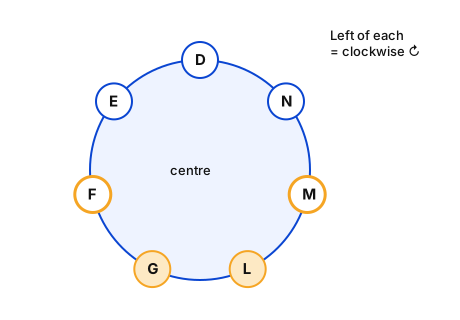
  1. Place D; E is to D's immediate right (anticlockwise).
  2. From E's left (clockwise): E, then 3 people, then L. From D's left: D, then 3 people, then G.
  3. N is immediate right of M ⇒ clockwise order: D, N, M, L, G, F, E.
  4. From M's left (clockwise): M → L, G → F; 2 people between.

Trick: For people facing the centre, 'counted from the left' means move clockwise.

Answer: (A) Two

अवधारणा: केंद्र की ओर मुख: बायाँ = दक्षिणावर्त, दायाँ = वामावर्त।

  1. D रखें; E, D के ठीक दाएँ (वामावर्त)।
  2. E के बाएँ (दक्षिणावर्त) से: E, फिर 3 व्यक्ति, फिर L। D के बाएँ से: D, फिर 3 व्यक्ति, फिर G।
  3. N, M के ठीक दाएँ ⇒ दक्षिणावर्त क्रम: D, N, M, L, G, F, E।
  4. M के बाएँ (दक्षिणावर्त) से: M → L, G → F; बीच में 2 व्यक्ति।

ट्रिक: केंद्र की ओर मुख वालों के लिए 'बाएँ से गिनना' = दक्षिणावर्त चलना।

उत्तर: (A) दो
RRB Technician Grade IIIGeneral Intelligence and ReasoningCircular Seating ArrangementRRB Technician Grade III 2024 · 30 Dec Shift 1 →
Q242.
Which of the following options should come in place of the question mark (?) in the given series to make it logically complete?
16, 27, 38, 49, 60, ?
दी गई श्रृंखला को तार्किक रूप से पूर्ण करने के लिए प्रश्न चिह्न (?) के स्थान पर निम्नलिखित में से कौन-सा विकल्प आना चाहिए?
16, 27, 38, 49, 60, ?
  1. A71
  2. B73
  3. C70
  4. D72
Show answer

Concept: Find the common difference.

  1. 27−16=38−27=49−38=60−49=11.
  2. Next term =60+11=71.

Trick: Constant difference ⇒ arithmetic progression; just add 11.

Answer: (A) 71

अवधारणा: सार्व अंतर ज्ञात करें।

  1. 27−16=38−27=49−38=60−49=11।
  2. अगला पद =60+11=71।

ट्रिक: अंतर स्थिर ⇒ समांतर श्रेढ़ी; बस 11 जोड़ें।

उत्तर: (A) 71

RRB Technician Grade IIIGeneral Intelligence and ReasoningNumber SeriesRRB Technician Grade III 2024 · 30 Dec Shift 1 →
Q243.
If ‘I’ stands for ‘+’, ‘J’ stands for ‘×’, ‘K’ stands for ‘÷’, and ‘L’ stands for ‘−’, what will be come in place of the question mark ‘?’ in the following equation?
148 I 104 L 126 I (76 K 2) I (11 J 3) L 55 =?
यदि ‘I’ का अर्थ ‘+’, ‘J’ का अर्थ ‘×’, ‘K’ का अर्थ ‘÷’ और ‘L’ का अर्थ ‘−’ है, तो निम्नलिखित समीकरण में प्रश्न चिह्न ‘?’ के स्थान पर क्या आएगा?
148 I 104 L 126 I (76 K 2) I (11 J 3) L 55 =?
  1. A168
  2. B154
  3. C122
  4. D142
Show answer

Concept: Replace letters by signs and simplify using BODMAS.

  1. 148+104−126+(76÷2)+(11×3)−55.
  2. =148+104−126+38+33−55.
  3. =323−181=142.

Trick: Add all positive terms (323) and all negative terms (181) separately, then subtract.

Answer: (D) 142

अवधारणा: अक्षरों को चिह्नों से बदलकर BODMAS से हल करें।

  1. 148+104−126+(76÷2)+(11×3)−55।
  2. =148+104−126+38+33−55।
  3. =323−181=142।

ट्रिक: सभी धन पद (323) और ऋण पद (181) अलग-अलग जोड़ें, फिर घटाएँ।

उत्तर: (D) 142

RRB Technician Grade IIIGeneral Intelligence and ReasoningMathematical OperationsRRB Technician Grade III 2024 · 30 Dec Shift 1 →
Q244.
If ‘A’ stands for ‘÷’, ‘B’ stands for ‘×’, ‘C’ stands for ‘+’, and ‘D’ stands for ‘−’, what will come in place of the question mark ‘?’ in the following equation?
78 A 13 B 15 D 20 C 30 =?
यदि ‘A’ का अर्थ ‘÷’, ‘B’ का अर्थ ‘×’, ‘C’ का अर्थ ‘+’ और ‘D’ का अर्थ ‘−’ है, तो निम्नलिखित समीकरण में प्रश्न चिह्न ‘?’ के स्थान पर क्या आएगा?
78 A 13 B 15 D 20 C 30 =?
  1. A90
  2. B110
  3. C80
  4. D100
Show answer

Concept: Replace letters by signs and apply BODMAS.

  1. 78÷13×15−20+30.
  2. =6×15−20+30=90−20+30.
  3. =100.

Trick: ÷ and × are done left to right before + and −.

Answer: (D) 100

अवधारणा: अक्षरों को चिह्नों से बदलें और BODMAS लगाएँ।

  1. 78÷13×15−20+30।
  2. =6×15−20+30=90−20+30।
  3. =100।

ट्रिक: + और − से पहले ÷ और × बाएँ से दाएँ।

उत्तर: (D) 100

RRB Technician Grade IIIGeneral Intelligence and ReasoningMathematical OperationsRRB Technician Grade III 2024 · 30 Dec Shift 1 →
Q245.
Based on the English alphabetical order, three of the following four letter-clusters are alike in a certain way and thus form a group. Which letter-cluster does not belong to that group ?
(Note: The odd one out is not based on the number of consonants/vowels or their position in the letter cluster.)
अंग्रेज़ी वर्णमाला क्रम के आधार पर, निम्नलिखित चार अक्षर-समूहों में से तीन किसी निश्चित प्रकार से एकसमान हैं और इस प्रकार एक समूह बनाते हैं। कौन-सा अक्षर-समूह उस समूह से संबंधित नहीं है?
(ध्यान दें: असंगत अक्षर-समूह, उस अक्षर-समूह में व्यंजनों/स्वरों की संख्या या उनके स्थान पर आधारित नहीं है।)
  1. ARYT
  2. BJQK
  3. CFMH
  4. DNUP
Show answer

Concept: Compare the gaps between letters using alphabet positions.

  1. RYT: R+7=Y, Y−5=T. FMH: F+7=M, M−5=H. NUP: N+7=U, U−5=P.
  2. JQK: J+7=Q, but Q−6=K.
  3. JQK breaks the pattern +7,−5.

Trick: Also 1st→3rd: R→T, F→H, N→P are +2, but J→K is +1.

Answer: (B) JQK

अवधारणा: अक्षरों की स्थिति लेकर उनके बीच अंतर की तुलना करें।

  1. RYT: R+7=Y, Y−5=T। FMH: F+7=M, M−5=H। NUP: N+7=U, U−5=P।
  2. JQK: J+7=Q, पर Q−6=K।
  3. JQK प्रतिरूप +7,−5 को तोड़ता है।

ट्रिक: पहला→तीसरा: R→T, F→H, N→P में +2, पर J→K में +1।

उत्तर: (B) JQK

RRB Technician Grade IIIGeneral Intelligence and ReasoningOdd One Out – Letter ClustersRRB Technician Grade III 2024 · 30 Dec Shift 1 →
Q246.
Select the triad which follows the same pattern as that followed by the two triads given below. Both triads follow the same pattern.
MOVE - MOVE - EVOM
EXAM - EXAM - MAXE
उस त्रिक का चयन कीजिए जो उसी पैटर्न का अनुसरण करता है जिसका अनुसरण नीचे दिए गए दो त्रिक करते हैं। दोनों त्रिक एक ही पैटर्न का अनुसरण करते हैं।
MOVE - MOVE - EVOM
EXAM - EXAM - MAXE
  1. ANOSE - NSOE - ESON
  2. BDRAW - DRAW - RAWD
  3. CREAD - READ - DAER
  4. DMOST - OMST - TOSM
Show answer

Concept: Find how the 2nd and 3rd words are formed from the 1st.

  1. MOVE – MOVE – EVOM: 2nd is the same word, 3rd is the word reversed.
  2. EXAM – EXAM – MAXE follows the same rule.
  3. READ – READ – DAER: same, then reversed ✓.

Trick: Check option (A), (B), (D): their 2nd or 3rd word is not 'same' / 'reverse'.

Answer: (C) READ - READ - DAER

अवधारणा: दूसरा और तीसरा शब्द पहले से कैसे बना, ज्ञात करें।

  1. MOVE – MOVE – EVOM: दूसरा वही शब्द, तीसरा शब्द उल्टा।
  2. EXAM – EXAM – MAXE भी यही नियम।
  3. READ – READ – DAER: वही, फिर उल्टा ✓।

ट्रिक: (A), (B), (D) में दूसरा या तीसरा शब्द 'वही'/'उल्टा' नहीं है।

उत्तर: (C) READ - READ - DAER

RRB Technician Grade IIIGeneral Intelligence and ReasoningWord TriadsRRB Technician Grade III 2024 · 30 Dec Shift 1 →
Q247.
In a certain code language,
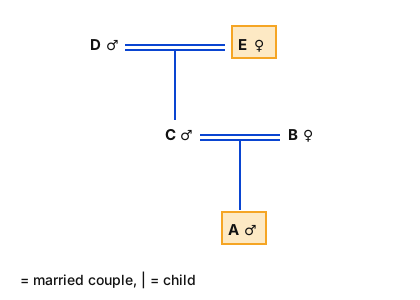
‘P + Q’ means ‘P is the son of Q’,
‘P – Q’ means ‘P is the wife of Q’,
‘P x Q’ means ‘P is the husband of Q’ and
‘P ÷ Q’ means ‘P is the brother of Q’,
How is A related to E if ‘A + B – C + D x E’?
एक निश्चित कूट भाषा में,
‘P + Q’ का अर्थ है ‘P, Q का पुत्र है’,
‘P – Q’ का अर्थ है ‘P, Q की पत्नी है’,
‘P x Q’ का अर्थ है ‘P, Q का पति है’ और
‘P ÷ Q’ का अर्थ है ‘P, Q का भाई है’,
यदि ‘A + B – C + D x E’ है, तो A, E से किस प्रकार संबंधित है?
  1. ASon’s sonपुत्र का पुत्र
  2. BDaughter's sonपुत्री का पुत्र
  3. CBrotherभाई
  4. DSonपुत्र
Show answer

Concept: Decode each symbol step by step and draw the family tree.

  1. A + B: A is the son of B. B − C: B is the wife of C (so C is A's father).
  2. C + D: C is the son of D. D × E: D is the husband of E (E is C's mother).
  3. E → son C → son A. So A is E's son's son.

Trick: Generation count: E is two generations above A through a male line (son of son).

Answer: (A) Son’s son

अवधारणा: हर चिह्न को क्रम से डिकोड करें और वंश-वृक्ष बनाएँ।

  1. A + B: A, B का पुत्र है। B − C: B, C की पत्नी है (अतः C, A का पिता)।
  2. C + D: C, D का पुत्र है। D × E: D, E का पति है (E, C की माता)।
  3. E → पुत्र C → पुत्र A। अतः A, E के पुत्र का पुत्र है।

ट्रिक: पीढ़ी गणना: E, A से दो पीढ़ी ऊपर है, पुरुष क्रम में (पुत्र का पुत्र)।

उत्तर: (A) पुत्र का पुत्र

RRB Technician Grade IIIGeneral Intelligence and ReasoningBlood Relations – CodedRRB Technician Grade III 2024 · 30 Dec Shift 1 →
Q248.
Kevin ranked 15th from the top and 20th from the bottom in his class. How many students are there in his class?
केविन की अपनी कक्षा में ऊपर से 15वीं और नीचे से 20वीं रैंक है। उसकी कक्षा में कितने विद्यार्थी हैं?
  1. A36
  2. B33
  3. C34
  4. D35
Show answer

Concept: Total=Rank from top+Rank from bottom−1.

  1. Total=15+20−1.
  2. =34.

Yaad rakhein: Subtract 1 because the person is counted in both ranks.

Answer: (C) 34

अवधारणा: कुल=ऊपर से रैंक+नीचे से रैंक−1।

  1. कुल=15+20−1।
  2. =34।

याद रखें: 1 घटाते हैं क्योंकि व्यक्ति दोनों रैंक में गिना गया है।

उत्तर: (C) 34

RRB Technician Grade IIIGeneral Intelligence and ReasoningRankingRRB Technician Grade III 2024 · 30 Dec Shift 1 →
Q249.
Which of the following options should come in place of the question mark (?) in the given series based on the English alphabetical order?
ADI EHM ILQ MPU ?
अंग्रेज़ी वर्णमाला क्रम के आधार पर दी गई श्रृंखला में प्रश्न चिह्न (?) के स्थान पर निम्नलिखित में से कौन-सा विकल्प आना चाहिए?
ADI EHM ILQ MPU ?
  1. ATYQ
  2. BTQY
  3. CQTY
  4. DQYT
Show answer

Concept: Check each letter position separately.

  1. 1st: A, E, I, M, Q (+4).
  2. 2nd: D, H, L, P, T (+4).
  3. 3rd: I, M, Q, U, Y (+4).

Trick: Each letter jumps +4; add 4 to every letter of MPU.

Answer: (C) QTY

अवधारणा: हर स्थान का अक्षर अलग से जाँचें।

  1. पहला: A, E, I, M, Q (+4)।
  2. दूसरा: D, H, L, P, T (+4)।
  3. तीसरा: I, M, Q, U, Y (+4)।

ट्रिक: हर अक्षर +4; MPU के हर अक्षर में 4 जोड़ें।

उत्तर: (C) QTY

RRB Technician Grade IIIGeneral Intelligence and ReasoningLetter SeriesRRB Technician Grade III 2024 · 30 Dec Shift 1 →
Q250.
Refer to the given number and symbol series and answer the question that follows. Counting to be done from left to right only.
(Left) 2 7 & 3 Ω 9 # 1 * £ & % 4 6 @ 8 $ 5 (Right)
If all the symbols are dropped from the series, which of the following will be fifth from the right?
दी गई संख्या और प्रतीक श्रृंखला को देखिए और इसके बाद आने वाले प्रश्न का उत्तर दीजिए। गिनती केवल बाएँ से दाएँ की जानी है।
(बाएँ) 2 7 & 3 Ω 9 # 1 * £ & % 4 6 @ 8 $ 5 (दाएँ)
यदि श्रृंखला से सभी प्रतीक हटा दिए जाएँ, तो निम्नलिखित में से कौन-सा दाएँ से पाँचवें स्थान पर होगा?
  1. A3
  2. B9
  3. C1
  4. D4
Show answer

Concept: Remove all symbols, rewrite the series and count from the right.

  1. Digits only: 2 7 3 9 1 4 6 8 5.
  2. From the right: 5 (1st), 8 (2nd), 6 (3rd), 4 (4th), 1 (5th).

Trick: Write the cleaned series first – counting on the original list causes mistakes.

Answer: (C) 1

अवधारणा: सभी प्रतीक हटाएँ, श्रृंखला दोबारा लिखें और दाएँ से गिनें।

  1. केवल अंक: 2 7 3 9 1 4 6 8 5।
  2. दाएँ से: 5 (पहला), 8 (दूसरा), 6 (तीसरा), 4 (चौथा), 1 (पाँचवाँ)।

ट्रिक: पहले साफ़ श्रृंखला लिखें – मूल सूची पर गिनने से गलती होती है।

उत्तर: (C) 1

RRB Technician Grade IIIGeneral Intelligence and ReasoningNumber–Symbol SeriesRRB Technician Grade III 2024 · 30 Dec Shift 1 →
Q251.
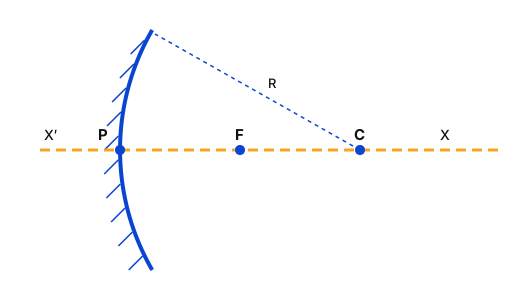
An imaginary straight line passing through the pole and the centre of curvature of a spherical mirror is called as ________.
गोलीय दर्पण के ध्रुव और वक्रता केंद्र से होकर गुजरने वाली एक काल्पनिक सीधी रेखा ________ कहलाती है।
  1. Aemergent rayनिर्गत किरण (emergent ray)
  2. Breflected rayपरावर्तित किरण (reflected ray)
  3. Cprincipal axisमुख्य अक्ष (principal axis)
  4. Dincident rayआपतित किरण (incident ray)
Show answer

Concept: For a spherical mirror, the pole (P) is the centre of its reflecting surface and the centre of curvature (C) is the centre of the sphere of which the mirror is a part.

  1. Join P and C by a straight line and extend it both ways (XX′ in the figure).
  2. This imaginary line is the principal axis; the focus F also lies on it, midway between P and C.
  3. Incident, reflected and emergent rays are actual light rays, not this reference line.

Yaad rakhein: Principal axis = line through P, F and C; it is normal to the mirror at the pole.

Answer: (C) principal axis

अवधारणा: गोलीय दर्पण में ध्रुव (P) परावर्तक सतह का मध्य बिंदु है और वक्रता केंद्र (C) उस गोले का केंद्र है जिसका दर्पण एक भाग है।

  1. P और C को सीधी रेखा से मिलाकर दोनों ओर बढ़ाइए (चित्र में XX′)।
  2. यही काल्पनिक रेखा मुख्य अक्ष कहलाती है; फोकस F भी इसी पर P और C के बीच में होता है।
  3. आपतित, परावर्तित और निर्गत किरणें वास्तविक प्रकाश किरणें हैं, यह संदर्भ रेखा नहीं।

याद रखें: मुख्य अक्ष = P, F और C से गुजरने वाली रेखा; यह ध्रुव पर दर्पण के अभिलंबवत होती है।

उत्तर: (C) मुख्य अक्ष (principal axis)

RRB Technician Grade IIIGeneral ScienceSpherical mirror termsRRB Technician Grade III 2024 · 30 Dec Shift 1 →
Q252.
Identify the balanced chemical equation for the following reaction.
Mg+O2→MgO
निम्नलिखित अभिक्रिया के लिए संतुलित रासायनिक समीकरण की पहचान कीजिए।
Mg+O2→MgO
  1. AMg+32O2→MgO
  2. B2Mg+32O2→3MgO
  3. C2Mg+12O2→2MgO
  4. DMg+12O2→MgO
Show answer

Concept: A balanced equation has equal numbers of each type of atom on both sides (law of conservation of mass).

  1. Mg: 1 on left, 1 in MgO on right – balanced.
  2. O: 1 atom in MgO, so we need 12O2 on the left.
  3. Check others: (A) has 3 O vs 1; (B) and (C) do not match Mg/O counts.

Trick: Multiply Mg+12O2→MgO by 2 → the familiar 2Mg+O2→2MgO.

Answer: (D) Mg+12O2→MgO

अवधारणा: संतुलित समीकरण में दोनों ओर प्रत्येक प्रकार के परमाणुओं की संख्या बराबर होती है (द्रव्यमान संरक्षण का नियम)।

  1. Mg: बाएँ 1, दाएँ MgO में 1 – संतुलित।
  2. O: MgO में 1 परमाणु, अतः बाएँ 12O2 चाहिए।
  3. बाकी जाँचें: (A) में 3 O बनाम 1; (B) व (C) में Mg/O की गिनती मेल नहीं खाती।

ट्रिक: Mg+12O2→MgO को 2 से गुणा करें → परिचित 2Mg+O2→2MgO।

उत्तर: (D) Mg+12O2→MgO

RRB Technician Grade IIIGeneral ScienceBalancing chemical equationsRRB Technician Grade III 2024 · 30 Dec Shift 1 →
Q253.
Which of the following elements is monoatomic?
निम्नलिखित में से कौन-सा तत्व एकपरमाणुक (monoatomic) है?
  1. AHeliumहीलियम
  2. BNitrogenनाइट्रोजन
  3. COxygenऑक्सीजन
  4. DHydrogenहाइड्रोजन
Show answer

Concept: Atomicity is the number of atoms in one molecule of an element. Noble gases have a stable complete outer shell, so they exist as single atoms.

  1. Helium (noble gas) – monoatomic: He.
  2. Nitrogen, oxygen and hydrogen exist as diatomic molecules: N2, O2, H2.
  3. Hence only helium is monoatomic.

Yaad rakhein: All noble gases (He, Ne, Ar, Kr, Xe, Rn) are monoatomic; O3 is triatomic, P4 tetra-atomic, S8 poly-atomic.

Answer: (A) Helium

अवधारणा: परमाणुकता किसी तत्व के एक अणु में परमाणुओं की संख्या है। उत्कृष्ट गैसों का बाहरी कोश पूर्ण व स्थिर होता है, इसलिए वे एकल परमाणु के रूप में रहती हैं।

  1. हीलियम (उत्कृष्ट गैस) – एकपरमाणुक: He।
  2. नाइट्रोजन, ऑक्सीजन और हाइड्रोजन द्विपरमाणुक अणु बनाते हैं: N2, O2, H2।
  3. अतः केवल हीलियम एकपरमाणुक है।

याद रखें: सभी उत्कृष्ट गैसें (He, Ne, Ar, Kr, Xe, Rn) एकपरमाणुक हैं; O3 त्रिपरमाणुक, P4 चतुष्परमाणुक, S8 बहुपरमाणुक।

उत्तर: (A) हीलियम

RRB Technician Grade IIIGeneral ScienceAtomicity of elementsRRB Technician Grade III 2024 · 30 Dec Shift 1 →
Q254.
Which of the following functions is NOT regulated by the medulla in the hind brain?
निम्नलिखित में से कौन-सा कार्य पश्चमस्तिष्क (hind brain) में स्थित मेडुला द्वारा नियंत्रित नहीं होता है?
  1. ASalivary regulationलार का नियमन
  2. BBlood pressure regulationरक्तचाप का नियमन
  3. CRegulation of hearingश्रवण का नियमन
  4. DVomiting controlउल्टी (वमन) का नियंत्रण
Show answer

Concept: The medulla oblongata of the hind brain controls involuntary actions of the body.

  1. Medulla controls blood pressure, salivation, vomiting, swallowing, coughing and sneezing.
  2. Hearing, smell and sight are sensory functions handled by specific regions of the fore brain (cerebrum).
  3. So regulation of hearing is NOT a medulla function.

Yaad rakhein: Medulla = involuntary 'SBV' – Salivation, Blood pressure, Vomiting; Cerebellum = balance and posture.

Answer: (C) Regulation of hearing

अवधारणा: पश्च मस्तिष्क का मेडुला ऑब्लांगेटा शरीर की अनैच्छिक क्रियाओं को नियंत्रित करता है।

  1. मेडुला रक्तचाप, लार स्राव, वमन (उल्टी), निगलना, खाँसना व छींकना नियंत्रित करता है।
  2. सुनना, सूँघना और देखना अग्र मस्तिष्क (प्रमस्तिष्क) के विशेष क्षेत्रों का कार्य है।
  3. अतः श्रवण का नियमन मेडुला का कार्य नहीं है।

याद रखें: मेडुला = अनैच्छिक कार्य – लार, रक्तचाप, वमन; अनुमस्तिष्क = संतुलन व मुद्रा।

उत्तर: (C) श्रवण का नियमन

RRB Technician Grade IIIGeneral ScienceHind brain – medullaRRB Technician Grade III 2024 · 30 Dec Shift 1 →
Q255.
The electric power consumed by a resistor of resistance R, carrying current I, is ________.
धारा I प्रवाहित करने वाले R प्रतिरोध के प्रतिरोधक द्वारा उपभुक्त विद्युत शक्ति ________ होती है।
  1. AIR
  2. BI/R
  3. CIR2
  4. DI2R
Show answer

Concept: Electric power is the rate of doing electrical work: P=VI.

  1. By Ohm's law, V=IR.
  2. Substitute: P=(IR)×I=I2R.
  3. Other forms: P=V2R.

Yaad rakhein: P=VI=I2R=V2R – unit watt (W).

Answer: (D) I2R

अवधारणा: विद्युत शक्ति विद्युत कार्य करने की दर है: P=VI।

  1. ओम के नियम से V=IR।
  2. रखने पर: P=(IR)×I=I2R।
  3. अन्य रूप: P=V2R।

याद रखें: P=VI=I2R=V2R – मात्रक वाट (W)।

उत्तर: (D) I2R

RRB Technician Grade IIIGeneral ScienceElectric powerRRB Technician Grade III 2024 · 30 Dec Shift 1 →
Q256.
In phloem, which of the following cells are dead cells?
फ्लोएम में, निम्नलिखित में से कौन-सी कोशिकाएँ मृत कोशिकाएँ होती हैं?
  1. ACompanion cellsसहचर कोशिकाएँ (Companion cells)
  2. BSieve cellsचालनी कोशिकाएँ (Sieve cells)
  3. CPhloem fibresफ्लोएम रेशे (Phloem fibres)
  4. DPhloem parenchymaफ्लोएम मृदूतक (Phloem parenchyma)
Show answer

Concept: Phloem has four elements: sieve tubes (sieve cells), companion cells, phloem parenchyma and phloem fibres.

  1. Sieve tubes, companion cells and phloem parenchyma are living cells.
  2. Phloem fibres are sclerenchymatous, thick-walled and dead.
  3. Hence phloem fibres are the only dead cells of phloem.

Yaad rakhein: Phloem – only fibres are dead; Xylem – only xylem parenchyma is living (tracheids, vessels, fibres are dead).

Answer: (C) Phloem fibres

अवधारणा: फ्लोएम के चार अवयव हैं: चालनी नलिकाएँ (चालनी कोशिकाएँ), सहचर कोशिकाएँ, फ्लोएम मृदूतक और फ्लोएम रेशे।

  1. चालनी नलिकाएँ, सहचर कोशिकाएँ और फ्लोएम मृदूतक जीवित कोशिकाएँ हैं।
  2. फ्लोएम रेशे दृढ़ोतक (स्क्लेरेनकाइमा) के, मोटी भित्ति वाले और मृत होते हैं।
  3. अतः फ्लोएम में केवल फ्लोएम रेशे मृत कोशिकाएँ हैं।

याद रखें: फ्लोएम – केवल रेशे मृत; जाइलम – केवल जाइलम मृदूतक जीवित (वाहिनिकाएँ, वाहिकाएँ, रेशे मृत)।

उत्तर: (C) फ्लोएम रेशे (Phloem fibres)

RRB Technician Grade IIIGeneral SciencePhloem – complex tissueRRB Technician Grade III 2024 · 30 Dec Shift 1 →
Q257.
Which of the following factors does NOT affect the rate of evaporation?
निम्नलिखित में से कौन-सा कारक वाष्पन की दर को प्रभावित नहीं करता है?
  1. AHumidity of the surrounding airआसपास की वायु की आर्द्रता
  2. BSurface area of the liquidद्रव का पृष्ठीय क्षेत्रफल
  3. CTemperature of the liquidद्रव का तापमान
  4. DColour of the liquidद्रव का रंग
Show answer

Concept: Evaporation is a surface phenomenon in which liquid particles escape into vapour below the boiling point.

  1. Larger surface area → faster evaporation.
  2. Higher temperature → more particles have enough kinetic energy → faster.
  3. Higher humidity → slower; wind speed increases it.
  4. Colour of the liquid has no effect on the rate.

Yaad rakhein: Evaporation factors: surface area ↑, temperature ↑, wind speed ↑ → rate ↑; humidity ↑ → rate ↓.

Answer: (D) Colour of the liquid

अवधारणा: वाष्पीकरण एक सतही प्रक्रिया है जिसमें द्रव के कण क्वथनांक से नीचे ही वाष्प में बदलते हैं।

  1. अधिक पृष्ठ क्षेत्रफल → तेज वाष्पीकरण।
  2. अधिक ताप → अधिक कणों को पर्याप्त गतिज ऊर्जा → तेज।
  3. अधिक आर्द्रता → धीमा; वायु की गति इसे बढ़ाती है।
  4. द्रव के रंग का दर पर कोई प्रभाव नहीं।

याद रखें: पृष्ठ क्षेत्रफल ↑, ताप ↑, वायु गति ↑ → दर ↑; आर्द्रता ↑ → दर ↓।

उत्तर: (D) द्रव का रंग

RRB Technician Grade IIIGeneral ScienceFactors affecting evaporationRRB Technician Grade III 2024 · 30 Dec Shift 1 →
Q258.
When iron filings are sprinkled around a magnet, they form a pattern. What does this pattern represent?
जब किसी चुंबक के चारों ओर लौह-चूर्ण छिड़का जाता है, तो वे एक प्रतिरूप (पैटर्न) बनाते हैं। यह प्रतिरूप किसे दर्शाता है?
  1. ANeither electric nor magnetic field linesन तो विद्युत और न ही चुंबकीय क्षेत्र रेखाएँ
  2. BBoth electric and magnetic field linesविद्युत और चुंबकीय दोनों क्षेत्र रेखाएँ
  3. CElectric field linesविद्युत क्षेत्र रेखाएँ
  4. DMagnetic field linesचुंबकीय क्षेत्र रेखाएँ
Show answer

Concept: A magnet produces a magnetic field around it; small iron filings act like tiny magnets and align along this field.

  1. Iron filings sprinkled near a bar magnet arrange themselves in curved lines from N to S.
  2. These curves trace the magnetic field lines.
  3. A stationary magnet produces no electric field, so the pattern is only magnetic.

Yaad rakhein: Field lines go N → S outside the magnet, S → N inside; they never intersect and are crowded near the poles (strong field).

Answer: (D) Magnetic field lines

अवधारणा: चुंबक अपने चारों ओर चुंबकीय क्षेत्र बनाता है; लोहे का बुरादा छोटे-छोटे चुंबकों की तरह इस क्षेत्र के अनुदिश व्यवस्थित हो जाता है।

  1. दंड चुंबक के पास छिड़का बुरादा N से S तक वक्र रेखाओं में सज जाता है।
  2. ये वक्र चुंबकीय क्षेत्र रेखाएँ दर्शाते हैं।
  3. स्थिर चुंबक विद्युत क्षेत्र नहीं बनाता, अतः यह पैटर्न केवल चुंबकीय है।

याद रखें: बाहर क्षेत्र रेखाएँ N → S, अंदर S → N; ये कभी नहीं काटतीं और ध्रुवों के पास घनी (प्रबल क्षेत्र) होती हैं।

उत्तर: (D) चुंबकीय क्षेत्र रेखाएँ

RRB Technician Grade IIIGeneral ScienceMagnetic field linesRRB Technician Grade III 2024 · 30 Dec Shift 1 →
Q259.
Mendel used a number of contrasting visible characters of garden peas. Match the last of the following with Which one of the following options appropriately fills the below blank space?
A. Round / Wrinkled seeds
B. Tall / Short plants
C. White / ______ flowers
मेंडल ने उद्यान मटर के अनेक विपरीत दृश्य लक्षणों का उपयोग किया। निम्नलिखित में से कौन-सा विकल्प नीचे दिए गए रिक्त स्थान को उपयुक्त रूप से भरता है?
A. गोल / झुर्रीदार बीज
B. लंबे / बौने पौधे
C. सफ़ेद / ______ फूल
  1. AYellowपीला
  2. BGreenहरा
  3. CVioletबैंगनी
  4. DPinkगुलाबी
Show answer

Concept: Mendel studied seven pairs of contrasting characters in garden pea (Pisum sativum).

  1. Seed shape: round / wrinkled; plant height: tall / short (dwarf).
  2. Flower colour: violet (purple) / white.
  3. So the blank is filled by violet.

Yaad rakhein: Seven pea traits: seed shape, seed colour (yellow/green), flower colour (violet/white), pod shape, pod colour, flower position, stem height.

Answer: (C) Violet

अवधारणा: मेंडल ने उद्यान मटर (पाइसम सैटाइवम) के सात विपर्यासी लक्षण-युग्मों का अध्ययन किया।

  1. बीज का आकार: गोल / झुर्रीदार; पौधे की लंबाई: लंबा / बौना।
  2. पुष्प का रंग: बैंगनी / सफेद।
  3. अतः रिक्त स्थान में बैंगनी आएगा।

याद रखें: सात लक्षण: बीज आकार, बीज रंग (पीला/हरा), पुष्प रंग (बैंगनी/सफेद), फली आकार, फली रंग, पुष्प स्थिति, तने की लंबाई।

उत्तर: (C) बैंगनी

RRB Technician Grade IIIGeneral ScienceMendel's contrasting traitsRRB Technician Grade III 2024 · 30 Dec Shift 1 →
Q260.
1 kilowatt is equal to ________.
1 किलोवाट ________ के बराबर होता है।
  1. A1000 J s−1
  2. B1000 J s−2
  3. C1000 J s
  4. D1000 J
Show answer

Concept: Power is energy used or work done per unit time: P=Wt, so 1 W=1 J s−1.

  1. 1 kW=1000 W.
  2. 1000 W=1000 J s−1.
  3. J alone is energy and J s is not power.

Yaad rakhein: 1 kWh=3.6×10⁶ J is energy (1 unit), while kW is power.

Answer: (A) 1000 J s−1

अवधारणा: शक्ति प्रति इकाई समय में किया गया कार्य या खर्च ऊर्जा है: P=Wt, अतः 1 W=1 J s−1।

  1. 1 kW=1000 W।
  2. 1000 W=1000 J s−1।
  3. केवल J ऊर्जा का मात्रक है और J s शक्ति नहीं है।

याद रखें: 1 kWh=3.6×10⁶ J ऊर्जा (1 यूनिट) है, जबकि kW शक्ति है।

उत्तर: (A) 1000 J s−1

RRB Technician Grade IIIGeneral ScienceUnit of powerRRB Technician Grade III 2024 · 30 Dec Shift 1 →