Question bank

Q&A: practice questions with answers

Search questions on any topic. Filter by exam category, exam, subject and topic, try the question, then open the answer and explanation.

Courses – airGurukul

3,200 questions found.

Q2621.
The sum of the length, breadth and height of a cuboid is p cm and its diagonal is q cm. Find its total surface area (in cm2).
एक घनाभ की लंबाई, चौड़ाई और ऊँचाई का योग p cm है और उसका विकर्ण q cm है। इसका कुल पृष्ठीय क्षेत्रफल (cm2 में) ज्ञात कीजिए।
  1. A(p−q)2
  2. Bp2−q2
  3. Cp2−q22
  4. Dp2+q2
Show answer

Concept: (l+b+h)2=l2+b2+h2+2(lb+bh+hl).

  1. l+b+h=p, diagonal2=l2+b2+h2=q2.
  2. p2=q2+TSA (since TSA=2(lb+bh+hl)).
  3. TSA=p2−q2.

Trick: Test a unit cube: l=b=h=1→p=3,q2=3,TSA=6=9−3=p2−q2 ✓.

Answer: (B) p2−q2

अवधारणा: (l+b+h)2=l2+b2+h2+2(lb+bh+hl)।

  1. l+b+h=p, विकर्ण2=l2+b2+h2=q2
  2. p2=q2+TSA (क्योंकि TSA=2(lb+bh+hl))
  3. TSA=p2−q2

ट्रिक: इकाई घन लें: l=b=h=1→p=3,q2=3,TSA=6=9−3 ✓

उत्तर: (B) p2−q2

RRB Technician Grade IIIMathematicsCuboid – surface area from sum of edges and diagonalRRB Technician Grade III 2025 · 9 Mar Shift 3 →
Q2622.
​A car travels 120 km at an unknown speed x km/h and then returns at (x + 20) km/h. The average speed for the whole journey is 60 km/h. Find the value of x. (Round to one decimal place.)
एक कार अज्ञात चाल x km/h से 120 km की यात्रा करती है और फिर (x + 20) km/h की चाल से वापस लौटती है। पूरी यात्रा की औसत चाल 60 km/h है। x का मान ज्ञात कीजिए। (एक दशमलव स्थान तक पूर्णांकित कीजिए।)
  1. A54.5
  2. B51.6
  3. C50.2
  4. D52.4
Show answer

Concept: For equal distances, average speed = 2xyx+y.

  1. 2x(x+20)2x+20=60→x(x+20)=60(x+10).
  2. x2−40x−600=0.
  3. x=40+1600+24002=40+63.252≈51.6 km/h.

Trick: Average speed lies between x and x + 20 and closer to the smaller one — check 51.6: 2×51.6×71.6123.2≈60 ✓.

Answer: (B) 51.6

अवधारणा: समान दूरी पर औसत चाल = 2xyx+y।

  1. 2x(x+20)2x+20=60→x(x+20)=60(x+10)
  2. x2−40x−600=0
  3. x=40+40002=40+63.252≈51.6 किमी/घंटा

ट्रिक: विकल्प जाँचें: 2×51.6×71.6123.2≈60 ✓। (दूरी 120 km का उत्तर पर कोई असर नहीं।)

उत्तर: (B) 51.6

RRB Technician Grade IIIMathematicsAverage speed – equal distancesRRB Technician Grade III 2025 · 9 Mar Shift 3 →
Q2623.
Two numbers are in the ratio of 4 : 9. If their sum is 26, then find the mean proportional between them.
दो संख्याएँ 4 : 9 के अनुपात में हैं। यदि उनका योग 26 है, तो उनके बीच का मध्यानुपाती ज्ञात कीजिए।
  1. A11
  2. B12
  3. C10
  4. D14
Show answer

Concept: Mean proportional of a and b = ab.

  1. Numbers = 26×413=8 and 26×913=18.
  2. 8×18=144=12.

Trick: Ratio 4 : 9 → mean proportional ratio = 4×9=6 parts; 1 part = 2613=2 → 12.

Answer: (B) 12

अवधारणा: a और b का मध्यानुपाती = ab।

  1. संख्याएँ = 26×413=8 और 26×913=18
  2. 8×18=144=12

ट्रिक: 4 : 9 → 4×9=6 भाग; 1 भाग = 2613=2 → 6×2=12।

उत्तर: (B) 12

RRB Technician Grade IIIMathematicsRatio – mean proportionalRRB Technician Grade III 2025 · 9 Mar Shift 3 →
Q2624.
A dealer buys two articles X and Y for ₹1,200 each. He marks each of them at the same price. He sells X by giving two successive discounts of 80% and 44% and still earns ₹172 as profit. If he sells Y at a single discount of 88%, then what is the profit
percentage on Y?
एक व्यापारी दो वस्तुएँ X और Y, प्रत्येक ₹1,200 में खरीदता है। वह उनमें से प्रत्येक पर समान मूल्य अंकित करता है। वह X को 80% और 44% की दो क्रमिक छूट देकर बेचता है और फिर भी ₹172 का लाभ अर्जित करता है। यदि वह Y को 88% की एकल छूट पर बेचता है, तो Y पर लाभ
प्रतिशत क्या है?
  1. A22.5%
  2. B21.5%
  3. C22%
  4. D21%
Show answer

Concept: SP after successive discounts =MP×(1−d1)(1−d2).

  1. SP of X = 1200+172= ₹1372.
  2. MP×0.20×0.56=1372→0.112MP=1372→MP= ₹12,250.
  3. SP of Y = 12% of 12250 = ₹1470.
  4. Profit = 270 → 2701200×100=22.5%.

Trick: SP(Y)SP(X)=0.120.112=1514→SP(Y)=1372×1514=1470.

Answer: (A) 22.5%

अवधारणा: क्रमिक छूट के बाद SP =MP×(1−d1)(1−d2)।

  1. X का SP = 1200+172= ₹1372
  2. MP×0.20×0.56=1372→MP= ₹12,250
  3. Y का SP = 12250 का 12% = ₹1470
  4. लाभ = 270 → 2701200×100=22.5%

ट्रिक: SP(Y)SP(X)=0.120.112=1514→SP(Y)=1372×1514=1470।

उत्तर: (A) 22.5%

RRB Technician Grade IIIMathematicsSuccessive discounts and profit percentageRRB Technician Grade III 2025 · 9 Mar Shift 3 →
Q2625.
In a test, B got 50 marks while A got 80 marks out of 110 maximum marks. What percentage of A's marks were B's marks?
एक परीक्षा में, 110 अधिकतम अंकों में से B को 50 अंक मिले जबकि A को 80 अंक मिले। B के अंक, A के अंकों का कितना प्रतिशत थे?
  1. A110%
  2. B160%
  3. C72.73%
  4. D62.5%
Show answer

Concept: x as % of y = xy×100 (base = the quantity after 'of').

  1. B's marks as % of A's = 5080×100.
  2. =62.5%.

Trick: Maximum marks (110) is a distractor — ignore it. 5080=58=62.5%.

Answer: (D) 62.5%

अवधारणा: x, y का कितना % = xy×100 ('का' के बाद वाली राशि आधार है)।

  1. B के अंक, A के अंकों का = 5080×100
  2. =62.5%

ट्रिक: अधिकतम अंक (110) ध्यान भटकाने के लिए है। 58=62.5%।

उत्तर: (D) 62.5%

RRB Technician Grade IIIMathematicsPercentage – one quantity as % of anotherRRB Technician Grade III 2025 · 9 Mar Shift 3 →
Q2626.
In a certain code language, ‘SNOW’ is coded as ‘1732’ and ‘KNOW’ is coded as ‘5317’. What is the code for ‘K’ in that language?
एक निश्चित कूट भाषा में, ‘SNOW’ को ‘1732’ के रूप में कूटबद्ध किया जाता है और ‘KNOW’ को ‘5317’ के रूप में कूटबद्ध किया जाता है। उस भाषा में ‘K’ के लिए कूट क्या है?
  1. A7
  2. B5
  3. C2
  4. D1
Show answer

Concept: Common letters in two words share the common digits; the leftover letter gets the leftover digit.

  1. SNOW → 1732, KNOW → 5317.
  2. Common letters N, O, W ↔ common digits 1, 3, 7.
  3. So S = 2 and K = 5.

Trick: Digit present in KNOW's code but not in SNOW's code = code of K → 5.

Answer: (B) 5

अवधारणा: दोनों शब्दों के सामान्य अक्षरों के कोड भी सामान्य होते हैं; बचा अक्षर = बचा अंक।

  1. SNOW → 1732, KNOW → 5317
  2. सामान्य अक्षर N, O, W ↔ सामान्य अंक 1, 3, 7
  3. अतः S = 2 और K = 5

ट्रिक: KNOW के कोड का वह अंक जो SNOW में नहीं है = K का कोड → 5।

उत्तर: (B) 5

RRB Technician Grade IIIGeneral Intelligence and ReasoningCoding-decoding – common lettersRRB Technician Grade III 2025 · 9 Mar Shift 3 →
Q2627.
Based on the English alphabetical order, three of the following four letter-cluster pairs are alike in a certain way and thus form a group. Which letter-cluster pair DOES NOT belong to that group?
(Note: The odd one out is not based on the number of consonants/vowels or their position in the letter-cluster.)
अंग्रेज़ी वर्णमाला क्रम के आधार पर, निम्नलिखित चार अक्षर-समूह युग्मों में से तीन किसी निश्चित प्रकार से एकसमान हैं और इस प्रकार एक समूह बनाते हैं। कौन-सा अक्षर-समूह युग्म उस समूह से संबंधित नहीं है?
(ध्यान दें: असंगत अक्षर-समूह, उस अक्षर-समूह में व्यंजनों/स्वरों की संख्या या उनके स्थान पर आधारित नहीं है।)
  1. AQK - RL
  2. BHB - IC
  3. CJD - LE
  4. DMG - NH
Show answer

Concept: Compare each letter of the first cluster with the matching letter of the second.

  1. QK → RL: +1, +1. HB → IC: +1, +1. MG → NH: +1, +1.
  2. JD → LE: +2, +1 → different.

Trick: In the three alike pairs the second cluster is just the 'next letters' of the first — JD's next letters would be KE, not LE.

Answer: (C) JD - LE

अवधारणा: पहले समूह के हर अक्षर की तुलना दूसरे समूह के संगत अक्षर से करें।

  1. QK → RL: +1, +1; HB → IC: +1, +1; MG → NH: +1, +1
  2. JD → LE: +2, +1 → अलग।

ट्रिक: JD के अगले अक्षर KE होने चाहिए, LE नहीं।

उत्तर: (C) JD - LE

RRB Technician Grade IIIGeneral Intelligence and ReasoningOdd one out – letter-cluster pairsRRB Technician Grade III 2025 · 9 Mar Shift 3 →
Q2628.
Select the pair which follows the same pattern as that followed by the two set of pairs given below. Both pairs follow the same pattern.
POK−GFB
FEA−WVR
उस युग्म का चयन कीजिए जो उसी पैटर्न का अनुसरण करता है जिसका अनुसरण नीचे दिए गए दो युग्मों द्वारा किया गया है। दोनों युग्म एक ही पैटर्न का अनुसरण करते हैं।
POK−GFB
FEA−WVR
  1. AWVR−NMI
  2. BWUP−NMI
  3. CWUP−MLH
  4. DWVR−MMH
Show answer

Concept: Each letter moves back by the same number of places.

  1. POK → GFB: P(16) − 9 = G(7), O − 9 = F, K − 9 = B.
  2. FEA → WVR: F − 9 = W, E − 9 = V, A − 9 = R (wrapping round).
  3. WVR → W − 9 = N, V − 9 = M, R − 9 = I → NMI.

Trick: −9 is the same as +17; or note WVR itself appears in the given pair, so just apply the same −9 to it.

Answer: (A) WVR−NMI

अवधारणा: हर अक्षर समान स्थान पीछे खिसकता है।

  1. POK → GFB: P(16) − 9 = G(7), O − 9 = F, K − 9 = B
  2. FEA → WVR: F − 9 = W, E − 9 = V, A − 9 = R (Z के बाद फिर से)
  3. WVR → N, M, I → NMI

ट्रिक: −9 = +17; विकल्प A और D में WVR है, केवल A में −9 सही बैठता है।

उत्तर: (A) WVR−NMI

RRB Technician Grade IIIGeneral Intelligence and ReasoningLetter analogy – fixed backward shiftRRB Technician Grade III 2025 · 9 Mar Shift 3 →
Q2629.
What should come in place of ? in the given series based on the English alphabetical order?
SJT HYI WNX LCM ?
अंग्रेज़ी वर्णमाला क्रम के आधार पर दी गई श्रृंखला में प्रश्न चिह्न (?) के स्थान पर क्या आना चाहिए?
SJT HYI WNX LCM ?
  1. AABR
  2. BARB
  3. CASD
  4. DABS
Show answer

Concept: Track each position separately (mod 26).

  1. 1st letters: S → H → W → L → A (each +15, i.e. −11).
  2. 2nd letters: J → Y → N → C → R (+15).
  3. 3rd letters: T → I → X → M → B (+15).
  4. Missing term = ARB.

Trick: +15 = −11 in a circular alphabet; L(12) − 11 = A(1), C(3) + 15 = R(18), M(13) − 11 = B(2).

Answer: (B) ARB

अवधारणा: हर स्थान के अक्षर को अलग-अलग देखें (26 के चक्र में)।

  1. पहला अक्षर: S → H → W → L → A (हर बार +15 यानी −11)
  2. दूसरा: J → Y → N → C → R
  3. तीसरा: T → I → X → M → B
  4. उत्तर = ARB

ट्रिक: +15 = −11; L(12) − 11 = A(1), C(3) + 15 = R(18), M(13) − 11 = B(2)।

उत्तर: (B) ARB

RRB Technician Grade IIIGeneral Intelligence and ReasoningLetter series – constant +15 shiftRRB Technician Grade III 2025 · 9 Mar Shift 3 →
Q2630.
Each vowel in the word AMBLERS is changed to the letter immediately following it in the English alphabetical order and each consonant is changed to the letter immediately preceding it in the English alphabetical order. How many letters will appear exactly twice in the new group of letters thus formed?
शब्द AMBLERS के प्रत्येक स्वर को अंग्रेज़ी वर्णमाला क्रम में उसके ठीक बाद वाले अक्षर से बदल दिया जाता है और प्रत्येक व्यंजन को अंग्रेज़ी वर्णमाला क्रम में उसके ठीक पहले वाले अक्षर से बदल दिया जाता है। इस प्रकार बने अक्षरों के नए समूह में कितने अक्षर ठीक दो बार आएँगे?
  1. ATwoदो
  2. BZeroशून्य
  3. CThreeतीन
  4. DOneएक
Show answer

Concept: Vowel → next letter; consonant → previous letter.

  1. A → B, M → L, B → A, L → K, E → F, R → Q, S → R.
  2. New group: B L A K F Q R.
  3. All 7 letters are different → no letter appears twice.

Trick: Watch pairs like B→A and A→B or S→R and R→Q — they swap letters but don't create repeats here.

Answer: (B) Zero

अवधारणा: स्वर → अगला अक्षर; व्यंजन → पिछला अक्षर।

  1. A → B, M → L, B → A, L → K, E → F, R → Q, S → R
  2. नया समूह: B L A K F Q R
  3. सभी 7 अक्षर अलग → कोई अक्षर दो बार नहीं।

ट्रिक: B→A, A→B और S→R, R→Q जैसे जोड़ों पर ध्यान दें — यहाँ ये दोहराव नहीं बनाते।

उत्तर: (B) शून्य

RRB Technician Grade IIIGeneral Intelligence and ReasoningLetter shifting – vowels and consonantsRRB Technician Grade III 2025 · 9 Mar Shift 3 →
Q2631.
Based on the English alphabetical order, three of the following four letter-cluster pairs are alike in a certain way and thus form a group. Which is the one that does not belong to that group?
(Note: The odd one out is not based on the number of consonants/vowels or their position in the letter-cluster.)
अंग्रेज़ी वर्णमाला क्रम के आधार पर, निम्नलिखित चार अक्षर-समूह युग्मों में से तीन किसी निश्चित प्रकार से एकसमान हैं और इस प्रकार एक समूह बनाते हैं। वह कौन-सा युग्म है जो उस समूह से संबंधित नहीं है?
(ध्यान दें: असंगत अक्षर-समूह, उस अक्षर-समूह में व्यंजनों/स्वरों की संख्या या उनके स्थान पर आधारित नहीं है।)
  1. AMP - RT
  2. BPS - TW
  3. CJM - NQ
  4. DQT - UX
Show answer

Concept: Check gaps within each cluster and between clusters.

  1. PS - TW: P→S +3, T→W +3, P→T +4.
  2. JM - NQ and QT - UX follow the same +3, +3, +4 pattern.
  3. MP - RT: M→P +3 but R→T +2 → odd.

Trick: Just check the second cluster's gap: TW, NQ, UX are all +3; RT is +2.

Answer: (A) MP - RT

अवधारणा: हर समूह के भीतर और दोनों समूहों के बीच का अंतर देखें।

  1. PS - TW: P→S +3, T→W +3, P→T +4
  2. JM - NQ और QT - UX भी +3, +3, +4
  3. MP - RT: M→P +3 पर R→T +2 → विषम

ट्रिक: दूसरे समूह का अंतर देखें: TW, NQ, UX में +3; RT में +2।

उत्तर: (A) MP - RT

RRB Technician Grade IIIGeneral Intelligence and ReasoningOdd one out – letter-cluster pairsRRB Technician Grade III 2025 · 9 Mar Shift 3 →
Q2632.
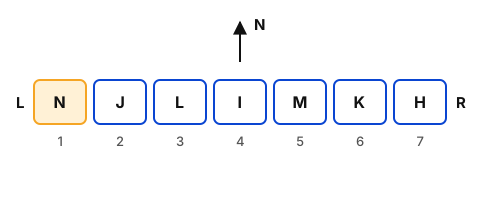
Seven people H, I, J, K, L, M, and N are sitting in a row facing the north. Only two people are seated to the left of L. Only three people are seated between L and H. I is seated second to the right of J. I is not an immediate neighbour of H. K is seated to the immediate right of M. Who is seated at the extreme left end of the row?
सात व्यक्ति H, I, J, K, L, M और N उत्तर की ओर मुख करके एक पंक्ति में बैठे हैं। L के बाईं ओर केवल दो व्यक्ति बैठे हैं। L और H के बीच केवल तीन व्यक्ति बैठे हैं। I, J के दाईं ओर दूसरे स्थान पर बैठा है। I, H का निकटतम पड़ोसी नहीं है। K, M के ठीक दाईं ओर बैठा है। पंक्ति के सबसे बाएँ छोर पर कौन बैठा है?
  1. AN
  2. BJ
  3. CK
  4. DH
Show answer

Concept: Fix the definite positions first, then place pairs.

  1. Two people left of L → L at position 3 (from left).
  2. Three between L and H → H at 7.
  3. I is 2nd right of J: (2, 4) works; (4, 6) fails as I would be H's neighbour → J = 2, I = 4.
  4. M, K adjacent (K right of M) → M = 5, K = 6; N = 1.

Trick: Once L and H are fixed, only one J–I placement survives the 'not neighbour of H' clue.

Answer: (A) N

अवधारणा: पहले निश्चित स्थान तय करें, फिर जोड़े बैठाएँ।

  1. L के बाएँ केवल दो → L स्थान 3 पर (बाएँ से)।
  2. L और H के बीच तीन → H स्थान 7 पर।
  3. I, J के दूसरे दाएँ: (4, 6) में I, H का पड़ोसी बनता → J = 2, I = 4।
  4. K, M के ठीक दाएँ → M = 5, K = 6; N = 1।

ट्रिक: L और H तय होते ही J–I का केवल एक स्थान बचता है।

उत्तर: (A) N

RRB Technician Grade IIIGeneral Intelligence and ReasoningLinear seating arrangementRRB Technician Grade III 2025 · 9 Mar Shift 3 →
Q2633.
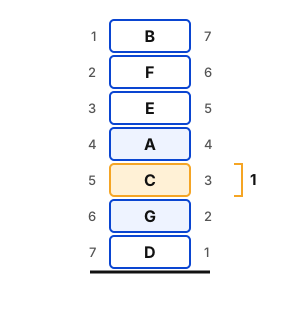
Seven boxes A, B, C, D, E, F and G are kept one over the other but not necessarily in the same order. E is kept fifth from the bottom. C is kept fifth from the top. Only one box is kept between D and C. F is kept immediately below B. A is not kept below G. How many boxes are kept between G and A?
सात बक्से A, B, C, D, E, F और G एक के ऊपर एक रखे गए हैं, लेकिन जरूरी नहीं कि इसी क्रम में हों। E को नीचे से पाँचवें स्थान पर रखा गया है। C को ऊपर से पाँचवें स्थान पर रखा गया है। D और C के बीच केवल एक बक्सा रखा गया है। F को B के ठीक नीचे रखा गया है। A को G के नीचे नहीं रखा गया है। G और A के बीच कितने बक्से रखे गए हैं?
  1. ANoneकोई नहीं
  2. BTwoदो
  3. CThreeतीन
  4. DOneएक
Show answer

Concept: Convert 'from top' to 'from bottom' (7 boxes: nth from top = (8 − n)th from bottom).

  1. E = 5th from bottom; C = 5th from top = 3rd from bottom.
  2. One box between D and C → D = 1 or 5; 5 is E → D = 1.
  3. F just below B → free consecutive slots only 6, 7 → F = 6, B = 7.
  4. A, G in 2 and 4; A not below G → A = 4, G = 2.
  5. Between G (2) and A (4): only C → one box.

Trick: Fill fixed positions first; the B–F pair then has just one possible place.

Answer: (D) One

अवधारणा: 'ऊपर से' को 'नीचे से' में बदलें (7 बॉक्स: ऊपर से n वाँ = नीचे से (8 − n) वाँ)।

  1. E = नीचे से 5वाँ; C = ऊपर से 5वाँ = नीचे से 3रा।
  2. D और C के बीच एक → D = 1 या 5; 5 पर E → D = 1।
  3. F, B के ठीक नीचे → खाली लगातार स्थान 6, 7 → F = 6, B = 7।
  4. A, G के लिए 2 और 4; A, G से नीचे नहीं → A = 4, G = 2।
  5. G (2) और A (4) के बीच केवल C → एक बॉक्स।

ट्रिक: निश्चित स्थान भरते ही B–F जोड़े का एक ही स्थान बचता है।

उत्तर: (D) एक

RRB Technician Grade IIIGeneral Intelligence and ReasoningBox stacking puzzleRRB Technician Grade III 2025 · 9 Mar Shift 3 →
Q2634.
Each vowel in the word THALERS is changed to the letter immediately following it in the English alphabetical order and each consonant is changed to the letter immediately preceding it in the English alphabetical order. How many letters will appear exactly twice in the group of letters thus formed?
शब्द THALERS के प्रत्येक स्वर को अंग्रेज़ी वर्णमाला क्रम में उसके ठीक बाद वाले अक्षर से बदल दिया जाता है और प्रत्येक व्यंजन को अंग्रेज़ी वर्णमाला क्रम में उसके ठीक पहले वाले अक्षर से बदल दिया जाता है। इस प्रकार बने अक्षरों के समूह में कितने अक्षर ठीक दो बार आएँगे?
  1. A3
  2. B0
  3. C2
  4. D1
Show answer

Concept: Vowel → next letter; consonant → previous letter.

  1. T → S, H → G, A → B, L → K, E → F, R → Q, S → R.
  2. New group: S G B K F Q R.
  3. All letters are different → 0 letters appear twice.

Trick: Repeats can only come from 'chains' like S→R and R→Q; here the original R and S both shift, so no clash.

Answer: (B) 0

अवधारणा: स्वर → अगला अक्षर; व्यंजन → पिछला अक्षर।

  1. T → S, H → G, A → B, L → K, E → F, R → Q, S → R
  2. नया समूह: S G B K F Q R
  3. सभी अक्षर अलग → 0

ट्रिक: दोहराव केवल S→R, R→Q जैसी 'शृंखला' से बन सकता है; यहाँ R और S दोनों बदल जाते हैं, इसलिए कोई टकराव नहीं।

उत्तर: (B) 0

RRB Technician Grade IIIGeneral Intelligence and ReasoningLetter shifting – vowels and consonantsRRB Technician Grade III 2025 · 9 Mar Shift 3 →
Q2635.
Based on the English alphabetical order, three of the following four letter-clusters are alike in a certain way and thus form a group. Which letter-cluster DOES NOT belong to that group?
(Note: The odd one out is not based on the number of consonants/vowels or their position in the letter-cluster.)
अंग्रेज़ी वर्णमाला क्रम के आधार पर, निम्नलिखित चार अक्षर-समूहों में से तीन किसी निश्चित प्रकार से एकसमान हैं और इस प्रकार एक समूह बनाते हैं। कौन-सा अक्षर-समूह उस समूह से संबंधित नहीं है?
(ध्यान दें: असंगत अक्षर-समूह, उस अक्षर-समूह में व्यंजनों/स्वरों की संख्या या उनके स्थान पर आधारित नहीं है।)
  1. ARKL
  2. BPSQ
  3. CUXV
  4. DSVT
Show answer

Concept: Find the gap pattern between consecutive letters.

  1. PSQ: P→S +3, S→Q −2.
  2. UXV: +3, −2; SVT: +3, −2.
  3. RKL: R→K −7, K→L +1 → odd.

Trick: In the alike clusters the 3rd letter is just after the 1st (P-Q, U-V, S-T); in RKL it isn't.

Answer: (A) RKL

अवधारणा: लगातार अक्षरों के बीच का अंतर देखें।

  1. PSQ: +3, −2
  2. UXV: +3, −2; SVT: +3, −2
  3. RKL: −7, +1 → विषम

ट्रिक: समान समूहों में तीसरा अक्षर पहले के ठीक बाद वाला है (P-Q, U-V, S-T); RKL में नहीं।

उत्तर: (A) RKL

RRB Technician Grade IIIGeneral Intelligence and ReasoningOdd one out – letter clustersRRB Technician Grade III 2025 · 9 Mar Shift 3 →
Q2636.
What will come in the place of ‘?’ in the following equation, if ‘+’ and ‘-’ are interchanged and ‘x’ and ‘÷’ are interchanged?
4 ÷ 2 + 12 x 4 - 3 = ?
यदि ‘+’ और ‘-’ को आपस में बदल दिया जाए तथा ‘x’ और ‘÷’ को आपस में बदल दिया जाए, तो निम्नलिखित समीकरण में ‘?’ के स्थान पर क्या आएगा?
4 ÷ 2 + 12 x 4 - 3 = ?
  1. A4
  2. B6
  3. C8
  4. D9
Show answer

Concept: Swap the signs first, then apply BODMAS.

  1. 4÷2+12×4−3 becomes 4×2−12÷4+3.
  2. =8−3+3.
  3. =8.

Trick: Rewrite the whole expression with new signs before calculating — avoids sign mix-ups.

Answer: (C) 8

अवधारणा: पहले चिह्न बदलें, फिर BODMAS लगाएँ।

  1. 4÷2+12×4−3 → 4×2−12÷4+3
  2. =8−3+3
  3. =8

ट्रिक: गणना से पहले पूरा व्यंजक नए चिह्नों के साथ दोबारा लिखें।

उत्तर: (C) 8

RRB Technician Grade IIIGeneral Intelligence and ReasoningMathematical operations – interchange of signsRRB Technician Grade III 2025 · 9 Mar Shift 3 →
Q2637.
Refer to the following letter series and answer the question that follows. Counting to be done from left to right.
(Left) E Z J K A R T S W H M F U C N P D K I E N O A K (Right)
How many such vowels are there, each of which is immediately preceded by a consonant and also immediately followed by a consonant?
निम्नलिखित अक्षर श्रृंखला को देखिए और उसके बाद दिए गए प्रश्न का उत्तर दीजिए। गिनती बाएँ से दाएँ की जानी है।
(बाएँ) E Z J K A R T S W H M F U C N P D K I E N O A K (दाएँ)
ऐसे कितने स्वर हैं, जिनमें से प्रत्येक के ठीक पहले एक व्यंजन है और ठीक बाद भी एक व्यंजन है?
  1. A1
  2. B3
  3. C4
  4. D2
Show answer

Concept: Check each vowel's left and right neighbours.

  1. Vowels: E(1st, no left), A (K A R ✓), U (F U C ✓), I (K I E ✗), E (I E N ✗), O (N O A ✗), A (O A K ✗).
  2. Only A and U qualify → 2.

Trick: The cluster 'I E N O A' at the end has vowels next to each other — none of them can count.

Answer: (D) 2

अवधारणा: हर स्वर के बाएँ और दाएँ पड़ोसी देखें।

  1. स्वर: E (पहला, बाएँ कोई नहीं), A (K A R ✓), U (F U C ✓), I (K I E ✗), E (I E N ✗), O (N O A ✗), A (O A K ✗)
  2. केवल A और U → 2

ट्रिक: अंत के 'I E N O A' में स्वर आपस में सटे हैं — इनमें कोई नहीं गिना जाएगा।

उत्तर: (D) 2

RRB Technician Grade IIIGeneral Intelligence and ReasoningLetter series – vowel between consonantsRRB Technician Grade III 2025 · 9 Mar Shift 3 →
Q2638.
Seven boxes, B, F, G, H, R, T and Y, kept one over the other, but not necessarily in the same order.
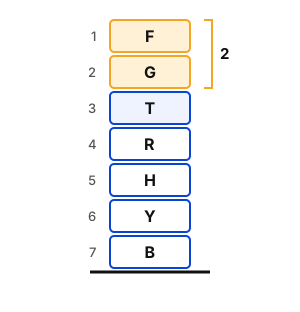
R is kept immediately above H. G is kept immediately above T. Only one box is kept between H and T. T is kept above R. Only one box is kept below Y. G or B are not kept at the top.
How many boxes are kept above T?
सात बक्से B, F, G, H, R, T और Y एक के ऊपर एक रखे गए हैं, लेकिन जरूरी नहीं कि इसी क्रम में हों।
R को H के ठीक ऊपर रखा गया है। G को T के ठीक ऊपर रखा गया है। H और T के बीच केवल एक बक्सा रखा गया है। T को R के ऊपर रखा गया है। Y के नीचे केवल एक बक्सा रखा गया है। G या B सबसे ऊपर नहीं रखे गए हैं।
T के ऊपर कितने बक्से रखे गए हैं?
  1. A1
  2. B4
  3. C2
  4. D3
Show answer

Concept: Join the linked clues into one block, then place it.

  1. G just above T, T above R, R just above H, one box (R) between T and H → block G-T-R-H (top to bottom).
  2. Only one box below Y → Y = 6th from top.
  3. Block cannot cover slot 6 and G is not at top → G = 2, T = 3, R = 4, H = 5.
  4. Top is not B → F = 1, B = 7.
  5. Above T: F and G → 2.

Trick: A 4-box block in 7 slots with slot 6 taken has only 2 options; 'G not at top' kills one.

Answer: (C) 2

अवधारणा: जुड़े हुए संकेतों से एक ब्लॉक बनाएँ, फिर उसे रखें।

  1. G, T के ठीक ऊपर; T, R के ऊपर; R, H के ठीक ऊपर; T और H के बीच एक (R) → ब्लॉक G-T-R-H (ऊपर से नीचे)।
  2. Y के नीचे केवल एक → Y ऊपर से 6वाँ।
  3. G सबसे ऊपर नहीं → G = 2, T = 3, R = 4, H = 5।
  4. ऊपर B नहीं → F = 1, B = 7।
  5. T के ऊपर: F और G → 2।

ट्रिक: 7 स्थानों में 4 का ब्लॉक (स्थान 6 भरा) — केवल 2 विकल्प; 'G ऊपर नहीं' से एक हटता है।

उत्तर: (C) 2

RRB Technician Grade IIIGeneral Intelligence and ReasoningBox stacking puzzleRRB Technician Grade III 2025 · 9 Mar Shift 3 →
Q2639.
Refer to the following series and answer the question. (All numbers are single-digit numbers only. Counting to be done from left to right.)
(Left) 7 2 9 1 3 2 9 4 1 6 8 5 4 3 7 6 4 2 8 1 3 5 (Right)
How many such odd digits are there, each of the which is immediately preceded by an even digit and immediately followed by an even digit?
निम्नलिखित श्रृंखला को देखिए और प्रश्न का उत्तर दीजिए। (सभी संख्याएँ केवल एक-अंकीय संख्याएँ हैं। गिनती बाएँ से दाएँ की जानी है।)
(बाएँ) 7 2 9 1 3 2 9 4 1 6 8 5 4 3 7 6 4 2 8 1 3 5 (दाएँ)
ऐसे कितने विषम अंक हैं, जिनमें से प्रत्येक के ठीक पहले एक सम अंक है और ठीक बाद भी एक सम अंक है?
  1. AOneएक
  2. BFourचार
  3. CTwoदो
  4. DThreeतीन
Show answer

Concept: Look for the pattern Even – Odd – Even.

  1. 2 9 4 ✓ (positions 6–8).
  2. 4 1 6 ✓ (8–10).
  3. 8 5 4 ✓ (11–13).
  4. Others (2 9 1, 4 3 7, 8 1 3 …) fail → total 3.

Trick: Scan only the even digits and look two steps ahead: E _ E with an odd digit in between.

Answer: (D) Three

अवधारणा: सम – विषम – सम पैटर्न खोजें।

  1. 2 9 4 ✓
  2. 4 1 6 ✓
  3. 8 5 4 ✓
  4. बाकी (2 9 1, 4 3 7, 8 1 3 …) नहीं → कुल 3

ट्रिक: केवल सम अंकों पर नजर रखें और दो कदम आगे देखें: सम _ सम, बीच में विषम।

उत्तर: (D) तीन

RRB Technician Grade IIIGeneral Intelligence and ReasoningNumber series – odd digit between even digitsRRB Technician Grade III 2025 · 9 Mar Shift 3 →
Q2640.
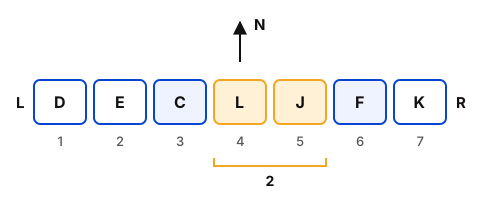
Seven people, C, D, E, F, J, K and L, are sitting in a row, facing north. Only three people sit between D and J. L sits to the immediate left of J. No one sits to the right of K. Only two people sit between K and L. C sits to the immediate right of E.
How many people sit between F and C?
सात व्यक्ति C, D, E, F, J, K और L उत्तर की ओर मुख करके एक पंक्ति में बैठे हैं। D और J के बीच केवल तीन व्यक्ति बैठे हैं। L, J के ठीक बाईं ओर बैठा है। K के दाईं ओर कोई नहीं बैठा है। K और L के बीच केवल दो व्यक्ति बैठे हैं। C, E के ठीक दाईं ओर बैठा है।
F और C के बीच कितने व्यक्ति बैठे हैं?
  1. AFourचार
  2. BOneएक
  3. CTwoदो
  4. DThreeतीन
Show answer

Concept: Start from the end-fixed person.

  1. No one right of K → K = 7 (from left).
  2. Two between K and L → L = 4; J immediate right of L → J = 5.
  3. Three between D and J → D = 1.
  4. E, C adjacent (C right of E) in 2, 3 → E = 2, C = 3; F = 6.
  5. Between F (6) and C (3): positions 4, 5 → two.

Trick: People between positions a and b = |a − b| − 1 = 6 − 3 − 1 = 2.

Answer: (C) Two

अवधारणा: छोर पर निश्चित व्यक्ति से शुरू करें।

  1. K के दाएँ कोई नहीं → K = 7
  2. K और L के बीच दो → L = 4; J, L के ठीक दाएँ → J = 5
  3. D और J के बीच तीन → D = 1
  4. C, E के ठीक दाएँ (2, 3 में) → E = 2, C = 3; F = 6
  5. F (6) और C (3) के बीच → दो

ट्रिक: बीच के व्यक्ति = |a − b| − 1 = 6 − 3 − 1 = 2।

उत्तर: (C) दो

RRB Technician Grade IIIGeneral Intelligence and ReasoningLinear seating arrangementRRB Technician Grade III 2025 · 9 Mar Shift 3 →