Question bank

Q&A: practice questions with answers

Search questions on any topic. Filter by exam category, exam, subject and topic, try the question, then open the answer and explanation.

Courses – airGurukul

3,200 questions found.

Q3101.
If 15 workers can build a wall in 10 days, how many workers are needed to build it in 6 days?
यदि 15 श्रमिक किसी दीवार को 10 दिनों में बना सकते हैं, तो उसे 6 दिनों में बनाने के लिए कितने श्रमिकों की आवश्यकता होगी?
  1. A22
  2. B26
  3. C20
  4. D25
Show answer

Concept: Total work is fixed, so workers × days stays constant (M1D1=M2D2).

  1. Work = 15×10=150 worker-days.
  2. Workers needed in 6 days = 150÷6=25.

Trick: Fewer days → more workers: 15×106=25. Multiply by the inverse ratio of days.

Answer: (D) 25

अवधारणा: काम निश्चित है, इसलिए मजदूर × दिन स्थिर रहता है (M1D1=M2D2)।

  1. कुल काम = 15×10=150 मजदूर-दिन।
  2. 6 दिन में चाहिए = 150÷6=25 मजदूर।

ट्रिक: दिन कम → मजदूर ज़्यादा: 15×106=25, यानी दिनों का उल्टा अनुपात लगाएँ।

उत्तर: (D) 25
RRB Technician Grade IIIMathematicsWork and time – workers and daysRRB Technician Grade III 2025 · 6 Mar Shift 1 →
Q3102.
If a sum of ₹8000 becomes thrice of itself after 8 years on
compound interest, then how much will it become after 24 years?
यदि ₹8000 की कोई राशि चक्रवृद्धि ब्याज पर 8 वर्षों में
स्वयं की तीन गुनी हो जाती है, तो 24 वर्षों के बाद यह कितनी हो जाएगी?
  1. A₹236000
  2. B₹253000
  3. C₹206000
  4. D₹216000
Show answer

Concept: In CI the amount gets multiplied by the same factor in every equal time period.

  1. In 8 years the sum becomes 3 times.
  2. 24 years = 3 periods of 8 years → factor = 3×3×3=27.
  3. Amount = 8000×27= ₹216000.

Trick: If P becomes n times in t years, it becomes nk times in k·t years: 33=27.

Answer: (D) ₹216000

अवधारणा: चक्रवृद्धि ब्याज में हर बराबर अवधि में राशि उसी गुणक से गुणा होती है।

  1. 8 वर्ष में राशि 3 गुना होती है।
  2. 24 वर्ष = 8-8 वर्ष की 3 अवधियाँ → 3×3×3=27 गुना।
  3. राशि = 8000×27= ₹216000।

ट्रिक: t वर्ष में n गुना हो तो k·t वर्ष में nk गुना: 33=27।

उत्तर: (D) ₹216000

RRB Technician Grade IIIMathematicsCompound interest – multiplying factorRRB Technician Grade III 2025 · 6 Mar Shift 1 →
Q3103.
The value of a machine is first depreciated by 20%. It is then appreciated by 25% and finally depreciated by 10%. Find the overall percentage change in its value.
किसी मशीन के मूल्य में पहले 20% का अवमूल्यन होता है। फिर इसमें 25% की वृद्धि होती है और अंत में 10% का अवमूल्यन होता है। इसके मूल्य में कुल प्रतिशत परिवर्तन ज्ञात कीजिए।
  1. A10% decrease10% कमी
  2. B12% decrease12% कमी
  3. C5% decrease5% कमी
  4. D8% decrease8% कमी
Show answer

Concept: Successive changes are multiplied, not added.

  1. Take value = 100.
  2. After −20%: 80; after +25%: 100; after −10%: 90.
  3. Change = 100 → 90 = 10% decrease.

Trick: Multiply factors: 0.8×1.25×0.9=0.90 → 10% decrease. Note 0.8×1.25=1 cancels out.

Answer: (A) 10% decrease

अवधारणा: क्रमिक प्रतिशत बदलाव गुणा होते हैं, जोड़े नहीं जाते।

  1. मान = 100 लें।
  2. −20% पर 80; +25% पर 100; −10% पर 90।
  3. 100 से 90 = 10% कमी।

ट्रिक: गुणक: 0.8×1.25×0.9=0.90 → 10% कमी। (0.8×1.25=1 आपस में कट जाते हैं)

उत्तर: (A) 10% कमी

RRB Technician Grade IIIMathematicsSuccessive percentage changeRRB Technician Grade III 2025 · 6 Mar Shift 1 →
Q3104.
A can finish a work in 5 days and B can do the same work in 50 days. B worked alone for 10 days and left the job. In how many days can A alone finish the remaining work?
A किसी कार्य को 5 दिनों में पूरा कर सकता है और B उसी कार्य को 50 दिनों में कर सकता है। B ने 10 दिनों तक अकेले कार्य किया और कार्य छोड़ दिया। शेष कार्य को A अकेले कितने दिनों में पूरा कर सकता है?
  1. A4
  2. B3.5
  3. C4.5
  4. D3
Show answer

Concept: Work done = days worked ÷ total days needed by that person.

  1. B's work in 10 days = 1050=15.
  2. Remaining work = 1−15=45.
  3. A's time = 45×5=4 days.

Trick: Total work = LCM(5, 50) = 50 units; A = 10/day, B = 1/day. B does 10, left 40 → 40÷10=4 days.

Answer: (A) 4

अवधारणा: किया गया काम = काम के दिन ÷ उस व्यक्ति के कुल दिन।

  1. B का 10 दिन का काम = 1050=15।
  2. शेष काम = 1−15=45।
  3. A का समय = 45×5=4 दिन।

ट्रिक: कुल काम = LCM(5, 50) = 50 इकाई; A = 10/दिन, B = 1/दिन। B ने 10 किया, बचा 40 → 40÷10=4 दिन।

उत्तर: (A) 4

RRB Technician Grade IIIMathematicsWork and time – remaining workRRB Technician Grade III 2025 · 6 Mar Shift 1 →
Q3105.
If a number is added to each of the numbers 16, 20 and 30, then the resulting numbers are in the continued proportion. Find the mean proportional between the largest and smallest of the resulting numbers.
यदि संख्याओं 16, 20 और 30 में से प्रत्येक में एक संख्या जोड़ी जाती है, तो परिणामी संख्याएँ वितत अनुपात (continued proportion) में होती हैं। परिणामी संख्याओं में से सबसे बड़ी और सबसे छोटी संख्या के बीच मध्यानुपाती ज्ञात कीजिए।
  1. A269
  2. B509
  3. C403
  4. D203
Show answer

Concept: a, b, c are in continued proportion if b2=ac; then b is the mean proportional of a and c.

  1. (20+x)2=(16+x)(30+x)→400+40x=480+46x→x=−403.
  2. Numbers: 83,203,503.
  3. Mean proportional of 83 and 503 = 4009=203.

Trick: In continued proportion, the mean proportional of the 1st and 3rd term is simply the middle term (20+x).

Answer: (D) 203

अवधारणा: a, b, c सतत अनुपात में हों तो b2=ac; b ही a और c का मध्यानुपाती है।

  1. (20+x)2=(16+x)(30+x)→400+40x=480+46x→x=−403।
  2. संख्याएँ: 83,203,503।
  3. 83 और 503 का मध्यानुपाती = 4009=203।

ट्रिक: सतत अनुपात में पहले और तीसरे पद का मध्यानुपाती सीधे बीच वाला पद (20+x) होता है।

उत्तर: (D) 203

RRB Technician Grade IIIMathematicsContinued proportion – mean proportionalRRB Technician Grade III 2025 · 6 Mar Shift 1 →
Q3106.
Simplify (5z-12y)2 + (12z+5y)2 - 144z2.
(5z-12y)2 + (12z+5y)2 - 144z2 को सरल कीजिए।
  1. A24z2+171y2
  2. B25z2+169y2
  3. C31z2+161y2
  4. D32z2+170y2
Show answer

Concept: Use (a−b)2=a2−2ab+b2 and (a+b)2=a2+2ab+b2.

  1. (5z−12y)2=25z2−120zy+144y2.
  2. (12z+5y)2=144z2+120zy+25y2.
  3. Sum −144z2=25z2+169y2 (the ±120zy terms cancel).

Trick: Cross terms cancel, so just add squares: z2→25+144−144=25; y2→144+25=169.

Answer: (B) 25z2+169y2

अवधारणा: (a−b)2=a2−2ab+b2 और (a+b)2=a2+2ab+b2 का प्रयोग।

  1. (5z−12y)2=25z2−120zy+144y2।
  2. (12z+5y)2=144z2+120zy+25y2।
  3. जोड़ −144z2=25z2+169y2 (±120zy कट जाते हैं)।

ट्रिक: बीच वाले पद कट जाते हैं, बस वर्ग जोड़ें: z2→25+144−144=25; y2→144+25=169।

उत्तर: (B) 25z2+169y2

RRB Technician Grade IIIMathematicsAlgebraic identities – (a ± b)²RRB Technician Grade III 2025 · 6 Mar Shift 1 →
Q3107.
The average of three numbers is 20. If the two numbers are 11 and 22, respectively, then the third number is:
तीन संख्याओं का औसत 20 है। यदि दो संख्याएँ क्रमशः 11 और 22 हैं, तो तीसरी संख्या है:
  1. A27
  2. B26
  3. C28
  4. D29
Show answer

Concept: Sum = average × number of items.

  1. Sum of 3 numbers = 20×3=60.
  2. Third number = 60−(11+22)=27.

Trick: Deviation method: 11 is −9, 22 is +2 from 20 → net −7, so third = 20+7=27.

Answer: (A) 27

अवधारणा: योग = औसत × संख्याओं की गिनती।

  1. 3 संख्याओं का योग = 20×3=60।
  2. तीसरी संख्या = 60−(11+22)=27।

ट्रिक: विचलन विधि: 11 → −9, 22 → +2, कुल −7, तो तीसरी = 20+7=27।

उत्तर: (A) 27

RRB Technician Grade IIIMathematicsAverage – missing numberRRB Technician Grade III 2025 · 6 Mar Shift 1 →
Q3108.
The sum of the present ages of Sharad and Adarsh is 36 years. After 2 years from now, Sharad's age will be three times that of Adarsh. Sharad's present age (in years) is:
शरद और आदर्श की वर्तमान आयु का योग 36 वर्ष है। अब से 2 वर्ष बाद, शरद की आयु आदर्श की आयु की तीन गुनी होगी। शरद की वर्तमान आयु (वर्षों में) है:
  1. A26
  2. B37
  3. C28
  4. D24
Show answer

Concept: Form equations from present sum and future ratio.

  1. Let Adarsh = A, Sharad = 36 − A.
  2. After 2 years: 38 − A = 3(A + 2) → 38 − A = 3A + 6 → A = 8.
  3. Sharad = 36 − 8 = 28 years.

Trick: Option check: Sharad 28 → Adarsh 8; after 2 years 30 and 10 → 3 times. ✓

Answer: (C) 28

अवधारणा: वर्तमान योग और भविष्य के अनुपात से समीकरण बनाएँ।

  1. आदर्श = A, शरद = 36 − A।
  2. 2 वर्ष बाद: 38 − A = 3(A + 2) → 38 − A = 3A + 6 → A = 8।
  3. शरद = 36 − 8 = 28 वर्ष।

ट्रिक: विकल्प जाँच: शरद 28 → आदर्श 8; 2 वर्ष बाद 30 और 10 → 3 गुना। ✓

उत्तर: (C) 28

RRB Technician Grade IIIMathematicsProblems on agesRRB Technician Grade III 2025 · 6 Mar Shift 1 →
Q3109.
A person borrows ₹10,000 for 3 years at 5% per annum simple interest. He immediately lends it to another person at 814% per annum simple interest for 3 years. What is his gain (in ₹) in the transaction per year?
एक व्यक्ति ₹10,000, 3 वर्षों के लिए 5% वार्षिक साधारण ब्याज पर उधार लेता है। वह तुरंत इसे दूसरे व्यक्ति को 3 वर्षों के लिए 814% वार्षिक साधारण ब्याज पर उधार दे देता है। इस लेन-देन में प्रति वर्ष उसका लाभ (₹ में) कितना है?
  1. A375
  2. B450
  3. C325
  4. D400
Show answer

Concept: Yearly gain = principal × (difference of rates) ÷ 100.

  1. Rate difference = 814%−5%=314%=3.25%.
  2. Gain per year = 10000×3.25100= ₹325.

Trick: Don't compute both interests – just apply the rate difference; 1% of 10000 = 100, so 3.25% = 325.

Answer: (C) 325

अवधारणा: प्रति वर्ष लाभ = मूलधन × (दरों का अंतर) ÷ 100।

  1. दरों का अंतर = 814%−5%=314%=3.25%।
  2. प्रति वर्ष लाभ = 10000×3.25100= ₹325।

ट्रिक: दोनों ब्याज अलग न निकालें; 10000 का 1% = 100, तो 3.25% = 325।

उत्तर: (C) 325

RRB Technician Grade IIIMathematicsSimple interest – gain per yearRRB Technician Grade III 2025 · 6 Mar Shift 1 →
Q3110.
What is the decimal form of 72+32.5+1.245+34?
72+32.5+1.245+34 का दशमलव रूप क्या है?
  1. A39.778
  2. B37.995
  3. C35.005
  4. D32.125
Show answer

Concept: Convert each fraction to a decimal, then add.

  1. 72=3.5 and 34=0.75.
  2. 3.5+32.5=36; 36+1.245=37.245.
  3. 37.245+0.75=37.995.

Trick: Look at the last 3 decimal places: .245+.750=.995 – only option (B) ends in .995.

Answer: (B) 37.995

अवधारणा: हर भिन्न को दशमलव में बदलकर जोड़ें।

  1. 72=3.5 और 34=0.75।
  2. 3.5+32.5=36; 36+1.245=37.245।
  3. 37.245+0.75=37.995।

ट्रिक: दशमलव के बाद के अंक देखें: .245+.750=.995 – केवल (B) का अंत .995 है।

उत्तर: (B) 37.995

RRB Technician Grade IIIMathematicsSimplification – fractions to decimalsRRB Technician Grade III 2025 · 6 Mar Shift 1 →
Q3111.
If x is the third proportional to 2 and y, and y is the third proportional to x and 18, then what is the value of y?
यदि x, 2 और y का तृतीयानुपाती है, तथा y, x और 18 का तृतीयानुपाती है, तो y का मान क्या है?
  1. A433
  2. B533
  3. C333
  4. D633
Show answer

Concept: Third proportional of a and b = b2a.

  1. x=y22.
  2. y=182x=324x→xy=324.
  3. (y22)×y=324→y3=648=216×3.
  4. y=633.

Trick: 648=63×3, so 6483=633 – spot the cube 216 quickly.

Answer: (D) 633

अवधारणा: a और b का तृतीयानुपाती = b2a।

  1. x=y22।
  2. y=182x=324x→xy=324।
  3. (y22)×y=324→y3=648=216×3।
  4. y=633।

ट्रिक: 648=63×3, इसलिए 6483=633 – घन 216 तुरंत पहचानें।

उत्तर: (D) 633

RRB Technician Grade IIIMathematicsThird proportionalRRB Technician Grade III 2025 · 6 Mar Shift 1 →
Q3112.
A classroom has 46 boys and 36 girls. If the number of girls is increased successively by 25% followed by another 20%, by how many will the number of girls exceed the number of boys?
एक कक्षा में 46 लड़के और 36 लड़कियाँ हैं। यदि लड़कियों की संख्या में क्रमिक रूप से पहले 25% और फिर 20% की वृद्धि की जाती है, तो लड़कियों की संख्या लड़कों की संख्या से कितनी अधिक हो जाएगी?
  1. A12
  2. B8
  3. C6
  4. D10
Show answer

Concept: Apply increases one after another on the new value.

  1. Girls after 25% rise = 36×1.25=45.
  2. After further 20% = 45×1.2=54.
  3. Excess over boys = 54−46=8.

Trick: Net increase = 25+20+25×20100=50% → 36×1.5=54.

Answer: (B) 8

अवधारणा: बढ़ोतरी एक के बाद एक नए मान पर लगाएँ।

  1. 25% बढ़ने पर लड़कियाँ = 36×1.25=45।
  2. फिर 20% बढ़ने पर = 45×1.2=54।
  3. लड़कों से अधिक = 54−46=8।

ट्रिक: कुल वृद्धि = 25+20+25×20100=50% → 36×1.5=54।

उत्तर: (B) 8

RRB Technician Grade IIIMathematicsSuccessive percentage increaseRRB Technician Grade III 2025 · 6 Mar Shift 1 →
Q3113.
If the lateral surface area of a cylinder is 140.1 cm2 and its height is 3 cm, then find its volume. (Use π = 3.14 and round off to two decimal places.)
यदि एक बेलन का वक्र पृष्ठीय क्षेत्रफल 140.1 cm2 है और इसकी ऊँचाई 3 cm है, तो इसका आयतन ज्ञात कीजिए। (π = 3.14 लीजिए और दो दशमलव स्थानों तक पूर्णांकित कीजिए।)
  1. A562.32 cm3
  2. B559.99 cm3
  3. C520.91 cm3
  4. D570.58 cm3
Show answer

Concept: CSA=2πrh, Volume =πr2h=CSA×r2.

  1. r=140.1÷(2×3.14×3)=140.1÷18.84≈7.4363 cm.
  2. V=140.1×7.43632=70.05×7.4363≈520.91cm3.

Trick: V=CSA×r2 avoids recomputing π: 70.05×7.44≈521 → option (C).

Answer: (C) 520.91 cm3

अवधारणा: वक्र पृष्ठ =2πrh, आयतन =πr2h =वक्र पृष्ठ×r2।

  1. r=140.1÷(2×3.14×3)=140.1÷18.84≈7.4363 cm।
  2. V=140.1×7.43632=70.05×7.4363≈520.91cm3।

ट्रिक: V=CSA×r2 से π दोबारा नहीं लगाना पड़ता: 70.05×7.44≈521 → (C)।

उत्तर: (C) 520.91 cm3

RRB Technician Grade IIIMathematicsCylinder – volume from curved surface areaRRB Technician Grade III 2025 · 6 Mar Shift 1 →
Q3114.
Find the value of 36−[10−3{14÷2−(10÷2×3−4+7)}].
36−[10−3{14÷2−(10÷2×3−4+7)}] का मान ज्ञात कीजिए।
  1. A-5
  2. B-7
  3. C5
  4. D7
Show answer

Concept: Solve innermost bracket first; inside it, ÷ and × left to right.

  1. (10÷2×3−4+7)=15−4+7=18.
  2. {14÷2−18}=7−18=−11.
  3. [10−3×(−11)]=10+33=43.
  4. 36−43=−7.

Trick: Watch the sign: −3×(−11) becomes +33. A sign slip gives the trap option −5 / 7.

Answer: (B) -7

अवधारणा: सबसे भीतरी कोष्ठक पहले; उसमें ÷ और × बाएँ से दाएँ।

  1. (10÷2×3−4+7)=15−4+7=18।
  2. {14÷2−18}=7−18=−11।
  3. [10−3×(−11)]=10+33=43।
  4. 36−43=−7।

ट्रिक: चिह्न पर ध्यान: −3×(−11)=+33। चिह्न की गलती से गलत विकल्प मिलता है।

उत्तर: (B) -7

RRB Technician Grade IIIMathematicsBODMAS simplificationRRB Technician Grade III 2025 · 6 Mar Shift 1 →
Q3115.
For a given data, the mean is 48.5 and the median is 44. The mode of the data is:
किसी दिए गए आँकड़े के लिए, माध्य 48.5 और माध्यिका 44 है। आँकड़े का बहुलक है:
  1. A42
  2. B35
  3. C32
  4. D25
Show answer

Concept: Mode =3× Median −2× Mean.

  1. Mode = 3×44−2×48.5.
  2. =132−97=35.

Yaad rakhein: Mean − Mode = 3(Mean − Median): 48.5− Mode =3×4.5=13.5→ Mode =35.

Answer: (B) 35

अवधारणा: बहुलक =3× माध्यिका −2× माध्य।

  1. बहुलक = 3×44−2×48.5।
  2. =132−97=35।

याद रखें: माध्य − बहुलक = 3(माध्य − माध्यिका): 48.5− बहुलक =13.5→ बहुलक =35।

उत्तर: (B) 35

RRB Technician Grade IIIMathematicsEmpirical relation – mean, median, modeRRB Technician Grade III 2025 · 6 Mar Shift 1 →
Q3116.
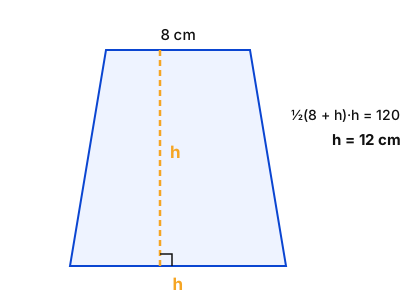
The length of one of the two parallel sides of a trapezium is 8 cm, while the length of the other side of this pair of parallel sides is equal to the distance between this pair of parallel sides. If the area of the trapezium is 120 cm2, then what is the distance (in cm) between the said pair of parallel sides?
एक समलंब की दो समांतर भुजाओं में से एक की लंबाई 8 cm है, जबकि समांतर भुजाओं के इस युग्म की दूसरी भुजा की लंबाई, समांतर भुजाओं के इस युग्म के बीच की दूरी के बराबर है। यदि समलंब का क्षेत्रफल 120 cm2 है, तो समांतर भुजाओं के उक्त युग्म के बीच की दूरी (cm में) कितनी है?
  1. A20
  2. B10
  3. C15
  4. D12
Show answer

Concept: Area = 12× (sum of parallel sides) × height.

  1. Let height = h, so sides are 8 and h.
  2. 12×(8+h)×h=120→h2+8h−240=0.
  3. (h+20)(h−12)=0→h=12 cm.

Trick: Test options: h=12→12×20×12=120 ✓.

Answer: (D) 12

अवधारणा: क्षेत्रफल = 12× (समांतर भुजाओं का योग) × ऊँचाई।

  1. ऊँचाई = h, तो भुजाएँ 8 और h।
  2. 12×(8+h)×h=120→h2+8h−240=0।
  3. (h+20)(h−12)=0→h=12 cm।

ट्रिक: विकल्प जाँचें: h=12→12×20×12=120 ✓।

उत्तर: (D) 12

RRB Technician Grade IIIMathematicsArea of trapeziumRRB Technician Grade III 2025 · 6 Mar Shift 1 →
Q3117.
If the surface area of a sphere is 314 cm2, find its radius.
(Take π = 3.14)
यदि एक गोले का पृष्ठीय क्षेत्रफल 314 cm2 है, तो इसकी त्रिज्या ज्ञात कीजिए।
(π = 3.14 लीजिए)
  1. A50 cm
  2. B0.5 cm
  3. C0.05 cm
  4. D5 cm
Show answer

Concept: Surface area of a sphere = 4πr2.

  1. 4×3.14×r2=314→12.56r2=314.
  2. r2=25→r=5 cm.

Trick: 314=3.14×100, so 4r2=100→r=5 instantly.

Answer: (D) 5 cm

अवधारणा: गोले का पृष्ठीय क्षेत्रफल = 4πr2।

  1. 4×3.14×r2=314→12.56r2=314।
  2. r2=25→r=5 cm।

ट्रिक: 314=3.14×100, तो 4r2=100→r=5 तुरंत।

उत्तर: (D) 5 cm

RRB Technician Grade IIIMathematicsSurface area of sphereRRB Technician Grade III 2025 · 6 Mar Shift 1 →
Q3118.
The value of 4+tan2θ+cot2θ−sec2θcosec2θ is:
4+tan2θ+cot2θ−sec2θcosec2θ का मान है:
  1. A0
  2. B-2
  3. C4
  4. D2
Show answer

Concept: sec2θ=1+tan2θ, cosec2θ=1+cot2θ, tanθ·cotθ=1.

  1. sec2θ·cosec2θ=(1+tan2θ)(1+cot2θ)=1+tan2θ+cot2θ+1.
  2. =2+tan2θ+cot2θ.
  3. Expression = 4+tan2θ+cot2θ−2−tan2θ−cot2θ=2.

Trick: Put θ=45∘: 4+1+1−2×2=2.

Answer: (D) 2

अवधारणा: sec2θ=1+tan2θ, cosec2θ=1+cot2θ, tanθ·cotθ=1।

  1. sec2θ·cosec2θ=(1+tan2θ)(1+cot2θ)=2+tan2θ+cot2θ।
  2. व्यंजक = 4+tan2θ+cot2θ−2−tan2θ−cot2θ=2।

ट्रिक: θ=45∘ रखें: 4+1+1−2×2=2।

उत्तर: (D) 2

RRB Technician Grade IIIMathematicsTrigonometric identitiesRRB Technician Grade III 2025 · 6 Mar Shift 1 →
Q3119.
Find the product of the common prime factors of the numbers 1950, 1560 and 2340.
संख्याओं 1950, 1560 और 2340 के उभयनिष्ठ अभाज्य गुणनखंडों का गुणनफल ज्ञात कीजिए।
  1. A360
  2. B390
  3. C480
  4. D520
Show answer

Concept: Find prime factors of each number and pick the common primes.

  1. 1950=2×3×52×13.
  2. 1560=23×3×5×13; 2340=22×32×5×13.
  3. Common primes: 2, 3, 5, 13 → product = 390.

Trick: All three end in 0 and are multiples of 39 (1950=39×50, 1560=39×40, 2340=39×60) → 2×3×5×13=390.

Answer: (B) 390

अवधारणा: हर संख्या के अभाज्य गुणनखंड निकालकर उभयनिष्ठ अभाज्य चुनें।

  1. 1950=2×3×52×13।
  2. 1560=23×3×5×13; 2340=22×32×5×13।
  3. उभयनिष्ठ: 2, 3, 5, 13 → गुणनफल = 390।

ट्रिक: तीनों 39 के गुणज हैं (39×50, 39×40, 39×60) और 0 पर खत्म → 2×3×5×13=390।

उत्तर: (B) 390

RRB Technician Grade IIIMathematicsPrime factorisation – common factorsRRB Technician Grade III 2025 · 6 Mar Shift 1 →
Q3120.
A, B, C, and D can do a piece of work in 12, 15, 20, and 30 days, respectively. All start together, but D leaves after 2 days, C leaves 3 days before the completion, and B leaves 2 days before the completion. Determine the total time required to complete the work.
A, B, C और D किसी कार्य को क्रमशः 12, 15, 20 और 30 दिनों में कर सकते हैं। सभी एक साथ कार्य शुरू करते हैं, लेकिन D 2 दिनों के बाद कार्य छोड़ देता है, C कार्य पूरा होने से 3 दिन पहले छोड़ देता है, और B कार्य पूरा होने से 2 दिन पहले छोड़ देता है। कार्य को पूरा करने में लगने वाला कुल समय ज्ञात कीजिए।
  1. A5 days 20 hours5 दिन 20 घंटे
  2. B8 days 6 hours8 दिन 6 घंटे
  3. C6 days 2 hours6 दिन 2 घंटे
  4. D5 days 10 hours5 दिन 10 घंटे
Show answer

Concept: Take total work = LCM; sum of each person's work = total.

  1. LCM(12, 15, 20, 30) = 60 units; A = 5, B = 4, C = 3, D = 2 per day.
  2. Let total time = T: 5T+4(T−2)+3(T−3)+2×2=60.
  3. 12T−13=60→T=7312=6112 days.
  4. 112 day = 2 hours → 6 days 2 hours.

Yaad rakhein: When people leave 'x days before completion', write their working days as (T−x).

Answer: (C) 6 days 2 hours

अवधारणा: कुल काम = LCM लें; सबके काम का योग = कुल काम।

  1. LCM(12, 15, 20, 30) = 60 इकाई; A = 5, B = 4, C = 3, D = 2 प्रति दिन।
  2. कुल समय T: 5T+4(T−2)+3(T−3)+2×2=60।
  3. 12T−13=60→T=7312=6112 दिन।
  4. 112 दिन = 2 घंटे → 6 दिन 2 घंटे।

याद रखें: 'समाप्ति से x दिन पहले छोड़ा' हो तो उसके काम के दिन (T−x) लिखें।

उत्तर: (C) 6 दिन 2 घंटे

RRB Technician Grade IIIMathematicsWork and time – workers leavingRRB Technician Grade III 2025 · 6 Mar Shift 1 →