Question bank

Q&A: practice questions with answers

Search questions on any topic. Filter by exam category, exam, subject and topic, try the question, then open the answer and explanation.

Courses – airGurukul

3,200 questions found.

Q3121.
During a sale 50% of the goods are sold at 40% profit, 40% of the remaining goods are sold at 13% profit and the still remaining goods are sold at a loss of 32%. If there is an overall profit of x%, then what is the value of x?
एक सेल के दौरान 50% माल 40% लाभ पर बेचा जाता है, शेष माल का 40% भाग 13% लाभ पर बेचा जाता है और फिर भी बचा हुआ माल 32% की हानि पर बेचा जाता है। यदि कुल लाभ x% है, तो x का मान क्या है?
  1. A13.5
  2. B14
  3. C12.5
  4. D13
Show answer

Concept: Overall profit % = weighted average of profit % on each part.

  1. Parts: 50% goods, 40% of rest = 20%, remaining 30%.
  2. Profit = 0.5×40+0.2×13−0.3×32.
  3. =20+2.6−9.6=13%.

Trick: Convert the shares to 5 : 2 : 3 → 5×40+2×13−3×3210=13010=13.

Answer: (D) 13

अवधारणा: कुल लाभ % = हर भाग के लाभ % का भारित औसत।

  1. भाग: 50% माल, शेष का 40% = 20%, बाकी 30%।
  2. लाभ = 0.5×40+0.2×13−0.3×32।
  3. =20+2.6−9.6=13%।

ट्रिक: हिस्से 5 : 2 : 3 → 5×40+2×13−3×3210=13010=13।

उत्तर: (D) 13

RRB Technician Grade IIIMathematicsProfit and loss – weighted profitRRB Technician Grade III 2025 · 6 Mar Shift 1 →
Q3122.
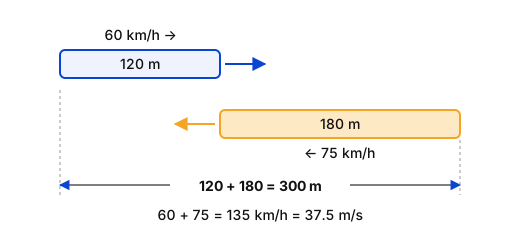
Two trains of lengths 120 m and 180 m are running in opposite directions at speeds of 60 km/h and 75 km/h, respectively. In how many seconds will they completely cross each other?
120 m और 180 m लंबाई वाली दो रेलगाड़ियाँ क्रमशः 60 km/h और 75 km/h की चाल से विपरीत दिशाओं में चल रही हैं। वे एक-दूसरे को कितने सेकंड में पूरी तरह से पार कर लेंगी?
  1. A10 seconds10 सेकंड
  2. B8 seconds8 सेकंड
  3. C9 seconds9 सेकंड
  4. D11 seconds11 सेकंड
Show answer

Concept: Opposite directions: relative speed = sum; distance = sum of lengths.

  1. Relative speed = 60+75=135 km/h =135×518=37.5 m/s.
  2. Distance = 120+180=300 m.
  3. Time = 300÷37.5=8 s.

Trick: Time (s)=total length×185×speed sum = 300×18675=8.

Answer: (B) 8 seconds

अवधारणा: विपरीत दिशा में सापेक्ष चाल = चालों का योग; दूरी = लंबाइयों का योग।

  1. सापेक्ष चाल = 60+75=135 km/h =135×518=37.5 m/s।
  2. दूरी = 120+180=300 m।
  3. समय = 300÷37.5=8 s।

ट्रिक: समय (s)=कुल लंबाई×185×चालों का योग = 300×18675=8।

उत्तर: (B) 8 सेकंड

RRB Technician Grade IIIMathematicsTrains crossing – opposite directionsRRB Technician Grade III 2025 · 6 Mar Shift 1 →
Q3123.
A shopkeeper lists the price of a fan at 36% above its cost price and offers a 25% discount on its list price. If he earns a profit of ₹179, then what is the list price (in ₹) of the fan?
एक दुकानदार एक पंखे का मूल्य उसके क्रय मूल्य से 36% अधिक अंकित करता है और उसके सूची मूल्य पर 25% की छूट देता है। यदि वह ₹179 का लाभ अर्जित करता है, तो पंखे का सूची मूल्य (₹ में) कितना है?
  1. A12,172
  2. B12,247
  3. C12,166
  4. D12,213
Show answer

Concept: SP = CP × (1 + markup) × (1 − discount).

  1. SP=CP×1.36×0.75=1.02CP → profit = 2% of CP.
  2. 2% of CP = 179 → CP = ₹8950.
  3. List price = 1.36×8950= ₹12172.

Trick: Net effect of +36% and −25% = 36−25−36×25100=+2%.

Answer: (A) 12,172

अवधारणा: विक्रय मूल्य = क्रय मूल्य × (1 + बढ़ोतरी) × (1 − छूट)।

  1. SP=CP×1.36×0.75=1.02CP → लाभ = CP का 2%।
  2. CP का 2% = 179 → CP = ₹8950।
  3. अंकित मूल्य = 1.36×8950= ₹12172।

ट्रिक: +36% और −25% का शुद्ध प्रभाव = 36−25−36×25100=+2%।

उत्तर: (A) 12,172

RRB Technician Grade IIIMathematicsMarked price and discountRRB Technician Grade III 2025 · 6 Mar Shift 1 →
Q3124.
Simplify:
8×8+6×6+[6×{4÷2×(3 of 2)}−{36÷(6×3)+(8×3)}]÷2
सरल कीजिए:
8×8+6×6+[6×{4÷2×(3 of 2)}−{36÷(6×3)+(8×3)}]÷2
  1. A93
  2. B123
  3. C73
  4. D153
Show answer

Concept: Order: brackets → of → ÷ / × (left to right) → + / −.

  1. 8×8+6×6=64+36=100.
  2. {4÷2×(3 of 2)}=2×6=12→6×12=72.
  3. {36÷18+24}=2+24=26.
  4. [72−26]÷2=23→100+23=123.

Yaad rakhein: 'of' is done before ÷ and ×, so 3 of 2 = 6 is solved first.

Answer: (B) 123

अवधारणा: क्रम: कोष्ठक → of (का) → ÷ / × (बाएँ से दाएँ) → + / −।

  1. 8×8+6×6=64+36=100।
  2. {4÷2×(3 of 2)}=2×6=12→6×12=72।
  3. {36÷18+24}=2+24=26।
  4. [72−26]÷2=23→100+23=123।

याद रखें: 'of' (का) ÷ और × से पहले हल होता है, इसलिए 3 of 2 = 6 पहले।

उत्तर: (B) 123

RRB Technician Grade IIIMathematicsBODMAS simplificationRRB Technician Grade III 2025 · 6 Mar Shift 1 →
Q3125.
When one-third of a number is increased by 87, the result is 107. Find the sum of the digits of the original number.
जब किसी संख्या के एक-तिहाई में 87 की वृद्धि की जाती है, तो परिणाम 107 प्राप्त होता है। मूल संख्या के अंकों का योग ज्ञात कीजिए।
  1. A3
  2. B6
  3. C5
  4. D8
Show answer

Concept: Translate words into an equation.

  1. n3+87=107→n3=20.
  2. n = 60.
  3. Sum of digits = 6+0=6.

Trick: Work backwards: 107−87=20, ×3=60.

Answer: (B) 6

अवधारणा: शब्दों को समीकरण में बदलें।

  1. n3+87=107→n3=20।
  2. n = 60।
  3. अंकों का योग = 6+0=6।

ट्रिक: उल्टा चलें: 107−87=20, ×3=60।

उत्तर: (B) 6

RRB Technician Grade IIIMathematicsLinear equation – number problemRRB Technician Grade III 2025 · 6 Mar Shift 1 →
Q3126.
What will come in the place of ‘?’ in the following equation, if ‘+’ and ‘-’ are interchanged and ‘x’ and ‘÷’ are interchanged?
5 ÷ 2 + 16 x 4 - 4 = ?
यदि ‘+’ और ‘-’ को आपस में बदल दिया जाए तथा ‘x’ और ‘÷’ को आपस में बदल दिया जाए, तो निम्नलिखित समीकरण में ‘?’ के स्थान पर क्या आएगा?
5 ÷ 2 + 16 x 4 - 4 = ?
  1. A14
  2. B8
  3. C12
  4. D10
Show answer

Concept: Swap the signs first, then apply BODMAS.

  1. After swapping: 5×2−16÷4+4.
  2. =10−4+4.
  3. =10.

Trick: Rewrite the whole expression with new signs before calculating – never calculate with the old signs.

Answer: (D) 10

अवधारणा: पहले चिह्न बदलें, फिर BODMAS लगाएँ।

  1. बदलने के बाद: 5×2−16÷4+4।
  2. =10−4+4।
  3. =10।

ट्रिक: पूरा व्यंजक नए चिह्नों के साथ दोबारा लिखें, फिर हल करें।

उत्तर: (D) 10

RRB Technician Grade IIIGeneral Intelligence and ReasoningMathematical operations – interchange of signsRRB Technician Grade III 2025 · 6 Mar Shift 1 →
Q3127.
The position(s) of how many letters will remain unchanged if each letter in the word "FOXHUNTERS" is arranged in alphabetical order?
यदि शब्द "FOXHUNTERS" के प्रत्येक अक्षर को वर्णमाला क्रम में व्यवस्थित किया जाए, तो कितने अक्षरों का/के स्थान अपरिवर्तित रहेगा/रहेंगे?
  1. AOneएक
  2. BTwoदो
  3. CThreeतीन
  4. DNoneएक भी नहीं
Show answer

Concept: Sort the letters and compare position by position.

  1. Original: F O X H U N T E R S.
  2. Sorted: E F H N O R S T U X.
  3. No position has the same letter in both.

Trick: Write both words one below the other and match column-wise – fastest and error-free.

Answer: (D) None

अवधारणा: अक्षरों को क्रम में लगाकर हर स्थान की तुलना करें।

  1. मूल: F O X H U N T E R S।
  2. क्रमबद्ध: E F H N O R S T U X।
  3. किसी भी स्थान पर एक जैसा अक्षर नहीं है।

ट्रिक: दोनों शब्द एक के नीचे एक लिखकर कॉलम-वार मिलाएँ।

उत्तर: (D) एक भी नहीं

RRB Technician Grade IIIGeneral Intelligence and ReasoningAlphabetical arrangement – unchanged positionsRRB Technician Grade III 2025 · 6 Mar Shift 1 →
Q3128.
Select the pair which follows the same pattern as that followed by the two pairs given below. Both pairs follow the same pattern.
NEX : RIB
VBS : ZFW
उस युग्म का चयन कीजिए जो उसी पैटर्न का अनुसरण करता है जिसका अनुसरण नीचे दिए गए दो युग्मों द्वारा किया गया है। दोनों युग्म एक ही पैटर्न का अनुसरण करते हैं।
NEX : RIB
VBS : ZFW
  1. ATAJ : XEN
  2. BGWR : IZU
  3. CQKE : TNH
  4. DYSD : CUF
Show answer

Concept: Find the shift from each letter of the first group to the second.

  1. NEX → RIB: N+4 = R, E+4 = I, X+4 = B.
  2. VBS → ZFW: +4, +4, +4.
  3. TAJ → XEN: T+4 = X, A+4 = E, J+4 = N ✓.

Trick: Check only the first letter of each option (+4): T→X ✓, G→I ✗, Q→T ✗, Y→C ✓; then the second letter: S→U ✗.

Answer: (A) TAJ : XEN

अवधारणा: पहले समूह से दूसरे समूह तक हर अक्षर का अंतर देखें।

  1. NEX → RIB: N+4 = R, E+4 = I, X+4 = B।
  2. VBS → ZFW: +4, +4, +4।
  3. TAJ → XEN: T+4 = X, A+4 = E, J+4 = N ✓।

ट्रिक: हर विकल्प का पहला अक्षर जाँचें (+4): T→X ✓, G→I ✗, Q→T ✗, Y→C ✓; फिर दूसरा: S→U ✗।

उत्तर: (A) TAJ : XEN

RRB Technician Grade IIIGeneral Intelligence and ReasoningLetter analogy – pair patternRRB Technician Grade III 2025 · 6 Mar Shift 1 →
Q3129.
Based on the English alphabetical order, three of the following four letter-cluster pairs are alike in a certain way and thus form a group. Which is the one that does not belong to that group?(Note: The odd one out is not based on the number of
consonants/vowels or their position in the letter-cluster.)
अंग्रेज़ी वर्णमाला क्रम के आधार पर, निम्नलिखित चार अक्षर-समूह युग्मों में से तीन किसी निश्चित प्रकार से एकसमान हैं और इस प्रकार एक समूह बनाते हैं। वह कौन-सा युग्म है जो उस समूह से संबंधित नहीं है?(ध्यान दें: असंगत का चयन, अक्षर-समूह में
व्यंजनों/स्वरों की संख्या या उनके स्थान पर आधारित नहीं है।)
  1. AFN – KS
  2. BHP – NV
  3. CCK – IQ
  4. DGO – MU
Show answer

Concept: Compare the shift from the first cluster to the second.

  1. HP → NV: +6, +6; CK → IQ: +6, +6; GO → MU: +6, +6.
  2. FN → KS: +5, +5.
  3. So FN – KS is odd.

Yaad rakhein: Learn letter positions (EJOTY: 5, 10, 15, 20, 25) to find shifts instantly.

Answer: (A) FN – KS

अवधारणा: पहले समूह से दूसरे समूह का अंतर देखें।

  1. HP → NV: +6, +6; CK → IQ: +6, +6; GO → MU: +6, +6।
  2. FN → KS: +5, +5।
  3. इसलिए FN – KS अलग है।

याद रखें: अक्षरों के स्थान याद रखें (EJOTY: 5, 10, 15, 20, 25), अंतर तुरंत मिलेगा।

उत्तर: (A) FN – KS

RRB Technician Grade IIIGeneral Intelligence and ReasoningOdd one out – letter-cluster pairsRRB Technician Grade III 2025 · 6 Mar Shift 1 →
Q3130.
In a certain code language, ‘MIND’ is coded as ‘7542’ and ‘DOPE’ is coded as ‘1436’. What is the code for ‘D’ in that language?
एक निश्चित कूट भाषा में, ‘MIND’ को ‘7542’ लिखा जाता है और ‘DOPE’ को ‘1436’ लिखा जाता है। उस भाषा में ‘D’ के लिए कूट क्या है?
  1. A4
  2. B2
  3. C3
  4. D1
Show answer

Concept: A letter common to two words gets the digit common to both codes.

  1. MIND = 7542 and DOPE = 1436.
  2. Common letter: D; common digit: 4.
  3. So D = 4.

Trick: Intersect the letter sets and the digit sets – the single common item pairs up.

Answer: (A) 4

अवधारणा: दोनों शब्दों का साझा अक्षर, दोनों कोड के साझा अंक से जुड़ता है।

  1. MIND = 7542 और DOPE = 1436।
  2. साझा अक्षर: D; साझा अंक: 4।
  3. अतः D = 4।

ट्रिक: अक्षरों और अंकों का साझा हिस्सा निकालें – वही जोड़ी उत्तर है।

उत्तर: (A) 4

RRB Technician Grade IIIGeneral Intelligence and ReasoningCoding-decoding – common letterRRB Technician Grade III 2025 · 6 Mar Shift 1 →
Q3131.
Based on the English alphabetical order, three of the following four letter-clusters are alike in a certain way and thus form a group. Which letter-cluster DOES NOT belong to that group?
(Note: The odd one out is not based on the number of consonants/vowels or their position in the letter-cluster.)
अंग्रेज़ी वर्णमाला क्रम के आधार पर, निम्नलिखित चार अक्षर-समूहों में से तीन किसी निश्चित प्रकार से एकसमान हैं और इस प्रकार एक समूह बनाते हैं। कौन-सा अक्षर-समूह उस समूह से संबंधित नहीं है?
(ध्यान दें: असंगत का चयन, अक्षर-समूह में व्यंजनों/स्वरों की संख्या या उनके स्थान पर आधारित नहीं है।)
  1. AYTW
  2. BEHF
  3. CJMK
  4. DILJ
Show answer

Concept: Find the gaps between consecutive letters.

  1. EHF: +3, −2; JMK: +3, −2; ILJ: +3, −2.
  2. YTW: Y→T = −5, T→W = +3.
  3. So YTW is odd.

Yaad rakhein: In such clusters, write position numbers (E5, H8, F6) and check the differences.

Answer: (A) YTW

अवधारणा: लगातार अक्षरों का अंतर देखें।

  1. EHF: +3, −2; JMK: +3, −2; ILJ: +3, −2।
  2. YTW: Y→T = −5, T→W = +3।
  3. इसलिए YTW अलग है।

याद रखें: स्थान संख्या लिखें (E5, H8, F6) और अंतर जाँचें।

उत्तर: (A) YTW

RRB Technician Grade IIIGeneral Intelligence and ReasoningOdd one out – letter clustersRRB Technician Grade III 2025 · 6 Mar Shift 1 →
Q3132.
What should come in place of ‘?’ in the given series?
31 44 52 65 73 ?
दी गई श्रृंखला में ‘?’ के स्थान पर क्या आना चाहिए?
31 44 52 65 73 ?
  1. A80
  2. B82
  3. C86
  4. D84
Show answer

Concept: Check the differences between terms.

  1. 31 → 44 → 52 → 65 → 73: differences +13, +8, +13, +8.
  2. Next difference = +13.
  3. 73 + 13 = 86.

Trick: Two alternating differences → the pattern repeats: +13, +8, +13…

Answer: (C) 86

अवधारणा: पदों के बीच अंतर देखें।

  1. 31 → 44 → 52 → 65 → 73: अंतर +13, +8, +13, +8।
  2. अगला अंतर = +13।
  3. 73 + 13 = 86।

ट्रिक: दो अंतर बारी-बारी से दोहराए जा रहे हैं: +13, +8, +13…

उत्तर: (C) 86

RRB Technician Grade IIIGeneral Intelligence and ReasoningNumber series – alternating differencesRRB Technician Grade III 2025 · 6 Mar Shift 1 →
Q3133.
Based on the English alphabetical order, three of the following four letter-cluster pairs are alike in a certain way and thus form a group. Which letter-cluster pair DOES NOT belong to that group?
(Note: The odd one out is not based on the number of consonants/vowels or their position in the letter-cluster.)
अंग्रेज़ी वर्णमाला क्रम के आधार पर, निम्नलिखित चार अक्षर-समूह युग्मों में से तीन किसी निश्चित प्रकार से एकसमान हैं और इस प्रकार एक समूह बनाते हैं। कौन-सा अक्षर-समूह युग्म उस समूह से संबंधित नहीं है?
(ध्यान दें: असंगत का चयन, अक्षर-समूह में व्यंजनों/स्वरों की संख्या या उनके स्थान पर आधारित नहीं है।)
  1. AEW – BB
  2. BHK – DP
  3. CQC – NH
  4. DKM – HR
Show answer

Concept: Compare corresponding letters of the two clusters.

  1. EW → BB: −3, +5 (W→B going round); QC → NH: −3, +5; KM → HR: −3, +5.
  2. HK → DP: −4, +5.
  3. So HK – DP is odd.

Trick: Check only the first letters: E→B, Q→N, K→H are all −3; H→D is −4 → odd one found.

Answer: (B) HK – DP

अवधारणा: दोनों समूहों के संगत अक्षरों की तुलना करें।

  1. EW → BB: −3, +5 (W→B चक्र में); QC → NH: −3, +5; KM → HR: −3, +5।
  2. HK → DP: −4, +5।
  3. इसलिए HK – DP अलग है।

ट्रिक: सिर्फ पहले अक्षर देखें: E→B, Q→N, K→H सब −3; H→D −4 है।

उत्तर: (B) HK – DP

RRB Technician Grade IIIGeneral Intelligence and ReasoningOdd one out – letter-cluster pairsRRB Technician Grade III 2025 · 6 Mar Shift 1 →
Q3134.
Based on the alphabetical order, three of the following four are alike in a certain way and thus form a group. Which is the one that does not belong to that group?
(Note: The odd man out is not based on the number of consonants/vowels or their position in the letter cluster.)
वर्णमाला क्रम के आधार पर, निम्नलिखित चार में से तीन किसी निश्चित प्रकार से एकसमान हैं और इस प्रकार एक समूह बनाते हैं। वह कौन-सा है जो उस समूह से संबंधित नहीं है?
(ध्यान दें: असंगत का चयन, अक्षर-समूह में व्यंजनों/स्वरों की संख्या या उनके स्थान पर आधारित नहीं है।)
  1. AFGO
  2. BPQV
  3. CIJO
  4. DBCH
Show answer

Concept: Find the gaps between consecutive letters.

  1. PQV: +1, +5; IJO: +1, +5; BCH: +1, +5.
  2. FGO: +1, +8.
  3. So FGO is odd.

Yaad rakhein: Positions: F6 G7 O15 vs P16 Q17 V22 – the second gap differs.

Answer: (A) FGO

अवधारणा: लगातार अक्षरों का अंतर देखें।

  1. PQV: +1, +5; IJO: +1, +5; BCH: +1, +5।
  2. FGO: +1, +8।
  3. इसलिए FGO अलग है।

याद रखें: स्थान: F6 G7 O15 बनाम P16 Q17 V22 – दूसरा अंतर अलग है।

उत्तर: (A) FGO

RRB Technician Grade IIIGeneral Intelligence and ReasoningOdd one out – letter clustersRRB Technician Grade III 2025 · 6 Mar Shift 1 →
Q3135.
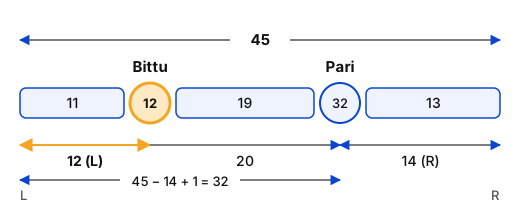
In a row of 45 people facing north, Pari is 14th from the right end. If Bittu sits 20th to the left of Pari, what is Bittu’s position from the left end of the line?
उत्तर की ओर मुख करके बैठे 45 व्यक्तियों की एक पंक्ति में, परी दाएँ छोर से 14वें स्थान पर है। यदि बिट्टू, परी के बाएँ से 20वें स्थान पर बैठा है, तो पंक्ति के बाएँ छोर से बिट्टू का स्थान क्या है?
  1. A10th10वाँ
  2. B13th13वाँ
  3. C11th11वाँ
  4. D12th12वाँ
Show answer

Concept: Position from left = total − position from right + 1.

  1. Pari from left = 45 − 14 + 1 = 32nd.
  2. Bittu is 20 to her left → 32 − 20 = 12th from left.

Yaad rakhein: Facing north, 'left' means towards the left end, so subtract from the left-end position.

Answer: (D) 12th

अवधारणा: बाएँ से स्थान = कुल − दाएँ से स्थान + 1।

  1. परी बाएँ से = 45 − 14 + 1 = 32वीं।
  2. बिट्टू उसके 20 बाएँ → 32 − 20 = बाएँ से 12वाँ।

याद रखें: उत्तर की ओर मुख हो तो 'बाएँ' का मतलब बाएँ छोर की ओर – बाएँ वाले स्थान से घटाएँ।

उत्तर: (D) 12वाँ

RRB Technician Grade IIIGeneral Intelligence and ReasoningRanking – position in a rowRRB Technician Grade III 2025 · 6 Mar Shift 1 →
Q3136.
Select the set in which the numbers are related in the same way as are the numbers of the following sets.
(Note: Operations should be performed on the whole numbers, without breaking down the numbers into their constituent digits. E.g. 13 – Operations on 13 such as
adding/subtracting/multiplying to 13 can be performed. Breaking down 13 into 1 and 3 and then performing mathematical operations on 1 and 3 is not allowed.)
(8, 3, 7)
(9, 4, 9)
उस समुच्चय का चयन कीजिए जिसमें संख्याएँ उसी प्रकार संबंधित हैं जिस प्रकार निम्नलिखित समुच्चयों की संख्याएँ संबंधित हैं।
(ध्यान दें: संख्याओं को उनके घटक अंकों में तोड़े बिना, संक्रियाएँ पूर्ण संख्याओं पर की जानी चाहिए। उदाहरण के लिए 13 – 13 पर संक्रियाएँ जैसे 13 में
जोड़ना/घटाना/गुणा करना आदि की जा सकती हैं। 13 को 1 और 3 में तोड़कर फिर 1 और 3 पर गणितीय संक्रियाएँ करने की अनुमति नहीं है।)
(8, 3, 7)
(9, 4, 9)
  1. A(7, 2, 5)
  2. B(13, 8, 15)
  3. C(12, 17, 35)
  4. D(11, 5, 13)
Show answer

Concept: Find one rule that fits both given sets.

  1. (8, 3, 7): 8 + 3 − 4 = 7.
  2. (9, 4, 9): 9 + 4 − 4 = 9.
  3. (7, 2, 5): 7 + 2 − 4 = 5 ✓; others fail (e.g. 13 + 8 − 4 = 17 ≠ 15).

Yaad rakhein: Try simple rules (sum, difference, product ± constant) on both sets before checking options.

Answer: (A) (7, 2, 5)

अवधारणा: ऐसा एक नियम खोजें जो दोनों दिए गए समूहों पर लागू हो।

  1. (8, 3, 7): 8 + 3 − 4 = 7।
  2. (9, 4, 9): 9 + 4 − 4 = 9।
  3. (7, 2, 5): 7 + 2 − 4 = 5 ✓; बाकी नहीं (जैसे 13 + 8 − 4 = 17 ≠ 15)।

याद रखें: विकल्प देखने से पहले दोनों समूहों पर सरल नियम (योग, अंतर, गुणा ± स्थिरांक) आज़माएँ।

उत्तर: (A) (7, 2, 5)

RRB Technician Grade IIIGeneral Intelligence and ReasoningNumber set relationshipRRB Technician Grade III 2025 · 6 Mar Shift 1 →
Q3137.
In a certain code language, ‘CRAB’ is coded as ‘8642’ and ‘BENT’ is coded as ‘1358’. What is the code for ‘B’ in that language?
एक निश्चित कूट भाषा में, ‘CRAB’ को ‘8642’ लिखा जाता है और ‘BENT’ को ‘1358’ लिखा जाता है। उस भाषा में ‘B’ के लिए कूट क्या है?
  1. A8
  2. B2
  3. C3
  4. D1
Show answer

Concept: A letter common to two words gets the digit common to both codes.

  1. CRAB = 8642 and BENT = 1358.
  2. Common letter: B; common digit: 8.
  3. So B = 8.

Trick: Intersect letters and digits – one common pair gives the answer directly.

Answer: (A) 8

अवधारणा: दोनों शब्दों का साझा अक्षर, दोनों कोड के साझा अंक से जुड़ता है।

  1. CRAB = 8642 और BENT = 1358।
  2. साझा अक्षर: B; साझा अंक: 8।
  3. अतः B = 8।

ट्रिक: अक्षरों और अंकों का साझा हिस्सा निकालें – सीधा उत्तर।

उत्तर: (A) 8

RRB Technician Grade IIIGeneral Intelligence and ReasoningCoding-decoding – common letterRRB Technician Grade III 2025 · 6 Mar Shift 1 →
Q3138.
In a certain code language,
A + B means ‘A is the son of B’,
A - B means ‘A is the brother of B’,
A x B means ‘A is the wife of B’, and
A ÷ B means ‘A is the father of B’.
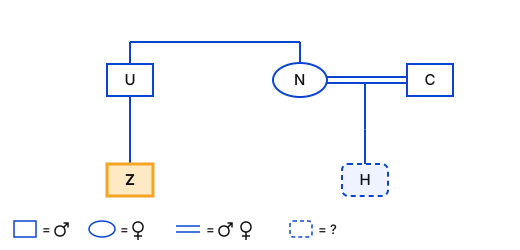
Based on the above, how is Z related to H if 'Z+U-NxC÷H’?
एक निश्चित कूट भाषा में,
A + B का अर्थ है ‘A, B का पुत्र है’,
A - B का अर्थ है ‘A, B का भाई है’,
A x B का अर्थ है ‘A, B की पत्नी है’, और
A ÷ B का अर्थ है ‘A, B का पिता है’।
उपरोक्त के आधार पर, यदि 'Z+U-NxC÷H' है, तो Z, H से किस प्रकार संबंधित है?
  1. ABrother's Sonभाई का पुत्र
  2. BFatherपिता
  3. CMother's brother's Sonमाँ के भाई का पुत्र
  4. DMother's brotherमाँ का भाई
Show answer

Concept: Decode each symbol and move step by step.

  1. Z + U: Z is the son of U; U − N: U is the brother of N.
  2. N × C: N is the wife of C; C ÷ H: C is the father of H → N is H's mother.
  3. U = H's mother's brother; Z = his son.

Yaad rakhein: Draw a quick family tree: males □, females ○ – avoids gender mistakes.

Answer: (C) Mother's brother's Son

अवधारणा: हर चिह्न का अर्थ लगाकर क्रम से चलें।

  1. Z + U: Z, U का बेटा; U − N: U, N का भाई।
  2. N × C: N, C की पत्नी; C ÷ H: C, H का पिता → N, H की माँ।
  3. U = H का मामा; Z = मामा का बेटा।

याद रखें: छोटा परिवार-वृक्ष बनाएँ: पुरुष □, स्त्री ○ – लिंग की गलती नहीं होगी।

उत्तर: (C) माँ के भाई का पुत्र

RRB Technician Grade IIIGeneral Intelligence and ReasoningCoded blood relationsRRB Technician Grade III 2025 · 6 Mar Shift 1 →
Q3139.
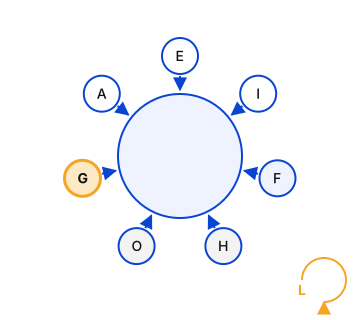
A, E, I, O, F, G and H are sitting around a circular table facing the centre of the table. Only two people sit between E and O when counted from the right of E. Only two people sit between O and I. Only three people sit between E and H. A sits to the immediate left of G.
Who sits third to the left of F?
A, E, I, O, F, G और H एक वृत्ताकार मेज़ के चारों ओर मेज़ के केंद्र की ओर मुख करके बैठे हैं। E के दाएँ से गिनने पर E और O के बीच केवल दो व्यक्ति बैठे हैं। O और I के बीच केवल दो व्यक्ति बैठे हैं। E और H के बीच केवल तीन व्यक्ति बैठे हैं। A, G के ठीक बाएँ बैठा है।
F के बाएँ से तीसरे स्थान पर कौन बैठा है?
  1. AG
  2. BI
  3. CE
  4. DA
Show answer

Concept: Facing the centre: right = anticlockwise, left = clockwise.

  1. Fix E; going right of E, two sit between → O is 3rd to E's right.
  2. Two between O and I → I is 3rd from O on the other side (adjacent to E's left). Three between E and H → H sits next to O.
  3. Remaining 3 seats for A, F, G with A immediately left of G → order clockwise from E: E, I, F, H, O, G, A.
  4. Third to the left of F (clockwise): H, O, G → G.

Yaad rakhein: With 7 seats, 'two between' on one side means three between on the other – use it to place people fast.

Answer: (A) G

अवधारणा: केंद्र की ओर मुख: दायाँ = वामावर्त, बायाँ = दक्षिणावर्त।

  1. E तय करें; E के दाएँ से दो बीच में → O, E के दाएँ तीसरा।
  2. O और I के बीच दो → I, E के ठीक बाएँ। E और H के बीच तीन → H, O के पास।
  3. बची 3 सीटों पर A, F, G; A, G के ठीक बाएँ → E से दक्षिणावर्त: E, I, F, H, O, G, A।
  4. F के बाएँ तीसरा (दक्षिणावर्त): H, O, G → G।

याद रखें: 7 सीटों में एक ओर 'दो बीच में' = दूसरी ओर तीन बीच में – इससे जल्दी जगह तय होती है।

उत्तर: (A) G

RRB Technician Grade IIIGeneral Intelligence and ReasoningCircular seating arrangementRRB Technician Grade III 2025 · 6 Mar Shift 1 →
Q3140.
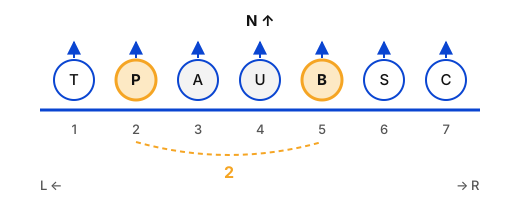
A, B, C, P, S, T and U are sitting in a straight line facing the north. Only two people are seated between T and U. Only C is seated to the right of S. Only one person is seated between U and S. A is seated at some place to the right of P, but at some place to the left of B. How many people are seated between B and P?
A, B, C, P, S, T और U एक सीधी पंक्ति में उत्तर की ओर मुख करके बैठे हैं। T और U के बीच केवल दो व्यक्ति बैठे हैं। S के दाएँ केवल C बैठा है। U और S के बीच केवल एक व्यक्ति बैठा है। A, P के दाएँ किसी स्थान पर, लेकिन B के बाएँ किसी स्थान पर बैठा है। B और P के बीच कितने व्यक्ति बैठे हैं?
  1. AThreeतीन
  2. BFourचार
  3. COneएक
  4. DTwoदो
Show answer

Concept: Start with the most definite clue.

  1. Only C right of S → S = 6th, C = 7th (from left).
  2. One between U and S → U = 4th; two between T and U → T = 1st.
  3. P, A, B fill 2, 3, 5 with P, A, B in left-to-right order → P = 2, A = 3, B = 5.
  4. Between B and P: seats 3 and 4 → two people.

Yaad rakhein: Facing north, your right = right end of the line.

Answer: (D) Two

अवधारणा: सबसे पक्के संकेत से शुरू करें।

  1. S के दाएँ केवल C → S = 6वाँ, C = 7वाँ (बाएँ से)।
  2. U और S के बीच एक → U = 4; T और U के बीच दो → T = 1।
  3. P, A, B के लिए 2, 3, 5 (बाएँ से क्रम P, A, B) → P = 2, A = 3, B = 5।
  4. B और P के बीच: 3 और 4 → दो व्यक्ति।

याद रखें: उत्तर की ओर मुख हो तो आपका दायाँ = पंक्ति का दायाँ छोर।

उत्तर: (D) दो

RRB Technician Grade IIIGeneral Intelligence and ReasoningLinear seating arrangementRRB Technician Grade III 2025 · 6 Mar Shift 1 →