Question bank

Q&A: practice questions with answers

Search questions on any topic. Filter by exam category, exam, subject and topic, try the question, then open the answer and explanation.

Courses – airGurukul

3,200 questions found.

Q421.
Due to a reduction of 6.25% in the price of sugar, a man can buy 1 kg more for ₹120. The reduced price per kg of sugar is:
चीनी के मूल्य में 6.25% की कमी होने के कारण, एक व्यक्ति ₹120 में 1 kg अधिक चीनी खरीद सकता है। चीनी का प्रति kg घटा हुआ मूल्य कितना है?
  1. A₹7.5
  2. B₹7
  3. C₹8
  4. D₹6.5
Show answer

Concept: Money saved due to the price cut buys the extra quantity at the reduced price.

  1. Saving =6.25% of ₹120 =6.25100×120=7.5.
  2. This ₹7.5 buys the extra 1 kg.
  3. Reduced price = ₹7.5 per kg.

Trick: Reduced price=R%×Amountextra quantity=6.25×120100×1=7.5.

Answer: (A) ₹7.5

अवधारणा: मूल्य घटने से बची राशि से घटे मूल्य पर अतिरिक्त मात्रा मिलती है।

  1. बचत = ₹120 का 6.25%=6.25100×120=7.5।
  2. इन ₹7.5 से अतिरिक्त 1 किग्रा मिलता है।
  3. घटा मूल्य = ₹7.5 प्रति किग्रा।

ट्रिक: घटा मूल्य=R%×राशिअतिरिक्त मात्रा=6.25×120100×1=7.5।

उत्तर: (A) ₹7.5

RRB Technician Grade IIIMathematicsPercentage (Price Reduction)RRB Technician Grade III 2024 · 29 Dec Shift 2 →
Q422.
If a person covers 90 km at a speed of 45 km/h and another distance of 150 km at a speed of 50 km/h, then his average speed for the whole journey is:
यदि एक व्यक्ति 90 km की दूरी 45 km/h की चाल से और अन्य 150 km की दूरी 50 km/h की चाल से तय करता है, तो पूरी यात्रा के लिए उसकी औसत चाल कितनी है?
  1. A46 km/h
  2. B48 km/h
  3. C49 km/h
  4. D47 km/h
Show answer

Concept: Average speed=Total distanceTotal time.

  1. Time 1 =9045=2 h; time 2 =15050=3 h.
  2. Total distance =240 km, total time =5 h.
  3. Average speed =2405=48 km/h.

Yaad rakhein: Never average the speeds directly (45+502 is wrong) unless the times are equal.

Answer: (B) 48 km/h

अवधारणा: औसत चाल=कुल दूरीकुल समय।

  1. समय 1 =9045=2 घंटे; समय 2 =15050=3 घंटे।
  2. कुल दूरी =240 किमी, कुल समय =5 घंटे।
  3. औसत चाल =2405=48 किमी/घंटा।

याद रखें: चालों का सीधा औसत (45+502) तभी लें जब समय बराबर हों।

उत्तर: (B) 48 km/h

RRB Technician Grade IIIMathematicsAverage SpeedRRB Technician Grade III 2024 · 29 Dec Shift 2 →
Q423.
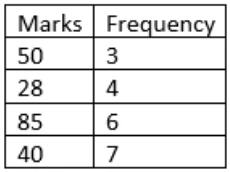
Find the arithmetic mean of the given frequency distribution.

दिए गए बारंबारता बंटन का समांतर माध्य ज्ञात कीजिए।

  1. A56.2
  2. B50.5
  3. C52.6
  4. D40.95
Show answer

Concept: x¯=∑fx∑f.

  1. fx: 50×3=150, 28×4=112, 85×6=510, 40×7=280.
  2. ∑fx=1052, ∑f=3+4+6+7=20.
  3. x¯=105220=52.6.

Trick: Dividing by 20 = dividing by 2 then by 10: 526÷10=52.6.

Answer: (C) 52.6

अवधारणा: x¯=∑fx∑f।

  1. fx: 50×3=150, 28×4=112, 85×6=510, 40×7=280।
  2. ∑fx=1052, ∑f=20।
  3. x¯=105220=52.6।

ट्रिक: 20 से भाग = 2 से भाग फिर 10 से: 526÷10=52.6।

उत्तर: (C) 52.6

RRB Technician Grade IIIMathematicsStatistics (Mean of Frequency Distribution)RRB Technician Grade III 2024 · 29 Dec Shift 2 →
Q424.
By what per cent does the curved surface area of a cylinder decrease, if the radius is increased by 30% and the height is decreased by 30%?
यदि एक बेलन की त्रिज्या में 30% की वृद्धि की जाए और ऊँचाई में 30% की कमी की जाए, तो उसके वक्र पृष्ठीय क्षेत्रफल में कितने प्रतिशत की कमी होगी?
  1. A0%
  2. B30%
  3. C60%
  4. D9%
Show answer

Concept: Curved surface area =2πrh, so it changes in proportion to r×h.

  1. New r=1.3r, new h=0.7h.
  2. New CSA =2π(1.3r)(0.7h)=0.91×2πrh.
  3. Decrease =1−0.91=0.09=9%.

Trick: Successive change: +30−30+30×(−30)100=−9%.

Answer: (D) 9%

अवधारणा: वक्र पृष्ठ क्षेत्रफल =2πrh, अतः यह r×h के अनुपात में बदलता है।

  1. नया r=1.3r, नया h=0.7h।
  2. नया CSA =0.91×2πrh।
  3. कमी =1−0.91=0.09=9%।

ट्रिक: क्रमिक परिवर्तन: +30−30+30×(−30)100=−9%।

उत्तर: (D) 9%

RRB Technician Grade IIIMathematicsMensuration (Cylinder – % Change)RRB Technician Grade III 2024 · 29 Dec Shift 2 →
Q425.
Pure ghee costs ₹100 per kg. After adulterating it with vegetable oil costing ₹50 per kg, a shopkeeper sells the mixture at the rate of ₹96 per kg, thereby making a profit of 20%. In what ratio does he mix the two?
शुद्ध घी का मूल्य ₹100 प्रति kg है। इसमें ₹50 प्रति kg मूल्य वाला वनस्पति तेल मिलाने के बाद, एक दुकानदार मिश्रण को ₹96 प्रति kg की दर से बेचता है, जिससे उसे 20% का लाभ होता है। वह दोनों को किस अनुपात में मिलाता है?
  1. A1 : 2
  2. B3 : 1
  3. C4 : 1
  4. D3 : 2
Show answer

Concept: Find the cost price of the mixture from the selling price and profit, then apply alligation.

  1. CP of mixture =961.2= ₹80 per kg.
  2. Alligation: ghee ₹100, oil ₹50, mean ₹80.
  3. Ghee : oil =(80−50):(100−80)=30:20=3:2.

Trick: Alligation cross-difference: (cheaper − mean) goes with the dearer item, (dearer − mean) with the cheaper.

Answer: (D) 3 : 2

अवधारणा: विक्रय मूल्य और लाभ से मिश्रण का क्रय मूल्य निकालें, फिर एलीगेशन लगाएँ।

  1. मिश्रण का क्रय मूल्य =961.2= ₹80 प्रति किग्रा।
  2. एलीगेशन: घी ₹100, तेल ₹50, माध्य ₹80।
  3. घी : तेल =(80−50):(100−80)=30:20=3:2।

ट्रिक: एलीगेशन: (सस्ता − माध्य) महंगे के साथ, (महंगा − माध्य) सस्ते के साथ।

उत्तर: (D) 3 : 2

RRB Technician Grade IIIMathematicsAlligation and MixtureRRB Technician Grade III 2024 · 29 Dec Shift 2 →
Q426.
A tin of biscuits weighs 1 kg 750 g. What is the total weight of 7 such tins?
बिस्कुट के एक डिब्बे का भार 1 kg 750 g है। ऐसे 7 डिब्बों का कुल भार कितना है?
  1. A12.250 kg
  2. B12.350 kg
  3. C12.050 kg
  4. D12.150 kg
Show answer

Concept: Convert to kg, then multiply.

  1. 1 kg 750 g=1.75 kg.
  2. 7×1.75=12.25 kg.

Trick: 7×1750 g=12250 g=12.250 kg.

Answer: (A) 12.250 kg

अवधारणा: किग्रा में बदलें, फिर गुणा करें।

  1. 1 kg 750 g=1.75 किग्रा।
  2. 7×1.75=12.25 किग्रा।

ट्रिक: 7×1750 ग्राम =12250 ग्राम =12.250 किग्रा।

उत्तर: (A) 12.250 kg

RRB Technician Grade IIIMathematicsUnits of Measurement (Weight)RRB Technician Grade III 2024 · 29 Dec Shift 2 →
Q427.
Which of the following options should come in place of the question mark (?) in the given series based on the English alphabetical order?
GJN ILP KNR MPT ?
अंग्रेजी वर्णमाला क्रम के आधार पर दी गई श्रृंखला में प्रश्न चिह्न (?) के स्थान पर निम्नलिखित में से कौन-सा विकल्प आना चाहिए?
GJN ILP KNR MPT ?
  1. AORV
  2. BROV
  3. CRVO
  4. DOVR
Show answer

Concept: Track each letter position separately using alphabet numbers.

  1. 1st letters: G, I, K, M → +2 each → O.
  2. 2nd letters: J, L, N, P → +2 → R.
  3. 3rd letters: N, P, R, T → +2 → V.
  4. Next term: ORV.

Trick: Whole cluster shifts +2: just add 2 to every letter of MPT.

Answer: (A) ORV

अवधारणा: अक्षरों की स्थिति संख्या लेकर प्रत्येक स्थान अलग से देखें।

  1. पहले अक्षर: G, I, K, M → +2 → O।
  2. दूसरे अक्षर: J, L, N, P → +2 → R।
  3. तीसरे अक्षर: N, P, R, T → +2 → V।
  4. अगला पद: ORV।

ट्रिक: पूरा समूह +2 खिसकता है: MPT के हर अक्षर में 2 जोड़ें।

उत्तर: (A) ORV

RRB Technician Grade IIIGeneral Intelligence and ReasoningAlphabet SeriesRRB Technician Grade III 2024 · 29 Dec Shift 2 →
Q428.
EHCF is related to ILGJ in a certain way based on the English alphabetical order. In the same way, HKFI is related to LOJM. To which of the following options is MPKN related, following the same logic?
अंग्रेजी वर्णमाला क्रम के आधार पर EHCF एक निश्चित प्रकार से ILGJ से संबंधित है। उसी प्रकार, HKFI, LOJM से संबंधित है। समान तर्क का अनुसरण करते हुए, MPKN निम्नलिखित में से किस विकल्प से संबंधित है?
  1. AQTOR
  2. BTQRO
  3. CQTRO
  4. DTQOR
Show answer

Concept: Find the shift applied to each letter in the given pairs.

  1. EHCF → ILGJ: E→I, H→L, C→G, F→J, each +4.
  2. HKFI → LOJM: each +4 again.
  3. MPKN +4: M→Q, P→T, K→O, N→R = QTOR.

Trick: Check just the first letter (M +4 = Q) and the third (K +4 = O) to pick QTOR.

Answer: (A) QTOR

अवधारणा: दिए गए युग्मों में हर अक्षर पर लगी खिसक ज्ञात करें।

  1. EHCF → ILGJ: E→I, H→L, C→G, F→J, हर एक +4।
  2. HKFI → LOJM: फिर +4।
  3. MPKN में +4: M→Q, P→T, K→O, N→R = QTOR।

ट्रिक: केवल पहला (M +4 = Q) और तीसरा (K +4 = O) अक्षर जाँचकर QTOR चुनें।

उत्तर: (A) QTOR

RRB Technician Grade IIIGeneral Intelligence and ReasoningLetter AnalogyRRB Technician Grade III 2024 · 29 Dec Shift 2 →
Q429.
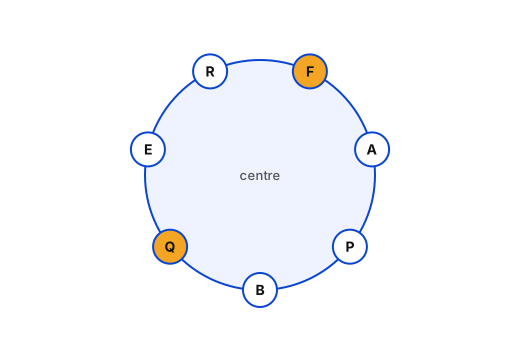
A, B, E, F, P, Q and R are sitting around a circular table facing the centre. A sits second to the right of B. Only one person sits between B and E. R sits to the immediate right of F. P is not an immediate neighbour of E. Who sits third to the left of Q?
A, B, E, F, P, Q और R एक वृत्ताकार मेज के चारों ओर केंद्र की ओर मुख करके बैठे हैं। A, B के दाईं ओर दूसरे स्थान पर बैठा है। B और E के बीच केवल एक व्यक्ति बैठा है। R, F के ठीक दाईं ओर बैठा है। P, E का निकटतम पड़ोसी नहीं है। Q के बाईं ओर तीसरे स्थान पर कौन बैठा है?
  1. AP
  2. BR
  3. CA
  4. DF
Show answer

Concept: Facing the centre, 'right' is anticlockwise and 'left' is clockwise. Fix B and place the rest.

  1. A is second to the right of B. One person between B and E: E is second to the left of B (right side is A).
  2. R immediately right of F: the only free adjacent pair is the 3rd and 4th seats to B's right, so F = 3rd, R = 4th.
  3. P is not next to E, so P sits immediately right of B, and Q is immediately left of B.
  4. Third to the left of Q: Q → E → R → F.

Trick: Draw the circle once and move only in one direction while counting — most mistakes come from switching direction mid-count.

Answer: (D) F

अवधारणा: केंद्र की ओर मुख होने पर 'दाएँ' = वामावर्त, 'बाएँ' = दक्षिणावर्त। B को स्थिर कर बाकी बैठाएँ।

  1. A, B के दाएँ दूसरे स्थान पर। B और E के बीच एक व्यक्ति: E, B के बाएँ दूसरे स्थान पर।
  2. R, F के ठीक दाएँ: खाली सटी जोड़ी केवल B के दाएँ तीसरा व चौथा स्थान है, अतः F = तीसरा, R = चौथा।
  3. P, E का पड़ोसी नहीं, अतः P, B के ठीक दाएँ और Q, B के ठीक बाएँ।
  4. Q के बाएँ तीसरा: Q → E → R → F।

ट्रिक: वृत्त एक बार बनाएँ और गिनते समय एक ही दिशा में चलें।

उत्तर: (D) F

RRB Technician Grade IIIGeneral Intelligence and ReasoningCircular Seating ArrangementRRB Technician Grade III 2024 · 29 Dec Shift 2 →
Q430.
Which of the following options should come in place of the question mark (?) in the given series to make it logically complete?
18, 23, 33, 48, 68, ?
दी गई श्रृंखला को तार्किक रूप से पूर्ण करने के लिए प्रश्न चिह्न (?) के स्थान पर निम्नलिखित में से कौन-सा विकल्प आना चाहिए?
18, 23, 33, 48, 68, ?
  1. A90
  2. B93
  3. C85
  4. D95
Show answer

Concept: Look at the differences between consecutive terms.

  1. Differences: 23−18=5, 33−23=10, 48−33=15, 68−48=20.
  2. They increase by 5, so the next difference is 25.
  3. 68+25=93.

Trick: Differences are multiples of 5: 5,10,15,20,25.

Answer: (B) 93

अवधारणा: क्रमागत पदों के अंतर देखें।

  1. अंतर: 5,10,15,20।
  2. अंतर 5-5 बढ़ रहे हैं, अगला अंतर 25।
  3. 68+25=93।

ट्रिक: अंतर 5 के गुणज हैं: 5,10,15,20,25।

उत्तर: (B) 93

RRB Technician Grade IIIGeneral Intelligence and ReasoningNumber SeriesRRB Technician Grade III 2024 · 29 Dec Shift 2 →
Q431.
In a certain code language,
'P + Q' means 'P is the brother of Q',
'P – Q' means 'P is the daughter of Q',
'P x Q' means 'P is the wife of Q' and
'P ÷ Q' means 'P is the son of Q'.
How is A related to E if 'A + B – C x D ÷ E'?
एक निश्चित कूट भाषा में,
'P + Q' का अर्थ है 'P, Q का भाई है',
'P – Q' का अर्थ है 'P, Q की पुत्री है',
'P x Q' का अर्थ है 'P, Q की पत्नी है' और
'P ÷ Q' का अर्थ है 'P, Q का पुत्र है'।
यदि 'A + B – C x D ÷ E' है, तो A, E से किस प्रकार संबंधित है?
  1. ABrotherभाई
  2. BDaughter's sonपुत्री का पुत्र
  3. CSonपुत्र
  4. DSon's sonपुत्र का पुत्र
Show answer

Concept: Decode each symbol one by one and build the family tree.

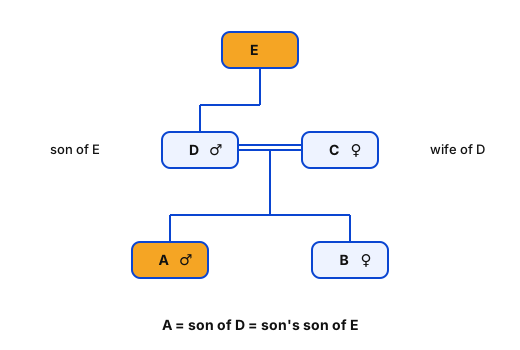
  1. A + B: A is the brother of B (A is male).
  2. B – C: B is the daughter of C; C × D: C is the wife of D, so B and A are children of D.
  3. D ÷ E: D is the son of E.
  4. A is the son of D, and D is the son of E, so A is E's son's son.

Trick: Mark gender as soon as a relation reveals it — here 'brother' tells you A is male.

Answer: (D) Son's son

अवधारणा: हर चिन्ह को एक-एक करके डिकोड करें और वंश-वृक्ष बनाएँ।

  1. A + B: A, B का भाई है (A पुरुष)।
  2. B – C: B, C की बेटी; C × D: C, D की पत्नी, अतः A और B, D की संतान।
  3. D ÷ E: D, E का बेटा है।
  4. A, D का बेटा और D, E का बेटा, अतः A, E के बेटे का बेटा (पोता)।

ट्रिक: संबंध से लिंग पता चलते ही चिह्नित करें — 'भाई' से A पुरुष है।

उत्तर: (D) पुत्र का पुत्र

RRB Technician Grade IIIGeneral Intelligence and ReasoningBlood Relations (Coded)RRB Technician Grade III 2024 · 29 Dec Shift 2 →
Q432.
Based on the English alphabetical order, three of the following four letter-cluster pairs are alike in a certain way and thus form a group. Which pair does not belong to that group?
(Note: The odd one out is not based on the number of consonants/vowels or their position in the letter-cluster.)
अंग्रेजी वर्णमाला क्रम के आधार पर, निम्नलिखित चार अक्षर-समूह युग्मों में से तीन किसी निश्चित प्रकार से एक समान हैं और इस प्रकार एक समूह बनाते हैं। कौन-सा युग्म उस समूह से संबंधित नहीं है?
(ध्यान दें: असंगत युग्म, अक्षर-समूह में व्यंजनों/स्वरों की संख्या या उनके स्थान पर आधारित नहीं है।)
  1. AWT-XZ
  2. BRO-SV
  3. CUR-VX
  4. DNK-OQ
Show answer

Concept: Compare each letter of the first cluster with the corresponding letter of the second.

  1. WT-XZ: W→X +1, T→Z +6.
  2. UR-VX: +1, +6; NK-OQ: +1, +6.
  3. RO-SV: R→S +1, but O→V +7.
  4. RO-SV breaks the pattern.

Trick: Since the first letter always moves +1, compare only the second letters' jumps.

Answer: (B) RO-SV

अवधारणा: पहले समूह के हर अक्षर की तुलना दूसरे समूह के संगत अक्षर से करें।

  1. WT-XZ: W→X +1, T→Z +6।
  2. UR-VX: +1, +6; NK-OQ: +1, +6।
  3. RO-SV: R→S +1, पर O→V +7।
  4. RO-SV नियम तोड़ता है।

ट्रिक: पहला अक्षर हमेशा +1 है, इसलिए केवल दूसरे अक्षर की छलांग देखें।

उत्तर: (B) RO-SV

RRB Technician Grade IIIGeneral Intelligence and ReasoningOdd One Out (Letter Pairs)RRB Technician Grade III 2024 · 29 Dec Shift 2 →
Q433.
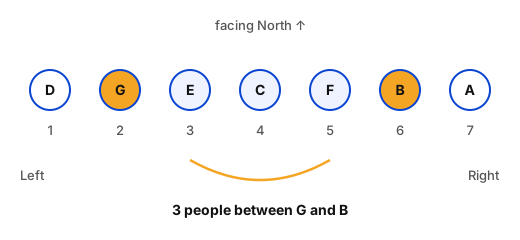
Seven people, A, B, C, D, E, F and G, are sitting in a row, facing north. No one sits to the right of A. Only four people sit between D and B. E sits second to the right of D. C sits to the immediate left of F. How many people sit between G and B?
सात व्यक्ति, A, B, C, D, E, F और G, एक पंक्ति में उत्तर की ओर मुख करके बैठे हैं। A के दाईं ओर कोई नहीं बैठा है। D और B के बीच केवल चार व्यक्ति बैठे हैं। E, D के दाईं ओर दूसरे स्थान पर बैठा है। C, F के ठीक बाईं ओर बैठा है। G और B के बीच कितने व्यक्ति बैठे हैं?
  1. AFourचार
  2. BTwoदो
  3. COneएक
  4. DThreeतीन
Show answer

Concept: Facing north, right = east. Place the fixed person first, then the gap clues.

  1. No one is right of A: A at seat 7 (right end).
  2. Four between D and B: seats 1 and 6. E second to the right of D works only if D = 1, so E = 3, B = 6.
  3. C immediately left of F: free adjacent seats 4, 5 → C = 4, F = 5; G = 2.
  4. Between G (2) and B (6): E, C, F = three people.

Trick: Persons between seats p and q =|p−q|−1=6−2−1=3.

Answer: (D) Three

अवधारणा: उत्तर की ओर मुख होने पर दायाँ = पूर्व। पहले निश्चित व्यक्ति, फिर अंतराल वाले संकेत लगाएँ।

  1. A के दाएँ कोई नहीं: A स्थान 7 (दायाँ छोर)।
  2. D और B के बीच चार: स्थान 1 और 6। E, D के दाएँ दूसरा तभी जब D = 1, अतः E = 3, B = 6।
  3. C, F के ठीक बाएँ: खाली सटे स्थान 4, 5 → C = 4, F = 5; G = 2।
  4. G (2) और B (6) के बीच: E, C, F = तीन व्यक्ति।

ट्रिक: स्थान p और q के बीच व्यक्ति =|p−q|−1=6−2−1=3।

उत्तर: (D) तीन

RRB Technician Grade IIIGeneral Intelligence and ReasoningLinear Seating ArrangementRRB Technician Grade III 2024 · 29 Dec Shift 2 →
Q434.
Which of the following options should come in place of the question mark (?) in the given series based on the English alphabetical order?
HKO, JMQ, LOS, NQU, ?
अंग्रेजी वर्णमाला क्रम के आधार पर दी गई श्रृंखला में प्रश्न चिह्न (?) के स्थान पर निम्नलिखित में से कौन-सा विकल्प आना चाहिए?
HKO, JMQ, LOS, NQU, ?
  1. ASPW
  2. BSWP
  3. CPSW
  4. DPWS
Show answer

Concept: Each letter of the cluster moves forward by the same step.

  1. 1st: H, J, L, N → +2 → P.
  2. 2nd: K, M, O, Q → +2 → S.
  3. 3rd: O, Q, S, U → +2 → W.
  4. Next: PSW.

Trick: Add 2 to each letter of NQU directly.

Answer: (C) PSW

अवधारणा: समूह का हर अक्षर समान कदम से आगे बढ़ता है।

  1. पहला: H, J, L, N → +2 → P।
  2. दूसरा: K, M, O, Q → +2 → S।
  3. तीसरा: O, Q, S, U → +2 → W।
  4. अगला: PSW।

ट्रिक: NQU के हर अक्षर में सीधे 2 जोड़ें।

उत्तर: (C) PSW

RRB Technician Grade IIIGeneral Intelligence and ReasoningAlphabet SeriesRRB Technician Grade III 2024 · 29 Dec Shift 2 →
Q435.
Read the given statements and conclusions carefully. You have to take the given statements to be true even if they seem to be at variance from commonly known facts and decide which conclusion(s) logically follow(s) from the given statements.
Statements:
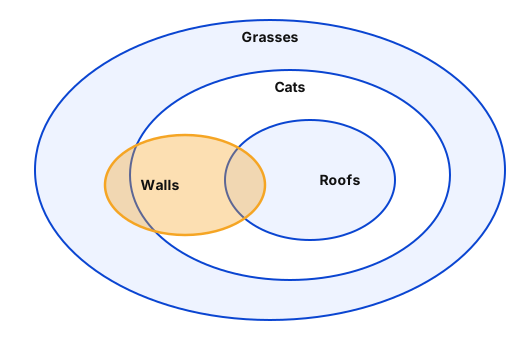
Some walls are roofs.
All roofs are cats.
All cats are grasses.
Conclusions:
(I) Some grasses are walls.
(II) All grasses are roofs.
दिए गए कथनों और निष्कर्षों को ध्यानपूर्वक पढ़िए। आपको दिए गए कथनों को सत्य मानना है, भले ही वे सामान्यतः ज्ञात तथ्यों से भिन्न प्रतीत होते हों, और निर्णय करना है कि कौन-सा/से निष्कर्ष दिए गए कथनों का तार्किक रूप से अनुसरण करता/करते है/हैं।
कथन:
कुछ दीवारें, छतें हैं।
सभी छतें, बिल्लियाँ हैं।
सभी बिल्लियाँ, घास हैं।
निष्कर्ष:
(I) कुछ घास, दीवारें हैं।
(II) सभी घास, छतें हैं।
  1. AOnly conclusion (II) follows.केवल निष्कर्ष (II) अनुसरण करता है।
  2. BNeither conclusion (I) nor (II) follows.न तो निष्कर्ष (I) और न ही (II) अनुसरण करता है।
  3. COnly conclusion (I) follows.केवल निष्कर्ष (I) अनुसरण करता है।
  4. DBoth conclusions (I) and (II) follow.दोनों निष्कर्ष (I) और (II) अनुसरण करते हैं।
Show answer

Concept: Draw the least-overlap Venn diagram; a conclusion follows only if it is true in every possible diagram.

  1. All roofs are cats and all cats are grasses: Roofs ⊂ Cats ⊂ Grasses.
  2. Some walls are roofs, so those walls are also grasses → some grasses are walls. (I) follows.
  3. Grasses may contain items that are not roofs (e.g. cats outside roofs), so 'All grasses are roofs' (II) does not follow.

Trick: 'Some' + 'All' = 'Some' (Some A are B, All B are C ⇒ Some A are C).

Answer: (C) Only conclusion (I) follows.

अवधारणा: न्यूनतम ओवरलैप वाला वेन आरेख बनाएँ; निष्कर्ष तभी सही है जब हर संभव आरेख में सही हो।

  1. सभी छतें बिल्लियाँ और सभी बिल्लियाँ घास: छत ⊂ बिल्ली ⊂ घास।
  2. कुछ दीवारें छतें हैं, अतः वे घास भी हैं → कुछ घास दीवारें हैं। (I) अनुसरण करता है।
  3. घास में ऐसे सदस्य हो सकते हैं जो छत नहीं, अतः (II) 'सभी घास छतें हैं' अनुसरण नहीं करता।

ट्रिक: 'कुछ' + 'सभी' = 'कुछ' (कुछ A, B हैं; सभी B, C हैं ⇒ कुछ A, C हैं)।

उत्तर: (C) केवल निष्कर्ष (I) अनुसरण करता है।

RRB Technician Grade IIIGeneral Intelligence and ReasoningSyllogismRRB Technician Grade III 2024 · 29 Dec Shift 2 →
Q436.
If 'A' stands for '÷', 'B' stands for '×', 'C' stands for '+', and 'D' stands for '−', then the resultant of which of the following would be 26?
यदि 'A' का अर्थ '÷', 'B' का अर्थ '×', 'C' का अर्थ '+' और 'D' का अर्थ '−' है, तो निम्नलिखित में से किसका परिणाम 26 होगा?
  1. A29 A 34 D 2 B 4 C 5
  2. B29 C 34 A 2 D 4 B 5
  3. C29 B 34 C 2 A 4 D 5
  4. D29 D 34 B 2 C 4 A 5
Show answer

Concept: Replace letters with signs and solve using BODMAS (÷, ×, then +, −).

  1. Option (B): 29+34÷2−4×5.
  2. 34÷2=17, 4×5=20.
  3. 29+17−20=26 ✓.

Trick: Check the option where ÷ splits an even number neatly — whole-number results are usually the intended one.

Answer: (B) 29 C 34 A 2 D 4 B 5

अवधारणा: अक्षरों को चिह्नों से बदलें और BODMAS (÷, ×, फिर +, −) से हल करें।

  1. विकल्प (B): 29+34÷2−4×5।
  2. 34÷2=17, 4×5=20।
  3. 29+17−20=26 ✓।

ट्रिक: जहाँ ÷ से पूर्ण संख्या बने, वह विकल्प पहले जाँचें।

उत्तर: (B) 29 C 34 A 2 D 4 B 5

RRB Technician Grade IIIGeneral Intelligence and ReasoningMathematical Operations (Symbol Substitution)RRB Technician Grade III 2024 · 29 Dec Shift 2 →
Q437.
Select the triad which follows the same pattern as that followed by the two triads given below. Both triads follow the same pattern.
TODE - EOTD - ODTE
FAST - TAFS - ASFT
उस त्रिक का चयन कीजिए जो नीचे दिए गए दो त्रिकों के समान पैटर्न का अनुसरण करता है। दोनों त्रिक समान पैटर्न का अनुसरण करते हैं।
TODE - EOTD - ODTE
FAST - TAFS - ASFT
  1. ABACK - KABC - ACBK
  2. BGREW - GERW - WERG
  3. CNEST - TENS - SENT
  4. DPACK - APCK - KACP
Show answer

Concept: Number the letters of the first word 1-2-3-4 and track their positions in the other two words.

  1. TODE = 1234 → EOTD = 4-2-1-3 → ODTE = 2-3-1-4.
  2. FAST: TAFS = 4-2-1-3, ASFT = 2-3-1-4 ✓.
  3. BACK: 4-2-1-3 = KABC, 2-3-1-4 = ACBK ✓.

Trick: Test only the second word of each option first; just BACK gives KABC.

Answer: (A) BACK - KABC - ACBK

अवधारणा: पहले शब्द के अक्षरों को 1-2-3-4 क्रमांक दें और बाकी दो शब्दों में उनकी स्थिति देखें।

  1. TODE = 1234 → EOTD = 4-2-1-3 → ODTE = 2-3-1-4।
  2. FAST: TAFS = 4-2-1-3, ASFT = 2-3-1-4 ✓।
  3. BACK: 4-2-1-3 = KABC, 2-3-1-4 = ACBK ✓।

ट्रिक: पहले हर विकल्प का केवल दूसरा शब्द जाँचें; केवल BACK से KABC बनता है।

उत्तर: (A) BACK - KABC - ACBK

RRB Technician Grade IIIGeneral Intelligence and ReasoningLetter Rearrangement PatternRRB Technician Grade III 2024 · 29 Dec Shift 2 →
Q438.
In a certain code language, 'VOCAL' is coded as '46218' and 'OVALS' is coded as '68514'. What is the code for 'S' in the given code language?
एक निश्चित कूट भाषा में, 'VOCAL' को '46218' के रूप में और 'OVALS' को '68514' के रूप में कूटबद्ध किया जाता है। दी गई कूट भाषा में 'S' का कूट क्या है?
  1. A1
  2. B6
  3. C5
  4. D4
Show answer

Concept: Letters common to two words share the digits common to both codes; the leftover letter gets the leftover digit.

  1. VOCAL = 46218, OVALS = 68514.
  2. Common letters: V, O, A, L ↔ common digits 4, 6, 8, 1.
  3. VOCAL leftover: C = 2; OVALS leftover: S = 5.

Trick: Strike out common digits from the second code: 68514 − {6, 8, 1, 4} leaves 5.

Answer: (C) 5

अवधारणा: दो शब्दों के उभयनिष्ठ अक्षरों के कोड दोनों कोडों के उभयनिष्ठ अंक होते हैं; बचा अक्षर बचा अंक लेता है।

  1. VOCAL = 46218, OVALS = 68514।
  2. उभयनिष्ठ अक्षर: V, O, A, L ↔ उभयनिष्ठ अंक 4, 6, 8, 1।
  3. VOCAL में बचा: C = 2; OVALS में बचा: S = 5।

ट्रिक: दूसरे कोड 68514 से {6, 8, 1, 4} हटाएँ, 5 बचता है।

उत्तर: (C) 5

RRB Technician Grade IIIGeneral Intelligence and ReasoningCoding–Decoding (Common Letters)RRB Technician Grade III 2024 · 29 Dec Shift 2 →
Q439.
Refer to the given number and symbol series and answer the question that follows. Counting to be done from left to right only.
(Left) 7 & 3 Ω 9 5 & 4 6 @ 8 $ # 1 * £ 5 (Right)
How many such symbols are there, each of which is immediately preceded by an even number and also immediately followed by an odd number?
दी गई संख्या और प्रतीक श्रृंखला को देखिए और उसके बाद आने वाले प्रश्न का उत्तर दीजिए। गिनती केवल बाएँ से दाएँ की जानी है।
(बाएँ) 7 & 3 Ω 9 5 & 4 6 @ 8 $ # 1 * £ 5 (दाएँ)
ऐसे कितने प्रतीक हैं, जिनमें से प्रत्येक के ठीक पहले एक सम संख्या है और ठीक बाद एक विषम संख्या भी है?
  1. AOneएक
  2. BMore than twoदो से अधिक
  3. CNoneकोई नहीं
  4. DTwoदो
Show answer

Concept: Check every symbol: the element just before must be even and the one just after must be odd.

  1. & (after 7) – before is odd ✗; Ω (after 3) ✗; & (after 5) ✗.
  2. @: before 6 (even) but after 8 (even) ✗.
  3. $: before 8 (even) but after # (symbol) ✗.
  4. #, *, £: preceded by a symbol or odd 1 ✗. Count =0.

Trick: First list only symbols preceded by an even number (@, $), then test what follows them.

Answer: (C) None

अवधारणा: हर चिह्न जाँचें: ठीक पहले सम संख्या और ठीक बाद विषम संख्या होनी चाहिए।

  1. & (7 के बाद) – पहले विषम ✗; Ω (3 के बाद) ✗; & (5 के बाद) ✗।
  2. @: पहले 6 (सम) पर बाद में 8 (सम) ✗।
  3. $: पहले 8 (सम) पर बाद में # (चिह्न) ✗।
  4. #, *, £: पहले चिह्न या विषम 1 ✗। गिनती =0।

ट्रिक: पहले केवल वे चिह्न छाँटें जिनके पहले सम संख्या है (@, $), फिर उनके बाद देखें।

उत्तर: (C) कोई नहीं

RRB Technician Grade IIIGeneral Intelligence and ReasoningNumber–Symbol SeriesRRB Technician Grade III 2024 · 29 Dec Shift 2 →
Q440.
Which of the following options should come in place of the question mark (?) in the given series to make it logically complete?
274, 252, 282, 260, 290, 268,?
दी गई श्रृंखला को तार्किक रूप से पूर्ण करने के लिए प्रश्न चिह्न (?) के स्थान पर निम्नलिखित में से कौन-सा विकल्प आना चाहिए?
274, 252, 282, 260, 290, 268,?
  1. A272
  2. B280
  3. C284
  4. D298
Show answer

Concept: The series alternates between two operations.

  1. 274→252: −22; 252→282: +30.
  2. 282→260: −22; 260→290: +30; 290→268: −22.
  3. Next: 268+30=298.

Trick: Alternate terms also form simple series: 274, 282, 290, 298 (+8).

Answer: (D) 298

अवधारणा: श्रृंखला में दो संक्रियाएँ बारी-बारी से लगती हैं।

  1. 274→252: −22; 252→282: +30।
  2. 282→260: −22; 260→290: +30; 290→268: −22।
  3. अगला: 268+30=298।

ट्रिक: एकांतर पद भी सरल श्रृंखला हैं: 274, 282, 290, 298 (+8)।

उत्तर: (D) 298

RRB Technician Grade IIIGeneral Intelligence and ReasoningNumber Series (Alternating)RRB Technician Grade III 2024 · 29 Dec Shift 2 →