Question bank

Q&A: practice questions with answers

Search questions on any topic. Filter by exam category, exam, subject and topic, try the question, then open the answer and explanation.

Courses – airGurukul

3,200 questions found.

Q501.
Evaluate the given expression.
(−18)+6÷3+5
दिए गए व्यंजक का मान ज्ञात कीजिए।
(−18)+6÷3+5
  1. A11
  2. B1
  3. C−1
  4. D−11
Show answer

Concept: By BODMAS, division is done before addition.

  1. 6÷3=2
  2. (−18)+2+5=−18+7
  3. =−11

Trick: Do ÷ and × first, then add the positives together and the negatives together.

Answer: (D) −11

अवधारणा: BODMAS के अनुसार भाग, जोड़ से पहले होता है।

  1. 6÷3=2
  2. (−18)+2+5=−18+7
  3. =−11

ट्रिक: पहले ÷ और ×, फिर धनात्मक व ऋणात्मक संख्याओं को अलग-अलग जोड़ें।

उत्तर: (D) −11
RRB Technician Grade IIIMathematicsSimplification (BODMAS)RRB Technician Grade III 2024 · 29 Dec Shift 1 →
Q502.
Rani has borrowed an amount of ₹2,00,000 from a bank to start a business. How much simple interest will she pay at a rate of 7% per annum after 2 years?
रानी ने व्यवसाय शुरू करने के लिए एक बैंक से ₹2,00,000 की राशि उधार ली है। 7% वार्षिक की दर से 2 वर्ष बाद वह कितना साधारण ब्याज चुकाएगी?
  1. A₹28,500
  2. B₹28,000
  3. C₹26,000
  4. D₹24,000
Show answer

Concept: SI=P×R×T100

  1. P=2,00,000, R=7%, T=2 years.
  2. SI=200000×7×2100
  3. =2000×14=28000

Trick: 1 year interest =7% of ₹2,00,000 =14000; for 2 years just double it: 28000.

Answer: (B) ₹28,000

अवधारणा: साधारण ब्याज=P×R×T100

  1. P=2,00,000, R=7%, T=2 वर्ष।
  2. SI=200000×7×2100
  3. =2000×14=28000

ट्रिक: 1 वर्ष का ब्याज =200000 का 7%=14000; 2 वर्ष के लिए दोगुना: 28000।

उत्तर: (B) ₹28,000

RRB Technician Grade IIIMathematicsSimple InterestRRB Technician Grade III 2024 · 29 Dec Shift 1 →
Q503.
A, B, C alone can do a piece of work in 9, 12 and 18 days, respectively. They all started the work together, but A left after 3 days. In how many days was the remaining work completed?
A, B, C अकेले किसी काम को क्रमशः 9, 12 और 18 दिनों में कर सकते हैं। उन सभी ने एक साथ काम शुरू किया, लेकिन A ने 3 दिन बाद काम छोड़ दिया। शेष काम कितने दिनों में पूरा हुआ?
  1. A114
  2. B52
  3. C2
  4. D95
Show answer

Concept: Take total work as LCM of 9, 12, 18 =36 units; efficiency = units per day.

  1. Efficiencies: A =369=4, B =3612=3, C =3618=2.
  2. In 3 days A+B+C do (4+3+2)×3=27 units.
  3. Remaining work =36−27=9 units.
  4. B+C do 5 units/day, so time =95 days.

Trick: LCM method avoids fractions: work left ÷ combined efficiency of those still working.

Answer: (D) 95

अवधारणा: कुल कार्य = 9, 12, 18 का LCM =36 इकाई मानें; दक्षता = प्रतिदिन इकाई।

  1. दक्षता: A =369=4, B =3612=3, C =3618=2।
  2. 3 दिनों में A+B+C =(4+3+2)×3=27 इकाई।
  3. शेष कार्य =36−27=9 इकाई।
  4. B+C प्रतिदिन 5 इकाई, अतः समय =95 दिन।

ट्रिक: LCM विधि से भिन्न नहीं आतीं: शेष कार्य ÷ बचे लोगों की संयुक्त दक्षता।

उत्तर: (D) 95

RRB Technician Grade IIIMathematicsTime and WorkRRB Technician Grade III 2024 · 29 Dec Shift 1 →
Q504.
A pipe can fill a tank in 12 hours. Another pipe can empty the filled tank in 28 hours. If both the pipes are opened simultaneously, then the time (in hours) in which the tank will be one-third filled, is:
एक पाइप किसी टंकी को 12 घंटे में भर सकता है। दूसरा पाइप भरी हुई टंकी को 28 घंटे में खाली कर सकता है। यदि दोनों पाइप एक साथ खोल दिए जाएँ, तो टंकी कितने समय (घंटों में) में एक-तिहाई भर जाएगी?
  1. A14
  2. B21
  3. C28
  4. D7
Show answer

Concept: Net filling rate = filling rate − emptying rate.

  1. Net rate =112−128=7−384=484=121 tank per hour.
  2. Full tank takes 21 hours.
  3. One-third tank =213=7 hours.

Trick: Capacity = LCM(12, 28) =84 units: +7−3=4 units/h; 13 of 84 =28 units ⇒284=7 h.

Answer: (D) 7

अवधारणा: कुल भरने की दर = भरने की दर − खाली करने की दर।

  1. कुल दर =112−128=7−384=484=121 टंकी प्रति घंटा।
  2. पूरी टंकी 21 घंटे में भरेगी।
  3. एक-तिहाई टंकी =213=7 घंटे।

ट्रिक: क्षमता = LCM(12, 28) =84 इकाई: +7−3=4 इकाई/घंटा; 84 का 13=28 इकाई ⇒284=7 घंटे।

उत्तर: (D) 7

RRB Technician Grade IIIMathematicsPipes and CisternRRB Technician Grade III 2024 · 29 Dec Shift 1 →
Q505.
The cost of 2 tables and 3 chairs is ₹540, while that of 2 tables and 1 chair is ₹470. What is the cost of 35 chairs?
2 मेजों और 3 कुर्सियों का मूल्य ₹540 है, जबकि 2 मेजों और 1 कुर्सी का मूल्य ₹470 है। 35 कुर्सियों का मूल्य क्या है?
  1. A₹1,185
  2. B₹1,205
  3. C₹1,245
  4. D₹1,225
Show answer

Concept: Subtract the two equations to eliminate the tables.

  1. 2T+3C=540 and 2T+C=470.
  2. Subtracting: 2C=70⇒C=35.
  3. Cost of 35 chairs =35×35=1225.

Trick: Both bills have the same 2 tables, so the ₹70 difference is the price of 2 chairs.

Answer: (D) ₹1,225

अवधारणा: दोनों समीकरण घटाकर मेज़ों को हटाएँ।

  1. 2T+3C=540 तथा 2T+C=470।
  2. घटाने पर: 2C=70⇒C=35।
  3. 35 कुर्सियों का मूल्य =35×35=1225।

ट्रिक: दोनों में 2 मेज़ समान हैं, इसलिए ₹70 का अंतर 2 कुर्सियों का मूल्य है।

उत्तर: (D) ₹1,225

RRB Technician Grade IIIMathematicsLinear EquationsRRB Technician Grade III 2024 · 29 Dec Shift 1 →
Q506.
In which of the pairs of the following numbers is none of the two numbers a prime number, but the two numbers are co-primes?
निम्नलिखित संख्याओं के किस युग्म में दोनों में से कोई भी संख्या अभाज्य संख्या नहीं है, लेकिन दोनों संख्याएँ सह-अभाज्य हैं?
  1. A(11, 17)
  2. B(19, 27)
  3. C(8, 25)
  4. D(21, 35)
Show answer

Concept: Co-primes have HCF=1; here both numbers must also be composite.

  1. (11, 17): both are prime — rejected.
  2. (19, 27): 19 is prime — rejected.
  3. (21, 35): both composite but HCF=7 — not co-prime.
  4. (8, 25): 8=23, 25=52, no common factor, HCF=1 ✓.

Yaad rakhein: Two composite numbers can still be co-prime if their prime factors are completely different.

Answer: (C) (8, 25)

अवधारणा: सह-अभाज्य संख्याओं का HCF=1 होता है; यहाँ दोनों संख्याएँ भाज्य भी होनी चाहिए।

  1. (11, 17): दोनों अभाज्य — अस्वीकार।
  2. (19, 27): 19 अभाज्य — अस्वीकार।
  3. (21, 35): दोनों भाज्य पर HCF=7 — सह-अभाज्य नहीं।
  4. (8, 25): 8=23, 25=52, कोई उभयनिष्ठ गुणनखंड नहीं, HCF=1 ✓।

याद रखें: दो भाज्य संख्याएँ भी सह-अभाज्य हो सकती हैं, यदि उनके अभाज्य गुणनखंड बिल्कुल अलग हों।

उत्तर: (C) (8, 25)

RRB Technician Grade IIIMathematicsNumber System (Co-primes)RRB Technician Grade III 2024 · 29 Dec Shift 1 →
Q507.
If the area of an equilateral triangle is 163 sq cm, then the length of each side of the triangle is:
यदि किसी समबाहु त्रिभुज का क्षेत्रफल 163 वर्ग cm है, तो त्रिभुज की प्रत्येक भुजा की लंबाई है:
  1. A10 cm
  2. B8 cm
  3. C12 cm
  4. D5 cm
Show answer

Concept: Area of an equilateral triangle =34a2.

  1. 34a2=163
  2. a2=16×4=64
  3. a=8 cm

Trick: Cancel 3 on both sides at once: a2=4×16.

Answer: (B) 8 cm

अवधारणा: समबाहु त्रिभुज का क्षेत्रफल =34a2।

  1. 34a2=163
  2. a2=16×4=64
  3. a=8 सेमी

ट्रिक: दोनों ओर का 3 तुरंत काटें: a2=4×16।

उत्तर: (B) 8 cm

RRB Technician Grade IIIMathematicsMensuration (Equilateral Triangle)RRB Technician Grade III 2024 · 29 Dec Shift 1 →
Q508.
Using the empirical relation between the mean, median and mode, find the value of the mode if the median is 30 and mean is 25.
माध्य, माध्यिका और बहुलक के बीच आनुभविक संबंध का उपयोग करके, बहुलक का मान ज्ञात कीजिए, यदि माध्यिका 30 और माध्य 25 है।
  1. A40
  2. B60
  3. C50
  4. D30
Show answer

Concept: Empirical relation: Mode=3Median−2Mean.

  1. Mode=3×30−2×25
  2. =90−50=40

Yaad rakhein: Remember “3 Median minus 2 Mean”.

Answer: (A) 40

अवधारणा: आनुभविक संबंध: बहुलक=3माध्यिका−2माध्य।

  1. बहुलक=3×30−2×25
  2. =90−50=40

याद रखें: याद रखें: “3 माध्यिका घटा 2 माध्य”।

उत्तर: (A) 40

RRB Technician Grade IIIMathematicsStatistics (Mean, Median, Mode)RRB Technician Grade III 2024 · 29 Dec Shift 1 →
Q509.
The value of sin248∘+sin242∘tan240∘−cosec250∘ is:
sin248∘+sin242∘tan240∘−cosec250∘ का मान है:
  1. A1
  2. B0
  3. C−1
  4. D2
Show answer

Concept: sin(90∘−θ)=cosθ, cosec(90∘−θ)=secθ, and sin2θ+cos2θ=1, sec2θ−tan2θ=1.

  1. sin42∘=cos48∘, so numerator =sin248∘+cos248∘=1.
  2. cosec50∘=sec40∘, so denominator =tan240∘−sec240∘=−1.
  3. Value =1−1=−1.

Trick: Angles adding to 90∘ (48+42, 40+50) signal the complementary-angle identities.

Answer: (C) −1

अवधारणा: sin(90∘−θ)=cosθ, cosec(90∘−θ)=secθ तथा sin2θ+cos2θ=1, sec2θ−tan2θ=1।

  1. sin42∘=cos48∘, अतः अंश =sin248∘+cos248∘=1।
  2. cosec50∘=sec40∘, अतः हर =tan240∘−sec240∘=−1।
  3. मान =1−1=−1।

ट्रिक: कोणों का योग 90∘ (48+42, 40+50) हो तो पूरक कोण सर्वसमिकाएँ लगाएँ।

उत्तर: (C) −1

RRB Technician Grade IIIMathematicsTrigonometry (Complementary Angles)RRB Technician Grade III 2024 · 29 Dec Shift 1 →
Q510.
If 50 is subtracted from 60% of a number, then the result is 40. 60% of the same number is:
यदि किसी संख्या के 60% में से 50 घटाया जाए, तो परिणाम 40 आता है। उसी संख्या का 60% है:
  1. A90
  2. B120
  3. C150
  4. D60
Show answer

Concept: Translate the statement directly into an equation in “60% of the number”.

  1. Let 60% of the number =y.
  2. y−50=40
  3. y=90

Trick: The question asks for 60% itself, so there is no need to find the number (x=150).

Answer: (A) 90

अवधारणा: कथन को सीधे “संख्या का 60%” के समीकरण में बदलें।

  1. माना संख्या का 60% =y।
  2. y−50=40
  3. y=90

ट्रिक: प्रश्न 60% ही पूछ रहा है, अतः संख्या (x=150) निकालने की ज़रूरत नहीं।

उत्तर: (A) 90

RRB Technician Grade IIIMathematicsPercentageRRB Technician Grade III 2024 · 29 Dec Shift 1 →
Q511.
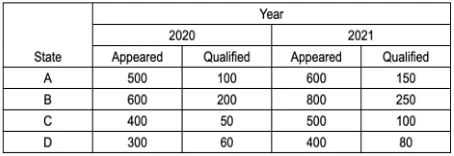
Study the following table and answer the question.
Number of candidates appeared and qualified in a competitive examination from different states over the years.

For which state did the percentage of students qualified did NOT change from 2020 to 2021?
निम्नलिखित तालिका का अध्ययन कीजिए और प्रश्न का उत्तर दीजिए।
विभिन्न वर्षों में विभिन्न राज्यों से एक प्रतियोगी परीक्षा में उपस्थित और उत्तीर्ण अभ्यर्थियों की संख्या।

किस राज्य के लिए उत्तीर्ण विद्यार्थियों का प्रतिशत 2020 से 2021 तक नहीं बदला?
  1. AD
  2. BC
  3. CA
  4. DB
Show answer

Concept: Qualified%=QualifiedAppeared×100 for each year; compare.

  1. A: 100500=20% → 150600=25% (changed).
  2. B: 200600=33.3% → 250800=31.25% (changed).
  3. C: 50400=12.5% → 100500=20% (changed).
  4. D: 60300=20% → 80400=20% (same).

Trick: Check if the ratio stays the same: 60300=15=80400.

Answer: (A) D

अवधारणा: हर वर्ष उत्तीर्ण%=उत्तीर्णउपस्थित×100 निकालकर तुलना करें।

  1. A: 100500=20% → 150600=25% (बदला)।
  2. B: 200600=33.3% → 250800=31.25% (बदला)।
  3. C: 50400=12.5% → 100500=20% (बदला)।
  4. D: 60300=20% → 80400=20% (समान)।

ट्रिक: केवल अनुपात देखें: 60300=15=80400।

उत्तर: (A) D

RRB Technician Grade IIIMathematicsData Interpretation (Table)RRB Technician Grade III 2024 · 29 Dec Shift 1 →
Q512.
A father’s age is seven times that of his son’s age. Three years from now, the age of the father will be five times that of his son’s age. After how many years will their combined age be 58 years?
एक पिता की आयु उसके पुत्र की आयु की सात गुनी है। अब से तीन वर्ष बाद, पिता की आयु उसके पुत्र की आयु की पाँच गुनी होगी। कितने वर्ष बाद उनकी संयुक्त आयु 58 वर्ष होगी?
  1. A5 years5 वर्ष
  2. B6 years6 वर्ष
  3. C4 years4 वर्ष
  4. D2 years2 वर्ष
Show answer

Concept: Form equations from present and future ages; the combined age rises by 2 every year.

  1. Son =x, father =7x.
  2. 7x+3=5(x+3)⇒2x=12⇒x=6; father =42.
  3. Present sum =48; needed increase =58−48=10.
  4. Years =102=5.

Trick: Check options: in 5 years ages are 11 and 47, sum =58 ✓.

Answer: (A) 5 years

अवधारणा: वर्तमान और भविष्य की आयु से समीकरण बनाएँ; दोनों की कुल आयु हर वर्ष 2 बढ़ती है।

  1. पुत्र =x, पिता =7x।
  2. 7x+3=5(x+3)⇒2x=12⇒x=6; पिता =42।
  3. वर्तमान योग =48; आवश्यक वृद्धि =58−48=10।
  4. वर्ष =102=5।

ट्रिक: विकल्प जाँचें: 5 वर्ष बाद आयु 11 और 47, योग =58 ✓।

उत्तर: (A) 5 वर्ष

RRB Technician Grade IIIMathematicsProblems on AgesRRB Technician Grade III 2024 · 29 Dec Shift 1 →
Q513.
If x+1x=6, then x2+1x2=?
यदि x+1x=6 है, तो x2+1x2=?
  1. A38
  2. B36
  3. C34
  4. D32
Show answer

Concept: x2+1x2=(x+1x)2−2

  1. (x+1x)2=62=36
  2. x2+1x2=36−2=34

Yaad rakhein: If x+1x=k, then x2+1x2=k2−2.

Answer: (C) 34

अवधारणा: x2+1x2=(x+1x)2−2

  1. (x+1x)2=62=36
  2. x2+1x2=36−2=34

याद रखें: यदि x+1x=k, तो x2+1x2=k2−2।

उत्तर: (C) 34

RRB Technician Grade IIIMathematicsAlgebraic IdentitiesRRB Technician Grade III 2024 · 29 Dec Shift 1 →
Q514.
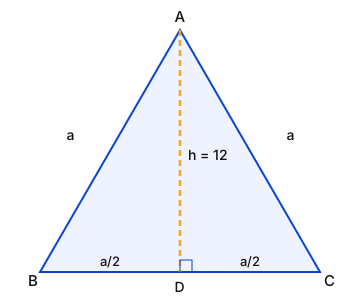
The area (in cm2) of an equilateral triangle whose altitude from vertex is 12 cm, is:
उस समबाहु त्रिभुज का क्षेत्रफल (cm2 में) क्या है, जिसके शीर्ष से शीर्षलंब 12 cm है?
  1. A273
  2. B932
  3. C934
  4. D483
Show answer

Concept: Altitude of an equilateral triangle h=32a; area =34a2=h23.

  1. 32a=12⇒a=243=83 cm.
  2. a2=64×3=192.
  3. Area =34×192=483 cm2.

Trick: Direct: Area =h23=1443=483.

Answer: (D) 483

अवधारणा: समबाहु त्रिभुज की ऊँचाई h=32a; क्षेत्रफल =34a2=h23।

  1. 32a=12⇒a=243=83 सेमी।
  2. a2=64×3=192।
  3. क्षेत्रफल =34×192=483 सेमी2।

ट्रिक: सीधे: क्षेत्रफल =h23=1443=483।

उत्तर: (D) 483

RRB Technician Grade IIIMathematicsMensuration (Equilateral Triangle)RRB Technician Grade III 2024 · 29 Dec Shift 1 →
Q515.
The mean proportional between two numbers is given as the positive square root of the product of those two numbers. If 72 is the mean proportional between 18 and y, then the value of y is:
दो संख्याओं के बीच मध्यानुपाती उन दोनों संख्याओं के गुणनफल के धनात्मक वर्गमूल के रूप में दिया जाता है। यदि 18 और y के बीच मध्यानुपाती 72 है, तो y का मान क्या है?
  1. A588
  2. B488
  3. C388
  4. D288
Show answer

Concept: Mean proportional of a and b is ab, i.e. m2=ab.

  1. 722=18×y
  2. 5184=18y
  3. y=518418=288

Trick: y=72×7218=72×4=288 — cancel first.

Answer: (D) 288

अवधारणा: a और b का मध्यानुपाती ab होता है, अर्थात m2=ab।

  1. 722=18×y
  2. 5184=18y
  3. y=518418=288

ट्रिक: y=72×7218=72×4=288 — पहले काटें।

उत्तर: (D) 288

RRB Technician Grade IIIMathematicsRatio and Proportion (Mean Proportional)RRB Technician Grade III 2024 · 29 Dec Shift 1 →
Q516.
The average of the eight numbers is 72. Find the least number if it is 116 of the sum of the numbers.
आठ संख्याओं का औसत 72 है। यदि सबसे छोटी संख्या, संख्याओं के योग का 116 है, तो सबसे छोटी संख्या ज्ञात कीजिए।
  1. A16
  2. B18
  3. C36
  4. D28
Show answer

Concept: Sum=Average×Count.

  1. Sum =72×8=576.
  2. Least number =116×576=36.

Trick: 8×7216=722=36 — half of the average.

Answer: (C) 36

अवधारणा: योग=औसत×संख्याओं की गिनती।

  1. योग =72×8=576।
  2. सबसे छोटी संख्या =116×576=36।

ट्रिक: 8×7216=722=36 — यानी औसत का आधा।

उत्तर: (C) 36

RRB Technician Grade IIIMathematicsAverageRRB Technician Grade III 2024 · 29 Dec Shift 1 →
Q517.
The number of prime numbers lying between 400 and 430 is:
400 और 430 के बीच स्थित अभाज्य संख्याओं की संख्या कितनी है?
  1. A6
  2. B5
  3. C4
  4. D3
Show answer

Concept: Test odd numbers (not ending in 5) for divisibility by primes up to 430≈20.7, i.e. 3, 7, 11, 13, 17, 19.

  1. Candidates: 401, 403, 407, 409, 411, 413, 417, 419, 421, 427, 429.
  2. Composite: 403=13×31, 407=11×37, 411=3×137, 413=7×59, 417=3×139, 427=7×61, 429=3×143.
  3. Primes left: 401, 409, 419, 421.

Trick: First drop multiples of 3 by digit sum, then test only 7, 11, 13, 17, 19.

Answer: (C) 4

अवधारणा: विषम संख्याओं (5 पर समाप्त न होने वाली) की 430≈20.7 तक के अभाज्यों 3, 7, 11, 13, 17, 19 से जाँच करें।

  1. उम्मीदवार: 401, 403, 407, 409, 411, 413, 417, 419, 421, 427, 429।
  2. भाज्य: 403=13×31, 407=11×37, 411=3×137, 413=7×59, 417=3×139, 427=7×61, 429=3×143।
  3. बचे अभाज्य: 401, 409, 419, 421।

ट्रिक: पहले अंकों के योग से 3 के गुणज हटाएँ, फिर केवल 7, 11, 13, 17, 19 से जाँचें।

उत्तर: (C) 4

RRB Technician Grade IIIMathematicsNumber System (Prime Numbers)RRB Technician Grade III 2024 · 29 Dec Shift 1 →
Q518.
A dishonest shopkeeper pretends to sell his goods at cost price, but uses a false weights and gains 1119%. For a weight of a kg, he uses:
एक बेईमान दुकानदार अपना माल क्रय मूल्य पर बेचने का दिखावा करता है, लेकिन गलत बाट का उपयोग करता है और 1119% लाभ प्राप्त करता है। एक kg के बाट के स्थान पर, वह किसका उपयोग करता है?
  1. A900 gm weight900 gm का बाट
  2. B950 gm weight950 gm का बाट
  3. C850 gm weight850 gm का बाट
  4. D875 gm weight875 gm का बाट
Show answer

Concept: With false weight, Gain%=ErrorTrue value−Error×100.

  1. 1119%=19.
  2. So error : weight used =1:9, i.e. out of 1000 g, error =100010=100 g.
  3. Weight used =1000−100=900 g.

Trick: Gain 1n ⇒ he gives nn+1 of the true weight: 910×1000=900 g.

Answer: (A) 900 gm weight

अवधारणा: गलत बाट में लाभ%=त्रुटिवास्तविक भार−त्रुटि×100।

  1. 1119%=19।
  2. अतः त्रुटि : दिया गया भार =1:9; 1000 ग्राम में त्रुटि =100010=100 ग्राम।
  3. प्रयुक्त बाट =1000−100=900 ग्राम।

ट्रिक: लाभ 1n ⇒ वह वास्तविक भार का nn+1 देता है: 910×1000=900 ग्राम।

उत्तर: (A) 900 gm का बाट

RRB Technician Grade IIIMathematicsProfit and Loss (False Weight)RRB Technician Grade III 2024 · 29 Dec Shift 1 →
Q519.
The value of a machine depreciates at the rate of 10% per annum. If its present value is ₹1,62,000, then what was the value of the machine 2 years ago?
एक मशीन के मूल्य में 10% वार्षिक की दर से मूल्यह्रास होता है। यदि इसका वर्तमान मूल्य ₹1,62,000 है, तो 2 वर्ष पहले मशीन का मूल्य कितना था?
  1. A₹2,00,000
  2. B₹2,04,000
  3. C₹1,90,000
  4. D₹1,86,000
Show answer

Concept: Present value=Past value×(1−r100)n.

  1. 162000=P×(0.9)2=0.81P
  2. P=1620000.81=200000

Trick: Check: 200000→180000→162000 (10% less each year) ✓.

Answer: (A) ₹2,00,000

अवधारणा: वर्तमान मूल्य=पहले का मूल्य×(1−r100)n।

  1. 162000=P×(0.9)2=0.81P
  2. P=1620000.81=200000

ट्रिक: जाँच: 200000→180000→162000 (हर वर्ष 10% कम) ✓।

उत्तर: (A) ₹2,00,000

RRB Technician Grade IIIMathematicsDepreciationRRB Technician Grade III 2024 · 29 Dec Shift 1 →
Q520.
In how many years will a sum of ₹12,000 become ₹14,520 at a rate of 10% per annum on compound interest, compounded annually?
₹12,000 की राशि, वार्षिक रूप से संयोजित चक्रवृद्धि ब्याज पर 10% वार्षिक की दर से कितने वर्षों में ₹14,520 हो जाएगी?
  1. A5
  2. B2
  3. C4
  4. D3
Show answer

Concept: A=P(1+R100)n.

  1. AP=1452012000=1.21.
  2. (1.1)n=1.21=(1.1)2.
  3. n=2 years.

Trick: At 10%: 1.1,1.21,1.331 — ratio 1.21 means 2 years.

Answer: (B) 2

अवधारणा: A=P(1+R100)n।

  1. AP=1452012000=1.21।
  2. (1.1)n=1.21=(1.1)2।
  3. n=2 वर्ष।

ट्रिक: 10% पर गुणक: 1.1,1.21,1.331 — 1.21 का अर्थ 2 वर्ष।

उत्तर: (B) 2

RRB Technician Grade IIIMathematicsCompound InterestRRB Technician Grade III 2024 · 29 Dec Shift 1 →