Question bank

Q&A: practice questions with answers

Search questions on any topic. Filter by exam category, exam, subject and topic, try the question, then open the answer and explanation.

Courses – airGurukul

3,200 questions found.

Q521.
A single discount equivalent to successive discounts of 40% and 20% is:
40% और 20% की क्रमिक छूटों के समतुल्य एकल छूट कितनी है?
  1. A55%
  2. B60%
  3. C52%
  4. D50%
Show answer

Concept: Equivalent discount of a% and b% =a+b−ab100.

  1. 40+20−40×20100
  2. =60−8=52%

Trick: On ₹100: 100→60→48, so total discount =52%.

Answer: (C) 52%

अवधारणा: a% और b% की समतुल्य छूट =a+b−ab100।

  1. 40+20−40×20100
  2. =60−8=52%

ट्रिक: ₹100 पर: 100→60→48, अतः कुल छूट =52%।

उत्तर: (C) 52%

RRB Technician Grade IIIMathematicsSuccessive DiscountsRRB Technician Grade III 2024 · 29 Dec Shift 1 →
Q522.
50 men took a dip in a water tank 40 m long and 20 m broad on a religious day. If the average displacement of water by a man is 4 m3, then the rise in the water level in the tank will be:
एक धार्मिक दिवस पर 50 व्यक्तियों ने 40 m लंबे और 20 m चौड़े पानी के टैंक में डुबकी लगाई। यदि एक व्यक्ति द्वारा विस्थापित पानी का औसत 4 m3 है, तो टैंक में पानी के स्तर में कितनी वृद्धि होगी?
  1. A35 cm
  2. B20 cm
  3. C50 cm
  4. D25 cm
Show answer

Concept: Rise in level =Volume displacedBase area of tank.

  1. Volume displaced =50×4=200 m3.
  2. Base area =40×20=800 m2.
  3. Rise =200800=0.25 m =25 cm.

Trick: Always convert the final metres to cm: ×100.

Answer: (D) 25 cm

अवधारणा: जल-स्तर में वृद्धि =विस्थापित आयतनटंकी का आधार क्षेत्रफल।

  1. विस्थापित आयतन =50×4=200 मी3।
  2. आधार क्षेत्रफल =40×20=800 मी2।
  3. वृद्धि =200800=0.25 मी =25 सेमी।

ट्रिक: अंत में मीटर को सेमी में बदलें: ×100।

उत्तर: (D) 25 cm

RRB Technician Grade IIIMathematicsMensuration (Volume Displacement)RRB Technician Grade III 2024 · 29 Dec Shift 1 →
Q523.
₹ 2,000 is divided between A and B such that half of A's part and one-third of B's part are equal. What is B's part (in ₹)?
₹ 2,000 को A और B के बीच इस प्रकार विभाजित किया जाता है कि A के भाग का आधा और B के भाग का एक-तिहाई बराबर है। B का भाग (₹ में) कितना है?
  1. A1,200
  2. B800
  3. C1,000
  4. D600
Show answer

Concept: If A2=B3, then A:B=2:3.

  1. Total parts =2+3=5.
  2. B's part =35×2000=1200.

Trick: Check: A =800, 8002=400=12003 ✓.

Answer: (A) 1,200

अवधारणा: यदि A2=B3, तो A:B=2:3।

  1. कुल भाग =2+3=5।
  2. B का भाग =35×2000=1200।

ट्रिक: जाँच: A =800, 8002=400=12003 ✓।

उत्तर: (A) 1,200

RRB Technician Grade IIIMathematicsRatio and ProportionRRB Technician Grade III 2024 · 29 Dec Shift 1 →
Q524.
The HCF of 240, 360 and 480 is:
240, 360 और 480 का HCF (महत्तम समापवर्तक) क्या है?
  1. A160
  2. B360
  3. C480
  4. D120
Show answer

Concept: HCF = product of common prime factors with the lowest powers.

  1. 240=24×3×5, 360=23×32×5, 480=25×3×5.
  2. HCF =23×3×5=120.

Trick: 240=2×120, 360=3×120, 480=4×120, and 2, 3, 4 have HCF 1.

Answer: (D) 120

अवधारणा: HCF = उभयनिष्ठ अभाज्य गुणनखंडों की न्यूनतम घातों का गुणनफल।

  1. 240=24×3×5, 360=23×32×5, 480=25×3×5।
  2. HCF =23×3×5=120।

ट्रिक: 240=2×120, 360=3×120, 480=4×120 और 2, 3, 4 का HCF 1 है।

उत्तर: (D) 120

RRB Technician Grade IIIMathematicsHCFRRB Technician Grade III 2024 · 29 Dec Shift 1 →
Q525.
The value of [(10)150÷(10)146] is:
[(10)150÷(10)146] का मान क्या है?
  1. A10000
  2. B106
  3. C105
  4. D1000
Show answer

Concept: am÷an=am−n.

  1. 10150÷10146=10150−146
  2. =104=10000

Yaad rakhein: Same base in division ⇒ subtract the powers.

Answer: (A) 10000

अवधारणा: am÷an=am−n।

  1. 10150÷10146=10150−146
  2. =104=10000

याद रखें: समान आधार के भाग में घातें घटाएँ।

उत्तर: (A) 10000

RRB Technician Grade IIIMathematicsIndices (Laws of Exponents)RRB Technician Grade III 2024 · 29 Dec Shift 1 →
Q526.
If each vowel in the word ARTICULATE is changed to the letter immediately following it in the English alphabetical order and each consonant is changed to the letter immediately preceding it in the English alphabetical order, then which of the following letters will appear more than twice in the group of letters thus formed?
यदि शब्द ARTICULATE में प्रत्येक स्वर को अंग्रेजी वर्णमाला क्रम में उसके ठीक बाद वाले अक्षर से बदल दिया जाए और प्रत्येक व्यंजन को अंग्रेजी वर्णमाला क्रम में उसके ठीक पहले वाले अक्षर से बदल दिया जाए, तो इस प्रकार बने अक्षरों के समूह में निम्नलिखित में से कौन-सा अक्षर दो से अधिक बार आएगा?
  1. AJ
  2. BK
  3. CS
  4. DB
Show answer

Concept: Vowels move one step forward (+1), consonants one step back (−1).

  1. A→B, R→Q, T→S, I→J, C→B, U→V, L→K, A→B, T→S, E→F.
  2. New group: B Q S J B V K B S F.
  3. B appears 3 times (from A, C, A); S only twice; J and K once.

Trick: Both A (vowel, +1) and C (consonant, −1) turn into B — look for such collisions.

Answer: (D) B

अवधारणा: स्वर एक अक्षर आगे (+1) और व्यंजन एक अक्षर पीछे (−1) जाते हैं।

  1. A→B, R→Q, T→S, I→J, C→B, U→V, L→K, A→B, T→S, E→F।
  2. नया समूह: B Q S J B V K B S F।
  3. B तीन बार (A, C, A से); S केवल दो बार; J और K एक-एक बार।

ट्रिक: A (स्वर, +1) और C (व्यंजन, −1) दोनों B बन जाते हैं — ऐसे टकराव पहचानें।

उत्तर: (D) B

RRB Technician Grade IIIGeneral Intelligence and ReasoningLetter Coding (Vowel/Consonant Shift)RRB Technician Grade III 2024 · 29 Dec Shift 1 →
Q527.
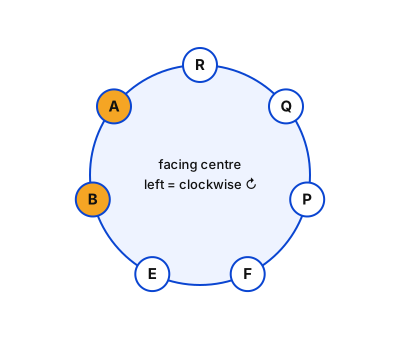
A, B, E, F, P, Q and R are sitting around a circular table facing the centre. Only three people sit between R and E when counted from the left of R. Only two people sit between E and Q. B sits third to the right of Q. F sits to the immediate left of P. Who sits to the immediate right of A?
A, B, E, F, P, Q और R एक वृत्ताकार मेज के चारों ओर केंद्र की ओर मुख करके बैठे हैं। R के बाएँ से गिनने पर R और E के बीच केवल तीन व्यक्ति बैठे हैं। E और Q के बीच केवल दो व्यक्ति बैठे हैं। B, Q के दाएँ से तीसरे स्थान पर बैठा है। F, P के ठीक बाएँ बैठा है। A के ठीक दाएँ कौन बैठा है?
  1. AR
  2. BQ
  3. CB
  4. DE
Show answer

Concept: For people facing the centre, left = clockwise and right = anticlockwise. Fix R and place others.

  1. Three people between R and E from R's left: E is 4th to the left of R.
  2. Two between E and Q: Q is immediately to the left of R.
  3. B is 3rd to the right of Q, i.e. 2nd to the right of R.
  4. F immediately left of P fills the next two seats (P, F); A takes the last seat, between B and R.

Trick: Clockwise order: R, Q, P, F, E, B, A — B sits to the immediate right of A.

Answer: (C) B

अवधारणा: केंद्र की ओर मुख होने पर बायाँ = दक्षिणावर्त, दायाँ = वामावर्त। R को स्थिर कर बाकी को बैठाएँ।

  1. R के बाएँ से गिनने पर R और E के बीच तीन व्यक्ति: E, R के बाएँ चौथा है।
  2. E और Q के बीच दो: Q, R के ठीक बाएँ है।
  3. B, Q के दाएँ तीसरा, अर्थात R के दाएँ दूसरा।
  4. F, P के ठीक बाएँ — अगली दो सीटें (P, F); A अंतिम सीट पर, B और R के बीच।

ट्रिक: दक्षिणावर्त क्रम: R, Q, P, F, E, B, A — A के ठीक दाएँ B बैठा है।

उत्तर: (C) B

RRB Technician Grade IIIGeneral Intelligence and ReasoningSeating Arrangement (Circular)RRB Technician Grade III 2024 · 29 Dec Shift 1 →
Q528.
In a certain code language,
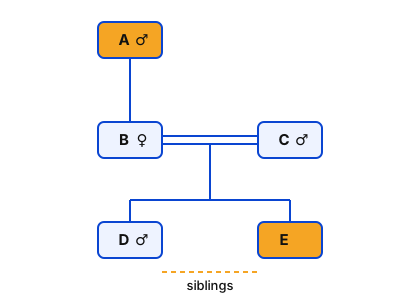
‘P + Q’ means ‘P is the father of Q’,
‘P – Q’ means ‘P is the wife of Q’,
‘P x Q’ means ‘P is the brother of Q’ and
‘P ÷ Q’ means ‘P is the sister of Q’.
How is A related to E if ‘A + B – C + D x E’?
एक निश्चित कूट भाषा में,
‘P + Q’ का अर्थ है ‘P, Q का पिता है’,
‘P – Q’ का अर्थ है ‘P, Q की पत्नी है’,
‘P x Q’ का अर्थ है ‘P, Q का भाई है’ और
‘P ÷ Q’ का अर्थ है ‘P, Q की बहन है’।
यदि ‘A + B – C + D x E’ है, तो A का E से क्या संबंध है?
  1. AFather’s brotherपिता का भाई
  2. BMother’s fatherमाता का पिता
  3. CMother’s brotherमाता का भाई
  4. DFather’s fatherपिता का पिता
Show answer

Concept: Decode each symbol one pair at a time and build the family tree.

  1. A + B: A is the father of B.
  2. B − C: B is the wife of C (so B is female).
  3. C + D: C is the father of D; D × E: D is the brother of E, so E is also C's and B's child.
  4. B is E's mother and A is B's father.

Trick: Go from E upward: E → mother (B) → her father (A).

Answer: (B) Mother’s father

अवधारणा: हर चिह्न को एक-एक जोड़ी में डिकोड करें और वंश-वृक्ष बनाएँ।

  1. A + B: A, B का पिता है।
  2. B − C: B, C की पत्नी है (B महिला)।
  3. C + D: C, D का पिता; D × E: D, E का भाई, अतः E भी C और B की संतान है।
  4. B, E की माँ है और A, B का पिता है।

ट्रिक: E से ऊपर चलें: E → माँ (B) → उसके पिता (A)।

उत्तर: (B) माता का पिता

RRB Technician Grade IIIGeneral Intelligence and ReasoningCoded Blood RelationsRRB Technician Grade III 2024 · 29 Dec Shift 1 →
Q529.
In a certain code language, ‘WHELP’ is coded as ‘24681’ and ‘HELPS’ is coded as ‘12674’. What is the code for ‘W’ in the given code language?
एक निश्चित कूट भाषा में, ‘WHELP’ को ‘24681’ के रूप में और ‘HELPS’ को ‘12674’ के रूप में कूटबद्ध किया जाता है। दी गई कूट भाषा में ‘W’ का कूट क्या है?
  1. A1
  2. B4
  3. C2
  4. D8
Show answer

Concept: Letters common to both words take the digits common to both codes.

  1. WHELP = 24681, HELPS = 12674.
  2. Common letters H, E, L, P ↔ common digits 1, 2, 4, 6.
  3. Left in WHELP: letter W and digit 8 ⇒ W = 8 (and S = 7).

Trick: Remove the shared letters and shared digits; what remains pairs up.

Answer: (D) 8

अवधारणा: दोनों शब्दों के उभयनिष्ठ अक्षरों के कोड दोनों कोडों के उभयनिष्ठ अंक होते हैं।

  1. WHELP = 24681, HELPS = 12674।
  2. उभयनिष्ठ अक्षर H, E, L, P ↔ उभयनिष्ठ अंक 1, 2, 4, 6।
  3. WHELP में बचा अक्षर W और अंक 8 ⇒ W = 8 (और S = 7)।

ट्रिक: साझा अक्षर और साझा अंक हटाएँ; जो बचे वे आपस में जोड़ी बनाते हैं।

उत्तर: (D) 8

RRB Technician Grade IIIGeneral Intelligence and ReasoningCoding–Decoding (Common Letters)RRB Technician Grade III 2024 · 29 Dec Shift 1 →
Q530.
Select the set in which the numbers are related in the same way as are the numbers of the following sets.
(NOTE: Operations should be performed on the whole numbers, without breaking down the numbers into its constituent digits. E.g. 13 – Operations on 13 such as adding/subtracting/multiplying etc. to 13 can be performed. Breaking down 13 into 1 and 3 and then performing mathematical operations on 1 and 3 is not allowed.)
(4, 12, 48)
(7, 21, 84)
उस समुच्चय का चयन कीजिए जिसमें संख्याएँ उसी प्रकार संबंधित हैं जिस प्रकार निम्नलिखित समुच्चयों की संख्याएँ संबंधित हैं।
(ध्यान दें: संख्याओं को उनके घटक अंकों में तोड़े बिना, संक्रियाएँ पूर्ण संख्याओं पर की जानी चाहिए। उदाहरण 13 – 13 पर संक्रियाएँ जैसे 13 में जोड़ना/घटाना/गुणा करना आदि किया जा सकता है। 13 को 1 और 3 में तोड़कर फिर 1 और 3 पर गणितीय संक्रियाएँ करने की अनुमति नहीं है।)
(4, 12, 48)
(7, 21, 84)
  1. A(5, 45, 180)
  2. B(15, 45, 180)
  3. C(15, 45, 170)
  4. D(15, 25, 180)
Show answer

Concept: Find the rule: (first × 3) = second, (second × 4) = third.

  1. 4×3=12, 12×4=48; 7×3=21, 21×4=84.
  2. (15, 45, 180): 15×3=45, 45×4=180 ✓.
  3. (5, 45, 180): 5×3=15≠45; (15, 45, 170): 45×4≠170; (15, 25, 180): 15×3≠25.

Trick: Equivalently third =12× first: 15×12=180.

Answer: (B) (15, 45, 180)

अवधारणा: नियम खोजें: (पहली × 3) = दूसरी, (दूसरी × 4) = तीसरी।

  1. 4×3=12, 12×4=48; 7×3=21, 21×4=84।
  2. (15, 45, 180): 15×3=45, 45×4=180 ✓।
  3. (5, 45, 180): 5×3=15≠45; (15, 45, 170): 45×4≠170; (15, 25, 180): 15×3≠25।

ट्रिक: यानी तीसरी =12× पहली: 15×12=180।

उत्तर: (B) (15, 45, 180)

RRB Technician Grade IIIGeneral Intelligence and ReasoningNumber Analogy (Triads)RRB Technician Grade III 2024 · 29 Dec Shift 1 →
Q531.
Read the given statements and conclusions carefully. You have to take the given statements to be true even if they seem to be at variance from commonly known facts and decide which conclusion(s) logically follow(s) from the given statements.
Statements:
All villas are buildings.
Some buildings are apartments.
Conclusions:
(I) All buildings are villas.
(II) Some villas are not apartments.
दिए गए कथनों और निष्कर्षों को ध्यानपूर्वक पढ़िए। आपको दिए गए कथनों को सत्य मानना है, भले ही वे सामान्यतः ज्ञात तथ्यों से भिन्न प्रतीत होते हों, और निर्णय कीजिए कि कौन-सा/से निष्कर्ष दिए गए कथनों का तार्किक रूप से अनुसरण करता है/करते हैं।
कथन:
सभी विला, इमारतें हैं।
कुछ इमारतें, अपार्टमेंट हैं।
निष्कर्ष:
(I) सभी इमारतें, विला हैं।
(II) कुछ विला, अपार्टमेंट नहीं हैं।
  1. AOnly conclusion I followsकेवल निष्कर्ष I अनुसरण करता है
  2. BNeither conclusion I nor II followsन तो निष्कर्ष I और न ही II अनुसरण करता है
  3. COnly conclusion II followsकेवल निष्कर्ष II अनुसरण करता है
  4. DBoth conclusions I and II followनिष्कर्ष I और II दोनों अनुसरण करते हैं
Show answer

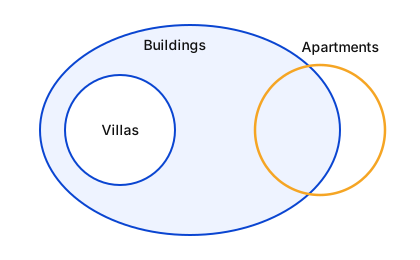
Concept: Draw the least-overlap Venn diagram; a conclusion follows only if it is true in every possible diagram.

  1. All villas are buildings: Villas circle lies inside Buildings.
  2. Some buildings are apartments: Apartments overlaps Buildings.
  3. I: “All buildings are villas” — Buildings can be bigger than Villas, so not certain.
  4. II: “Some villas are not apartments” — Apartments may contain all villas; not certain.

Trick: There is no direct link between villas and apartments, so nothing definite can be said about them.

Answer: (B) Neither conclusion I nor II follows

अवधारणा: न्यूनतम ओवरलैप वाला वेन आरेख बनाएँ; निष्कर्ष तभी निकलेगा जब हर संभव आरेख में सत्य हो।

  1. सभी विला भवन हैं: विला का वृत्त भवन के अंदर।
  2. कुछ भवन अपार्टमेंट हैं: अपार्टमेंट, भवन से ओवरलैप करता है।
  3. I: “सभी भवन विला हैं” — भवन, विला से बड़ा हो सकता है, अतः निश्चित नहीं।
  4. II: “कुछ विला अपार्टमेंट नहीं हैं” — अपार्टमेंट सारे विला को घेर भी सकता है; निश्चित नहीं।

ट्रिक: विला और अपार्टमेंट के बीच कोई सीधा संबंध नहीं, अतः उनके बारे में कुछ निश्चित नहीं कहा जा सकता।

उत्तर: (B) न तो निष्कर्ष I और न ही II अनुसरण करता है

RRB Technician Grade IIIGeneral Intelligence and ReasoningSyllogismRRB Technician Grade III 2024 · 29 Dec Shift 1 →
Q532.
Which of the following options should come in place of the question mark (?) in the given series to make it logically complete?
194, 249, 199, 244, 204,?
दी गई श्रृंखला को तार्किक रूप से पूर्ण करने के लिए प्रश्न चिह्न (?) के स्थान पर निम्नलिखित में से कौन-सा विकल्प आना चाहिए?
194, 249, 199, 244, 204,?
  1. A239
  2. B219
  3. C224
  4. D234
Show answer

Concept: Split the series into two alternate series.

  1. Odd positions: 194, 199, 204 (each +5).
  2. Even positions: 249, 244, ? (each −5).
  3. ? =244−5=239.

Trick: When terms jump up and down, check alternate terms.

Answer: (A) 239

अवधारणा: श्रेणी को दो एकांतर श्रेणियों में बाँटें।

  1. विषम स्थान: 194, 199, 204 (हर बार +5)।
  2. सम स्थान: 249, 244, ? (हर बार −5)।
  3. ? =244−5=239।

ट्रिक: जब पद ऊपर-नीचे कूदें, तो एकांतर पद देखें।

उत्तर: (A) 239

RRB Technician Grade IIIGeneral Intelligence and ReasoningNumber Series (Alternate)RRB Technician Grade III 2024 · 29 Dec Shift 1 →
Q533.
Given below is a statement followed by two possible reasons numbered I and II. Read the statement carefully and decide which of the two reasons explain(s) the event/observation/information given in the statement.
Statement:
Many trains on the Arakkonam–Chennai route are running several hours late today.
Reasons:
(I) Railways has decided to run two holiday special trains between Kolkata and Patna from November to December 2023.
(II) A major train accident occurred at Arakkonam Junction last night, where seven bogies of an express train derailed and fell across the tracks.
नीचे एक कथन और उसके बाद I और II क्रमांकित दो संभावित कारण दिए गए हैं। कथन को ध्यानपूर्वक पढ़िए और निर्णय कीजिए कि दोनों में से कौन-सा/से कारण कथन में दी गई घटना/अवलोकन/सूचना की व्याख्या करता है/करते हैं।
कथन:
आज अरक्कोणम–चेन्नई मार्ग पर कई ट्रेनें कई घंटे देरी से चल रही हैं।
कारण:
(I) रेलवे ने नवंबर से दिसंबर 2023 तक कोलकाता और पटना के बीच दो हॉलिडे स्पेशल ट्रेनें चलाने का निर्णय लिया है।
(II) कल रात अरक्कोणम जंक्शन पर एक बड़ी रेल दुर्घटना हुई, जिसमें एक एक्सप्रेस ट्रेन के सात डिब्बे पटरी से उतरकर पटरियों पर गिर गए।
  1. ANeither I nor II is a possible reasonन तो I और न ही II संभावित कारण है
  2. BOnly II is a possible reasonकेवल II संभावित कारण है
  3. CBoth I and II are possible reasonsI और II दोनों संभावित कारण हैं
  4. DOnly I is a possible reasonकेवल I संभावित कारण है
Show answer

Concept: A valid reason must directly explain the event in the statement (same place, same time).

  1. Statement: trains on the Arakkonam–Chennai route are late today.
  2. I: holiday specials between Kolkata and Patna — different route, unrelated. Not a reason.
  3. II: derailment at Arakkonam Junction last night blocking the tracks — directly delays trains on this route. Valid.

Trick: Match the location and timing of the reason with the statement.

Answer: (B) Only II is a possible reason

अवधारणा: मान्य कारण वही है जो कथन की घटना को सीधे समझाए (वही स्थान, वही समय)।

  1. कथन: अरक्कोणम–चेन्नई मार्ग पर आज ट्रेनें देर से चल रही हैं।
  2. I: कोलकाता–पटना के बीच हॉलिडे स्पेशल — अलग मार्ग, असंबंधित। कारण नहीं।
  3. II: पिछली रात अरक्कोणम जंक्शन पर डिब्बे पटरी से उतरकर ट्रैक पर गिरे — इसी मार्ग की ट्रेनें सीधे लेट होंगी। मान्य।

ट्रिक: कारण का स्थान और समय कथन से मिलाएँ।

उत्तर: (B) केवल II संभावित कारण है

RRB Technician Grade IIIGeneral Intelligence and ReasoningStatement and ReasonsRRB Technician Grade III 2024 · 29 Dec Shift 1 →
Q534.
In the following number-pairs, the second number is obtained by applying certain mathematical operations to the first number. Select the set in which the numbers are related in the same way as are the numbers of the following sets.
(NOTE: Operations should be performed on the whole numbers, without breaking down the numbers into its constituent digits. E.g. 13 – Operations on 13 such as adding/subtracting/multiplying etc. to 13 can be performed. Breaking down 13 into 1 and 3 and then performing mathematical operations on 1 and 3 is not allowed.)
153, 17
216, 24
निम्नलिखित संख्या-युग्मों में, पहली संख्या पर कुछ गणितीय संक्रियाएँ करके दूसरी संख्या प्राप्त की जाती है। उस समुच्चय का चयन कीजिए जिसमें संख्याएँ उसी प्रकार संबंधित हैं जिस प्रकार निम्नलिखित समुच्चयों की संख्याएँ संबंधित हैं।
(ध्यान दें: संख्याओं को उनके घटक अंकों में तोड़े बिना, संक्रियाएँ पूर्ण संख्याओं पर की जानी चाहिए। उदाहरण 13 – 13 पर संक्रियाएँ जैसे 13 में जोड़ना/घटाना/गुणा करना आदि किया जा सकता है। 13 को 1 और 3 में तोड़कर फिर 1 और 3 पर गणितीय संक्रियाएँ करने की अनुमति नहीं है।)
153, 17
216, 24
  1. A225, 35
  2. B189, 31
  3. C243, 27
  4. D171, 18
Show answer

Concept: Find the operation linking the pair: first number ÷9 = second number.

  1. 153÷9=17, 216÷9=24.
  2. 243÷9=27 ✓.
  3. Others: 225÷9=25≠35, 189÷9=21≠31, 171÷9=19≠18.

Trick: Divide first by second in the given pairs: 15317=21624=9.

Answer: (C) 243, 27

अवधारणा: युग्म को जोड़ने वाली संक्रिया खोजें: पहली संख्या ÷9 = दूसरी संख्या।

  1. 153÷9=17, 216÷9=24।
  2. 243÷9=27 ✓।
  3. अन्य: 225÷9=25≠35, 189÷9=21≠31, 171÷9=19≠18।

ट्रिक: दिए युग्मों में पहली को दूसरी से भाग दें: 15317=21624=9।

उत्तर: (C) 243, 27

RRB Technician Grade IIIGeneral Intelligence and ReasoningNumber Pair AnalogyRRB Technician Grade III 2024 · 29 Dec Shift 1 →
Q535.
Manju ranked 17th from the bottom and 8th from the top in his class. How many students are there in his class?
मंजू अपनी कक्षा में नीचे से 17वें और ऊपर से 8वें स्थान पर है। उसकी कक्षा में कितने विद्यार्थी हैं?
  1. A25
  2. B24
  3. C23
  4. D22
Show answer

Concept: Total=Rank from top+Rank from bottom−1.

  1. Total =8+17−1
  2. =24

Yaad rakhein: Subtract 1 because the person is counted in both ranks.

Answer: (B) 24

अवधारणा: कुल=ऊपर से क्रम+नीचे से क्रम−1।

  1. कुल =8+17−1
  2. =24

याद रखें: 1 इसलिए घटाते हैं क्योंकि वही व्यक्ति दोनों क्रमों में गिना गया है।

उत्तर: (B) 24

RRB Technician Grade IIIGeneral Intelligence and ReasoningRankingRRB Technician Grade III 2024 · 29 Dec Shift 1 →
Q536.
Based on the English alphabetical order, three of the following four letter-clusters are alike in a certain way and thus form a group. Which letter-cluster does not belong to that group ?
(Note: The odd one out is not based on the number of consonants/vowels or their position in the letter cluster.)
अंग्रेजी वर्णमाला क्रम के आधार पर, निम्नलिखित चार अक्षर-समूहों में से तीन किसी निश्चित प्रकार से एक समान हैं और इस प्रकार एक समूह बनाते हैं। कौन-सा अक्षर-समूह उस समूह से संबंधित नहीं है?
(ध्यान दें: असंगत अक्षर-समूह, व्यंजनों/स्वरों की संख्या या अक्षर-समूह में उनकी स्थिति पर आधारित नहीं है।)
  1. AIPL
  2. BELH
  3. CLSP
  4. DCJF
Show answer

Concept: Use alphabet positions and check the gaps between letters.

  1. IPL: I(9) → P(16) +7, P → L(12) −4.
  2. ELH: E(5) → L(12) +7, L → H(8) −4.
  3. CJF: C(3) → J(10) +7, J → F(6) −4.
  4. LSP: L(12) → S(19) +7, but S → P(16) is −3 — odd one.

Trick: Pattern +7,−4 in three clusters; LSP breaks the second gap.

Answer: (C) LSP

अवधारणा: अक्षरों के स्थानीय मान लेकर उनके अंतर देखें।

  1. IPL: I(9) → P(16) +7, P → L(12) −4।
  2. ELH: E(5) → L(12) +7, L → H(8) −4।
  3. CJF: C(3) → J(10) +7, J → F(6) −4।
  4. LSP: L(12) → S(19) +7, पर S → P(16) −3 — यही अलग है।

ट्रिक: तीन समूहों में +7,−4 का पैटर्न है; LSP में दूसरा अंतर टूटता है।

उत्तर: (C) LSP

RRB Technician Grade IIIGeneral Intelligence and ReasoningOdd One Out (Letter Clusters)RRB Technician Grade III 2024 · 29 Dec Shift 1 →
Q537.
Which of the following options should come in place of the question mark (?) in the given series based on the English alphabetical order?
ACY, MOK, YAW, KMI,?
अंग्रेजी वर्णमाला क्रम के आधार पर दी गई श्रृंखला में प्रश्न चिह्न (?) के स्थान पर निम्नलिखित में से कौन-सा विकल्प आना चाहिए?
ACY, MOK, YAW, KMI,?
  1. AWZU
  2. BWYU
  3. CWZV
  4. DWYV
Show answer

Concept: Track each letter position separately; each moves +12 (wrapping after Z).

  1. 1st letters: A → M → Y → K → W (+12 each).
  2. 2nd letters: C → O → A → M → Y (+12 each).
  3. 3rd letters: Y → K → W → I → U (+12 each).
  4. Next cluster: WYU.

Trick: +12 is the same as −14; after Z continue from A (e.g. Y(25) +12=37−26=11 = K).

Answer: (B) WYU

अवधारणा: हर स्थान के अक्षर को अलग-अलग देखें; हर अक्षर +12 चलता है (Z के बाद A से)।

  1. पहले अक्षर: A → M → Y → K → W (हर बार +12)।
  2. दूसरे अक्षर: C → O → A → M → Y (हर बार +12)।
  3. तीसरे अक्षर: Y → K → W → I → U (हर बार +12)।
  4. अगला समूह: WYU।

ट्रिक: +12 वही है जो −14; Z के बाद A से गिनें (जैसे Y(25) +12=37−26=11 = K)।

उत्तर: (B) WYU

RRB Technician Grade IIIGeneral Intelligence and ReasoningLetter SeriesRRB Technician Grade III 2024 · 29 Dec Shift 1 →
Q538.
Which of the following options should come in place of the question mark (?) in the given series based on the English alphabetical order?
DJC, YEX, TZS, OUN,?
अंग्रेजी वर्णमाला क्रम के आधार पर दी गई श्रृंखला में प्रश्न चिह्न (?) के स्थान पर निम्नलिखित में से कौन-सा विकल्प आना चाहिए?
DJC, YEX, TZS, OUN,?
  1. AJPM
  2. BJRI
  3. CJRM
  4. DJPI
Show answer

Concept: Each letter position moves back by 5 (wrapping before A to Z).

  1. 1st letters: D → Y → T → O → J (−5 each).
  2. 2nd letters: J → E → Z → U → P (−5 each).
  3. 3rd letters: C → X → S → N → I (−5 each).
  4. Next cluster: JPI.

Trick: In each cluster the third letter is just before the first (D-C, Y-X, T-S, O-N), so the answer must be J _ I.

Answer: (D) JPI

अवधारणा: हर स्थान का अक्षर 5 पीछे जाता है (A से पहले Z)।

  1. पहले अक्षर: D → Y → T → O → J (हर बार −5)।
  2. दूसरे अक्षर: J → E → Z → U → P (हर बार −5)।
  3. तीसरे अक्षर: C → X → S → N → I (हर बार −5)।
  4. अगला समूह: JPI।

ट्रिक: हर समूह में तीसरा अक्षर पहले से ठीक पहले वाला है (D-C, Y-X, T-S, O-N), अतः उत्तर J _ I होगा।

उत्तर: (D) JPI

RRB Technician Grade IIIGeneral Intelligence and ReasoningLetter SeriesRRB Technician Grade III 2024 · 29 Dec Shift 1 →
Q539.
In a certain code language, ‘FIRE’ is coded as ‘3718’ and ‘FARE’ is coded as ‘1438’. What is the code for ‘A’ in the given code language?
एक निश्चित कूट भाषा में, ‘FIRE’ को ‘3718’ और ‘FARE’ को ‘1438’ के रूप में कूटबद्ध किया जाता है। दी गई कूट भाषा में ‘A’ के लिए कूट क्या है?
  1. A4
  2. B8
  3. C3
  4. D1
Show answer

Concept: Letters common to both words share the digits common to both codes.

  1. FIRE = 3718, FARE = 1438.
  2. Common letters F, R, E ↔ common digits 1, 3, 8.
  3. FIRE leaves I = 7; FARE leaves A = 4.

Trick: Only one letter differs (I vs A), and only one digit differs (7 vs 4).

Answer: (A) 4

अवधारणा: दोनों शब्दों के उभयनिष्ठ अक्षरों के कोड उभयनिष्ठ अंक होते हैं।

  1. FIRE = 3718, FARE = 1438।
  2. उभयनिष्ठ अक्षर F, R, E ↔ उभयनिष्ठ अंक 1, 3, 8।
  3. FIRE में I = 7 बचता है; FARE में A = 4।

ट्रिक: केवल एक अक्षर अलग (I और A) और केवल एक अंक अलग (7 और 4)।

उत्तर: (A) 4

RRB Technician Grade IIIGeneral Intelligence and ReasoningCoding–Decoding (Common Letters)RRB Technician Grade III 2024 · 29 Dec Shift 1 →
Q540.
What will come in the place of ‘?’ in the following equation, if ‘+’ and ‘÷’ are interchanged and ‘×’ and ‘−’ are interchanged?
27÷14×21+3−4=?
यदि ‘+’ और ‘÷’ को आपस में बदल दिया जाए तथा ‘×’ और ‘−’ को आपस में बदल दिया जाए, तो निम्नलिखित समीकरण में ‘?’ के स्थान पर क्या आएगा?
27÷14×21+3−4=?
  1. A16
  2. B10
  3. C13
  4. D15
Show answer

Concept: Swap the signs first, then solve by BODMAS.

  1. Swap +↔÷ and ×↔−: 27+14−21÷3×4.
  2. 21÷3=7, 7×4=28.
  3. 27+14−28=13.

Trick: Rewrite the whole expression before calculating — don't swap in your head.

Answer: (C) 13

अवधारणा: पहले चिह्न बदलें, फिर BODMAS से हल करें।

  1. +↔÷ और ×↔− बदलने पर: 27+14−21÷3×4।
  2. 21÷3=7, 7×4=28।
  3. 27+14−28=13।

ट्रिक: गणना से पहले पूरा व्यंजक दोबारा लिखें — मन में बदलाव न करें।

उत्तर: (C) 13

RRB Technician Grade IIIGeneral Intelligence and ReasoningMathematical Operations (Interchange)RRB Technician Grade III 2024 · 29 Dec Shift 1 →