Question bank

Q&A: practice questions with answers

Search questions on any topic. Filter by exam category, exam, subject and topic, try the question, then open the answer and explanation.

Courses – airGurukul

3,200 questions found.

Q721.
Arvind spends 75% of his income. His income is increased by 20% and he increased his expenditure by 10%. His savings are increased by:
अरविंद अपनी आय का 75% खर्च करता है। उसकी आय में 20% की वृद्धि होती है और वह अपने व्यय में 10% की वृद्धि करता है। उसकी बचत में कितनी वृद्धि होती है?
  1. A50%
  2. B10%
  3. C25%
  4. D37.5%
Show answer

Concept: Savings=Income−Expenditure; take income =100.

  1. Old: income 100, expenditure 75, savings 25.
  2. New: income 120, expenditure 75×1.1=82.5.
  3. New savings =120−82.5=37.5.
  4. Increase =37.5−2525×100=50%.

Trick: Assume income =100 in every income–expenditure–savings question.

Answer: (A) 50%

अवधारणा: बचत=आय−व्यय; आय =100 मानें।

  1. पहले: आय 100, व्यय 75, बचत 25।
  2. अब: आय 120, व्यय 75×1.1=82.5।
  3. नई बचत =120−82.5=37.5।
  4. वृद्धि =37.5−2525×100=50%।

ट्रिक: आय–व्यय–बचत के हर प्रश्न में आय =100 मानें।

उत्तर: (A) 50%

RRB Technician Grade IIIMathematicsPercentage – Income and SavingsRRB Technician Grade III 2024 · 28 Dec Shift 2 →
Q722.
If John travels 90 km at a speed of 30 km/h and returns at a speed of 60 km/h, his average speed is:
यदि जॉन 30 km/h की चाल से 90 km की यात्रा करता है और 60 km/h की चाल से वापस लौटता है, तो उसकी औसत चाल क्या है?
  1. A30 km/h
  2. B60 km/h
  3. C40 km/h
  4. D45 km/h
Show answer

Concept: For equal distances, average speed =2xyx+y.

  1. x=30, y=60 km/h.
  2. Average speed =2×30×6030+60=360090=40 km/h.

Trick: Check: total distance 180 km, time 3+1.5=4.5 h, 1804.5=40.

Answer: (C) 40 km/h

अवधारणा: समान दूरी के लिए औसत चाल =2xyx+y।

  1. x=30, y=60 किमी/घंटा।
  2. औसत चाल =2×30×6030+60=360090=40 किमी/घंटा।

ट्रिक: जाँच: कुल दूरी 180 किमी, समय 3+1.5=4.5 घंटे, 1804.5=40।

उत्तर: (C) 40 km/h

RRB Technician Grade IIIMathematicsSpeed – Average SpeedRRB Technician Grade III 2024 · 28 Dec Shift 2 →
Q723.
In the set {61, 62…100}, the sum of the second greatest and the second smallest prime numbers is:
समुच्चय {61, 62…100} में, दूसरी सबसे बड़ी और दूसरी सबसे छोटी अभाज्य संख्याओं का योग कितना है?
  1. A164
  2. B150
  3. C158
  4. D156
Show answer

Concept: List the primes between 61 and 100.

  1. Primes: 61,67,71,73,79,83,89,97.
  2. Second smallest =67, second greatest =89.
  3. Sum =67+89=156.

Yaad rakhein: Primes from 61 to 100 are 8 in number: 61, 67, 71, 73, 79, 83, 89, 97.

Answer: (D) 156

अवधारणा: 61 से 100 के बीच की अभाज्य संख्याएँ लिखें।

  1. अभाज्य: 61,67,71,73,79,83,89,97।
  2. दूसरी सबसे छोटी =67, दूसरी सबसे बड़ी =89।
  3. योग =67+89=156।

याद रखें: 61 से 100 तक 8 अभाज्य: 61, 67, 71, 73, 79, 83, 89, 97।

उत्तर: (D) 156

RRB Technician Grade IIIMathematicsPrime NumbersRRB Technician Grade III 2024 · 28 Dec Shift 2 →
Q724.
If 12, 24, 45 and y are in proportion, then the value of y is:
यदि 12, 24, 45 और y समानुपात में हैं, तो y का मान क्या है?
  1. A30
  2. B25
  3. C60
  4. D90
Show answer

Concept: If a,b,c,d are in proportion, a×d=b×c.

  1. 12×y=24×45.
  2. y=108012=90.

Trick: 2412=2, so y=2×45=90.

Answer: (D) 90

अवधारणा: यदि a,b,c,d समानुपात में हैं, तो a×d=b×c।

  1. 12×y=24×45।
  2. y=108012=90।

ट्रिक: 2412=2, अतः y=2×45=90।

उत्तर: (D) 90

RRB Technician Grade IIIMathematicsProportionRRB Technician Grade III 2024 · 28 Dec Shift 2 →
Q725.
Two successive discounts of 12% and 15% on any number of toys bought are equivalent to a single discount of:
खरीदे गए कितने भी खिलौनों पर 12% और 15% की दो क्रमिक छूटें किस एकल छूट के समतुल्य हैं?
  1. A27%
  2. B26%
  3. C26.2%
  4. D25.2%
Show answer

Concept: Equivalent single discount for a% and b% =a+b−ab100.

  1. 12+15−12×15100.
  2. =27−1.8=25.2%.

Trick: Price after both =0.88×0.85=0.748, so discount =25.2%.

Answer: (D) 25.2%

अवधारणा: a% और b% की समतुल्य एकल छूट =a+b−ab100।

  1. 12+15−12×15100।
  2. =27−1.8=25.2%।

ट्रिक: दोनों के बाद मूल्य =0.88×0.85=0.748, अतः छूट =25.2%।

उत्तर: (D) 25.2%

RRB Technician Grade IIIMathematicsSuccessive DiscountsRRB Technician Grade III 2024 · 28 Dec Shift 2 →
Q726.
In the following number-pairs, the second number is obtained by applying certain mathematical operations to the first number. Which numbers should replace X and Y so that the pattern followed by the two numbers on the left side of :: is the same as that on the right side of :: ?
(NOTE: Operations should be performed on the whole numbers, without breaking down the numbers into its constituent digits. E.g. 13 – Operations on 13 such as adding /subtracting /multiplying etc. to 13 can be performed. Breaking down 13 into 1 and 3 and then performing mathematical operations on 1 and 3 is not allowed.)
X : 18.8 :: 21 : Y
निम्नलिखित संख्या-युग्मों में, पहली संख्या पर कुछ निश्चित गणितीय संक्रियाएँ करके दूसरी संख्या प्राप्त की जाती है। X और Y के स्थान पर कौन-सी संख्याएँ आनी चाहिए ताकि :: के बाईं ओर की दोनों संख्याओं द्वारा अनुसरण किया गया पैटर्न वही हो जो :: के दाईं ओर की संख्याओं द्वारा अनुसरण किया गया है?
(ध्यान दें: संक्रियाएँ पूर्ण संख्याओं पर की जानी चाहिए, संख्याओं को उनके घटक अंकों में तोड़े बिना। उदाहरण के लिए 13 – 13 पर की जाने वाली संक्रियाएँ, जैसे 13 में जोड़ना/घटाना/गुणा करना आदि की जा सकती हैं। 13 को 1 और 3 में तोड़कर फिर 1 और 3 पर गणितीय संक्रियाएँ करने की अनुमति नहीं है।)
X : 18.8 :: 21 : Y
  1. AX = 20, Y = 26.8
  2. BX = 15, Y = 24.8
  3. CX = 11, Y = 29.4
  4. DX = 17, Y = 22.6
Show answer

Concept: Test each option: the same operation must link both pairs.

  1. Option (B): 15+3.8=18.8.
  2. 21+3.8=24.8 – same rule.
  3. Others fail, e.g. (A): 20→18.8 is −1.2 but 21→26.8 is +5.8.

Trick: In X–Y options, find the difference for each pair; the option with equal changes wins.

Answer: (B) X = 15, Y = 24.8

अवधारणा: प्रत्येक विकल्प जाँचें: दोनों युग्मों में एक ही संक्रिया होनी चाहिए।

  1. विकल्प (B): 15+3.8=18.8।
  2. 21+3.8=24.8 – वही नियम।
  3. अन्य असफल, जैसे (A): 20→18.8 में −1.2 पर 21→26.8 में +5.8।

ट्रिक: X–Y विकल्पों में हर युग्म का अंतर देखें; जिसमें बराबर बदलाव हो वही उत्तर।

उत्तर: (B) X = 15, Y = 24.8

RRB Technician Grade IIIGeneral Intelligence and ReasoningNumber AnalogyRRB Technician Grade III 2024 · 28 Dec Shift 2 →
Q727.
If + means −, − means ×, × means ÷, and ÷ means +, then what will come in place of the question mark (?) in the following equation?
16 ÷ 96 × 6 − 4 + 20 = ?
यदि + का अर्थ −, − का अर्थ ×, × का अर्थ ÷ और ÷ का अर्थ + है, तो निम्नलिखित समीकरण में प्रश्न चिह्न (?) के स्थान पर क्या आएगा?
16 ÷ 96 × 6 − 4 + 20 = ?
  1. A60
  2. B56
  3. C54
  4. D50
Show answer

Concept: Replace the symbols as given, then apply BODMAS.

  1. 16÷96×6−4+20 becomes 16+96÷6×4−20.
  2. 96÷6=16, 16×4=64.
  3. 16+64−20=60.

Trick: Write the decoded expression fully before calculating – most mistakes come from half-converted signs.

Answer: (A) 60

अवधारणा: दिए अनुसार चिह्न बदलें, फिर BODMAS लगाएँ।

  1. 16÷96×6−4+20 बनता है 16+96÷6×4−20।
  2. 96÷6=16, 16×4=64।
  3. 16+64−20=60।

ट्रिक: गणना से पहले पूरा बदला हुआ व्यंजक लिखें – आधे बदले चिह्न ही गलती का कारण बनते हैं।

उत्तर: (A) 60

RRB Technician Grade IIIGeneral Intelligence and ReasoningMathematical OperationsRRB Technician Grade III 2024 · 28 Dec Shift 2 →
Q728.
Which of the following options should come in place of the question mark (?) in the given series to make it logically complete?
17, 20, 26, 35, 47, ?
दी गई श्रृंखला को तार्किक रूप से पूर्ण करने के लिए प्रश्न चिह्न (?) के स्थान पर निम्नलिखित में से कौन-सा विकल्प आना चाहिए?
17, 20, 26, 35, 47, ?
  1. A63
  2. B60
  3. C64
  4. D62
Show answer

Concept: Check the differences between consecutive terms.

  1. Differences: 3,6,9,12 – multiples of 3.
  2. Next difference =15.
  3. Next term =47+15=62.

Trick: Second-level difference is constant (+3), so add the next multiple of 3.

Answer: (D) 62

अवधारणा: क्रमागत पदों के अंतर देखें।

  1. अंतर: 3,6,9,12 – 3 के गुणज।
  2. अगला अंतर =15।
  3. अगला पद =47+15=62।

ट्रिक: दूसरे स्तर का अंतर स्थिर (+3) है, अतः 3 का अगला गुणज जोड़ें।

उत्तर: (D) 62

RRB Technician Grade IIIGeneral Intelligence and ReasoningNumber SeriesRRB Technician Grade III 2024 · 28 Dec Shift 2 →
Q729.
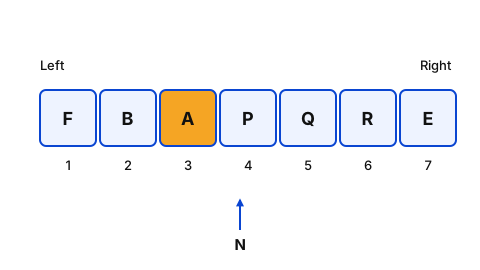
Seven people, A, B, E, F, P, Q and R, are sitting in a row, facing north. Only two people sit to the right of Q. Only two people sit between Q and B. Only two people sit between F and P. P sits to the immediate left of Q. E sits to the immediate right of R. Who sits at the third position from the left end of the row?
सात व्यक्ति, A, B, E, F, P, Q और R, एक पंक्ति में उत्तर की ओर मुख करके बैठे हैं। Q के दाईं ओर केवल दो व्यक्ति बैठे हैं। Q और B के बीच केवल दो व्यक्ति बैठे हैं। F और P के बीच केवल दो व्यक्ति बैठे हैं। P, Q के ठीक बाईं ओर बैठा है। E, R के ठीक दाईं ओर बैठा है। पंक्ति के बाएँ छोर से तीसरे स्थान पर कौन बैठा है?
  1. AR
  2. BP
  3. CA
  4. DB
Show answer

Concept: All face north, so their right is our right. Fix sure positions first.

  1. Two people to the right of Q: Q at position 5; P (immediate left) at 4.
  2. Two people between Q and B: B at 2.
  3. Two between F and P: F at 1 or 7. R–E must sit together; only F at 1 leaves 6–7 free, so R at 6, E at 7.
  4. A takes the last seat, position 3.

Trick: Place the person with a fixed count (Q) first, then build around him.

Answer: (C) A

अवधारणा: सभी उत्तर की ओर मुख किए हैं, अतः उनका दायाँ हमारा दायाँ है। पहले निश्चित स्थान तय करें।

  1. Q के दाएँ दो लोग: Q स्थान 5 पर; P (ठीक बाएँ) स्थान 4 पर।
  2. Q और B के बीच दो लोग: B स्थान 2 पर।
  3. F और P के बीच दो: F स्थान 1 या 7 पर। R–E साथ बैठें; केवल F के 1 पर होने से 6–7 खाली रहते हैं, अतः R 6, E 7 पर।
  4. बचा स्थान 3 – A।

ट्रिक: जिसकी स्थिति गिनती से तय है (Q), उसे पहले बैठाएँ, फिर उसके चारों ओर बनाएँ।

उत्तर: (C) A

RRB Technician Grade IIIGeneral Intelligence and ReasoningSeating Arrangement – LinearRRB Technician Grade III 2024 · 28 Dec Shift 2 →
Q730.
If ‘A’ stands for ‘÷’, ‘B’ stands for ‘×’, ‘C’ stands for ‘+’ and ‘D’ stands for ‘−’, then the resultant of which of the following would be 113?
यदि ‘A’ का अर्थ ‘÷’, ‘B’ का अर्थ ‘×’, ‘C’ का अर्थ ‘+’ और ‘D’ का अर्थ ‘−’ है, तो निम्नलिखित में से किसका परिणाम 113 होगा?
  1. A96 C 12 B 2 D (42 A 6) D 3 C 20
  2. B96 D 12 A 2 C (42 B 6) A 3 C 20
  3. C96 C 12 A 2 D (42 A 6) A 3 D 20
  4. D96 D 12 B 2 C (42 A 6) B 3 C 20
Show answer

Concept: Decode A = ÷, B = ×, C = +, D = − and solve each option with BODMAS.

  1. Option (D): 96−12×2+(42÷6)×3+20.
  2. =96−24+7×3+20.
  3. =96−24+21+20=113.

Trick: Start with the option whose bracket gives a clean value (42÷6=7) – fewer steps to test.

Answer: (D) 96 D 12 B 2 C (42 A 6) B 3 C 20

अवधारणा: A = ÷, B = ×, C = +, D = − रखकर हर विकल्प BODMAS से हल करें।

  1. विकल्प (D): 96−12×2+(42÷6)×3+20।
  2. =96−24+7×3+20।
  3. =96−24+21+20=113।

ट्रिक: जिस विकल्प के कोष्ठक का मान साफ़ आता है (42÷6=7) उसे पहले जाँचें।

उत्तर: (D) 96 D 12 B 2 C (42 A 6) B 3 C 20

RRB Technician Grade IIIGeneral Intelligence and ReasoningMathematical OperationsRRB Technician Grade III 2024 · 28 Dec Shift 2 →
Q731.
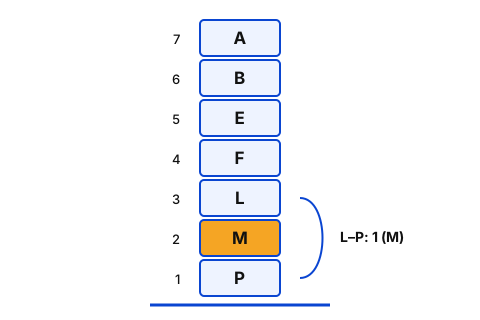
Seven boxes, A, B, E, F, L, M and P, are kept one over the other but not necessarily in the same order. M is kept second from the bottom. Only three boxes are kept between M and B. P is kept at one of the positions below M. Only E is kept between B and F. A is kept at one of the positions above B. How many boxes are kept between L and P?
सात बक्से, A, B, E, F, L, M और P, एक के ऊपर एक रखे गए हैं, लेकिन जरूरी नहीं कि इसी क्रम में हों। M को नीचे से दूसरे स्थान पर रखा गया है। M और B के बीच केवल तीन बक्से रखे गए हैं। P को M के नीचे के स्थानों में से किसी एक पर रखा गया है। B और F के बीच केवल E रखा गया है। A को B के ऊपर के स्थानों में से किसी एक पर रखा गया है। L और P के बीच कितने बक्से रखे गए हैं?
  1. AOneएक
  2. BThreeतीन
  3. CTwoदो
  4. DFourचार
Show answer

Concept: Number positions 1 (bottom) to 7 (top) and place the fixed boxes first.

  1. M at 2; P below M, so P at 1.
  2. Three boxes between M and B: B at 6.
  3. Only E between B and F: E at 5, F at 4 (above B is impossible – no position 8).
  4. A above B: A at 7; L takes 3. Between L (3) and P (1): only M – one box.

Trick: Draw the stack vertically and number it from the bottom – 'second from bottom' becomes position 2.

Answer: (A) One

अवधारणा: स्थान 1 (नीचे) से 7 (ऊपर) तक संख्या दें और पहले निश्चित बॉक्स रखें।

  1. M स्थान 2 पर; P, M के नीचे अतः स्थान 1 पर।
  2. M और B के बीच तीन बॉक्स: B स्थान 6 पर।
  3. B और F के बीच केवल E: E स्थान 5, F स्थान 4 (B के ऊपर संभव नहीं – स्थान 8 नहीं है)।
  4. A, B के ऊपर: A स्थान 7; L स्थान 3। L (3) और P (1) के बीच केवल M – एक बॉक्स।

ट्रिक: स्टैक को खड़ा बनाकर नीचे से गिनें – 'नीचे से दूसरा' यानी स्थान 2।

उत्तर: (A) एक

RRB Technician Grade IIIGeneral Intelligence and ReasoningBox ArrangementRRB Technician Grade III 2024 · 28 Dec Shift 2 →
Q732.
Based on the English alphabetical order, three of the following four letter-clusters are alike in a certain way and thus form a group. Which letter-cluster does not belong to that group?
(Note: The odd one out is not based on the number of consonants/vowels or their position in the letter-cluster.)
अंग्रेज़ी वर्णमाला क्रम के आधार पर, निम्नलिखित चार अक्षर-समूहों में से तीन किसी निश्चित प्रकार से एक समान हैं और इस प्रकार एक समूह बनाते हैं। कौन-सा अक्षर-समूह उस समूह से संबंधित नहीं है?
(ध्यान दें: असंगत अक्षर-समूह, उस अक्षर-समूह में व्यंजनों/स्वरों की संख्या या उनके स्थान पर आधारित नहीं है।)
  1. AFHK
  2. BUWZ
  3. CJLP
  4. DPRU
Show answer

Concept: Find the gaps between letters using their positions.

  1. FHK: F(6)→H(8)→K(11), gaps +2,+3.
  2. UWZ: 21→23→26, gaps +2,+3; PRU: 16→18→21, gaps +2,+3.
  3. JLP: 10→12→16, gaps +2,+4 – different.

Trick: Learn EJOTY (5,10,15,20,25) to get letter positions quickly.

Answer: (C) JLP

अवधारणा: अक्षरों के स्थानीय मान से उनके बीच का अंतर निकालें।

  1. FHK: F(6)→H(8)→K(11), अंतर +2,+3।
  2. UWZ: 21→23→26, अंतर +2,+3; PRU: 16→18→21, अंतर +2,+3।
  3. JLP: 10→12→16, अंतर +2,+4 – भिन्न।

ट्रिक: EJOTY (5,10,15,20,25) याद रखें, अक्षरों के स्थान जल्दी मिलेंगे।

उत्तर: (C) JLP

RRB Technician Grade IIIGeneral Intelligence and ReasoningOdd One Out – Letter ClustersRRB Technician Grade III 2024 · 28 Dec Shift 2 →
Q733.
In a certain code language, ‘someday in paradise’ is written as ‘yd pl ws’ and ‘in dense forest’ is written as ‘fc ws nm’. How is ‘in’ coded in the given language?
एक निश्चित कूट भाषा में, ‘someday in paradise’ को ‘yd pl ws’ लिखा जाता है और ‘in dense forest’ को ‘fc ws nm’ लिखा जाता है। उस भाषा में ‘in’ को किस प्रकार कूटबद्ध किया जाता है?
  1. Ayd
  2. Bfc
  3. Cnm
  4. Dws
Show answer

Concept: A word common to two sentences takes the code common to both.

  1. 'someday in paradise' → yd pl ws.
  2. 'in dense forest' → fc ws nm.
  3. Common word 'in', common code 'ws'.

Trick: Match common words with common codes – no need to decode the rest.

Answer: (D) ws

अवधारणा: दोनों वाक्यों में उभयनिष्ठ शब्द का कूट भी दोनों में उभयनिष्ठ होता है।

  1. 'someday in paradise' → yd pl ws।
  2. 'in dense forest' → fc ws nm।
  3. उभयनिष्ठ शब्द 'in', उभयनिष्ठ कूट 'ws'।

ट्रिक: उभयनिष्ठ शब्द को उभयनिष्ठ कूट से मिलाएँ – बाकी को हल करने की ज़रूरत नहीं।

उत्तर: (D) ws

RRB Technician Grade IIIGeneral Intelligence and ReasoningCoding–DecodingRRB Technician Grade III 2024 · 28 Dec Shift 2 →
Q734.
The position(s) of how many letters will remain unchanged if each of the letters in the word ARTICLE is arranged in the English alphabetical order ?
यदि शब्द ARTICLE के प्रत्येक अक्षर को अंग्रेज़ी वर्णमाला क्रम में व्यवस्थित किया जाए, तो कितने अक्षरों का स्थान अपरिवर्तित रहेगा?
  1. A1
  2. B2
  3. C0
  4. D3
Show answer

Concept: Arrange the letters alphabetically and compare position by position.

  1. Original: A R T I C L E.
  2. Sorted: A C E I L R T.
  3. Same position: A (1st) and I (4th) – 2 letters.

Trick: Write both words one under the other and tick the matching columns.

Answer: (B) 2

अवधारणा: अक्षरों को वर्णानुक्रम में रखें और स्थान-दर-स्थान मिलाएँ।

  1. मूल: A R T I C L E।
  2. क्रमबद्ध: A C E I L R T।
  3. समान स्थान पर: A (पहला) और I (चौथा) – 2 अक्षर।

ट्रिक: दोनों शब्द एक-दूसरे के नीचे लिखें और मिलते कॉलम पर निशान लगाएँ।

उत्तर: (B) 2

RRB Technician Grade IIIGeneral Intelligence and ReasoningAlphabetical ArrangementRRB Technician Grade III 2024 · 28 Dec Shift 2 →
Q735.
Read the given statements and conclusions carefully. You have to take the given statements to be true even if they seem to be at variance from commonly known facts and decide which conclusion(s) logically follow(s) from the given statements.
Statements:
All shirts are pants.
Some pants are tie.
Conclusions:
(I) At least some pants are shirts.
(II) Some shirts are tie.
दिए गए कथनों और निष्कर्षों को ध्यानपूर्वक पढ़िए। आपको दिए गए कथनों को सत्य मानना है, भले ही वे सामान्यतः ज्ञात तथ्यों से भिन्न प्रतीत होते हों, और निर्णय लेना है कि कौन-सा/से निष्कर्ष दिए गए कथनों का तार्किक रूप से अनुसरण करता/करते है/हैं।
कथन:
सभी शर्ट, पैंट हैं।
कुछ पैंट, टाई हैं।
निष्कर्ष:
(I) कम से कम कुछ पैंट, शर्ट हैं।
(II) कुछ शर्ट, टाई हैं।
  1. AOnly conclusion II followsकेवल निष्कर्ष II अनुसरण करता है
  2. BOnly conclusion I followsकेवल निष्कर्ष I अनुसरण करता है
  3. CNeither conclusion I nor II followsन तो निष्कर्ष I और न ही II अनुसरण करता है
  4. DBoth conclusions I and II followनिष्कर्ष I और II दोनों अनुसरण करते हैं
Show answer

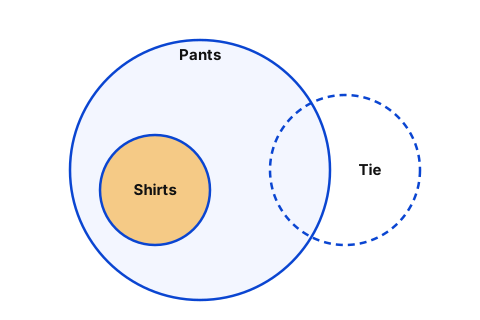
Concept: Draw the least-overlap Venn diagram and test each conclusion.

  1. All shirts are pants – the shirts circle lies inside pants.
  2. I: Some pants are shirts – true (conversion of 'All'). Follows.
  3. II: Tie touches pants, not necessarily shirts – does not follow.

Trick: 'All A are B' always gives 'Some B are A'; a 'Some' link through B does not reach A.

Answer: (B) Only conclusion I follows

अवधारणा: न्यूनतम ओवरलैप वाला वेन आरेख बनाएँ और हर निष्कर्ष जाँचें।

  1. सभी शर्ट पैंट हैं – शर्ट का वृत्त पैंट के अंदर।
  2. I: कुछ पैंट शर्ट हैं – सत्य ('सभी' का रूपांतरण)। अनुसरण करता है।
  3. II: टाई केवल पैंट को छूती है, शर्ट को आवश्यक नहीं – अनुसरण नहीं करता।

ट्रिक: 'सभी A, B हैं' से सदा 'कुछ B, A हैं'; B से 'कुछ' वाली कड़ी A तक नहीं पहुँचती।

उत्तर: (B) केवल निष्कर्ष I अनुसरण करता है

RRB Technician Grade IIIGeneral Intelligence and ReasoningSyllogismRRB Technician Grade III 2024 · 28 Dec Shift 2 →
Q736.
Given below is a cause followed by possible effects numbered I, II and III. Read the cause carefully and decide which of the three can be a/the possible effect(s).
Cause:
There has been an increase in the number of thefts of bicycles being reported in the apartments in locality X in the last 2 months.
Effects:
(I) Police have instructed security guards of locality X to record details of all entries and exits and verify the phone numbers of all delivery personnel.
(II) Many apartment complexes have decided to install multiple CCTV cameras inside and outside their gates.
(III) More women police constables have been appointed in the police station adjoining locality X.
नीचे एक कारण और उसके बाद I, II और III क्रमांकित संभावित प्रभाव दिए गए हैं। कारण को ध्यानपूर्वक पढ़िए और निर्णय लीजिए कि तीनों में से कौन-सा/से संभावित प्रभाव हो सकता/सकते है/हैं।
कारण:
पिछले 2 महीनों में इलाके X के अपार्टमेंटों में साइकिल चोरी की रिपोर्ट की गई घटनाओं की संख्या में वृद्धि हुई है।
प्रभाव:
(I) पुलिस ने इलाके X के सुरक्षा गार्डों को सभी प्रवेश और निकास का विवरण दर्ज करने और सभी डिलीवरी कर्मियों के फ़ोन नंबरों का सत्यापन करने का निर्देश दिया है।
(II) कई अपार्टमेंट परिसरों ने अपने गेट के अंदर और बाहर कई CCTV कैमरे लगाने का निर्णय लिया है।
(III) इलाके X से सटे पुलिस थाने में अधिक महिला पुलिस कांस्टेबल नियुक्त किए गए हैं।
  1. AOnly I can be a possible effectकेवल I संभावित प्रभाव हो सकता है
  2. BBoth I and II can be the possible effectsI और II दोनों संभावित प्रभाव हो सकते हैं
  3. COnly II is can be a possible effectकेवल II संभावित प्रभाव हो सकता है
  4. DBoth II and III can be the possible effectsII और III दोनों संभावित प्रभाव हो सकते हैं
Show answer

Concept: An effect must be a direct, logical response to the cause.

  1. I: Recording entries/exits and verifying delivery staff directly targets thefts – valid.
  2. II: Installing CCTV cameras is a direct anti-theft step – valid.
  3. III: Appointing more women constables has no link to bicycle thefts – not valid.

Trick: Ask 'Would this happen because of the cause?' – keep only actions that address that exact problem.

Answer: (B) Both I and II can be the possible effects

अवधारणा: प्रभाव, कारण की सीधी और तार्किक प्रतिक्रिया होना चाहिए।

  1. I: आने-जाने का रिकॉर्ड और डिलीवरी कर्मियों का सत्यापन सीधे चोरी रोकता है – मान्य।
  2. II: CCTV कैमरे लगाना सीधा चोरी-रोधी कदम है – मान्य।
  3. III: अधिक महिला कांस्टेबल नियुक्त करने का साइकिल चोरी से संबंध नहीं – अमान्य।

ट्रिक: पूछें 'क्या यह इसी कारण से होगा?' – केवल उसी समस्या पर केंद्रित कदम रखें।

उत्तर: (B) I और II दोनों संभावित प्रभाव हो सकते हैं

RRB Technician Grade IIIGeneral Intelligence and ReasoningCause and EffectRRB Technician Grade III 2024 · 28 Dec Shift 2 →
Q737.
Based on the English alphabetical order, three of the following four letter-clusters are alike in a certain way and thus form a group. Which letter-cluster does not belong to that group?
(Note: The odd one out is not based on the number of consonants/vowels or their position in the letter-cluster.)
अंग्रेज़ी वर्णमाला क्रम के आधार पर, निम्नलिखित चार अक्षर-समूहों में से तीन किसी निश्चित प्रकार से एक समान हैं और इस प्रकार एक समूह बनाते हैं। कौन-सा अक्षर-समूह उस समूह से संबंधित नहीं है?
(ध्यान दें: असंगत अक्षर-समूह, उस अक्षर-समूह में व्यंजनों/स्वरों की संख्या या उनके स्थान पर आधारित नहीं है।)
  1. ARYT
  2. BMTP
  3. CJQL
  4. DFMH
Show answer

Concept: Compare the moves from 1st to 2nd and 2nd to 3rd letter.

  1. RYT: 18→25→20, i.e. +7,−5.
  2. JQL: 10→17→12, +7,−5; FMH: 6→13→8, +7,−5.
  3. MTP: 13→20→16, +7,−4 – odd one.

Trick: Shortcut: in the group, 3rd letter = 1st letter +2 (R→T, J→L, F→H); M→P is +3.

Answer: (B) MTP

अवधारणा: पहले से दूसरे और दूसरे से तीसरे अक्षर का अंतर देखें।

  1. RYT: 18→25→20, अर्थात +7,−5।
  2. JQL: 10→17→12, +7,−5; FMH: 6→13→8, +7,−5।
  3. MTP: 13→20→16, +7,−4 – विषम।

ट्रिक: शॉर्टकट: समूह में तीसरा अक्षर = पहला +2 (R→T, J→L, F→H); M→P में +3 है।

उत्तर: (B) MTP

RRB Technician Grade IIIGeneral Intelligence and ReasoningOdd One Out – Letter ClustersRRB Technician Grade III 2024 · 28 Dec Shift 2 →
Q738.
Which of the following options should come in place of the question mark (?) in the given series based on the English alphabetical order?
ZSN, QJE, HAV, YRM,?
अंग्रेजी वर्णमाला क्रम के आधार पर दी गई श्रृंखला में प्रश्न चिह्न (?) के स्थान पर निम्नलिखित में से कौन-सा विकल्प आना चाहिए?
ZSN, QJE, HAV, YRM,?
  1. APJC
  2. BPJD
  3. CPID
  4. DPIC
Show answer

Concept: Each letter moves back by 9 positions (wrapping from A to Z).

  1. Z(26)→Q(17)→H(8)→Y(25)→P(16).
  2. S(19)→J(10)→A(1)→R(18)→I(9).
  3. N(14)→E(5)→V(22)→M(13)→D(4).
  4. Next term: PID.

Trick: Moving back 9 is the same as moving forward 17 – use whichever is easier near A/Z.

Answer: (C) PID

अवधारणा: हर अक्षर 9 स्थान पीछे जाता है (A के बाद Z पर लौटकर)।

  1. Z(26)→Q(17)→H(8)→Y(25)→P(16)।
  2. S(19)→J(10)→A(1)→R(18)→I(9)।
  3. N(14)→E(5)→V(22)→M(13)→D(4)।
  4. अगला पद: PID।

ट्रिक: 9 पीछे जाना = 17 आगे जाना – A/Z के पास जो आसान हो वही लें।

उत्तर: (C) PID

RRB Technician Grade IIIGeneral Intelligence and ReasoningLetter SeriesRRB Technician Grade III 2024 · 28 Dec Shift 2 →
Q739.
In the following number-pairs, the second number is obtained by applying certain mathematical operations to the first number. Which numbers should replace X and Y so that the pattern followed by the two numbers on the left side of :: is the same as that on the right side of :: ?
(NOTE: Operations should be performed on the whole numbers, without breaking down the numbers into its constituent digits. E.g. 13 – Operations on 13 such as adding /subtracting /multiplying etc. to 13 can be performed. Breaking down 13 into 1 and 3 and then performing mathematical operations on 1 and 3 is not allowed.)
X : 96 :: 53 : Y
निम्नलिखित संख्या-युग्मों में, पहली संख्या पर कुछ गणितीय संक्रियाएँ करके दूसरी संख्या प्राप्त की जाती है। X और Y के स्थान पर कौन-सी संख्याएँ आनी चाहिए ताकि :: के बाईं ओर की दोनों संख्याओं द्वारा अनुसरित पैटर्न वही हो जो :: के दाईं ओर की संख्याओं द्वारा अनुसरित है?
(ध्यान दें: संक्रियाएँ संख्याओं को उनके घटक अंकों में तोड़े बिना, पूर्ण संख्याओं पर की जानी चाहिए। उदाहरण: 13 – 13 पर संक्रियाएँ जैसे 13 में जोड़ना/घटाना/गुणा करना आदि किया जा सकता है। 13 को 1 और 3 में तोड़कर फिर 1 और 3 पर गणितीय संक्रियाएँ करने की अनुमति नहीं है।)
X : 96 :: 53 : Y
  1. AX = 58, Y = 112
  2. BX = 49, Y = 118
  3. CX = 52, Y = 104
  4. DX = 47, Y = 108
Show answer

Concept: Test options so that one rule fits both pairs.

  1. Option (D): 47×2+2=96.
  2. 53×2+2=108 – same rule.
  3. Others fail, e.g. (A): 58×2−20=96 but 53×2−20=86≠112.

Trick: When the second number is about double, try ×2±k and check the same k on both sides.

Answer: (D) X = 47, Y = 108

अवधारणा: विकल्प जाँचें ताकि एक ही नियम दोनों युग्मों पर लागू हो।

  1. विकल्प (D): 47×2+2=96।
  2. 53×2+2=108 – वही नियम।
  3. अन्य असफल, जैसे (A): 58×2−20=96 पर 53×2−20=86≠112।

ट्रिक: जब दूसरी संख्या लगभग दोगुनी हो, ×2±k आज़माएँ और दोनों ओर वही k जाँचें।

उत्तर: (D) X = 47, Y = 108

RRB Technician Grade IIIGeneral Intelligence and ReasoningNumber AnalogyRRB Technician Grade III 2024 · 28 Dec Shift 2 →
Q740.
If each vowel in the word FRIENDLY is changed to the letter immediately preceding it in the English alphabetical order and each consonant is changed to the letter immediately following it in the English alphabetical order, the how many letters will appear twice in the group of letters thus formed?
यदि शब्द FRIENDLY के प्रत्येक स्वर को अंग्रेजी वर्णमाला क्रम में उसके ठीक पहले आने वाले अक्षर से बदल दिया जाए और प्रत्येक व्यंजन को अंग्रेजी वर्णमाला क्रम में उसके ठीक बाद आने वाले अक्षर से बदल दिया जाए, तो इस प्रकार बने अक्षरों के समूह में कितने अक्षर दो बार आएँगे?
  1. A3
  2. B2
  3. C0
  4. D1
Show answer

Concept: Vowels go one letter back, consonants one letter forward.

  1. F→G, R→S, I→H, E→D, N→O, D→E, L→M, Y→Z.
  2. New group: G S H D O E M Z.
  3. All 8 letters are different – none appears twice.

Trick: Y is treated as a consonant here; check repeats only in the new group.

Answer: (C) 0

अवधारणा: स्वर एक अक्षर पीछे, व्यंजन एक अक्षर आगे।

  1. F→G, R→S, I→H, E→D, N→O, D→E, L→M, Y→Z।
  2. नया समूह: G S H D O E M Z।
  3. सभी 8 अक्षर अलग हैं – कोई दो बार नहीं।

ट्रिक: यहाँ Y व्यंजन माना गया है; दोहराव केवल नए समूह में जाँचें।

उत्तर: (C) 0

RRB Technician Grade IIIGeneral Intelligence and ReasoningLetter CodingRRB Technician Grade III 2024 · 28 Dec Shift 2 →